Viewed through the lens of traditional East Asian geomancy, Wong Tai Sin Temple occupies one of the most auspicious locations on the Kowloon Peninsula. Situated in the Chuk Un neighborhood, the sacred complex nestles firmly at the foot of towering Lion Rock—a revered mountain peak acting as a protective northern Black Tortoise screen receiving vital energy flowing down from majestic Tai Mo Shan. In front of the temple, the terrain slopes gently outward into a broad geomantic courtyard looking toward the fertile waters of Victoria Harbour. This classic “mountain-backed, water-facing” configuration not only allows the sanctuary to gather the pure vitality of Lingnan earth and sky, but also establishes a seamless balance between motion and stillness, between quiet sacred space and the bustling metropolis surrounding it.
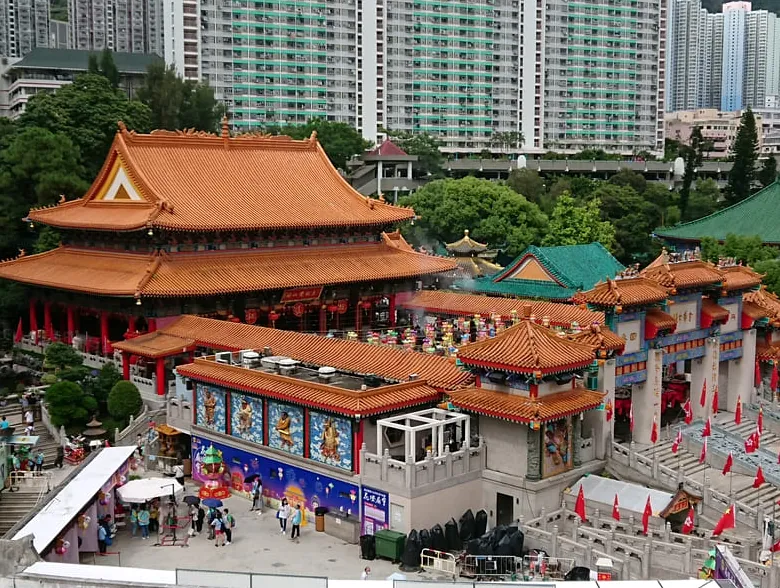
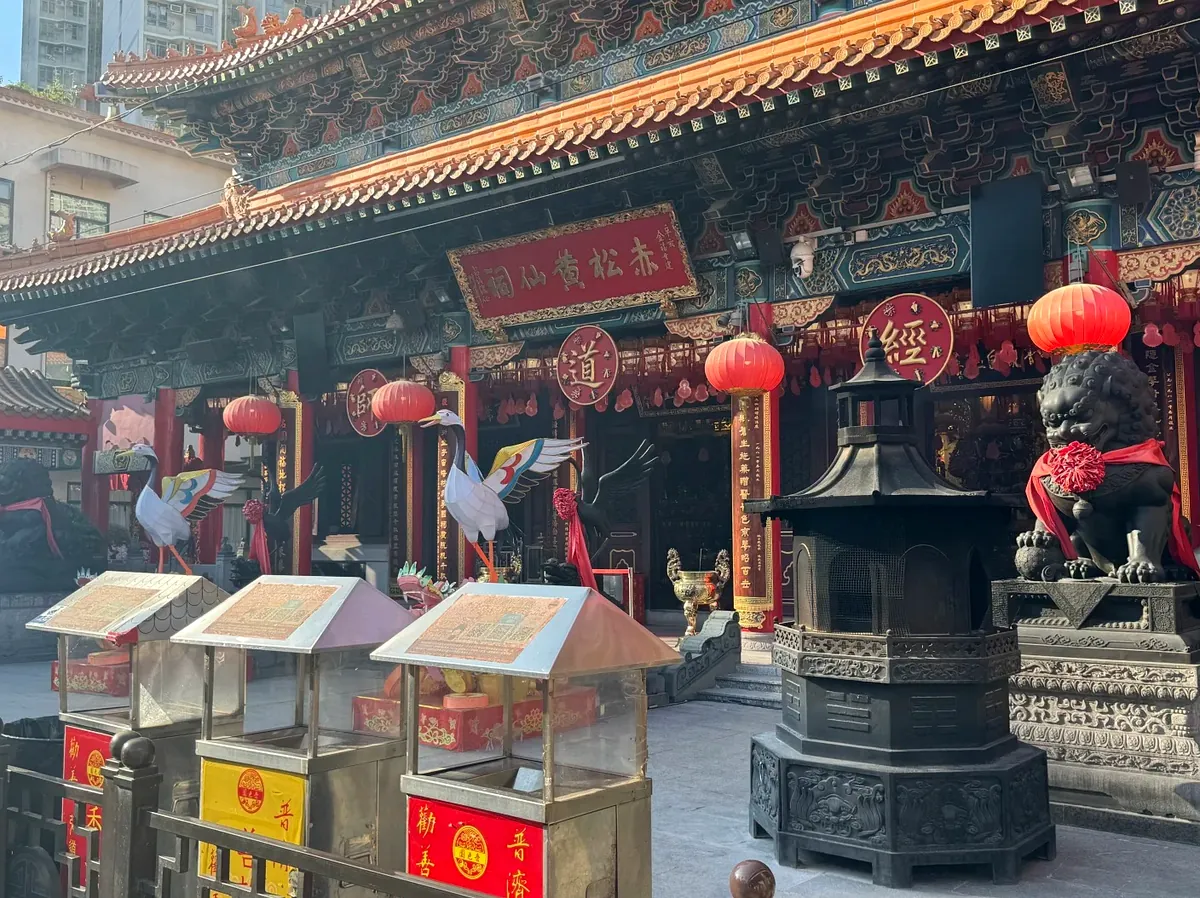
The temple grounds exude regal splendor with a stepped layout hugging the hillside, where gleaming golden glazed-tile roofs catch the sunlight alongside crimson columns and intricately carved wooden rafters. Dignified granite stairways lead through spacious ceremonial courtyards, unveiling a harmonious dialogue between northern imperial palace architecture and refined classical garden landscaping. The tranquil emerald waters of Yuk Yik Fountain mirror gracefully arched stone bridges, accented by jade bamboo groves and ancient bonsai trees—weaving a serene yet expansive sanctuary right in the heart of the city.
Spatial planning at Wong Tai Sin Temple is a masterwork rooted in Daoist cosmology, guided by the Five Elements (*Wu Xing*) theory of mutual generation. Five core architectural landmarks are positioned with precision to represent Metal, Wood, Water, Fire, and Earth, forming a closed, harmonious circuit of vital energy: the soaring Bronze Pavilion stands for Metal; the Archives Hall housing sacred scriptures embodies Wood; the winding Yuk Yik Fountain represents Water; the incense-burning Yueh Heung Shrine blazes for Fire; and the imposing Nine-Dragon Screen Wall anchors the front as a steadfast symbol of Earth. This thoughtful arrangement harmonizes steep hillside contours, channeling mountain winds into gentle, auspicious breezes sheltering pilgrims from every direction.
Connecting seamlessly with the main ceremonial axis is the Good Wish Garden, an ecological landscape meticulously modeled after Beijing’s Summer Palace. Employing classic rock-and-water garden artistry, artisans arranged dramatic Taihu stones alongside a meandering stream flowing beneath a nine-turn zigzag bridge into a fragrant lotus pond. Beneath weeping willows and venerable pines and cypresses, colorful koi carp glide effortlessly through crystal-clear water, inviting visitors to let go of worldly cares—making the temple an enduring oasis where Daoist spirituality and natural beauty thrive side by side.
Resting along the gentle slopes beneath Lion Rock in Chuk Un, Wong Tai Sin Temple unfolds across a grand religious complex covering more than 18,000 square meters. Its layout balances the strict axial symmetry of northern imperial architecture with the expressive, intricate woodcarving artistry of Lingnan traditions. Over decades of restoration and expansion, the landmark has grown beyond a conventional Daoist shrine into a multifaceted architectural masterpiece harmonizing Confucianism, Buddhism, and Daoism through vivid visual symbolism and layered garden spaces.
At the heart of the master plan lies the deliberate application of the Five Elements principle to orient and define each major structure: Metal is embodied by the stately cast-bronze Kam Ling Pavilion; Wood resides in the Herbal Dispensary and Sutra Library with carved hardwood beams; Water circulates through Yuk Yik Fountain and its winding streams; Fire glows at the Chiu Chiu Hall and crimson ceremonial incense braziers; and Earth anchors the monumental foundation of the Main Altar. This rigorous geomantic alignment reflects Daoist understanding of cosmic order while infusing the entire sanctuary with grounded tranquility.
The centerpiece of the complex is the Main Altar (Great Hall), rising majestically atop a tall granite terrace. The primary sanctuary commands attention with double-eaved golden glazed roofs contrasting vividly against crimson round wooden columns and gilded dragon-and-phoenix relief beams. Inside, a revered portrait of Wong Tai Sin occupies the central altar, framed by gilded latticework, ceremonial banners, and couplets chronicling his spiritual cultivation on Red Pine Mountain. Adjacent to it, the quieter Three Saints Hall enshrines Guan Yin (Avalokiteshvara), Daoist Master Lü Dongbin, and Lord Guan Yu—giving vivid expression to the philosophy of the “Three Teachings Flowing from One Source” deeply rooted in Hong Kong folk faith.
Behind the main ceremonial halls lies the Good Wish Garden, faithfully recreating the classical elegance of Beijing’s Summer Palace. The garden showcases traditional landscaping mastery through arched stone bridges spanning koi-filled lotus ponds, weathered Taihu rockeries, and winding covered corridors hugging pine-shaded slopes. Punctuating the serene greenery is a polychrome glazed-ceramic Nine-Dragon Screen modeled after the Forbidden City original, depicting nine writhing dragons amidst clouds and waves in timeless regal majesty.
Alongside historic structures, substantial modern investment shines in the subterranean Taisui Yuanchen Hall. Built deep beneath the main courtyard, this engineering marvel unites traditional astral devotion with cutting-edge fiber-optic illumination. Its ceiling forms a vast astronomical dome inlaid with thousands of fiber-optic points mapping the Twenty-Eight Mansions, casting an ethereal glow over sixty gleaming gilded-bronze statues of the Taisui Generals—demonstrating how multi-million-dollar modern infrastructure can elevate millennia-old worship traditions inside one of Asia’s busiest metropolises.
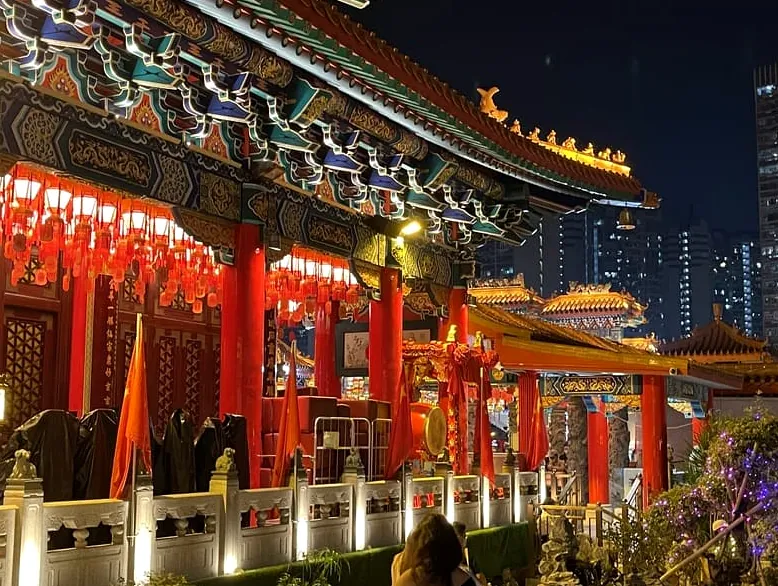
As sunset fades behind the silhouette of Lion Rock, Wong Tai Sin Temple enters an enchanting nocturnal visual dance illuminated by hundreds of crimson lanterns and warm architectural lighting tracing every curve of its glazed roofs. Soft golden light grazes dragon-carved stone pillars, awakening timeless dignity amidst bustling Kowloon. After dark, the main halls and gardens take on a mystical aura where traditional Eastern architectural lighting merges with contemporary city energy.
Punctuating these tranquil evening scenes are extraordinary bursts of spiritual energy and cultural pageantry—most famously on Lunar New Year’s Eve. The cherished tradition of offering the “First Incense Stick” (*Tau Heung*) turns the forecourt into a massive living stage drawing tens of thousands of devotees from dusk onward. Amid swirling incense smoke and glowing lanterns, crowds wait patiently in long lines until midnight; at the exact stroke of the *Zi* hour, twelve resonant chimes of the ancient bronze bell signal thousands of glowing incense sticks raised in unison—creating a flickering sea of light carrying prayers for peace and prosperity skyward.
Beyond Lunar New Year, lantern artistry at Wong Tai Sin Temple reaches dazzling visual heights during the Mid-Autumn Festival and annual Daoist celebrations. The Good Wish Garden—with its semicircular lotus pond, arched stone bridges, and octagonal pavilions—comes alive with intricate illuminated lantern displays shimmering across mirror-still water. Lanterns shaped like celestial cranes, carp leaping the Dragon Gate, and scenes from the Eight Immortals Crossing the Sea line winding corridors, while ethereal Daoist music and drifting mist turn every evening stroll into a journey back through legend.
Once the temple gates close after evening worship, nighttime energy flows naturally into surrounding neighborhood streets. Visitors and devotees alike step into the lively local rhythm around nearby Lung Cheung Road, illuminated by nostalgic neon signs. Mouthwatering aromas from steaming dim sum baskets, bowls of springy shrimp wonton noodle soup in clear savory broth, and heirloom sweet almond cream desserts ward off evening chills—blending solemn Daoist devotion inside the temple with vibrant street gastronomy outside.
Encircling the sacred grounds of Wong Tai Sin Temple is a thriving culinary landscape rooted in authentic Hong Kong neighborhood life, with bustling food streets in nearby San Po Kong and Kowloon City brimming with enticing aromas. Amid clouds of steam rising from tall stacks of handwoven bamboo steamer baskets, diners feast on translucent *har gow* shrimp dumplings tinted coral-pink, golden crab-roe *siu mai*, fluffy split-top *char siu bao* barbecue pork buns, and rich, amber-hued “silk-stocking” milk tea—preserving artisanal Cantonese culinary craft passed down across generations.
In keeping with Daoist ideals of compassion and mindful cultivation, serene vegetarian cuisine holds an honored place around the sanctuary. The tradition of enjoying a purifying vegetarian meal after offering incense has sustained historic vegetarian restaurants nestled around Chuk Un. Cantonese vegetarian gastronomy here achieves remarkable subtlety by applying yin-yang and five-element balance to natural plant ingredients—transforming classics such as Buddha’s Delight (*Luohan Zhai*), braised tofu skin rolls with shiitake mushrooms in vegetarian oyster sauce, and double-boiled lotus root soup with lotus seeds and red dates into pure, restorative dishes that refresh body and spirit.
Stepping out from tranquil vegetarian dining rooms, everyday local life draws visitors into nostalgic *cha chaan teng* (Hong Kong-style cafés) dotting nearby avenues. Here lives the soul of everyday Hong Kong comfort food: crisp, golden-crusted pineapple buns (*bo lo bau*) sliced open to cradle a thick slab of cold butter slowly melting inside, paired with hand-pulled milk tea brewed to a secret blend combining the brisk astringency of black tea with velvety evaporated milk. Time-worn marble-topped round tables, the clatter of porcelain dishes, and lively Cantonese chatter create an authentic neighborhood slice of life ideal for an unhurried afternoon snack.
For lovers of bold, time-honored flavors, bowls of fresh shrimp wonton noodles in dried-flounder broth are unmissable. Delicate, thread-thin egg noodles—kneaded using traditional bamboo-pole pressing techniques for signature springy bite—float in crystal-clear broth simmered deeply from pork bones, dried shrimp heads, and monk fruit, topped with plump wontons packed with minced pork and crisp whole sea shrimp. Alongside them, wok-fried beef *ho fun* noodles seared over roaring flames to capture unmistakable *wok hei* (“breath of the wok”) showcase the supreme skill of local master chefs.
A culinary stroll around the historic temple concludes memorably at traditional sweet soup (*tong sui*) parlors open late into the night. Velvety stone-ground black sesame paste, cooling snow fungus and lotus seed soup, or herbal *guilinggao* tortoise jelly drizzled with fragrant longan honey serve as both refined desserts and gentle wellness tonics—soothing away travel fatigue in Kowloon’s peaceful night breeze.
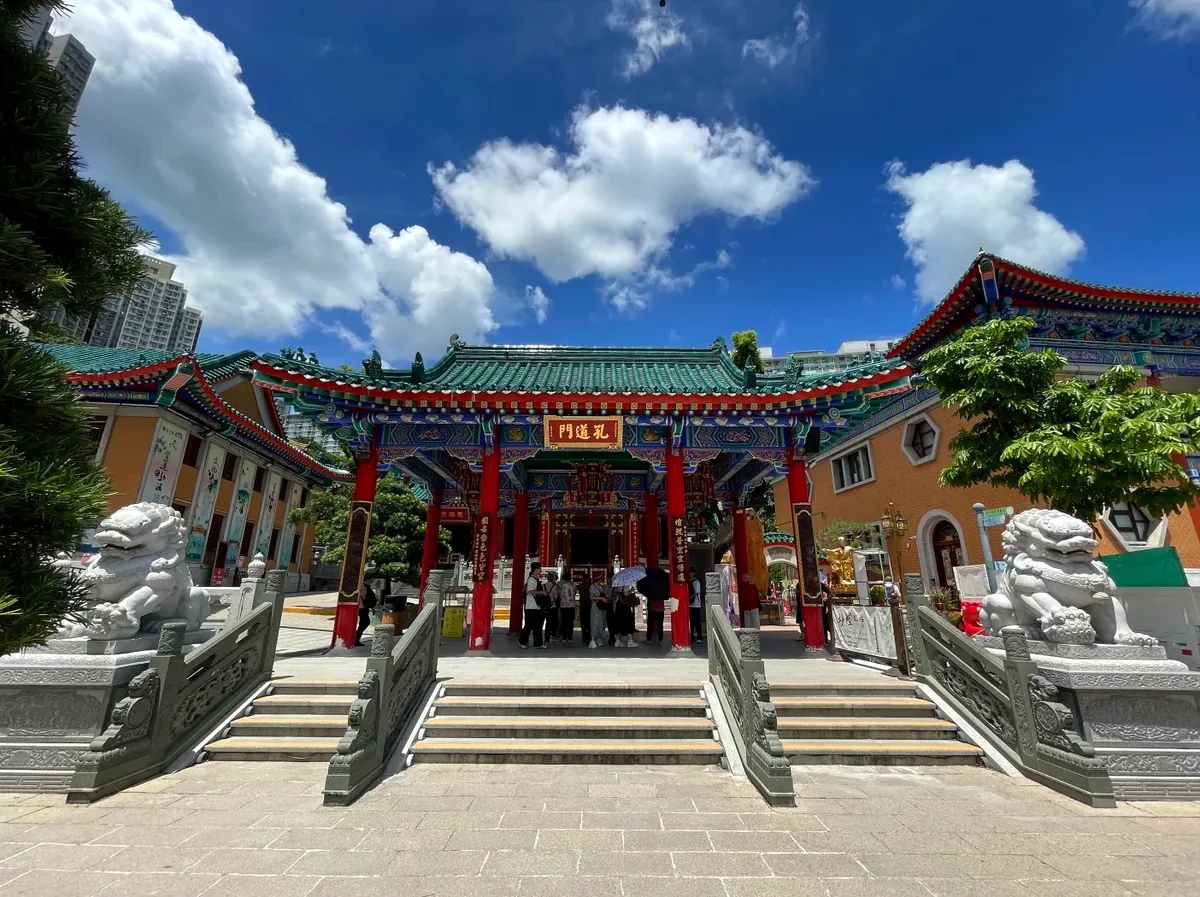
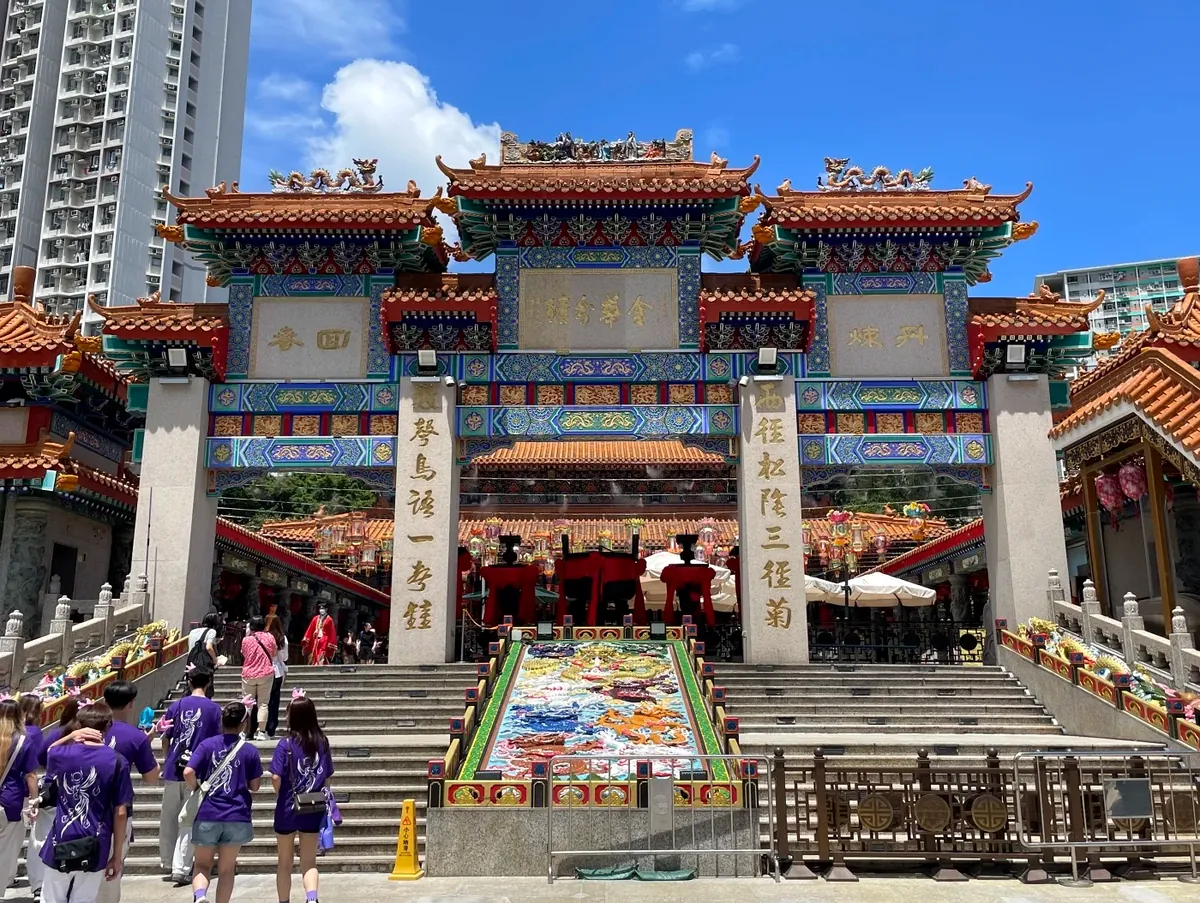
The overall panorama of Wong Tai Sin Temple shines with regal, colorful grandeur modeled on classical Eastern palace architecture. The imposing entrance archway welcomes visitors beneath upturned golden glazed-tile eaves curving gracefully against Kowloon’s open sky, while crimson columns and gilded plaques shimmer through wisps of fragrant incense drifting across the forecourt. Behind the front courtyard rises the Main Altar axis, uniting intricate dragon-and-phoenix carvings with serene garden walls to create a tranquil sanctuary amidst Hong Kong’s bustling metropolis.
Hong Kong’s world-class public transit network makes visiting the temple remarkably quick and effortless. The simplest route is taking the MTR Kwun Tong Line (shown in green on transit maps) to Wong Tai Sin Station and exiting via Exit B2 or B3, which opens directly in front of the main Sik Sik Yuen entrance. Iconic double-decker buses stopping at Wong Tai Sin Bus Terminus also offer a scenic ride letting you watch modern city life flow continuously around this historic sanctuary.
The main temple complex welcomes visitors daily from 7:30 AM to 4:30 PM, while the tranquil Good Wish Garden on the eastern wing opens at 8:00 AM. To experience the grounds at their most peaceful and avoid peak crowds of local worshipers, arrive early in the morning. Keep in mind that during major festivals—such as Lunar New Year’s Eve or Wong Tai Sin’s Birthday on the 23rd day of the eighth lunar month—the temple remains illuminated overnight to welcome tens of thousands of devotees queuing to offer first incense in a deeply moving spiritual atmosphere.
When entering the incense-offering zones, Sik Sik Yuen management limits each visitor to lighting exactly nine incense sticks to preserve air quality and protect heritage structures—three sticks each at the Main Altar, the Three Saints Hall, and the Meng Tak Hall. After shaking the traditional bamboo fortune-stick cylinder (*kau cim*) in front of the main terrace to seek guidance, you can bring your numbered bamboo stick to the Fortune-Telling Arcade. This two-story complex houses over 160 booths staffed by seasoned divination and feng shui masters fluent in Cantonese, Mandarin, and English who offer detailed interpretations regarding life path, family, and career.
For trip preparation, international visitors entering Hong Kong should ensure their passport remains valid for at least six months, hold a valid visa or electronic entry authorization if required, and keep the small white arrival slip issued at Chek Lap Kok International Airport safely until departure. Dress modestly and respectfully when entering temple grounds—avoiding above-the-knee shorts or skirts and sleeveless tops—to honor sacred decorum. Keeping a topped-up Octopus transit card makes paying for trains, offerings, or temple donations effortless; and to ensure your southern China getaway runs smoothly from itinerary planning to seamless logistics, consider booking an all-inclusive China tour package for a truly rewarding and worry-free journey.