Featuring distinctive architecture built from late 1918, Hai Phong Museum serves today as a cultural hub, a showcase for valuable artifacts, and a favorite check-in spot for younger visitors. In this guide, we share key details to know before visiting—read on to explore!
See more: Hon Dau Lighthouse – Vietnam’s Oldest Lighthouse
Where Is Hai Phong Museum?
Hai Phong Museum is an unmissable cultural stop in the port city, preserving and reflecting Hai Phong’s cultural, historical, and revolutionary heritage. Built in 1919 across roughly 1 hectare, the building showcases European Gothic-inspired architectural elements—marked by pointed arches, arched windows, and intricate decorative details—and is recognized among Vietnam’s earliest local research museums.
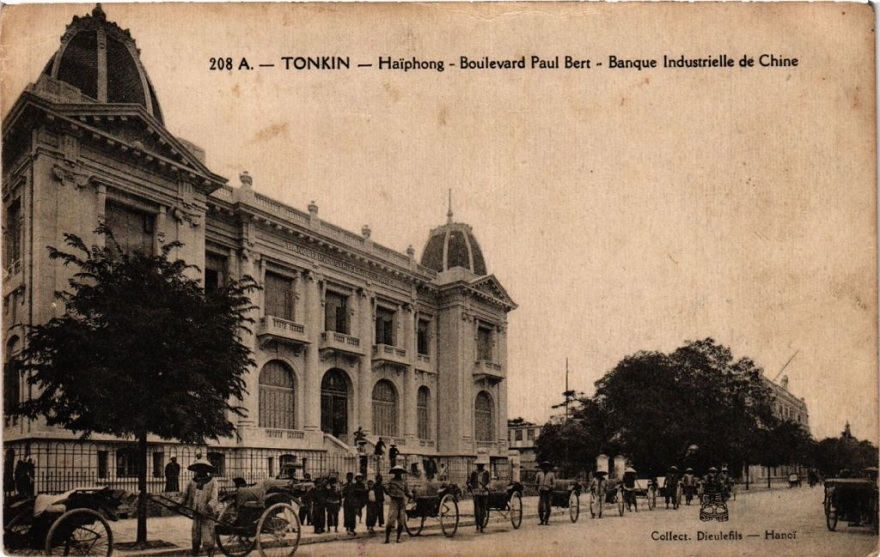
Original appearance of Hai Phong Museum
Hai Phong Museum has a rich, distinctive history. Originally constructed in 1918 by a Hong Kong business group, the property was later sold to a French financier following financial losses, becoming known around 1920 as the Sino-French Bank (*Ngân hàng Pháp – Hoa*)—a notable colonial-era building. After Hai Phong’s liberation on May 13, 1955, it served as a banking college before being transferred by the Ministry of Finance in 1958 at the request of the Hai Phong People’s Committee for use as a museum. Following renovations, Hai Phong Museum officially opened on December 20, 1959, to preserve, display, and share Hai Phong’s historical, revolutionary, and cultural traditions through thousands of artifacts.
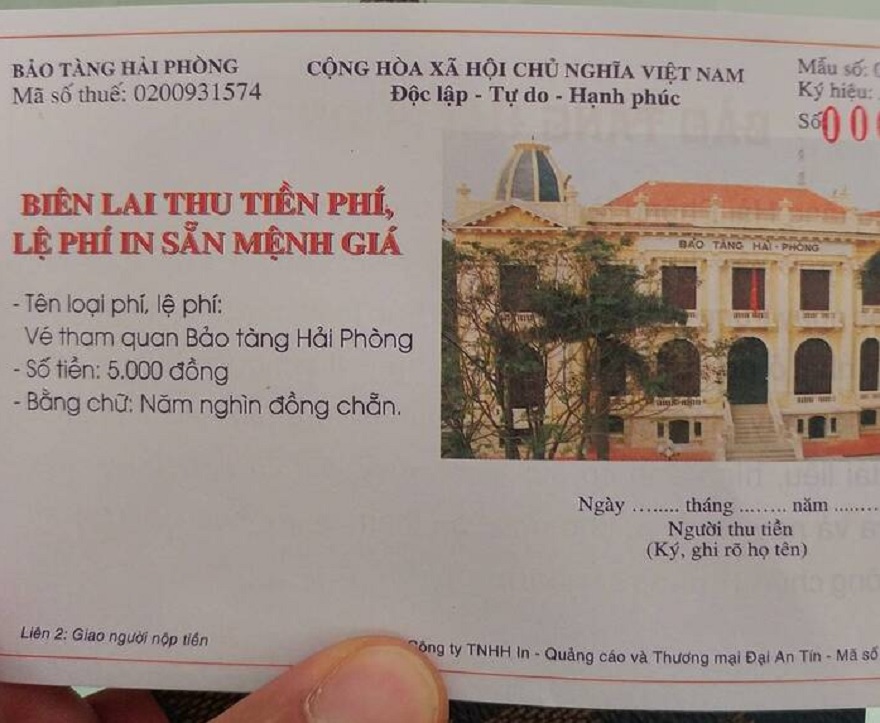
Admission ticket for Hai Phong Museum
Hai Phong Museum sits at No. 65 Dien Bien Phu Street, Hong Bang District, right in central Hai Phong, making it easy to reach by public transport or private vehicle.
- Open Tuesday through Sunday (closed on Saturday and Sunday afternoons).
- Opening hours: 8:00 AM – 10:30 AM and 2:00 PM – 4:30 PM.
- Admission fee: 5,000 VND per person—very budget-friendly for all visitors.
Architecture of Hai Phong Museum
Covering roughly 1,200 m2 across two main floors with 16 exhibition rooms plus a basement level, the museum uses the basement for artifact storage, the first floor for themes on Hai Phong’s history, culture, and revolution, and the second floor for themes on science, technology, and art—complemented by a spacious front courtyard suited to public cultural, artistic, and educational programs.
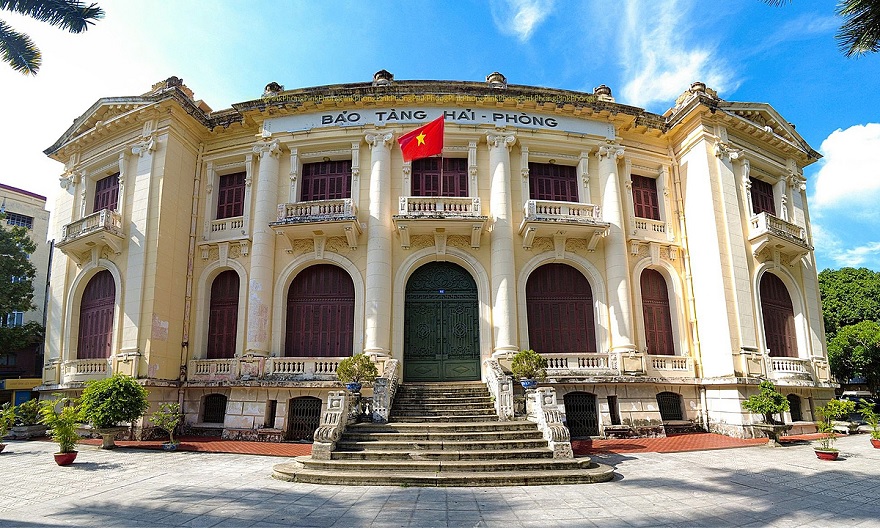
Hai Phong Museum
The facade stretches roughly 40 meters wide and 16 meters high in a tripartite layout with a wider central section flanked by slightly projecting side wings. The second floor features five windows across the central span—three larger openings in the middle and two smaller ones on the sides—while the first floor mirrors that symmetry with arched openings and a green-painted central main entrance.
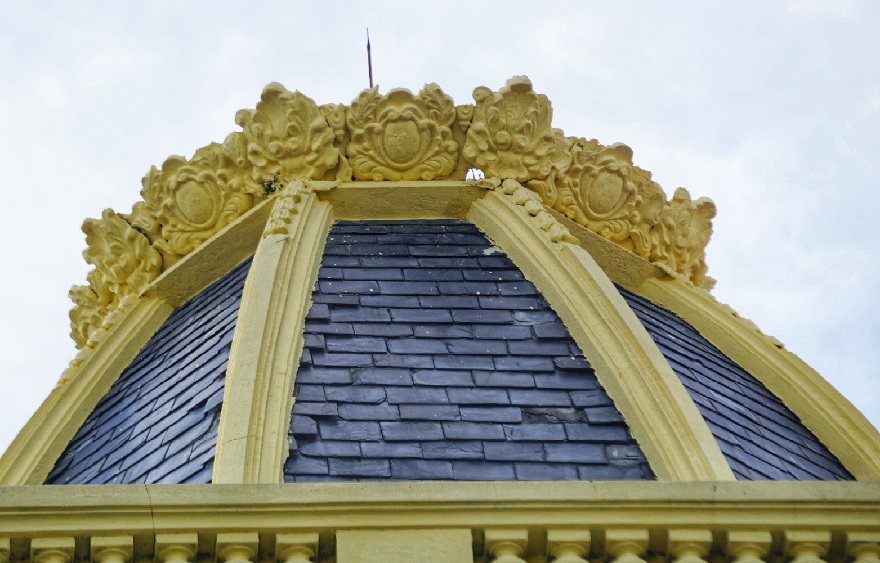
European-style roofline of Hai Phong Museum
Inside, a broad corridor leads to exhibition galleries decorated with paintings, photographs, and thematic signage. Galleries use modern layouts with tailored lighting and sound, arranging carefully preserved, clearly labeled artifacts chronologically or by theme.
Exhibition Spaces at Hai Phong Museum
Exhibition galleries across the first and second floors cover 1,283 m2 across 16 rooms spanning 12 core topics plus a dedicated gallery for special exhibitions marking national and city holidays or cultural events. Out of more than 22,000 items in the collection, 1,736 artifacts and 840 photographs and documents are on display.
The first floor showcases prehistoric archaeological finds from sites such as Bai Ben, Cat Do, and Trang Kenh arranged clearly by historical sequence—most notably the famed Cai Beo archaeological site on Cat Ba, divided into two cultural layers:
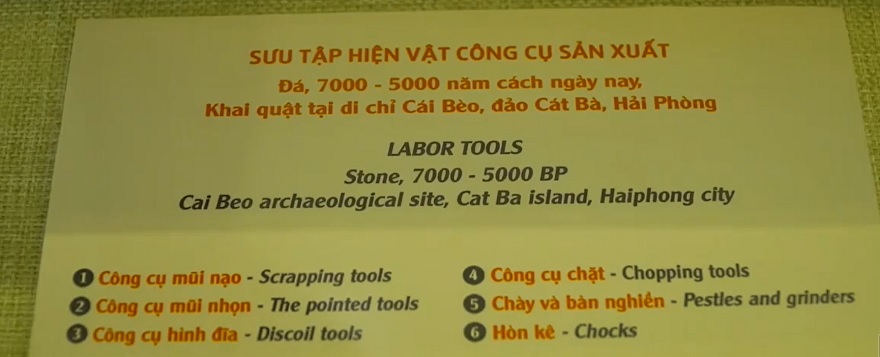
Lower layer Cai Beo 1 belonging to pre-Ha Long culture dated 7,000–5,000 years ago
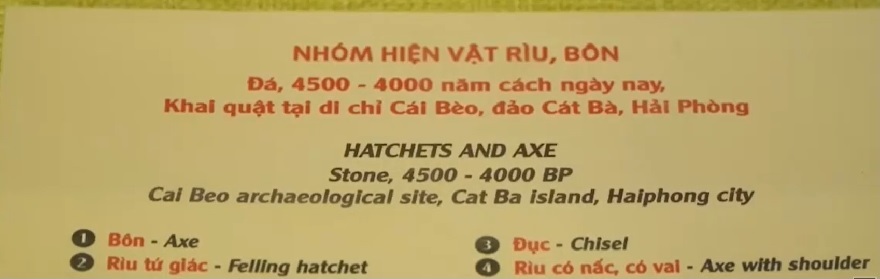
Ha Long culture dated around 4,000 years ago” width=”880″ height=”279″ /> Upper layer Cai Beo 2 belonging to Ha Long culture dated around 4,000 years ago
Stone artifacts here include short axes, flaked and chipped tools, pointed disc scrapers, and ground stone tools. Builders of Cai Beo 1 formed early coastal fishing communities that pioneered northeastern Vietnam’s waters in a post-Hoa Binh and Bac Son Neolithic maritime culture, while Cai Beo 2 inhabitants contributed to Ha Long culture‘s flourishing Neolithic stage paving the way toward the Metal Age along Vietnam’s northeast coast.
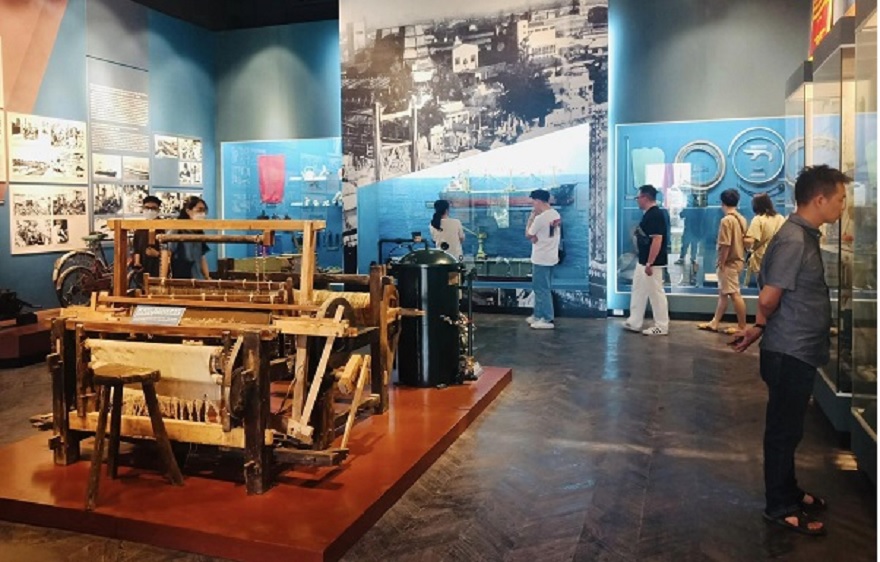
Traditional work tools of early Hai Phong residents
The second floor highlights the port city’s development, illustrating past daily life in Hai Phong through tools, specimens, models, and emblems tied to farmers, factory workers, and industrial life—offering perspective beyond bustling seaports and busy streets.
Spacious, varied galleries let visitors explore Hai Phong’s history, revolution, and culture through artifacts, photos, documents, and models, including these standout sections:
- Metal Artifacts Gallery: The museum’s largest and oldest gallery, occupying over half of the first floor, featuring 279 metal objects from millennia ago into the modern era—including ritual items, ornaments, everyday tools, wartime weapons, and industrial equipment—that trace the evolution of local metalcraft, highlighted by Vietnam’s largest ancient bronze bell (13th century), a Nguyen-dynasty royal palanquin crafted with gold and jade, anti-French uprising blades and axes, and Hai Phong industrial machinery.
- Ceramics Gallery: Located at the rear of the first floor, showcasing 1,200 ceramic pieces from the 10th to the 20th centuries that reflect regional and international trade—including wares from China, Japan, Thailand, Cambodia, and the Netherlands recovered from construction and excavations in Hai Phong—highlighted by a 10th-century blue-glazed bowl among Vietnam’s oldest surviving ceramics, a pomelo-shaped vase exemplifying Hai Phong ceramic craft, and a jade-green Japanese teapot gifted to Emperor Minh Mang in 1832.
- Textiles Gallery: Positioned at the front of the second floor, displaying 300 textile pieces from the 19th and 20th centuries—including *ao dai*, *ao tu than*, *ao ba ba*, and checkered *khan ran* scarves across Kinh, Tay, and Nung traditions in silk, brocade, and linen with fine embroidery—highlighted by a modernized green silk *ao dai* with peacock motifs worn by actress Ngoc Lan, a white linen Tay *ao tu than* with geometric triangle patterns, and a Nung *khan ran* dyed red with *gac* fruit featuring S-curve motifs.
- Paper & Print Gallery: Located at the rear of the second floor, presenting 200 paper items from the 19th and 20th centuries—books, newspapers, magazines, leaflets, and records printed via woodblock, movable type, or copperplate in Han, Nom, Quoc Ngu, and French—highlighted by the 1937 book *Hai Phong Past and Present* (*Hải Phòng xưa và nay*), the 1959 debut issue of *Hai Phong* newspaper, and the 1946 leaflet *Save Hai Phong* (*Hãy cứu Hải Phòng*) as an important historical document.