Biography of Tran Quoc Nghien
Tran Quoc Nghien was a royal kinsman of Dai Viet during the Tran Dynasty, the eldest son of Prince Hung Dao Tran Quoc Tuan and elder brother of Prince Hung Nhuong Tran Quoc Tang. He was granted marriage by King Tran Thanh Tong to Princess Thien Thuy, daughter of King Tran Nhan Tong. However, it was discovered that Princess Thien Thuy had previously engaged in an affair with Prince Nhan Hue Tran Khanh Du. Fearing he would offend Quoc Tuan, King Tran Thanh Tong ordered men to beat Khanh Du to death at West Lake, yet secretly instructed them not to strike too hard so he would not actually die. Shortly afterward, the King issued an edict stripping Khanh Du of all official titles and military rank and confiscating his property down to the last piece. Because Chi Linh District was the private estate of Senior General Tran Pho Duyet, Khanh Du managed to retain it. He retreated to Chi Linh and made a living selling charcoal.
In Chapter 6 of the Complete Annals of Dai Viet (Dai Viet Su Ky Toan Thu), there is a famous anecdote: One day, Tran Quoc Tuan tested his son, Prince Hung Vu, by asking, “The ancients held the entire realm to pass down to their descendants; what do you think of that?” Tran Quoc Nghien replied, “Even for someone of a different surname that should not be done, let alone someone of the same clan.” Tran Quoc Tuan reflected and agreed he was right. Another day, he posed the same question to his second son, Prince Hung Nhuong Tran Quoc Tang. Quoc Tang answered, “Emperor Taizu of Song was originally just an old farmer who seized the moment to rise to power and win the realm”—implying support for his father usurping the throne in accordance with the deathbed wish of his grandfather, Prince An Sinh Tran Lieu, who had once rebelled in an unsuccessful bid for the crown. Tran Quoc Tuan drew his sword and denounced him: “Rebellious subjects spring from unfilial sons,” intending to execute Quoc Tang. Hearing the commotion, Prince Hung Vu rushed in weeping and begged to bear the punishment in his brother’s stead, prompting Tran Quoc Tuan to spare him. Afterward, he instructed his eldest son: “After I die, seal the coffin lid first before allowing Quoc Tang in to pay his respects.”
Tran Quoc Nghien was regarded as a gifted general accomplished in both literary and martial arts, a deeply filial son, and a fiercely loyal subject. Although his role during the three resistance wars against the Mongol-Yuan invasions (1258–1288) was less prominent in records than that of his younger brother, Prince Hung Nhuong Tran Quoc Tang, his contributions in the third Battle of Bach Dang River (Quang Ninh) in 1288 cannot be overlooked. Alongside his father and fellow Tran Dynasty generals, he helped crush Kublai Khan’s Mongol-Yuan armada in one of the greatest military triumphs in world history.
Following the victory, the royal court elevated him to Duke of National Founding (Khai Quoc Cong) and later Prince Hung Vu. He moved to Chung My in Thuy Duong District, Dong Trieu Prefecture, Tan Hung Province, to gather settlers and establish villages. He passed away on the 24th day of the 4th lunar month, though the exact year remains unknown.
To commemorate his merit in defending the northeastern frontier of the nation, the people of Quang Ninh erected a small shrine at the foot of Bai Tho Mountain named Duc Ong Temple, part of the Bai Tho Mountain Relic Cluster in Hong Gai Ward, Ha Long City. Built around the late 13th century, the temple was recognized as a National Historical Monument in 1993. Meanwhile, his younger brother, Grand Prince Hung Nhuong Tran Quoc Tang, is also enshrined at Cua Ong Temple in present-day Cam Pha City.
Duc Ong Tran Quoc Nghien Temple
Duc Ong Tran Quoc Nghien Temple is a national-level historical and scenic monument located in Hong Gai Ward, Ha Long City. According to historical records, the temple was constructed in the late 13th century to honor the achievements of Duc Ong Tran Quoc Nghien, eldest son of Prince Hung Dao Tran Quoc Tuan. Known in classical script as Phuc Linh Tu (Phuc Linh Temple), it follows a T-shaped architectural layout comprising a three-bay front ceremonial hall and a single-bay inner sanctuary. Inside are numerous ritual vessels, ceremonial regalia, and the Eight Treasures (Bat Buu). The temple has undergone multiple restorations; according to an inscribed stele on site, local boat owners rebuilt the temple in the Year of the Water Ox (1913). In 2011, the Ha Long City People’s Committee expanded the total construction area of the Duc Ong Temple Relic Site to 2,531.8 square meters, and further adjusted it to 2,689.8 square meters in 2013.
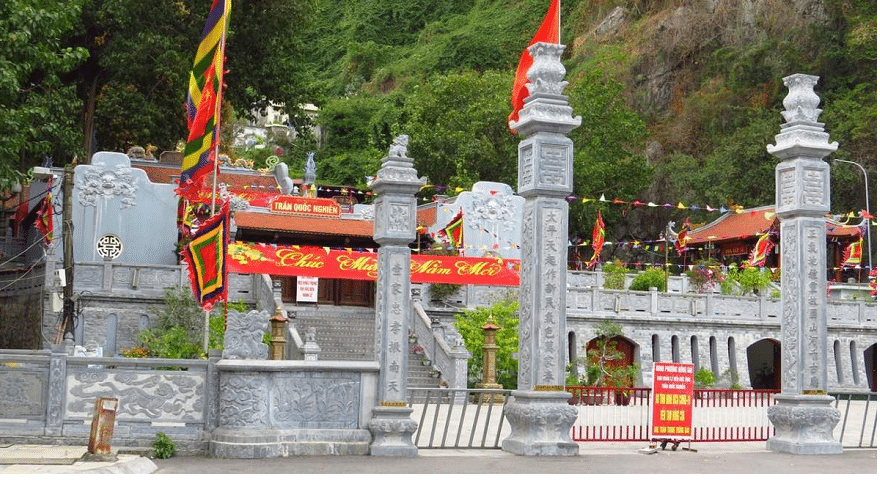
Duc Ong Tran Quoc Nghien Temple at Bai Tho Bridge
Duc Ong Tran Quoc Nghien Temple occupies an auspicious setting on the eastern foot of Bai Tho Mountain. Built on elevated ground in the heart of the city with its facade facing Ha Long Bay, the temple is adorned with motifs of pine, chrysanthemum, bamboo, and apricot blossoms transforming into dragons. Standing before the entrance is an ancient banyan tree casting shade day and night, bearing witness to the monument’s enduring legacy. Beneath the banyan tree stands a stele inscribed: “Witnessed by Prince Hung Vu of the Tran Dynasty, Grand King of the Eastern Sea.” Also preserved here is a stone stele carved in 1913 reading: “Observing that this place (Bai Tho Mountain) possesses picturesque mountains and waters and magnificent shrines, it is truly the foremost sacred site under heaven revered by all. We boat owners have journeyed from thousands of miles afar, braving wind and waves—without the Grand Prince’s divine protection, how could we have arrived safely? Yet seeing the ancient temple battered by wind and rain fills our hearts with sorrow. I have gathered fellow boatmen to unite in rebuilding this ancient shrine so worship may endure for generations…”
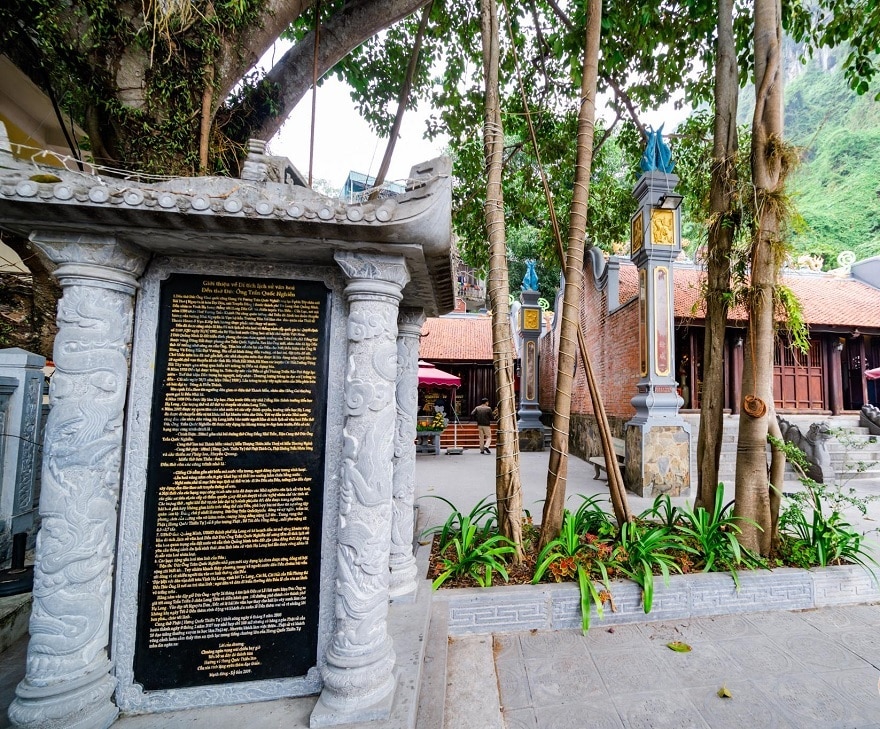
Stone stele beneath the banyan tree at Tran Quoc Nghien Temple
Nearby stand Bai Tho Mountain and Long Tien Pagoda, fellow highlights within Quang Ninh’s Historical, Cultural, and Scenic Relic Complex ranked at the national level in 1992. Duc Ong Tran Quoc Nghien Temple has long served not only as a resting stop for fishermen, but also as a freshwater supply point before setting out to sea, thanks to an ancient well within the temple grounds whose water remains crystal clear and sweet despite sitting right beside the ocean. Today, the temple still preserves two stone steles and five ancient statues dating back to the 13th century, commissioned and erected by local boat owners.
Festival at Duc Ong Temple
The Duc Ong Tran Quoc Nghien Temple Festival is an annual cultural and spiritual event traditionally held on the 24th day of the 3rd lunar month (the anniversary of his passing). Since 2008, the festival has been scheduled around April 29 and 30 in conjunction with Ha Long Tourism Week. The celebration comprises two parts: the ceremonial portion featuring rituals such as the procession of Duc Ong’s palanquin, lion-kylin-dragon dances, prayers for peace, and animal release ceremonies; and the festive portion featuring lively entertainment, folk games, and traditional performing arts. A highlight of the festival takes place in the evening with a sacred torch procession and floating lantern release on the sea—a ritual symbolizing Duc Ong’s enduring light guiding and enlightening humanity, while offering prayers for safety and calm waters for fishermen and coastal communities.
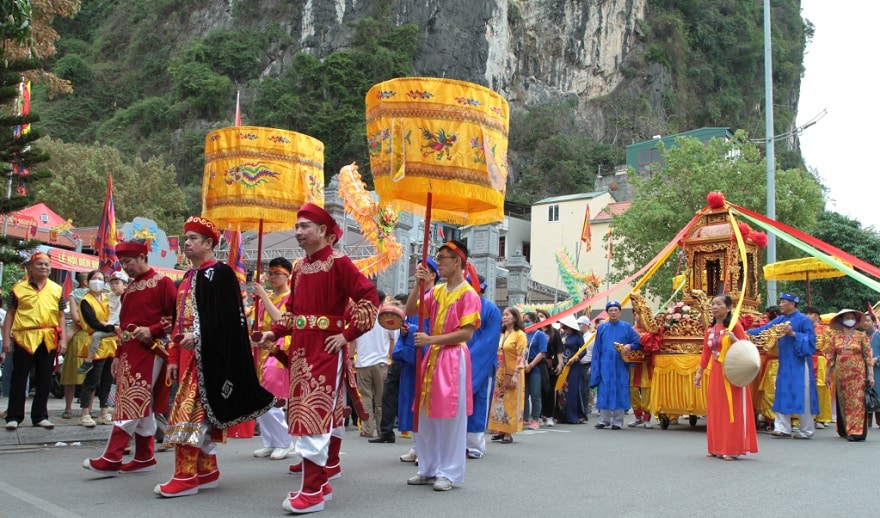
Annual palanquin procession festival at Duc Ong Temple
The Duc Ong Tran Quoc Nghien Temple Festival offers locals and visitors an occasion to honor a national hero, instill patriotism in younger generations, and promote local tourism. It also helps raise community awareness about preserving and celebrating the historical and cultural heritage of the national monument cluster encompassing Bai Tho Mountain, Long Tien Pagoda, and Duc Ong Temple.
See more: Famous Tourist Attractions and Experiences in Hon Gai