Long Tien Pagoda is a famous Buddhist temple in Ha Long City, Quang Ninh Province. Built in the late 19th century, it has weathered many historical vicissitudes and undergone numerous restorations. Long Tien Pagoda is not only a place of practice for monks but also an attractive spiritual tourism destination for domestic and international visitors. The pagoda features unique architecture, a rich collection of Buddha statues, and ancient relics. It is also famous for its annual festival held on the 24th day of the 3rd lunar month, attracting thousands of locals and tourists to participate. Let’s learn about Long Tien Pagoda through the following article!
see more: Famous tourist attractions and experiences in Hon Gai
History of Long Tien Pagoda – An Ancient Sacred Pagoda in Ha Long
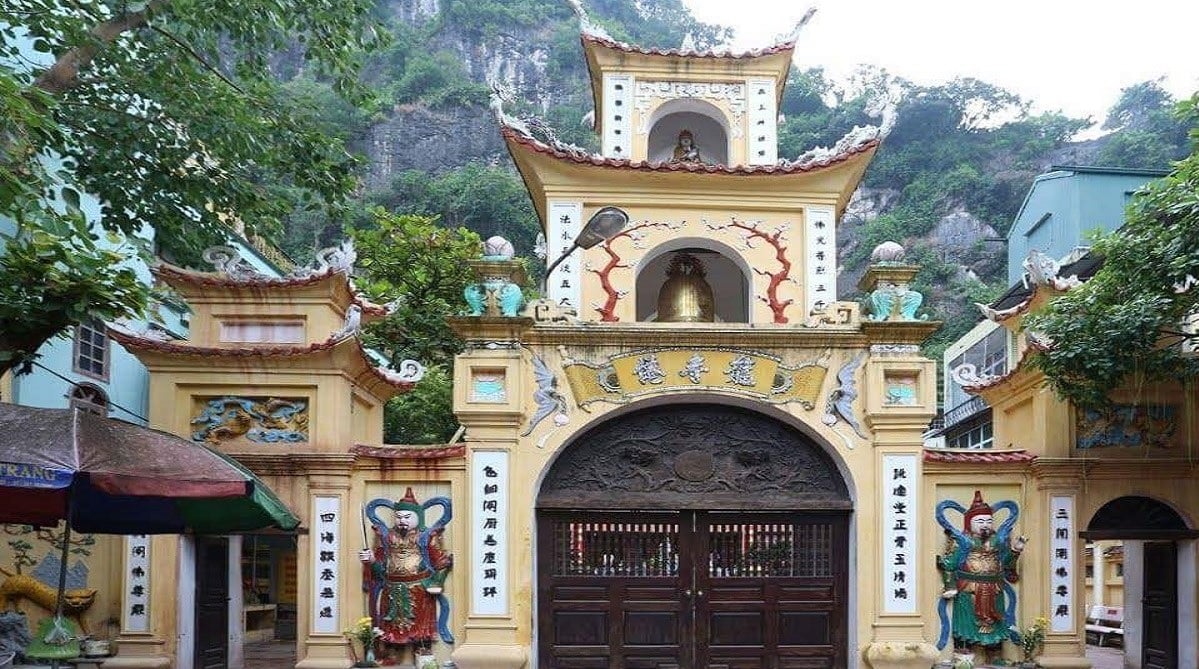
Long Tien Pagoda Ha Long
Every ancient structure carries its own stories, and Long Tien Pagoda is no exception. The history of the pagoda is intertwined with the cultural currents and fluctuations of the Ha Long region, from primitive hermitages to a thriving Buddhist center as it is today.
From Ancient Hermitages to a Spacious Pagoda at the Foot of Poem Mountain
Before Long Tien Pagoda was officially built to its present scale, the foot of Poem Mountain was already an important spiritual location. Legend has it that this place once housed ancient hermitages used as places of practice and worship by people of the past. Prominent among them was Thien Thach Dong Hermitage, also known as Thien Long Tien Hermitage. This was not only a place where Zen masters secluded themselves in search of the Dao, but also a space for worshipping Amitabha Buddha. Alongside Thien Long Tien Hermitage, people also mention the existence of Chin Co Hermitage on the right and the Tran Dynasty Temple on the left, commemorating the great merits of the Tran Dynasty’s famous generals in defending the borders. These hermitages, though modest, laid the spiritual foundation for the birth of a larger pagoda later on.
The Construction Process of Long Tien Pagoda (1942)
In 1942, Long Tien Pagoda was officially commenced, marking an important milestone. The work bears the strong imprint of Nguyen Dynasty architectural and sculptural art, featuring sophisticated “chồng rường giá chiêng” timber framing techniques and traditional decorative motifs. The original purpose of building the pagoda was not only to worship the Buddha and meet local spiritual needs, but also to honor and commemorate the merits of Tran Dynasty generals—national heroes who made immense contributions during wars of resistance against foreign invaders.
Historical Imprints and Endurance
Through the ups and downs of the nation’s history, Long Tien Pagoda also bears the marks of time. One memorable incident was when the pagoda was burned down during wartime. However, with the piety and determination of Buddhists and locals, the pagoda was gradually restored and embellished to preserve its inherent architectural beauty and continue its role as an important spiritual center. The pagoda’s endurance through various vicissitudes stands as proof of the vibrant vitality of cultural and spiritual values within the community.
Long Tien Pagoda – National Historical and Cultural Relic (1992)
Recognizing its immense historical, cultural, and architectural values, the State honored Long Tien Pagoda. On August 31, 1992, the Ministry of Culture and Information (now the Ministry of Culture, Sports and Tourism) issued Decision No. 1140/QĐ recognizing Long Tien Pagoda (along with the Poem Mountain relic complex) as a National Historical and Cultural Relic. This recognition is not only a source of pride for the people of Quang Ninh but also creates an important legal foundation for preserving and promoting the relic’s value, while elevating the pagoda’s status within Vietnam’s cultural and spiritual destinations.
See more: Top 9 Sacred Pagodas in Quang Ninh
Outstanding Architecture and Sculpture of Long Tien Pagoda
Beyond its profound historical and spiritual significance, Long Tien Pagoda is also a distinctive artistic architectural work, representing Vietnamese temple styles of the Nguyen Dynasty. Every line and detail in the pagoda conceals the ingenuity of ancestors and traditional cultural values.
Situated on a campus spanning about 1,000 square meters, Long Tien Pagoda was planned and built with a harmonious, balanced layout. The temple strongly bears Nguyen royal court architectural styles featuring sophisticated “chồng rường giá chiêng” timber structural techniques, creating sturdiness and majesty. Overall, the temple may be constructed in the shape of the Chinese character for “Er” (二) or feature a Main Hall designed in the shape of the character for “Ding” (丁)—a popular style in ancient Vietnamese temple architecture, consisting of the Front Hall connected to the Upper Hall. The architectural highlight is the roof system designed in the “chồng diêm hai tầng tám mái” (double-tiered eight-roof stacked) style, covered with traditional yin-yang tiles. The four corner eaves curve softly and gracefully, creating an elegant yet solemn appearance. The main entrance through the majestic Triple Gate (Tam Quan) and the central Main Hall (Mahavira Hall) clearly demonstrate this style.
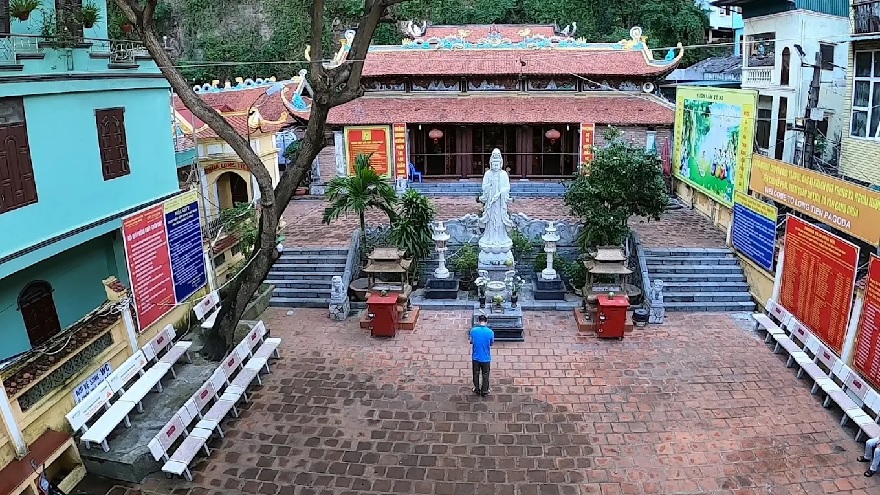
The Main Hall area with Ding-shaped architecture at Long Tien Pagoda
Behind the Main Hall typically lies the Ancestor House (To Duong), an indispensable component in traditional pagodas. This is where Patriarchs who pioneered and propagated Buddhism are worshipped, especially patriarchs of the Truc Lâm Zen sect such as Buddhist Emperor Tran Nhan Tong, First Patriarch Phuc Loa, and Second Patriarch Huyen Quang. This demonstrates the inheritance and honoring of Vietnamese Buddhism’s spiritual current. Additionally, the pagoda grounds feature front and back yards, tree gardens, monk quarters (living quarters for monks), guesthouses, and other auxiliary structures serving the pagoda’s daily activities as well as welcoming Buddhists and visitors from all directions to pay homage.
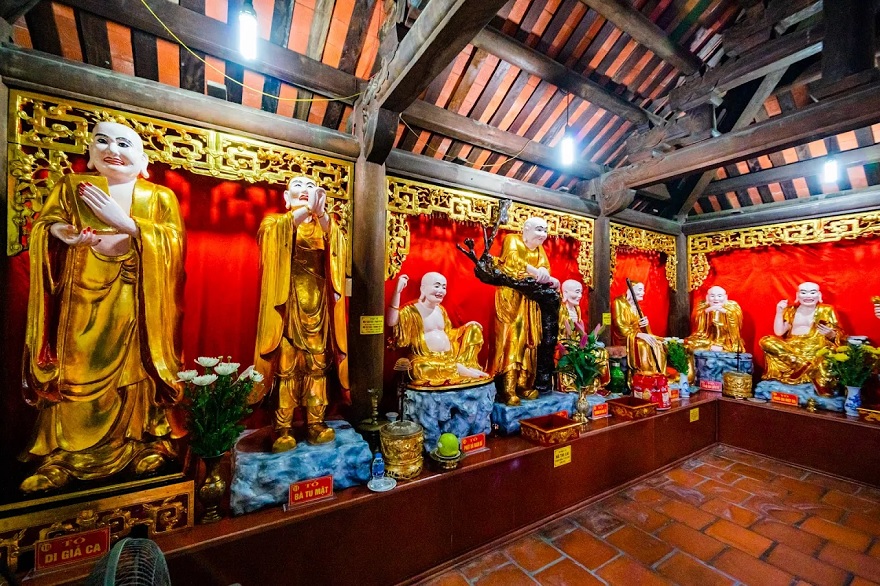
The Ancestor House area
Sculptural and decorative arts at Long Tien Pagoda are also exceptionally sophisticated. Most wooden architectural members such as columns, beams, trusses, and purlins are elaborately carved with traditional motifs like flying dragons, dancing phoenixes, and stylized flora (pine, chrysanthemum, bamboo, apricot). These images not only enhance the work’s aesthetic beauty but carry profound symbolic meanings in Vietnamese Buddhist and folk culture. A special artistic highlight in the front hall is a relief mural depicting the tale of Tang Sanzang and his disciples Sun Wukong, Zhu Bajie, and Sha Wujing on their pilgrimage to the Western Heavens to retrieve scriptures. The mural is not only vivid but carries educational significance regarding perseverance and arduous spiritual practice to attain truth.
Within a single temple space, three subjects are worshipped: the Buddha, Saint Tran Hung Dao and Tran Dynasty generals, and the Three Palaces Holy Mothers. The statue system here is quite rich, distinctive, and holds high artistic value.
| Architecture | Characteristics |
|---|---|
| Triple Gate (Tam Quan) | Atop the triple gate sits a statue of Amitabha Buddha in a seated posture; below is the bell tower inscribed with the prominent words “Long Tiên Tự” and the year of construction. Flanking it are two parallel couplets: “Long tác linh, tiên tác danh” meaning where there are dragons it is sacred, where there are fairies it is renowned. The triple gate features a three-tiered stacked-roof pyramid style, demonstrating a combination of divine and Buddhist elements. |
| Main Hall | The Main Hall is a grand shrine known as the Mahavira Hall, where Buddhas are worshipped and arranged across tiers:
Additionally, the right side of the Main Hall worships Tran Dynasty generals, while the left side houses the Three Realms Holy Mothers shrine. |
Rich Worshipping Space and Religious Harmonization at Long Tien Pagoda
Long Tien Pagoda is not merely a beautiful architectural work but also a diverse spiritual space, converging and clearly reflecting the rich religious life of the Vietnamese people. Entering the temple, visitors will perceive a harmonious intersection between Buddhism and indigenous folk beliefs.
Following the Mahayana Buddhist Current
As a Buddhist temple, Long Tien Tu adheres to the Mahayana (North Sect) tradition, one of the two major branches of Buddhism and the most popular denomination in Vietnam. Mahayana Buddhist teachings emphasize the path of the Bodhisattva ideal, practicing not only to attain personal enlightenment but to deliver and rescue all sentient beings from the sea of suffering and reincarnation. This is clearly demonstrated through the solemn system of Buddha statues worshipped in the Main Hall, such as the Amitabha Triad, Amitabha Buddha, Thousand-Eyed Thousand-Armed Avalokiteshvara… along with rituals and dharma assemblies regularly held at the temple, guiding people toward wholesome values and liberation.
A Convergence of Vietnamese Folk Beliefs
One of the most distinctive features driving Long Tien Pagoda’s appeal is the unique harmonization between Buddhism and traditional Vietnamese folk beliefs. This is manifested through the joint worship of deities, national heroes, and Mother Goddesses right within the temple space:
- Worshipping National Heroes: As seen in the Main Hall architecture, alongside worshipping the Buddha, the temple allocates solemn space to worship Saint Tran Hung Dao and Tran Dynasty generals. This is an expression of gratitude and reverence toward those with immense contributions to the nation’s defense, a fine tradition of “drinking water, remember its source” in national culture.
- Mother Goddess Worship: The presence of the Three Realms Holy Mothers shrine (or Three Palaces Holy Mothers) and the worship of Mother Goddess Van Phuong demonstrate the profound influence of Mother Goddess worship in Vietnamese spiritual life. This makes the temple more approachable, meeting the diverse religious needs of the community.
- Syncretism with Taoist Elements: Worshipping the Jade Emperor in the Buddhist sanctuary is also proof of the syncretism among the Three Teachings (Buddhism – Taoism – Confucianism) and folk beliefs, forging a colorful religious cultural picture at Long Tien Pagoda.
Festival at Long Tien Pagoda
Long Tien Pagoda Festival – A Distinctive Cultural Feature of the Coal Region (24th of the 3rd Lunar Month)
Every year, on the 24th day of the 3rd Lunar month, Long Tien Pagoda becomes the focal point of one of the largest and most distinctive traditional festivals in Ha Long City in particular and Quang Ninh Province in general. This is not only an occasion for locals and pilgrims from all directions to express piety toward sacred deities but also an opportunity to immerse in a cultural space steeped in national identity.
Solemn Palanquin Procession Ritual for Duc Ong Tran Quoc Nghien
The central and most anticipated activity during the Long Tien Pagoda Festival is the solemn and grand palanquin procession ritual for Duc Ong Tran Quoc Nghien (the eldest son of Hung Dao Vuong Tran Quoc Tuan). The procession with colorful umbrellas, bustling gongs and drums, and orderly formations departs from Long Tien Pagoda, passing through other important spiritual locations in the area such as Duc Ong Temple (the main shrine for Duc Ong Tran Quoc Nghien), potentially passing An Duong Vuong Temple in Vung Dang, the Loong Toong area, and returning to the temple. This ritual not only demonstrates reverence for national heroes and contributors to the nation and Quang Ninh, but also symbolizes spiritual and community cultural connectivity, reminding future generations of the tradition “Drinking water, remember its source.”
Other Distinctive Folk Cultural Activities
Besides the majestic palanquin procession ritual, the Long Tien Pagoda Festival buzzes with rich folk cultural activities, attracting massive participant crowds:
- Chầu văn singing and spirit possession (hầu đồng): Chầu văn melodies praising merits of Saints, Gods, and Mothers, combined with solemn and mystical spirit possession rituals, create a special spiritual space.
- Folk games: The temple yard and surrounding areas animate with traditional games like wrestling, Chinese chess competitions, and tug-of-war, displaying martial spirit and skill.
- Traditional art performances: Cheo troupes and local art teams often perform classic Cheo excerpts or items praising hometowns and countries, enriching the festival’s spiritual life.
- Hoadang lantern releasing: In the evening, shimmering flower lanterns carrying wishes for peaceful, happy lives are released onto water surfaces, creating mystical and sacred scenes.
Notes When Visiting the Pagoda
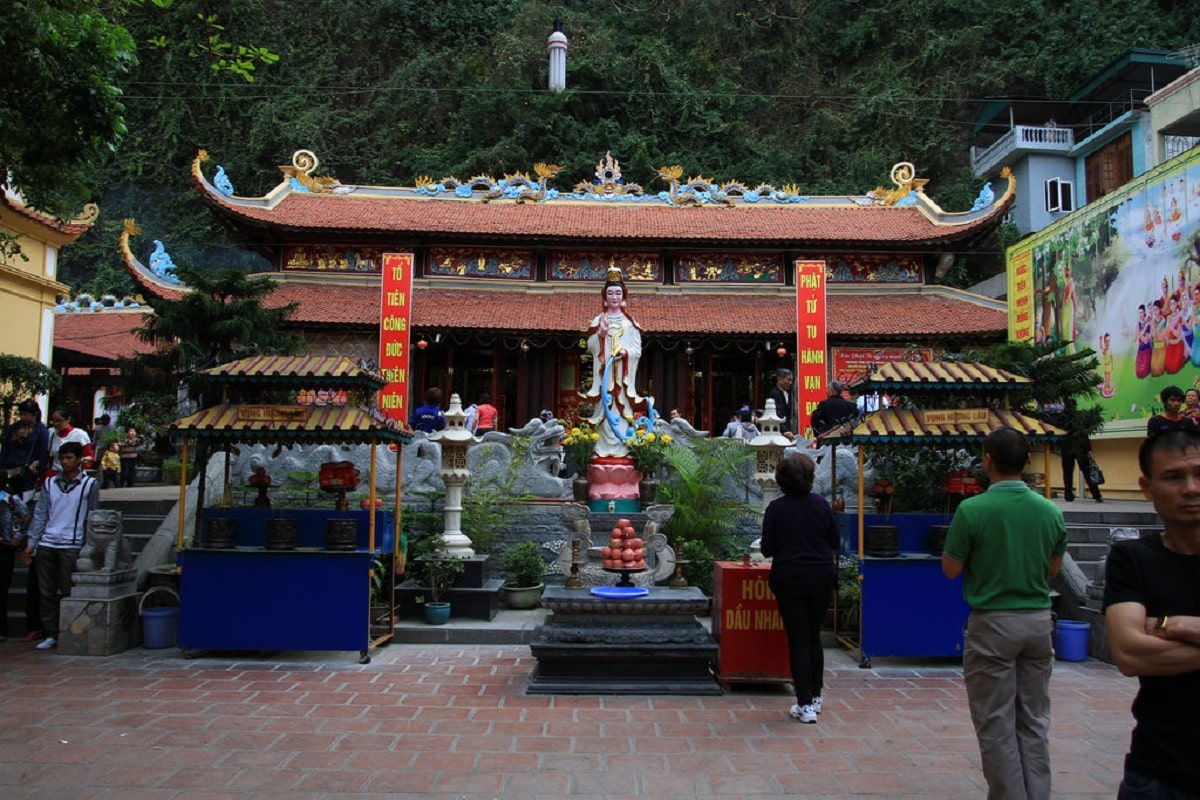
Regarding Attire
- When visiting the pagoda, dress neatly, cleanly, modestly, and elegantly.
- Avoid wearing short skirts, shorts, revealing clothes, tank tops, off-the-shoulder tops… to prevent disrespecting the Buddha hall.
- Wear polite, muted colors, avoiding overly bright or dark shades.
Regarding Forms of Address
- When meeting monks in the temple, address them as “thầy” (master) or “ni” (nun) depending on their gender.
- Bow your head and greet with hands folded across your chest.
- Speak softly, politely, and respectfully.
Regarding How to Worship the Buddha
- Entering the temple, enter through the Jialing gate (right) and exit via the Emptiness gate (left). The Middle gate is reserved for Sons of Heaven, high monks, and scholarly elites.
- Upon entering the Buddha hall, remove shoes or go barefoot to show respect.
- When lighting incense, light 3 or 5 sticks and do not let incense extinguish while using. Light incense at burners placed outside temple courtyards and limit lighting incense inside.
- When praying, kneel or stand slightly to the left or right to worship, avoiding standing directly in front of altars. Worship Buddhas and Saints starting from the center first, then proceeding from right to left.
- When praying, ask for Buddha’s protection and shelter, avoiding unreasonable or selfish requests. Pray sincerely and concisely to yield space to others.
Regarding Conduct
- Inside the temple, maintain order and solemnity, avoiding noise.
- Turn off phones or set them to vibrate before entering, especially before lighting incense and worshipping.
- Avoid running around, talking, commenting, sitting, or lying down inside Buddha halls.
- Avoid sneezing, sniffling, or spitting around Buddhist sanctuaries and Triple Jewels.
- Avoid taking photos or recording videos arbitrarily in the temple, especially in sacred areas.
- Avoid touching Buddha statues, ritual objects, or taking temple property home as personal belongings.
Regulations of Long Tien Pagoda
Per Article 6 of Circular No. 04/2014 dated May 30, 2014 by the joint Ministry of Culture, Sports and Tourism and Ministry of Home Affairs stipulating responsibilities for visitors and participants in religious and belief activities as follows:
- Strictly obey legal regulations, rules, and regulations of belief and religious establishments, adhering to civilized lifestyle standards when participating.
- Respect everyone and ensure solemnity at belief and religious establishments. Attire must be polite, neat, and appropriate to religious customs.
- Maintain hygiene, security, order, and protect environmental landscapes at belief establishments.
- Place offerings and donations in designated locations.
Long Tien Pagoda Festival
The Long Tien Pagoda Festival is a distinctive spiritual and cultural activity for the people of Quang Ninh in particular and Vietnamese people in general. The festival is not only an occasion to express piety toward the Buddha Dharma and ancestral Saints but also an opportunity to exchange, learn, and introduce traditional beauties of Ha Long. Visiting the Long Tien Pagoda Festival, you will experience unique spiritual and cultural values, while admiring majestic natural scenery of Poem Mountain and Ha Long Bay. Preserve beautiful, meaningful moments participating in the Long Tien Pagoda Festival and share them with friends and family!