Ha Long, a mystical and magnificent city in Vietnam, is not only famous for Ha Long Bay—a UNESCO World Natural Heritage site—but is also home to numerous historical relics and beautiful landscapes that are a source of pride for the Vietnamese people in general and the residents of Ha Long in particular. Among these valuable monuments and scenic spots, Poem Mountain (Nui Bai Tho) is likened to the city’s “telescope” overlooking the heritage bay.
see more: Famous tourist attractions and experiences in Hon Gai
Introduction to Poem Mountain
Poem Mountain, a limestone mountain formed during the Devonian period by the Indonesian orogeny, was historically known as Roi Den (Lamp-Lighting) Mountain or Truyen Dang Son. The name “Poem Mountain” (Bai Tho) officially originated in 1468 after King Le Thanh Tong carved a poem into the cliffside during his royal inspection tour.
Standing 168 meters above sea level, the mountain is located in Bach Dang Ward (Hon Gai), the heart of Ha Long City. From here, visitors can enjoy a panoramic view of the city and the beautiful Ha Long Bay. Historically, the mountain served as a watchtower to observe enemy ships from the open sea, where fires were lit to signal the capital in case of invasion. Today, Poem Mountain has become an attractive trekking destination for travelers visiting Ha Long.
In 2017, a forest fire caused by a group of irresponsible tourists lighting a fire led to a landslide, forcing local authorities to close the mountain. Despite various efforts to reopen Poem Mountain for tourism, these attempts have not yet been successful. Nevertheless, many visitors still seek to explore it despite the warnings, including Caroline, the granddaughter of a British billionaire, who conquered the mountain in May 2019 and caused a social media sensation with her stunning photos.
Legends and the origin of the name Poem Mountain
According to folklore, Poem Mountain and Man Mountain are an inseparable pair. The legend of the giant who carried stones to mend the sky from the dawn of time tells that: When the world in this region was first created, the sky had many holes, and the scorching sun caused the people to pray to the gods, whose prayers were answered. A giant was sent down to patch the holes in the sky. From the large gaps, stones fell and scattered, creating hundreds of thousands of large and small islands in the bay. The last load was carried across Cua Luc Bay; because it was so heavy, the giant shifted his shoulder to rest, and suddenly the carrying pole broke in two. One side of the load fell into Xich Tho commune, creating Man Mountain, while the other fell into Hiep Khau commune—the old Hiep Khau of Yen My district, which is now the land comprising the four wards of Hong Gai, Bach Dang, Yet Kieu, and Tran Hung Dao. This is the center of Ha Long City, where Poem Mountain has stood majestically for thousands of years. Because the carrying pole broke in two, shaping the mountains, Poem Mountain and Man Mountain share a similar appearance. They are not only similar in shape, but researchers also note that the geology, geomorphology, and flora and fauna ecosystems on both mountains are similar. Seen from afar, both mountains tower above the surrounding peaks, situated by the Cua Luc space. Viewed from the northeast, Poem Mountain resembles a compassionate Mother Nature, cradling her child on the waves of Ha Long. Thus, nature has gifted Ha Long City with Poem Mountain and Man Mountain, which not only possess breathtaking scenery but also serve as a spiritual, historical, and cultural landmark passed down through folklore, standing as a symbol of a young, dynamic, intelligent, and modern city.

The old name of Poem Mountain was Truyen Dang, which the locals called “Roi Den” (Lamp-Lighting). Folklore tells that in the past, fishing boats would cast their nets in the area, working by day and gathering around here at night. They would tie their boats to the cliffs, and the oil lamps from the boats would glow red like stars, while a lamp on the mountain peak would signal the boats to navigate the correct channels safely. That is why the locals called it Roi Den Mountain. Additionally, there is a theory that during the Yuan invasion on the Bach Long River, Poem Mountain was an important garrison station on the border. The soldiers stationed there were tasked with hanging a lantern on the peak every night to signal peace. In times of danger, the soldiers would light a large fire (using wolf feces mixed with dry wood) to send thick columns of smoke into the sky, alerting the next guard stations and surrounding areas.
The mountain earned the name “Poem Mountain” (Bai Tho) following King Le Thanh Tong’s royal inspection, during which he carved a poem into the rock in 1468. According to scientists, King Le Thanh Tong visited An Bang and composed three poems: two in Han (Classical Chinese) and one in Nom (Vietnamese script). Of the two Han poems, one was carved on Truyen Dang Mountain and the other on Chich Tro Hon Dua on Ha Long Bay. This can be considered a firm declaration of independence, asserting sovereignty over the sea and islands. It confirmed the national territorial boundaries that the ancient feudal court had established in the northeastern sea and sky. In addition to King Le Thanh Tong’s poem, the southeastern cliff also features a poem by Lord Trinh Cuong in 1729 and a collection of poems by several Nguyen dynasty notables.
According to poet Tran Nhuan Minh, former chairman of the Quang Ninh Literature and Arts Association, Poem Mountain holds a rare honor of being named after poems, making it a “mountain of poetry.” There are only one or two such places in Vietnam. Poem Mountain contains a total of 12 poems, but only three are of high value, worthy of being masterpieces. The first is by King Le Thanh Tong; the second, in my opinion, is the best poem in 18th-century Vietnam, authored by Lord An Do Vuong Trinh Cuong; and the third is by Nguyen Can, written in 1910. In essence, Poem Mountain is truly the mountain of these three poems.
Bai Tho Mountain (Poem Mountain) is not only a repository of poetic masterpieces but also a witness to significant historical moments for the soldiers and people of the mining region. On May 1, 1930, the people of Hon Gai were overwhelmed with joy when they saw the red flag with the hammer and sickle flying atop Bai Tho Mountain, symbolizing the victory of the working class over French colonial rule in the mining area. Since then, this flag has remained on the summit as a source of national pride. Throughout the resistance war against the US, Bai Tho Mountain also played a crucial role in air defense, communications, and healthcare. The air defense observation post, the Telegraph Center (under the Quang Ninh Post Office), and the loudspeaker system broadcasting combat orders from the Quang Ninh Provincial Air Defense Council were all located on the mountain. Additionally, several caves within the mountain were used for production, housing, first-aid stations, shops, classrooms, and headquarters for various agencies and enterprises during the American imperialist bombing campaigns. During those periods of working while fighting the enemy, Bai Tho Mountain also became a site of many heroic feats and examples of selfless labor for the sake of independence and freedom by the children of the mining region.
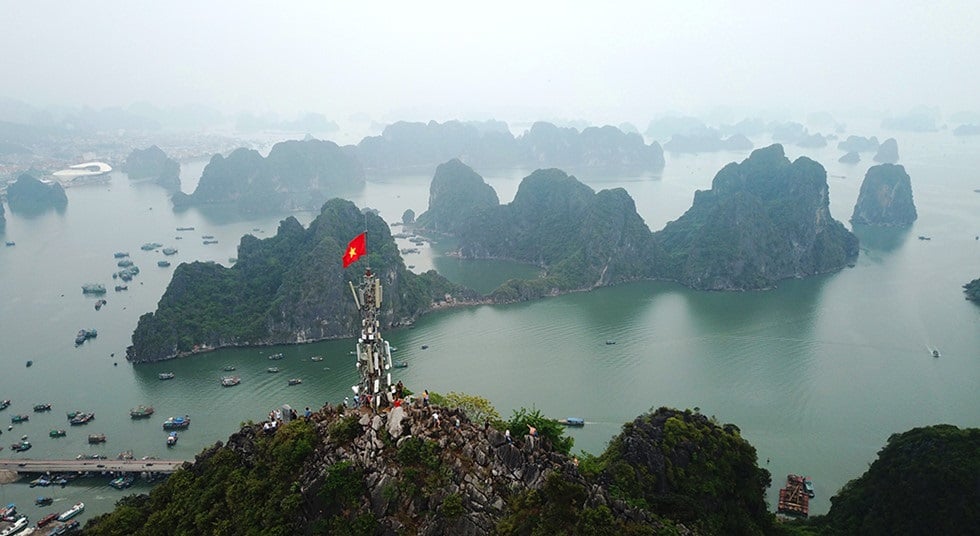
The red flag with the yellow star fluttering on Bai Tho Mountain
Today, Bai Tho Mountain witnesses a peaceful life alongside the transformations of the Heritage City. At the foot of the mountain lie historical and cultural relics such as Long Tien Pagoda, the Duc Ong Tran Quoc Nghien Temple, and the Bai Tho Mountain Cultural Center—places frequently visited by Ha Long residents during special occasions like the New Year or festivals. Visiting Bai Tho Mountain, we will surely see not only a mountain with magnificent scenery but also feel the “soul” of a land that possesses its own emotions, joys, and sorrows.
However, since late 2017, due to forest fires and landslides, Bai Tho Mountain has been closed and marked with warning signs to ensure the safety of visitors and the preservation of the site. According to information from the Quang Ninh Department of Culture and Sports, on May 18, 2017, a forest fire occurred in the protection forest area of the Bai Tho Mountain historical and cultural site, caused by human activity. The fire destroyed approximately 2 hectares of protection forest and caused landslides on the mountain. To protect visitors and the heritage site, the Ha Long City People’s Committee decided to temporarily suspend tourism activities at the Bai Tho Mountain site starting May 19, 2017. By February 2023, following public feedback, the Quang Ninh provincial government began considering plans for renovation and the development of tourism tours to Bai Tho Mountain to meet public demand.
Content of the poems on Bai Tho Mountain
1. The poem by King Le Thanh Tong
The poem on Bai Tho Mountain is a Sino-Vietnamese poem by King Le Thanh Tong, carved into the rock in 1468 when he led his troops on an inspection tour of the Northeast sea. He stopped his boat at the foot of Truyen Dang Mountain, on the side facing Ha Long Bay, to drink wine and compose poetry. This poem is often called “Ngu che Thien Nam dong chu de” (Thien Nam Dong Chu is the title of Le Thanh Tong). The poem was carved on a relatively flat rock face, about 2.5 meters above the ground, consisting of 56 Sino-Vietnamese characters carved in a continuous line, without the current sentence divisions. Of these 56 characters, 21 have faded completely and are unreadable, while the remaining ones are very faint. Before the poem, there is an inscription (preface) of 49 characters, which has also almost completely weathered away. Fortunately, the poem was recorded in ancient texts, which serves as the basis for researchers.
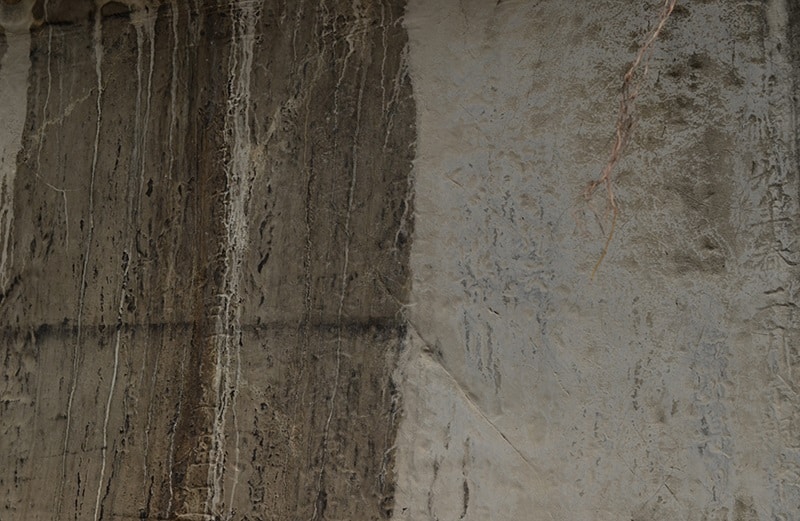
The poem by King Le Thanh Tong on Bai Tho Mountain has weathered
This poem signifies the praise of the charming natural landscape and expresses the patriotism and national pride of King Le Thanh Tong. He led his troops to the Northeast sea to protect the borders and national security against the threat of the Yuan-Mongol invaders. He also built a powerful and prosperous dynasty, considered the “golden age” of Vietnamese history. The poem also demonstrates the talent and majesty of the King and is one of the masterpieces of Vietnamese literature. He used Sino-Vietnamese characters to write the poem in the style of Chinese poetry, yet it bears the distinct mark of Vietnamese culture. He described the natural scenery with vivid and emotional imagery, such as “phong hoa” (gentle wind), “canh le” (beautiful scenery), “hai bat duong ba” (the sea without waves), “phiem Hoang Hai” (sailing the Yellow Sea), and “tuan An Bang” (inspecting An Bang). This poem gave the mountain its new name, Bai Tho (Poem) Mountain, as it is the only poem remaining on the mountain after the poem by Trinh Cuong was destroyed.
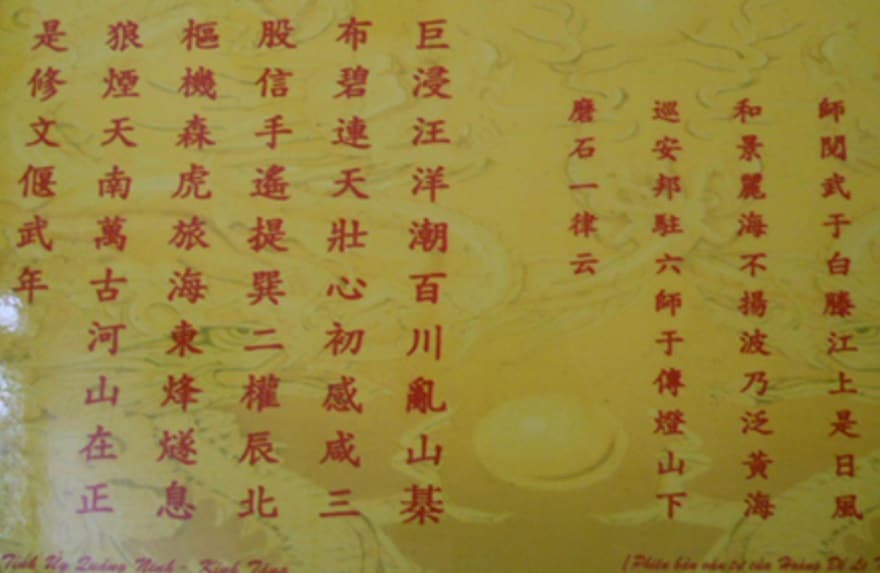
The poem by King Le Thanh Tong has been restored
The poem is loosely translated as follows: “The vast ocean, a hundred rivers flow into it/ Mountains are scattered like chess pieces, cliffs reach the sky/ With grand ambitions, yet when first establishing the cause, one follows others, like the third line of the Ham hexagram (already determined)/ Now, one can roam freely, with power like the wind god/ In the North, the bandits like tigers and leopards have been pacified/ In the Eastern sea, the smoke of war has vanished/ For eternity, the Southern sky, the mountains and rivers remain firm/ Now is the time to reduce military affairs and cultivate literary pursuits.”
2. The poem by Lord An Do Vuong Trinh Cuong
261 years later, in 1729, Lord An Do Vuong Trinh Cuong, a renowned poet of the Le-Trinh era, also led his troops on an inspection tour through this area. He stationed his troops at the foot of Truyen Dang Mountain. Upon reading King Le Thanh Tong’s poem, Lord Trinh composed a response in the form of a seven-word, eight-line poem (that-ngon bat-cu), following the “yen” rhyme of the previous poem and reusing the four words “thien,” “quyen,” “yeu,” and “nien” from Le Thanh Tong’s work. The poem includes a preface stating:
“Now, in times of peace, enjoying the leisure of many tasks, I went out for a tour. I rode my warship to the Eastern sea and saw the mountains like a painting, the sea calm and clear. The naval and land troops were as strong as tigers, resounding like thunder. My spirit at that moment was inspired, so I followed the rhyme of the poem carved on the cliff before, to compose a seven-word poem to leave on the cliff.”
3. The poem by Le Can
Nguyen Can’s poem was previously located on the cliff face, lower than the poems of King Le Thanh Tong and Lord Trinh Cuong. After the construction of the Bai Tho Mountain poem temple was completed, this poem was buried deep underground because the area where it was located was filled with soil to raise the ground level.
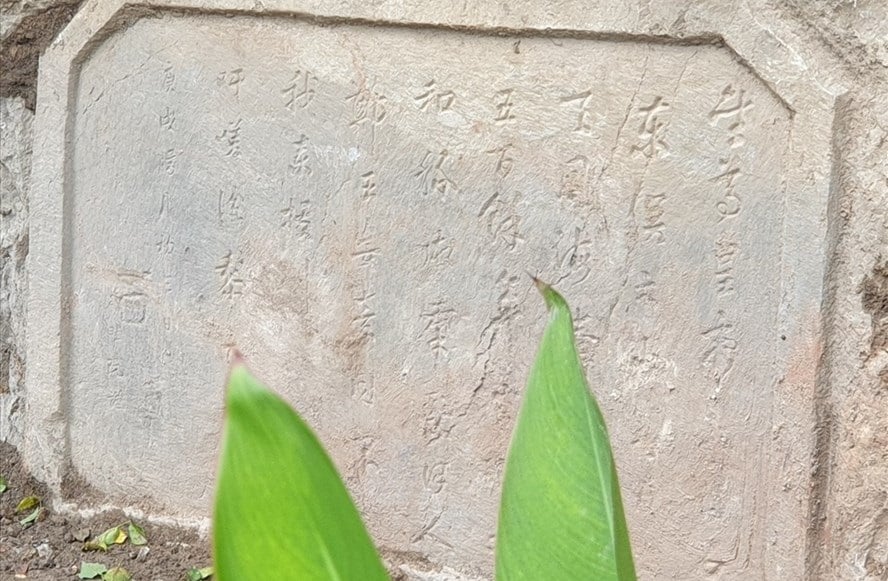
Nguyen Can’s poem on Bai Tho Mountain
Nguyen Can’s poem was carved into the cliff of Bai Tho Mountain in 1910. The Sino-Vietnamese transcription of the poem is as follows: “Thánh Tông hoàng đế đề thi thạch/ Đông minh chi sơn cao bách xích/ Thiên phong, hải đảo nhật dạ kích/ Ngũ bách niên dư, tự do xích/ Họa xưng ngự bút ế hà nhân?/ Trịnh Vương vọng ý đồng bất dân/ Ngã lai bạt kiếm, nộ thả sân/ Hu ta hậu Lê chi quân thần”. (Translated meaning: Emperor Thanh Tong inscribed a poem on the stone/ The mountain in the East Sea is a hundred feet high/ Heavenly winds and sea waves strike day and night/ Yet after more than 500 years, the characters remain, not lost/ Imitating and daring to claim it as royal calligraphy; hmph, who is this?/ The Trinh Lord’s evil intention was to last forever/ I come, draw my sword in anger and resentment/ Alas for the monarchs and subjects of the Later Le dynasty).
Guide to climbing Bai Tho Mountain
You can find the entrance on Google Maps by simply typing ‘Lối vào Núi Bài Thơ’ (Bai Tho Mountain Entrance). If you arrive by taxi, tell the driver to go to Bai Tho Mountain – they will know and drop you off right at the alley entrance. If you are traveling by motorbike, just follow the Google Maps location. The entrance is located on “Hang Noi” street, right behind “Le Thanh Tong” street. There is plenty of space to park your motorbike on the street. Previously, the entrance to Bai Tho Mountain was very easy to walk past and miss entirely! It is a small doorway between shops. However, there is now a large sign at the entrance prohibiting climbing, so if you see this sign, you have reached the right place.
However, if she thinks you can overcome the obstacles along the way, she will let you pass through the backyard where the climbing path is, and you will need to pay her a small fee. Pay her a few dollars (50,000 VND/person) if you are a foreigner, while for Vietnamese people, it depends. It is a small price to pay, so please do not argue with her. You will pass through some dog kennels in the backyard to reach the stairs where the path to the mountain peak begins. Often, one of the dogs will walk with you for a bit.
This is the hardest part of the climb. Once you have passed the owner’s house, you will climb some stairs and reach a locked metal gate. Previously, you could just climb over the gate and fence to get past. However, it is now completely covered with 2-3 meter high barbed wire and is impassable. Therefore, you will need to actually climb the rocks to the right of the gate for about 3 meters to get over the fence. After that, you need to crawl under a hole that has been cut out of the fence. The hole is large enough for a tall person to crawl through, so as long as you can climb the rocks, you can get through.
The rest of the climb is not too bad as it is mostly stairs, so it is quite easy to follow. However, it is a bit strenuous, so you might need to stop a few times and take a sip of water. You can enjoy the stunning views of Ha Long Bay throughout the walk, so this is a good reason to stop. However, the final part of the hike is difficult as the stairs disappear and you need to climb over large rocks.
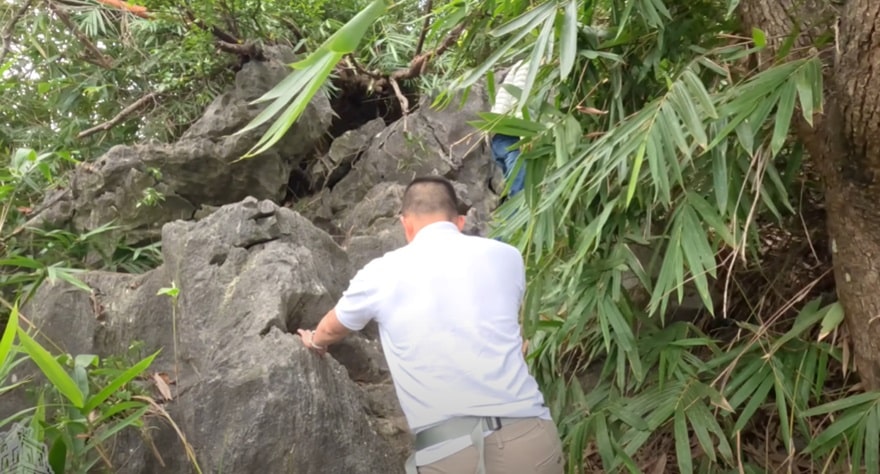
Visitors must climb over rocks to continue
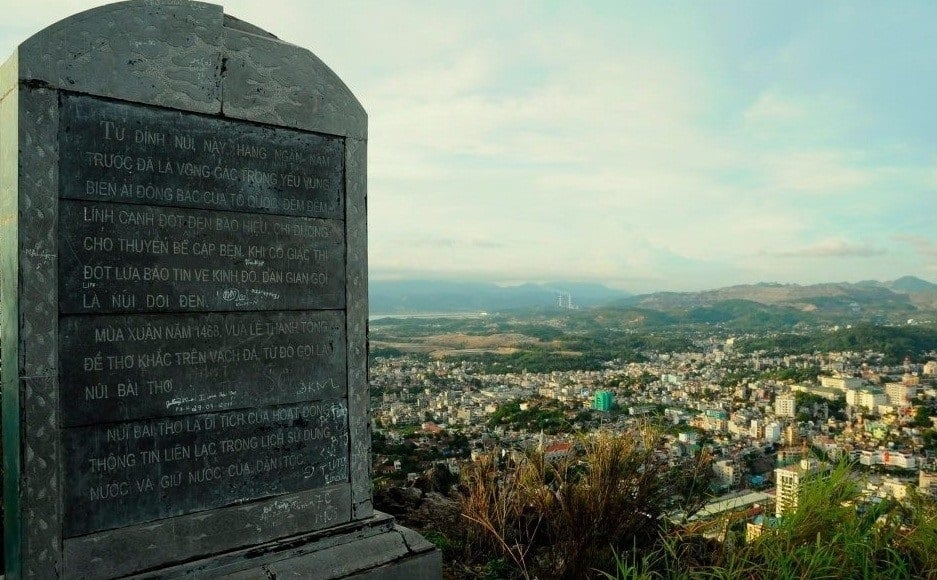
Stone stele on the peak of Bai Tho Mountain
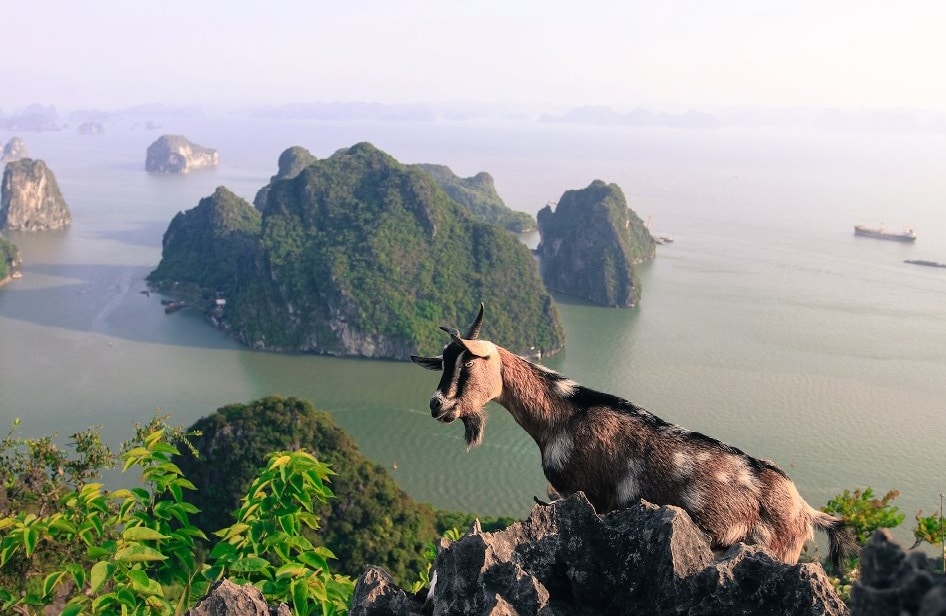
Wild goats surprise visitors on the way to the peak

Panoramic view of Ha Long from the peak of Bai Tho Mountain