The Cat Ba Archipelago and Lan Ha Bay are famous not only for their unspoiled natural beauty, but also as the cradle of the Cai Beo Culture—one of the oldest Neolithic cultures of ancient Vietnam. Here lie the enduring traces of prehistoric inhabitants from thousands of years ago whose lives were deeply tied to the sea. At VDS Travel, we take pride in curating memorable journeys through Lan Ha Bay and Cat Ba where you can immerse yourself in dramatic seascapes while discovering this remarkable cultural heritage. Step back in time with VDS Travel to explore the Cai Beo Culture in the guide below!
Origins of the Cai Beo Culture
The Cai Beo Culture is an ancient prehistoric culture of Vietnam named after the Cai Beo archaeological site on Cat Ba Island, Hai Phong. Dating back 4,000–7,000 years, the site is closely linked to the Ha Long Culture and the maritime traditions of ancient Vietnam. It was first discovered in 1938 by French archaeologist Madeleine Colani and subsequently excavated multiple times by Vietnamese and international research teams.

Portrait of French archaeologist Madeleine Colani, who discovered and named the Cai Beo Culture
Archaeological evidence indicates genetic and cultural links between the Cai Beo people and the Hoa Binh–Bac Son cultural groups. Pebble tools crafted by the Cai Beo inhabitants share manufacturing techniques and forms with Hoa Binh–Bac Son assemblages, dwelling layouts show comparable structural organization, and biological analyses point to shared ancestry and ecological continuity.
At the same time, archaeological findings reveal clear innovation and adaptation beyond earlier Hoa Binh–Bac Son traditions. Pebble implements from Cai Beo became smaller and more specialized for marine fishing and shellfish harvesting, dwelling structures adapted to coastal tides and winds, and population studies reflect coastal adaptation alongside interaction with neighboring cultural groups.
Read more: Cai Beo Fishing Village in Lan Ha Bay
Location and Specimens Recovered at the Cai Beo Archaeological Site
The Cai Beo site (20°43′8″ N, 107°3′2″ E), situated nearly 4 meters above sea level on Cat Ba Island—the largest island in the Ha Long Bay area within Hai Phong City (Figure 1)—was first reported and test-excavated by French archaeologist Madeleine Colani in 1938. Later, in 1972, 1973, 1981, 1986, and 2006, Vietnamese archaeologists conducted five excavations covering a total area of 449 m², within an estimated site distribution of roughly 18,000 square meters.
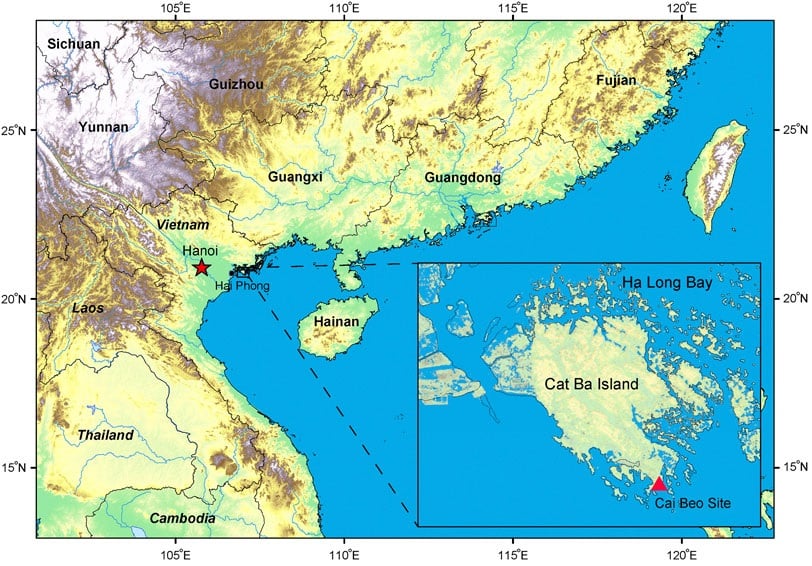
FIGURE 1. Location of the Cai Beo area, indicated by a red triangle.
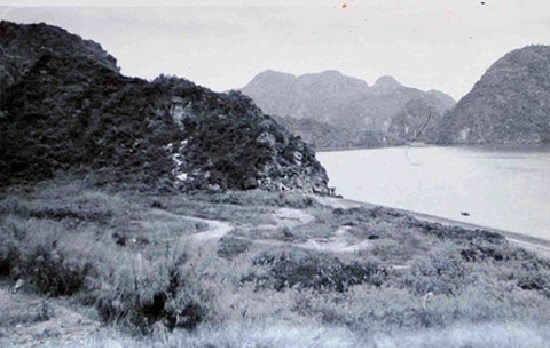
Figure 1: The Cai Beo archaeological site area
Hundreds of kilograms of large fish bones and marine mollusk shells recovered during excavations at Cai Beo point to a strongly maritime-oriented subsistence economy. Alongside marine remains, excavators also documented terrestrial fauna—including masked palm civets, brown bears, deer, sambar, wild boar, elephants, and monkeys—reflecting a lush ancient forest environment surrounding the coast at that time.
The Cai Beo stratigraphy contains three cultural layers, initially designated as Early Neolithic, Late Neolithic, and Ha Long Culture during the 1973 excavation. Since the 1981 campaign, however, researchers have generally grouped the sequence into a local “Cai Beo phase” (subdivided into Cai Beo 1 and Cai Beo 2) followed by a later “Ha Long phase” (Figure 2). The two lower Cai Beo layers (Phases 1 and 2) span roughly 7,000 to 5,000 years ago, supported by radiocarbon dating (ZK-328-0, detailed below) and comparisons with five related Cai Beo cultural sites around Ha Long Bay.
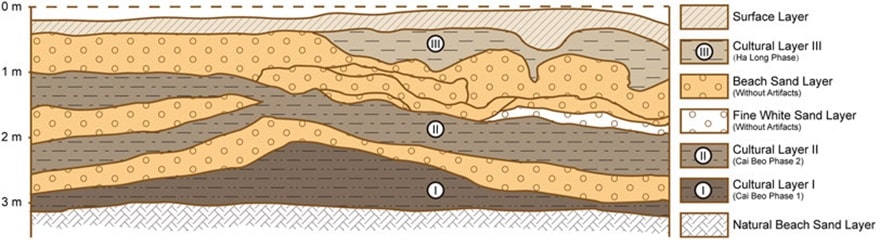
FIGURE 2. Trench profile of the south wall of H3, Cai Beo site (1973 excavation).
The lowest stratum (Cai Beo Phase 1; see Figure 2: Cultural Layer I) represents the earliest human occupation at the site. Lying at a depth of 2.4–3.2 m, it consists of sandy deposits mixed with rounded pebbles, shell fragments, marine fish bones, oysters, and other marine mollusks. Excavators uncovered abundant stone artifacts, including numerous grinding stones (Figure 3A) showing clear wear from use, alongside flake choppers made by direct percussion, discoidal tools, pointed implements, quarter-pebble tools, hammerstones, and anvils. Edge-ground stone tools in this layer were polished only along the cutting blade, while pottery sherds are sparse, small, thick-walled, and coarse. The middle cultural layer (Figure 2: Cultural Layer II / Cai Beo Phase 2), at a depth of 1.2–2.4 m, marks the appearance of polished stone axes.
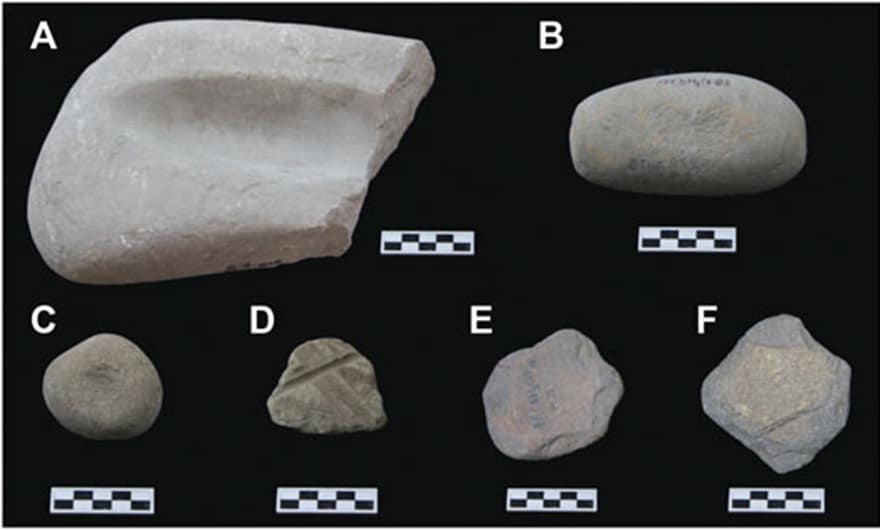
FIGURE 3. Typical stone tools collected at the Cai Beo site (Scale: 5 cm). (A) Grinding stone, (B) Grinder/pestle, (C) Pitted stone, (D) Stone artifact with Ha Long grooves, (E) Scraper, (F) Pointed tool.
A radiocarbon date (ZK-328-0) of 6,893–6,391 BP (5,810 ± 115 BP uncalibrated, half-life: 5,730 years; or 5,645 ± 115 BP uncalibrated, half-life: 5,570 years) was obtained from fish bone (Institute of Archaeology Laboratory, 1977) excavated from the Cai Beo cultural horizon. Additional chronological indicators include burial customs, craniometric traits, pottery, and lithic assemblages: for instance, pebble tools comparable to Haolizhuo types appear in Cai Beo layers and across southern Chinese coastal sites in Fujian, Guangdong, and Guangxi dating to 7,000–5,000 years ago, while a flexed burial identified by Nguyen Lan Cuong shows Australo-Papuan affinities characteristic of pre-Neolithic hunter-gatherers across southern China and Southeast Asia.
During the 1981 excavation, the lowest cultural layer was documented beneath—and therefore predating—a sterile marine transgression gravel layer (roughly 20 cm thick) occurring at a depth of 2.4 meters below the trench surface. Consequently, initial occupation at Cai Beo predates the mid-Holocene marine transgression in the Ha Long Bay area around 6,000 to 5,500 years ago, reinforcing an age estimate prior to roughly 6,000–5,500 cal. BP for Cai Beo Phase 1.
The upper horizon at Cai Beo represents the Ha Long Culture phase (Figure 2: Cultural Layer III), generally dated from around 4,500 years ago and occurring here at depths of 0.2–1.2 m. Fully polished stone forms appear, including finely ground shouldered axes and quadrangular adzes, alongside chisels, hammers, grooved sandstone sharpeners (“Ha Long marks”), and stone rings. Compared with earlier Cai Beo strata, pottery in the Ha Long horizon becomes far more abundant and varied in form and decoration, incorporating wheel-throwing techniques.
More than 38 sites around Ha Long Bay have been attributed to the Ha Long Culture based on artifact typology and chronology, with radiocarbon dates consistently placing them after the older Cai Beo horizon—clustering between roughly 4,500 and 3,500 BP (for example, 4,727–4,517 BP at Ba Vung and 4,381–3,926 BP at Hon Hai Co Tien). At Cai Beo, ceramics and artifacts from the upper layer align closely with early Ha Long Culture assemblages.
Researchers submitted 12 samples from Cai Beo—including a human cranium, a deer antler, a deer tooth, five mammalian bones, and four marine fish bones—to Beta Analytic for AMS radiocarbon dating. Unfortunately, reliable collagen could not be isolated and purified from any of the specimens, leaving the bone material undated via AMS; nevertheless, the site’s baseline chronology and two primary cultural phases remain firmly established through the converging lines of stratigraphic and artifactual evidence outlined above.
Hai Phong Museum: Where Cai Beo Culture Artifacts Are Displayed
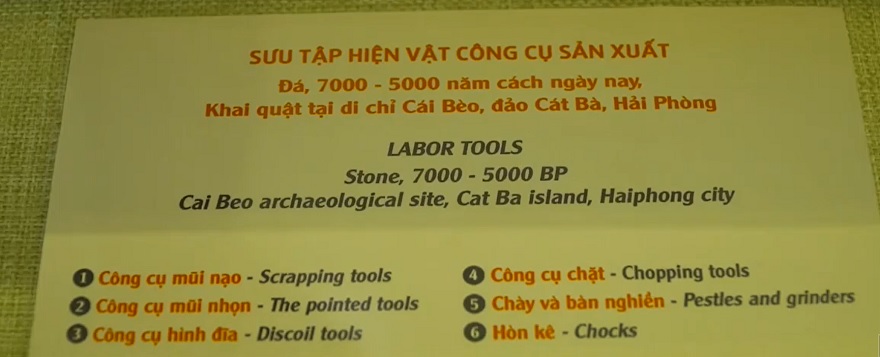
The lower stratum is Cai Beo 1 of the pre-Ha Long culture, dating back 7,000–5,000 years
Dedicated to the history and heritage of Hai Phong City, the Hai Phong Museum exhibits numerous artifacts excavated from the Cai Beo site, organized across three periods: Period I (7,500–6,000 BP), Period II (6,000–5,000 BP), and Period III (5,000–4,000 BP). Visitors can examine stone axes, grooved grinding stones, net sinkers, porous earthenware, thin hard-fired ceramics, and stone bracelets reflecting the Cai Beo people’s growing craftsmanship and maritime livelihood. The museum is open daily from 8:00 AM to 11:30 AM and 1:30 PM to 4:30 PM (closed Mondays and Sundays); admission is 20,000 VND for adults and 10,000 VND for students and children. Address: No. 66 Dien Bien Phu Street, Hong Bang District, Hai Phong.