Tracing back through time to the final years of the 18th century—when the fervent fires of the French Revolution were consuming the long-standing absolute monarchy in Europe—the Lion Monument of Lucerne (also known by its German name *Löwendenkmal* and Chinese characters 琉森獅子紀念碑) was conceived out of one of humanity’s most tragic and blood-soaked historical chapters. Amidst a turbulent Europe, when the guillotine of the revolution sealed the fate of the Bourbon Dynasty, France was plunged into the smoke and flames of royal collapse. On August 10, 1792, a historical tragedy occurred at the Tuileries Palace in Paris, where the Swiss Guard (*Schweizergarde*)—mercenary soldiers renowned across the continent for their iron discipline, strict protocols, and absolute loyalty—stood their ground to the death to defend King Louis XVI and the royal family against the ferocious assault of insurgent crowds. It was a fateful morning when honor and military oaths were placed above life itself, resulting in a fierce massacre that claimed the lives of approximately 600 to 700 Swiss soldiers who fell right upon the palace steps, staining a corner of the City of Light with blood and marking a sorrowful yet proud milestone of chivalric spirit.
Yet the shockwaves of the Tuileries tragedy were not buried in the historical footnotes of distant France; instead, they echoed deeply back to their Swiss homeland, where mothers, wives, and comrades waited in vain for elite sons who would never return. It took nearly three decades, as the smoke of war faded into the past and Europe regained a fragile tranquility under the Restoration, that former officer Karl Pfyffer von Altishofen—who miraculously survived due to his absence on that fateful mission—conceived and initiated a grand project to commemorate the heroic sacrifice of his compatriots. This vision was not merely a simple memorial, but a haunting stone monument, a choked tribute dedicated to souls who perished for their country in a foreign land. To materialize this epic aspiration, Karl Pfyffer von Altishofen sought out the renowned Danish neoclassicist sculptor Bertel Thorvaldsen, then living and working in Rome, to sketch the original design imbued with the soul of classical art, where the image of a valiant, suffering lion was projected as the ultimate symbol of supreme loyalty.
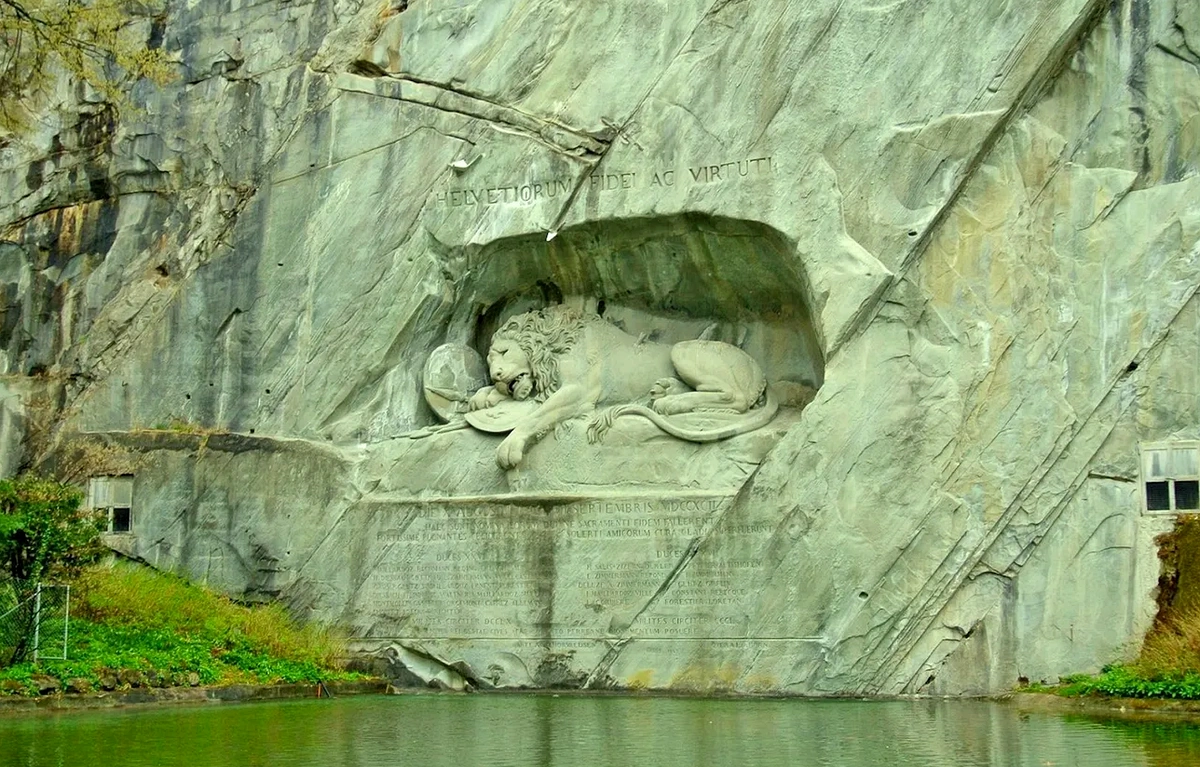
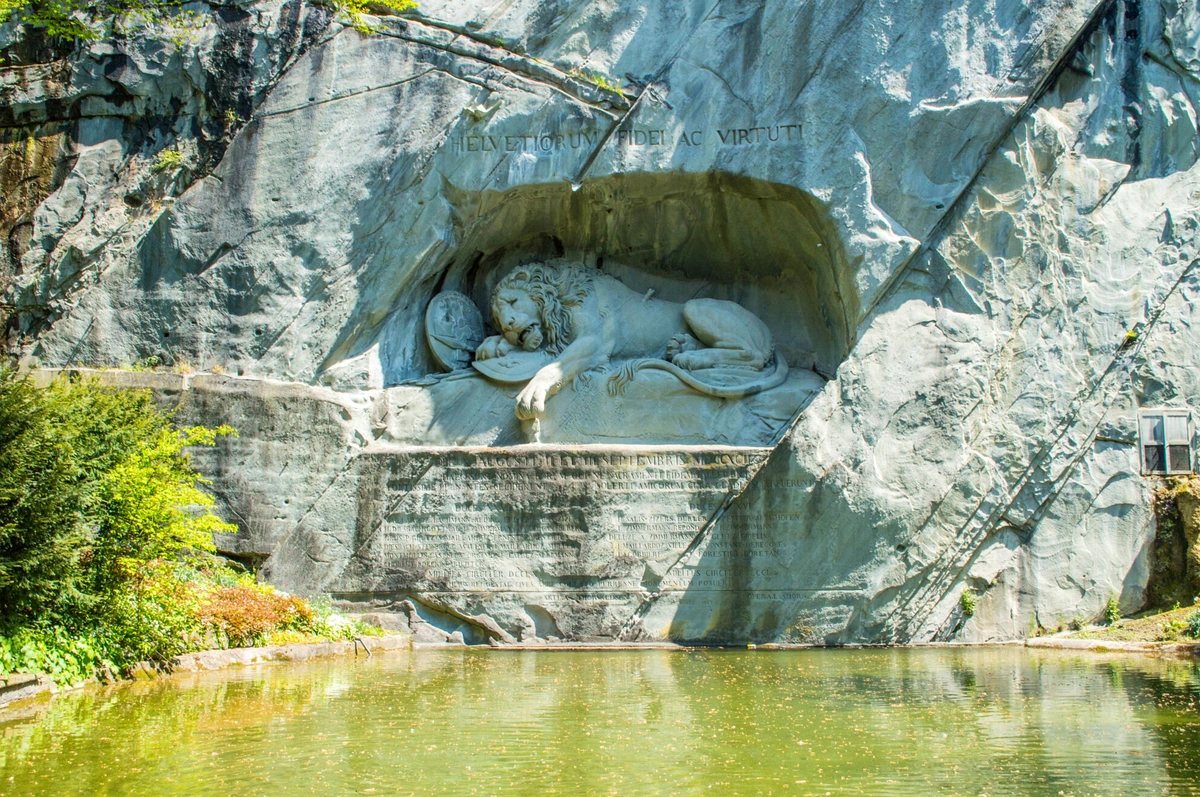
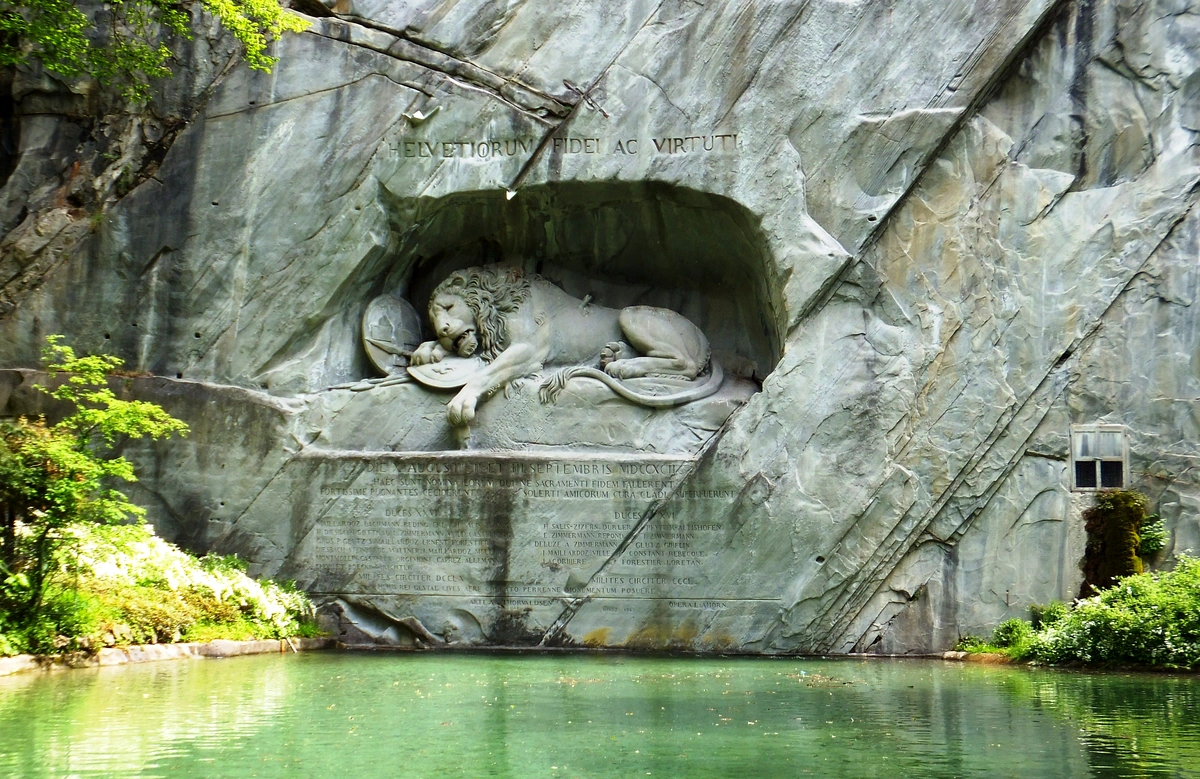
The journey transforming cold paper sketches into an eternal masterpiece amidst Lucerne’s natural scenery was an artistic feat spanning from March 1819 to August 1821. Under the direction of sculptor Thorvaldsen from Rome, talented artisan Lucas Ahorn directly wielded hammer and chisel, painstakingly carving deep into the natural sandstone cliff of an old Lucerne quarry to release the form of the beast struggling in agony. This outdoor sculpture was not carved after the grandiose templates typically seen in victory monuments, but instead chose to portray a robust dying lion, pierced in the back by an enemy’s fatal spear, resting one paw upon a shield carved with the fleur-de-lis of the French royal family, while the other paw protects a cluster of lilies—symbols of purity and devotion to the final breath. Its half-closed eyes, choked roars trapped within its chest, and every convulsing muscle of the wounded beast touched the deepest emotional layers of anyone standing before that moss-grown cliff.
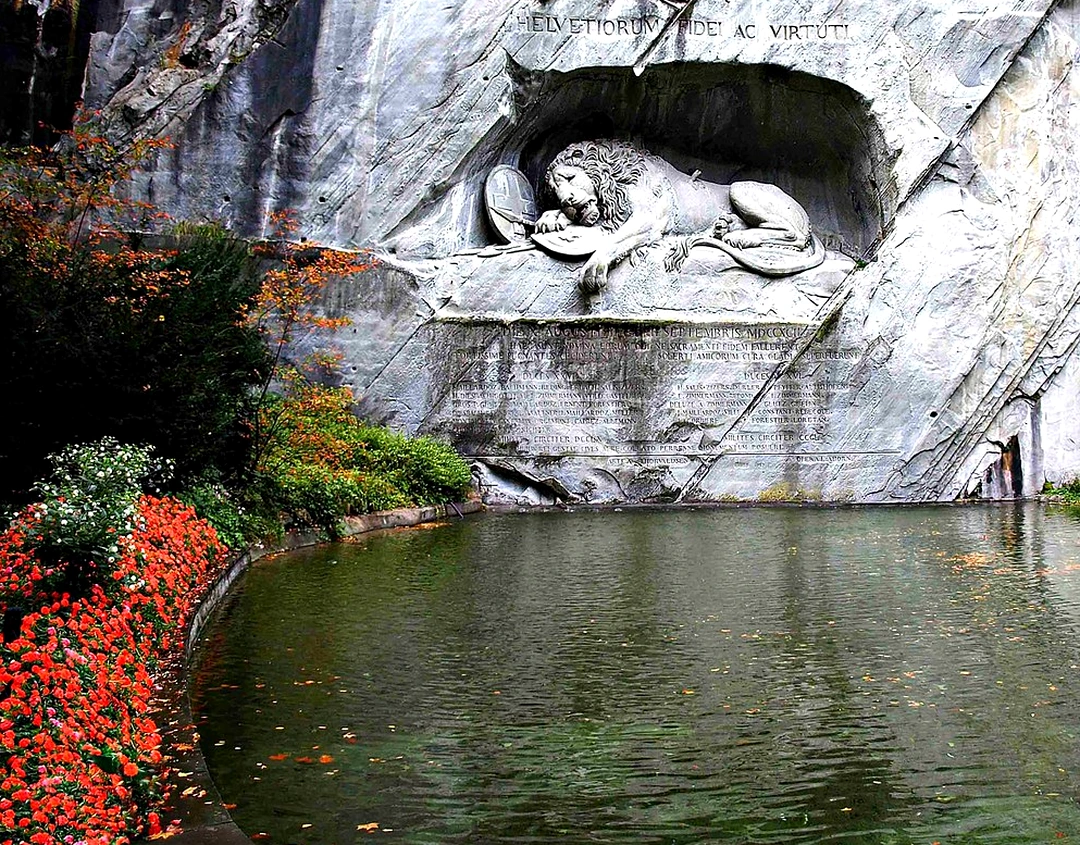
Directly above the sculpture, the classic Latin inscription is solemnly engraved: *HELVETIORUM FIDEI AC VIRTUTI*, meaning “To the loyalty and bravery of the Swiss,” serving as an unyielding affirmation transcending all temporal boundaries regarding the core qualities of a nation. Right beneath the statue, peaceful stone slabs are meticulously carved with the names of the officers who fell in battle on August 10, 1792, transforming the natural cliff into an invisible yet immensely sacred cemetery. Through the vicissitudes of the 19th century—as surrounding landscapes shifted and the monument’s historical value gained proper recognition—the Swiss Federal Council and the Lucerne city government officially took over and preserved the heritage site in 1882 as an inviolable national legacy. Rising from the pain of revolutionary turmoil, the Lucerne Lion Monument has ascended to become an immortal cultural symbol where history, art, and humanism blend completely within every grain of somber sandstone nestled in the heart of the watchmaking nation.
Regarding terrain and landscape, the Lucerne Lion Monument is situated in the Denkmal-Garten garden in the northeastern sector of Lucerne, embodying a unique spatial structure combining natural geology and 19th-century memorial architecture. It rests against a natural sandstone cliff, an ancient geological formation shaped over tens of years by glacial erosion, forming a towering vertical wall that acts as a gigantic screen shielding the entire artwork. In traditional planning terminology, this terrain establishes a secure rear guardian formation, carrying not only architectural-technical significance in protecting the sculptural mass from weather erosion, but also serving as a windbreaker blocking bitter northern gales blowing down from the majestic Alps. Directly at the cliff’s base, the monument’s facade faces a small, tranquil artificial pond, acting as a flawless water-gathering focal point where crystal-clear, mirror-like waters reflect the entire image of the dying lion, multiplying the spatial philosophy and profound stillness manifold.
The choice of a location hidden from urban clamor, nestled beneath shady tree canopies and tucked inside a natural rocky alcove, generated a remarkably distinct microclimate and landscape psychology for the entire Denkmal-Garten area. As visitors cross the entrance gate, the noise of traffic and the frantic pace of modern urban life appear swallowed by dense vegetation layers and somber sandstone blocks. This space was crafted to serve deep contemplation and nostalgic reflection, where sunlight does not shine directly but filters through foliage, casting dim, hazy light trails embracing the majestic yet agonizing body of the wounded beast. This natural arrangement combined with artistic intent transformed an inert block of stone into an outdoor memorial sanctuary, where anyone stepping before it naturally lowers their voice and slows their footsteps to immerse in the solemn, melancholic, and deeply meditative atmosphere of Swiss history.
From the perspective of carving technique and topographic excavation processes, crafting the Lucerne Lion Monument stands as a marvel of human labor and ingenuity when confronting the harsh challenges of natural materials. The monolithic sandstone wall is not a soft, malleable medium, but rather an ancient sedimentary strata whose hardness and elasticity shift across geological layers, demanding meticulous precision with every chisel stroke from Danish master sculptor Bertel Thorvaldsen and direct artisan Lukas Ahorn. Construction took place directly on the exposed cliff face in the early 1820s, requiring artisans to erect complex scaffolding clinging to the vertical glacial cliff to carve straight into the stone’s heart. Avoiding additive techniques or assembling separate stone blocks, carving directly from a single monolithic entity elevated technical requirements to the absolute; any minor misstep with chisel or sledgehammer could permanently ruin the entire artwork, turning collective effort into vanity. Under Lukas Ahorn’s talented hands, rigid sandstone softened before the blade; every tense, pain-wracked muscle fiber, the wind-ruffled mane, the shield bearing the French royal fleur-de-lis, and the Swiss national coat-of-arms shield were carved sharply and durably through time, defying weather harshness and centuries of erosion.
Retracing time and space to approach the masterpiece in the city beside Lake Lucerne, any traveler cannot fail to marvel at the monumental scale and meticulous craftsmanship of the Lucerne Lion Monument, also known to locals by its Chinese name 琉森狮子纪念碑. Impressively present alongside a green-canopied natural cliff reflecting in the crystal waters of a peaceful small lake, this work is not simply an outdoor sculpture, but a pinnacle testament combining human talent with unique local geology. Unlike ordinary statues formed through relief molding or carving separate stones for assembly, the monument holds unique historical and artistic value thanks to carving directly into native soft Tertiary sandstone, known professionally as local Molasse stone. This stone possesses a characteristic warm golden tone alongside moderate softness, facilitating delicate, precise artistic detailing while presenting major durability challenges against weathering.
Viewing the spatial structure overall, the artwork appears as a sacred alcove excavated deep into the mountain wall, strongly reminiscent of ancient Roman niches characterized by grandeur and solemnity. This artificial alcove was meticulously shaped with an impressive depth of approximately three meters and a height reaching up to six meters, forming a profound framing backdrop that elevates the tragic grandeur of the central subject. Nestled horizontally within that alcove is the sculptural mass of a lion in its final dying moments, rendered as a large relief of monumental proportions. The length of the majestic yet agonizing body spans roughly ten meters, while the total height of the relief reaches approximately six meters, commanding an overwhelming, highly emotional visual field for anyone gazing upward from the courtyard below.
Delving deeper into manufacturing art and plastic vocabulary, observers admire the supreme expressive talent of Danish sculptor Bertel Thorvaldsen and executing stone mason Lukas Ahorn. The artwork captures the agonizing yet noble expiration of the king of beasts. The lion’s shoulder is deeply pierced by a broken French military spear—a historical detail symbolizing the heroic sacrifice of the Swiss Guard during the bloody bloodshed at the Tuileries Palace during the French Revolution. Despite fatal wounds and impending death, the lion’s two forepaws reach upward with final resolute energy to protect two sacred items positioned below: a shield engraved with the Bourbon royal fleur-de-lis and a shield bearing the Swiss Confederation cross. Each muscle fiber contracting in agony, the drooping head, and half-closed eyes were rendered with heart-wrenching realism, making the inert sandstone block appear to breathe, writhe, and bear the heavy historical sorrow of a nation.
The synthesis of monumental scale, high-tier relief art, and natural spatial exploitation turned the Lucerne Lion Monument into one of European cultural heritage’s brightest jewels. Every carved line across the Molasse stone under past master sculptors not only reconstructs a tragic historical event but instills an indomitable spirit, absolute loyalty, and profound humanistic values. This monument stands as an eternal reminder of fallen soldiers, cementing its status as an outdoor architectural masterpiece enduring across time, drawing millions of travelers to contemplate, reflect, and surrender to Lucerne’s nostalgic realm.
When night falls over the lakeside city, as daytime tourist crowds recede to yield to thin Alpine valley mists, the surroundings of the Lucerne Lion Monument (琉森狮子纪念碑) enter an entirely different dimension. Unlike night tourism spots bursting with neon lights, bar music, or street food aromas, the public space enclosing this stone sculpture is governed by strict regulations. Silence here is not a void of urban neglect, but a consciously maintained solemnity protecting historical value and the sacred realm of a humanity-scale war memorial. Enclosed by ancient trees and pristine sandstone cliffs, nighttime life slows into an underground contemplation current where the tragic 18th-century past of the Swiss Guard breathes alongside the present.
To recreate that tragic atmosphere without harming natural landscapes or the delicate sculpture, local authorities designed a sophisticated lighting system. High-tech LED fixtures featuring warm-toned spectrums are discreetly installed, hidden beneath the steep cliff base. From this concealed vantage point, light beams upward, highlighting deep eye sockets filled with sorrow, rigid tensing muscles, and the lion’s fatal bleeding wound against dark sandstone. This theatrical staging elevates Thorvaldsen and Ahorn’s artistry while provoking poignant emotional resonance for nocturnal visitors. Warm golden light embraces the majestic yet collapsing body, turning cold stone into a living historical stage where time freezes at 1792’s tragic climax.
Due to strict nocturnal public space regulations, the monument’s surroundings completely forbid noisy performances, bustling commercial services, or lively eateries. Instead, this quiet space is reserved for cultural and memorial events. Visitors occasionally encounter historical commemorations organized by the Swiss Historical Society, where flickering candles line the small lake beneath the monument, accompanied by low bell chimes from neighboring ancient churches. On special occasions, cultural guides specializing in European warfare and Enlightenment diplomacy lead small tour groups through solemn atmospheres, whispering tales of Swiss mercenaries’ absolute loyalty defending French royalty. Devoid of loud laughter or modern commotion, nocturnal light art appreciation here demands absolute mental stillness to listen to historical echoes whispering through mossy stones and the tearful gaze of a forest king asleep in legend.
Departing Lucerne’s tranquil, nostalgic Lion Monument—where old pine shadows veil marble testicles of chivalric spirit—central Switzerland’s cultural heritage opens sensory worlds of alpine gastronomy and heirloom depth. If the monument is a stone symbol engraving sorrow and chivalry, local cuisine is a flavorful symphony capturing Lucerne’s essence across centuries. Amidst biting Alpine winds, seeking antique restaurants tucked along cobblestone lanes offers living cultural experiences where signature dishes encapsulate intangible heritage passed down generations.
Occupying a premier position in Lucerne’s culinary heritage is the Lucerne Meat Pastry, locally known as Luzerner Chügelipastei. This masterpiece of classical European pastry features a dome-shaped thousand-layer crust baked to golden crispness like honey. Upon slicing the crispy crust, diners encounter steaming vapors carrying rich aromas of butter and mountain herbs. The filling blends finely minced local veal, succulent fresh mushrooms, and sweet pastry puffs, all simmered within smooth white-wine cream sauce. This blend yields complex flavors: rich and savory, balanced with refined sweet-sour notes capable of conquering demanding palates. This dish has long symbolized hospitality during traditional festivals among Lucerne’s citizens.
Alongside flaky pastry elegance, Lucerne’s winter culinary landscape requires the golden hue and pungent aroma of traditional cheese fondue. Crafted from a flawless blend of two renowned aged cheeses, Gruyère and Vacherin Fribourgeois, this fondue results from meticulous simmering over low heat, combined with premium white wine and regional Kirsch cherry brandy. Dipping crispy bread cubes into rich, herb-scented melted cheese spreads warming energy throughout the body, banishing Swiss winter cold. This transcends mere dining into a communal ritual where families and friends gather around traditional copper pots, sharing life’s stories.
Steps away from the Lucerne Lion Monument, nestled peacefully amid living culinary legend lies Old Swiss House, preserving Swiss hospitality since 1859. Crossing antique oak doors, diners step back into the 19th century amidst exquisite frescoes, heirloom antiques, and candlelight flickering on rustic wooden tables. Fine dining elevates into visual and olfactory art with Wiener Schnitzel prepared tableside. Under veteran chefs’ skilled hands, tender beef cutlets are coated in light breadcrumbs and fried in pure butter until golden, releasing captivating aromas. Savoring this amidst Old Swiss House’s museum-like ambiance, blending with historical echoes from the nearby Lion Monument, concludes Lucerne explorations with profound multisensory depth.
Concluding contemplation of Lucerne’s cliffside sculptural masterpiece, equipping a precise field guide optimizes exploration in this picturesque lakeside city. Preserved as invaluable Swiss humanistic heritage, the Lucerne Lion Monument welcomes public access completely free 24/7 across all weekdays. Visitors need no online pre-booking or complex ticketing queues, delivering absolute itinerary flexibility for self-paced scheduling without tight schedules. Regarding ideal daily timing to absorb the monument’s tragic grandeur, veteran travelers and photographers recommend early morning slots from 8:00 AM to 10:00 AM when dawn light strikes the sandstone alcove, offering optimal lighting highlighting muscle fibers and sorrowful faces. Another special time is post-7:00 PM when artistic lighting activates, draping golden light and transforming surroundings into a solemn nocturnal outdoor theater. From SBB Luzern central station, visitors stroll through medieval old-town streets northward for 15-20 minutes, or take public buses 1, 19, and 22 to Löwenplatz station.
Adhering strictly to spatial etiquette at this sacred memorial reflects utmost cultural respect when visiting Central Europe. Due to sandstone geology and lake humidity, surrounding surfaces remain damp and slippery, requiring grip-soled walking shoes for safety. Being a war memorial honoring hundreds of fallen Swiss guards, visitors must maintain silence, avoid climbing sandstone cliffs, and respect protective barriers. Such quiet respect preserves historical solemnity.
Practical safety and shopping tips round out the journey. Löwenplatz square bustles with global tourists, requiring pickpocket vigilance. When purchasing Swiss souvenirs like artisanal chocolates or pocket knives, visiting reputable supermarkets like Coop or Migros ensures authentic quality and standard pricing. For seamless exploration across Switzerland, consult all-inclusive tour packages designed by leading cultural experts.