Geological History of Ha Long Bay
Ha Long Bay has a long geological history spanning shifting paleoenvironments starting nearly 570 million years ago. Between the Ordovician and Silurian periods (500 to 410 million years ago), the area lay beneath deep seas, followed by shallow marine conditions between the Carboniferous and Permian periods (340 to 250 million years ago). By the late Paleogene and early Neogene (26 to 20 million years ago), the area formed part of a broad coastal plain, before experiencing repeated marine submergence during the Quaternary over the past 2 million years and taking its modern bay shape roughly 7,000 to 8,000 years ago as seas rose during Holocene sedimentation beginning around 17,000–18,000 years ago.

Ha Long Bay’s geological evolution involves three major mountain-building phases: the Caledonide orogeny at the end of the Silurian (around 410 million years ago), Indosinide tectonic structuring in the late Triassic (around 200 million years ago), and the Alpide phase in the late Paleogene (around 30 million years ago) that shaped horst and graben structures underlying the future bay. Two paleoenvironments stand out in the region: during the Carboniferous (340 to 285 million years ago), warm climates and shallow seas deposited thick carbonate layers that subsided over hundreds of millions of years to reach roughly 1,200 meters—forming the limestone base for karst scenery—whereas during the Triassic (240 to 195 million years ago), warm, humid conditions across Ha Long supported lush fern forests that became the basis for regional coal seams.
Origins of the Name “Ha Long Bay”
“Ha Long” means “Descending Dragon.” Before the nineteenth century, the name Ha Long Bay did not appear in classical Vietnamese records, which referred to the region under names such as Giao Chau, Luc Thuy, An Bang, An Quang, Hai Dong, Hoa Phong, and Nghieu Phong. By the late nineteenth century, the name Ha Long Bay appeared on French hydrographic charts of the Gulf of Tonkin and in French- and Vietnamese-language press—including a report in *Tin Tuc Hai Phong* (“Rồng xuất hiện trên vịnh Hạ Long”) noting an 1898 encounter by Sub-Lieutenant Lagresille, Captain of the *Avalanche*, and crew with giant sea serpents that European observers likened to Asian dragons, helping popularize the name Ha Long Bay (as noted in *Van hoa nghe thuat Quang Ninh, tu mot goc nhin*, Quang Ninh, 2002).
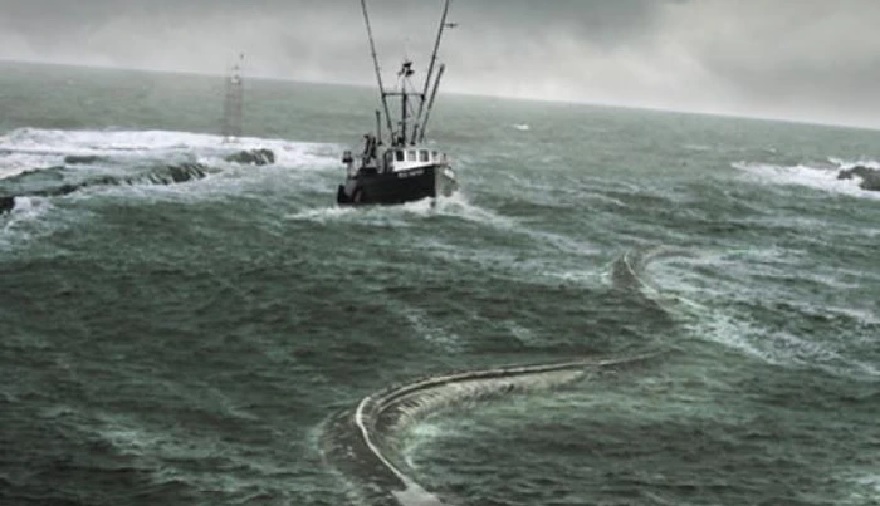
Historical account of giant sea creatures in the region
Legend of the Descending Dragons
In Vietnamese, “Ha Long” means “Dragon descending.” According to tradition passed down across generations, early in the nation’s founding era invaders attacked by sea, prompting the Jade Emperor to send a Mother Dragon with young dragons to aid the people: as enemy vessels pressed toward shore, the dragons breathed fire to burn ships and spat pearls and jade that formed a stone barrier shattering the invading fleet.

AI-generated depiction of dragons descending over Ha Long
After repelling the invaders, the dragons looked out over peaceful land, lush greenery, and hardworking people, and the Mother Dragon and young dragons chose to remain to guard Dai Viet—with the place where the Mother Dragon landed known as Ha Long Bay and where the young dragons settled known as Bai Tu Long Bay.
Associated with the Hung King era, this descending-dragon tale reflects Vietnamese patriotism, determination against invaders, and faith in protective spirits—inspiring writers, artists, and researchers while turning Ha Long Bay into a lasting cultural emblem of Vietnam.
Legends of Ha Long Bay’s Caves
Exploring Ha Long Bay brings visitors past dramatic caves, many accompanied by their own local legends. Below are stories behind well-known caves on Ha Long Bay.
Legend of Dau Go Cave
Dau Go Cave (“Wooden Stake Cave”) is among the largest and most striking caves on Ha Long Bay. According to legend, an old man once gave a skilled local boatbuilder a large piece of timber to carve into a boat within three days—saying he could keep it if finished on time or return it otherwise; as the wood shifted and warped despite his efforts, the old man reclaimed it on the third day, saying it belonged to the Dragon Spirit and could only be shaped by spirits, leaving timber behind in the cave that gave the site its name.
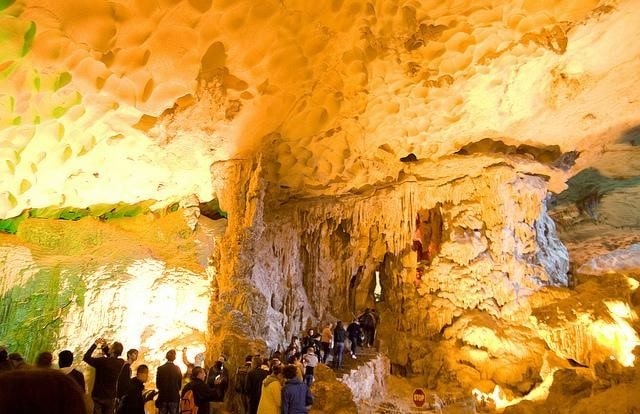
Rooted in wonder at striking natural formations, this legend reflects Vietnamese imagination and draws curious visitors exploring Dau Go Cave.
See also: Dau Go Cave – Cavern of Wonders
Trinh Nu (“Maiden”) Cave and Trong (“Drum”) Cave sit on the Bo Hon island chain alongside Sung Sot Cave, Ho Dong Tien, and Luon Cave, linked to a poignant love story passed down in local lore.
According to the legend, a lovely fishing-village girl loved a young man from a wealthy Van Don family whose relatives opposed their marriage over social standing and arranged another match; when the young man fled with her by boat and they were pursued by his family and pirates, she prayed to the Dragon Spirit and was turned into a stone figure inside the cave—whereupon the heartbroken young man leaped into the sea and was turned into a stone figure facing her from the opposite cave, giving rise to Trinh Nu Cave and Trong Cave.
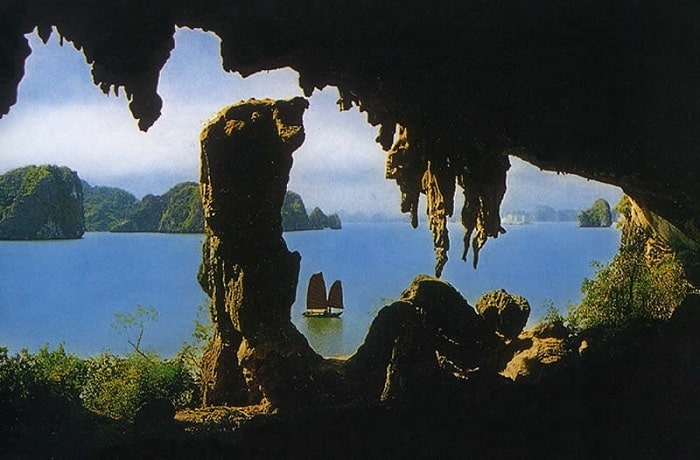
Ha Long Bay’s legends do more than entertain—they showcase Vietnamese storytelling and imagination, giving the bay a distinct cultural identity alongside its natural scenery, history, and spiritual heritage.