During the golden age of the Middle Ages, when the Mediterranean was a fierce chessboard of imperial power struggles, the Maritime Republic of Pisa rose as a formidable naval state whose sailing fleets controlled most of the lucrative maritime trade routes. The historic turning point that paved the way for the birth of this monumental architectural complex began in 1063, when the Pisan fleet launched a daring raid and defeated the Saracen Muslim forces at the seaport of Palermo on the island of Sicily. This glorious victory not only affirmed the maritime hegemony of the independent republic, but also brought back priceless spoils of gold, silver, precious gems, and minerals. Rather than dividing the wealth among the aristocracy, the governing consuls of Pisa made a decision of millennial significance: to dedicate the entire treasure to constructing a sacred center of worship just outside the city walls, transforming the fertile alluvial plain into an eternal symbol of the republic’s pride.
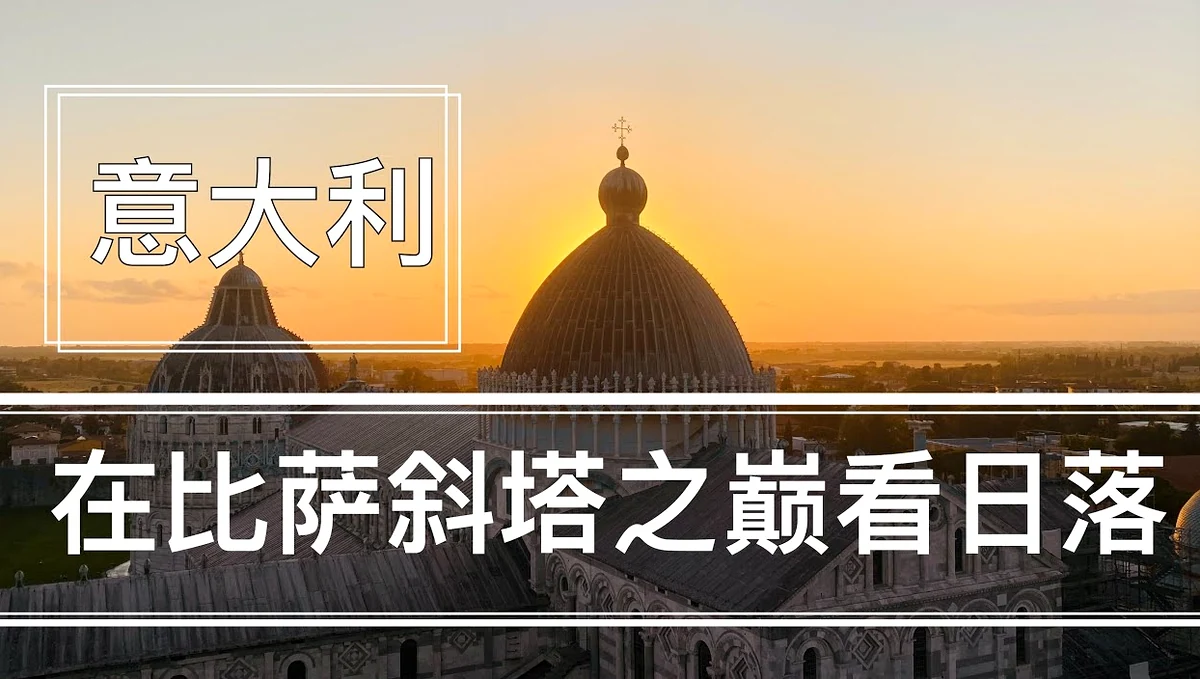
This sacred precinct originally bore the modest name Campo dei Miracoli, or the Field of Miracles. It was not until the early twentieth century, when the renowned Italian romantic poet Gabriele D’Annunzio penned his celebrated novel “Forse che sì forse che no,” published in 1910, that he praised the lush green lawn where gleaming white marble monuments rise up as a “meadow of miracles.” From then on, the name Piazza dei Miracoli entered the collective consciousness of humanity. The first grand monument to lay the foundation for the entire complex was the Cattedrale di Santa Maria Assunta, begun in 1063 under the direction of the brilliant architect Buscheto. With extraordinary talent, combining the classic Romanesque style of Lombardy with Byzantine dome artistry and intricate Islamic motifs acquired through maritime voyages, Buscheto forged a new architectural standard known as Pisan Romanesque. This solemn edifice underwent more than half a century of continuous construction and was solemnly consecrated by Pope Gelasius II himself in 1118.
Carrying forward this civic spirit, in 1153, the master architect Diotisalvi laid the first stone for the Battistero di San Giovanni (Baptistery) directly to the west of the cathedral, establishing a rare and exemplary symmetry. In 1277, the architect Giovanni di Simone began constructing the monumental cemetery Camposanto Monumentale by spreading shiploads of sacred soil brought back from Golgotha after the Crusades, completing the sacred quadrilateral representing the human cycle of birth, aging, sickness, and death. However, the focal point that drew the most dramatic turns of history was the freestanding bell tower, the Torre Pendente, whose foundations were laid on August 9, 1173, under the guidance of two gifted sculptors and architects, Bonanno Pisano and Gherardo di Gherardo, opening a poignant historical chapter spanning nearly two hundred years.
The fate of the tower took a grim turn just a few years into construction, upon the completion of the third tier in 1178. The complex geological composition at the lower reaches of the Arno River and the ancient Serchio River—characterized by weak clay layers, silt, and subterranean sand—could not support the multi-thousand-ton weight of the San Giuliano marble, causing the entire structure to begin sinking and tilting gradually toward the south. Right in the midst of this engineering crisis, political turmoil struck as the Republic of Pisa was repeatedly drawn into prolonged wars with neighboring rivals such as Lucca, Florence, and especially its archenemy, the Republic of Genoa. The climax was a devastating defeat at the naval Battle of Meloria in 1284, which dealt a crippling blow to Pisa’s financial resources and political vitality, stalling the bell tower project for decades.
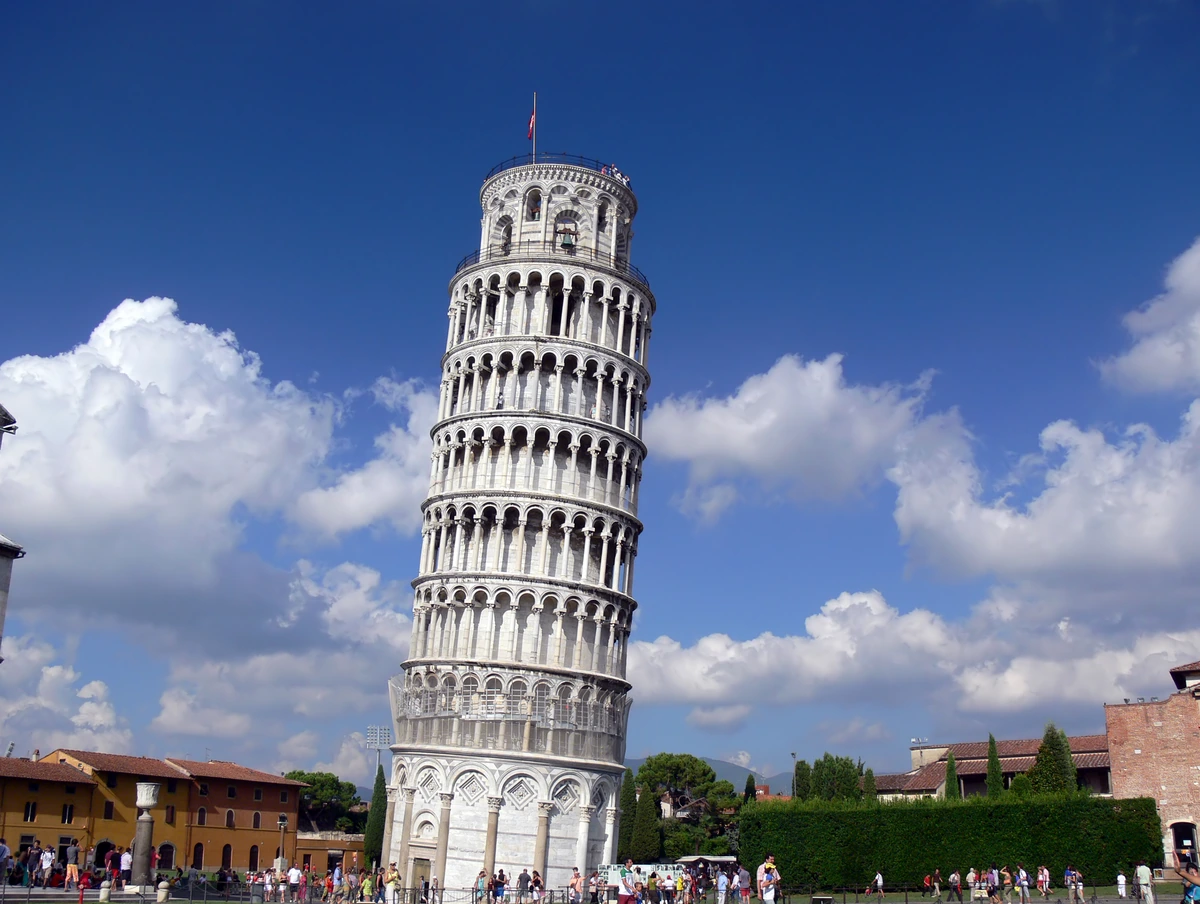
Yet this irony of history proved to be the very grace that saved the tower from catastrophic collapse. The nearly century-long hiatus between military conflicts provided an invaluable window of time for the geological strata beneath the tower to self-compress and achieve the necessary mechanical stability. When Giovanni di Simone resumed construction in 1272, followed by Tommaso di Andrea Pisano who completed the Gothic-style eighth belfry tier around 1372, they sought to counteract the tilt by building the columns on one side taller than on the other. After a full one hundred and ninety-nine years interrupted by the dust of war and the subsidence of the earth, the proud tower, rising fifty-six meters high, was officially completed, standing as an immortal monument to human resilience against the relentless laws of nature.
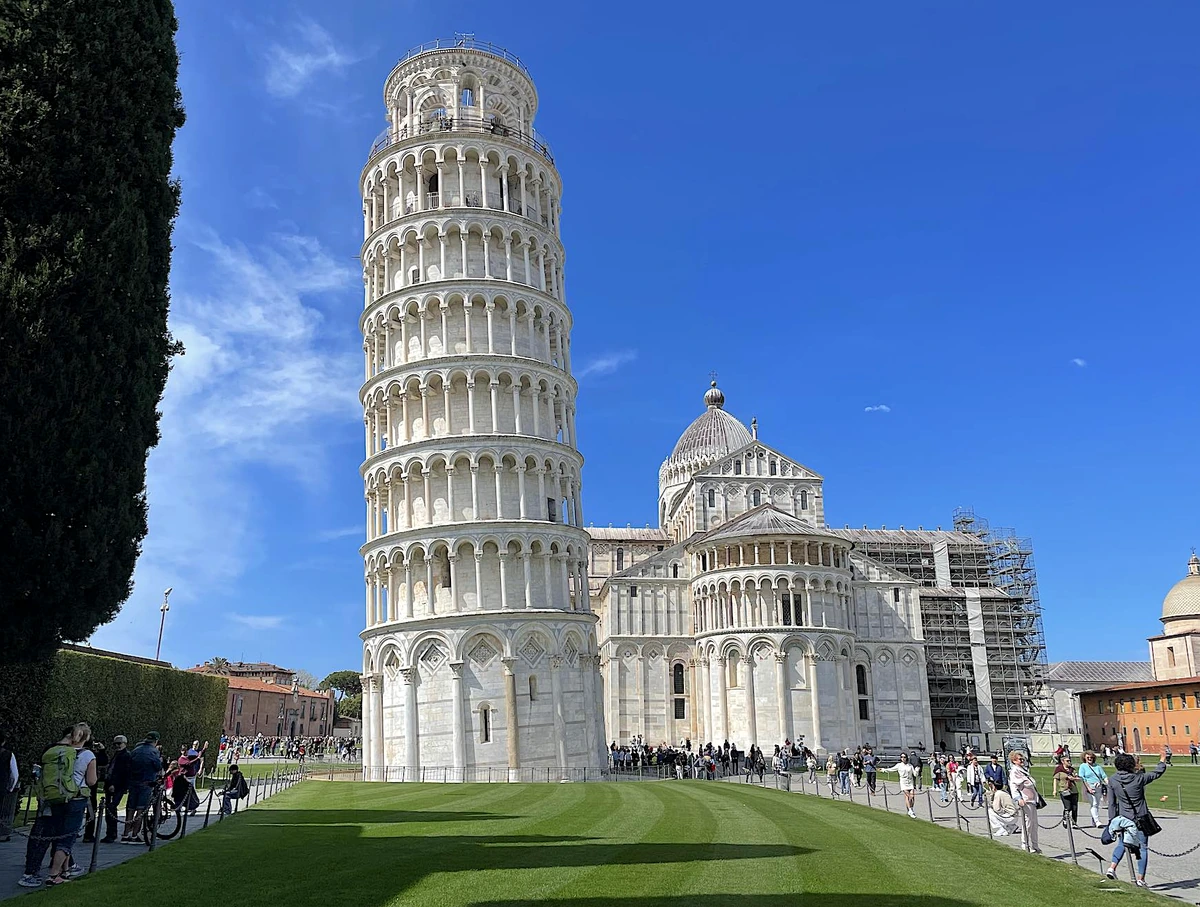
Situated in the secluded and tranquil northwestern corner of Pisa’s medieval city walls, the Square of Miracles does not adhere to the enclosed stone-paved layout typical of Italian peninsula cities of that era. Instead, the entire complex is expansively arranged across a vast, uninterrupted expanse of lush green lawn known as the tappeto erboso. In the sacred spatial planning philosophy of medieval masters, this natural carpet of vegetation was far more than a visual landscaping detail; it served as an invisible purifying screen. The green turf completely isolated the four religious monuments from the polluted air, dust, and chaos of a bustling Mediterranean maritime trading port, creating a pure spiritual oasis mirroring paradise right on earth.
Beneath this serene surface, however, lies a remarkably complex and treacherous hydrogeological structure. The terrain of the Tuscan delta here consists of alluvial sediments deposited over tens of millennia by two ancient waterways: the surging Arno River and the Auser River, which has long vanished from modern maps. The stratigraphic foundation of the square is essentially a loose layer of paleosol, composed primarily of water-saturated fine sand, highly compressible organic silty clay, and a shallow water table lying just a few meters below ground. When the engineers of the era decided to erect a colossal white marble bell tower weighing over fourteen thousand tons, they placed that immense load onto a shallow annular foundation only about three meters deep, resting precariously atop unreinforced alluvial mud.
Geotechnical trouble surfaced when the structure reached its third story around 1178, just five years after the first stones were laid in the autumn of 1173. Under the crushing weight of the San Giuliano marble tiers, the waterlogged silty clay on the southern side of the foundation compressed unevenly, causing severe subsidence and tilting the tower’s entire axis sharply southward. Historic fate intervened in a curious way: incessant wars between the Republic of Pisa and its rivals Genoa, Lucca, and Florence halted construction for almost a century. This unintended pause inadvertently allowed the muddy clay strata beneath the foundation enough time to consolidate and stabilize gradually under the static load, saving the monument from total collapse in its infancy.
When work resumed in 1272 under the direction of architect Giovanni di Simone, a daring geometric correction technique known as curvatura di compenso was implemented to counter the tower’s lean. Rather than demolishing the off-axis foundation, master stonemasons deliberately carved marble blocks into wedge shapes and built the supporting columns and arches on the southern side subtly taller than those on the north. This optical and gravitational compensation method was continued by architect Tommaso di Andrea Pisano when he finished the top belfry chamber in the fourteenth century, creating a slight banana-like curve bending back toward the center to realign the structural center of gravity. The interplay of natural geological deformation and manual geometric correction transformed the leaning tower into a one-of-a-kind architectural marvel, reflecting a breathtaking dialogue between human ingenuity and the unpredictable shifting strata of Tuscany.
The entire Piazza dei Miracoli complex stands as a radiant manifesto of the Pisan Romanesque style—a unique architectural variant born during the zenith of the Maritime Republic of Pisa. Unlike the heavy, somber aesthetic commonly seen in medieval Western European architecture, the visual language here achieves an extraordinary lightness through a spectacular marriage of classical Roman spirit, Lombard arcading techniques, and decorative motifs deeply influenced by Moorish Islamic art and Byzantine mosaics brought back from the East by Pisan expeditions. Across the sweeping green lawn, the chromatic contrast between pure white marble quarried from Carrara and bands of blue-gray limestone from the San Giuliano mountains creates a visual rhythm that is both majestic and deeply poetic.
At the heart of the square stands the Duomo, or Cattedrale di Santa Maria Assunta, the monument that defines the character of the entire architectural ensemble. Its facade showcases four tiers of open loggias with slender semicircular arches stacked one atop another, opening up spatial depth shimmering in the Mediterranean sunlight. The cathedral entrance is guarded by massive bronze doors cast by the workshop of master sculptor Giambologna and his collaborators following a devastating fire in the late Renaissance, intricately depicting episodes from the New Testament. Stepping across the stone threshold, the interior opens into a Latin cross plan with five vast naves. Two rows of monumental monolithic granite columns painstakingly transported from the island of Elba stand tall, supporting a sumptuous sixteenth-century gilded coffered wooden ceiling emblazoned with the Medici coat of arms. In the sacred apse, the eye is immediately drawn to the mosaic of Christ Enthroned flanked by St. John the Evangelist—a work marking the final brushstrokes of the master painter Cimabue—alongside Giovanni Pisano’s marble pulpit masterpiece, whose supporting columns are sculpted as lions and cardinal virtues, demonstrating a groundbreaking sense of dynamic movement in Italian Gothic sculpture.
Immediately west of the cathedral rises the Battistero di San Giovanni, standing proudly as the largest baptistery in all of Italy, boasting a base circumference of 107.24 meters. The building features a distinctive cylindrical structure that vividly illustrates a transitional artistic period: its lower tier embodies austere Romanesque architecture with blind round arches, while its upper tier blossoms into pointed lace-like gables and sharp pinnacles brimming with Gothic splendor, crafted jointly by Nicola and Giovanni Pisano. The most magical feature of the Baptistery lies in its ingenious double-conical dome, which transforms the bare marble interior into a natural acoustic resonance chamber where every sung note lingers for dozens of seconds, blending together like an angelic choir. At the center of the sanctuary, an octagonal marble baptismal font carved by Guido Bigarelli da Como in 1246 sits beside the celebrated hexagonal pulpit completed by Nicola Pisano in 1260—a pivotal work that paved the way for the Proto-Renaissance with its remarkably vivid revival of classical Roman expressiveness.
The final piece completing this architectural epic is the Campanile, known worldwide as the Leaning Tower of Pisa. Erected as the freestanding bell tower for the cathedral, the structure is a hollow marble cylinder comprising six tiers of colonnaded galleries wrapped around a solid masonry core, measuring approximately 55.86 meters high on its sunken side and 56.67 meters on its elevated side. This discrepancy is the direct result of the subsidence of the weak, water-saturated alluvial strata of the Arno basin as soon as construction reached the third story. At one point, the tower’s tilt exceeded 4.5 degrees from the vertical, pushing the entire structure—weighing over 14,500 tons—to the brink of catastrophic collapse. A world-class engineering campaign spanning more than a decade, led by Professor Michele Jamiolkowski and an international conservation committee, applied controlled under-excavation of soil from the northern counterweight side, pulling the tilt back and restoring more than 40 centimeters of verticality. This feat of geotechnical intervention preserved its captivating, precarious lean, turning a structural flaw of the past into an eternal architectural masterpiece of humanity.
As the setting sun dips behind the Monti Pisani hills, giving way to the Mediterranean night descending over the lush green turf of the Square of Miracles, a mesmerizing visual transformation unfolds. The Campo dei Miracoli complex sheds its solemn daytime grandeur to don a mystical optical cloak courtesy of an architectural lighting system calibrated to the finest degree of dispersion. Beneath warm beams with optimal color rendering, the white marble slabs quarried from Carrara and San Giuliano appear to glow from within, accentuating the curves of the Romanesque arches, the delicate Pisan geometric inlays, and the gravity-defying lean of the Campanile. The hush of night celebrates the full three-dimensional sculptural volume of the monuments, evoking the refined aesthetic rapture that Grand Tour luminaries such as Johann Wolfgang von Goethe and art critic John Ruskin once passionately praised when beholding southern Italy’s heritage.
The pinnacle of harmony between architecture, astronomy, and the art of light in Pisa occurs during the Capodanno Pisano celebration held annually on March 25, coinciding with the Feast of the Annunciation. According to the ancient Pisan calendar dating back to the tenth-century heyday of the Maritime Republic, this moment marks the beginning of a new chronological cycle. At precisely 12:00 noon, inside the majestic Duomo di Pisa, a brilliant shaft of sunlight pierces through a round window on the south side of the nave, cutting a straight beam of light across the quiet sanctuary to strike an intricately carved ivory-white marble egg atop Giovanni Pisano’s pulpit. This natural astronomical light show, lasting only a fleeting moment, is not merely a feat of medieval surveying precision, but a ritual steeped in mythic resonance, drawing scholars and travelers from far and wide to watch in breathless awe as light ushers in a new year.
Pisa’s nightlife reaches its most radiant crescendo during the Luminarie di San Ranieri, a cultural tradition dating back to 1688 honoring the city’s patron saint, Ranieri Scacceri. On this festive evening, all modern electric lighting along the embankments of the Arno River and around Piazza dei Miracoli is switched off, yielding to more than one hundred thousand traditional wax candles known as lampanini or lusanai. These flickering candles are carefully placed inside wind-shielding glass cups and mounted uniformly onto white-painted wooden frames called biancheria, tracing every cornice, balcony, and dome of the historic palaces and sacred monuments. Tens of thousands of tiny flames dance in the summer night, reflecting off the tranquil waters of the Arno and transforming the entire historic cityscape into a breathtaking open-air stage where the boundary between reality and illusion dissolves in the warm golden glow of a thousand-year-old flame.
After admiring the surreal beauty of the leaning tower bathed in nocturnal illumination, crowds stroll gently toward the narrow cobblestone alleys surrounding the historic Borgo Stretto district to immerse themselves in an evening imbued with authentic Tuscan charm. The nocturnal ambiance here is a refined blend of soulful violin melodies played by chamber musicians beneath ancient vaulted porticoes and enticing aromas wafting from family-run eateries tucked shyly down side lanes. Visitors can sip a glass of tannin-rich Chianti Colli Pisani red wine, savor a slice of golden-brown cecina—crispy chickpea flatbread baked in a traditional wood-fired oven—or share a platter of celebrated Cinta Senese cured pork. The rustic yet sophisticated culinary atmosphere and lively laughter around outdoor café tables create a deeply resonant night out, leaving lasting echoes of a Pisa that is endlessly proud and romantic.
Stepping away from the white marble splendor of Piazza dei Miracoli, travelers embark on a different sensory journey where Pisa’s culinary heritage unfolds with depth and soul. Positioned at a unique geographic crossroads between the fertile Val di Serchio valley and the wave-washed Tyrrhenian coast, the dining table of the Leaning Tower’s homeland harmonizes fresh coastal seafood with bold, earthy Tuscan woodland bounty. The cornerstone of the local gastronomic soul lies in a cooking philosophy that is rustic yet profound, honoring the pure, unadulterated essence of ingredients born from the earth and the time-honored craftsmanship preserved by generations of ancestors.
The shining star opening a classic Pisan meal is Zuppa alla Pisana, an enduring emblem of local rural life. This hearty soup is slow-simmered for hours in traditional terracotta pots, melding the valley’s renowned San Michele white beans, crisp sweet green cabbage, slightly bitter cavolo nero kale, and rich strips of cured pork fatback. The herb-fragrant broth is ladled generously over slices of stale, unsalted Tuscan bread, softening the crumb while preserving a satisfyingly chewy texture. Alongside velvety, plump Bianchi di Spagna white beans, diners are also treated to the forest’s liquid gold: white truffles from San Miniato, rare fungi growing wild beneath ancient oak roots whose noble, earthy aroma awakens every sense.
Main courses across Pisa’s historic quarters take food lovers deeper into medieval hunting traditions. Starting with crisp toasted crostini generously spread with chicken liver pâté sautéed with onions, capers, and sweet dessert wine, diners are guided toward renowned hunter-style game stews cooked alla cacciatora. Lean wild boar (cinghiale) from vast oak forests is marinated in Chianti red wine, bay leaves, and juniper berries before being slow-braised in a rich tomato sauce until every fiber melts like butter. Complementing this is fragrant herb-braised wild hare (lepre), delivering the robust flavors of central Italy’s rolling hills and attesting to the culinary artistry with which residents along both banks of the Arno transform wild ingredients into courtly delicacies.
Crowning Pisa’s culinary symphony is the sweet crescendo of Torta co’ Bischeri, a celebrated sixteenth-century pastry tied to traditional pilgrimage festivals in the Pontasserchio area. This tart stands out with its intricately crimped pastry rim shaped like the tuning pegs of an antique violin, cradling a creamy filling made from sweet milk-simmered rice, pure cocoa powder, bittersweet dark chocolate, liqueur-soaked raisins, chewy candied fruit (canditi), nutty pine nuts (pinoli) harvested from the San Rossore forest, and a warm hint of nutmeg. Meanwhile, the ritual of dipping crunchy almond cantuccini biscuits into a glass of amber-hued Vin Santo dessert wine offers a poetic indulgence where delicate sweetness and aged warmth fuse seamlessly on the palate.
To truly tap into the rhythm of local life, a culinary exploration would be incomplete without leisurely afternoons tucked inside family-run trattorias nestled beneath ancient bell towers. In the heart of the old town, Trattoria Il Campano, with its exposed brick vaults and dust-kissed wine racks, offers a warm atmosphere akin to a multi-generational Pisan family kitchen, where every plate of wide pappardelle pasta with wild game ragù carries the aroma of cherished memory. Not far away, Osteria di Culegna welcomes kindred spirits with rustic oak tables, where the proprietor personally greets guests with generous warmth, pours glasses of coastal wine, and serves steaming ceramic platters brimming with the honest flavors of an immortal culinary civilization.
Strolling across the lush lawn of the Square of Miracles, visitors quickly appreciate the open grace of an architectural ensemble unbound by enclosing walls. The grassy expanse of Campo dei Miracoli welcomes guests freely twenty-four hours a day, allowing admirers to contemplate the quiet silhouette of the leaning tower beneath a starry Tuscan sky or catch the pure light of dawn before daytime crowds arrive. However, to step inside the sacred interiors of the Cathedral of Santa Maria Assunta, the Baptistery of San Giovanni, the Camposanto cemetery, and the Museo dell’Opera del Duomo, travelers should take note of the operating schedule set by the governing body, Opera della Primaziale Pisana. During the crisp winter months, the monuments generally open from 9:00 AM to 5:00 PM, whereas sun-drenched Mediterranean summers extend visiting hours until 8:00 PM, offering the chance to behold the Carrara marble glowing brilliantly in the late afternoon sun.
For those harboring the dream of climbing the tilted steps of the legendary bell tower, advance preparation is essential. To protect the fragile geotechnical structure and preserve the dignity of the heritage site, the OPA Pisa authority enforces strict capacity limits for each fixed thirty-minute time slot, requiring visitors to book tickets in advance via the official online portal. Ascending the tower demands strict adherence to safety and baggage regulations; management strictly prohibits backpacks, handbags, bulky cameras, or any heavy items to prevent damage to marble surfaces and reduce the risk of losing balance on stone steps worn smooth over centuries. All personal belongings must be stored in the complimentary locker facility located near the central ticket office, leaving visitors unencumbered to experience the surreal, off-kilter sensation of climbing nearly three hundred spiral steps straight to the summit observation deck.
The journey to this wonder is also a poetic cultural experience when combining rail travel with a leisurely walk. From the central train station, Pisa Centrale, a relaxed twenty-to-twenty-five-minute stroll leads you through the tranquil rhythm of the historic center, down bustling Corso Italia, across the Ponte di Mezzo spanning the gentle Arno River, and past the famed Piazza dei Cavalieri (Knights’ Square). If you prefer to save time or are carrying luggage, the urban LAM Rossa bus line is an ideal option, whisking passengers directly from outside the station concourse to the Porta Nuova archway in about ten minutes. Conversely, those driving themselves along Italy’s scenic hillsides must strictly avoid entering the inner city by car, as the entire vicinity around the tower falls within a Restricted Traffic Zone (ZTL) monitored rigorously by automated cameras. The smartest and most convenient choice is to park at Parcheggio Pietrasantina on the north side of the city, where regular shuttle buses run continuously right to the monument complex.
Beyond logistical considerations, a visit to Pisa is only truly complete when you embrace the unpretentious local food culture of this region. After admiring the magnificent Pisan Romanesque colonnades, linger at a cozy corner eatery to savor cecina—thin chickpea flatbread baked crisp in traditional copper pans, dusted with pungent black pepper, and paired with a sip of Chianti red wine from the Pisan hills. Keep in mind that while the square itself is an open public space, respecting a modest dress code when entering the sacred interior of the Cathedral is an inviolable standard, requiring shoulders and knees to be tastefully covered. As the daytime rush of visitors thins out in the late afternoon, Pisa reclaims its original serene beauty, where echoes from the marble arcades mingle with the sunset breeze to leave an unforgettable impression.
To ensure your journey through Italy goes beyond hurried snapshots and becomes a deeply enriching cultural discovery, avid travelers can find inspiration and explore curated all-inclusive European tour packages thoughtfully designed to seamlessly connect the splendor of Pisa with the timeless depth of the Old Continent.