At the start of the seventeenth century, the Ottoman Empire entered a turbulent period of transition after decades of continuous expansion across three continents—Asia, Europe, and Africa. In 1606, signing the Treaty of Zsitvatorok with the Habsburg monarchy of Austria formally brought the Long War to a close, yet it dealt a heavy blow to absolute Ottoman dominance when a Sultan accepted the Holy Roman Emperor as a diplomatic equal for the first time. Amid dynastic prestige shaken both by Western powers and fierce Jalali rebellions erupting across Anatolia, a monumental religious structure capable of rallying morale, uniting the populace, and reaffirming the supreme power of Allah alongside the imperial house became more urgent than ever for the court in Kostantiniyye.
Amidst these undercurrents of the age, Sultan Ahmed I—a young ruler who ascended the throne at just thirteen—harbored a desire to etch his reign into the enduring chronicles of Istanbul. Unlike predecessors who funded grand mosques solely from spoils won on military campaigns, Ahmed I made a bold move by drawing directly from the imperial treasury to cover the entire immense construction cost. This historic event, along with heated debates among scholastic Islamic jurists over the legitimacy of the funding source, was vividly recorded by court historian Mustafa Naima in his classic work Naima Tarihi, reflecting intense piety intertwined with a young sovereign’s wish to assert divine mandate in the face of national destiny.
In the autumn of 1609, the cornerstone ceremony for the Sultan Ahmed Mosque was solemnly held on the gentle slope of the ancient Byzantine Hippodrome, directly across from the millennia-old Hagia Sophia and looking out over the Bosphorus Strait and the Sea of Marmara. According to old Istanbul accounts, Sultan Ahmed I himself wore a simple robe and took a jewel-inlaid silver shovel to turn the first earth as a sign of utter submission before God. Responsibility for building this landmark of the century was entrusted to Sedefkâr Mehmed Ağa, the outstanding pupil and most gifted heir to the legacy of master chief architect Mimar Sinan. Across years of dedicated work from 1609 to 1616, Mehmed Ağa synthesized classical Ottoman dome engineering with an aesthetic philosophy of refined beauty, turning every granite slab into a lasting symbol of sovereign majesty.
When walnut doors inlaid with mother-of-pearl and tortoiseshell swung open to the public in 1616, the wider Islamic world marveled at a breathtaking spiritual space where daylight filtering through hundreds of stained-glass windows illuminated more than twenty thousand handmade Iznik glazed ceramic tiles in vibrant blues, turquoises, and tulip motifs. That serene, otherworldly blue splendor amazed Western envoys and passed down the immortal name “Blue Mosque” to posterity. Tragically, just one year after completion, Sultan Ahmed I passed away suddenly at twenty-seven following a sudden illness. He was laid to rest in the adjacent royal mausoleum, forever linking his name and short life with the towering shadow of six minarets rising into Istanbul’s sky.
Perched on a historic hill facing the Sea of Marmara and the breezy entrance to the Bosphorus Strait, the Sultan Ahmed Mosque occupies one of the finest strategic and geomantic sites on Istanbul’s historic peninsula. This ground once formed the power heart of ancient Constantinople, belonging to the famed Augustaion square complex of the Eastern Roman Empire and sitting right beside the legendary Hippodrome—which the Ottomans later transformed into the horse square At Meydanı. Young Sultan Ahmed I’s choice of this stretch of land for an emblematic religious complex showed keen urban vision, turning the mosque into a proud crown over the skyline while establishing a balanced presence directly opposite the centuries-old Hagia Sophia.
Placing the monument over the ruins of the Great Palace of Constantinople was more than an urban inheritance; it was a profound royal statement by the Ottoman dynasty. To clear the way for construction, the crown paid steep compensations to acquire and demolish aristocratic mansions alongside remaining Roman palace ruins along the southern edge of the square. The terrain sloped gently toward the Sea of Marmara, requiring royal chief architect Sedefkar Mehmed Agha—star pupil of Mimar Sinan—to solve complex ground-settlement challenges. He leveled limestone slopes and used part of the sturdy vaulted structure of the ancient Sphendone as a natural base, creating a vast artificial level platform rising above neighboring quarters.
Sedefkar Mehmed Agha’s foundation engineering remains remarkable in Middle Eastern construction history. Because Istanbul sits near the North Anatolian fault zone with persistent seismic risk, the mosque’s foundations were sunk dozens of meters down to bedrock, reinforced with limestone blocks bound in resilient volcanic-ash hydraulic mortar. Beneath the expansive white-marble courtyard lies a network of vaults and cisterns that both stored fresh water for ritual ablution and acted as a natural hydraulic shock absorber, distributing the weight of tens of thousands of tons of material evenly across softer ground sloping toward the sea.
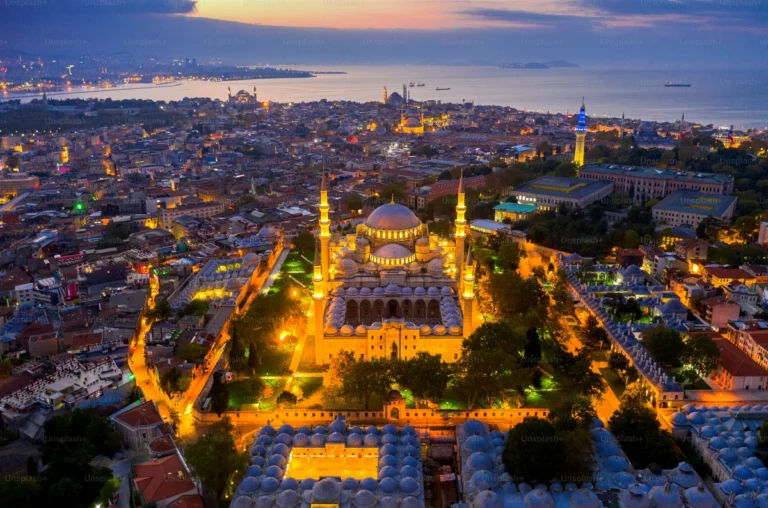
In its overall landscape, the monument was planned as a complete religious and social complex (külliye) spanning dozens of hectares, including a theological school (medrese), soup kitchen (imaret), hospital (darüşşifa), covered bazaar (arasta), and royal mausoleum. Stone arcades and perimeter walls separate the sacred interior from the bustle of At Meydanı outside, creating smooth transitions through imposing vaulted portals. Viewed from a boat on the Sea of Marmara looking up the hillside, the cascading domes paired with six slender minarets reaching skyward create a dramatic visual effect, affirming the harmony between master engineering and the natural scenery where Asia meets Europe.
Under the skilled hands of chief architect Sedefkâr Mehmed Ağa, foremost student of master architect Mimar Sinan, the Sultan Ahmed Mosque stands as a high point uniting traditional Ottoman architecture with graceful Byzantine echoes. The overall space follows a soft stepped-pyramid layout where cascading semi-domes support a majestic central dome rising forty-three meters above Constantinople. Central to the prayer hall’s grandeur is its bold load-bearing system: four massive stone piers nicknamed “elephant feet,” each up to five meters in diameter, finely molded and clad in pure white marble. These four towering piers transfer the weight of the 23.5-meter-diameter main dome down to deep foundations, opening up an expansive prayer hall unobstructed by partition walls so tens of thousands of worshippers can gather toward the sacred direction in shared devotion.
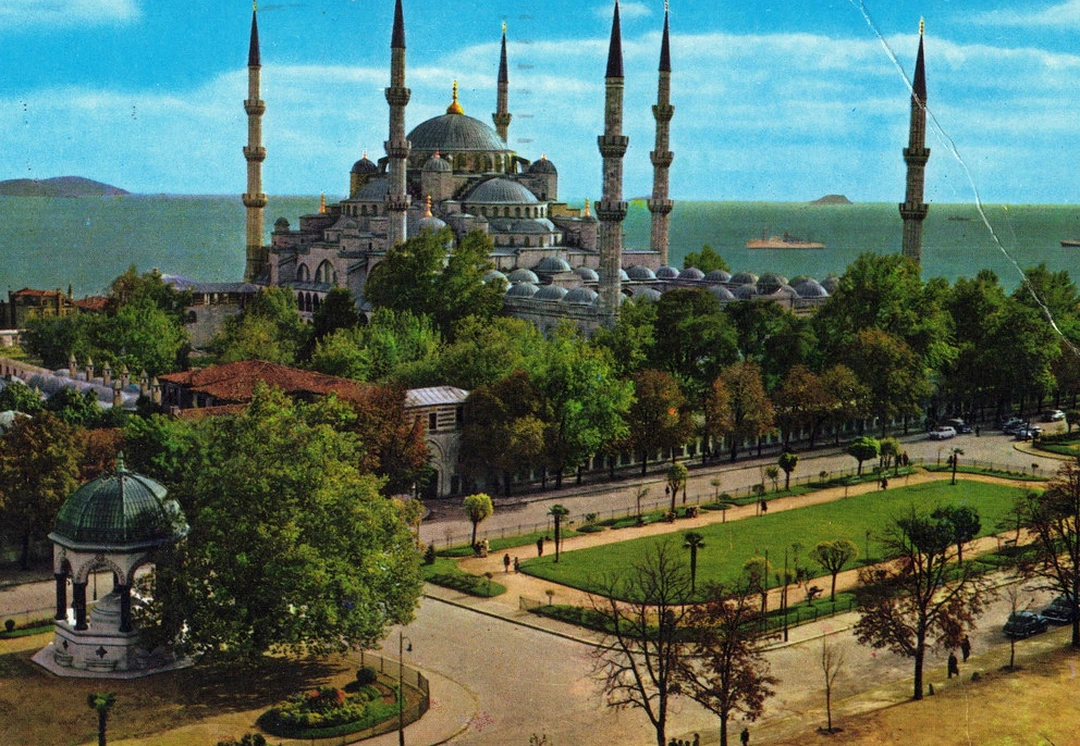
The signature feature that put the building into world architectural history is its extraordinary six minarets soaring into the clouds. In Islamic architectural convention of the era, mosques commissioned directly by a Sultan could have up to four minarets, while Al-Masjid al-Haram in Mecca was the sole sanctuary on earth with six minarets symbolizing supreme dignity. Istanbul folklore still recalls the anecdote that architect Sedefkâr Mehmed Ağa misheard the instruction altın minare (“gold minaret”) as altı minare (“six minarets”). Whether born of a linguistic mix-up or a young sovereign’s grand artistic ambition, the choice met fierce pushback from theological scholars and clerics of the Arabian Peninsula, who saw it as presumptuous to place an imperial capital on par with the cradle of faith. To ease public outrage and keep his masterpiece intact in the capital, Sultan Ahmed I generously funded a seventh minaret from the imperial treasury for the sacred mosque in Mecca, upholding Mecca’s unique status while preserving all six minarets beside the Bosphorus.
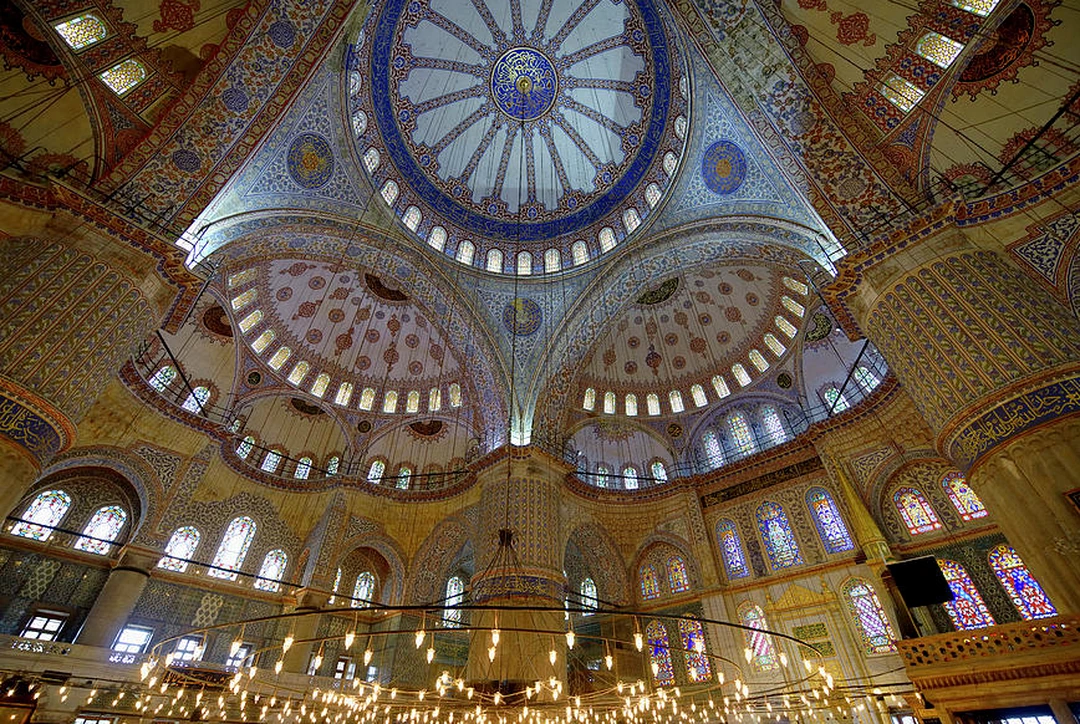
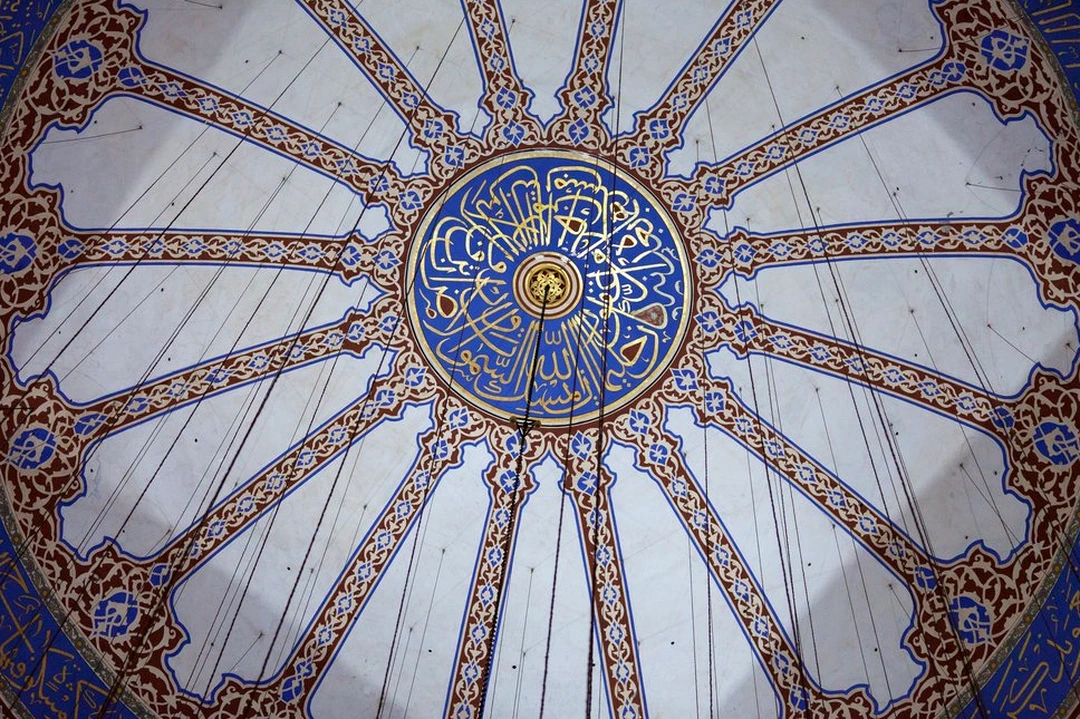
Stepping through ebony doors inlaid with fine mother-of-pearl into the interior, visitors are immediately captivated by a cool sea of blue where the enduring name “Blue Mosque” comes alive. Walls from the gallery level upward are clad in 21,143 splendid Iznik glazed ceramic tiles, handcrafted during the golden peak of renowned workshops in northwestern Anatolia. In daylight filtering through more than two hundred Venetian stained-glass windows, each tile shimmers with turquoise and cobalt hues, displaying over fifty stylized tulip variations alongside blooming carnations, ripe fruit clusters, and upright cypress trees symbolizing eternity in Eastern poetry. The blend of bold massing, structural precision, and intricate ceramic artistry turns the interior into a living art museum reflecting the aesthetic peak of an empire spanning Europe and Asia.
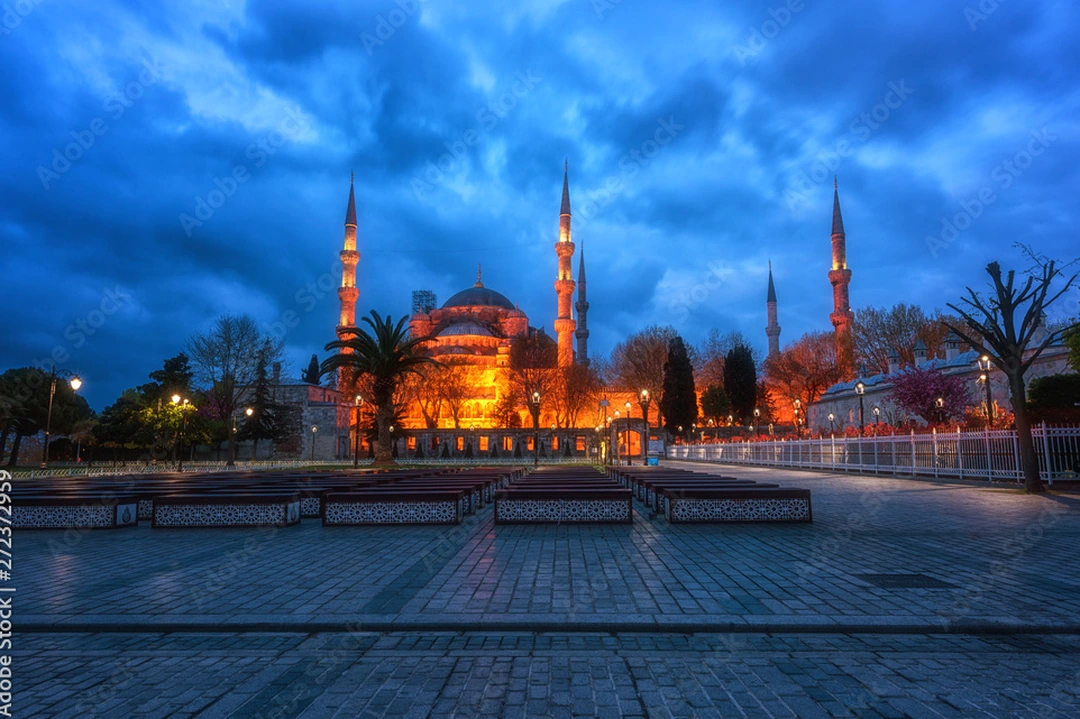
As turquoise twilight settles over the Bosphorus Strait and the Golden Horn, life around the historic Fatih peninsula does not quiet down so much as shift into a different emotional register. Ancient Sultanahmet Square—once the famed Byzantine Hippodrome—becomes an open-air stage of Eastern splendor. Carefully calibrated by modern lighting specialists, multi-tiered architectural lights bring out every carved detail of the Blue Mosque. Cascading semi-domes and six slender minarets rising against a dark velvet sky are bathed in warm gold and soft blue light, evoking a palace straight from the Arabian Nights.
A highlight drawing visitors from around the world after dark is the periodic “Sound and Light” (Son et Lumière) show staged between the Blue Mosque and Hagia Sophia. The quiet space between the two architectural landmarks becomes a backdrop for epic stories tracing the highs and lows of old Constantinople and the golden Ottoman era. Shifting beams of light move in rhythm with the contemplative ney flute, resonant oud, and multilingual narration. Each sweep of light across stained glass or granite molding seems to peel back layers of time, helping visitors grasp the spiritual vision chief architect Sedefkâr Mehmed Ağa offered his enlightened sovereign.
Visiting Istanbul during the holy month of Ramadan brings a visual cultural tradition dating back to the seventeenth century: the art of mahya lighting. Under Sultan Ahmed I, skilled court artisans pioneered stringing oil lamps between the galleries of twin minarets. Against the quiet night sky, glowing Arabic script hovers in midair, spelling out prayers for peace, moral truths, and charity. Mahya lights push back city darkness and serve as a spiritual beacon guiding worshippers toward the mosque courtyard.
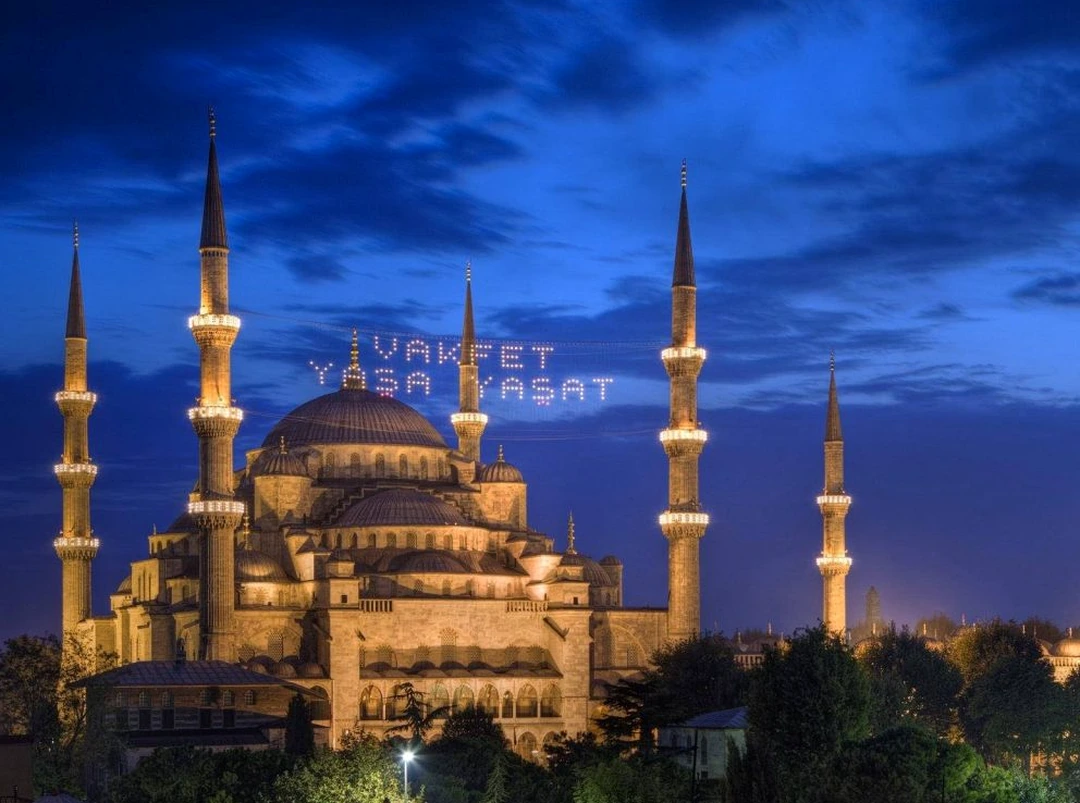
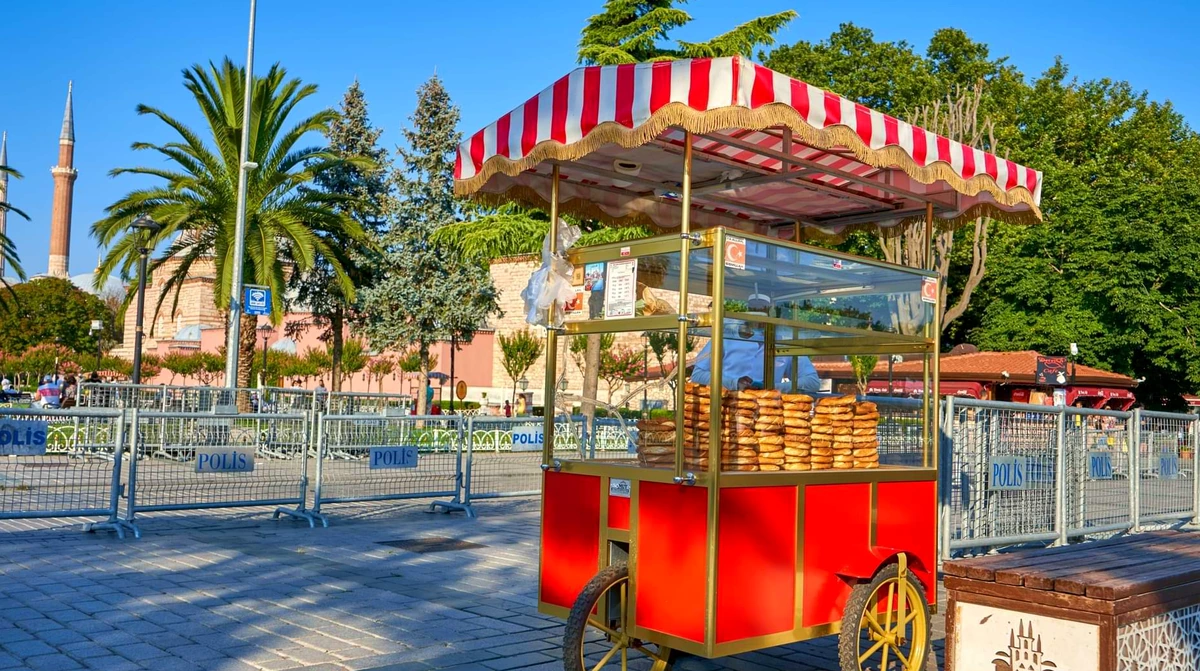
Beneath that luminous canopy, evening life around Sultanahmet unfolds into a scene of community that feels both sacred and full of vitality. As soon as the Maghrib call to prayer and traditional cannon signal the breaking of the fast, local families and travelers gather on green lawns to share warm Iftar meals. Inviting aromas drift along cobbled lanes: smoky kebab skewers, crisp sesame-crusted simit bread rings fresh from the oven, and warm cinnamon-anise notes from trays of colorful macun—traditional chewy paste wound neatly around a wooden stick with practiced wrist flicks inherited from Ottoman court confectionery.
Later at night, the mood grows more relaxed as people linger at open-air tea spots around brightly lit fountains. Sipping rich black çay from a tulip-shaped glass while listening to trickling water and murmured conversation in many languages reveals an enduring Istanbul—where imperial past and modern pulse meet beneath the shadow of timeless stone vaults.
Stepping out of the quiet solemnity beneath the blue domes of Sultanahmet Camii, visitors are quickly drawn in by tempting flavors wafting from cobbled alleys around the Hippodrome. Having served as the heart of radiant Constantinople and then the seat of Ottoman power for centuries, local cuisine holds a rich heritage blending Topkapi palace culinary craft with hearty Anatolian folk traditions.
The standout culinary icon across from the mosque is famed Sultanahmet Köftesi. Originating in the 1920s during the turbulent transition when the young Republic of Turkey was founded, a family eatery started by culinary craftsman Mehmet Serif laid the groundwork for this celebrated meatball. Unlike spicier varieties from the southeast, Sultanahmet Köftesi achieves refinement by honoring the natural sweetness of the meat. Prime beef is combined with a measured share of young lamb, seasoned simply with sea salt and water-soaked bread crumbs, and hand-kneaded without heavy garlic, onion, or harsh spices. Each elongated patty is grilled over glowing oak charcoal, charred lightly outside while staying juicy, tender, and fragrant within.
Enjoying Sultanahmet Köftesi in true classic style pairs it with a white-bean salad called piyaz. Tenderly cooked white İspir beans are tossed with thinly sliced red onion rinsed with salt to tame its bite, fresh parsley, and tangy crimson sumac spice. The salad is drizzled with cold-pressed olive oil and lemon juice or pure pomegranate molasses, garnished with hard-boiled egg wedges. Alternating a bite of hot meatball dipped in family-recipe spicy acı sos with a spoonful of cool piyaz creates a balanced, clean contrast of richness, heat, and bright acidity.
To round out an Ottoman tasting spread, do not miss the classic royal drink şerbet. Once prepared as a cooling elixir by imperial physicians in Topkapi Palace for Sultans and the harem across dynasties, it can still be found around old Sultanahmet in ornate copper vessels. Especially distinctive is demirhindi şerbeti, brewed from ripe tamarind with more than forty spices and botanicals—such as cinnamon, anise, clove, cardamom, and honey—for a deep, warming sweet-tart profile. Rose-petal şerbet distilled from fragrant Isparta roses or naturally rosy purple-basil şerbet also bring an alluring Eastern touch.

Alongside family kitchens, food life around the Blue Mosque carries nostalgia in simple street sounds: the clink of bright red carts stacked with warm, sesame-crusted simit rings fresh from the oven, the sweet nutty scent of chestnuts splitting over hot coals, or steam rising from salted grilled corn in the cool Bosphorus breeze. Finishing with a sip of strong black tea in a slim tulip glass or sand-brewed Turkish coffee with velvety foam lets visitors take in centuries of imperial food culture right beside the towering minarets.
Unlike static memorials or quiet museum halls, the Sultan Ahmed Mosque remains a living place of worship where the spiritual rhythm of old Constantinople and modern Istanbul beats continuously. Because it is an active mosque, five daily prayers follow the sun’s cycle from dawn to late night. During prayer times—especially the midday congregational service on Fridays—the main prayer hall closes temporarily to visitors so worshippers can pray in peace. Prayers usually last around thirty to forty-five minutes, making mid-morning—after morning prayers finish and before the midday adhan echoes from the six minarets—an ideal time to step inside.
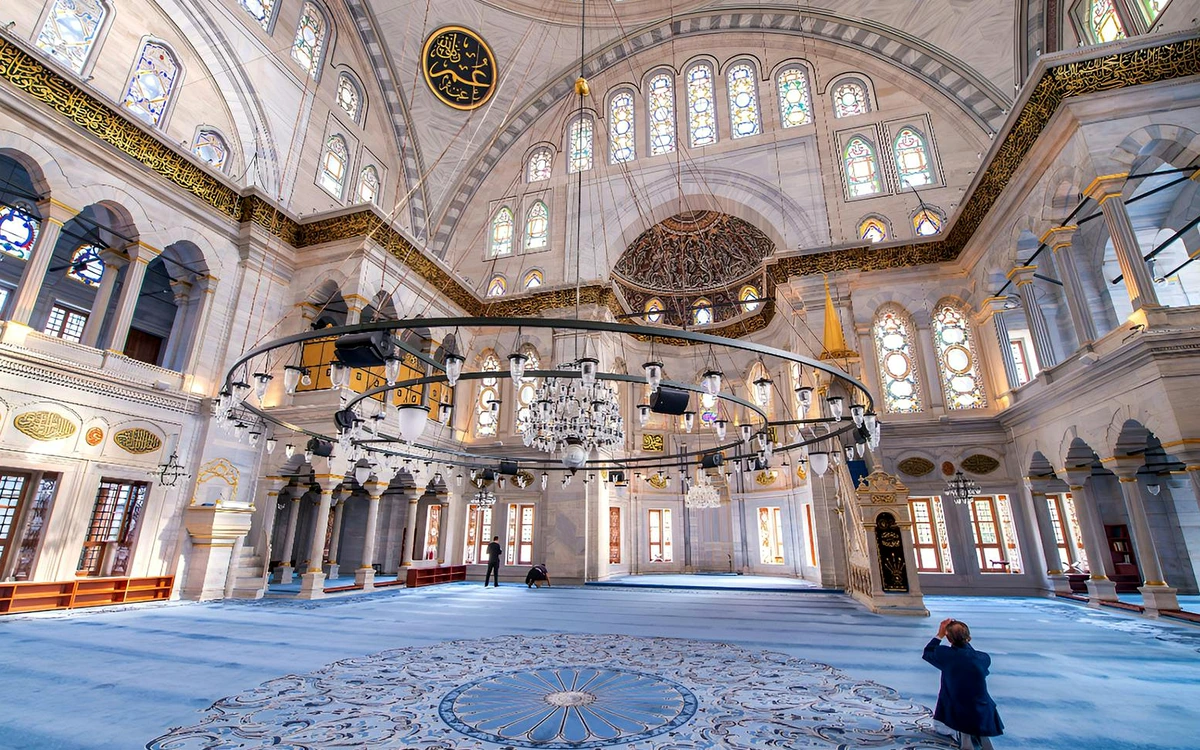
In keeping with the Islamic charitable foundations (vakıf) established by Sultan Ahmed I in the early seventeenth century, admission is free for locals and international visitors alike. In return, entering this sacred space calls for following traditional dress and etiquette known as adab. Visitors remove their shoes and place them in bags provided at the entrance before walking on soft carpets sourced from royal workshops. Attire must be modest, covering shoulders, chest, and past the knees for both men and women, with women covering hair and neck with a headscarf. Right at the visitor entrance on the west side facing Sultanahmet Square, staff provide clean wraps and long skirts free of charge for anyone who needs modest cover.
Reaching this architectural landmark is straightforward along one of the easiest transit corridors on the historic Fatih peninsula. Taking the T1 Kabataş–Bağcılar tram line to the Sultanahmet stop is both convenient and scenic. From the stop, it is just a short walk through shaded Hippodrome Square—once the famed Byzantine chariot track, home to the millennia-old Obelisk of Theodosius and the intricately carved marble German Fountain. Flagstone paths wind past mature cypress trees before leading through a stately white-stone arched portal into the wide granite forecourt designed by chief architect Sedefkar Mehmed Agha.
To appreciate the craftsmanship of more than twenty thousand Iznik tiles alongside gold-gilded Arabic calligraphy by Seyyid Kasim Gubari, bringing a compact handheld pair of binoculars is a smart tip. While massive “elephant-foot” piers and sweeping arches easily draw the eye, delicate cobalt and vermilion motifs of tulips, carnations, and pomegranates rise high up into the domes in soft daylight from over two hundred stained-glass windows. After an unhurried one- to two-hour visit, stopping at a traditional spot near the square for early-twentieth-century-style grilled Sultanahmet Köftecisi meatballs and a warm Turkish tea rounds out the local experience.
Exploring such a defining landmark of Ottoman architecture rewards a thoughtful, unhurried pace that respects religious customs and the layers of history accumulated across a city spanning two continents. To prepare smoothly and enjoy Istanbul alongside rich cultural sites across Asia and Europe, travelers can explore itineraries and details through a curated all-inclusive Turkey tour package designed for a seamless and memorable journey.