Tucked into the heart of modern Seoul, where soaring skyscrapers of glass and steel rise tirelessly into the sky, Insadong (仁寺洞) endures as a quiet sanctuary of time, safeguarding over six centuries of urban memory on the Korean Peninsula. The name Insadong did not originate as a single place at the founding of the capital, but rather emerged from a late-feudal administrative merger combining the syllable “In” from Gwanin-dong with “Sa” from Daedong-dong. Situated on an auspicious geomantic site within the former royal capital of Hanyang—nestled squarely between the two grand palace complexes of Gyeongbokgung and Changdeokgung—the neighborhood was destined early on to become a gathering hub for the court’s most distinguished cultural, political, and artistic elite.
During the Joseon dynasty (1392–1910), this quarter served as the favored residential enclave of the Yangban—the aristocratic ruling class of high-ranking officials and learned Confucian scholars. Its lanes once echoed with the footsteps of sages debating statecraft over cups of lotus tea, inkstones, and traditional mulberry paper. Even more notably, Insadong’s cultural pedigree was sealed when the royal court established the headquarters of Dohwaseo (the Royal Bureau of Painting), the supreme state academy responsible for painting royal portraits, recording court ceremonies, and producing palace fine art. Within these refined precincts, two of the greatest masters in Korean art history—Kim Hong-do (Danwon) and Shin Yun-bok (Hyewon)—wielded their brushes, leaving behind genre painting masterpieces that vividly captured everyday life and the cultivated spirit of the Joseon era.
Yet the tides of history never remain still. With the onset of the Japanese colonial period (1910–1945), the Joseon dynasty came to an end, triggering the rapid decline and impoverishment of the Yangban nobility. Stripped of titles and family fortunes, many aristocratic clans were forced to unlock ancestral chests and bring heirloom blue-and-white porcelains, ritual bronzes, ancient scroll paintings, and celebrated calligraphy works to pawnshops along this street to make ends meet. That poignant historical upheaval inadvertently transformed Insadong into the largest antiques market on the Korean Peninsula. Merchants, scholars, and collectors flocked to the district, giving rise to a dense network of classical Chinese bookstores, shops selling the “Four Treasures of the Study,” and traditional scroll-mounting workshops—shaping the character of an open-air living museum.
Surviving the devastation of war and the breakneck industrialization of the late twentieth century, Insadong stood firm against commercial concrete redevelopment. Recognizing the core value of its heritage, on June 3, 1988, the government of Seoul officially designated Insadong as South Korea’s first “Traditional Culture Street,” establishing strict legal protections to preserve its historic golmok alleyways, traditional wooden hanok houses, and artisanal crafts. Rather than freezing the neighborhood into a static relic, this designation paved the way for a remarkable dialogue between past and present—epitomized by the arrival of the spiraling architectural complex Ssamziegil in 2004, affirming the undying vitality of a six-hundred-year-old cultural quarter in the heart of a modern metropolis.
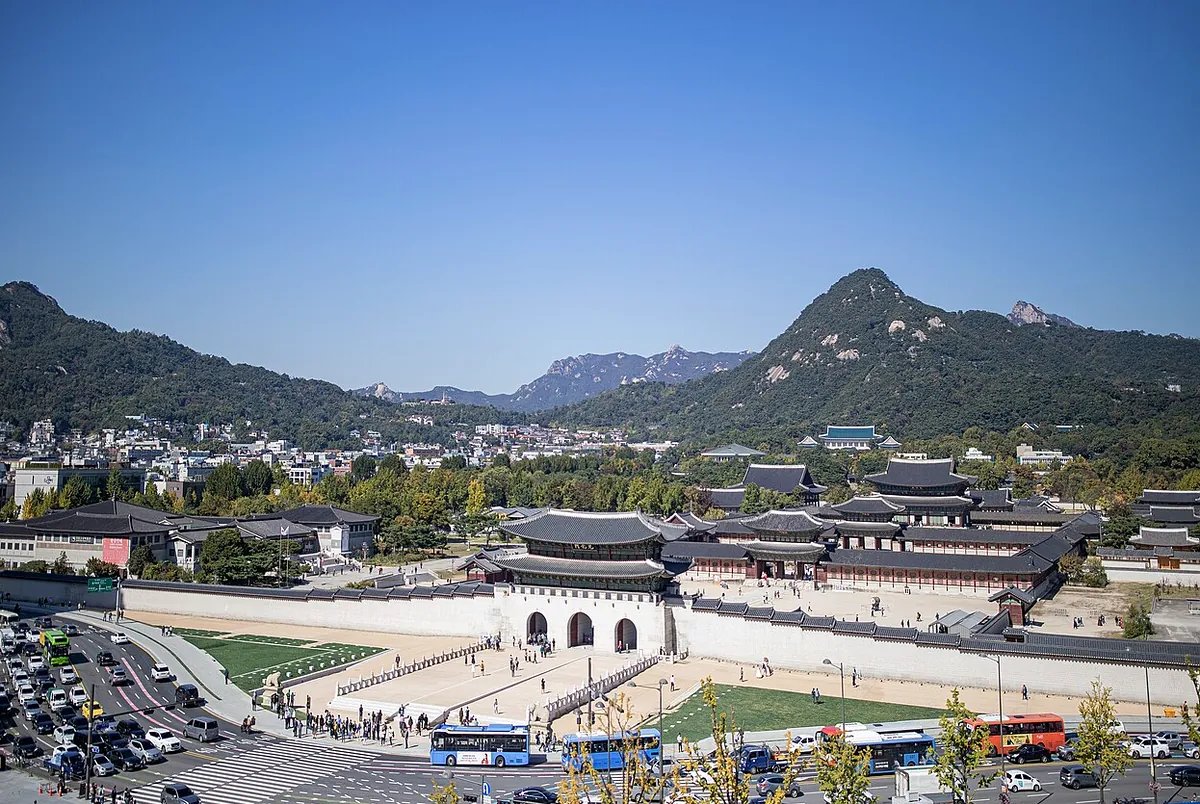
Viewed through the lens of traditional East Asian geomancy, the spatial layout of Insadong inherits the full regal energy of Hanyang, the capital founded by King Taejo Yi Seong-gye at the dawn of the Joseon dynasty. Occupying a prime position in central Jongno District, Insadong strictly adheres to the classical principle of “mountain at the back, water in front,” anchored firmly by towering Mount Bukaksan to the north while drawing vital energy down toward the gentle waters of Cheonggyecheon Stream to the south. Positioned at the strategic corridor wedged between majestic Gyeongbokgung Palace and graceful Changdeokgung Palace, this strip of land was prized by royal geomancers as an auspicious haven that gathers harmony and shelters wind—ideal for high-ranking nobles and refined literati.
Geographic synergy links Insadong with Bukchon Hanok Village and Gyeongbokgung Palace to form Seoul’s inseparable “Royal Heritage Triangle.” Within this distinct spatial triad, while Gyeongbokgung embodied the supreme authority of the throne and Bukchon housed solemn aristocratic clans, Insadong served as the fluid cultural bridge uniting courtly artistry with scholarly urban life. Its natural north-to-south downward slope facilitated rainwater drainage and cooling breezes, turning the quarter into a tranquil cultural oasis insulated from the clamor of a rapidly transforming megacity.
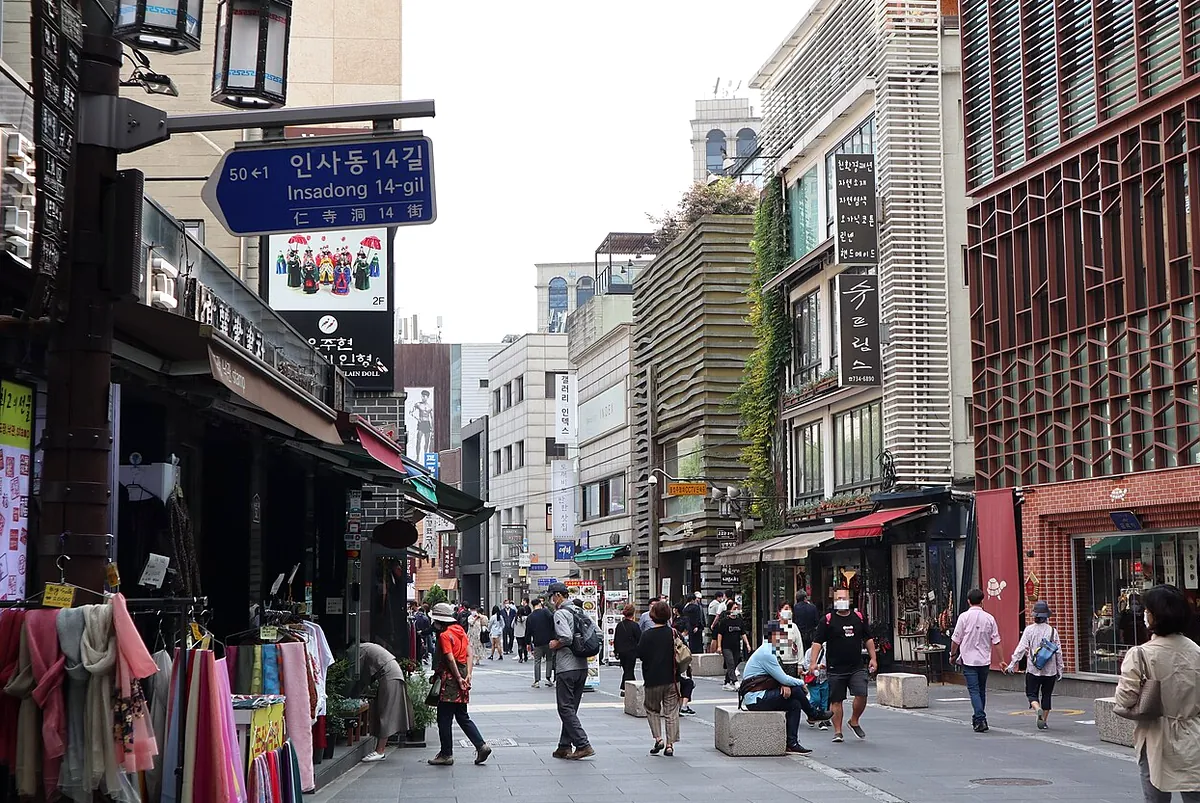
Forming the structural spine of the district is Insadong-gil, stretching roughly 700 meters from the Anguk-dong intersection down toward Jongno Tower. Unlike wide, car-centric boulevards built during modern urban expansion, Insadong-gil retains human-scale proportions tailored to the eye of the strolling pedestrian. Its urban fabric unfolds in a “fishbone” pattern, branching off the main avenue into dozens of labyrinthine side alleys known locally as golmok. These winding lanes act like capillaries nourishing a living organism, concealing traditional teahouses built of pine and clay, small moss-dappled granite courtyards, and somber tiled hanok walls shielding artisan workshops from the relentless march of time.
Complementing this heritage streetscape is a precision-engineered public transit network with convenient access points at every corner. Travelers can step straight into the northern end of Insadong-gil via Exit 6 of Anguk Station on Subway Line 3. At the opposite southern gateway, multi-line connectivity is anchored by Jongno 3-ga Station—a major interchange linking Lines 1, 3, and 5—alongside Jonggak Station on Line 1 just steps away. Thanks to this subterranean transit infrastructure, massive crowds of visitors circulate smoothly without overwhelming the historic streetscape above.
To safeguard the integrity of its cultural atmosphere, a strict time-regulated traffic plan governs the district. Every weekend, the entire 700-meter stretch of Insadong-gil closes completely to motorized vehicles, transforming into a pure pedestrian promenade. Car-free hours run from 2:00 PM to 10:00 PM on Saturdays and from 10:00 AM to 10:00 PM on Sundays. This weekly transformation draws between 40,000 and 60,000 visitors each weekend day, turning the stone-paved avenue into an expansive open-air stage where resonant gayageum zither performances, live brush calligraphy demonstrations, and the delicate aroma of magnolia tea mingle effortlessly in the crisp Korean air.
The urban fabric of Insadong reads like a layered architectural blueprint in which the boundary between centuries-old timber houses and contemporary structures dissolves into quiet harmony. Along the roughly 700-meter thoroughfare linking Jongno 2-ga to the Anguk-dong intersection, the neighborhood compacts itself into a dense web of crisscrossing lanes locals affectionately call miro (labyrinth). The entire quarter operates as a living open-air museum where Joseon-era mortise-and-tenon carpentry stands side by side with twenty-first-century steel, glass, and exposed concrete—sparking a rich material dialogue between past and present.
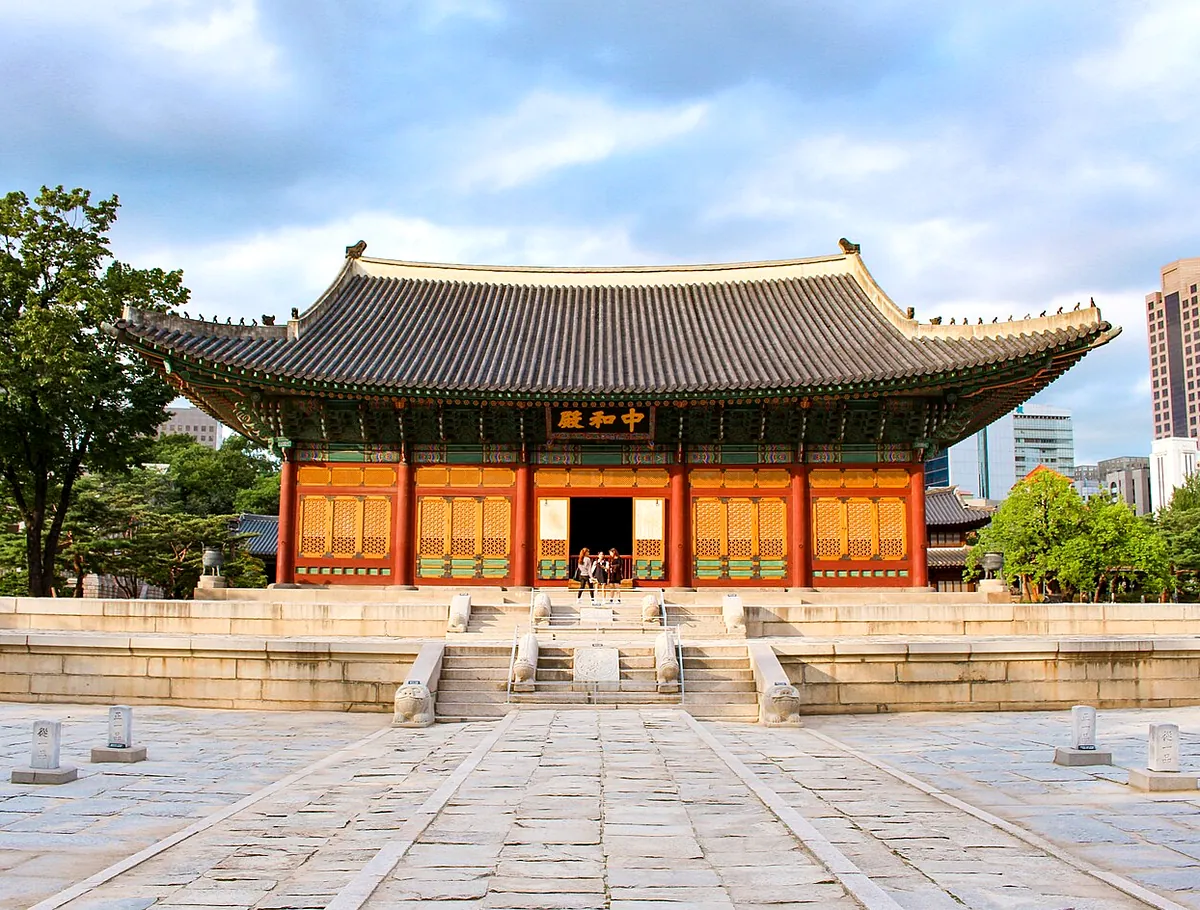
The soul of old Insadong springs from its traditional hanok houses topped with undulating ash-gray giwa clay roof tiles. Each historic residence is a triumph of vernacular architecture, relying on massive red-pine post-and-beam frames locked together through precision wood joinery without a single metal nail. Exterior walls plastered with clay, chopped straw, and slaked lime provide natural insulation against Korea’s bitter winters, working in concert with the famed ondol underfloor heating system beneath the floors. At the heart of Insadong’s classic hanok residences lies the open-air madang courtyard paved in rough-hewn granite, acting as a microclimatic lung that draws cooling breezes beneath curved eaves while separating living spaces from artisan studios. Many historic hanok have been gracefully repurposed into fine calligraphy brush workshops, hand-carved stone dojang seal studios, and serene teahouses fragrant with chrysanthemum and cinnamon.
Offering a striking counterpoint to somber tiled roofs is the Ssamziegil complex, an award-winning architectural landmark designed by architect Choi Moon-gyu. Rather than stacking floors connected by conventional vertical staircases that fragment the visual experience, Choi boldly realized the concept of “verticalizing a Seoul alleyway.” Spanning four levels and over 4,000 square meters, the building is linked entirely by a continuous, gently sloping ramp inclined at roughly five degrees that spirals around a breezy central atrium. Stretching more than half a kilometer, this upward promenade guides visitors effortlessly past over seventy craft boutiques, celadon ceramic galleries, and hand-embroidery studios before opening onto the Sky Garden rooftop terrace. Its open, partition-free design floods every corner with natural daylight while echoing the communal spirit of old Seoul’s hillside alleys.
Insadong’s cultural landscape is further anchored by distinguished art institutions such as the Kyung-in Museum of Fine Art and Gana Art Space. The Kyung-in Museum occupies the former estate of Park Yeong-hyo, a prominent late-Joseon cabinet minister, preserving authentic wooden pavilions fitted with rustic hanji mulberry-paper windows alongside three sleek glass-and-steel exhibition halls set within a tranquil tea garden shaded by century-old pines. By contrast, Gana Art Space embraces minimalist geometry, pairing raw gray stone with expansive tempered glass to showcase contemporary Korean sculpture. Weaving among these galleries, Insadong’s labyrinthine alleys act as living arteries where every turn reveals an unexpected architectural surprise, making the district a model of heritage preservation paired with urban renewal.
As late afternoon sunlight casts long shadows across rows of ash-gray giwa tiles, Insadong enters its most enchanting daily transition—the golden hour between 3:00 PM and 7:00 PM on weekends. With motorized traffic barred from the main avenue, crowds stroll beneath warm amber rays slanting across smooth paving stones. Light at this hour acts like a temporal filter, bathing earthen walls in a storybook glow that blurs the line between South Korea’s bustling modern capital and the contemplative grace of the Joseon era, while footsteps fall into rhythm with spontaneous folk performances erupting across open courtyards.
At central crossroads and in the open plaza before the spiraling Ssamziegil complex, vibrant street performances continually draw passersby to pause and watch. The resonant beat of a cowhide buk drum accompanies the soaring, soulful vocals of a Pansori epic storyteller—a UNESCO Intangible Cultural Heritage art form—filling the historic street with dramatic emotion. Interwoven with poignant ballads are satirical Talchum masked dances, in which performers clad in vibrant five-color costumes and expressive wooden masks leap gracefully to the piercing melody of the taepyeongso shawm. Energetic Samulnori percussion quartets—combining kkwaenggwari small gongs, jing large gongs, janggu hourglass drums, and buk barrel drums—unleash rolling waves of rhythm that revive the spirit of ancient Korean harvest festivals right in the heart of the modern capital.
Once night falls, Insadong undergoes a complete transformation through subtle, nostalgic lighting design. Rather than dazzling visitors with neon signs like neighboring Myeongdong, illumination here is restrained to a warm honey-gold glow radiating from traditional Cheongsa Chorong silk lanterns—woven in red and blue—suspended beneath wooden eaves. Soft light filters through translucent hanji paper lattice windows, casting crisp geometric shadows across dew-dampened granite flagstones. Ssamziegil’s four-story spiral ramp glows like a contemporary lantern oasis, gentle beams embracing metal sculptures in a striking visual dialogue with distant hanok rooflines.
As the evening deepens, Insadong’s energy shifts from lively street spectacle to quiet introspection as visitors slip into narrow, winding golmok alleys. Tucked inside passageways barely wide enough for two people to pass are century-old teahouses such as Shin Old Tea House and Jirisan, where time seems suspended in dark, aged pine beams. Unlike daytime craft browsing, nocturnal life here revolves around the contemplative philosophy of Darye (Korean tea etiquette). Guests sit cross-legged on woven rush cushions, listening to water simmer inside cast-iron kettles over glowing charcoal while slowly sipping fragrant Gukhwacha chrysanthemum tea or honey-sweet Mogwacha quince tea alongside sweet ginger Yakgwa pastries and crisp puffed-rice Yugwa confections.
Crowning an evening in Insadong is the artistry of traditional cuisine inspired by royal court tables of yore. Discreet hanok taverns welcome diners with miniature Surasang royal spreads featuring delicacies once reserved for monarchs—from fall-off-the-bone braised beef short ribs (Galbijjim) and crisp seafood scallion pancakes (Haemul Pajeon) sizzling on cast-iron skillets to steaming bowls of milky ox-bone soup (Seolleongtang). Alongside refined side dishes, rustic stoneware pitchers of effervescent Makgeolli rice wine and smooth red ginseng liquor are raised in quiet conversation as lantern light sways gently outside, leaving behind the lingering charm of an older, deeply romantic Seoul.
Beneath ancient ginkgo trees and curving hanok eaves, Insadong also safeguards a vast culinary heritage uniting formal Joseon royal court gastronomy with the thousand-year-old serenity of Buddhist temple cuisine. Far removed from the hurried pace of main boulevards, the neighborhood’s dining scene functions as a living culinary museum where Yin-Yang and Five Elements harmony and deep reverence for seasonal ingredients are faithfully upheld by generations of dedicated chefs.
The pinnacle of this meditative culinary philosophy resides at Sanchon, a renowned Buddhist temple restaurant and teahouse tucked deep inside a granite-paved alley. Founded by former monk Kim Ji-soon in the spirit of monastic contemplation, Sanchon guides diners through a sensory awakening with a multi-course banquet featuring over twenty varieties of wild mountain herbs and foraged greens (namul) hand-harvested from pristine highland slopes. Observing strict monastic dietary precepts, every dish excludes the five pungent roots—garlic, scallions, leeks, chives, and wild onions—as well as artificial seasonings. The clean sweetness of bellflower root sautéed in cold-pressed sesame oil, nutty chrysanthemum-infused soy tofu, and earthy wild pine mushrooms harmonize amid drifting incense smoke and classical gugak court music, inducing an extraordinary sense of inner stillness.
Stepping out from the ethereal calm of temple dining, travelers encounter classic capital gastronomy at Yeteul, a rustic pine-timber tavern dedicated to preserving secular royal culinary arts. Its signature dish is yukhoe, finely julienned seasoned raw beef tartare once featured at grand royal banquets. Tender, freshly sliced beef is marinated with aged black-bean soy sauce, fragrant pure sesame oil, and a touch of grated garlic, paired with crisp, juicy Korean pear matchsticks that balance richness and elevate the meat’s natural sweetness. Served alongside chilled handmade buckwheat noodles in a delicate broth simmered from vegetables and beef bones in earthenware pots, the meal captures the refined yet unpretentious spirit of old Hanyang literati.
Tucked into another winding lane, beloved local eatery Insadong Sujebi tells a heartwarming story of culinary memory through its signature hand-torn noodle soup. Served piping hot in rustic brown-glazed earthenware bowls, the dish wins over diners with a crystal-clear yet deeply savory broth simmered for hours from dried deep-sea anchovies, dasima kelp, and white radish. Chefs deftly tear thin ribbons of wheat dough by hand directly into the bubbling broth for an ideal chewy texture, enriched with plump fresh oysters, julienned zucchini, and scallions. Pairing each silky spoonful of noodle soup with crisp, spicy radish kimchi evokes the comforting warmth of Korean family kitchens across decades.
No culinary exploration of Insadong is complete without pausing for traditional tea ceremony at Dawon, the famed teahouse nestled inside the serene courtyard of the Kyung-in Museum of Fine Art. Seated on a wooden hanok veranda shaded by old maple trees while listening to water trickle from a bamboo spout, guests can sip golden wild chrysanthemum tea gathered from rocky slopes or sweet-tart honeyed green plum tea (maesilcha) served in exquisite celadon cups. Accompanying the tea are delicate dasik pressed confections crafted from grain flour, black sesame, pine nuts, and pine pollen bound with wild honey and stamped with auspicious motifs using heirloom wooden molds—a graceful finale celebrating a thousand-year-old culinary culture.
Understanding Seoul’s public transit network makes exploring Insadong effortless. Subway Line 3 provides the most direct access: alight at Anguk Station, take Exit 6, and walk roughly one hundred meters south to reach Buk-Insa Madang Square, marked by its giant calligraphy brush sculpture. Travelers arriving from southern Seoul or central Jongno can use Jongno 3-ga Station—an interchange for Lines 1, 3, and 5—exiting via Exit 5 to step directly into Nam-Insa Madang, lined with traditional yakgwa confectioneries and Buddhist ritual supply shops.
Daily rhythms along this 700-meter cultural boulevard shift noticeably between daytime and evening as well as weekdays and weekends. Most private art galleries, custom seal-carving studios, and fine art museums open at 10:00 AM and close between 7:00 PM and 8:00 PM, whereas tucked-away hanok teahouses keep their charcoal braziers glowing until 10:00 PM. On weekend afternoons, the main street’s conversion into a car-free pedestrian zone turns the stone pavement into a lively stage for traditional Talchum mask dances, gayageum recitals, and spontaneous outdoor antique auctions.
Amid a marketplace brimming with layers of historical artifacts, discerning shoppers should look for markers of true authenticity. To protect traditional craftsmanship from mass-produced souvenirs, the municipal government awards official Quality Certification Seals to accredited workshops. When shopping for iconic Korean creations such as Goryeo celadon ceramics, Joseon baekja white porcelain, handmade mulberry-bark hanji paper, or hwangmo-pil weasel-hair calligraphy brushes, prioritize ateliers led by designated Intangible Cultural Heritage artisans. Pieces bearing certification stamps from traditional craft associations not only possess timeless beauty but also include documentation verifying authenticity, helping visitors avoid inferior factory imitations.
Respectful etiquette is equally important when visiting this historic quarter. Inside antique galleries and ink-painting exhibitions, flash photography and filming are strictly prohibited to prevent light degradation of centuries-old mineral pigments. In quiet teahouses, guests are expected to converse softly and remove their shoes neatly at the wooden maru threshold before stepping inside. Urban cleanliness is maintained through South Korea’s Jongnyangje waste-sorting system; travelers enjoying street snacks such as sweet hotteok pancakes or spun-honey kkultarae “dragon’s beard” candy should dispose of wrappers in designated bins rather than leaving them on historic stone ledges.
To immerse yourself in Insadong’s rich historical layers without distractions from commercial pressure or detour shopping stops, curated cultural travel has become the top choice for discerning explorers. Thoughtfully crafted itineraries connect travelers directly with heritage artisans while unlocking the hidden cultural depths of Korea’s millennial capital. For a seamless, unhurried journey through nostalgic alleyways without worrying about logistics or language barriers, consider joining an all-inclusive South Korea tour package to turn your visit to Insadong into an unforgettable cultural memory.