Rising majestically along the Taebaek Mountain Range overlooking the East Sea of the Korean Peninsula, Seoraksan (雪岳山)—whose name translates as “Snowy Crag Mountain”—has been revered since antiquity as a sacred sanctuary gathering the purest energies of earth and sky. In classical East Asian chronicles, the name “Snowy Crag” originates from the wondrous sight of snow-white granite peaks shrouded year-round in mountain clouds, resembling eternal snowfields that never melt even in the height of summer. Far more than a natural masterpiece of sheer cliffs piercing the heavens, Seoraksan stands as a silent witness across pivotal eras of Korean history, preserving golden legacies from the dawn of the radiant Silla Kingdom (57 BC – 935 AD) through the Zen-infused Goryeo Dynasty (918–1392).
Seoraksan’s historical trajectory is deeply intertwined with the growth of Korean Buddhism, epitomized by the founding of ancient Sinheungsa Temple nestled at the foot of its towering peaks. In 652 AD, during the reign of Queen Jindeok—the 28th monarch of the Silla Kingdom—the eminent monk Jajang Yulsa chose this secluded mountain valley after years of spiritual pilgrimage to establish a monastic sanctuary. Originally named Hyangseongsa, the temple was built to propagate the Dharma, pray for national peace and prosperity, and provide a tranquil refuge for devoted practitioners deep in the mountains. Under Master Jajang’s guidance—renowned for codifying monastic precepts and enshrining sacred Buddhist relics across Silla—the temple swiftly grew into a vital spiritual center at the gateway to the northeastern coast.
Yet the tides of history and devastating calamities did not spare this sacred ground. Through centuries of warfare and destructive fires during the transition between the Goryeo and Joseon dynasties, the ancient monastery fell into ruin amid the mist-shrouded forest. Not until 1644, during the reign of King Injo of Joseon, did three distinguished Zen masters—Yeongseo, Hyewon, and Denu—vow together to rebuild the sanctuary from its ashes. Legend holds that all three monks experienced the very same prophetic dream revealing that if they reconstructed the temple on its present site, Buddhism would flourish there forever alongside the sun and moon. Inspired by this sacred omen, the rebuilt monastery was completed and officially renamed Sinheungsa—signifying an “auspicious new beginning” and inaugurating a glorious revival for Seoraksan’s spiritual heritage.
Entering the modern era, Seoraksan’s significance expanded beyond its millennium-old Buddhist heritage to be recognized as an irreplaceable ecological treasure demanding strict protection amid rapid industrialization. Recognizing the vital importance of its ancient geological formations and endemic flora and fauna, the South Korean government designated the mountain as Natural Monument No. 171 on November 5, 1965. Building on efforts to safeguard its untouched landscapes, Seoraksan was officially designated as the fifth National Park of South Korea on March 24, 1970, establishing a robust legal framework for scientific research and biodiversity conservation.
Seoraksan’s stature transcended national borders onto the world stage in August 1982, when UNESCO officially designated its entire core and buffer zones as a World Biosphere Reserve. This landmark recognition made Seoraksan the very first site on the Korean Peninsula inducted into the global biosphere network. More than a millennium after Master Jajang Yulsa first set foot in these valleys to its recognition as a world natural treasure, Seoraksan continues to stand like an epic carved in stone—where Silla cultural heritage merges eternally with the majestic breath of East Asia.
Set along the grand Baekdudaegan Mountain Range—the geographic and spiritual spine of the Korean Peninsula—Seoraksan rises like a natural feng shui masterpiece where earth energies converge, balancing the bold yang force of towering granite with the serene yin currents of the East Sea. Its poetic name stems directly from dramatic seasonal phenomena: from autumn in September stretching all the way into early summer the following year, early snowfalls weave a pure white mantle across sharp craggy summits. Under shifting sunlight, ancient granite walls transform magically—appearing like jade inlaid with pearls amid drifting clouds one moment, and standing like monumental stone pillars holding up the sky the next. In classical landscape harmony, its terrain forms an ideal mountain-backed, ocean-facing configuration sheltering the Gangwon coast from fierce sea gales and nurturing a crisp, tranquil microclimate.
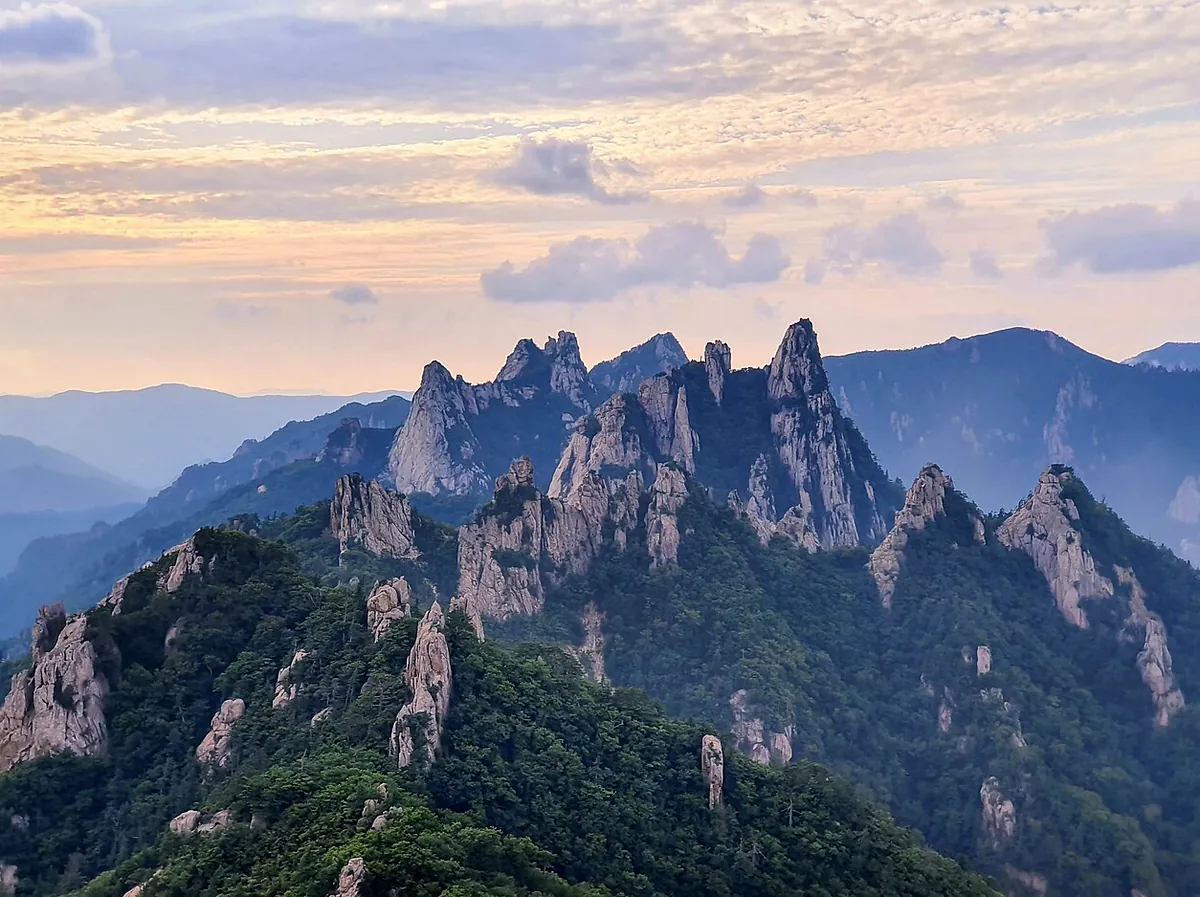
Hundreds of millions of years of tectonic uplift and erosion divided Seoraksan into two contrasting yet seamlessly unified realms: Inner Seorak (Naeseorak), serene and secluded with deep river gorges, and Outer Seorak (Oeseorak), dramatic and majestic facing directly toward the ocean. Tectonic faulting exposed colossal granite batholiths sculpted over eons by ice and wind into vertical rock faces, rugged crevasses, and lush primeval valleys. This forms a remarkable ecological transition zone between temperate maritime and cold continental climates. Vegetation shifts dramatically with elevation—from vibrant beech, oak, and crimson maple forests at the foothills to resilient dwarf pines and moss-draped birches clinging to subalpine frost-sculpted crags, providing vital sanctuary for rare protected flora and fauna.
The scenery here blends otherworldly fairy-tale beauty with a thousand years of cultural memory. Along winding valleys surrounding ancient Baekdamsa Temple, mirror-clear mountain streams flow over countless smooth river pebbles where generations of travelers have carefully stacked tens of thousands of small prayer cairns—creating a serene field of quiet energy uniting earth, stone, and human devotion. Beyond the tranquil valley floor, terrain rises abruptly into jagged cliffs where Biryong Falls plunges into a deep gorge like a mythical blue dragon soaring skyward through drifting mist. This exhilarating sense of vertical drama is heightened further by engineered glass walkways and suspension bridges spanning dizzying granite chasms, allowing visitors to take in nature’s breathtaking grandeur firsthand.
The ultimate union of ancient military strategy and dramatic mountain scenery crowns Gwongeumseong Fortress, perched atop a bare rocky summit roughly 700 meters above sea level. A modern cable car glides smoothly through thick layers of mountain mist to bring visitors within steps of these historic stone ramparts. According to Goryeo-era legend, facing fierce Mongol invasions, two generals surnamed Gwon and Kim rallied together to build the entire stone fortification in a single night to shelter local villagers. Standing atop windswept Gwongeumseong—where weathered white granite meets open sky—the vast wilderness of Seoraksan unfolds in endless majesty, testifying to the enduring vitality of a natural wonder bound inseparably to history.
Nestled inside Seoraksan’s grand granite valley, the Buddhist architectural ensemble of Sinheungsa stands as a quiet bridge between untamed nature and profound spirituality. Tracing its roots back to Hyangseongsa, founded by Great Master Jajang in the 7th century during the reign of Queen Seondeok of Silla, the temple weathered centuries of upheaval, fires, and reconstructions before assuming its classic Joseon-dynasty architectural form. Rather than imposing rigidly upon rugged terrain, Sinheungsa’s layout flows organically with the mountain contours, guiding pilgrims along a rhythmic spatial progression from the One-Pillar Gate (Iljumun) across the stone bridge near Biseondae over a babbling stream—allowing worldly distractions to fall away before entering the serene monastic courtyard.
Traditional Korean wooden craftsmanship reaches its pinnacle at Geuknakbojeon (Hall of Supreme Bliss), an architectural treasure exemplifying Joseon-era aesthetic mastery. Raised upon a sturdy natural stone foundation, the main hall employs pure timber post-and-beam construction joined through interlocking mortise-and-tenon joinery without a single metal nail. Its crowning glory lies in its multi-tiered bracket system (dapo) supporting gracefully curving tiled eaves, paired with vibrant dancheong painted motifs covering every wooden beam. Intricate patterns in blue, red, yellow, white, and black follow classical five-element harmony, depicting vivid lotus blossoms, swirling clouds, phoenixes, and celestial dragons. Hand-carved lattice doors featuring delicate chrysanthemum and lotus motifs filter soft natural light onto the solemn statue of Amitabha Buddha while showcasing the extraordinary artistry of Korea’s master woodcarvers.
Right in the broad courtyard leading toward the sanctuary, the landscape shines with the dignified presence of Tongil Daebul (the Great Unification Buddha). This monumental bronze sculpture rises an impressive 14.6 meters high atop a 4.3-meter monolithic stone lotus pedestal, radiating an aura of sacred calm across the Sogongwon entrance. Cast over more than a decade from 108 tons of pure bronze, the statue depicts Shakyamuni Buddha seated in serene meditation gazing northward, a radiant jewel inlaid upon his brow, his right hand raised in the mudra of fearlessness and his left resting in the gesture of wish-fulfillment. Inside the colossal statue lies a meditation chamber enshrining sacred Buddha relics, where Buddhists and travelers from around the world offer prayers for peace—a poignant emblem of the Korean people’s enduring longing for peaceful national reunification.
Alongside millennia-old heritage monuments, visitor infrastructure at Seoraksan has been engineered with forward-thinking precision to balance public access with strict ecological preservation. The centerpiece of this spatial planning is the Seoraksan Cable Car, departing from the Sogongwon valley station and soaring across deep gorges to reach the hilltop stone ruins of Gwongeumseong Fortress. Spanning 1.1 kilometers with sleek, whisper-quiet cabins capable of carrying roughly 900 passengers per hour, this aerial transit solution trims a strenuous multi-hour mountain climb down to a scenic flight of just a few minutes through drifting clouds—while preventing heavy foot traffic from trampling fragile subalpine flora and preserving the ecological integrity of this celebrated natural treasure.
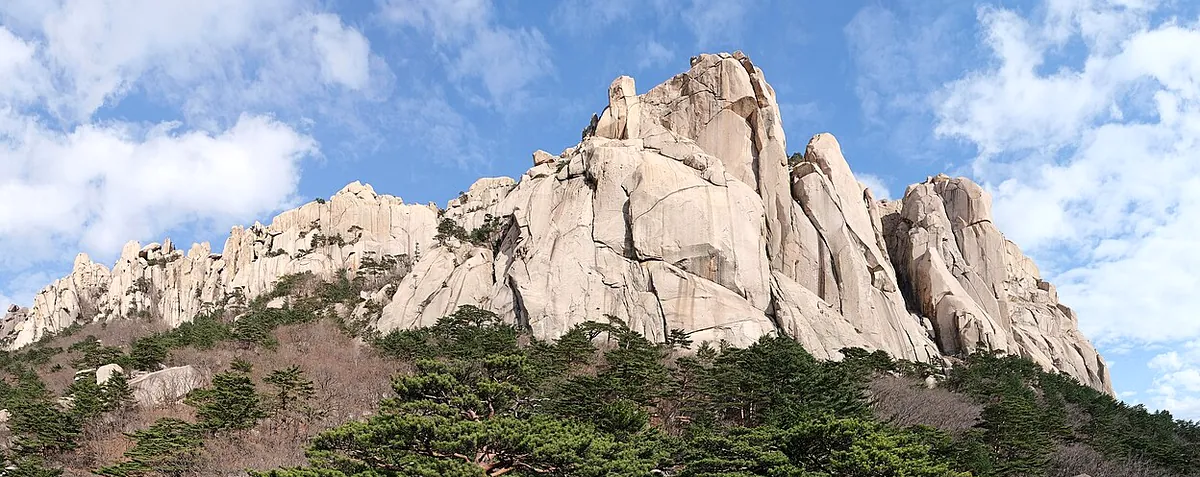
As sunset fades across the monumental granite ridges of the Baekdudaegan Range, Seoraksan sheds its daytime grandeur to drape itself in the mysterious velvet veil of a Gangwon night. Far removed from the bustling neon dazzle of metropolises like Seoul or Busan, evenings at Seoraksan unfold as a quiet nocturnal symphony where lighting and atmosphere follow nature’s own rhythm. Free of massive mechanical stages or glaring laser shows, the finest live performance here is orchestrated by the cosmos itself: bright moonlight filtering through pale blue mist around Ulsanbawi Rock, silhouettes of thousand-year-old pines etched against granite cliffs, and the murmur of mountain streams echoing up from deep Cheonbuldong Valley. That sacred stillness creates an evocative pause, inviting travelers into slow, mindful contemplation of untamed nature.
Right at the threshold of the National Park, the evening air is warmed by the refined golden glow of the Kensington Hotel Seoraksan. Styled in classic aristocratic elegance, the property feels like a hidden woodland museum of memories that has welcomed heads of state and celebrated artists over the decades. After dark, its English-style garden is softly illuminated, casting gentle reflections off an iconic red London double-decker bus and creating an intriguing East-meets-West dialogue amid primeval forest. Visitors can relax with a steaming cup of tea in the crisp highland chill, tracing silhouettes of towering peaks beneath a star-filled sky while breathing pure mountain air.
Just fifteen kilometers down from the highlands toward the coast, the town of Sokcho emerges as an historic fishing port pulsing with contemporary coastal charm. A standout nocturnal beacon along the East Sea shoreline is Lotte Resort Sokcho, perched dramatically on a rocky headland jutting into the ocean at Daepo-dong. Wrapping around the resort is the Bada Hyanggi-ro coastal boardwalk, where recessed low-glare architectural lighting illuminates winding wooden steps along sea cliffs while preserving the deep, tranquil darkness of the open ocean. Strolling here immerses visitors in a natural sensory spectacle where crashing waves mingle with cool mountain breezes sweeping down from Seoraksan toward the sea.
Sokcho’s nightlife truly comes alive the moment you step into the Sokcho Tourist & Fishery Market, originally established as bustling Jungang Market in 1953 right after the Korean War armistice. This vibrant night market preserves the living culinary heritage of displaced families from Hamgyong Province who settled in nearby Abai Village. Beneath warm golden lights and lively calls from local vendors, alleyways fill with savory steam from famed Abai Sundae—squid stuffed generously with seasoned minced pork, glass noodles, tofu, and aromatic herbs, steamed in wooden baskets—alongside glossy amber Dakgangjeong (crispy sweet-and-sour fried chicken topped with sunflower seeds) and brightly lit seafood tanks brimming with bright red snow crab (daege), cuttlefish, and cod landed fresh off boats at Dongmyeong Port.
Pulling up a stool at a simple round metal table in a traditional late-night eatery, sipping sweet corn makgeolli unique to Gangwon Province, and listening to sea lore shared by warm-hearted elders reveals the true soul of slow coastal living. Nights across Seoraksan and Sokcho are never hurried or ostentatious—settling instead like a timeless poem harmonizing deep mountain solitude with the generous warmth of a seaside town.
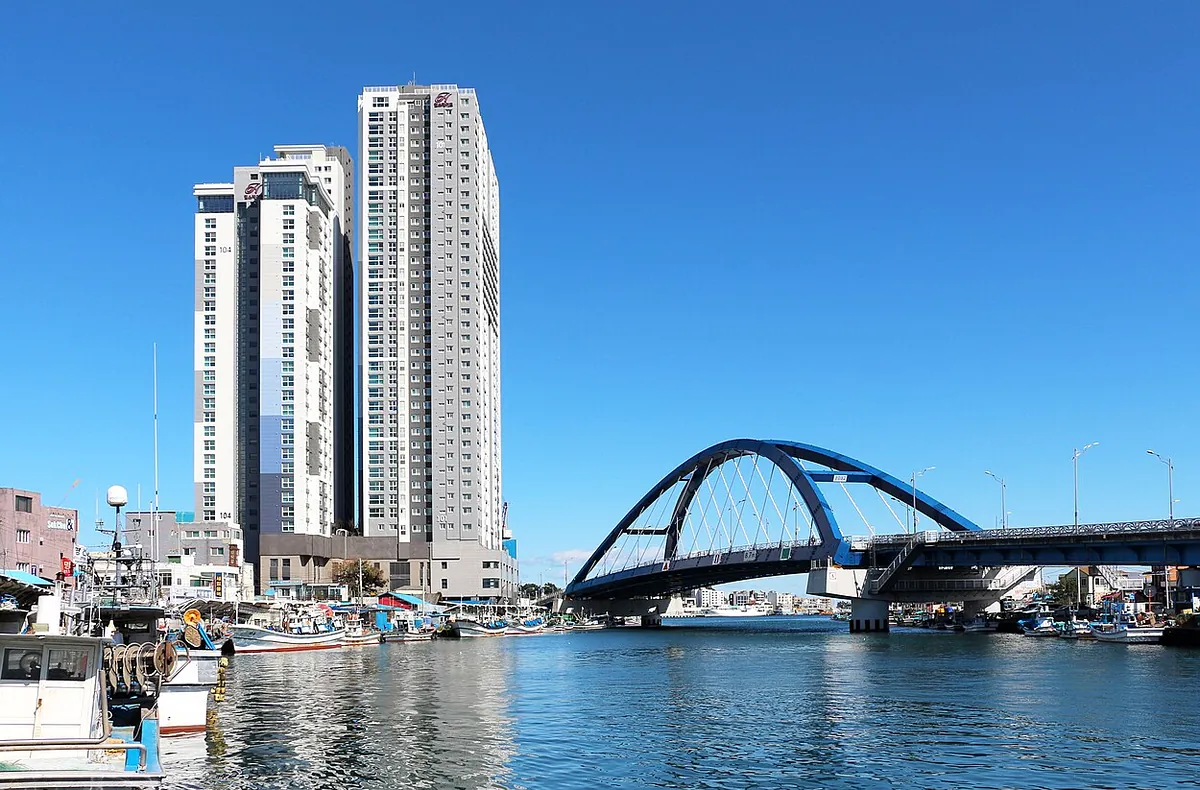
The culinary heritage surrounding Seoraksan National Park springs from a dramatic meeting of two geographic extremes: cloud-wrapped granite peaks of the Taebaek Range on one side, and the abundant continental shelf of Korea’s East Sea (Donghae) on the other. Turbulent migration history and rugged mountain climates forged a regional gastronomy both humble and deeply ingenious, treating ocean harvests and highland crops with time-honored techniques passed down through generations of displaced families and fishermen.
At the eastern gateway to Seoraksan, culinary fame centers on Abai Village tucked beside the Cheongho-dong inlet in coastal Sokcho. The village took shape during the Korean War in the 1950s when thousands of refugees from northern Hamgyong Province settled along the coast. Lacking pork intestines needed to make traditional hometown blood sausage, resourceful mothers and grandmothers turned to abundant fresh squid landed daily at Donghae fishing ports—giving birth to Ojingeo Sundae (stuffed squid), an enduring symbol of resilience and nostalgia. Firm, snow-white squid tubes are carefully cleaned to preserve natural elasticity, packed tightly with minced pork, smooth soft tofu, glass noodles, scallions, shiitake mushrooms, and fragrant perilla oil, then steamed until tender to lock in natural sweetness. Sliced into thick rounds, dipped in beaten egg, and pan-seared on a hot cast-iron griddle, each piece develops a golden, savory crust encasing a juicy, flavorful center.
Across on Seoraksan’s western slopes in Inje County, travelers enter the domain of a culinary tradition shaped entirely by highland winter weather: Hwangtae-guk (dried yellow pollack soup). Yongdae-ri Valley at the foot of Misiryeong Pass possesses a unique microclimate defined by long winters and freezing winds howling through mountain gorges. Here, vast wooden drying racks (deokjang) rise across snow-blanketed fields to cure millions of freshly caught pollack. Over more than four months of repeatedly thawing under daytime sun and freezing solid in -15°C nights, the fish flesh transforms from opaque white into fluffy, golden-yellow fibers packed with concentrated protein and amino acids. To prepare Hwangtae-guk, local cooks shred the golden fish, sauté it briefly in fragrant sesame oil, and simmer it slowly with winter daikon radish and soft tofu—yielding a milky, delicately savory broth prized for centuries as a restorative elixir by woodsmen and hikers conquering Daecheongbong Peak.
Along steep, rocky hillsides ringing Seoraksan’s base—where wet-rice paddies struggle to thrive—hardy buckwheat served as Gangwon Province’s staple crop for centuries, reaching culinary perfection in Makguksu (buckwheat noodles). Unlike factory-made noodles, traditional foothill eateries stone-grind whole buckwheat groats by hand, knead the flour with mineral-rich mountain spring water, and press fresh noodles directly into boiling water to order. Rustic, dark-hued, and nutty with earthy highland aroma, Makguksu is served either submerged in crisp, icy radish water kimchi (dongchimi) aged in buried earthenware crocks, or tossed in spicy-sweet gochujang chili paste topped with crushed seaweed and toasted sesame seeds—awakening every sense through classic East Asian five-flavor balance.
Rounding out Seoraksan’s culinary journey is a colorful feast at Sokcho Tourist & Fishery Market, showcase of the East Sea’s richest catches. Oxygenated tanks overflow with giant king crab, long-legged snow crab, sea snails, and live flounder brought ashore the very same day. Steamed inside fragrant cedar baskets to preserve sweet, succulent meat, the crab’s rich emerald-green tomalley is mixed directly into steaming rice with shredded seaweed and pure sesame oil—delivering a fitting finale celebrating the generosity of both Snowy Crag Mountain and the open sea.
Exploring Seoraksan National Park (雪岳山) in Sokcho City, Gangwon Province calls for thoughtful preparation in both entry logistics and on-trail readiness. International visitors must secure K-ETA electronic travel authorization or obtain a short-term C-3-9 tourist visa through a South Korean diplomatic mission prior to departure. The park’s main entrance at Sogongwon generally opens at dawn—around 5:00 AM in summer and 6:00 AM in winter—and remains open until sunset. From Seoul, the Donghongcheon–Yangyang Expressway makes getting there remarkably straightforward: intercity buses depart regularly from Dong Seoul Bus Terminal (Gangbyeon Station) or Seoul Express Bus Terminal, reaching Sokcho in roughly two and a half hours, where local City Bus 7 or 7-1 connects directly to the park’s main ticket gate.
The shifting rhythm of four distinct seasons across the Taebaek granite range creates two golden windows that travelers dream of experiencing. Most celebrated of all is autumn in October, when vivid foliage (danpung – 丹楓) sweeps crimson and brilliant gold down from 1,708-meter Daecheongbong Peak into dramatic Cheonbuldong Valley. Spring from April to May unveils an equally enchanting transformation as melting snow gives way to hillsides blanketed in royal pink azaleas (jindallae). Even so, high-altitude microclimates bring sharp, sudden temperature swings: diurnal shifts are substantial, and once night falls in autumn, temperatures routinely dip below 10°C accompanied by brisk mountain winds funneling through rocky gorges.
To stay safe and comfortable along winding stone trails, proper outdoor gear is essential. Sturdy, slip-resistant trekking shoes with high-traction soles and ankle support are indispensable on smooth granite slabs. Dress strictly in breathable layers—combining a moisture-wicking thermal base layer, an insulating fleece mid-layer, and a windproof, waterproof Gore-Tex outer shell to handle sudden mist and gusts. If you plan to ride the 1,200-meter cable car up to Gwongeumseong Fortress for sweeping summit views, make it a golden rule to arrive at the Sogongwon boarding station before 8:30 AM; during peak autumn foliage season, arriving later often means waiting hours in ticket and boarding queues that eat into your sightseeing schedule.
After hours of invigorating uphill hiking, local mountain fare offers the ultimate way to recharge. Stopping by traditional eateries near the park entrance, don’t miss a steaming bowl of silky Chodang Sundubu (soft tofu stew curdled with pure East Sea water), paired with crispy golden potato pancakes (gamjajeon) and a refreshing cup of corn-fermented dongdongju rice wine. Finally, remain alert against bargain-basement package tours that rely on forced shopping traps—cutting short precious sightseeing hours to herd travelers through commercial ginseng or red pine oil centers. Choosing a transparent, no-shopping itinerary ensures you can savor the serene dignity of ancient temples and Seoraksan’s vast natural beauty when traveling on a high-quality all-inclusive tour package.