Nestled amidst the undulating mountains and waters of Enshi in the majestic Wuling Range, Daughter City (Nü’er Cheng) has long transcended its boundaries as a mere geographical coordinate to become an iconic space preserving the cultural soul of the Tujia people. The origins of this land are deeply intertwined with the ancient Ba-Shu civilization, when prehistoric settlers built wooden shelters and established villages along the gorges of the Qingjiang River valley. Over thousands of years of accumulated history, this region crystallized a remarkably distinctive intangible cultural heritage known as “Nü’er Hui” (The Daughters’ Festival)—an authentic courtship tradition echoing vestiges of ancient matriarchal customs, where romantic freedom and the dignity of Tujia women were celebrated wholeheartedly amidst the isolated highlands.
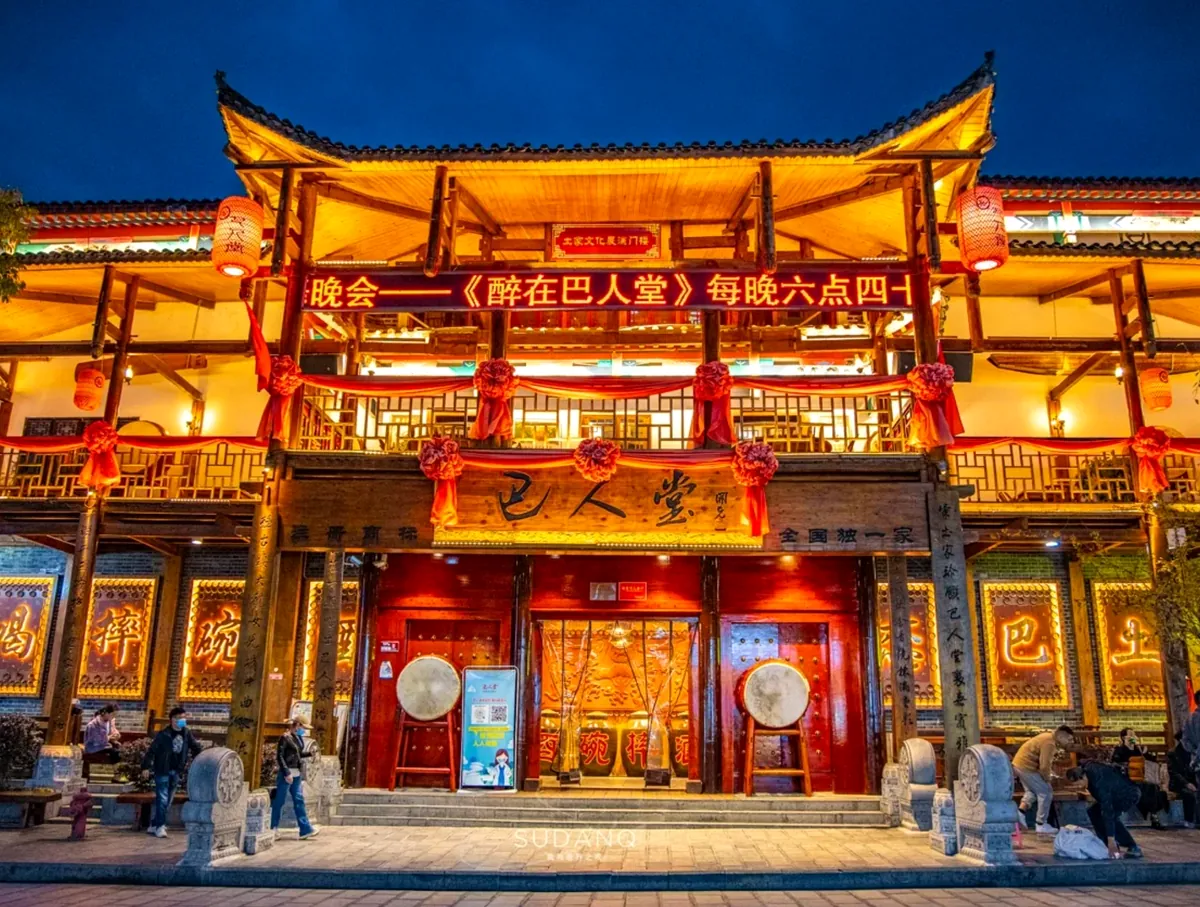
The magnificent vista greeting travelers is an imposing city gate crafted entirely in the traditional timber joinery of authentic Diaojiaolou stilt-house architecture. Tiers of concave-convex clay-tiled roofs curve upward like outstretched bird wings against the sky, accented by vibrant red lanterns hanging gracefully along intricately carved wooden railings. Smoothly laid local bluestone paving slabs beneath the gate open onto a bustling boulevard where warm light reflects off natural timber, creating a visual effect that is at once ancient and serene yet brimming with the vibrant energy of a Tujia cultural town.
Turning back the sacred pages of history, the roots of the local community trace to the Spring and Autumn and Warring States periods, when the ancient Ba people—revering the White Tiger Ancestor (Baihu Linjun)—migrated and settled deep within these mountain ranges. By the Song, Yuan, and especially Ming dynasties, the *Tusi* system (hereditary indigenous chieftains) was firmly established, granting broad autonomy to powerful local clans such as the Tan and Tian families governing this rugged mountainous domain. Sheltered within that self-contained Tusi system, Tujia free courtship customs and guild gatherings resisted assimilation by rigid Central Plains feudal etiquette. “Nü’er Hui” emerged as a graceful synthesis of frontier trade and fertility traditions, as young women carrying farm produce down to seasonal markets came not merely to barter goods, but to exchange heartfelt antiphonal folk songs and choose their own life partners.
The most dramatic historical turning point arrived during the Yongzheng reign of the Qing Dynasty, when the imperial court launched its sweeping *Gaitu Guiliu* policy—abolishing hereditary Tusi chieftaincies and integrating this rugged frontier directly into the central bureaucratic administration. While that upheaval toppled autonomous Tusi palaces, it remarkably could not extinguish the flame of folk culture burning in the veins of local residents. Across shifting eras, the historic market and festival grounds were thoughtfully reconstructed into today’s Daughter City, inheriting classic urban planning along a main east–west axis, traditional stilt-house clusters, and a thousand-year-old heritage of romance that has never ceased flowing.
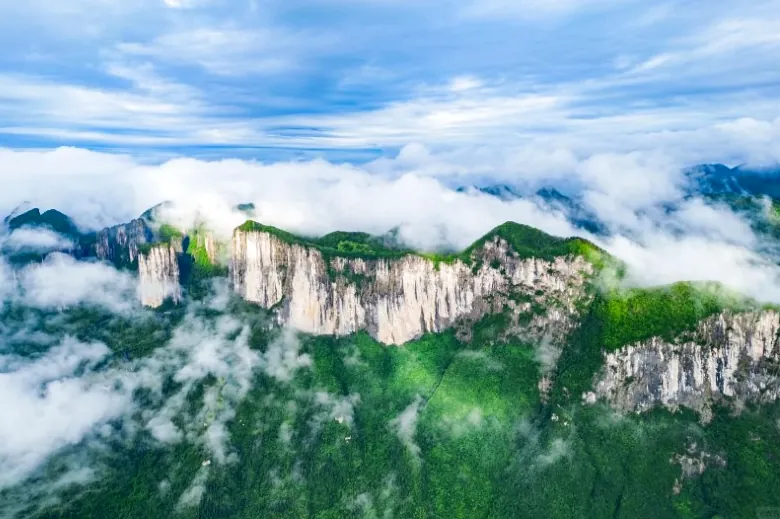
Occupying the heart of the Qiliping basin in Enshi Prefecture, Daughter City commands an auspicious geomantic setting where the vital energy of the Wuling Mountains converges. Encircled by western Hubei’s signature karst limestone hills, the basin forms a natural amphitheater resembling a half-opened lotus blossom—shielding against biting winter winds while gathering prosperous energy year-round. Rather than altering natural landforms aggressively, Tujia master planners followed gentle hillside gradients to sculpt a graceful tiered layout that avoids upstream gorge flash floods while welcoming warm sunlight and crisp breezes sweeping down from the Qingjiang River valley.
Viewed from above, Daughter City unfolds like a serene classical painting harmonizing charcoal-gray clay roof tiles with winding jade-green waterways. Clusters of dark-timber Diaojiaolou stilt houses nestle shoulder to shoulder along gentle slopes, their upturned eaves rising proudly toward the sky. Bluestone pathways wind around tranquil lakes and canals where arched stone bridges mirror weeping willows and historic pavilions in still water, achieving complete equilibrium between peaceful nature and dignified vernacular architecture.
Water engineering in Daughter City is revered as the lifeblood sustaining vitality across the entire community. Leveraging the intricate web of subterranean karst caverns and springs beneath the basin, waterways gather cool mountain streams from the foothills to feed the central scenic lake before branching evenly through perimeter moats. Circulating water not only moderates the microclimate—keeping ambient temperatures two to three degrees Celsius cooler than surrounding urban districts—but also embodies traditional beliefs in gathering prosperity: water enters gently, pools deeply, and winds away unhurriedly, fulfilling the classic geomantic ideal of waters embracing protective hills.
The historic town’s natural setting is further enriched by diverse subtropical highland flora. Stands of Masson pine, ancient ginkgos, and wild mountain azaleas remain carefully preserved alongside bluestone footpaths climbing from the valley floor up to hilltop pavilions. When morning mist or evening clouds rise from the Qingjiang River gorge, the entire town floats in a silvery-blue haze suspended between deep green limestone peaks and weathered gray tiles—creating an ecological sanctuary where sky, earth, and millennia of indigenous history converge.
Gazing across Daughter City, visitors are captivated by sweeping tiers of Diaojiaolou stilt houses whose gray-tiled roofs rise rhythmically across the Qiliping valley. Along cool bluestone alleys, upper-level red fir verandas glow warmly beneath rows of lanterns, creating spatial depth that feels both stately and intimate. Upturned eaves reach lightly toward drifting clouds, while geometric lattice window screens and finely turned wooden balustrades showcase the rustic yet dazzling artistry of traditional Enshi mountain timberwork.
To bring this living open-air museum of intangible cultural heritage to life, Daughter City received an investment exceeding three billion RMB across a master-planned site spanning more than 800 *mu* (over 53 hectares). Rather than imposing rigid urban grids, planners and local artisans adapted organically to the lush rolling basin, interweaving three major zones: a folk customs preservation and performance quarter, a historic merchant street recreating ancient frontier commerce, and boutique courtyard residences modeled after grand Tusi mansions. This balanced integration delivers modern national scenic-area comfort while safeguarding the authentic dignity of Tujia culture.
The architectural centerpiece of Daughter City lies in its faithful reconstruction of Diaojiaolou stilt houses—the pride of Tujia mountain engineering for centuries. Constructed entirely with precision mortise-and-tenon joinery without a single iron nail, these timber structures withstand both time and seismic tremors with remarkable resilience. Massive aged fir pillars rest firmly atop monolithic stone plinths carved with dragons, phoenixes, or stylized blossoms. Overhead, multi-tiered timber trusses support winged clay-tiled roofs pitched to shed torrential summer rains rapidly while promoting natural cross-ventilation during warm months. Beam ends and wooden partitions feature hand-carved geometric motifs inspired by classic *Xilankapu* brocade alongside the sacred White Tiger emblem of the ancient Ba people.
Internal circulation follows an intuitive loop anchored by Nü’er Street as its main spine leading into expansive cultural plazas. Branching off the smooth bluestone boulevard, dozens of smaller lanes weave like a web toward Ba-Ren Dining Hall, Tujia Snack Street, and open-air theatrical stages. Public gathering spaces such as Matchmaking Square and the Tujia Folk Customs Stage sit at key intersections, creating airy breathing room amid dense wooden facades. This rhythmic alternation between intimate moss-lined alleys and lively open squares turns every stroll into a layered discovery filled with *Bala* horn melodies and crimson embroidered curtains.
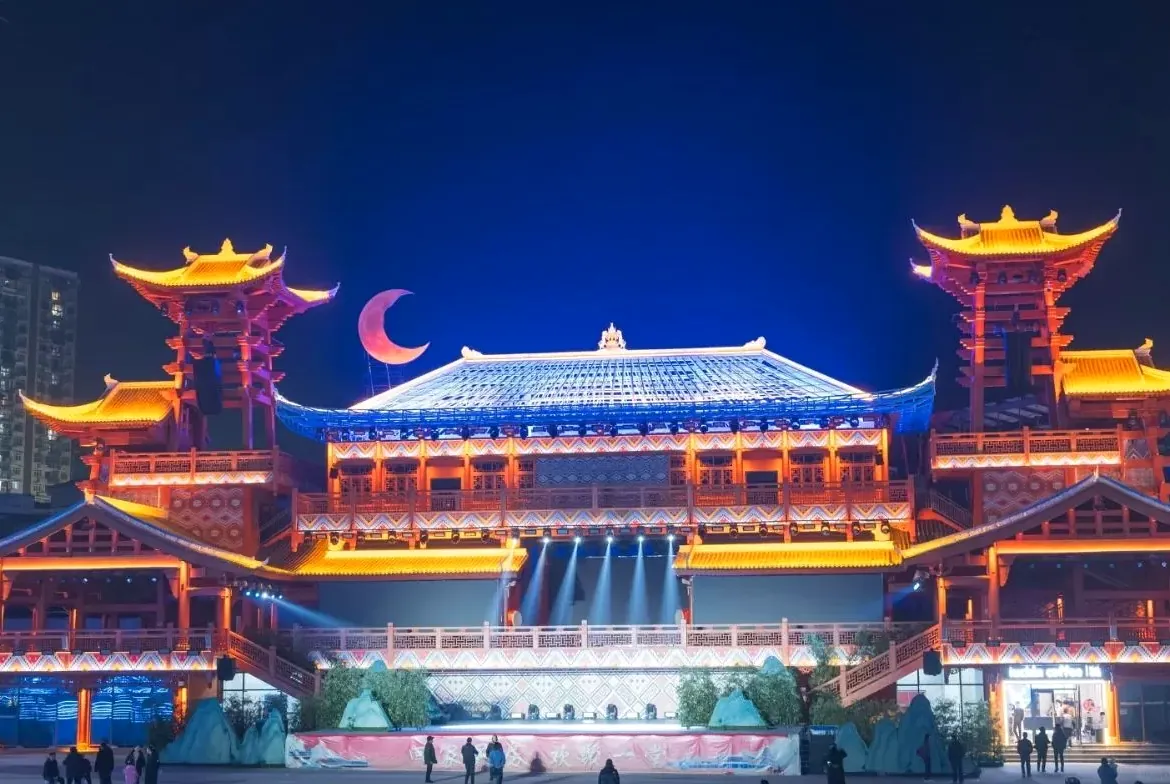
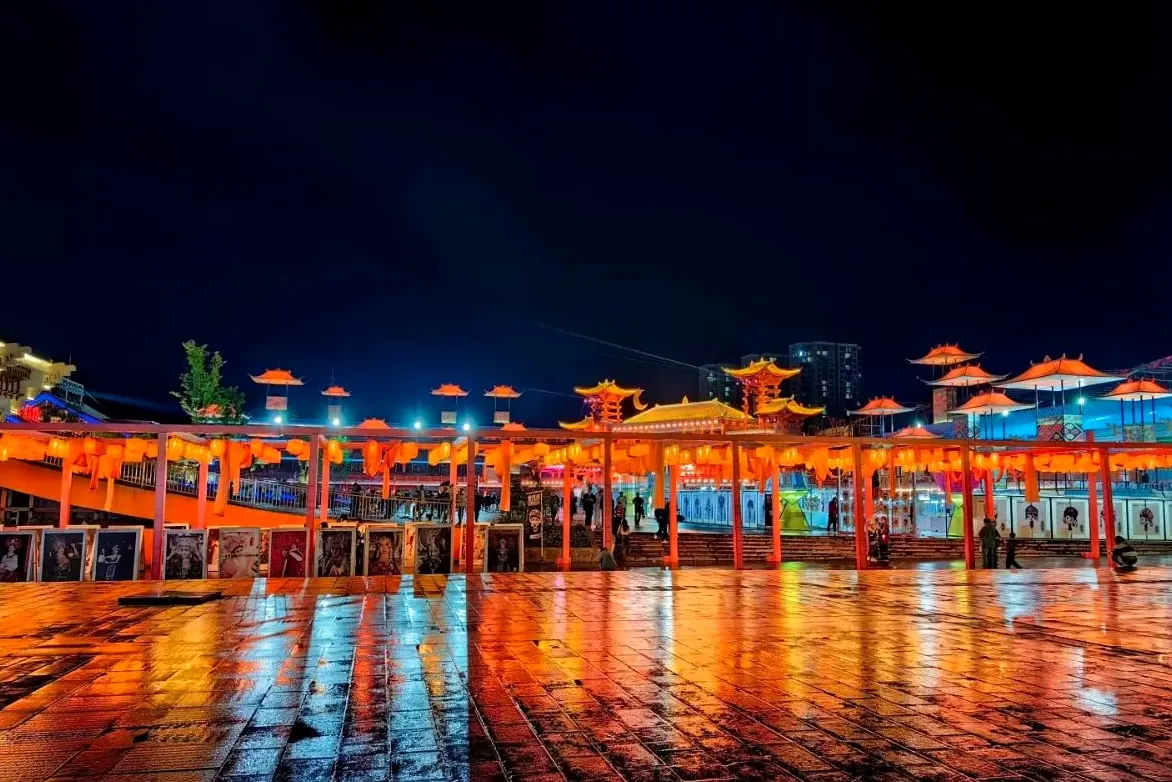
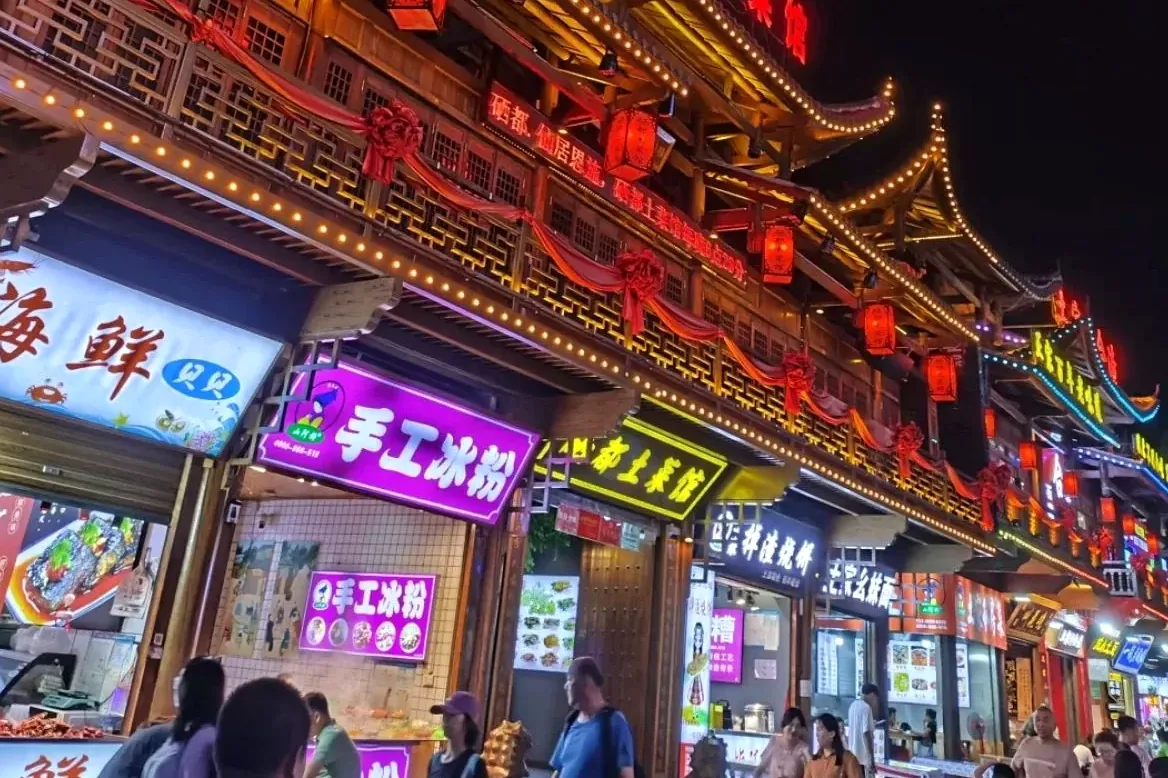
Once sunset fades behind Enshi’s distant ridges, Daughter City undergoes a dramatic metamorphosis into its most enchanting hours of the day, uniting modern illumination with thousand-year-old rustic charm. Tens of thousands of red lanterns strung along the curving eaves of Diaojiaolou stilt houses ignite simultaneously, casting a warm halo over moss-tinted roof tiles and weathered hardwood beams. Shimmering reflections ripple across winding canals, immersing travelers in an otherworldly nocturnal dreamscape.
The soul of this evening spectacle converges at the grand open-air amphitheater, where the large-scale live production *”Nü’er Hui”* brings the enduring epic of the ancient Ba-Shu people vividly to life. State-of-the-art surround sound and 3D projection mapping transform natural limestone cliffs into a monumental backdrop transporting audiences back through the centuries. Across the expansive stage, over a hundred local dancers clad in silver-embroidered traditional attire perform the authentic *Baishou* Hand-Waving Dance—energetic footwork and sweeping arm movements reenacting ancestral hunting, farming, and sacred rituals in a stirring hymn to heaven and earth.
The most emotionally resonant moment of the evening is the dramatic portrayal of the unique Tujia *Kujia* (“Bridal Laments”) wedding custom. Bathed in soft, dew-like stage lighting, the bride sings poignant antiphonal verses expressing filial gratitude to her parents and deep attachment to her village, striking a deeply moving chord amidst the mountains. Moments later, the mood erupts into joyful celebration as an embroidered silk ball (*xiuqiu*) is tossed from a crimson balcony to select a groom—drawing cheers and applause from delighted visitors lucky enough to catch the colorful symbol of good fortune.
As the stage curtain falls, a blazing bonfire ignites at the center of Folk Customs Square, kicking off a lively communal dance party lasting late into the night. Visitors from near and far join hands with local residents in concentric circles around the warm flames, stepping rhythmically to folk dances and spirited leaf-flute melodies. High spirits rise higher still inside traditional taverns staging the spirited *Shuaiwanjiu* (“Bowl-Smashing Wine”) ritual: after draining a bowl of aromatic herbal-fermented corn wine in one draught, guests hurl the earthenware bowl forcefully onto the stone floor with a crisp crash—an age-old custom symbolizing casting away worries, dispelling misfortune, and welcoming smooth sailing ahead.
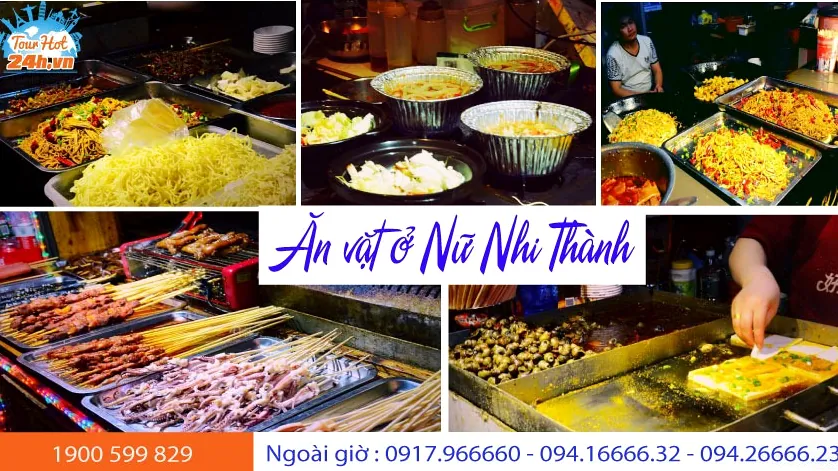
Along winding bluestone lanes, night markets hum with activity well past midnight as glowing charcoal braziers send up savory smoke from hearth-cured bacon, puffed glutinous rice cakes, and crispy chili-glazed tofu. Laughter mingles with the aroma of fermented rice wine and cool mist drifting down from mountain gorges, etching an unforgettable portrait of Daughter City—at once deeply historic and bursting with untamed vitality.
In the heart of Tujia Daughter City, exploration extends beyond the lilting notes of *Batu* horns to a feast for all five senses along long banquet tables brimming with fragrant steam. Tujia gastronomy in the Enshi highlands bears the unmistakable imprint of resilient mountain living, where the fiery tang of pickled chilies, the rich depth of wood-smoked meats, and the clean sweetness of upland grains unite in a distinctive heirloom culinary identity. Strolling down bluestone alleys at dusk, travelers are irresistibly drawn by the scent of pine smoke rising from sizzling cast-iron woks and sweet glutinous rice wine wafting from clay-tiled stilt houses.
Daughter City’s dining alleys come alive with long rustic wooden tables laden with steaming earthenware pots and platters of glossy mahogany-brown cured meats. Beneath red lanterns illuminating historic brick courtyards, bowls of herbal-fermented rice wine sit neatly beside skillets of golden pan-seared baby potatoes and glistening stir-fried pickled chilies—inviting guests into a generous celebration of mountain hospitality.
Foremost among Tujia culinary treasures is Hearth-Smoked Pork Bacon (*Larou*). Prime slabs of fresh pork belly cured with Sichuan peppercorns, coarse salt, and black cardamom according to millennial recipes are hung above wood-burning hearths for months, slowly absorbing fragrant smoke from cypress wood and dried wild orange peels. Sliced thin, the meat reveals ruby-red lean muscle marbled with translucent amber fat; stir-fried with young garlic shoots or shredded wild bamboo shoots, it delivers rich, savory sweetness without heaviness. Equally iconic is *Youcha Tang* (Oil-Tea Soup), revered locally as an elixir of hospitality: green tea leaves are pan-fried in local lard with fresh ginger and crushed garlic inside a copper pot, steeped with boiling water, and ladled over bowls of puffed rice, crispy soybeans, and roasted peanuts—yielding an astringent-sweet, nutty broth that warms travelers against mountain mist.
Dining in Daughter City reaches its ceremonial peak at a Long-Table Banquet (*Changzhuoyan*), the highest Tujia tradition for welcoming honored guests. Anchoring the feast is the Tujia Ten Great Bowls (*Shida Wan*)—ten generous bowls symbolizing complete perfection, showcasing braised, steamed, and stir-fried specialties ranging from mountain stream fish and sweet young corn to tender, fluffy meatballs. Highlighting the festive spirit is the famed *Shuaiwanjiu* wine ritual: after drinking a bowl of fragrant, fiery glutinous rice wine offered by Tujia women in embroidered floral attire, guests smash their clay bowl onto the stone floor to shatter ill fortune and invite peace and prosperity.
Beyond grand banquets, casual food lanes entice passersby with beloved rustic street snacks. Bite-sized Enshi baby potatoes are parboiled and pan-seared in flat cast-iron skillets with lard and cumin until crisp and golden outside while creamy inside. Nearby, stalls serve piping-hot Tujia *Jianggongbing*—flaky layered flatbreads brushed with secret sweet-and-spicy bean paste and toasted sesame seeds. This seamless marriage of humble local harvests and skilled artisanal hands turns every corner of Daughter City into a living culinary museum brimming with warmth and generosity.
As twilight settles over the Enshi valley, Daughter City glows like a classical painting illuminated by tens of thousands of red lanterns strung along dark-timber Diaojiaolou stilt houses. Moss-tinted gray stone walls and tiered curving clay roofs embrace the central plaza, where crowds gather to watch brocade weavers work colorful threads. Rich aromas of fermented rice wine mingle with steaming hibiscus tea from historic tea stalls, creating a highland atmosphere at once primal and enchanting.
Located within Enshi City in Hubei Province, Daughter City operates as an open cultural complex welcoming visitors at any hour with free admission to its main streets. Pedestrian lanes, folk shrines, and public stages bustle from roughly 8:00 AM until midnight, while signature performances—such as the Tujia wedding ceremony, mystical *Nuo* opera, and grand water-stage shows—typically run between 7:30 PM and 9:00 PM. Check daily showtimes at the West Gate or electronic boards near the main entrance so you don’t miss the spirited *Baishou* bonfire dances after dark.
Reaching Daughter City is straightforward thanks to Enshi’s well-connected transport infrastructure. International travelers flying into major hubs like Wuhan or Chongqing can board smooth high-speed trains winding through scenic mountain gorges to Enshi Station in two to four hours. From the railway station, a taxi or ride-hail covers the six-kilometer distance to the town’s grand entrance gate in roughly fifteen minutes. Travelers arriving via domestic flights at Enshi Xujiaping Airport enjoy an even shorter four-kilometer transfer, making Daughter City an ideal opening or closing stop for exploring the Enshi Grand Canyon.
For travel logistics, international visitors should secure an appropriate Chinese tourist visa prior to departure. Widespread broadband coverage ensures international mobile payment integrations such as Alipay and WeChat Pay work smoothly everywhere from stone-pot fish restaurants to brocade workshops. Even so, carrying a small supply of small-denomination RMB cash remains handy for buying sun-dried herbs from elderly local vendors, renting ethnic costumes for photos, or tossing coins for luck at historic feng shui wells.
The finest seasons to experience the spirit of this mountain town are warm spring from April through June and golden autumn from September through November, when temperatures stay crisp and mist drifts gently along wooded slopes. When joining a lively Tujia banquet, don’t hesitate to take part in the traditional “bowl-smashing for peace” custom after finishing your rice wine, as the crisp crash of pottery symbolizes dispelling bad luck and welcoming good fortune. Light attire paired with supportive, slip-resistant walking shoes is best for strolling comfortably across thousands of gently sloped stone steps.
To discover the enchanting heritage of the Tujia heartland alongside the dramatic Enshi Grand Canyon without worrying about transit logistics or language barriers, consider joining a thoughtfully curated all-inclusive China tour package for seamless service, deep cultural immersion, and unforgettable memories.