Spanning the emerald-green Tuojiang River in the mystical Xiangxi region, the Fengshui Hongqiao Pavilion stands stoically like a silent witness of stone and wood, bearing over six centuries of turbulent history and countless dynastic upheavals in feudal China. The structure is not merely a traffic lifeline connecting the two banks of the ancient town of Fenghuang; from its very inception, it has embodied mysterious tales intertwined with imperial geomancy and the harsh military calculations of the empire’s expansion era.
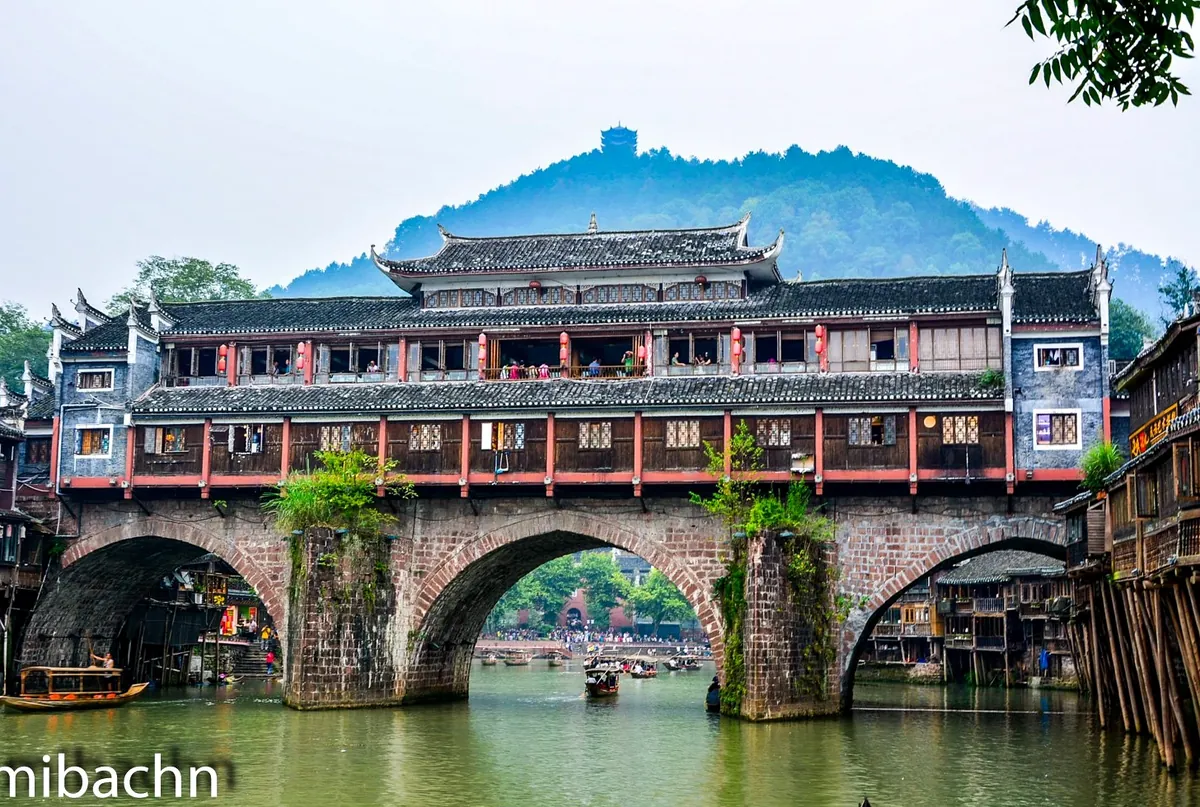
Tracing back through time to the founding of the Ming Dynasty, between the first and third years of Hongwu (1368 – 1370), Emperor Hongwu (Zhu Yuanzhang), having pacified the realm, remained deeply concerned about the rugged and perilous terrain of Xiangxi, where the fierce and resilient Miao people were always ready to revolt. Legend has it that, heeding the advice of imperial feng shui masters who claimed that the peaks of Mount Nanhuja and the Tuojiang River possessed the auspicious energy of a soaring dragon and dancing phoenix capable of producing a usurper, the Emperor secretly ordered the construction of a massive stone bridge across the narrowest section of the river. Tasked with “slashing the dragon vein,” this stone bridge was meant to act as a precious sword severing the spine of the sacred dragon, permanently extinguishing the unyielding spirit of the Miao people. Originally, it was bestowed the name Wolong Bridge (Reclining Dragon Bridge).
After weathering more than three hundred years of wind and rain, the bridge underwent a complete transformation during the Qing Dynasty. In the forty-third year of Kangxi (1704), the imperial court and local officials launched a large-scale restoration project, quarrying the region’s renowned red sandstone to build extremely solid foundations and arches. Here, the two-story Fengyu Bridge architecture made of precious timber officially took shape, and the bridge was renamed Hongqiao (Rainbow Bridge). The ingenious calculations of the ancients are clearly reflected in its dual functionality: the first tier was designed as a wide, airy pedestrian corridor for small merchants to bustlingly set up shops and trade, while the second tier served as a military outpost tower for strictly controlling the waterway gateway, as well as a fire watchtower to promptly warn the entire Fenghuang Ancient Town of fire hazards.
Entering the twentieth century, the turbulence of the times continued to test the durability of the structure. In 1914, the third year of the Republic, a fierce flood surging from the upper reaches swept away the wooden pavilion structure and severely damaged the sandstone piers. Faced with this desolation, two illustrious generals of the Xiangxi region, Chu Fuxian and Tian Yingzhao, stepped forward to rally gentry, noble clans, and merchants across the region to wholeheartedly donate funds to fully restore the sturdy three-span stone bridge and its traditional wooden pavilion. Between 2000 and 2001, the local government—with the dedicated artistic consultancy of master painter Huang Yongyu, an extraordinary son born from this very land—conducted a monumental century-old revival, embellishing the structure with graceful double-eaved yin-yang tile roofs, hanging wise horizontal lacquered boards and antithetical couples, and completing large-scale murals praising the land’s spiritual energy and talented people, thus cementing Hongqiao as the immortal soul of the ancient town.
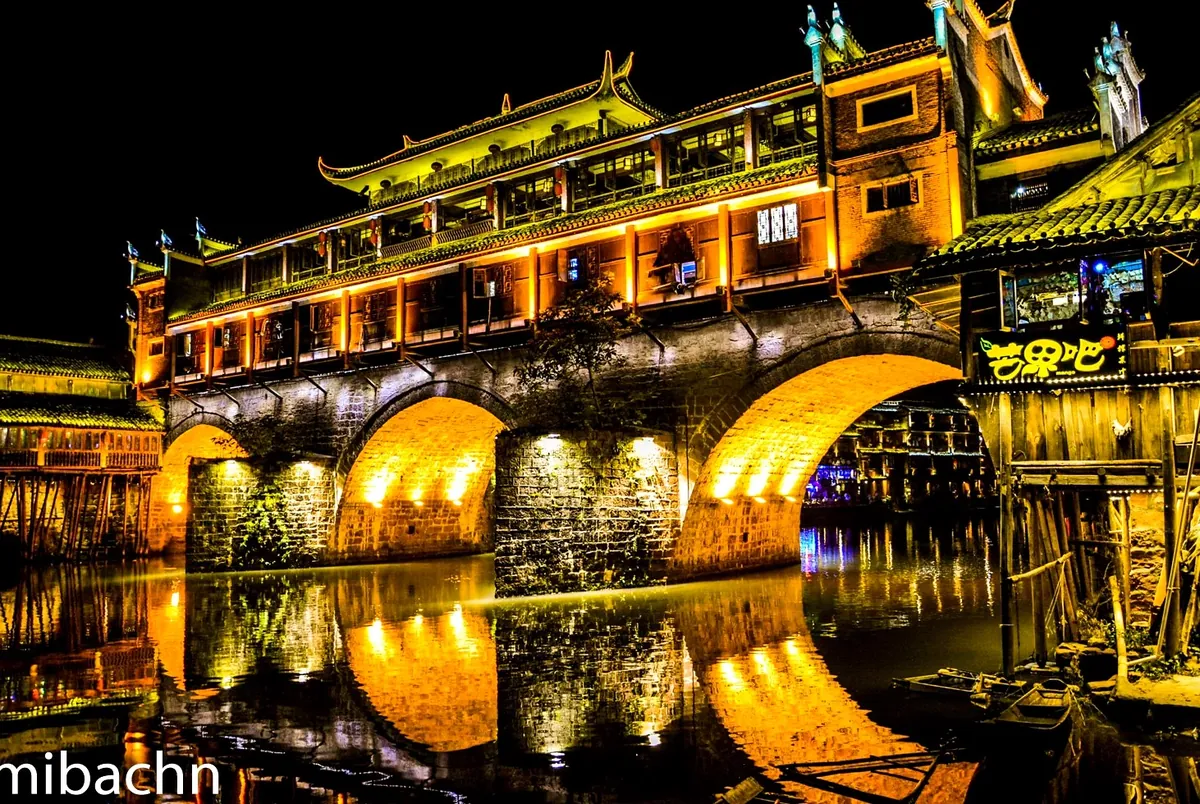
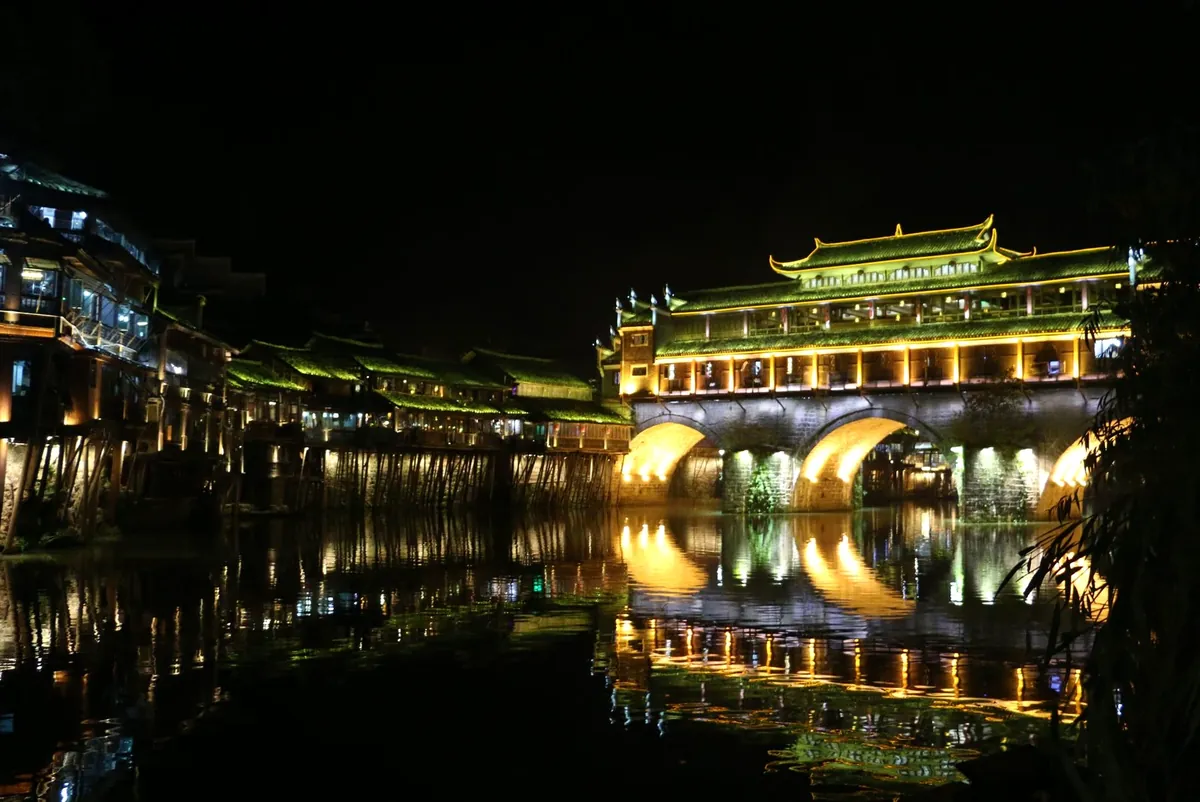
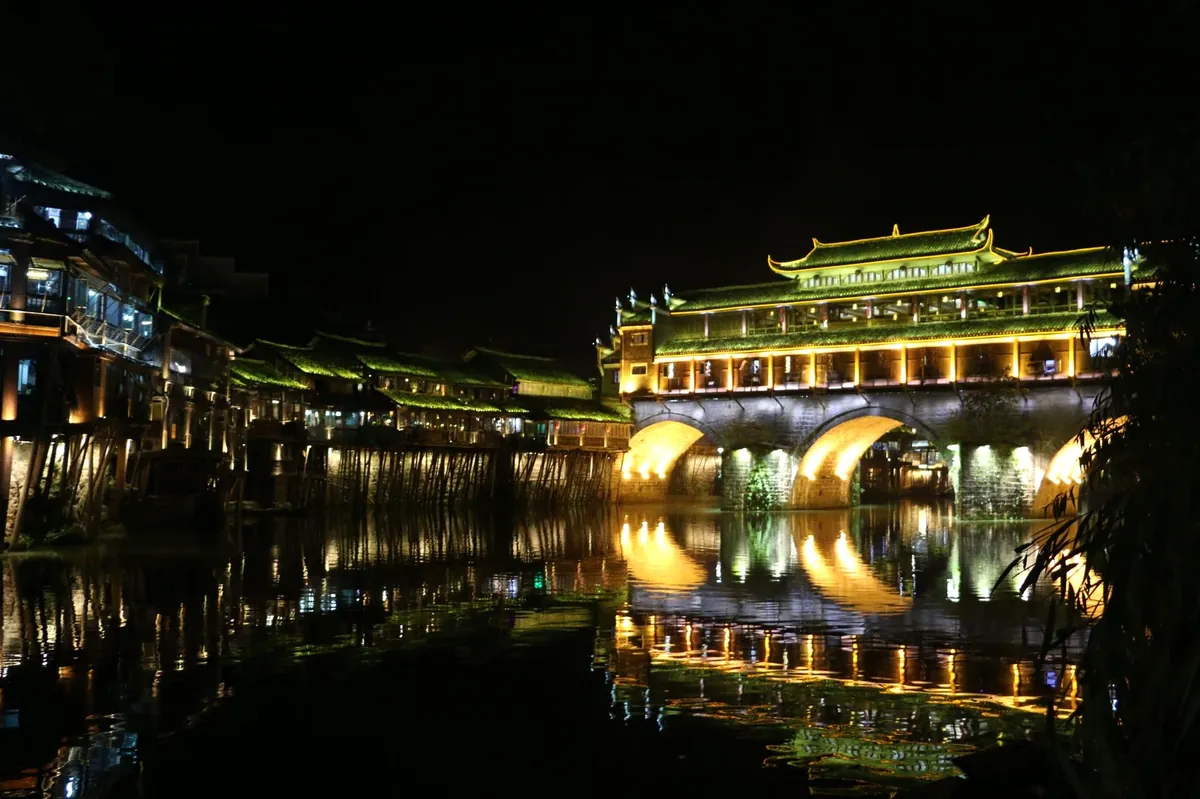
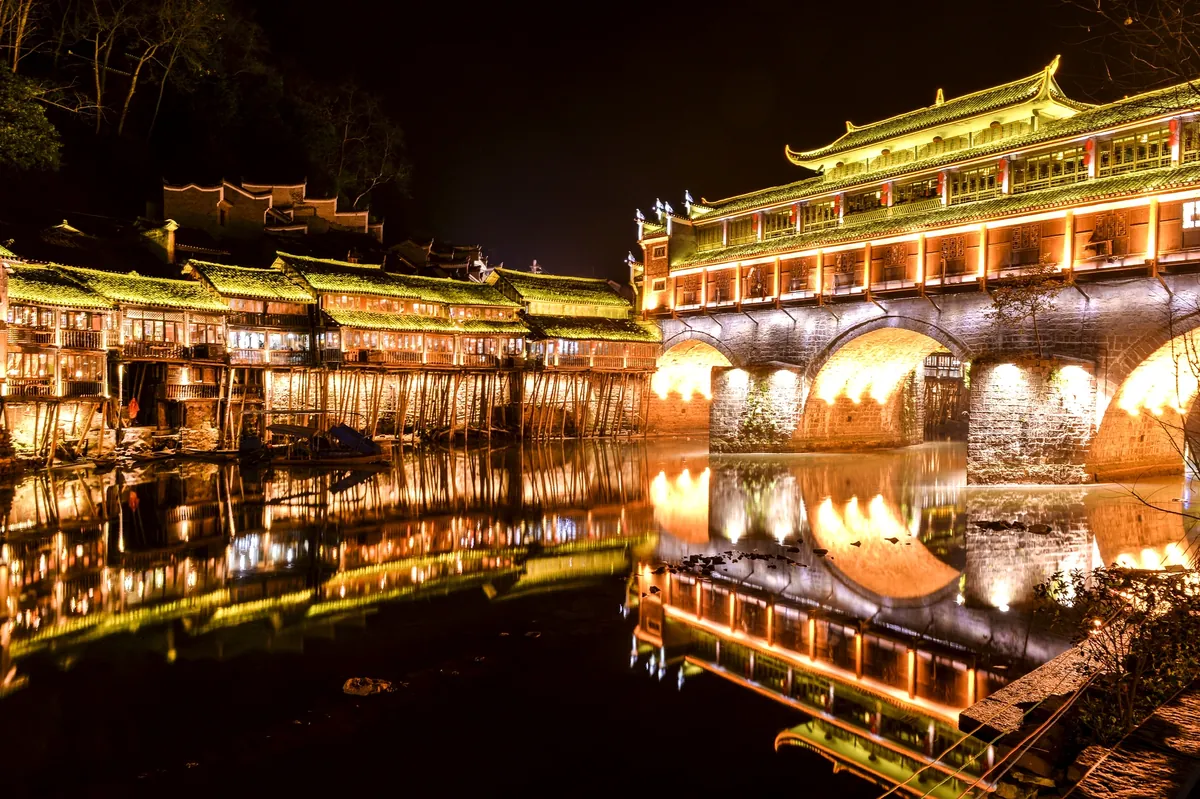
As night falls over the Tuojiang River, the Fengshui Hongqiao Pavilion illuminates brilliantly like a fairytale palace floating between reality and fantasy. The vibrant golden glow from the hidden lighting system weaves through the moss-covered sandstone arches and the traditional wooden tiered house structure above, casting radiant reflections shimmeringly upon the water’s surface like inlaid gold and jade. In the distance along both banks, the rustic Diaojiao Lou stilt houses nestled against the cliffs simultaneously light up, creating a breathtaking poetic dialogue between the centuries-old covered bridge and the tranquil rhythm of the ancient town.
From a geomantic slash steeped in the authoritarian power politics of the early Ming Dynasty, through the meticulous restoration by artisans during the prosperous Kangxi era, the loyalty of righteous men during the Republican period, and the dedication of contemporary artists, Hongqiao has completely shed the scars of war to transform into a peaceful rainbow shielding travelers from wind and rain. Every sandstone block polished smooth by travelers’ footsteps and every time-burnished wooden pillar here not only preserves the memory of the rushing Tuojiang River but also opens up a unique architectural and cultural treasure trove awaiting discovery and admiration by future generations.
Located in the heart of Fenghuang Ancient Town within the Xiangxi Tujia and Miao Autonomous Prefecture, Hunan Province, the Fengshui Hongqiao Pavilion occupies a rare and strategic geographical choke point. This imposing two-story bridge-cum-watchtower spans the narrowest and most critical bend of the Tuojiang River, where the current is squeezed tightly between cliff-lined banks before broadening downstream. The combination of frontier defense planning and Oriental architectural aesthetics has turned the structure into an absolute visual focal point, controlling the entire water and land spatial axis of the millennium-old ancient town.
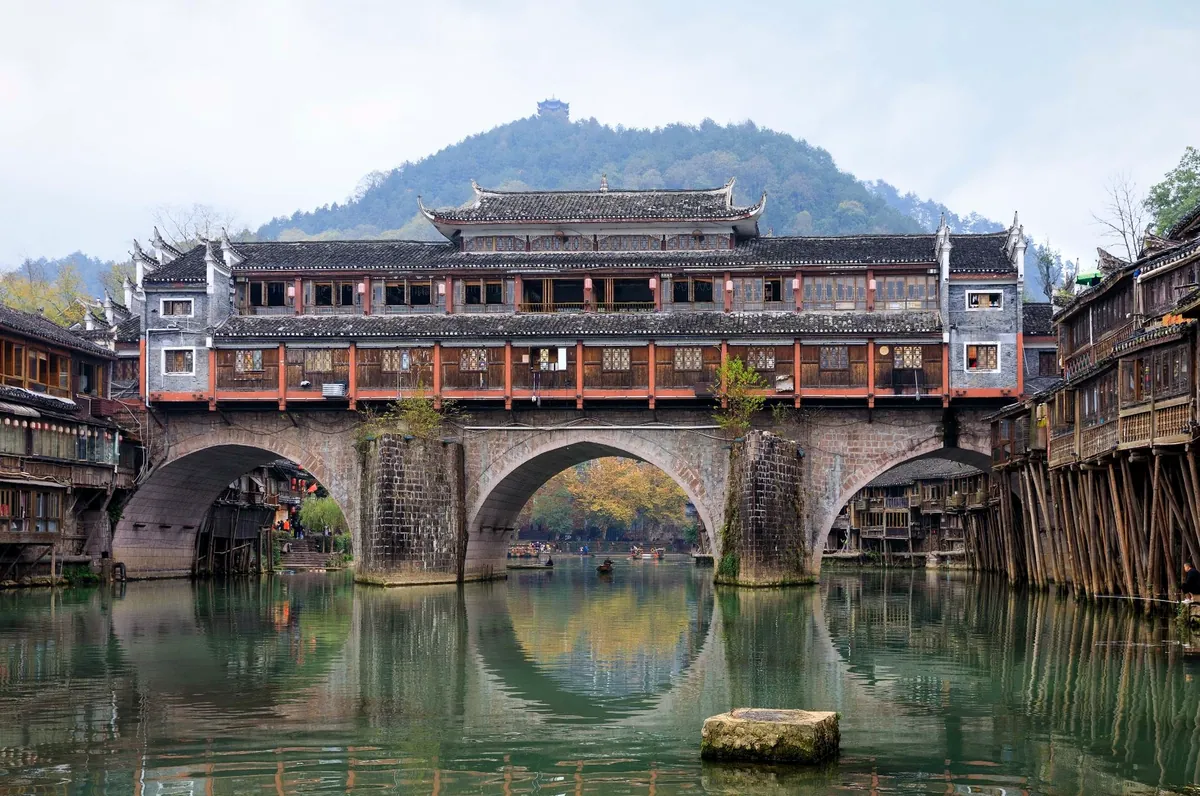
According to traditional feng shui principles, the terrain of Fenghuang Ancient Town is embraced by the rolling peaks of Mount Nanhua, resembling a sacred dragon winding and hiding amidst the misty clouds of western Hunan (Xiangxi). Meanwhile, the emerald-green waters of the Tuojiang River serve as the lifeblood nourishing this entire land of outstanding people and auspicious energy. Legend has it that in the early Ming Dynasty, imperial feng shui masters surveying this rugged border region were astounded by the imperial aura emanating from the dragon vein formation of Mount Nanhua. Fearing that formidable heroes might arise here to threaten the Central Plains throne, Emperor Hongwu (Zhu Yuanzhang) ordered the construction of a massive stone structure resembling a sharp precious sword plunging straight into the riverbed, cutting off the dragon spirit’s meridians. The legend of “Severing the Dragon Vein” associated with the birth of Hongqiao (Rainbow Bridge) symbolizes the feudal dynasty’s effort to tame nature and subdue the remote frontier.
Transcending the political folklore of feng shui, the Hongqiao Wind and Rain Tower blends seamlessly into the picturesque landscape of the local region. The stone arch bridge acts as a sturdy latch connecting both banks, serving as a convergence of traditional Miao ethnic residential architecture. Along the two riverbanks adjacent to the bridge piers lies a cascading complex of Diaojiaolou stilt houses, with fir-wood pillars deeply anchored into the waterlogged stone, supporting verandas extending out over the rippling surface. The interplay between the solid stone architecture of the wind and rain bridge and the rustic, delicate elegance of the precarious wooden houses creates a vivid ink-wash painting scene, where morning and evening mists transform the space into a magical, surreal realm.
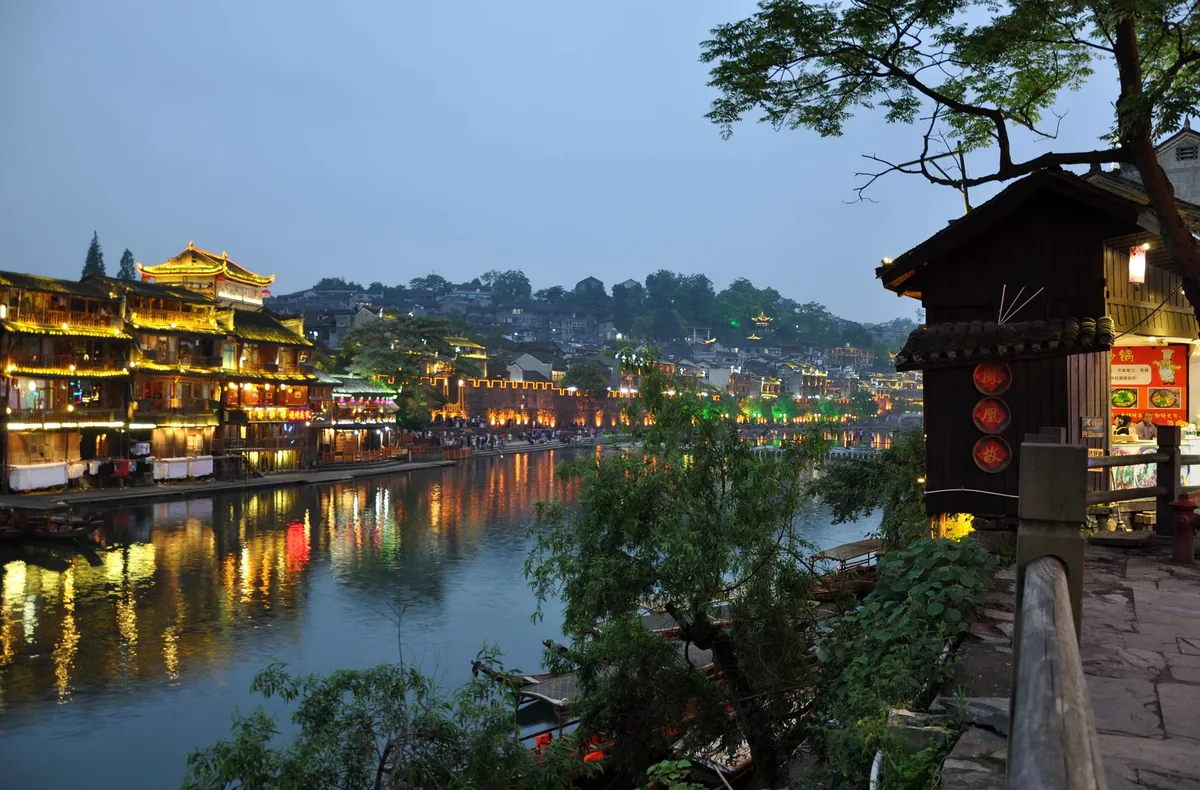
As night falls, the sublime and tranquil natural scenery of the Xiangxi river region instantly transforms into a breathtakingly enchanting spectacle. A system of lanterns and vibrant golden light spectra illuminates the entire ancient tower with its upturned tiled roofs and massive stone arch, casting brilliant reflections onto the calm surface of the Tuojiang River like a giant mirror. Along both banks, the Diaojiaolou stilt houses perched precariously on traditional wooden stilts simultaneously burst into warm illumination, reflecting magical shimmering colors that intertwine a millennia-old nostalgic heartbeat with contemporary splendor.
The rugged natural terrain combined with clever architectural planning demonstrates the ancient people’s standardized approach to living in harmony with nature. Despite roaring through countless flood seasons, the Tuojiang River flows gently as it passes through the bridge’s arches, thanks to the diversion design and solid stone block load-bearing capacity that has stood firm for centuries. Standing on the wind-swept upper floor, visitors can take in the panoramic harmonious blend between humanity and nature: in the distance is the hazy blue Mount Nanhua, at their feet flows the vibrant turquoise river, and all around is the culturally rich daily life of the Tujia and Miao ethnic communities. Therefore, the Hongqiao Wind and Rain Tower is not merely a conventional transport structure, but truly a feng shui soul, a magnificent bridge connecting the spiritual energy of the mountains with the mortal life of the borderlands.
Built according to the unique Fengyuqiao (Wind and Rain Bridge) style of the Tujia, Miao, and Dong communities, the Hongqiao Wind and Rain Tower is the flawless crystallization of Han Chinese solid stone arch bridge art and traditional mountainous wooden pavilion-building techniques. Far from being a simple river-crossing infrastructure, this wind and rain bridge architecture resembles a miniature Great Wall stretching across the Tuojiang River, sheltering travelers from wind, rain, and cold journeys while integrating commercial functions, cultural activities, and solid feng shui geomantic protection for the entire ancient valley town.
In terms of scale and load-bearing structure, Hongqiao boasts an overall length of up to 112 meters and a bridge deck width of 8 meters. The entire foundation and three load-bearing arches are crafted entirely from local red sandstone blocks, with each slab chiseled squarely and precisely down to every edge. To bind thousands of tons of stone firmly against the fierce currents of the Tuojiang River over centuries, the ancestors used a traditional mortar blended from quicklime, concentrated molasses, and sticky glutinous rice flour paste. The large arch span not only imparts a delicate elegance, supporting the massive architectural structure above, but also creates an optimal flood-discharge cross-section, protecting the structure robustly through rising flood seasons.
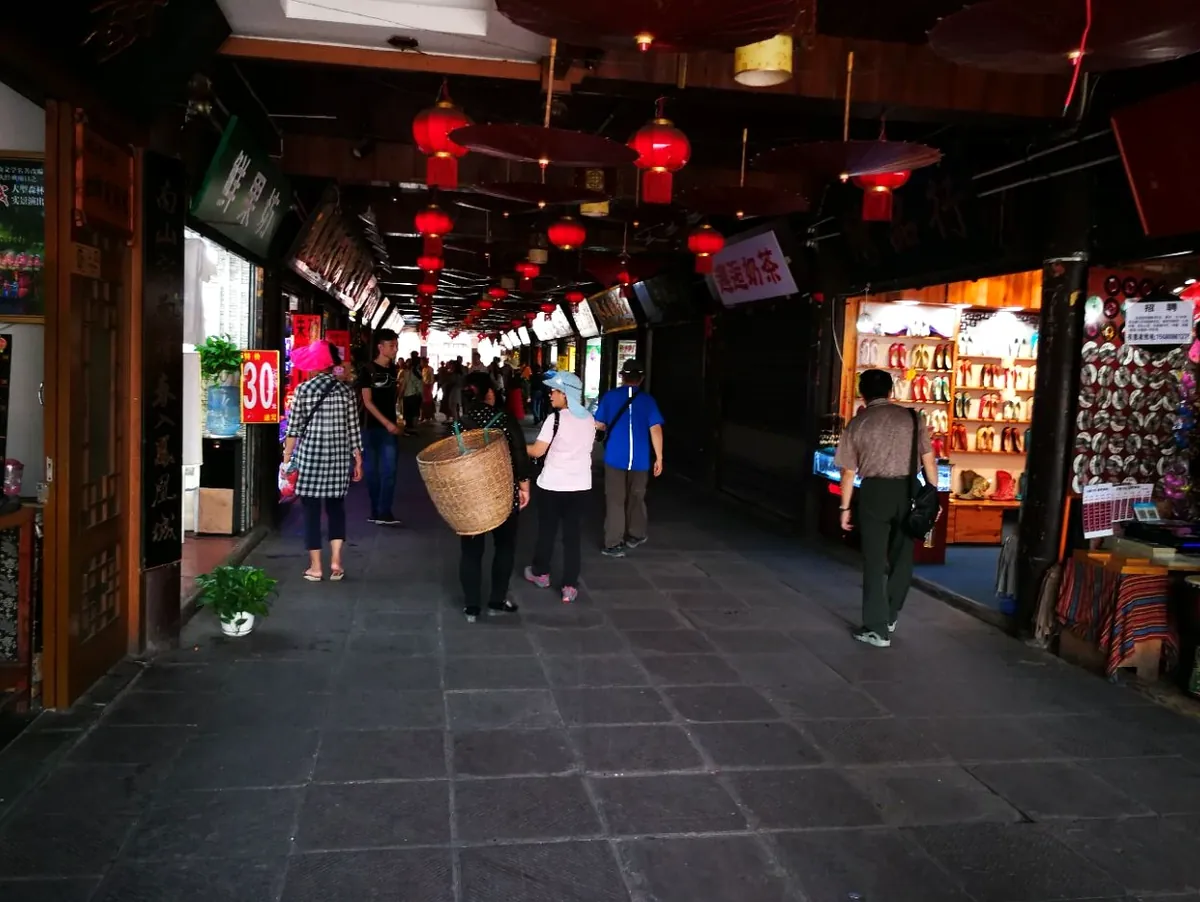
The spatial structure of Hongqiao is clearly layered by function, with the ground floor dedicated to daily life, featuring a 3.6-meter-wide slate-paved pedestrian corridor that runs throughout, sheltered by a somber, dark-grey yin-yang tile roof. Along both sides of the corridor are 12 ancient wooden stalls, where a variety of exotic flowers, herbs, local agricultural products, and exquisite handicrafts from the indigenous people are sold. Ascending to the second floor, one finds the serene Cultural Folklore Pavilion, built in a multi-eave style with upturned, soaring roof corners that reach toward the sky, adorned with relief carvings of dragons, phoenixes, and elegant lotus flowers. This pavilion currently preserves a grand historical mural by the renowned artist Huang Yongyu, sandstone restoration steles, and a tranquil tea house offering a sweeping 180-degree view that embraces the gentle bend of the river and the stilted Diaojiaolou buildings perched precariously on the slopes.
As dusk falls and night blankets the ancient town, the Hongqiao Fengshui Pavilion takes on an indescribably magnificent appearance, with its entire system of curved tiled roofs and bridge arches illuminated by warm, golden light. The regal golden glow from the bridge body blends with the deep red of lanterns hanging along the nearby shops, especially the Chinese-character sign of the “Meishi Buluo” (Food Tribe) restaurant by the water’s edge, casting shimmering, ethereal reflections onto the slow-moving river. This visual contrast between thousand-year-old antiquity and vibrant, bustling life creates a mystical space that captivates every traveler who stops to admire it.
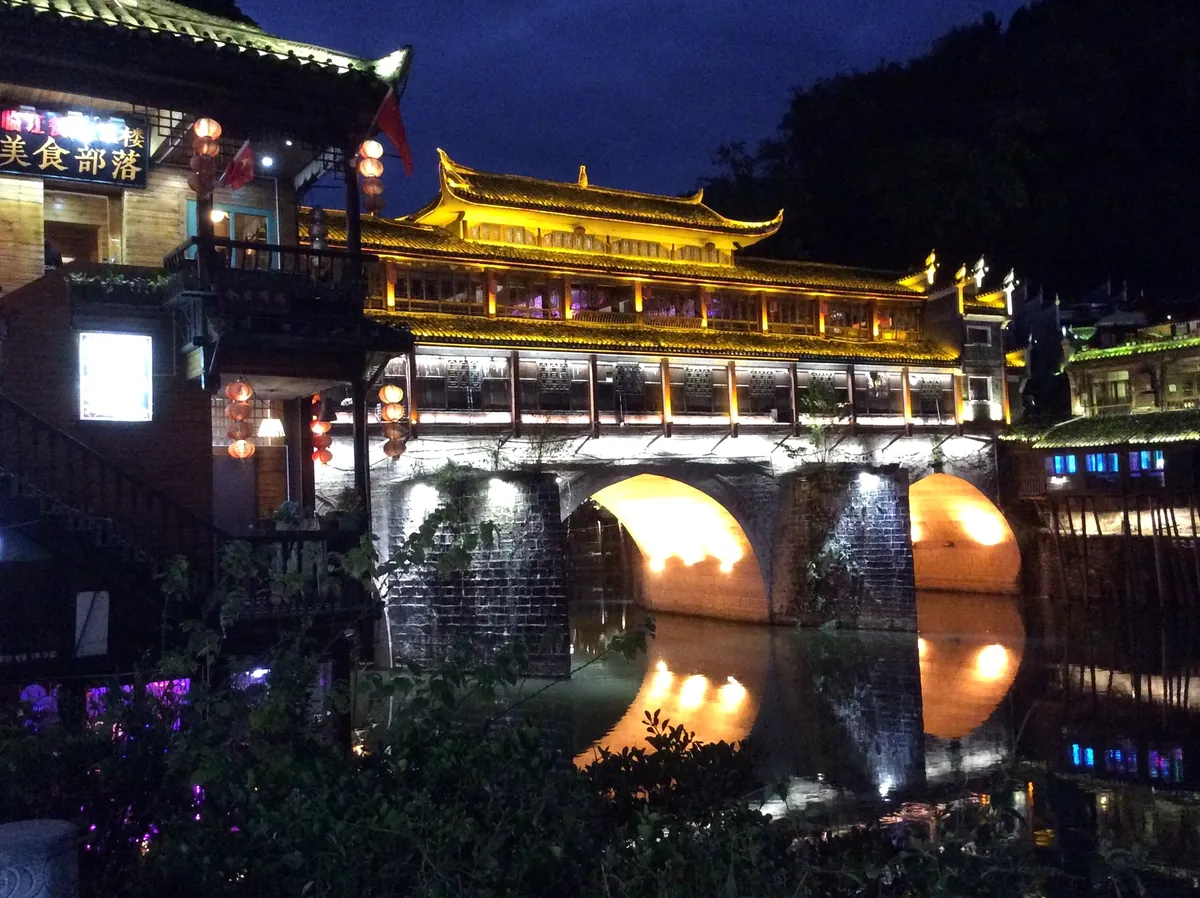
It is the rhythmic resonance between the sturdy sandstone foundation below and the exquisite wood carving art above that makes the Hongqiao Fengshui Pavilion a prime example of the architectural philosophy of harmony with nature. Every ironwood pillar, every lattice window, and every mossy tile row not only showcases the talent of the carpenters of Western Hunan but also preserves the memory of a bustling port city, where humanity and the river have harmonized through every breath for a thousand years.
As the sunset fades behind the rolling mountains surrounding the ancient town, Fenghuang enters the most magical transition of the day. During the “blue hour” from approximately 7:15 PM to 8:00 PM, the sky shifts from deep cobalt to a mysterious pitch black, marking the moment the Hongqiao Fengshui Pavilion awakens in a completely different guise. An artistic lighting system with warm-toned LEDs illuminates every curved roof ridge, tracing the mossy yin-yang tiles and embracing the three massive stone arches that plunge deep into the water. The somber structure of the day suddenly transforms into a magnificent palace of light reigning in the sky. The brilliant golden light illuminates every grain of the century-old red sandstone, casting its full reflection onto the mirror-like surface of the Tuojiang River, creating a visual realm where reality and dreams seem to blur completely.
Under the majestic shadow of the glowing ancient pavilion, the nightlife of Hongqiao begins to surge with vibrant energy, yet it never loses its ancient charm. Along both ends of the bridge and the stone embankment at the base of the structure, the stilted Diaojiaolou houses don their festive attire. A chain of nostalgic cafes, tea rooms, and rustic bars resonate with acoustic melodies, the sound of guitars blending with the gentle lapping of water against boat hulls. From the wooden balconies reaching out over the water, visitors can sip Biluochun tea and lose themselves in watching wooden passenger boats drift lazily along the current. These simple bamboo boats, without motors, use only wooden oars to gently stir the water, carrying travelers through the glowing bridge arches. Looking up, the entire system of purlins, wooden columns, and intricate carvings of the Fengshui Pavilion appears towering and majestic, offering a breathtaking and poetic visual experience.
Beyond the sounds of daily life, the architectural space of Hongqiao is also positioned as a central stage for top-tier live-action art projects combined with modern technology. The application of multi-point 3D Mapping technology directly onto the surfaces of the ancient stone arches and the Tuojiang River opens up a completely new way of expressing heritage. Against the towering backdrop of the stone pavilion, light projections vividly recreate legends from the early Ming Dynasty, when the Fengshui master Liu Bowen was ordered by the imperial court to sever the dragon vein of the Nanhua Mountain range to suppress the spiritual energy of the South. This led to the creation of the bridge-cum-Fengshui pavilion as a “treasure sword” plunged into the river to neutralize and protect the geomantic fortune for generations to come. Along with the ancient tale of the dragon-slaying, the poignant love story between the brave youth Thao Thao and the beautiful Tuojiang maiden is woven through the language of live-action dance, Miao-Tujia ethnic music, and magical laser light effects, transforming the thousand-year-old static space into a visual epic that touches the heart.
The lighting and performance art at the Wind and Rain Bridge Pavilion (Fengshui Hongqiao Pavilion) strictly adheres to the principle of non-invasive heritage conservation. All luminaire equipment utilizes high-tech LED light sources with tightly controlled wavelengths to eliminate thermal radiation, prevent the growth of harmful microorganisms, and avoid altering the structure of the ancient sandstone. Creating a colorful nocturnal economic landscape around the Hongqiao axis not only honors indigenous cultural values but also transforms this architectural symbol into a luminous heart, keeping the prosperous pulse and immortal soul of the entire ancient city alive through the still, long night.
Under the deep, solemn shadows of the Wind and Rain Bridge Pavilion, the Tuojiang River not only carries ancient legends and historical tales but also serves as the cradle nurturing a pristine, hearty, and mountain-infused Xiangxi culinary school deeply rooted in the traditions of the Miao and Tujia ethnic groups. As the hazy evening mist descends and blankets the mossy stone spans, the rich, enticing aromas of traditional family recipes begin to weave through every wooden door gap, releasing warmth to banish the damp, biting chill unique to the river valley. Here, cuisine is not merely a combination of spices, but a legacy of memory preserved rigorously through the vicissitudes of time.
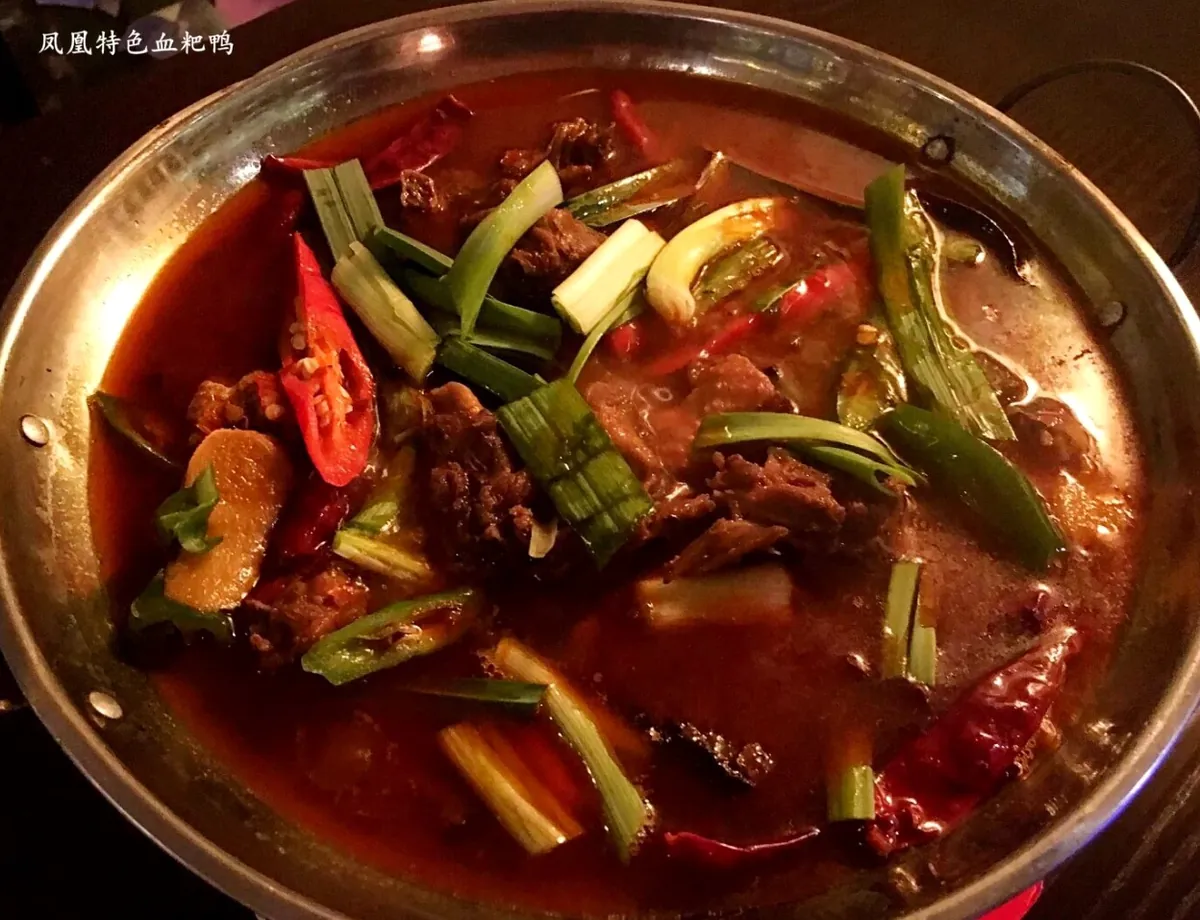
Holding the supreme position in the culinary map around the base of the Hongqiao bridge is the iconic Blood Duck Hotpot (known in Chinese characters as Fenghuang Xueba Ya). The soul of this heritage dish lies in the elaborate preparation of the solidified duck blood block: fresh duck blood collected upon processing is blended with fragrant local sticky rice, carefully steamed until the grains bind tightly together, then cut into chess-piece-sized blocks and deep-fried until the outer crust is crispy while the inside remains tender and spongy. These blood-and-rice blocks are subsequently tossed in a wok and stir-fried with firm Xiangxi mountain duck meat, tightly mingling with tongue-tingling spicy fresh chilies and specially crafted traditional fermented soybean paste. The rich, savory, and sweet duck meat harmonizes with the chewy, nutty blood cakes soaked in thick, glossy sauce, creating intense layers of flavor that leave travelers captivated after just a single taste in the middle of the breezy bridge, forever unforgettable.
Strolling along the granite embankment at the foot of the Wind and Rain Bridge Pavilion, the pure, steaming aroma of the Miao-style Sour and Spicy Fish Hotpot captures the traveler’s footsteps once more. The Miao people have an enduring proverb that going three days without eating something sour makes one’s legs too weak to stand firmly, and this renowned sour fish soup (suantangyu) serves as the most vivid testimony to that philosophy. Fresh fish just netted directly from the rushing currents of the Tuojiang River are dropped entirely into a broth cooked from naturally fermented wild tomatoes, combined with wild forest herbs and Xiangxi earthenware-jar-pickled chilies. The elegant, soothing sourness spreads across the tip of the tongue with the very first sip, awakening all senses and providing a miraculous warming vitality amidst the freezing nights around the ancient town.
Right on the stone steps leading to the lower level of the Hongqiao bridge, street food culture displays its rustic charm through batches of Golden Crispy River Shrimp Fritters. Tiny, translucent river shrimp freshly scooped from the rocky rapids are evenly mixed with smooth flour, finely chopped scallions, and a hint of local chili powder, then dropped straight into a bubbling wok of oil over a glowing charcoal stove. The delightful sizzling sound alongside the original sweet, nutty, and crispy flavors of these river and mountain alluvial products transforms this humble dish into a poetic experience tied to the memories of anyone stopping by the Tuojiang River.
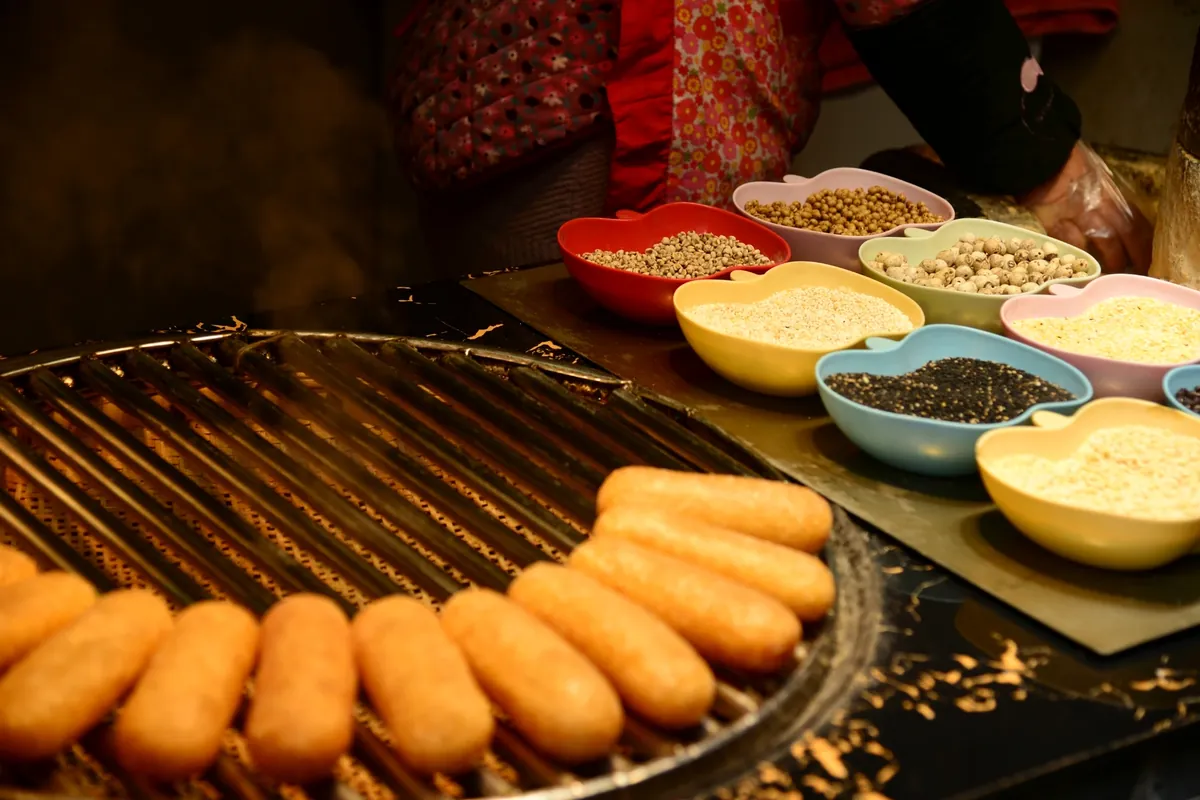
Alongside savory dishes, the warm, sweet fragrance of Fenghuang Handcrafted Ginger Candy has long been a nostalgic gift originating as far back as the Qianlong Emperor’s reign during the Qing Dynasty. In front of the traditional pastry shops around Hongqiao, elderly artisans demonstrate the skillful candy-pulling process: natural sugarcane molasses mixed with aged Xiangxi ginger juice boiled in a blazing red copper wok, which, once reaching a certain viscous consistency, is rhythmically stretched over a towering wooden pillar in expert motions resembling the dance of a fire phoenix. After shaping, each ginger candy stick turns a pale golden hue, offering a crispy bite with a harmonious sweet and spicy flavor that dispels the highland chill.
The culinary canvas of Xiangxi draws to a complete close as night fully falls, giving way to skewers of grilled meat marinated in forest peppers fragrant with Miao herbal spices, trays of deep-fried jet-black Huogongdian stinky tofu served with fiery chili dipping sauce, and above all, a pot of thousand-year fermented Xiangxi Ancient Tree Black Tea. Leaning against the railing of the Wind and Rain Bridge Pavilion, sipping a bold, astringent cup of black tea and savoring the lingering, profound sweet aftertaste at the back of the throat, one truly understands why the culinary culture here possesses such timeless allure.
To fully capture the soul of the Wind and Rain Bridge Pavilion in one’s field of vision, understanding the breathing rhythm of the Tuojiang River at different times of the day is crucial. The most precious golden hour to admire the pristine beauty of the ancient bridge falls between 05:30 and 06:45 in the early morning. At this time, the hazy mist drifting from the upper reaches floats gently over the azure water, the serene space completely devoid of noisy tour groups, leaving only the sound of gentle oars splashing and the majestic silhouette of the ancient pavilion looming vaguely like a breathtaking Tang-dynasty natural landscape. In contrast to the morning tranquility, the transitional moment from 19:15 to 20:00 every evening unfolds a visual feast as the entire lantern system and colored LED strips illuminate each upturned eaves, casting brilliant reflections onto the churning river and transforming the towering stone structure into a blazing rainbow arching across both heritage shores.
To fully admire this architectural masterpiece, choosing the right vantage points and shooting locations offers multiple angles rich in artistic depth. The most classic sightseeing spot is the Jumping Rock Steps (Tiao Yan – 跳岩), where round stone pillars emerge from the water, allowing you to capture the western stone arch and the flow of people crossing the bridge in one frame. Another epic perspective is from the stone embankment near the North Gate of the Ancient Town looking upstream, clearly revealing the majestic posture of the structure nestled against the Nanhua Mountains. In a more serene and contemplative space, the tea house balcony on the second floor of Hongqiao itself allows visitors to sip pure Tieguanyin tea while taking in the bustling fishing life below. Regarding visiting regulations, the first floor of the pedestrian bridge is open 24/7 free of charge for strolling and admiring the street markets, while the cultural preservation, calligraphy, and viewing space on the second floor charges a separate ticket of about 50 RMB per trip, or is fully bundled in the internal scenic area ticket package of the ancient town.
The spectacular breakthrough in the transportation infrastructure of western Hunan has completely eliminated the challenging travel barriers of the past. Via the Zhangjihuai High-Speed Railway (Zhangjihuai HSR), travelers take only 58 minutes from Zhangjiajie to set foot at Fenghuang Ancient Town Station. From this modern station, visitors can board the 9.12 km Fenghuang Maglev train with a design speed of 100 km/h, gliding smoothly past lush green hillsides and taking the group directly to the suburban stop right next to Hongqiao without the need for complex bus transfers.
Alongside infrastructure convenience, being equipped with commercial risk identification skills in tourist areas is an element that cannot be overlooked. Travelers should stay alert against subsidized tours or unusually cheap tours, as they often harbor itineraries that force shopping at fake Miao silver workshops claiming miraculous healing powers, traditional Chinese medicine clinics using pulse-taking to scare people into expensive prescriptions, or jade shops playing tricks of expressing gratitude to foreign tourists. When experiencing the service of dressing up as a Miao maiden and renting traditional costumes for souvenir photos around the base of the tower, the prerequisite is to decisively agree in writing or via text message on the total number of raw photo files received, the number of post-processed photos, the deadline for delivery, and any incurred costs if exceeding the specified time frame, to avoid disputes that could ruin the trip.
To fully capture the tranquil beauty of Fengshui Hongqiao and deeply feel the cultural flavors along both banks of the Tuojiang River without worrying about unexpected risks, choosing a standardized service journey is the optimal solution. You can refer to the detailed itinerary and register for a practical experience with the Zhangjiajie – Fenghuang Ancient Town – National Forest Park – Miao Village 6D5N Tour to enjoy an elegant, safe, and culturally rich excursion.