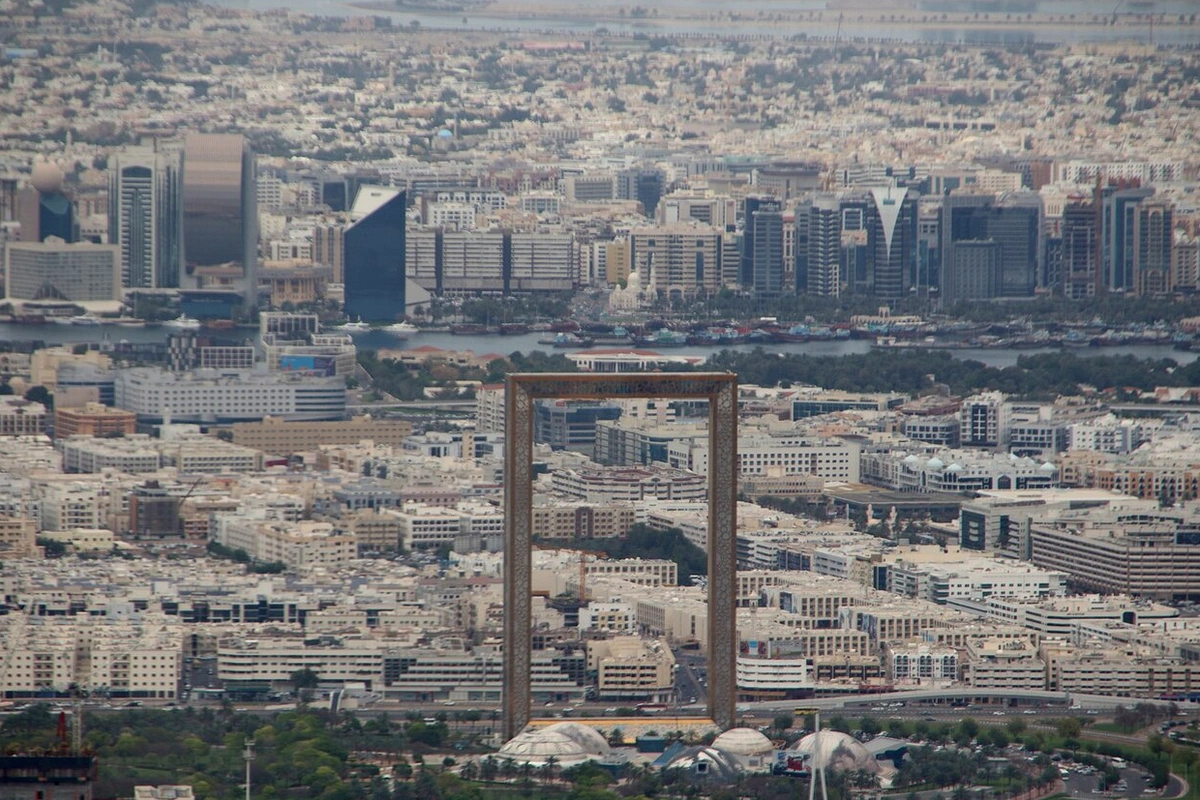
The creation of the Dubai Frame within the modern urban landscape of the United Arab Emirates reflects a long-term strategic vision aimed at chronicling a transformation unprecedented in human history. Situated in Zabeel Park, this monument is far more than a tall architectural structure; it is conceived as a prism of time connecting the humble past of a pearl-diving fishing village with the future of a high-tech global metropolis. The original concept for an iconic landmark bridging two halves of the city emerged from an international design competition held in 2008, attracting hundreds of architects from around the globe. This initiative formed part of Dubai’s broader effort to establish philosophical spatial landmarks where residents and visitors alike can observe the city’s evolution comprehensively from a single vantage point. Translating blueprints into a colossal structure of steel, glass, and reinforced concrete required cutting-edge twenty-first-century construction engineering, demonstrating the technical prowess of a Gulf nation rising as a premier regional economic hub.
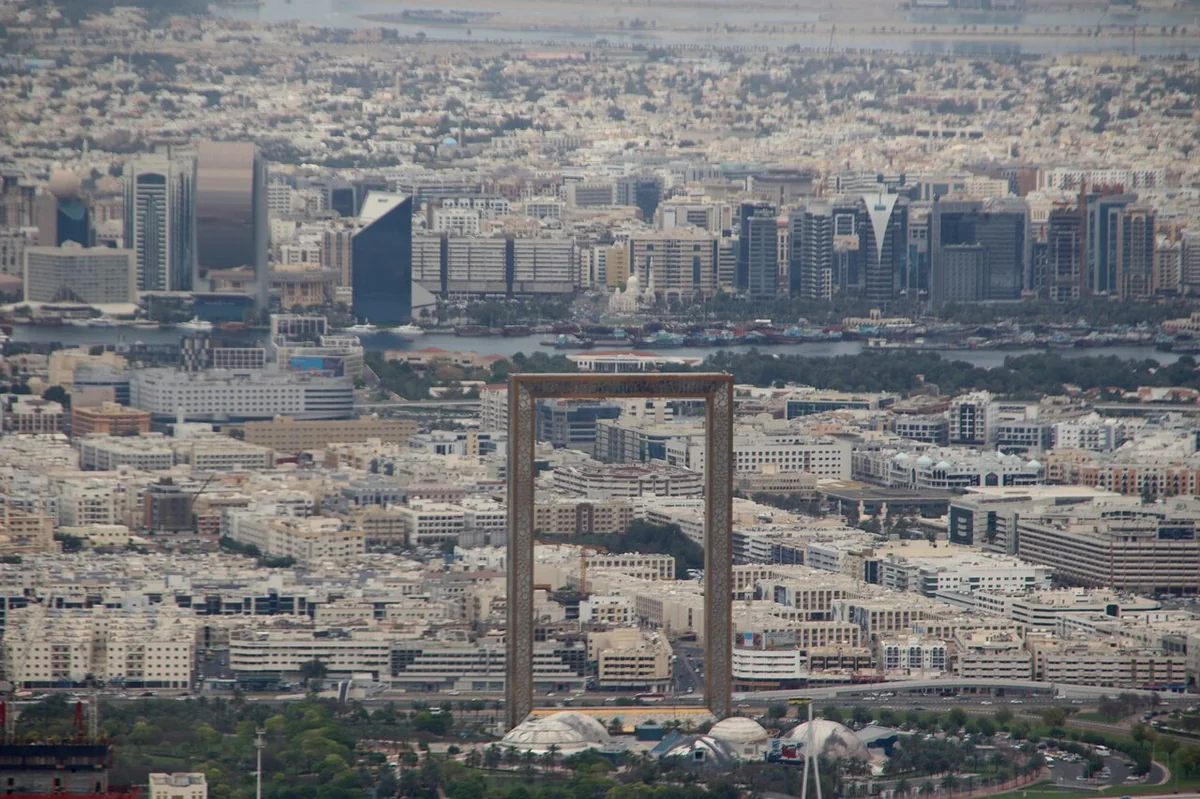
The historical trajectory leading to the birth of the Dubai Frame is closely tied to master-planning strategies designed to shape the city’s cultural and architectural identity in the post-oil era. Prior to the monument’s official inauguration in early 2018, Dubai’s urban fabric underwent dramatic transformations following the discovery of oil in the 1960s and the subsequent infrastructure boom of the 1990s and early twenty-first century. As skyscrapers rose continuously and gradually obscured traces of the past, civic authorities recognized the urgent need for a space dedicated to historical reflection and remembrance. The Dubai Frame was envisioned to reconcile hyper-modernization with the preservation of the indigenous community’s collective memory. Standing 150 meters tall and 93 meters wide, the structure faithfully mirrors the proportions of a golden-ratio picture frame, making a bold aesthetic and historical statement in the desert that reminds contemporary generations of the modest yet resilient roots of a coastal community.
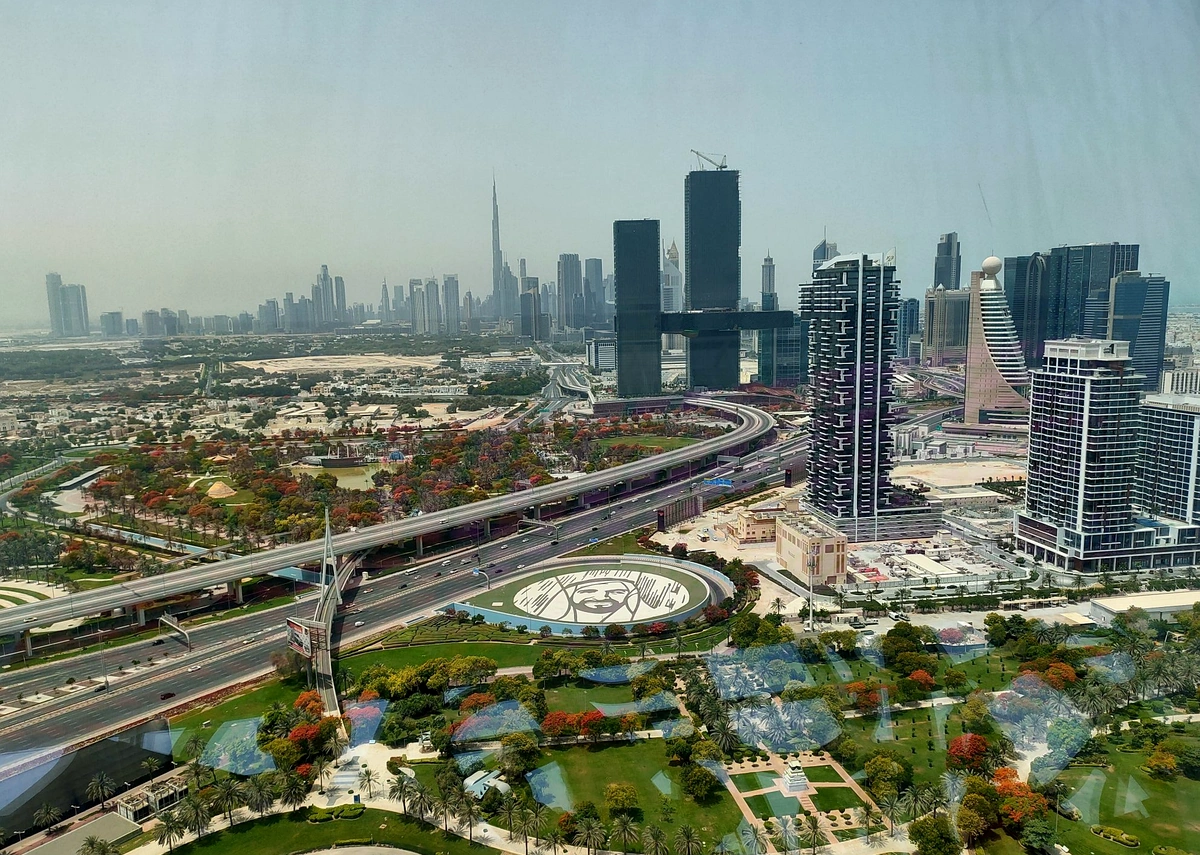
In terms of symbolic stature, the Dubai Frame serves as a one-of-a-kind spatial axis clearly delineating the emirate’s two dimensions of history and growth. From the observation deck along the glass sky bridge at the monument’s summit, looking north reveals Deira and Bur Dubai—districts preserving traditional souks, historic creeks, and classic Middle Eastern houses crowned with traditional wind towers. Conversely, turning one’s gaze south reveals a dramatically transformed panorama dominated by twenty-first-century architectural icons, led by the soaring silhouette of Burj Khalifa and sweeping, technology-lined boulevards. This deliberate visual contrast elevates the Dubai Frame into a profoundly philosophical landmark where history and future coexist within a single frame, embodying the guiding ethos of Dubai’s leadership and people: advancing into the future without ever forgetting one’s roots.
Inside this monumental structure, cultural meaning deepens through interactive multimedia museums and exhibitions arranged across the mezzanine and sky-deck levels. The ground-level exhibition space employs advanced lighting technology, rare archival photography, and evocative dioramas to recreate life in Dubai prior to the oil era, when livelihoods relied largely on pearl diving, fishing, and small-scale maritime trade. The transition from a subsistence economy shaped by a harsh natural environment to a global knowledge and service hub is narrated through compelling documentary visuals, helping visitors appreciate the sacrifices and extraordinary perseverance of earlier generations. At the opposite end of the journey, the Future Dubai gallery on the upper level offers an immersive vision of the city 50 to 100 years from now, where artificial intelligence, ecological engineering, and aerospace innovation anchor the metropolis’s continued prosperity.
The heritage significance of the Dubai Frame also extends into cultural diplomacy and how the monument redefines architectural iconography in the contemporary world. Whereas many global landmarks pursue grandeur through extreme height or complex organic forms, the Dubai Frame adopts a distilled, minimalist geometric approach. Its gold-clad rectangular facade draws inspiration from the ornamental motif on a millennia-old ring unearthed at a local archaeological site, affirming the region’s deep historical roots well beyond its modern oil-boom narrative. Standing as a thoughtful counterpoint to supertall towers, the structure demonstrates that honoring the past provides the strongest foundation for humanity’s boldest leaps forward.
Within the network of international cultural and architectural landmarks, the Dubai Frame holds substantial research value for contemporary urban planners and architectural historians. It illustrates how a state can harness architecture as a vehicle for national storytelling, shaping collective memory and educating younger generations about a challenging yet proud developmental journey. Integrating smart glass technology capable of shifting opacity in response to sunlight, alongside a massive steel structural frame engineered to withstand extreme desert conditions, makes the Dubai Frame a twenty-first-century engineering marvel. Over time, it continues to stand as one of the Middle East’s most compelling chronicles of urban spatial transformation, leaving behind an enduring intellectual legacy for global urban studies.
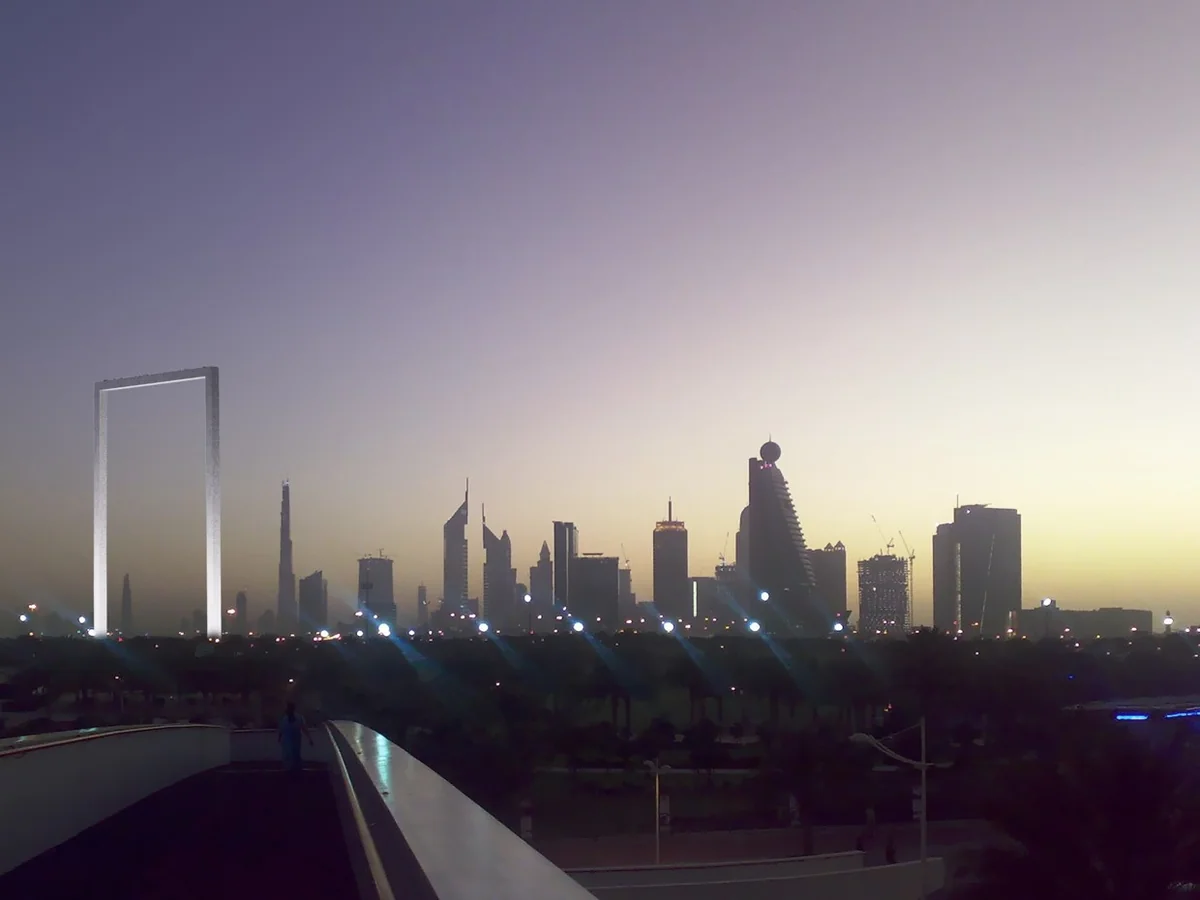
Officially designated in urban planning records as Berwaz Dubai, the architectural landmark known as the Dubai Frame stands on the strategic boundary between Dubai’s historic heritage quarters to the north and its modern commercial metropolis to the south in the United Arab Emirates. Geographically, the monument is situated within Zabeel Park, a sprawling green landscape positioned directly along major arterial corridors linking long-established districts such as Deira and Bur Dubai with twenty-first-century urban developments. This location was no geographical coincidence, but rather the outcome of rigorous master planning aimed at creating a visual focal point capable of uniting the desert city’s historical breadth and futuristic depth within a single sightline. Originally part of the flat coastal plain of the Persian Gulf, the surrounding grounds were landscaped into a curated urban ecosystem providing an ideal ecological pedestal for the monument’s metaphysical form.
In terms of master planning and design concept, the Dubai Frame was conceived by architect Fernando Donis, winner of the international design competition organized by Dubai Municipality in partnership with ThyssenKrupp Elevator in 2009. The core concept behind his proposal was a monumental picture frame built to classical geometric proportions, acting as a temporal lens condensing the emirate’s remarkable evolution from a modest coastal pearl-diving settlement into a global megacity. The structure comprises two vertical towers rising 150 meters, linked at their summit by a 93-meter-long horizontal glass bridge and anchored at their base by a low-rise podium housing subterranean exhibition galleries. The golden ratio between height and width was calculated according to strict geometric principles, ensuring visual equilibrium when viewed from major roadways encircling Zabeel Park.
Interior spatial partitioning is organized across three distinct layers of historical and urban perception, beginning on the ground level where visitors step back into the city’s past. Here, an interactive gallery serves as a sensory museum recreating Dubai’s formative identity through advanced projection mapping, three-dimensional models, and surround sound—vividly bringing to life nomadic traditions, pearl-diving expeditions, and the discovery of oil that transformed the region’s economic destiny. From this gallery, high-speed panoramic elevators concealed within the tower structure whisk visitors vertically in roughly 75 seconds up to the horizontal sky bridge at the summit, where unobstructed 360-degree views open across the entire city.
The upper sky bridge is designed as a linear observation gallery in which visual storytelling is deliberately framed by the viewer’s orientation. Looking north, the monumental frame acts as a time machine gazing out over historic Deira, revealing bustling traditional markets, wind-tower architecture, and vessel-filled creeks steeped in centuries-old Arab heritage. Turning southward, the exact same frame encapsulates the gleaming skyline of New Dubai—crowned by Burj Khalifa and rows of futuristic supertall towers symbolizing boundless ambition, economic dynamism, and twenty-first-century urban vision.
In terms of cladding materials and facade engineering, the exterior skin of the Dubai Frame exemplifies precision mechanical engineering merged with ornamental surface artistry. The outer surfaces of both vertical towers and the upper crossbeam are clad in gold-plated perforated aluminum-alloy panels inspired by the geometric motif found on an ancient ring excavated at the Saruq Al Hadid archaeological site. Beyond their deep cultural symbolism, these interlocking circular patterns perform a vital technical function in mitigating intense desert solar radiation, reducing heat gain inside the building through thousands of perforations calibrated via mathematical optimization models.
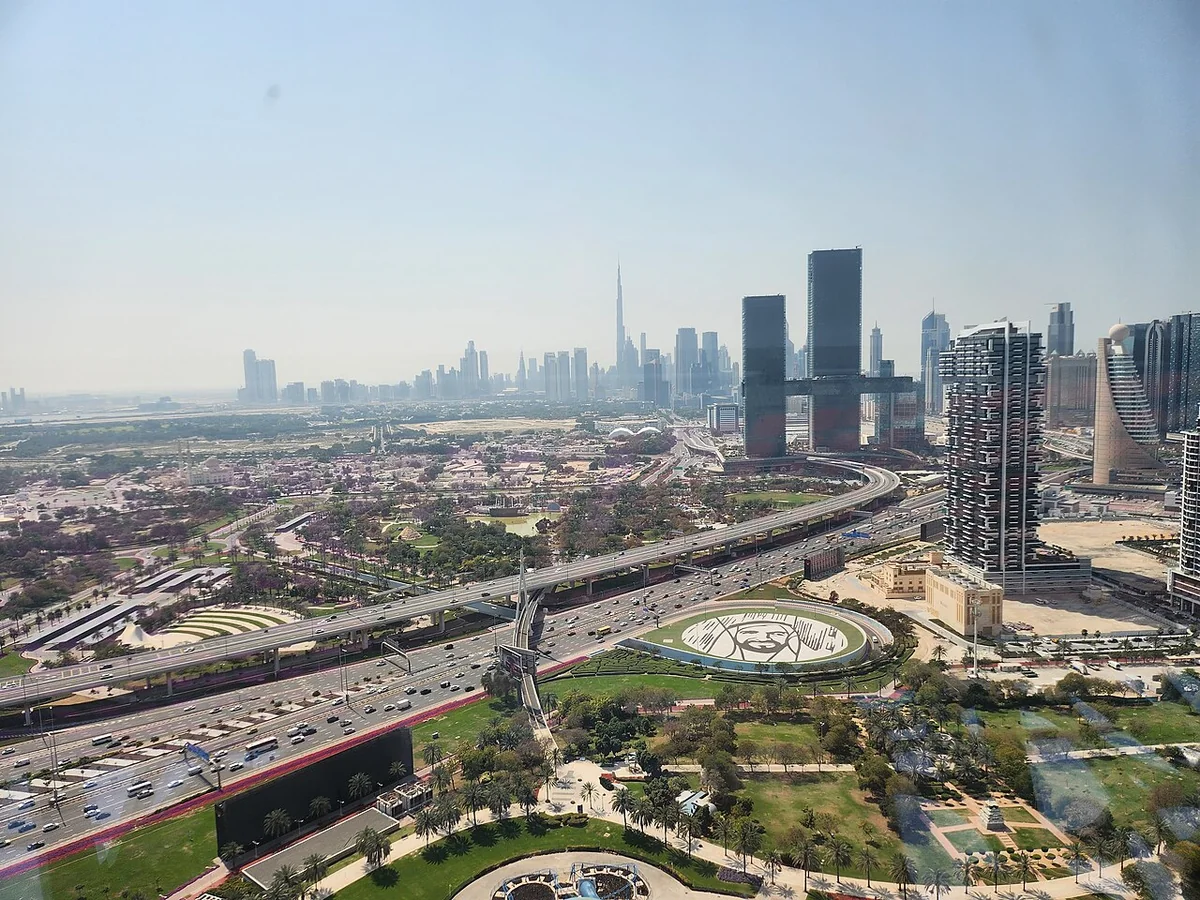
The surrounding landscape was master-planned in harmony with the expansive greenery of Zabeel Park, creating an essential ecological and visual buffer separating the monumental structure from the bustle of nearby highways. Pedestrian walkways, reflecting pools, and native plantings arranged around the base generate mirror-like reflections that make the frame appear to float suspended in mid-air from afar. Landscape architects selected drought-tolerant plant species with specialized foliage to maintain lush year-round greenery without excessive irrigation, aligning with the emirate’s broader sustainable urban development goals for major public landmarks.
The defining engineering highlight of the Dubai Frame’s interior space lies at the center of the horizontal sky bridge, where the walkway is fitted with smart liquid-crystal glass panels capable of shifting instantaneously from opaque to crystal-clear the moment someone steps onto them. Beyond creating a thrilling visual sensation of walking suspended 150 meters above the ground, this feature showcases high-strength structural steel combined with advanced composite materials. The primary load-bearing steel frame is seamlessly concealed inside the gold-clad exterior shell, ensuring that from outside the monument retains the pure, uninterrupted elegance of a flawless geometric picture frame free of exposed columns or cross-bracing.
Since opening to the public, the Dubai Frame has established a new benchmark for using iconic architecture to shape public space and contemporary urban planning discourse. Far more than a magnet for international travelers, it serves as an intuitive educational instrument inviting urban planners, architects, and local residents alike to reflect critically and multidimensionally on the city’s growth trajectory. By uniting strategic site placement, minimalist geometry, cutting-edge material science, and curated interior spatial storytelling, the Dubai Frame stands as one of the Middle East’s finest twenty-first-century works of civic architecture.
Rising within Dubai’s Zabeel Park, the architectural landmark known as the Dubai Frame stands as a monumental geometric form anchoring modern urban space and serving as a beacon across space and time. Designed by architect Fernando Donis through an international competition hosted by Dubai authorities in 2009, the structure embodies a distinctive urban planning philosophy in which landmarks do more than fulfill utilitarian roles—they narrate history. Measuring 150 meters high and 93 meters wide, the monument faithfully replicates the proportions of a standard picture frame enlarged to monumental scale so as to encompass the surrounding cityscape. Its creation reflects a nation’s quest to balance cherished heritage with bold future ambition through a minimalist architectural language layered with philosophical meaning.
From a structural engineering and materials standpoint, the Dubai Frame represents a major achievement in twenty-first-century civil engineering, uniting reinforced concrete, high-strength structural steel, and digital glazing. The foundations of its two vertical towers—supporting thousands of tons—are anchored deep into the earth via bored pile systems engineered to ensure stability against coastal desert soil conditions and high wind loads off the Persian Gulf. Connected at their peak by a 93-meter horizontal glass bridge, the two vertical shafts form an immense column-free window in the sky. To achieve seamless monolithic beauty, the entire exterior is wrapped in laminated glass panels paired with gold-plated stainless-steel geometric cladding. These metallic panels not only shield the underlying structure from intense solar radiation and desert sandstorms, but also generate shifting visual reflections throughout the day as sunlight angles change.
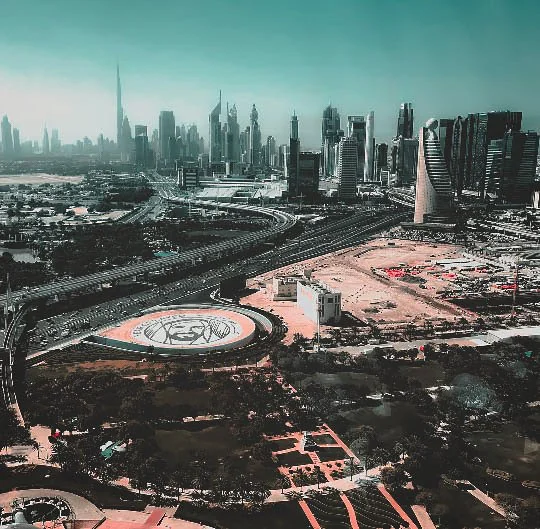
The exterior ornamentation of the Dubai Frame represents a distinct artistic highlight rooted in traditional Islamic art and cultural heritage. Examining the facade closely reveals geometric patterns inspired by the Expo 2020 emblem, the global event the monument was originally envisioned to welcome. Precision-fabricated using advanced laser-cutting technology on aluminum-alloy and stainless-steel panels, these motifs form a second skin enveloping the structure. Far from purely decorative, this perforated screen functions as an intelligent solar shading system that reduces heat gain inside the building while modulating natural daylight entering interior gallery spaces. The fusion of classical Islamic mathematical geometry with contemporary material fabrication yields an architectural surface at once timeless and futuristic.
At the heart of the Dubai Frame’s aesthetic philosophy lies the concept of temporal and spatial transition, transforming a static monument into a dynamic experiential journey. Positioned with meticulous precision, looking through the frame in one direction reveals historic Old Dubai—Deira and Bur Dubai with their traditional souks, low-rise courtyard houses, and the historic Dubai Creek. Turning toward the opposite direction through the exact same portal reveals the dazzling panorama of New Dubai’s supertall skyscrapers in Downtown Dubai, anchored by Burj Khalifa. The frame thus operates as a temporal lens placing past and future within a single visual composition, reminding onlookers of a coastal fishing village’s extraordinary rise into a global metropolis within just a few decades.
Interior spatial experiences further enrich the project’s cultural and artistic depth. Entering the base gallery, visitors walk through a digital museum utilizing 3D holographic projections, atmospheric mist effects, and surround sound to vividly portray Dubai’s evolution from its pearl-diving and desert-trading roots. Riding the high-speed panoramic elevators up to the sky bridge delivers an exhilarating visual crescendo as glazed walls open onto uninterrupted 360-degree vistas. Spanning 150 meters above ground, the horizontal sky bridge incorporates ultra-clear laminated structural glass that gives walkers the sensation of floating in mid-air—a gentle thrill that offers an entirely fresh perspective on human scale against a towering metropolis.
Descending via the opposite tower leads visitors into a visionary glimpse of the city 50 years into the future through augmented reality projections and interactive audiovisual installations. Here, architecture transcends physical mass to become a storytelling medium championing sustainable development, smart technology, and next-generation urban living. This curated progression reflects a consistent civic philosophy in which every iconic landmark carries a long-term strategic narrative—making the Dubai Frame not merely a visual tourist attraction, but a monumental urban sculpture leaving a distinctive imprint on world architecture.
In the broader sweep of contemporary architectural history, the Dubai Frame exemplifies symbol-driven design in which architectural form is distilled to maximize ideological expression. Rather than relying on sweeping curves or complex organic silhouettes seen in many Gulf landmarks, its architect chose the purest of geometric forms—a rectangle—to convey nuanced reflections on national identity. That choice demanded absolute precision in construction and detailing, as even minor proportional flaws would undermine the artistic illusion of a seamless picture frame. Over time, the landmark has cemented its reputation as a singular cultural icon where cutting-edge engineering meets a dynamic city’s enduring respect for its roots and bold vision for tomorrow.
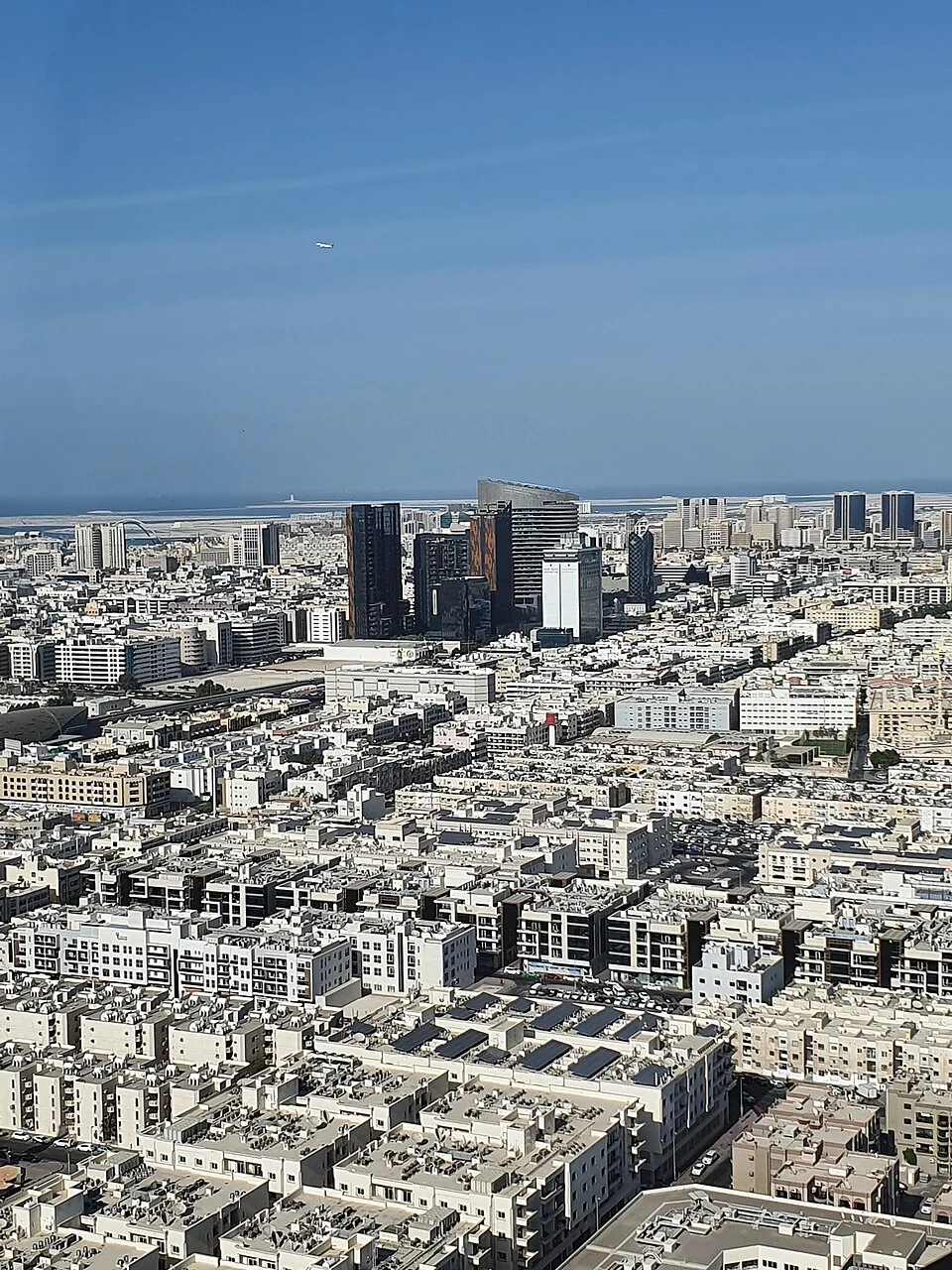
Located in Dubai’s Zabeel Park, the Dubai Frame is conceived not simply as a standalone architectural monument, but as an experiential time machine linking two defining chapters of the city’s growth. Its interior zones follow a closed, linear narrative loop guiding visitors from the nostalgic past on the mezzanine level up to the glittering present on the sky bridge, and concluding with a vision of the future before exit. Understanding this spatial choreography calls for an appreciation of urban planning, visual presentation technology, and visitor flow dynamics. The journey begins at the main reception hall, where carefully calibrated crowd-control protocols maintain steady visitor flow and prevent bottlenecks across the 150-meter vertical ascent.
The first zone along this immersive route is the mezzanine-level exhibition known as the Old Dubai Gallery (Museum of the Past). Utilizing atmospheric lighting, subtle mist effects, and directional audio, this gallery recreates 1960s Dubai when local livelihoods centered on fishing, pearl diving, and modest maritime commerce. Archival film footage and three-dimensional projections bring to life the daily routines of early communities settled along Dubai Creek, while finely crafted scale models trace the town’s transformation into a bustling trading port. Warm golden lighting paired with natural timber finishes creates an evocative, nostalgic ambiance that prepares visitors emotionally before their rapid leap across space and time.
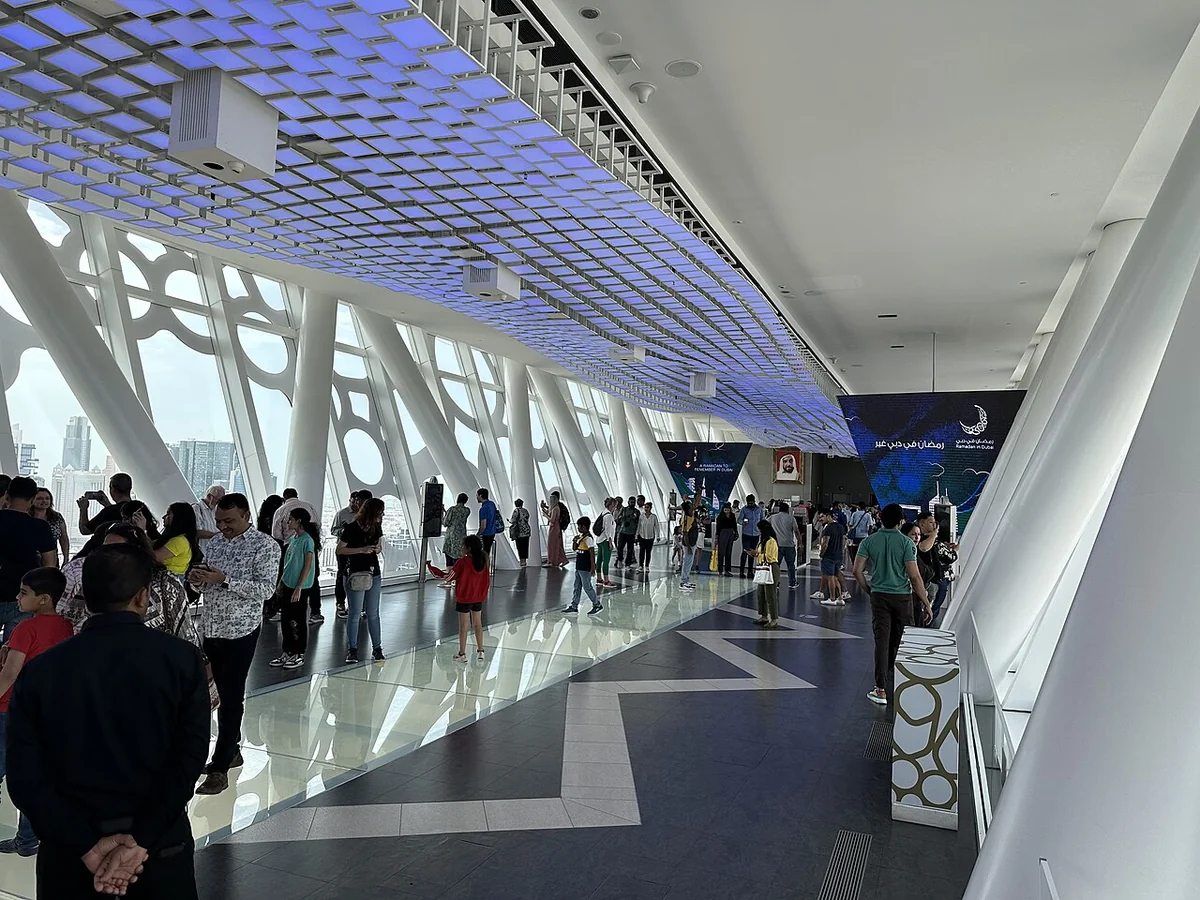
Upon completing the Old Dubai gallery, visitors are guided to high-speed glass elevators concealed inside the vertical shaft. Glazed exterior panels allow passengers to watch the ground recede and the skyline expand during the brisk 75-second climb to the summit. Reaching the upper sky bridge brings the experience to its climax in the Present Dubai zone. Its signature engineering centerpiece is the 93-meter-long reinforced glass walkway linking the two towers. Fitted with pressure- and motion-sensitive smart glass technology, panels appear opaque until stepped upon, instantly turning crystal-clear to reveal a dizzying drop roughly equivalent to a 50-story building directly underfoot. This thrilling feature challenges perceptual comfort while delivering an unobstructed perspective on Dubai’s striking urban duality.
From the sky bridge, visual sightlines are intentionally framed toward two contrasting faces of the metropolis. Looking north reveals historic Deira and Bur Dubai, characterized by traditional souks, wooden abras gliding across Dubai Creek, and low-rise neighborhoods steeped in cultural heritage. Turning south and west unveils the soaring spectacle of modern Dubai, dominated by Downtown Dubai’s glass skyscrapers and the towering spire of Burj Khalifa gleaming by day or shimmering with LED illuminations after dusk. Interactive augmented-reality screens mounted along the glass gallery provide detailed insights into landmarks across the horizon, enabling visitors to pinpoint locations, completion dates, and architectural functions below.
After taking in the present-day panorama at the summit, visitors descend via the opposite tower’s panoramic elevator to enter the final chapter of the tour: the Future Dubai gallery. Here, state-of-the-art digital projection mapping and wrap-around curved screens illustrate Dubai 50 years from now—envisioning flying autonomous transit, self-sustaining biophilic architecture, smart ecological infrastructure, and futuristic habitats. Surround sound and dynamic lighting immerse guests in a vivid portrait of rapid technological progress. The route concludes at the souvenir boutique showcasing cultural publications and traditional Emirati handicrafts, completing an unbroken narrative arc from past to present to future.
The urban surroundings enveloping the Dubai Frame within Zabeel Park capture a fascinating cross-section of Dubai, where the dialogue between a modest maritime past and a high-tech future comes vividly into focus. The surrounding service ecosystem and cultural amenities evolved not by chance, but through comprehensive master planning aimed at shaping Dubai’s post-oil civic identity. Stepping outside the monument’s ticket gates, visitors immediately enter an expansive public realm designed to welcome both local residents and international guests. Spanning dozens of hectares, Zabeel Park acts as a lush ecological buffer cushioning the monument from major highways like Sheikh Zayed Road while offering a tranquil prelude to the experience inside. Meticulously landscaped with thousands of trees, themed gardens, children’s play areas, and outdoor fitness zones, the park embodies the sustainable urban livability championed across the United Arab Emirates in recent decades.
Alongside the park’s greenery, visitor amenities around the Dubai Frame are organized to world-class standards emphasizing comfort, accessibility, and effortless orientation. Welcome plazas, tourist information desks, and curated gift shops sit conveniently near the base, offering authentic Gulf handicrafts alongside contemporary art editions. Accessibility facilities for guests of determination, multilingual digital signage, public Wi-Fi hotspots, and shaded seating areas are seamlessly integrated throughout, reflecting human-centered urban management. Rather than merely serving practical needs, these touchpoints introduce visitors to the historical context of the city before they ascend to view Dubai’s two halves from above.
Local community life around the Dubai Frame reflects the rich demographic diversity of a truly global metropolis. Positioned at the crossroads between historic Deira and Bur Dubai and newer financial hubs like Downtown Dubai, this neighborhood witnesses daily interaction between native Emiratis and expatriate residents hailing from South Asia, the Middle East, Europe, and North America. On weekends and public holidays, Zabeel Park becomes a lively civic gathering ground where Emirati families enjoy traditional picnics with home-cooked dishes while international communities join outdoor sports and municipal cultural festivals. This harmonious coexistence creates a vibrant social tapestry in which Islamic cultural traditions remain central while enriched by decades of global exchange.
Exploring the culinary scene around the Dubai Frame invites an appreciation of the region’s centuries-old maritime trade links with Persia, India, and East Africa. In adjacent neighborhoods such as Al Karama and Zabeel, restaurants and cafes showcase generations of culinary fusion. Visitors can savor traditional Emirati specialties like Machboos—fragrant spiced rice served with slow-cooked lamb or chicken infused with dried loomi lime and saffron—alongside Levantine charcoal grills. Traditional Arabic cafes serving cardamom-scented Gahwa coffee and sweet mint tea provide welcoming neighborhood social spaces where locals gather to discuss business, current events, and the city’s rapid transformation over aromatic shisha.
Transportation links around the Dubai Frame play a vital role in sustaining visitor access and urban vitality, anchored by nearby Dubai Metro stations and extensive public bus routes. Smart transit planning reduces private vehicle congestion while supporting seamless pedestrian connections linking heritage quarters like the Al Fahidi Historical Neighbourhood with modern architectural icons. Wide shaded walkways and outdoor cooling features allow pedestrians to enjoy the urban environment comfortably even during warmer months—demonstrating how thoughtful landscape engineering creates livable public spaces tailored to a desert climate.
Interactive cultural experiences around the Dubai Frame also flourish through community arts festivals, outdoor exhibitions, and traditional music performances held regularly during autumn and winter. Local cultural authorities frequently organize heritage craft fairs where senior artisans demonstrate palm-frond weaving, traditional Al Sadu Bedouin textile weaving, and historic pearl-diving techniques—passing indigenous knowledge on to younger generations and international travelers alike. These initiatives elevate sightseeing from passive observation into meaningful cultural engagement, turning the grounds around the Dubai Frame into a living open-air museum where nomadic heritage and ultra-modern urbanism converse.
Planning a smooth and rewarding visit to the Dubai Frame benefits from practical awareness of Dubai’s urban geography, local regulations, and seasonal Arabian Peninsula climate patterns. Standing inside Zabeel Park, this 150-meter hollow architectural frame acts as an optical lens connecting the city’s pearl-diving heritage with its gleaming skyscraper skyline. To make the most of photography and panoramic views, timing your visit around optimal natural light makes a remarkable difference. Two golden windows offer the richest visual contrast across the laminated glass and gold-plated facade: early morning right at opening (9:00 AM), when security queues are short and panoramic elevators can be enjoyed without crowds; and late afternoon from roughly 4:00 PM through sunset, when travelers can witness the magical transition from golden daylight to twinkling city lights across Deira and Downtown Dubai. Visitors aiming for sunset slots should book tickets online well in advance, as on-site tickets frequently sell out quickly due to strict capacity limits on the upper sky bridge.
Seasonally, visiting conditions are shaped strongly by Dubai’s tropical desert climate. November through April represents the prime window for combining a visit to the Dubai Frame with outdoor strolls through Zabeel Park, as pleasant daytime temperatures between 20°C and 30°C allow comfortable outdoor exploration without heat fatigue. Conversely, May through September brings intense summer heat frequently exceeding 45°C alongside coastal humidity. During summer months, outdoor walking should be minimized by relying on air-conditioned public transit or direct drop-offs near Zabeel Park Gate 4, where the main entrance is located. Planning around seasonal weather ensures physical comfort while maximizing time spent enjoying the monument’s climate-controlled galleries and sky deck.
Transportation infrastructure serving the Dubai Frame is among the most seamless in the Middle East, offering convenient options for every traveler. The Dubai Metro Red Line provides fast, punctual, and economical access: visitors can alight at Max Metro Station (formerly Al Jafiliya) and walk roughly ten minutes via shaded pedestrian paths and modern overpasses into Zabeel Park. For those preferring door-to-door convenience or traveling in groups, official Dubai Roads and Transport Authority (RTA) taxis operate continuously with transparent metered fares, while regional ride-hailing apps offer direct drop-offs at designated points near the ticket plaza. Self-driving visitors will also find ample public parking surrounding Zabeel Park, though arriving early is advisable on weekends and public holidays.
Dress code expectations at the Dubai Frame reflect respect for the traditional cultural values of the United Arab Emirates alongside practical comfort for a modern architectural attraction. While Dubai is cosmopolitan and welcoming, modest, respectful attire is expected of both men and women inside public cultural landmarks. Visitors are advised to cover shoulders and knees and avoid overly revealing clothing or garments bearing offensive slogans. Women are not required to wear a headscarf, though carrying a light cardigan or shawl in your bag is practical since air-conditioning inside subterranean galleries and elevators is kept noticeably cool. Additionally, because the tour includes walking across a transparent glass sky bridge 150 meters above ground, footwear choice matters: flat, supportive sneakers or walking shoes with good traction are ideal, whereas sharp stiletto heels should be avoided to protect the specialized glass flooring and ensure comfort along gallery walkways.
Alongside attire and transit, security protocols and visitor guidelines at the Dubai Frame adhere to strict international aviation-style standards to safeguard both the monument and guests. At the primary security checkpoint, all bags, backpacks, and personal belongings pass through X-ray scanners. Sharp objects, flammable materials, weapons of any kind, alcoholic beverages, and personal drones are strictly prohibited inside the venue. Photography enthusiasts should also note that bulky tripods and oversized selfie sticks are restricted in crowded areas and on the sky bridge to keep walkways unobstructed and protect glass surfaces from accidental impact. Furthermore, smoking—including e-cigarettes and vaping devices—is strictly banned throughout all enclosed areas of the landmark. Following staff instructions, queuing orderly, and respecting shared public spaces ensure a smooth visit while reflecting thoughtful stewardship at one of the contemporary world’s most iconic architectural landmarks.
To experience this journey seamlessly alongside a local guide, you can explore our 6D5N Dubai – Abu Dhabi – Desert Safari tour with a pre-arranged itinerary.