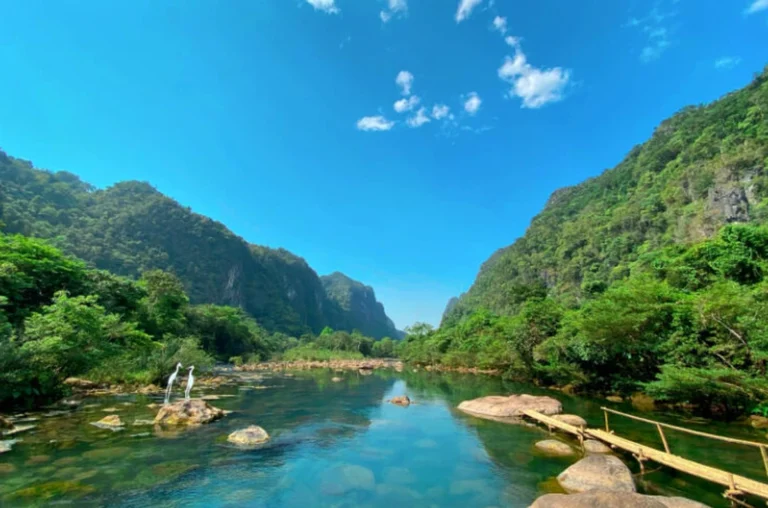
Hidden deep within the ancient, majestic karst formations of Phong Nha – Ke Bang National Park in Son Trach Commune, Bo Trach District, Quang Binh Province, Paradise Cave (Dong Thien Duong) emerges as a flawless geological masterpiece that nature spent hundreds of millions of years crafting. Situated in the core zone of a UNESCO World Natural Heritage Site, this scenic wonder boasts a unique geographical setting where the sacred energy of the towering Truong Son mountain range converges with the endless flow of pristine underground rivers and streams. The local terrain embodies traditional feng shui principles of “leaning against the mountains, facing the water,” surrounded by vast primeval forests largely untouched by modern encroachment, creating an ethereal, otherworldly sanctuary isolated from the outside world.
Viewed through the lens of tectonic geology and specialized historical records, this cave system was formed through the karst weathering of Phong Nha formation limestone, dating back 350 to 400 million years to the Early Carboniferous–Devonian period. Over countless epochs, the patient erosion of mildly acidic groundwater flowing along tectonic fault lines hollowed out the mountain’s interior, giving birth to a magnificent subterranean space with a surveyed length exceeding 31.4 km. The British Cave Research Association (BCRA) unhesitatingly designated it the longest dry cave in Asia—a natural wonder possessing a grand spatial architecture marked by soaring stone vaults and a myriad of intricate speleothems.
Renowned not only for its colossal geological scale, Paradise Cave is also intertwined with cultural depth and the prehistoric imprint of humanity. Although archaeological records indicate that this rugged valley experienced minimal influence from feudal dynasties or monarchical civilizations compared to Phong Nha Cave or Tien Son Cave, its surrounding peripheries bear witness to a remarkable era. Field expeditions by the Vietnam Institute of Archaeology in the Cha Noi Valley and along the Chang River uncovered numerous rudimentary chipped stone tools, providing clear evidence of prehistoric inhabitants belonging to the Late Paleolithic and Hoa Binh cultures. These traces confirm that the lands encircling Paradise Cave once served as a vital habitat for early humans before major shifts in the Earth’s crust completely sealed off this subterranean marvel.
Throughout its history of conservation and development, the value of Paradise Cave has been firmly cemented through national and international legal frameworks. Following the inscription of Phong Nha – Ke Bang National Park as a UNESCO World Natural Heritage Site in 2003 and its subsequent expansion in 2015, the stature of this wonder grew exponentially. Notably, on December 9, 2013, the Prime Minister of Vietnam officially issued Decision No. 2383/QD-TTg classifying the Phong Nha – Ke Bang Scenic Landscape Complex, including Paradise Cave, as a Special National Relic. This recognition serves not merely as a vital legal guarantee for heritage preservation, but also as a tribute to the pristine beauty and extraordinary scientific value of a national treasure nestled in the heart of Quang Binh’s wilderness.

Dubbed the “Underground Royal Palace,” Paradise Cave unfolds into a breathtaking world where nature has tirelessly sculpted over hundreds of millions of years to create a one-of-a-kind landscape amidst the Phong Nha – Ke Bang wilderness. The moment you step through the narrow cave entrance, a sudden rush of cool air washes over your face, completely dispelling the sweltering heat of Central Vietnam and giving way to a vast, mystical expanse. A long, gracefully winding wooden walkway guides visitors deep into the heart of the cavern, where widths reach over 100 meters in places and ceilings soar past 60 meters—easily spacious enough to house multi-story buildings. The scenery resembles an abandoned city of the gods, surrounded by thousands of fantastically shaped stalactites and stalagmites that ignite the imagination of everyone who sets foot inside.
Nature’s sculptural artistry in Paradise Cave reaches the pinnacle of refinement through the seamless interplay of calcium carbonate minerals and the passage of time. Unlike many other caverns, the formations here are predominantly dry speleothems, boasting a pure, luminous white hue reminiscent of quartz or jade. Along the pathway, visitors cannot help but marvel at grand structures such as the Gilded Palace, draped with delicate, silk-like flowstone curtains, or the imposing Lotus Tower rising majestically into mid-air. Drops of water continue to trickle steadily from the ceiling, nourishing the stalagmites day and night and sustaining a living, evolving speleothem ecosystem. Remarkably, certain stone formations resonate like ancient bronze gongs when gently tapped, lending the atmosphere an even deeper sense of sanctity and mystery.
To capture the most priceless moments at this natural wonder, professional photographers and travel journalists frequently share two unmissable “million-view” photo angles. The first is located right inside the entrance chamber (about 50 meters from the mouth of the cave), where natural daylight streaming in from outside intersects with the deep shadows of the cavern interior, creating a divine optical effect that highlights the long wooden boardwalk disappearing into infinity. The second spot lies deep along the first kilometer of the exploration route, beneath a towering vault adorned with stalactites hanging like giant fossilized teardrops—an ideal backdrop for full-length portraits framed against monumental natural architecture.
As for the ideal time to visit and shoot photos, even though Paradise Cave sits deep inside the mountain and is largely insulated from outside weather, photographers still recommend arriving between 9:00 AM and 11:00 AM or from 3:00 PM to 4:00 PM. During these windows, sunlight slants through the forest canopy and the cave mouth, casting dramatic natural light beams (crepuscular rays) into the dimly lit interior. This seamless harmony of million-year-old speleothem architecture and ethereal lighting is guaranteed to reward visitors with unforgettable visual experiences and awe-inspiring photographs straight out of a fantasy realm.

Arriving at Phong Nha – Ke Bang National Park, the journey to conquer Paradise Cave presents travelers with firsthand experiences that are both challenging and deeply rewarding. To reach the modest cave entrance tucked away in the lush green wilderness, you must either climb hundreds of stone steps shaded by ancient trees or take an electric buggy ride through a primeval valley alive with birdsong. Anticipation builds with every step as the outside heat subsides, giving way to brisk, natural currents of cool air billowing out from deep within the mountain to sweep away the tropical warmth of Central Vietnam.
The instant you take your first step past the narrow archway of the entrance, a breathtaking sense of awe washes over you. Rather than gloomy darkness, what greets your eyes is an enchanting realm illuminated by subtle artificial lighting that brings millions of shimmering stalactites to life. The gracefully curving wooden boardwalk leads explorers deeper into the “Underground Royal Palace.” Speleothems of every conceivable form—from stately Buddhist stupas and sweeping terraced rice fields to curtains of stone sparkling with natural mineral glitter—display the exquisite handiwork of millions of years of natural creation. The reverent stillness within invites quiet reflection, making you feel humble before the vastness of the cosmos yet profoundly at peace within.
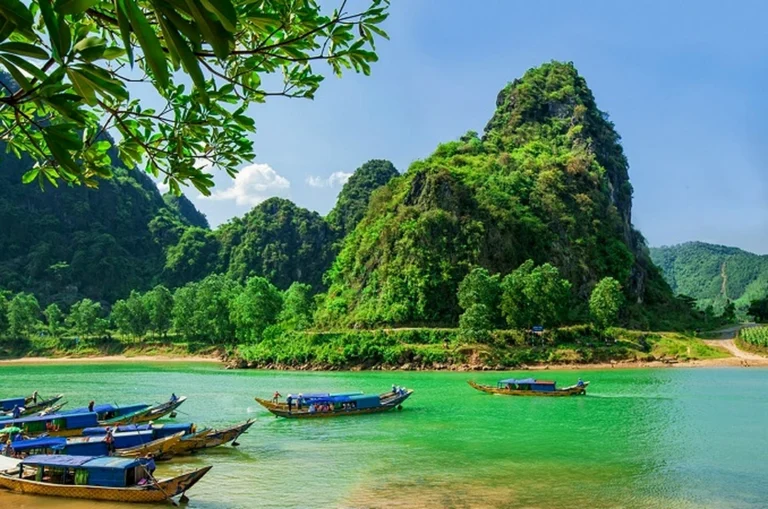
Stepping back out of the cave’s surreal interior, your journey continues with vibrant, authentic encounters with local culture. You can drift down the Son River aboard traditional wooden boats, leisurely taking in the unhurried daily rhythm of local ethnic minority communities whose stilt houses peek out behind clusters of green bamboo. Above all, no trip would be complete without savoring the celebrated mountain specialties of Quang Binh. The rich, savory flavors of grilled free-range chicken dipped in spicy lemongrass salt, freshly caught stream fish roasted to smoky perfection over wood embers, and a warm cup of locally distilled forest herbal wine will restore your spirits after hours of active trekking.
As your trip draws to a close, Paradise Cave leaves behind far more than stunning photographs of a 350-to-400-million-year-old geological marvel—it leaves a lasting impression of warm local hospitality, unadorned indigenous culture, and sheer wonder at the monumental creative power of time. These are the priceless, real-world moments that transform every step of travel into an intimate encounter with the essence of a World Natural Heritage Site.

Paradise Cave has long stood as one of Quang Binh’s most iconic tourist destinations, drawing domestic and international travelers alike with the grandeur of its million-year-old stalactite formations. To ensure a fulfilling, safe, and seamless exploration, equipping yourself with practical tips on timing, ticket prices, transportation, and proper attire is essential.
Regarding the best time to visit, travelers should plan their trip during the dry season, which runs from April to August each year. During these months, Quang Binh enjoys dry weather, minimal rainfall, and bright sunshine, making travel effortless and allowing you to admire the cave’s mystical beauty in ideal conditions. Conversely, the rainy season from September to March often brings heavy downpours and rising water levels in certain areas, which can disrupt sightseeing schedules.
The Paradise Cave Ecotourism Area is open daily during fixed hours from 7:30 AM to 4:30 PM, including weekends and public holidays. Admission tickets are clearly posted at the entrance gate at reasonable rates for adults and children based on height (children under 1.1 meters tall are typically admitted free of charge). Additionally, visitors wishing to take the electric shuttle service from the main gate to the foot of the mountain can purchase buggy tickets, with options for either standard shared shuttles or private golf carts.
To get there from downtown Dong Hoi City, travelers can follow either the eastern branch of the Ho Chi Minh Highway or National Route 16 toward Phong Nha – Ke Bang National Park. This scenic 65-kilometer route features smooth, well-maintained roads winding through limestone karst peaks and lush green valleys. The best ways to make the journey are by self-drive car, taxi, or rented motorbike for younger travelers seeking a freer, more adventurous road trip.
The rugged cave and mountain terrain requires thoughtful attention to your attire. Prioritize athletic shoes or hiking footwear with strong traction and non-slip soles, as the stone steps and walkways inside the cavern can be damp. Clothing should be neat, comfortable, and breathable to wick away sweat. Furthermore, the temperature inside Paradise Cave remains a steady 18°C to 20°C—noticeably cooler than outside—so packing a light jacket is highly recommended. Always adhere strictly to heritage conservation rules: refrain from touching the stalactites and help keep the environment clean so this natural masterpiece remains preserved for generations to come.

To enjoy a seamless getaway and take in the full splendor of Paradise Cave without worrying about arranging transportation, booking admission tickets, or planning itineraries, travelers can choose VDS Travel’s premium all-inclusive Quang Binh tours. Every itinerary is thoughtfully timed for optimal photo opportunities when the scenery is at its most radiant, accompanied by knowledgeable local guides and top-tier hotel and dining standards.