Nestled deep within the ancient urban fabric of the Eternal City of Rome, the Trevi Fountain (Fontana di Trevi) is far more than an ornate decorative monument; it is the glorious culmination of an engineering epic spanning over two millennia. The lifeblood of this sculptural masterpiece is rooted in the ancient Aqua Virgo aqueduct, an architectural feat initiated in 19 BC under the direct patronage and command of the renowned general Marcus Vipsanius Agrippa. As the loyal right-hand man and son-in-law of Rome’s founding Emperor Augustus, Agrippa realized the ambitious vision of channeling pure freshwater from springs located more than twenty kilometers outside the city to supply Rome’s first public bath complex in the Campo Marzio district. According to ancient chronicles, the name Aqua Virgo—meaning “Virgin Waters”—originates from the legend of a pure local maiden who guided a squad of parched Roman soldiers to an underground spring of cool water, unlocking a vital artery that sustained daily life and the empire’s famed public bathing culture.
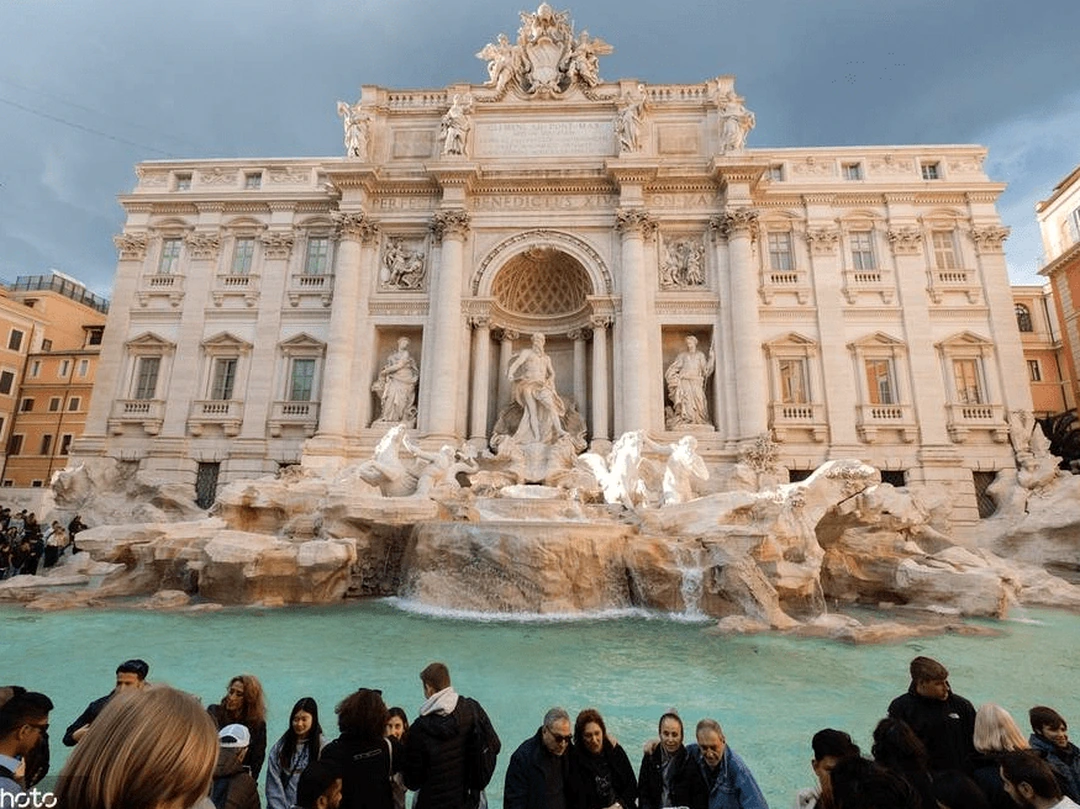
The name “Trevi,” passed down through the ages, carries a geographical origin deeply marked by medieval settlement patterns. Etymology reveals that Trevi derives from the Medieval Latin term “Trivii,” referring to the convergence of three major intersecting thoroughfares: Via dei Crociferi, Via di Poli, and Via delle Muratte. At this strategic junction, the subterranean stream of the Aqua Virgo once surfaced through a modest stone trough, serving as an indispensable source of vitality for residents through centuries of historical turmoil. Throughout the Dark Ages, amid the fall of the Western Roman Empire and relentless invasions that left many aqueducts in ruins, the Aqua Virgo endured resiliently thanks to its deep underground channels. By the mid-fifteenth century, swept up in the vibrant spirit of the Renaissance, Pope Nicholas V resolved to restore the ancient city’s former glory. In 1453, he commissioned the humanist scholar and master architect Leon Battista Alberti to rehabilitate the aqueduct and design an elegant rectangular limestone basin, officially establishing Trevi’s status as a symbol of the Roman papacy’s revival.
The revolutionary turning point that transformed Trevi into a pinnacle of European Baroque art took place in the eighteenth century, at a time when the Vatican sought to reaffirm the authority and splendor of the faith through monumental architectural language. In 1731, Pope Clement XII, a statesman hailing from the illustrious Corsini noble family of Florence, launched a grand design competition to convert the fountain’s dated, modest appearance into a majestic sculptural stage. Triumphed over many formidable rivals of the era, the daring blueprint of Roman architect Nicola Salvi was selected. Salvi’s extraordinary vision was an ingenious fusion of palatial architecture and the untamed power of nature, transforming the entire southern facade of Palazzo Poli into a colossal travertine backdrop for a breathtaking spectacle of marble and cascading water.
Construction on this landmark project officially began in 1732 and evolved into a demanding, three-decade-long undertaking. Nicola Salvi poured his heart, intellect, and health into every slab of stone and every undulating curve carved to mimic the rugged natural cliffs of a waterfall. However, the grueling demands of the project and endless technical disputes took a severe toll on the brilliant architect’s physical well-being, leading to his death in 1751 while his life’s masterpiece remained unfinished. The monumental responsibility of carrying forward this legacy was subsequently entrusted to architect Giuseppe Pannini. With absolute reverence for Salvi’s original conceptual framework, Pannini skillfully completed and refined the central sculptural ensembles, most notably the imposing figure of the sea god Oceanus and the spirited steeds representing the ever-changing moods of the ocean.
On May 22, 1762, during the reign of Pope Clement XIII, Fontana di Trevi was formally inaugurated in a grand ceremony to the awe of Roman citizens and art aficionados across Europe. Thirty years of relentless construction spanning multiple papacies culminated in an eternal icon, where Agrippa’s legendary waters from the dawn of Rome blended seamlessly with opulent Baroque aesthetics, turning the fountain into an immortal witness to the ebbs and flows of Italian history.
Situated right at the foot of the gentle slope of the Quirinal Hill—one of the legendary seven hills upon which the Eternal City of Rome was founded—Fontana di Trevi exemplifies a masterful approach to topographical urban planning steeped in Baroque theatricality (teatralità barocca). Rather than commanding a sweeping boulevard or a vast plaza in accordance with Renaissance norms of symmetry, the monument is tightly compressed within the modest, asymmetrical triangular space of Piazza di Trevi. Architects of the era capitalized fully on the natural gradient of the Quirinal slope descending toward the Tiber floodplain, transforming the intersection of three ancient thoroughfares—the origin of the name “Trevi,” derived from “Tre Vie”—into an artificial stone valley. This deliberate spatial compression creates an astonishing visual and acoustic effect: travelers navigating the labyrinth of narrow, shadowy alleys like Via delle Muratte or Via del Lavatore are suddenly overwhelmed when, just around a corner, a colossal sculpted wall and the thunderous roar of an open-air cascade burst dramatically into view.
This scenic marvel is sustained by one of the greatest subterranean hydraulic solutions of Mediterranean civilization. In reality, Fontana di Trevi serves as a “mostra d’acqua”—a monumental terminal display marking the triumphant endpoint of the great Aqua Virgo (Acqua Vergine) aqueduct, the engineering wonder initiated by Consul Marcus Vipsanius Agrippa, right-hand man to founding Emperor Augustus, in 19 BC. Originating from pure underground springs in the rural Salone area along the ancient Via Prenestina, the freshwater travels an underground journey of more than 20 kilometers to reach the heart of the city. The hydraulic genius of the ancient Romans lies in the fact that the entire system operates solely on gravity and natural topographical elevation differences, engineered with a gradient calibrated to the millimeter per meter without any mechanical pumps or artificial pressurization. To this very day, that subterranean spring continues to pour tirelessly into the Trevi basin after thousands of years, preserving its purity and endless flow across shifting historical eras.
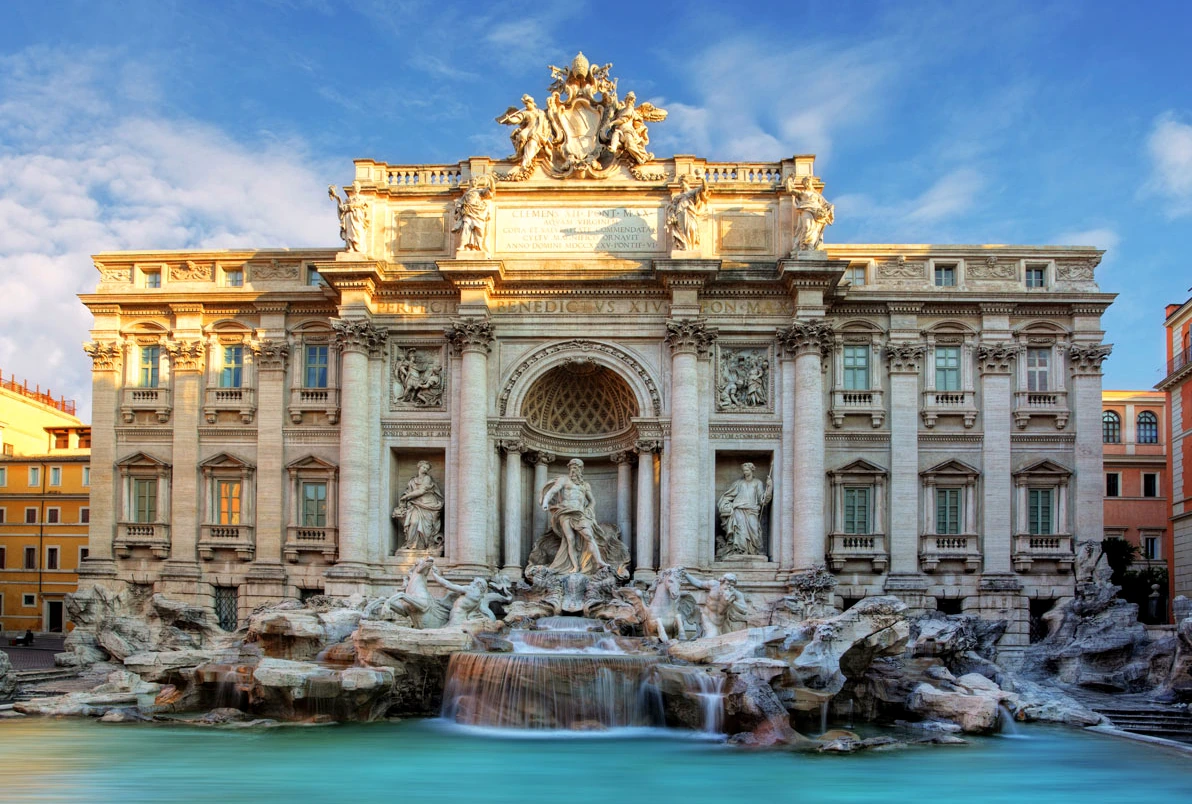
In terms of architectural technique and landscape integration, the masterpiece also stands out for its daring symbiosis between an outdoor sculptural monument and the facade of the noble Palazzo Poli. By organically anchoring the body of the fountain directly onto the palace front, architect Nicola Salvi turned the exterior wall of a secular residence into a grand stage backdrop, highlighting colossal Corinthian pilasters and a classical pediment. The primary material forming the complex is travertine limestone quarried from the ancient pits of Tivoli—the very same mineral source used to build the Colosseum—paired with famed white Carrara marble for carving the divine figures. The travertine blocks are roughly hewn and layered to imitate natural crags eroded by rushing water, forming terraced ledges over which currents plunge into the semicircular basin below. Day and night, tens of thousands of cubic meters of water surge across these stone cascades, simultaneously purifying the air and creating a refreshingly cool microclimate even in the height of a blazing Mediterranean summer.
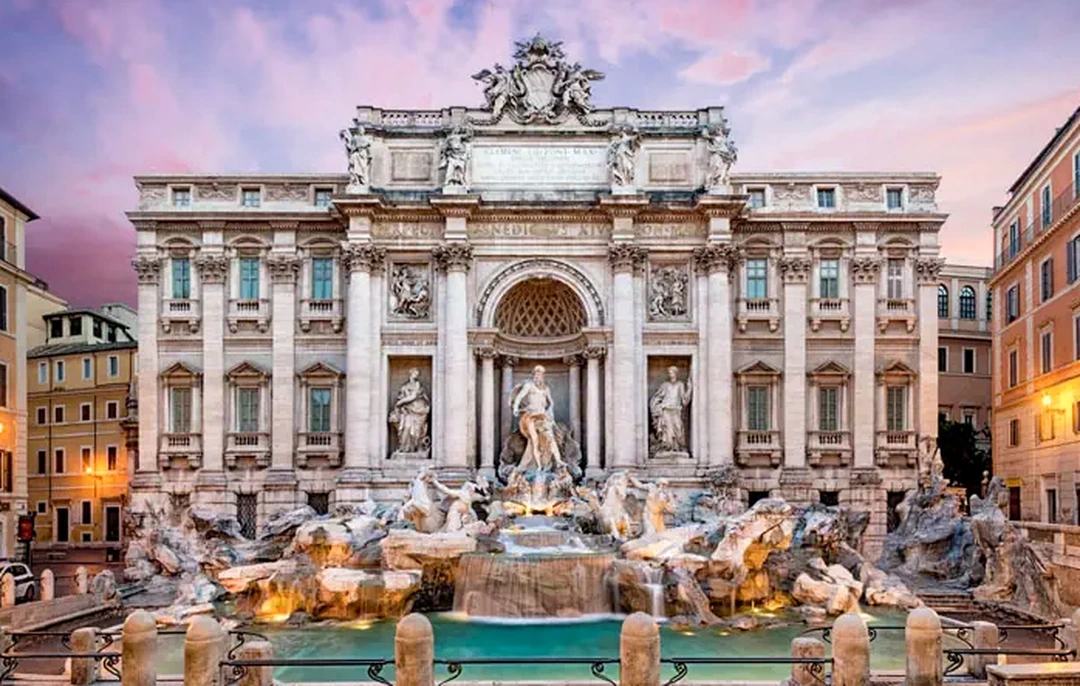
The presence of the Trevi Fountain within the tight confines of Piazza di Trevi delivers a breathtaking visual shock, embodying the spatial dramatization characteristic of Roman Baroque art. Soaring to an imposing height of 26.3 meters and spanning 49.15 meters in width, Trevi claims the title of the largest Baroque fountain on the planet. Rather than standing freestanding like contemporary waterworks, Trevi commandeers the entire southern facade of the historic Palazzo Poli as a magnificent theatrical backdrop, achieving a seamless marriage of sculpture and palatial architecture. Towering Corinthian columns rise across two stories, dividing the facade into strictly symmetrical rhythms that draw the gaze upward to the summit, where the majestic coat of arms of Pope Clement XII of the noble Corsini family is ceremoniously upheld by the angelic wings of two statues of Fame.
Commanding the central triumphal arch niche is the sculptural group of the sea god Oceanus, a dynamic masterpiece completed by sculptor Pietro Bracci. Casual visitors frequently mistake this deity for Neptune, yet mythology identifies him as Oceanus—the primordial Titan ruling over the great river encircling the ancient world. Oceanus stands tall upon a mythical shell-shaped chariot, radiating the eternal majesty of nature with flowing hair and beard resembling sea foam and a penetrating gaze fixed upon the mortal realm. His chariot is steered by two muscular Tritons leading two half-horse, half-fish sea creatures (hippocamps). These two sea horses symbolize the two eternal, contrasting moods of the ocean: one rears wildly, neighing with rippling muscles amid roaring waves and gales, representing the perilous fury of the sea; the other bows its head calmly, stepping forward in docile grace to signify moments of tranquil waters that bring life-giving peace to humanity.
Flanking Oceanus in the side niches are tributes to the core blessings that pure water bestows upon the Roman city-state, brought to life by the skilled hands of artist Filippo Della Valle. In the left niche, the statue of Abundance (Abbondanza) stands in a graceful contrapposto pose, cradling a cornucopia overflowing with fragrant blossoms and sweet fruits, symbolizing the agricultural prosperity nurtured by flowing waters. Symmetrically positioned in the right niche is Salubrity (Salubrità), holding a sacred cup from which a holy serpent drinks, representing the purity that wards off plague and disease. Directly above these two statues are vivid bas-relief panels: the panel on the right, by Andrea Bergondi, depicts the legend of the Roman maiden pointing out the pristine spring to thirsty soldiers, while the panel on the left, sculpted by Giovanni Battista Maini, captures the moment General Marcus Vipsanius Agrippa inspects and approves the architectural plans for the Aqua Virgo aqueduct in 19 BC.
The enduring vitality of the monument also stems from Nicola Salvi and his collaborators’ masterful orchestration of materials. The foundational mass, jagged crags, and load-bearing structures were carved from travertine limestone quarried from ancient Tivoli—a warm, golden-hued stone renowned for its exceptional resilience against centuries of rushing water and weathering. Meanwhile, the entire ensemble of deities, reliefs, and intricate friezes was sculpted from monolithic blocks of famous white Carrara marble from Tuscany, whose smooth surface reflects daylight brilliantly and captures every sinewy contour of the human form. This juxtaposition of rugged travertine mimicking natural cliffs and finely chiseled Carrara marble blurs the boundary between human craftsmanship and raw geological beauty, turning every drop of water cascading over the stone ledges into an eternal dance in the heart of Rome.
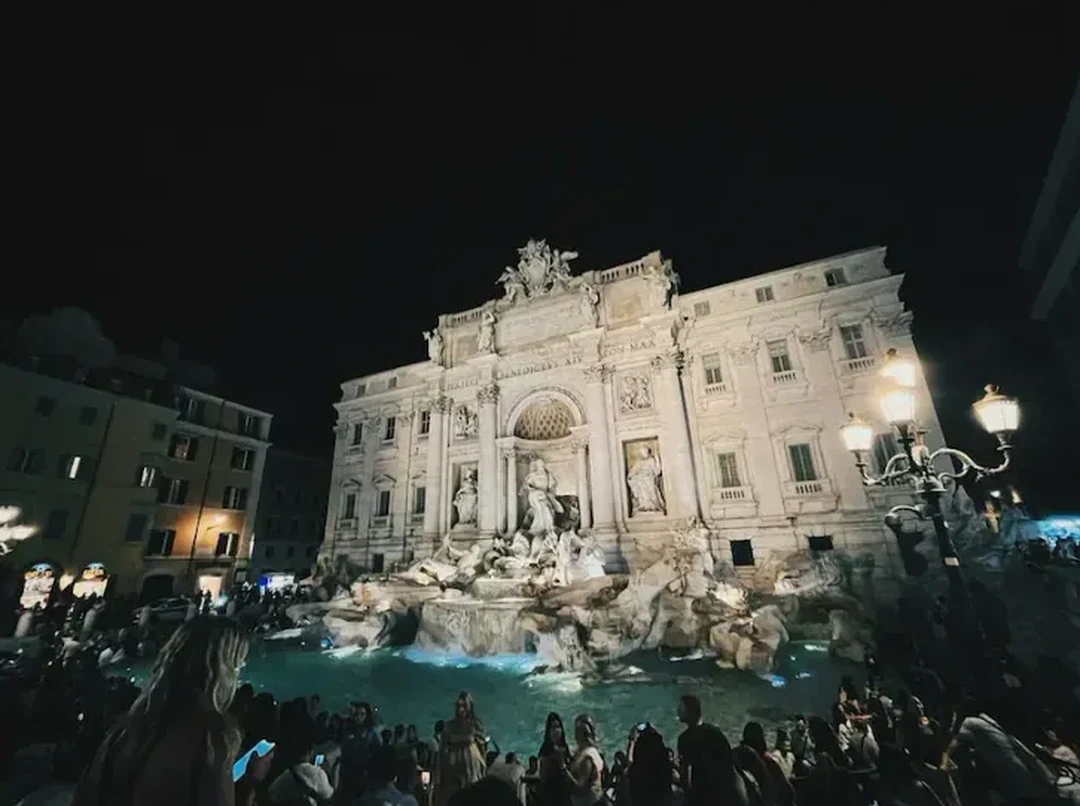
As dusk drapes a deep indigo veil over the ancient domes of Rome, the Trevi Fountain sheds its overwhelming daytime grandeur to transform into a spellbinding open-air stage. Darkness blankets the intimate Piazza di Trevi, and it is at this moment that architectural lighting strikes up its own symphony. Optical spotlights calibrated to warm color temperatures illuminate the monolithic travertine blocks of Palazzo Poli from precise angles. Rather than merely dispelling the night, this illumination acts like an invisible paintbrush celebrating the Baroque mastery of chiaroscuro. Every rippling muscle of Oceanus, the wind-tossed manes of the Tritons’ steeds, and the fluid folds of carved drapery seem to awaken from centuries of slumber. Deep architectural niches recede into mysterious shadow, contrasting sharply against the brilliant beams cast across the vast emerald basin, creating a visual depth that is at once surreal and intensely dramatic.
The nocturnal atmosphere at Trevi is inseparable from the immortal memory of cinema, which etched this masterpiece into humanity’s romantic consciousness through the visionary lens of director Federico Fellini. In his 1960 cinematic classic “La Dolce Vita,” the iconic scene in which actress Anita Ekberg, clad in a strapless black velvet evening gown, wades regally into the freezing basin and calls out to Marcello Mastroianni’s character became one of the most enchanting visual emblems in world cinema. Bathed in golden light shimmering across splashes of white foam, that transcendent moment forever turned Trevi into a global sanctuary of romance, where the line between everyday reality and artistic fantasy dissolves completely. Although strict preservation laws today prohibit anyone from stepping into the sacred waters, the free, uninhibited, and sensual spirit of that cinematic moment still lingers in every night breeze skimming across the mirror-like pool.
Blending with the sculptural beauty is the vibrant nightlife energy of locals and travelers gathered from every corner of the globe. Once night fully settles in, the thunderous roar of tens of thousands of cubic meters of water cascading over the travertine ledges becomes a natural symphony drowning out modern urban noise. Crowds sit shoulder to shoulder along the cool stone steps, savoring artisanal gelato infused with rich hazelnut or sweet vanilla from family-run gelaterias tucked along the historic Via delle Muratte. Every few seconds, the metallic clink of coins rings out before they arc over left shoulders and splash into the depths, carrying silent wishes for a guaranteed return to the Eternal City. Soft streetlamps mingle with the rich aroma of bold espresso wafting from historic cafes near the Trevi crossroads, crafting an immersive, multi-sensory Italian evening.
Late into the night, as the crowds thin out and give way to the stillness of the witching hour, Trevi reveals yet another facet: a quiet, eternal majesty. Far from the churning cascades, the water surface calms into a giant mirror reflecting the illuminated Corinthian columns and sculpted pediment above. Standing before the fountain in this tranquil hour, onlookers truly grasp the seamless harmony between the untamed force of natural water and the refined artistry of human hands. It is no mere outdoor monument, but a living entity breathing steadily through the centuries, preserving the opulent soul and immortal essence of a magnificent capital.
Stepping away from the rushing symphony of the marble cascades and venturing deeper into the winding network of alleys in the Trevi district (rione Trevi), Rome opens up an entirely different dimension, where dark sampietrini cobblestones lead diners to a thousand-year-old culinary heritage. The vital lanes embracing the square, such as Via della Stamperia and Via del Lavatore, have long served as gathering grounds for family-run osterias and trattorias whose chefs remain fiercely loyal to the authentic culinary philosophy of the Lazio region. Here, gastronomy eschews pretentious flourishes in favor of celebrating the pure integrity of strictly certified regional ingredients, from sharp, savory Pecorino Romano DOP cheese crafted from sheep’s milk in the upland pastures, to rich Guanciale di Amatrice IGP cured pork jowl seasoned with salt and whole black peppercorns over months of careful aging.
The soul of everyday Roman cuisine around the fountain crystallizes in the city’s iconic quartet of classic pasta dishes, each representing a milestone in culinary evolution. First comes Tonnarelli cacio e pepe—deceptively simple yet demanding masterful emulsification of starchy pasta water and grated sheep’s cheese to create a velvety sauce clinging to thick, fresh noodles, bursting with the pungent warmth of coarsely cracked black pepper. Building upon that foundation, Rigatoni alla gricia introduces crispy, golden-brown cubes of rendered guanciale, serving as the ancestor to Bucatini all’amatriciana—a hearty dish bathed in bright red San Marzano tomato sauce with a gentle kick of chili flakes, where hollow pasta tubes trap rich sauce in every bite. Completing this pasta pantheon is the legendary Spaghetti alla carbonara, which strictly forbids heavy cream or onions, relying instead on rich fresh egg yolks whisked with pecorino to form a glossy, silk-like emulsion when tossed with cured pork jowl sizzling straight off a cast-iron skillet.
Moving on to main courses, the traditional Roman table conveys generous hospitality through recipes passed down from century to century. Saltimbocca alla romana, poetically translating to “jumps in the mouth,” delights the palate with tender veal scallops layered with fresh sage leaves and prized prosciutto crudo, pinned with a wooden toothpick and pan-seared quickly in unsalted butter and fine Frascati white wine. Meanwhile, Abbacchio alla scottadito captures the rustic spirit of the Roman countryside with baby lamb chops marinated in rosemary and crushed garlic before being grilled directly over glowing embers—served so piping hot that diners must eat them with their fingers while blowing on their fingertips. Local culinary culture is also vividly showcased through two distinct artichoke preparations: Carciofi alla giudia, originating from the historic Jewish Ghetto, features whole artichokes opened wide and deep-fried in olive oil until their petals turn crispy like golden bronze blossoms, offering a striking contrast to Carciofi alla romana, which are braised until tender in wild mint, garlic, and extra-virgin olive oil.
The flavor of Trevi would be incomplete without sweet interludes at heritage bakeries and nineteenth-century historic cafes tucked along ancient passageways. Maritozzi con la panna—soft, airy brioche buns delicately scented with orange zest and pine nuts, sliced open and generously filled with billows of rich whipped cream—once served as romantic engagement tokens gifted by young Roman men to their sweethearts. Alongside them sits Pizzadolce Lazio, steeped in festive traditions preserved across generations of artisan bakers. Finally, pausing at a long-standing artisanal gelateria to savor slow-churned, velvety gelato crafted from Viterbo hazelnuts or organic pistachios offers the quintessential cultural finale to a day spent wandering and listening to the millennial pulse of the Eternal City.
Standing majestically at Piazza di Trevi in Rome’s historic center, the Trevi Fountain remains freely accessible 24 hours a day, welcoming travelers from around the world at any hour with no admission fee. To fully take in the pristine beauty of the travertine marble and hear the uninterrupted symphony of the ancient Aqua Virgo waters, dawn—when the first rays of morning sunlight strike the facade—or late at night in the quiet hours are the ideal times to visit. During these windows, the square clears of its usual bustling crowds, revealing a serene, majestic Trevi reminiscent of a grand cinematic set straight out of Federico Fellini’s classic film La Dolce Vita.
Reaching this celebrated Baroque landmark is effortless thanks to the Italian capital’s well-connected public transit network. The most convenient option for visitors is Metro Line A, alighting at either Barberini or Spagna station before enjoying a leisurely stroll of a few hundred meters through moss-kissed Sampietrini cobblestone lanes. In addition, the municipal ATAC bus network operates frequent routes along the bustling Via del Tritone, offering convenient stops just steps away from Piazza di Trevi. For those who love exploring on foot, walking the scenic route connecting the Spanish Steps through Trevi and straight on to the ancient Pantheon creates an unforgettable visual journey rich with Renaissance charm in the heart of a living heritage site.
Standing before the emerald-green basin, virtually no traveler can resist the allure of the legendary coin-tossing ritual woven into travel lore across generations. According to tradition, visitors must stand with their back to the fountain and use their right hand to toss a coin over their left shoulder. Popular legend holds that the first coin cast into the water guarantees a return trip to Rome; the second coin sparks hope for a sweet romance with a local; and the third coin leads to wedding bells. Each day, the waters of Trevi receive thousands of wishes from across the globe, accumulating over one million Euros annually. Once periodically collected from the basin, the entire sum is donated directly to the Catholic charity Caritas to fund soup kitchens, grocery programs, and shelters for underprivileged residents throughout the capital.
Alongside free public access, Rome’s municipal authorities enforce strict heritage conservation rules under the urban security decree Daspo urbano. Officers of the Roma Capitale Municipal Police maintain a constant presence on the square to closely monitor visitor behavior. Tourists are strictly forbidden from dipping their feet, wading, or swimming in the fountain, as well as climbing, sitting, or placing personal belongings on the sacred marble ledges and sculptural structures. Infractions such as eating messily or littering around the fountain carry heavy administrative fines and potential bans from entering central historic monuments. Maintaining respectful distance and honoring preservation guidelines remain the finest ways for every visitor to help safeguard this human treasure for generations to come.
After soaking in the surreal beauty of stone and cascading water, treat yourself to a scoop of artisanal pistachio gelato from a family-run shop tucked down a quiet lane, or claim a peaceful sidewalk table to sip a rich, authentic Italian espresso. For a seamless journey that uncovers the deeper stories behind Baroque masterpieces without having to worry about logistics or language barriers, exploring all-inclusive European tour packages opens the door to enriching, elevated cultural experiences.