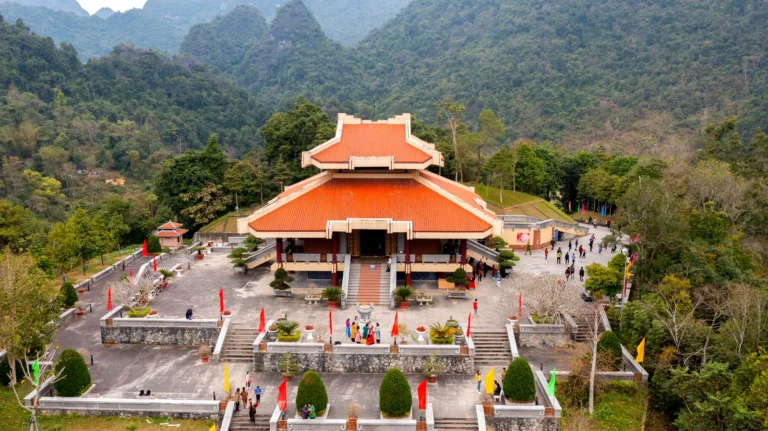
Hoa Yen Pagoda sits at an elevation of 535m above sea level; it is the largest temple in the Yen Tu pagoda system and is therefore also called Ca Pagoda (the Eldest/Main Pagoda). Built during the Ly Dynasty, it was originally named Phu Van. Over 700 years ago, the temple was merely a very small thatched hermitage where Buddha Emperor Tran Nhan Tong read sutras and preached the Dharma, named “Van Yen” (Cloud Smoke), implying: a temple atop the highest mountain, shrouded in clouds and mist year-round, with clouds drifting lazily, light and white like smoke rising over the peak. When King Le Thanh Tong ascended for sightseeing and saw the vibrant beauty of the blossoms, he renamed the pagoda Hoa Yen (Flower Smoke). Describing the beauty of this place, Huyen Quang wrote in his poetry:
Night chill breathes cold upon the orchid blind
Rustling courtyard trees tell autumn has arrived
Forgotten is the bamboo hall where pomegranate incense fades
Pine branches gleam across a woven web of moonlight
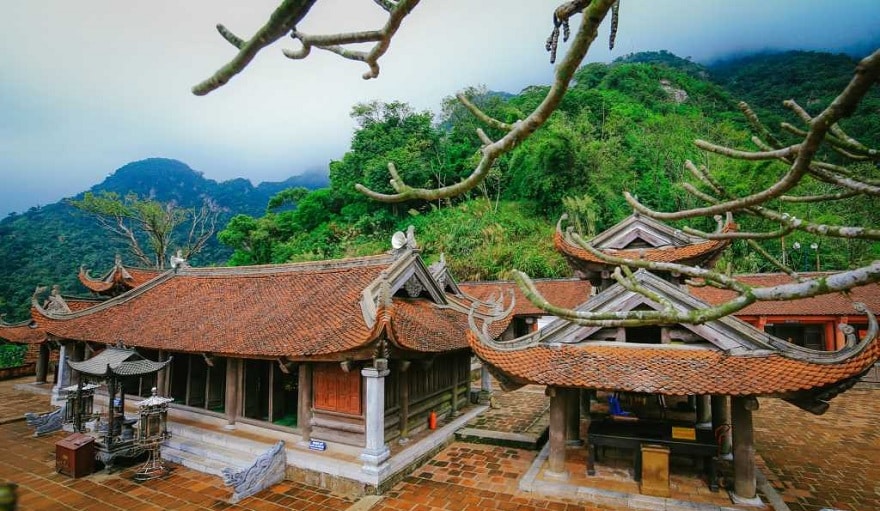
Hoa Yen Pagoda
See more: Top 9 Most Sacred Pagodas in Quang Ninh
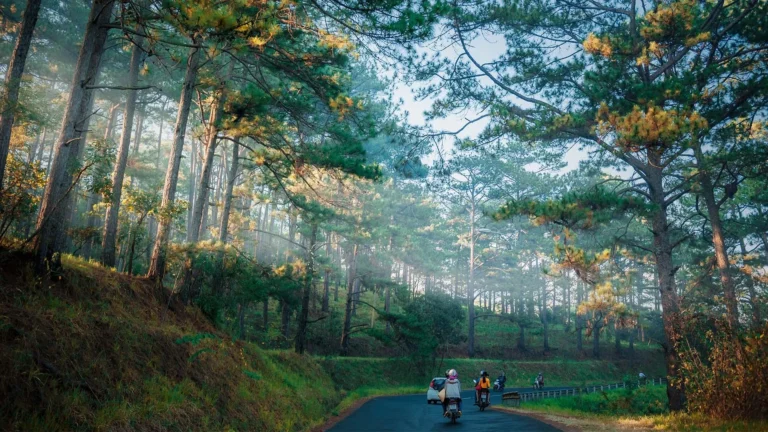
Yen Tu emerges dimly and ethereally against the cloudy sky like a sublime natural masterpiece painted with intimate, delicate, gentle, yet deeply mystical brushstrokes—which is why people liken Yen Tu to a celestial fairyland amidst the mortal world. If visitors arrive at Hoa Yen Pagoda at dawn, they will feel the pristine purity of the mountains, forests, and vegetation here; only then can one truly appreciate the subtlety of Nguyen Trai when he composed verses on Yen Tu:
Atop Yen Tu’s highest peak
At the fifth watch, the sky already shines bright
Eyes sweep the cosmos out across the vast sea
Talking, laughing—one stands amidst azure clouds
Ten thousand jade spears of bamboo bar the gate
Countless pearl tassels of stone hang like curtains
Relics of Nhan Tong still remain right here
Double pupils glimpsed amidst radiant light.”
Perhaps the very first sights that delight visitors on their journey up to Hoa Yen Pagoda are the three ancient frangipani trees standing majestically at over 700 years old. Their gnarled trunks appear to have weathered countless storms of heaven and earth, standing steadfast like heroes amidst a battlefield. Before Buddha Emperor Tran Nhan Tong ascended Yen Tu to practice asceticism, the pagoda was built by Ly Dynasty monks with roofs thatched from forest leaves. After ascending to practice, Buddha Emperor Tran Nhan Tong regularly held classes transmitting the Core Principles of Zen to his disciples Phap Loa, Huyen Quang, Bao Sai, Phap Khong, and others right here.
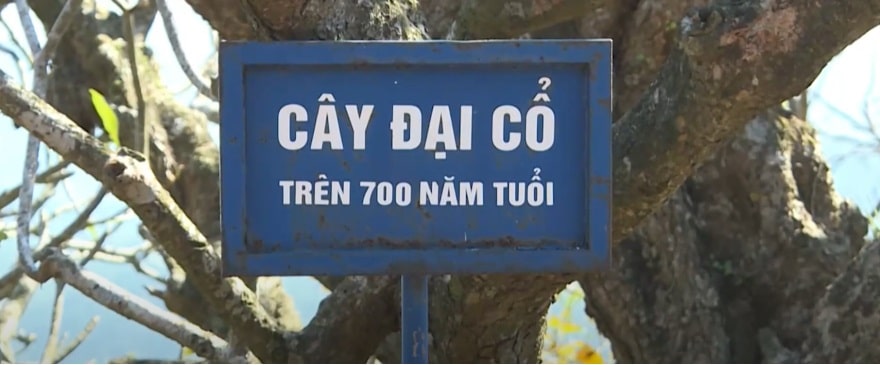
700-year-old ancient frangipani tree in front of Hoa Yen Pagoda
By 1317, when Phap Loa received the robe and alms bowl to become the second Patriarch of the Three Patriarchs, Hoa Yen Pagoda was grandly constructed into a vast architectural complex. In addition to the Front Hall and Upper Sanctuary for worshipping the Buddha, the pagoda’s structures previously included a drum tower, bell tower, guesthouse, preaching hall, and monks’ quarters. The current pagoda was built during the Nguyen Dynasty in a five-bay “Ding” (丁) shaped architectural layout. Ancients believed that according to the mountain’s geomantic formation, Hoa Yen Pagoda sits right at the dragon’s head, the dragon’s eyes are where the ancestral stupas stand, and the two flanking mountain ranges act like the dragon’s arms embracing the pilgrims’ path.
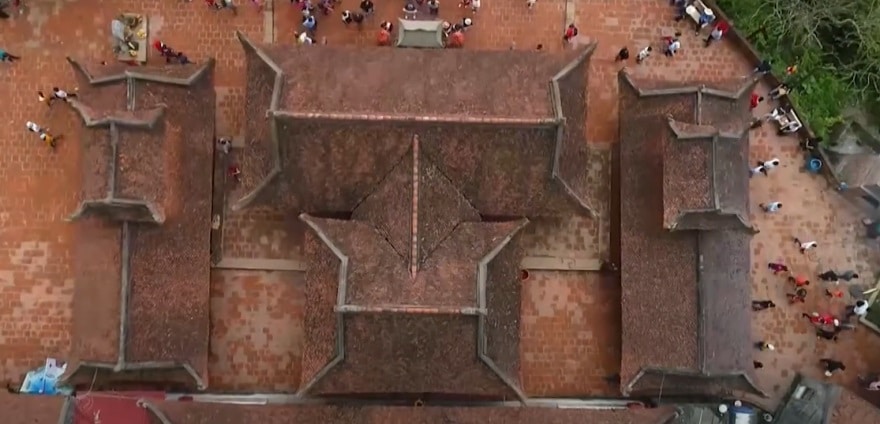
Hoa Yen Pagoda today features architecture shaped like the character ‘Quoc’
Today, the pagoda grounds no longer retain the bell tower, drum tower, meditation hermitage, monks’ quarters, or guesthouse. At the end of 2002, Hoa Yen Pagoda was restored with a structure closely resembling the Chinese character “Guo” (國 – Nation), a temple layout known as “inner Gong (工), outer Guo (國),” meaning the interior forms the character “Gong” while the exterior is enclosed by a frame like the character “Guo.” The pagoda is built on a lotus-petal-shaped strip of land curving around the mountainside, consisting of two parts: a front hall and a rear sanctuary spanning roughly 150 m² housing dozens of large statues cast entirely in bronze—the largest being the statue of Tran Nhan Tong placed at the center of the rear sanctuary, seated cross-legged upon a lotus pedestal with a countenance untouched by worldly dust. In the left bay of the pagoda, before the front hall, hangs a massive bell cast in the 14th year of Minh Mang’s reign, inscribed with an epitaph composed by Dien Chinh Nguyen Sieu Pham praising Tran Nhan Tong and Yen Tu. An excerpt reads:
“It has been heard that the sound of bells and stone chimes serves to awaken those lost in delusion; the resonant tolling echoes into distant realms—such is the pure voice of the Great Dharma at the Zen gate. At this mountain temple, ever since the Enlightened Emperor Tran Nhan Tong abdicated the throne to pursue the monastic path, the transmitted flame of Zen has continued to shine brilliantly, remaining the foremost renowned mountain pagoda of the Viet nation…” (Translated from classical Chinese).
In front of the Triple Jewels hall stands a very antique bronze incense pavilion; behind Hoa Yen Pagoda lies Pho Da Avalokiteshvara Bodhisattva Pagoda, though today only ruins remain. Directly below Hoa Yen Pagoda is the Hue Quang Stupa Garden, comprising 97 adjacent stupas forming a unified complex. Situated right at the center of Quy Duc Mausoleum is Hue Quang Stupa, the final resting place of the Enlightened Emperor and First Patriarch of Truc Lam, Tran Nhan Tong. Inside An Chi Mausoleum sits a statue of Tran Nhan Tong in a seated meditation posture, draped in a diagonally worn kasaya robe, exuding the serene and carefree demeanor of an enlightened Zen master.
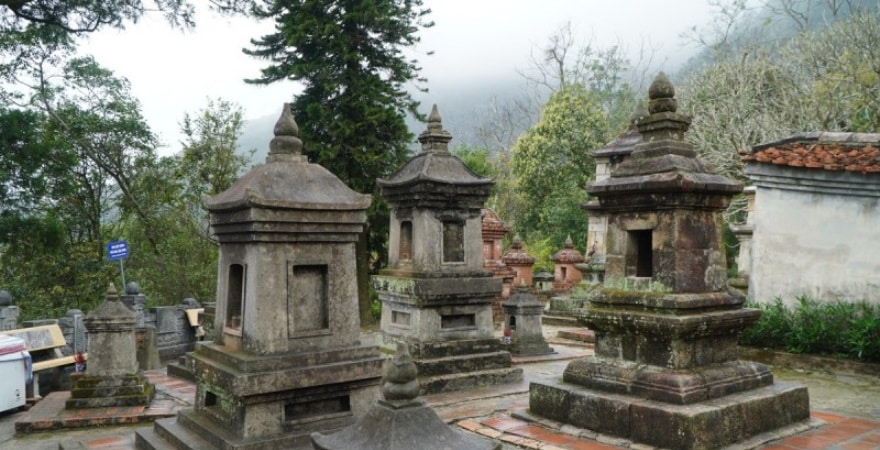
Ancient stupa hermitages beside Hoa Yen Pagoda
Hoa Yen Pagoda embodies harmony between architectural craftsmanship and nature, as well as the union between spiritual practice and secular life. The temple serves as the beating heart of the Yen Tu spiritual and cultural architectural complex that every traveler wishes to visit during their pilgrimage to the sacred Yen Tu scenic relic site.