The origins of Dongdaemun Night Market are intricately woven into Seoul’s tumultuous evolution across more than six centuries. Tracing history back to 1394, when King Taejo (Yi Seong-gye) founded the Joseon Dynasty and moved the capital to Hanyang (present-day Seoul), a formidable stone fortress wall was hastily constructed to enclose the royal city. Right at the eastern gateway of the capital—home to Heunginjimun Gate—the royal court established a bustling commercial zone named Baeogae Market (commonly known as Gogae Market). It quickly became a vital trade artery responsible for gathering and supplying agricultural goods, forest products, and fine textiles for the yangban nobility and the royal household under the strict supervision of the Joseon Ministry of Markets.
During the Japanese colonial occupation of the Korean Peninsula from 1910 to 1945, the historic landscape surrounding Heunginjimun underwent profound alterations imposed by colonial urban planning. Occupying forces demolished sections of the centuries-old fortress walls to expand motorized road networks while reorganizing traditional commerce. The historic Gogae Market was stripped of its original name, split, and restructured into Gwangjang Market and a modernized Dongdaemun market complex designed to exert absolute control over food and essential supply chains for the colonial administration. Despite being constrained by harsh wartime economic laws, the market quietly maintained its role as a grassroots trading hub for local residents, biding its time for a future rebirth.
The most dramatic historical turning point for Dongdaemun occurred in the aftermath of the devastating Korean War. Entering the 1960s and 1970s, tens of thousands of impoverished refugees from across the war-torn peninsula converged on the low-lying wasteland along Cheonggyecheon Stream, erecting makeshift shanties out of corrugated iron and scrap wood. Inside these weathered shacks, a vibrant trade in secondhand clothing, fabric remnants, and surplus military uniforms from army bases took root. Recognizing the industrial potential of this diligent workforce, President Park Chung-hee’s administration intervened with sweeping macroeconomic policies, transforming the streamside district into the National Garment Industry Center. Thousands of knitting workshops, tailoring factories, and hand-embroidery studios packed into concrete tenement buildings, turning Dongdaemun into a colossal apparel-manufacturing engine that laid a cornerstone for the “Miracle on the Han River.”
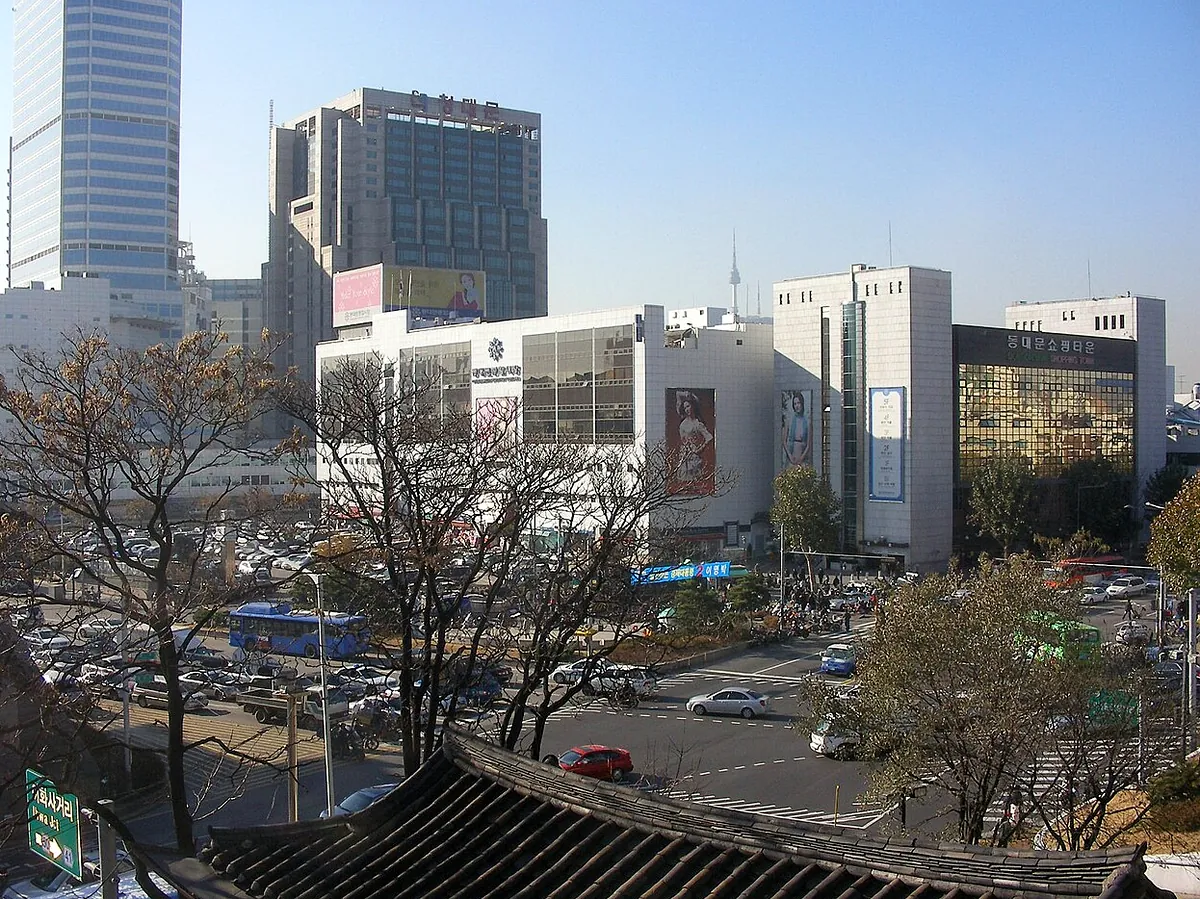
From the 1990s onward, Dongdaemun underwent a revolutionary transformation fueled by the rise of high-rise shopping malls and fast-paced consumer culture. A landmark moment arrived in 1999 with the opening of the Doota retail complex, joining neighboring megamalls such as Migliore and Hello apM to form an unprecedented alliance with traditional underground wholesale markets. This unique synergy gave birth to the internationally famous “sleepless night market” model, operating on a schedule completely inverted from normal biological rhythms—lighting up at 8:00 PM and resting only at 5:00 AM the next morning. This all-night commercial hub is far more than a shopping district; it has become Northeast Asia’s largest fashion capital, where new designs take a mere forty-eight hours to move from initial sketch to factory production and onto wholesale racks.
According to the traditional geomancy (pungsu) of ancient Hanyang, the eastern guardian sector held special significance within the capital’s terrestrial energy network. While Mount Inwangsan towered to the west like the White Tiger, the gentler slopes of Mount Naksan to the east formed a natural basin receiving the waters of Cheonggyecheon Stream as it flowed eastward through the city toward the expansive Hangang River. From a geomantic perspective, this water-gathering ground at the foot of Heunginjimun Gate was recognized from the early Joseon era as an auspicious dragon vein for wealth and merchant prosperity. The gentle meander of the natural stream combined with the basin topography turned Dongdaemun into a symbolic “silk pouch” accumulating vital energy, shaping a premier center for silk, produce, and textile trade across centuries of Korean history.
Building upon that naturally abundant terrain, contemporary urban planning has transformed Dongdaemun into an infrastructure masterpiece modeled on Seoul’s Smart City standards, where historic surface landscapes and subterranean transit networks interlock with clockwork precision. At the heart of this connectivity lies Dongdaemun History & Culture Park Station—a massive underground transit hub where three vital subway lines intersect: Line 2 (the circular city loop), Line 4 (running north–south), and Line 5 (connecting east–west). Handling over 120,000 passengers daily, this station channels surging crowds straight into the major shopping complexes. Alongside it, Dongdaemun Station links Lines 1 and 4, providing direct access to traditional markets and the ancient stone fortress walls, forming a sturdy transit pincer supporting East Asia’s busiest commercial district.
Dongdaemun’s lifeblood extends well above ground as well, powered by meticulously planned local and international transport links. Premium Airport Limousine Bus No. 6001 establishes an express corridor connecting both Incheon (ICN) and Gimpo (GMP) international airports directly to the heart of Dongdaemun every 15 to 20 minutes, offering seamless convenience for international buyers and travelers. Most notably, when the city falls asleep and subway lines pause overnight, a specialized late-night bus network known as the Owl Bus (Dokkaebi Bus) takes command of the streets. Operating tirelessly during the golden nocturnal hours from 11:30 PM to 6:00 AM, dedicated night routes such as N13, N16, N30, and N62 shuttle wholesalers, tailors, fashion designers, and travelers across the capital like streaks of light, keeping Dongdaemun’s nocturnal economic heartbeat pulsing without a second’s pause.
The spatial landscape of the night market stages a captivating dialogue between nature, historic heritage, and surreal deconstructivist architecture along two classic walking itineraries. The first route begins at the solemn, moss-draped stone arches of Heunginjimun Gate, curves past the fluid contours of Dongdaemun Design Plaza, and descends gently to the banks of Cheonggyecheon Stream—where cool flowing water and native greenery act as a natural green lung regulating the microclimate and softening the concrete and neon glare. Parallel to this, the second route immerses visitors in a bustling commercial labyrinth, starting among endless wholesale stalls at Dongpyeonghwa Market, sweeping past the dazzling modernity of Doota Mall and Goodmorning City, and culminating in Dakhanmari Alley, fragrant with simmering whole-chicken soup. These overlapping layers make Dongdaemun a living urban organism where millennium-old geomancy merges effortlessly with endless metropolitan energy.
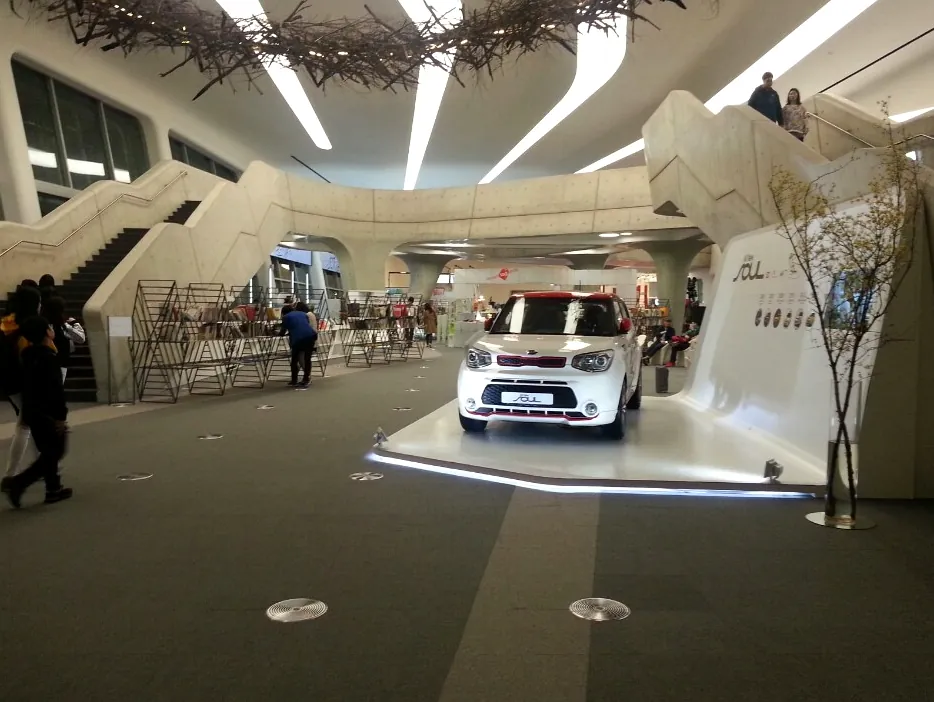
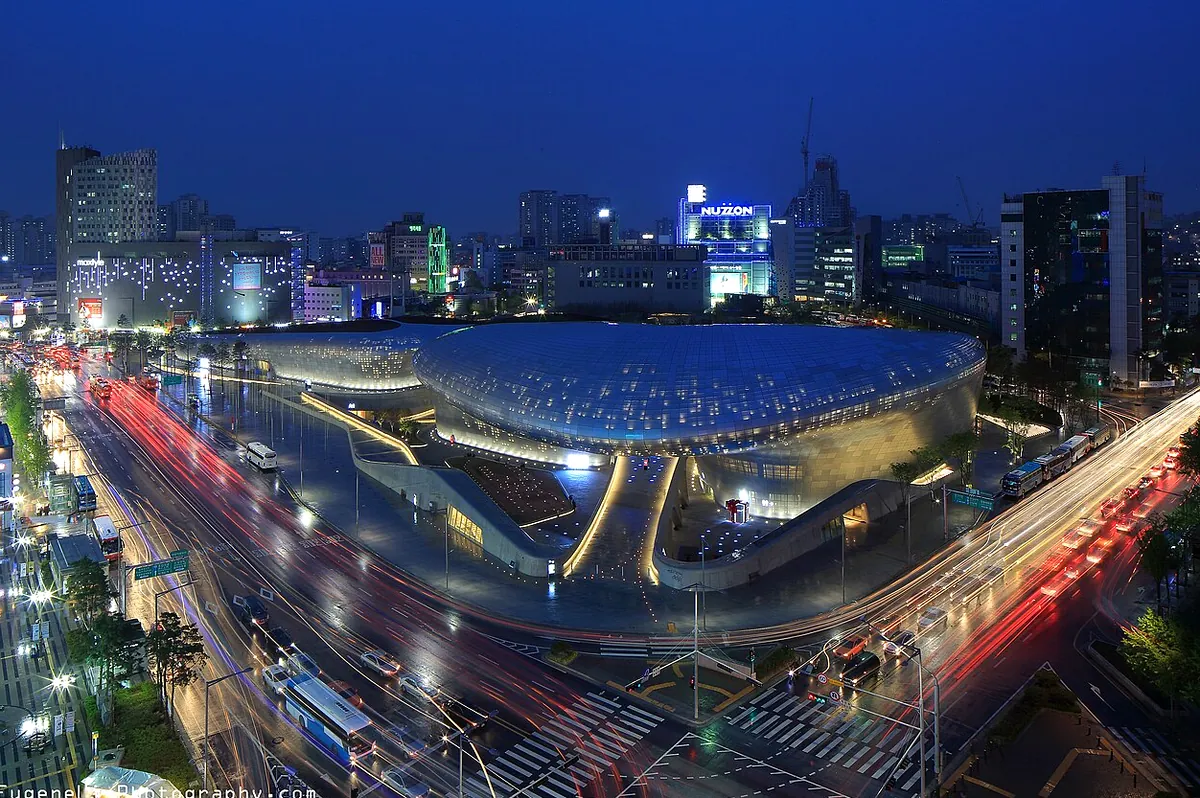
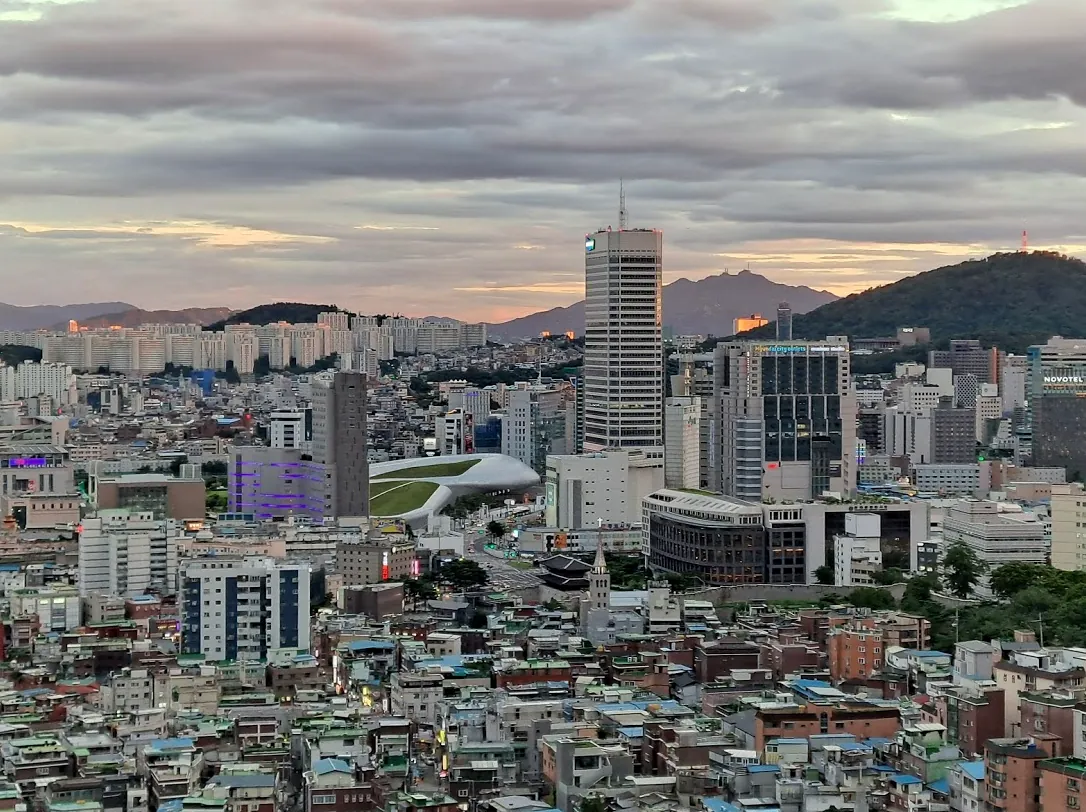
The most breathtaking and iconic visual anchor in Dongdaemun is Dongdaemun Design Plaza (DDP), a magnificent masterpiece by the late Iraqi-British architect Zaha Hadid—the first woman in history honored with the prestigious Pritzker Architecture Prize. Commanding a bustling intersection, the structure appears like a surreal spaceship that has just touched down in the heart of ancient Hanyang, a capital steeped in over six centuries of history. Recognized as one of the world’s largest three-dimensional free-form Neo-futuristic structures, DDP shatters conventional geometric norms by completely eliminating interior load-bearing columns, opening up continuous, fluid, and boundless interior spaces.
The exterior facade of this architectural marvel is clad in 45,133 geometrically varied aluminum panels, each engineered with unique curvature, inclination, and radius using cutting-edge Building Information Modeling (BIM) technology. Its reflective metallic skin shifts subtly in hue with changing natural daylight and dazzling city lights, creating an enchanting visual dance from dusk until dawn. Yet what lends DDP profound humanistic value goes beyond futuristic technology—it lies in how the complex embraces and preserves subterranean historical layers. Beneath this visionary structure rest excavated ruins of the bluestone Hanyangdoseong fortress wall, the Igansumun water gate, and remnants of the Joseon-era Hadogam military training grounds once buried beneath the old Dongdaemun Stadium, creating a philosophical harmony between ancient defensive heritage and twenty-first-century spatial design.
Surrounding the DDP nucleus is a massive commercial complex clearly divided into two distinct hemispheres—retail and wholesale—operating on a unique day-and-night circadian rhythm. Stretching along Jangchungdan-ro Boulevard to the west is a realm of upscale retail towers, led by Doota Mall—home to hundreds of independent studios by young Korean fashion designers—alongside Hello apM and Goodmorning City. Designed around modern lifestyle concepts, these multi-story malls integrate luxury fashion floors, domestic K-beauty boutiques, cinemas, and upscale dining, continually illuminating the streetscape with giant LED screens and lively street-music stages.
Across the avenue and deeper east behind DDP, the atmosphere shifts dramatically into a trillion-won cash-generating powerhouse: Asia’s largest nocturnal wholesale market complex. Encompassing renowned wholesale hubs such as Cheongpyeonghwa, Dongpyeonghwa, Designer Club, UUs, and apM Luxe, this district truly awakens at 8:00 PM and sustains a breathless pace until daybreak. Inside lies an endless maze of tens of thousands of specialized stalls, with narrow aisles stacked high with yellow canvas-wrapped cargo bundles bound for destinations worldwide. Here, the integrated cycle from design sketch to satellite sewing workshops within a few kilometers to wholesale display racks takes just 48 hours, forming a rapid circular ecosystem that cements Dongdaemun’s status as the world’s premier fast-fashion hub.
As sunset fades over the Han River basin and the ancient fortress walls of old Hanyang slip into shadow, the entire Dongdaemun district enters a dazzling nocturnal awakening, unfolding a mesmerizing symphony of sight and sound. Beginning around 8:00 PM, the neighborhood’s tempo quickens, reaching its vibrant crescendo between 10:00 PM and 2:00 AM. At these hours, the urban landscape transforms into a colossal open-air stage where boundaries between Joseon dynastic history—anchored by solemn Heunginjimun Gate—and a surreal futuristic era dissolve beneath millions of interlocking beams of light.
At the center of this visual spectacle stands Dongdaemun Design Plaza, crafted from 45,133 individually curved aluminum panels by Zaha Hadid. By night, its flowing metallic exterior becomes an immense digital canvas for multidimensional light projections. Ever-shifting spectrums—evoking everything from cosmic dances to traditional East Asian calligraphy—ripple smoothly across the undulating skin and shimmer across the sunken plaza below. Seamless transitions lead into Dongdaemun History & Culture Park, where rugged granite remnants of the Seoul City Wall are highlighted by subtle artistic uplighting, staging an intimate visual conversation between centuries past and the pulse of the present.
Joining this technological showcase is an overwhelming chorus of thousands of vibrant neon signs crowning high-rise fashion complexes like Doota, Migliore, Hello apM, and apM Luxe. Multicolored beams sweep across every level, turning the entire district into a valley of light that never dims. Here, fashion runways are no longer confined to exclusive auditoriums; instead, they spill onto stone steps and sleek brick promenades. Impromptu street-fashion shows by emerging designers and high-energy street-dance performances unfold right beneath the commercial towers, captivating curious travelers gathered from across every continent.
Beyond light art and spontaneous runways, the true soul of Dongdaemun after dark lies in the relentless commercial pulse of an intercontinental wholesale market. While the rest of Seoul sleeps in quiet stillness, Dongdaemun bustles with extraordinary energy as thousands of massive canvas-wrapped bundles are whisked through narrow alleys on scooters, supplying freshly produced apparel to global retail networks. Rapid-fire multilingual negotiations among international buyers mingle with the clatter of hand trucks rolling over pavement, composing an unmistakable nocturnal soundtrack unique to this powerhouse economy.
Those seeking a quiet interlude amid this grand symphony need only walk a few hundred meters toward the cool waters of Cheonggyecheon Stream. Rippling gently beneath softly illuminated stone arch bridges, the waterway forms a tranquil corridor running parallel to the blazing fashion capital. Along the stream banks and neighboring food alleys, steam billows from traditional late-night eateries, wafting rich aromas of savory whole-chicken soup (dakhanmari), glossy crimson trays of gochujang-glazed tteokbokki rice cakes, and herb-scented sundae blood sausage. This enduring nocturnal ecosystem operates seamlessly year after year, nourishing both fierce commercial enterprise and humanity’s endless appetite for aesthetic wonder.
When night falls and neon signs from towering malls bathe the Dongdaemun sky in color, the district’s energy shifts into another cultural dimension through billowing kitchen smoke rising from traditional culinary alleys. Emerging alongside bustling commerce during South Korea’s post-war economic reconstruction, Dongdaemun’s late-night food culture was born to warm and replenish generations of merchants and porters working overnight hauling bolts of fabric. Over decades of change, modest kitchens tucked along historic lanes elevated everyday working-class meals into celebrated culinary heritage—uniting comforting local flavors with the resilient spirit of Seoul’s townsfolk.
The brightest highlight on this late-night culinary map is Dongdaemun Dakhanmari Alley, a narrow lane tucked behind Dongdaemun Subway Station that remains perpetually packed with discerning diners. Here, the famed dakhanmari (“one whole chicken”) is served in gleaming aluminum pots, showcasing a tender whole young chicken simmered in a crystal-clear, naturally sweet broth extracted from hours of boiling bones with crushed garlic cloves and creamy potatoes. As the broth bubbles gently with a delicate aroma, servers deftly snip the chicken into bite-sized pieces right at the table using kitchen shears, revealing juicy, snow-white meat. The dish reaches perfection when paired with a custom dipping sauce mixed to a golden ratio of secret chili paste, yellow mustard, rich soy sauce, and crisp rice vinegar. Among the alley’s storied institutions, Chen Ok Wa Halmae Original Dakhanmari—operating continuously for over forty years—stands as an enduring icon preserving traditional Korean maternal recipes: broth seasoned purely with sea salt, accented with chewy tteok rice cakes, and finished at the end of the meal by dropping fresh, springy kalguksu noodles into the concentrated soup.
Just steps away from Dakhanmari Alley lies Dongdaemun Grilled Fish Alley (Saengseon-gui Golmok), where travelers’ senses are awakened by the unmistakable smoky perfume of charcoal grills. Established in the 1970s to provide quick, hearty meals for Dongdaemun garment factory workers, open charcoal grates glow continuously under racks of fatty mackerel and silvery hairtail. Veteran grill masters flip each batch with practiced skill, blistering the skin to a golden crisp while keeping the flesh inside moist, flaky, and naturally sweet without ever drying out. A rustic platter of grilled fish arrives alongside a bowl of steamed white rice, piping-hot soybean paste stew, and familiar banchan side dishes—aged napa cabbage kimchi, roasted seaweed, and crunchy pickled radish—forming a balanced, nostalgic meal evocative of home kitchens across the Land of Kimchi in the heart of a bustling metropolis.
Dongdaemun’s nocturnal flavorscape would be incomplete without the iconic orange tarpaulin tents of pojangmacha street-food stalls lining the gentle flow of Cheonggyecheon Stream. Beneath wind-sheltering plastic canopies, diners sit shoulder-to-shoulder on low plastic stools seeking comfort after hours of marathon shopping. Steam rises from pans of bright red tteokbokki coated in thick gochujang chili sauce, wavy skewers of odeng fish cakes simmering in sweet radish broth, and platters of savory sundae sausage garnished with salt, pepper, and fresh herbs. Nibbling on bite-sized gimbap rolls glistening with sesame oil while listening to rippling stream water mingle with lively local chatter allows travelers to truly absorb the vibrant pulse and enduring culinary soul of this market that never sleeps.
Once sunset dips behind historic Heunginjimun Gate, Dongdaemun enters its liveliest hours of the day. To experience the full magic of the contrast between Dongdaemun Design Plaza’s futuristic curves and the glowing facades of surrounding shopping towers, the prime window to visit is between 10:00 PM and 2:00 AM. Reaching this fashion mecca is effortless via Seoul’s world-class public transit network: take Subway Line 1 or Line 4 to Dongdaemun Station (Exits 8 or 9), or ride Line 2, Line 4, or Line 5 to Dongdaemun History & Culture Park Station (Exits 1 or 14). When subway trains stop running after midnight, Seoul’s overnight Owl Bus network (notably routes N13, N15, N16, and N30) or ride-hailing apps offer safe, reliable transport so your late-night exploration continues uninterrupted.
Dongdaemun’s commercial ecosystem is clearly divided into two shopping hemispheres governed by unwritten rules every visitor should know. West of the main boulevard stand modern retail malls such as Doota Mall, Hello apM, and Migliore, welcoming individual shoppers with clearly marked prices, attentive fitting rooms, and Instant Tax Refund services directly at checkout counters for purchases of 30,000 KRW or more upon presenting a valid passport. Conversely, east of DDP lies the domain of legendary wholesale complexes like Dongpyeonghwa Market and UUs Fashion Mall, where towering plastic-wrapped cargo bundles fill the corridors. In these wholesale buildings, vendors generally require purchasing a minimum of two to three pieces of the same style and accept payment exclusively in Korean Won cash—so individual shoppers should plan accordingly or team up with travel companions to unlock true factory-direct prices.
While carrying cash is essential for street-food tents and wholesale stalls, most retail fashion boutiques accept a wide range of cashless payments, from international Visa and Mastercard credit cards to domestic QR payment platforms like Naver Pay and Kakao Pay. To avoid unnecessary financial pitfalls, travelers should steer clear of unauthorized money changers soliciting near subway exits and instead exchange currency at reputable banks or licensed exchange booths. Notably, mindful travelers increasingly favor standardized “No Shopping” tour itineraries—programs guaranteed free of mandatory stops at overpriced, exclusive retail outlets—returning full freedom to stroll independently, savor authentic street cuisine, and hunt for stylish pieces at honest value.
Before departing, travelers should complete all required entry formalities, including applying for a Korea Electronic Travel Authorization (K-ETA) or tourist visa in accordance with current South Korean immigration regulations, as well as submitting the Q-Code electronic arrival declaration in advance to streamline clearance at Incheon International Airport. Comfortable sneakers and a lightweight windbreaker are indispensable companions for walking miles past tens of thousands of stalls through the night. If you wish to explore South Korea’s fashion capital on a well-paced, financially transparent itinerary led by guides deeply versed in local culture, consider exploring an all-inclusive South Korea tour package for a seamless, worry-free journey.