In the heart of the bustling southern metropolis, the Cathedral Basilica of Our Lady of the Immaculate Conception—fondly known to millions as Saigon Notre Dame Cathedral—occupies a prime location where the historical, cultural, and architectural currents of Ho Chi Minh City converge. Dominating Paris Commune Square (District 1), the structure is far more than a religious stop; it serves as the focal point of a classic urban axis, connecting directly to the Independence Palace via the stately Le Duan Boulevard. From a modern urban planning perspective, this vantage point was designed as a steadfast visual and spiritual anchor, where surrounding streets draw the eye toward its soaring twin spires as a timeless symbol of the city.
Looking back to the pivotal years of Vietnamese history in the second half of the 19th century, the origins of Notre Dame Cathedral are tied to a turbulent geopolitical landscape. When the Nguyen Dynasty under Emperor Tu Duc signed the Treaty of Saigon (1862), ceding three eastern provinces of Cochinchina to France, colonial authorities began reshaping Saigon’s urban layout after Western models. To meet the spiritual needs of French soldiers and parishioners in the colony, Admiral Pierre-Paul de La Grandière took the initial step in August 1865 by ordering a temporary church built along the Thi Nghe Canal on the site of an abandoned Vietnamese pagoda. Shortly thereafter, in March 1866, Father Lefèbvre oversaw the leveling of the land and broke ground on a larger wooden church at the present-day central site, completing it in 1868. However, the simple timber soon succumbed to the harsh tropical monsoon climate and severe termite damage, prompting the colonial government to commission a permanent edifice of brick and stone.
A historic turning point arrived on October 7, 1877, when the Governor of Cochinchina, Jauréguiberry, laid the foundation stones for the basilica according to the elaborate design of military architect Jules Bourard. After nearly three years of construction at a massive cost of 2,500,000 French gold francs, the solemn inauguration and consecration ceremony took place on April 11, 1880. Thus emerged an architectural masterpiece blending Gothic and Neo-Romanesque styles, standing as a testament to construction craftsmanship—every refined material, from cement and steel to roof tiles and stained glass, was shipped directly from France. Having weathered more than a century of ups and downs alongside the destiny of Saigon – Ho Chi Minh City, Notre Dame Cathedral endures as a living heritage monument, preserving layers of East-West cultural fusion and radiating its singular local beauty at the core of the modern city.
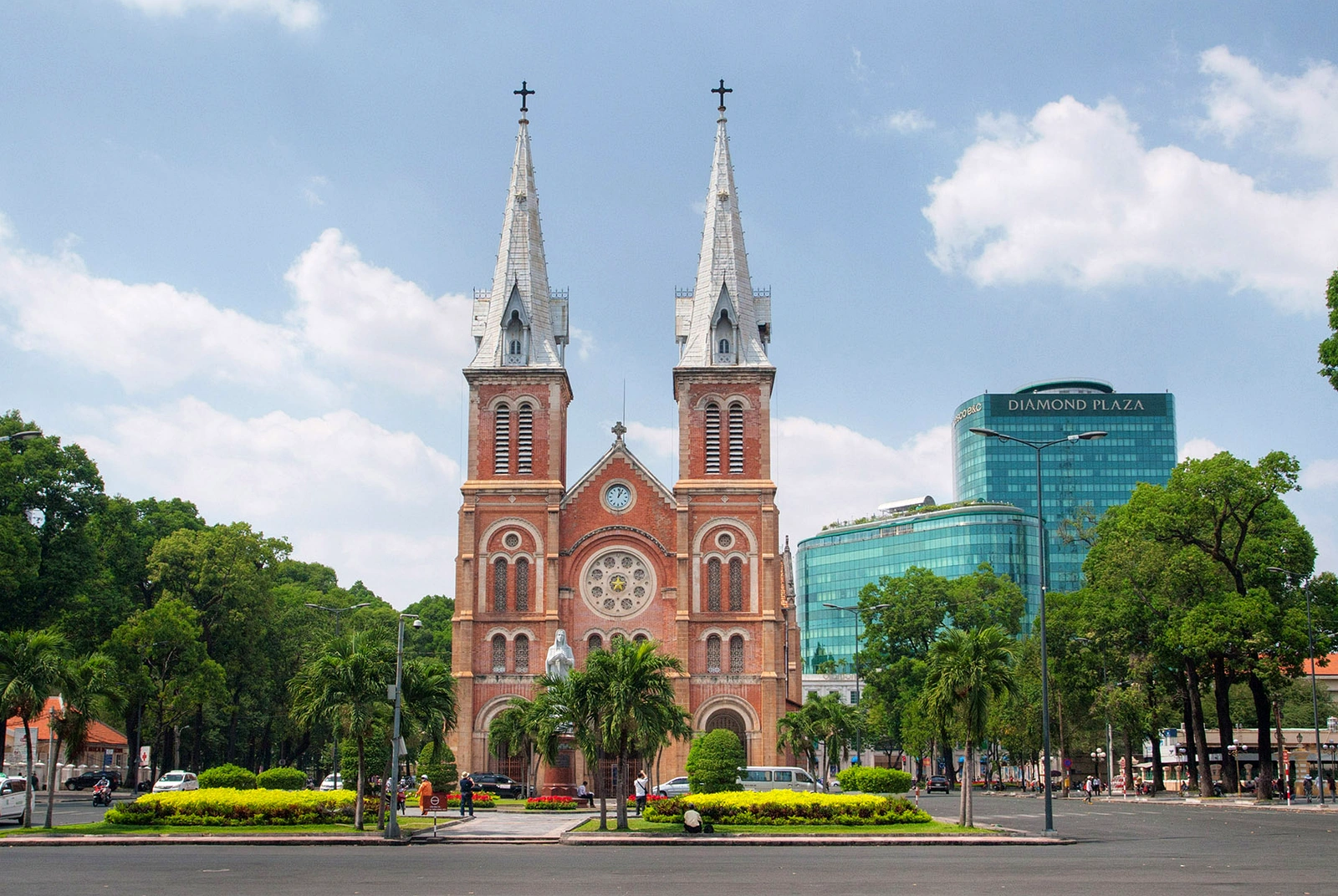
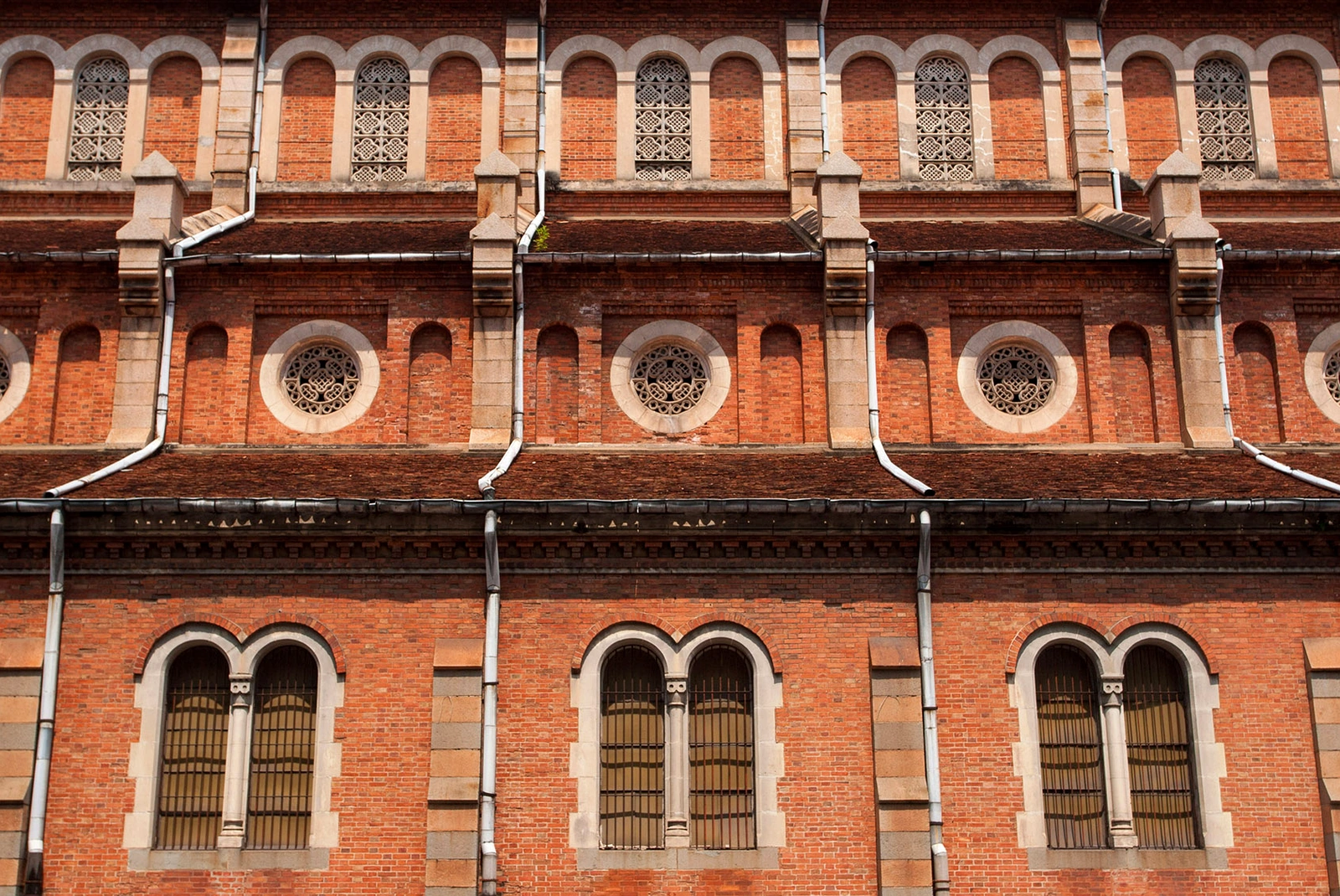
Standing majestically at the center of Ho Chi Minh City, the Cathedral Basilica of Our Lady of the Immaculate Conception—commonly known as Saigon Notre Dame Cathedral—appears as a rare, pure masterpiece of combined Gothic and Romanesque architecture in Asia. The entire structure is a seamless harmony of unplastered bricks imported directly from Marseille, creating a deep, weathered red hue that has endured through the decades without a single coat of paint. Its prime setting right on the central square acts as a converging hub for major thoroughfares, opening up an airy expanse where modern city rhythms meet quiet, late-19th-century historical charm.
Approaching closely, visitors are awestruck by the grandeur of the facade, crowned by twin bell towers rising nearly 60 meters into the sky—once the tallest point in Saigon at the end of the 19th century. Atop each tower stands a solemn cross pointing heavenward, while inside hangs a set of six massive bronze bells cast in France whose chimes resonate across the surrounding district. The facade features pointed Gothic arches paired harmoniously with sturdy buttresses and intricate stained-glass windows. When sunlight filters through the glass panels depicting biblical scenes, the sanctuary interior glows with a mystical, shimmering, and deeply reverent light, enveloping the marble columns in serene sanctity.
To capture the most memorable shots at this remarkable historical and architectural landmark, photographers and travelers swear by two unmissable “million-view” angles. The first is from the direction of April 30 Park, framing the entire cathedral facade with the statue of Our Lady of Peace in the foreground to create spatial depth that is both classic and poetic. The second is from Nguyen Du Street or the Le Duan – Hai Ba Trung intersection, capturing a dramatic side angle of the soaring twin bell towers alongside the stately arched windows.
For ideal lighting, professional photographers highly recommend the golden hours at dawn (from 5:30 AM to 7:00 AM) or sunset (from 4:00 PM to 5:30 PM). At dawn, the first slanting rays of morning sunlight filter through ancient trees, casting a warm golden glow across the bare red bricks and evoking the peaceful, nostalgic spirit of old Saigon. Meanwhile, sunset bathes the surroundings in soft, ethereal hues, accentuating the majestic and solemn architectural lines of a cultural icon that has stood the test of time.
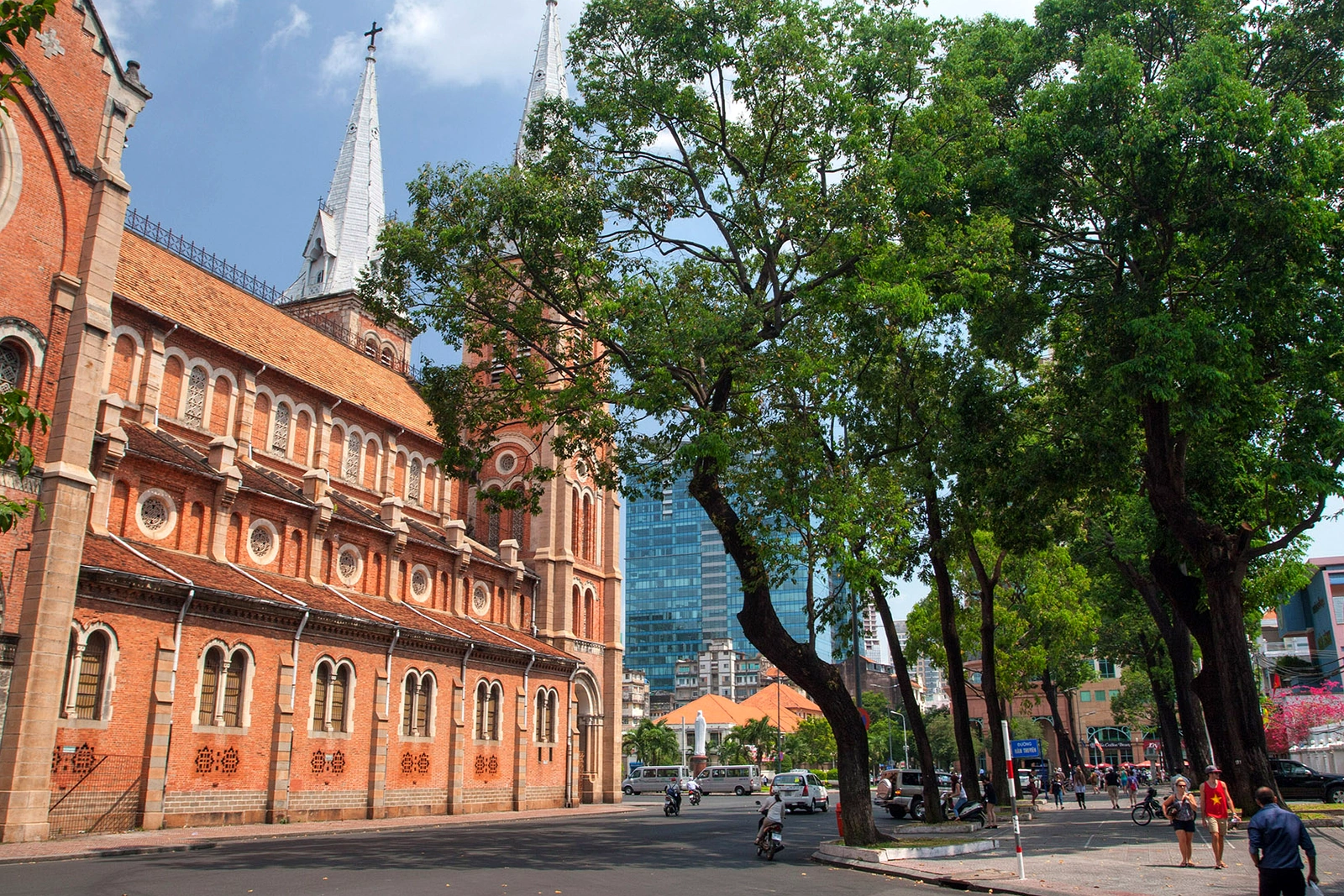
Stepping up to this iconic landmark, the very first thing that awakens every sense is the striking, deep red hue of millions of unplastered Marseille bricks, seemingly steeped in the breath of more than a century of history. Amid the fast-paced, bustling energy of a modern southern metropolis, the grounds around Saigon Notre Dame Cathedral offer a sacred, reflective pause. Beneath the shade of old tamarind trees, the church bells ringing out each morning and dusk are more than mere religious chimes—they have woven themselves into the local cultural heartbeat, becoming an inseparable memory for generations born and raised in Saigon.
A complete visit to this landmark wouldn’t be the same without a moving moment of spiritual contemplation and a taste of the uniquely vibrant sidewalk culture right beside the cathedral grounds. Visitors often stroll leisurely across the lush green lawns, admire the serene statue of Our Lady of Peace in the square, and settle in for a cup of “cà phê bệt” (sidewalk coffee)—a signature local tradition exclusive to Saigon. Sitting along the corner of Pham Ngoc Thach or Han Thuyen Street, watching traffic flow past the classic Gothic-Romanesque facade while savoring rich Vietnamese iced milk coffee and a crispy, warm banh mi from nearby park vendors, travelers experience a Saigon that is at once classic and nostalgic, yet approachable, unpretentious, and brimming with life.
As dusk settles, the late-afternoon amber glow drapes the cathedral’s towering twin spires in a breathtaking, almost magical splendor. That fleeting moment brings an extraordinary sense of calm, allowing you to leave behind the rush and worries of everyday life. Experiencing this place goes beyond admiring historic architecture or sampling quintessential street food; it is a journey into the deep soul of the city—where rich history, spiritual heritage, and urban energy merge as one, leaving every traveler with unforgettable memories of a warm-hearted, generous, and soulful Saigon.
Saigon Notre Dame Cathedral (Cathedral Basilica of Our Lady of the Immaculate Conception) is not only a historic architectural masterpiece but also an unmissable spiritual and cultural destination when visiting Ho Chi Minh City. To ensure a smooth and rewarding visit to this late-19th-century landmark, it helps to keep practical tips on opening hours, transportation, and local etiquette in mind.
Regarding operating hours, the cathedral opens daily for Catholic worshippers attending Mass and visitors touring the grounds. Opening hours are typically split into morning and afternoon sessions, running from early morning until before evening Mass. Best of all, admission to the basilica is completely free, with no entrance ticket required. The best times of day to visit are early morning (7:00 AM to 9:00 AM) or late afternoon (3:00 PM to 5:00 PM), when soft sunlight illuminates the red-brick facade, creating a luminous, timeless backdrop ideal for commemorative photos.
For getting there, its central location at Paris Commune Square, Ben Nghe Ward, District 1 makes reaching the cathedral from anywhere downtown effortless. If traveling by private vehicle or taxi, simply head along Le Duan or Dong Khoi Street. For those who enjoy public transit, bus routes 04, 18, 30, 36, and 93 all stop right near the park in front of the cathedral, leaving just a short, easy walk.
As both a sacred place of worship and a heritage site undergoing conservation and restoration, visitors are expected to observe strict dress and conduct guidelines. Choose respectful, modest attire such as skirts or trousers extending below the knee, and avoid overly short outfits, sleeveless tops, or sheer clothing. When entering worship areas or the interior (when open to visitors), maintain quietness, refrain from loud laughter or chatter, and do not touch antique fixtures or write on the brick walls. Additionally, because the surrounding grounds are expansive and paved with stone, opt for flat shoes or comfortable sneakers so you can easily explore the entire architectural complex on foot.
To enjoy a seamless getaway and take in the full beauty of Saigon Notre Dame Cathedral without worrying about arranging transportation, admission tickets, or itineraries, travelers can choose from VDS Travel’s premium all-inclusive Ho Chi Minh City tour packages. Every itinerary is thoughtfully timed for photo stops when the scenery shines brightest, accompanied by knowledgeable local guides and top-tier hotel and dining standards.