Straddling a mountain ridge at 3,100 meters above sea level, Dochula Pass has served since time immemorial as a vital military and commercial artery linking the political capital of Thimphu with the spiritual and winter administrative center of Punakha. For centuries before modern paved highways were carved into the cliffs, this windswept saddle was a perilous staging post along ancient trans-Himalayan trails, where caravans, eminent lamas, and royal soldiers of Druk Yul braved biting blizzards and perpetual mountain mist. The pass’s rugged natural terrain not only defines the geographic boundary between two of Bhutan’s most crucial valleys, but also stands as a silent witness to pivotal moments that shaped the survival of the Wangchuck Dynasty.
The most profound historical turning point tied to this sacred summit erupted at the turn of the twenty-first century, when the secluded peace of this Vajrayana Buddhist kingdom faced an unprecedented threat. From the 1990s into the early 2000s, separatist militant groups from Northeast India—including the United Liberation Front of Asom (ULFA), the National Democratic Front of Bodoland (NDFB), and the Kamtapur Liberation Organization (KLO)—covertly infiltrated and established dozens of fortified camps deep within the dense tropical jungles along Bhutan’s southern border. Their unlawful armed presence not only eroded national sovereignty, but also placed Bhutan in a delicate diplomatic bind between international obligations and preserving the serene tranquility of its mountain realm.
After years of patient yet unsuccessful peace negotiations aimed at persuading the armed factions to withdraw voluntarily, King Jigme Singye Wangchuck—the Fourth Druk Gyalpo (Dragon King) of Bhutan—made a historic decision. In the winter of 2003, a military campaign codenamed “Operation All Clear” was officially launched. Rather than commanding from the safety of the royal palace in Thimphu, the Fourth King donned combat fatigues and personally led the Royal Bhutan Army straight into the treacherous southern jungles. It was Bhutan’s first major military operation in over a century, executed with precision and resolve yet deeply rooted in Buddhist compassion: minimizing casualties and restoring security without sowing seeds of lasting hatred.
The decisive victory of “Operation All Clear” in late 2003 dismantled the insurgent bases, firmly reasserted inviolable sovereignty, and restored territorial integrity to the kingdom. Yet rather than erecting a triumphalist monument glorifying worldly might in the manner of Western empires, the Bhutanese royal court transformed this military victory into a pure emblem of spiritual redemption and healing. Moved by profound devotion to offer gratitude to the Triple Gem, honor the King’s courageous leadership, and commemorate the soldiers who gave their lives for the nation, Her Majesty Queen Mother Ashi Dorji Wangmo Wangchuck commissioned the construction of the 108 Druk Wangyal Chortens in 2004 atop the windswept crest of Dochula Pass.
In Tibetan Tantric Buddhism, the number 108 signifies spiritual completeness, dissolving the 108 earthly defilements and forming a protective spiritual rampart over the entire kingdom. Remarkably rare in the annals of human warfare, this stupa complex was built not only to honor the valor of fallen Royal Bhutan Army soldiers, but also to offer selfless, compassionate prayers for the liberation of the insurgent fighters who perished in battle. The union of King Jigme Singye Wangchuck’s martial courage and Queen Mother Ashi Dorji Wangmo Wangchuck’s compassionate vow elevated Dochula Pass from a mere mountain thoroughfare into a hallowed historical sanctuary, where the chronicles of the Wangchuck Dynasty merge eternally with Vajrayana Buddhist heritage amid the snow-clad peaks of the Himalayas.
Rising to an elevation of 3,100 meters above sea level, Dochula Pass acts as a crucial geographic and geomantic watershed separating the cool, mist-shrouded Thimphu basin from the low-lying, fertile valley of Punakha with its subtropical climate. In traditional Tibetan geomancy and sacred geography, the undulating saddle of this high ridge is likened by ancients to the spine of the Thunder Dragon (Druk), where mountain energy currents converge before branching down into deep gorges. This vital arterial junction not only hosts the perpetual collision of contrasting air masses—conjuring ever-shifting curtains of cloud and fog—but also marks a striking ecological transition zone, shifting gracefully from mossy temperate oak forests to high-altitude conifers and Himalayan firs.
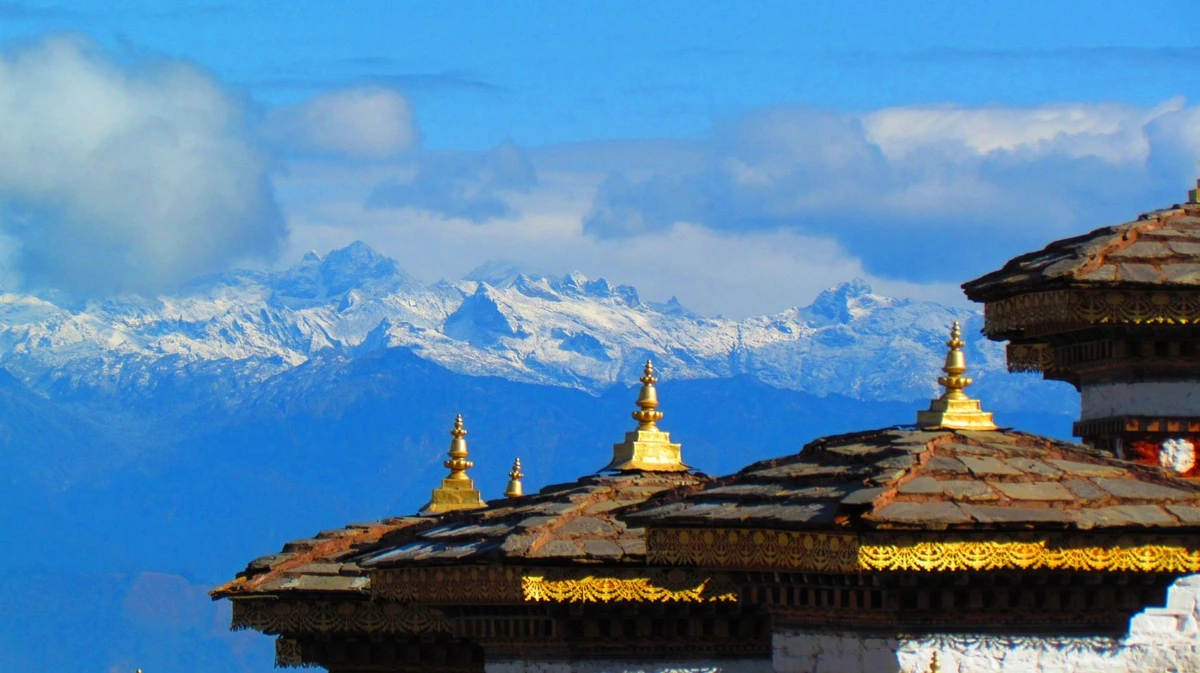
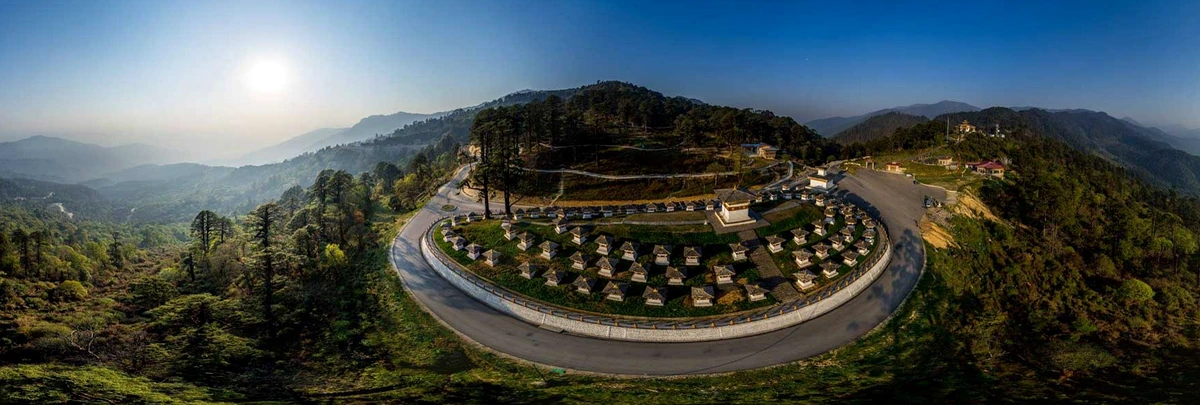
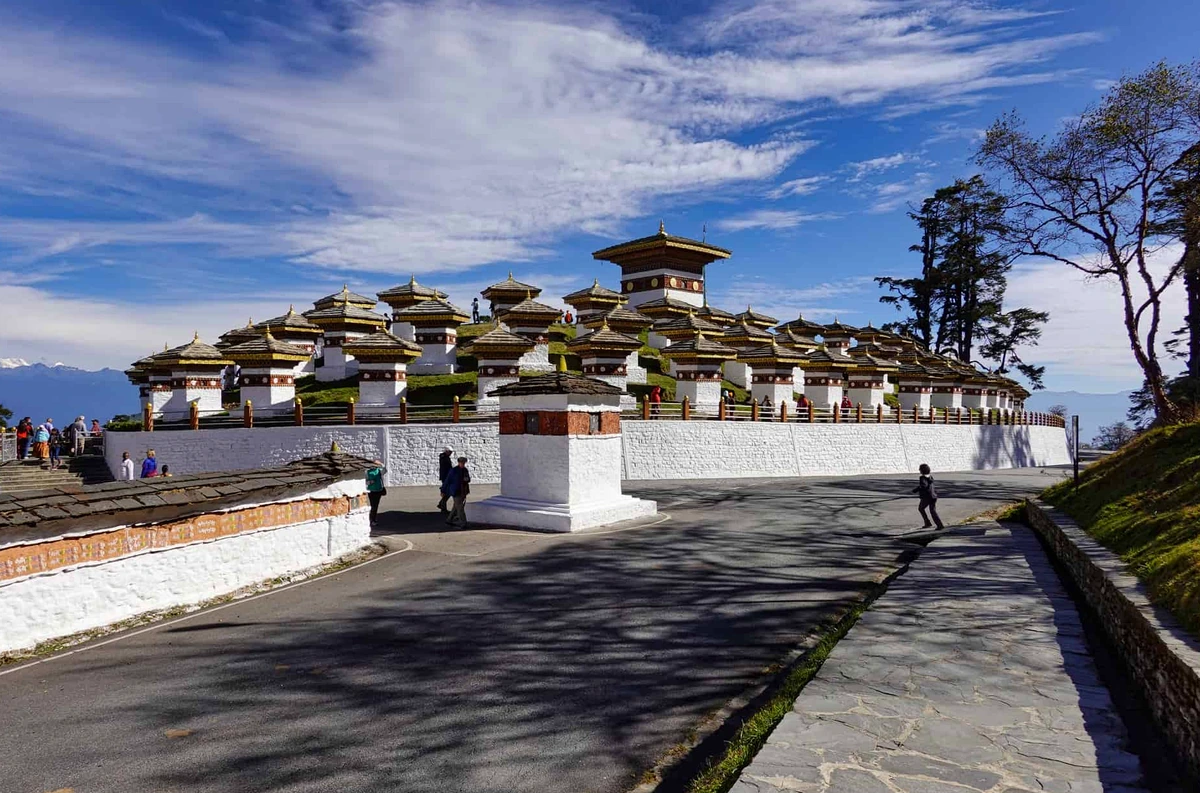
The landscape design of the 108 Druk Wangyal Chortens takes full advantage of the natural slope of an inverted bowl-shaped hillock, artfully transforming rugged terrain into a three-dimensional mandala set beneath an expansive sky. The terraced layout rises in three concentric tiers from bottom to top, symbolizing the three realms of existence and progressive stages of enlightenment in Vajrayana teachings. The lowest outer ring embraces the hillside with 45 smaller stupas, the middle tier gathers 36 stupas, and the uppermost level leads to 27 stupas encircling a majestic central chorten crowning the summit. Arranging the monuments in a symmetrical spiral both prevents soil erosion caused by spring snowmelt and naturally guides pilgrims into performing the sacred clockwise circumambulation ritual (kora) in serene reverence.
From an engineering standpoint, all 108 stupas strictly adhere to sacred Thangka geometric canons and centuries-old Zorig Chusum architectural treatises. Local master masons quarried slate and gray sandstone by hand from nearby mountain outcrops, dressing each block with precision so the stones interlock seamlessly. Rather than using industrial cement that compromises the breathability of traditional materials, mortar was painstakingly prepared from slaked lime, supple clay, chopped straw, concentrated molasses, and pine resin—yielding an elastic bond resilient against severe freeze-thaw cycles in winter. Inside the core of every chorten stands a consecrated juniper wood axis known as a sokshing (tree of life), sanctified by senior lamas with sacred mantras, five medicinal herbs, scriptures, and precious jewels, while the spires are adorned with intricately carved, gilded woodwork framing pure whitewashed masonry.
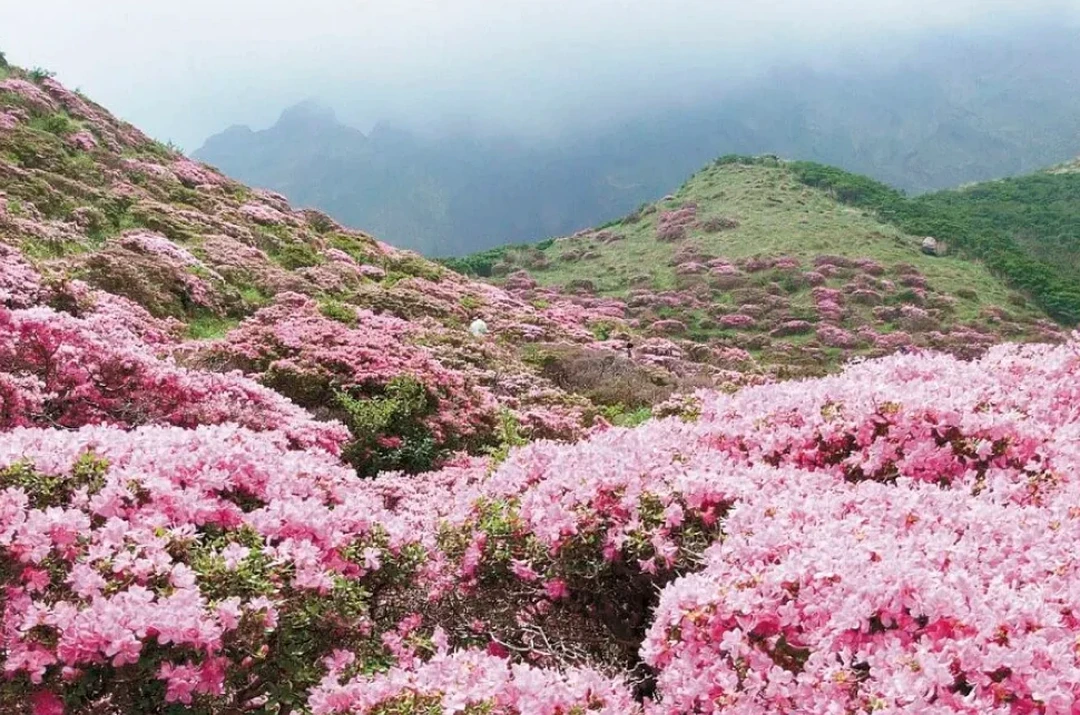
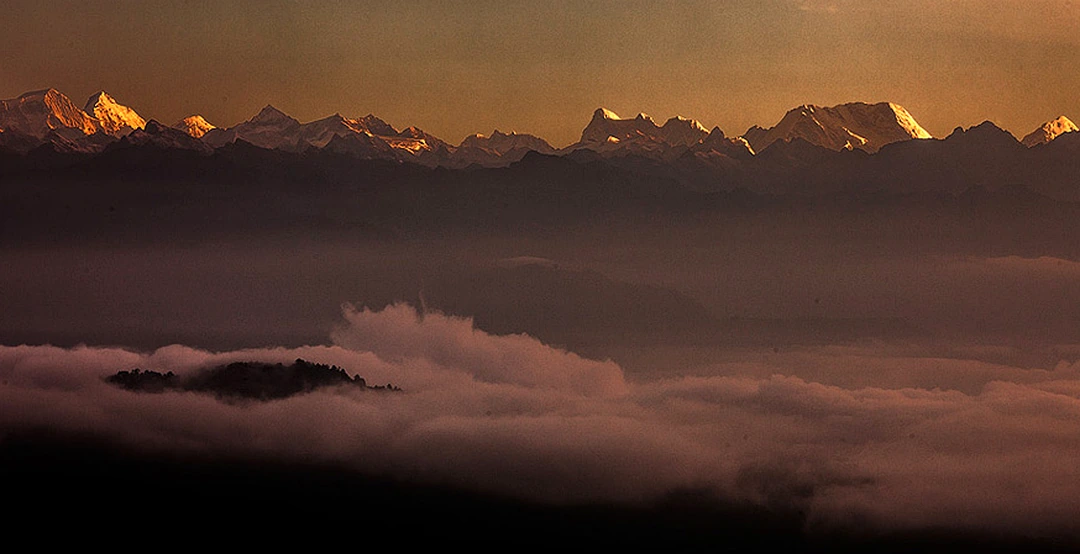
Surrounding this sacred architectural ensemble is a natural canvas that shifts dramatically with the seasons and mountain weather. Primeval rhododendron forests burst into riotous bloom in shades of crimson, blush pink, and snow white in late spring, contrasting vividly with soft beards of lichen draping ancient Himalayan pines. Standing at the heart of Dochula Pass on crisp winter mornings, when an ocean of clouds settles deep inside the valleys below, the entire eastern rampart of the Himalayas rises in surreal majesty. The sweeping panorama encompasses eternal snowfields, drawing the eye to the razor-sharp 7,158-meter peak of Masanggang—resembling a throne for dharma protectors—and Gangkhar Puensum soaring proudly to 7,570 meters as the highest unclimbed mountain in the world. Across this untamed wilderness, thousands of five-colored Lungta prayer flags strung thickly along the ridges flutter ceaselessly in the biting wind, carrying prayers of peace into the silver clouds of the snow peaks.
Perched proudly atop Dochula Pass at over three thousand meters above sea level, the Druk Wangyal Chortens rise like a monumental three-dimensional mandala set against the snow-blanketed backdrop of the pristine Himalayas. Rather than following a rigid linear axis, the complex is artfully distributed across three concentric elliptical tiers embracing a gentle natural knoll. The outermost lower ring comprises forty-five stupas, the second tier contains thirty-six, and the highest level gathers twenty-seven stupas around a commanding central chorten crowning the crest. This tiered progression mirrors the ascent of consciousness through spiritual realms, generating a field of stillness across the cloud-swept pass where every step of a pilgrim aligns with the cosmic order of Vajrayana Buddhism.
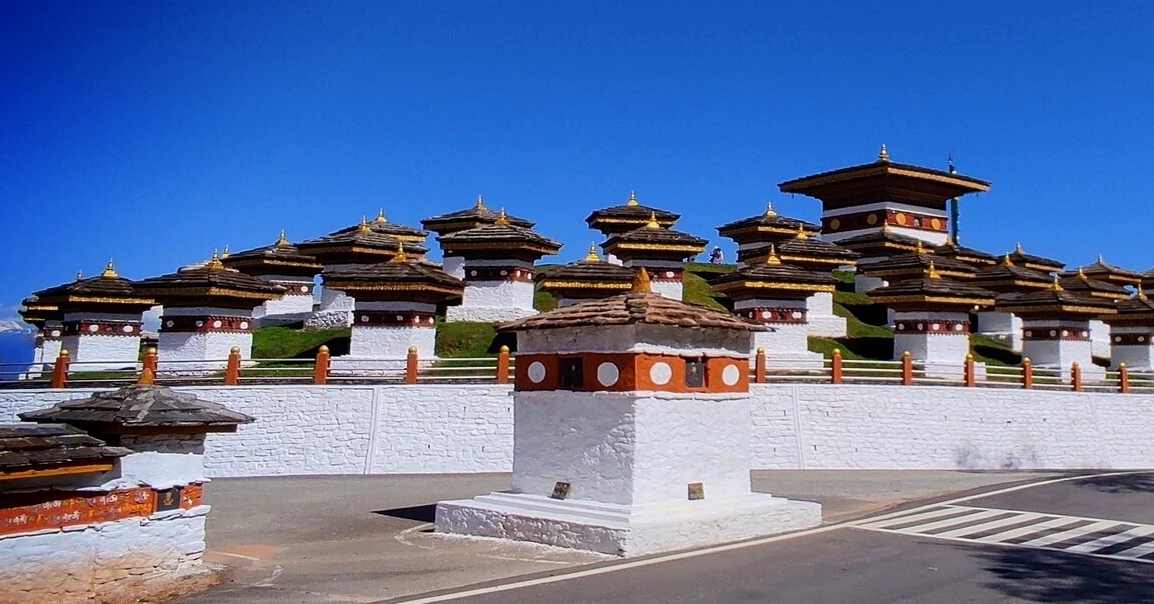
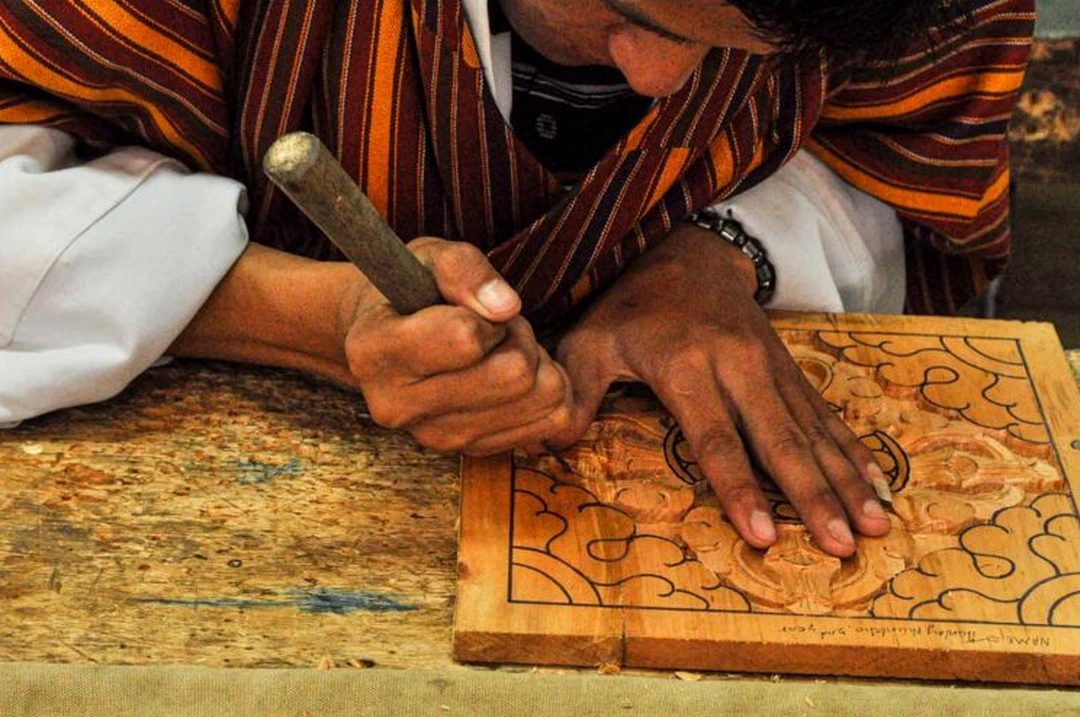
This spatial masterpiece is the radiant culmination of craftsmanship by artisans trained at the National Institute for Zorig Chusum—cradle of the thirteen traditional arts and crafts of the Kingdom of Bhutan. All one hundred and eight stupas were erected exclusively using indigenous traditional building methods, entirely free of modern reinforced concrete. Natural stone blocks were hand-quarried from neighboring slopes, dressed to exact angles, and combined with time-honored rammed-earth techniques proven over centuries. Coats of pure mineral limewash not only create a striking visual contrast against turquoise skies and dark rhododendron groves, but also act as a durable protective skin shielding the masonry core from freezing gales and heavy alpine snows.
Examined through architectural morphology, every individual stupa in the complex is a sacred sculptural whole governed by classical Trikaya proportional canons. Each chorten is articulated into three primary sections rich in symbolic resonance: the base (bumpa), the neck (harmika), and the spire (gajur). The sturdy bumpa evokes a treasure vase anchoring spiritual foundations into the earth, symbolizing the phenomenal world and pure moral discipline. Rising above it, the square harmika forms a graceful neck representing enlightened wisdom gazing across all directions to perceive impermanence. Crowning the summit is the gajur—a tapering gilded spire signifying the flame of Prajna wisdom and ultimate liberation. Within the inner chamber of each chorten rests the consecrated sokshing wooden axis inscribed with mantras alongside sacred texts, gemstones, and dried medicinal herbs sealed according to esoteric Tantric rites, transforming every monument into a living embodiment of the Dharma.
The count of one hundred and eight stupas is far more than a quantitative measure of architectural scale; it represents the most sacred mathematical symbol in Buddhist philosophy. According to Vajrayana scriptures, this number corresponds precisely to the one hundred and eight fundamental afflictions, or kleshas, arising from attachment, aversion, and ignorance as the six sense faculties interact with six sense objects across past, present, and future. Erecting one hundred and eight chortens establishes a vast mandala of purification, where each stupa acts as a spiritual antidote transmuting worldly defilements into the blossoms of supreme awakening. Standing amid the complex at dawn as Himalayan mist drifts across gray stone terraces, visitors can feel an unmistakable harmony between human devotion and the sacred spirit of nature, turning the pass into an eternal scripture carved in stone.
As the final sapphire hues of twilight fade behind the jagged snow peaks of the Himalayas, Dochula Pass at 3,100 meters enters an entirely different realm of experience—one devoid of artificial noise or modern entertainment. The grandest “live spectacle” here is the primal, mystical drama of the cosmos and raw nature staged against a canvas of deep mountain darkness. In the Bhutanese worldview, nightfall at a high mountain pass belongs to a state of absolute stillness known locally as nyen. This sacred domain does not belong to mortal humans, but is watched over by neydag—guardian mountain deities and local spirits dwelling in untamed forests and peaks. Out of deep respect for this unseen boundary, locals traditionally avoid crossing the pass late at night, both to preserve the tranquility of the deities’ abode and to honor the awe-inspiring majesty of the natural world.
Illumination at Dochula Pass does not come from electric floodlights or urban glare, but purely from the celestial vault arching over the high plateau. Completely removed from modern light pollution and framed by the crisp, thin air above three thousand meters, the night sky over Dochula transforms into an awe-inspiring natural planetarium. Millions of stars and the Milky Way stretch overhead like a vast ribbon of shimmering silver silk, casting ethereal starlight across the 108 Druk Wangyal Chortens. Beneath the brilliant constellations, the whitewashed domes arranged in their three-tiered mandala appear like 108 serene figures seated in silent meditation amid the void. Soft celestial light filters across every stone tier, catching the frost of winter snows and composing a surreal visual tableau far beyond any staged theatrical lighting.
Nocturnal life at this historic waystation gathers quietly inside the cozy warmth of the traditional Dochula teahouse nestled along a moss-draped slope. In stark contrast to the biting chill beyond its pinewood doors, the interior lounge glows with the crackling fire of a traditional bukhari wood-burning stove releasing fragrant resinous warmth. Here, travelers can unwind with authentic highland fare crafted to ward off the cold, foremost among them a steaming cup of suja—rich butter tea churned from hill-grown black tea leaves, salted yak butter, and natural mineral salt. Sipping the savory, piping-hot brew alongside crunchy roasted grains (zaow) or a taste of traditional fermented rice spirit (ara), visitors experience a deep communion with the ancient rhythms of the Himalayas.
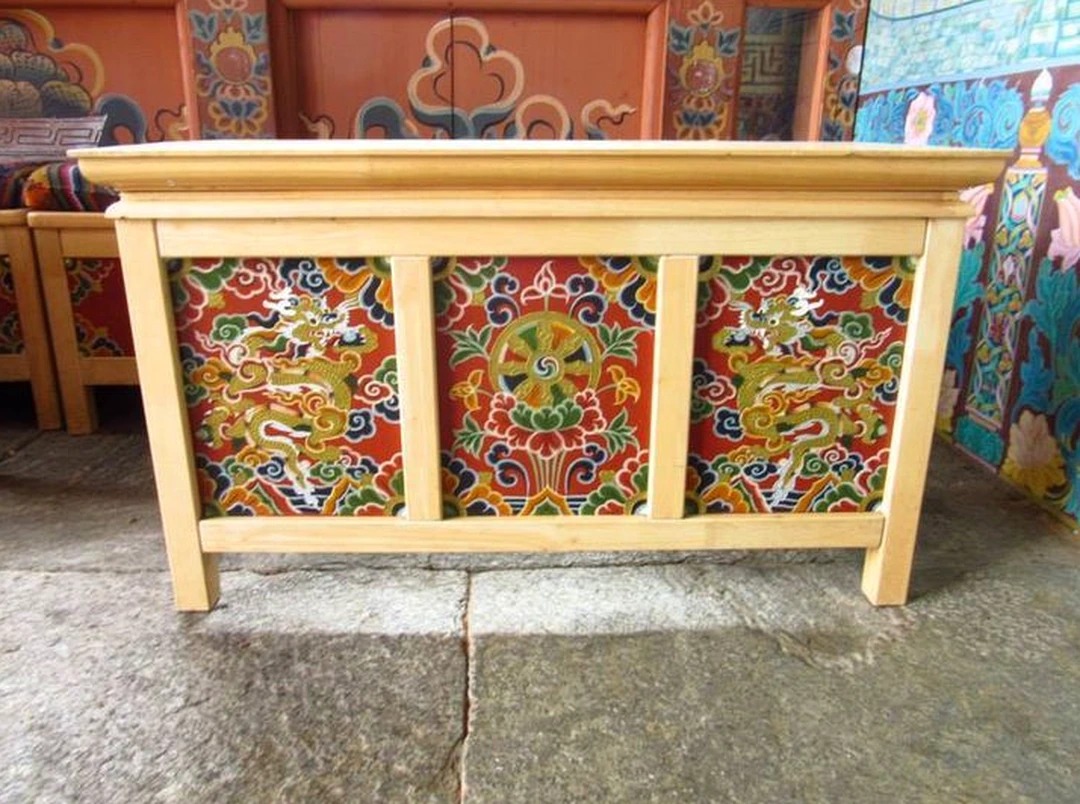
Punctuating this profound stillness is the gentle spiritual glow of karme butter lamps lit by monks inside the nearby Druk Wangyal Lhakhang monastery. Soft golden flames flicker across intricate wall murals, mingling with tendrils of juniper incense smoke drifting through timber doorways. Out in the vast mountain night, only the whistle of wind through granite crevices and the steady fluttering of thousands of five-colored lungta prayer flags remain, sending blessings of peace into the heavens. A night on Dochula is quietly enchanting—an experience measured not by dazzling outward spectacle, but by inner stillness amid the boundless silence of snow-crowned peaks.
Amid drifting clouds blanketing the saddle of Dochula Pass above three thousand meters—where icy winds sweep down from Himalayan snowfields through mossy pine forests—local culinary traditions serve as both an energetic shield and a time-honored wellness ritual. For mountain dwellers, sharing a meal at a high-altitude waystation goes far beyond simple nourishment; it is an art of balancing hot and cold energies rooted in traditional gSo-ba Rig-pa medicine. Every dish born of this rugged terrain carries bold, rich, and fiery flavors designed to keep blood circulating briskly and minds alert against sudden shifts in elevation and alpine weather.
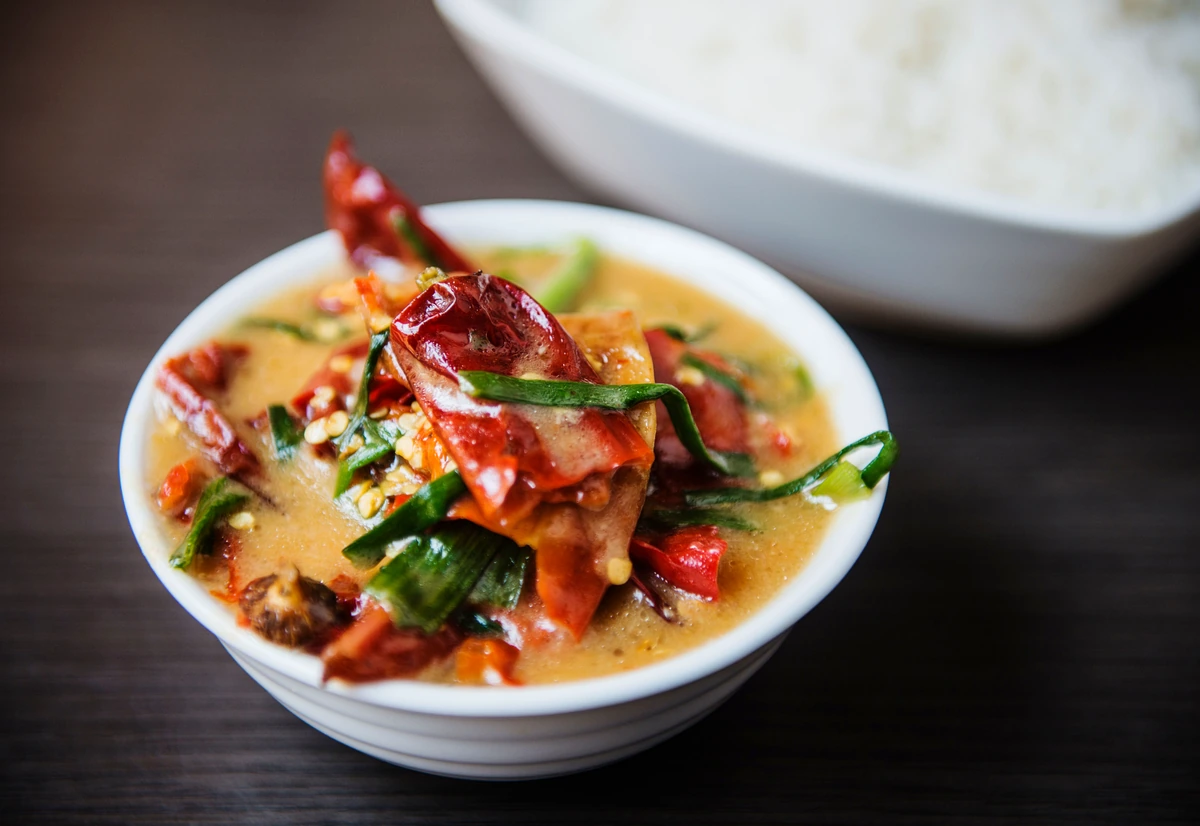
Reigning as the undisputed soul of every traditional table in the Land of the Thunder Dragon is Ema Datshi, a national dish revered almost like a sacred ritual of survival. Unlike Western cuisines that treat chili peppers merely as a seasoning, Bhutanese cooking celebrates fresh and dried chilies as a primary vegetable. Vibrant red or green chilies are slit lengthwise and simmered in earthenware pots with datshi—an artisanal farmer’s cheese crafted from yak or highland cow milk after butter churning. The thick, velvety cheese sauce balances subtle tanginess with an intense wave of chili heat that warms the chest instantly. Grounding this fiery centerpiece are bowls of nutty Bhutanese red rice, an heirloom variety nourished by glacial meltwater in the Paro and Punakha valleys. Rich in iron and dietary fiber, the unpolished red grains release a gentle, sweet aroma reminiscent of fresh straw when chewed slowly, providing the ideal counterpoint to soothe the bold spice of chili and cheese.
To fortify travelers against bone-chilling mist rolling across the 108 Druk Wangyal Chortens, mountain menus invariably feature cured meats steeped in pastoral tradition. Shakam—strips of highland beef air-dried naturally in crisp, dry winter winds—offers firm texture and concentrated flavor matured over months of frost. Alongside it, yaksha—prized dried yak meat—delivers the robust, wild richness of livestock grazing on icy pastures above four thousand meters. Both shakam and yaksha are typically sliced thin and slow-simmered with local white radishes or pan-fried in cast-iron skillets with sun-dried chili flakes, releasing dense protein and comforting warmth that swiftly revive weary travelers after winding mountain ascents.
A culinary stop at Dochula would be incomplete without lingering beside the timber windows of Druk Wangyal Café, gazing out at the white stupas emerging through swirling mist while cradling a warm bowl of salted butter tea, Suja. To prepare authentic suja, locals simmer traditional compressed black tea leaves (ja-dho) for hours before pouring the dark brew into a cylindrical wooden churn (chandong), adding a generous slab of rich yak butter and a pinch of highland mineral salt, and plunging briskly until fat and tea emulsify into a velvety, rose-tinted elixir. The earthy richness of butter weaves through brisk tea tannins and a comforting savory finish, instantly soothing wind-chapped lips while inspiring quiet contemplation amid the grandeur of the Himalayas.
Situated along the primary highway linking the capital Thimphu with the former royal Punakha Valley and Wangdue Phodrang, Dochula Pass at 3,100 meters imposes no entrance gates or separate admission fees on visitors year-round. Geographically and administratively, the mountain road remains open twenty-four hours a day for transit, while hospitality services at the Druk Wangyal Café rest stop generally operate from 08:00 to 17:00 daily. Covering the winding thirty-kilometer ascent from Thimphu takes roughly one hour by dedicated tour vehicle or high-clearance SUV, threading through dense stands of blue pine, ancient oaks, and vibrant rhododendrons clinging to steep mountain slopes.
Seasoned Himalayan travelers agree that the golden window for witnessing an unobstructed panorama of the legendary snow peaks is the tranquil dawn period before 07:30 in the morning. As the sun’s first rays break over the horizon, eastern skies reach crystal clarity before warm, moisture-laden clouds rise from deep valleys to cloak the ridges. From the Dochula viewpoint at this magical hour, visitors can gaze directly upon majestic Gangkhar Puensum at 7,570 meters—the highest unclimbed peak on Earth—flanked by towering giants such as Masang Kang and Kangphu Kang gleaming silver against an azure sky.
When entering the sacred grounds of the 108 Druk Wangyal Chortens, every visitor should observe the traditional Vajrayana Buddhist practice of kora: always walk slowly in a clockwise direction around the stupa tiers. Never climb onto stone plinths, sit leaning against chorten walls, or touch and remove the colorful Lungta prayer flags fluttering in the mountain breeze. Out of reverence for this consecrated site, guests should maintain a quiet, respectful demeanor and adhere strictly to Leave No Trace principles to safeguard the fragile alpine ecosystem cherished by the Land of the Thunder Dragon for generations.
In terms of logistics and costs, stopping to admire Dochula Pass is seamlessly covered under Bhutan’s regulated cultural tourism framework, which includes the mandatory Sustainable Development Fee alongside licensed private transport and a certified guide. In the crisp chill of a highland morning, few comforts rival stepping inside the wood-heated café opposite the stupas to sip freshly churned, savory suja butter tea paired with crunchy puffed rice (zaow) or fragrant fried pastry twists (khapse). For a seamless, worry-free journey handling everything from visa permits to deeply meaningful cultural encounters across the mountains, consider our all-inclusive Kingdom of Happiness Bhutan tour packages thoughtfully crafted to honor local heritage at every step.