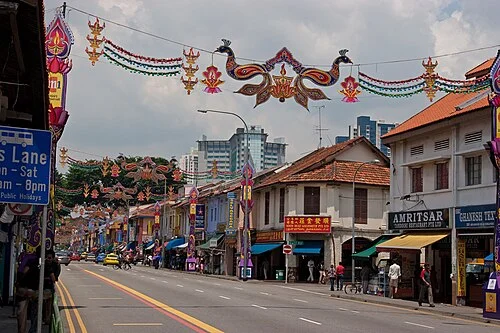
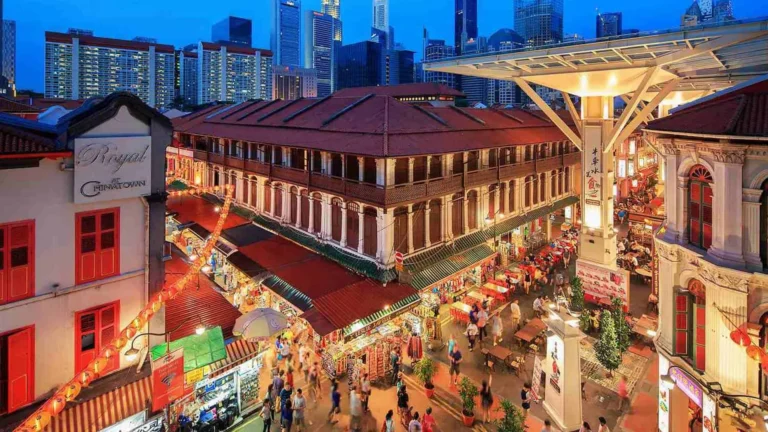
Amid the ever-shifting landscape of the global aviation industry in the modern era, the arrival of Jewel Changi Airport has completely redefined the concept of an airport terminal, elevating a mere transit space into an iconic contemporary heritage destination of global stature. The genesis of this monumental project stems from the far-reaching strategic vision of the Civil Aviation Authority of Singapore (CAAS) and Changi Airport Group (CAG). Under the astute leadership of Chief Executive Officer Lee Seow Hiang, a revolutionary master plan was charted to resolve the dilemma between expanding aviation infrastructure capacity and creating a magnetic urban landscape masterpiece in its own right. Rather than settling for a purely functional terminal model, Singapore shifted its focus to transform Changi International Airport into a premier hub for lifestyle, commerce, and ecological experiences, cementing its status as the world’s number one aviation gateway.
The initial concept began taking shape in 2010, when airport leadership faced an urgent need to upgrade and expand Terminal 1, which was steadily nearing capacity. Instead of simply constructing a rigid multi-story parking garage across the expansive open-air car park in front of the old T1 hall, a far bolder vision emerged: turning that bare expanse into a crossroads where majestic equatorial nature meets futuristic architectural engineering. By 2013, an international design competition bringing together the world’s finest creative minds was launched. Surpassing numerous prestigious proposals, the design submitted by renowned architect Moshe Safdie and his firm, Safdie Architects, was declared the winner. The blueprint was an exemplary interdisciplinary collaboration uniting the landscape architecture mastery of PWP Landscape Architecture, the structural engineering prowess of Buro Happold, and engineering consultancy WSP, laying the groundwork for an unprecedented steel-and-glass domed geometric complex.
On December 5, 2014, the official groundbreaking ceremony took place, marking a strategic joint venture between Changi Airport Group, holding a 51% stake, and leading Asian real estate developer CapitaLand Mall Asia, holding 49%. With a massive total investment of 1.7 billion Singapore dollars (SGD), the responsibility of bringing Asia’s most intricate blueprint to life was entrusted to main contractor Takenaka Corporation—a storied Japanese construction firm celebrated for its rigorous discipline and extraordinary mechanical precision. Over years of relentless construction, thousands of tons of alloy steel and more than nine thousand specialized double-glazed insulating glass panels were transported and delicately assembled atop a bustling site operating 24/7. June 2017 marked the successful topping-out of the magnificent semicircular toroidal dome structure, before the complex completed testing and officially opened its doors to its first visitors during a preview run on April 11, 2019, ushering in a dazzling new chapter in Southeast Asian tourism architecture.
The nomenclature and linguistic origins of this architectural complex carry profound layers of philosophy rooted in local culture and geography. The name “Jewel” signifies a sparkling landmark heritage piece set upon the aviation crown of the Lion City, while serving as a metaphor for its prismatic geometric structure that reflects brilliant light from every angle. At the very heart of the complex lies the HSBC Rain Vortex—designated in Chinese characters as Yu Xuan (雨漩)—reflecting a harmonious blend between the sponsorship of the Hongkong and Shanghai Banking Corporation (HSBC) and the sun-drenched, rain-abundant tropical monsoon climate of the equator. “Rain” symbolizes nature’s bountiful water resources, while “Vortex” accurately describes the centripetal spiral hydrodynamic motion that sends the cascade plunging straight from the heavens into the depths below. Cradling this miraculous waterfall is the Shiseido Forest Valley (known in Chinese as Sen Lin Gu – 森林谷), bearing the sponsorship of the famed Japanese cosmetics house. This name not only honors the pristine, untamed beauty of the multi-tiered flora sweeping across terraced slopes, but also fully realizes the “City in a Garden” philosophy that generations of Singaporean leaders have steadfastly cultivated over decades.
Viewed through the lenses of spatial geomancy and economic geography, Jewel Changi Airport occupies a pivotal focal point at the eastern tip of the Lion City, where the Changi coastline welcomes ocean currents and the bustling maritime routes of the Strait of Malacca. This parcel of land was once a flat stretch of reclaimed coastal sediment, previously zoned as a monotonous open-air car park serving Terminal 1. Under the guiding hands of leading urban planners, that dormant terrain was awakened to become a vibrant hub of circulating energy. The complex connects directly into the national transit network via Airport Boulevard alongside two arterial expressways, the East Coast Parkway (ECP) and the Pan Island Expressway (PIE). Simultaneously, three enclosed, glass-walled pedestrian link bridges equipped with state-of-the-art air conditioning extend like arteries connecting Jewel seamlessly to Terminals 1, 2, and 3. This layout creates a masterwork of converging water and airflow, transforming the crossroads of millions of global travelers into a thriving nexus of vitality.
Rather than leveling or conforming to the original reclaimed terrain, master architect Moshe Safdie executed a topographical revolution by sculpting a colossal artificial bowl-shaped valley, symmetrically aligned around a curved glass oculus spanning over 200 meters. The terrain is meticulously terraced, rising from the subterranean depths of commercial and technical basement levels before ascending in stepped tiers outward toward the perimeter of the steel ring. This multi-level botanical amphitheater faithfully mimics the lush, rolling slopes of Southeast Asia’s primeval tropical rainforests. Each terraced tier serves not merely as a botanical display space, but also as a distributed load-bearing framework that supports the entire landscaped complex while drawing the human eye inward toward the central void—where earth, sky, wind, and water converge in pristine geometric harmony.
To sustain a thriving tropical rainforest ecosystem inside a completely enclosed structure amidst the harsh equatorial conditions of a Köppen Af tropical rainforest climate, biophilic engineering was pushed to the absolute frontiers of modern technology. The building’s toroidal envelope is composed of a grid of more than 9,000 precision-cut triangular Low-E double-glazed glass panels engineered with highly sophisticated optical properties. This glazing system is rigorously calibrated to strike an ideal balance between Solar Heat Gain Coefficient (SHGC) and Visible Light Transmittance (VLT). The solution allows maximum natural light spectrum penetration to stimulate photosynthesis across the vast canopy of vegetation, while effectively reflecting and blocking intense solar heat, eliminating any risk of turning the structure into an artificial heat trap.
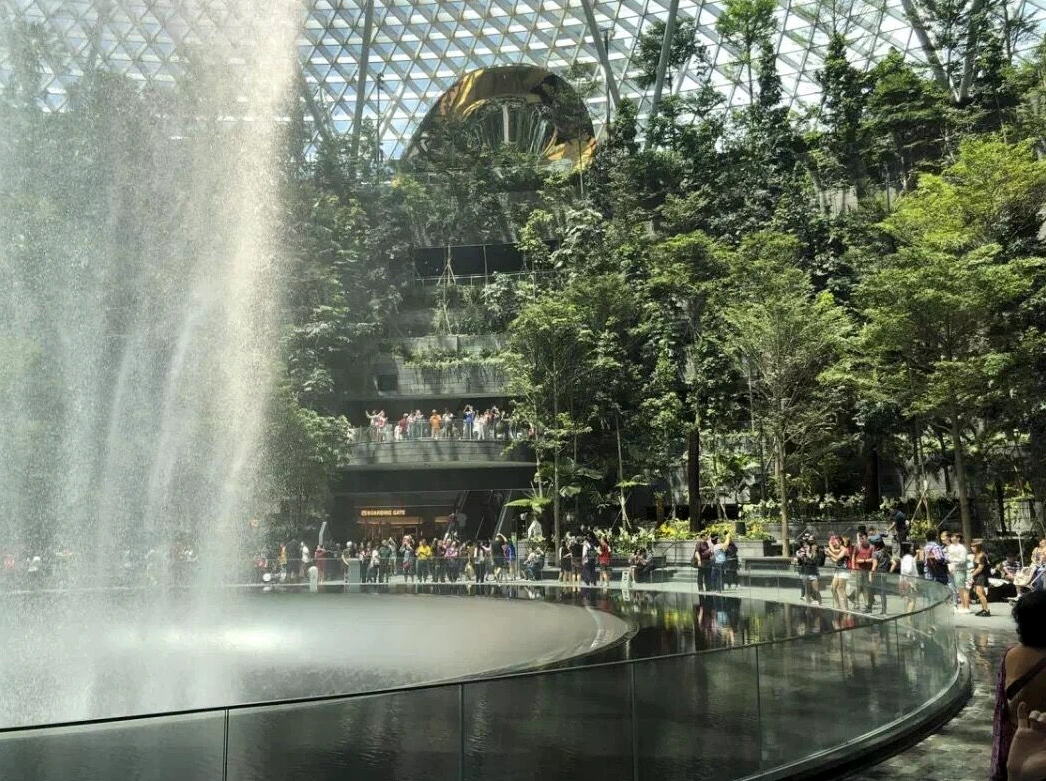
Hidden beneath the pristine beauty of the Forest Valley lies a microclimate conditioning marvel modeled on Computational Fluid Dynamics (CFD) simulations. Instead of blasting chilled air from overhead—which wastes energy and dries out sensitive tree canopies—the building employs a displacement ventilation strategy. Chilled air supply diffusers are artfully concealed at the bases of planters and within slots along the stone-paved walkways, gently releasing cool air at low pedestrian levels to form a stable thermal cushion between 23°C and 25°C, with relative humidity tightly controlled around 60%. This cool, moisture-rich air circulates continuously, neutralizing the turbulent downdrafts generated by the plunging water of the central cascade and enveloping visitors in the sensation of breathing crisp, serene highland mist, despite being just a few hundred meters from active airport runways.
Engineered as a seamless fusion of contemporary structural artistry and advanced ecological technology, Jewel Changi stands tall with a gross floor area of 135,700 square meters, soaring 40 meters high across a symmetrical ten-story configuration. Five above-ground levels open into sun-drenched realms dedicated to retail and ecological landscapes, while five deep subterranean levels form an intricately mechanized “underground city.” These lower depths house complex mechanical, electrical, and plumbing (MEP) plants alongside cutting-edge baggage handling and transit systems linking all airport terminals, and integrate directly with the MRT subway station—allowing millions of travelers to flow effortlessly through the heart of the wonder without ever noticing the colossal engineering machinery humming beneath their feet.
The crowning engineering feat that forms the soul of the building is its steel-and-tempered-glass toroidal grid-shell roof, achieving an extraordinary clear span of over 200 meters without a single interior support column in the center. To hold aloft the entire dome—resembling a colossal glass spiderweb stretched across the sky—brilliant engineers strategically positioned 14 monumental steel columns shaped like soaring tree trunks with branching limbs (known as Mega-Columns) along the building’s perimeter. These steel branches support a continuous perimeter ring beam that absorbs gravitational loads and natural dynamic forces, safely channeling them down into high-strength reinforced concrete piles driven deep into the island’s bedrock.
The craftsmanship and material precision achieved here set an almost absolute benchmark in global construction. Over 10,000 tons of structural steel were prefabricated to mechanical tolerances measured in mere millimeters, interlocking into a resilient lattice engineered to withstand fierce tropical storms. Clad atop this monumental steel skeleton are thousands of custom-fabricated Insulated Glass Units (IGUs) crafted from ultra-low-iron float glass. This refined metallurgical process eliminates the greenish tint inherent to standard glass, yielding crystal-clear optical transparency that optimizes natural light transmission to nourish the lush greenery below while blocking thermal radiation and insulating the interior from the mechanical roar of jet engines on nearby runways.
Positioned at the focal center of the toroidal glass dome is the wondrous HSBC Rain Vortex, which holds the world record as the tallest indoor waterfall on Earth at a majestic height of 40 meters (130 feet). Water plunges dramatically from the apex of the funnel-shaped oculus in the roof, swirling like a silver cyclone through the verdant valley before crashing into a recessed collection funnel on Basement Level 2. At peak flow rates, the cascade circulates up to 37,850 liters—or 10,000 gallons—of water per minute, shrouding the atrium in a delicate mist that naturally cools the indoor microclimate. This entire flow operates via an intelligent closed-loop hydraulic recirculation system: tropical rainwater falling onto the glass dome is harvested into dedicated underground holding tanks, routed through variable-frequency pressurized pumps and an automated treatment plant that strictly monitors pH levels and water turbidity prior to recirculation, and backed up by a fresh potable water reserve to keep the wonder flowing endlessly even during prolonged dry spells.
As equatorial dusk settles over the skies of the Lion City, the sunlit biophilic expanse of the Shiseido Forest Valley begins a breathtaking metamorphosis into a theatrical visual stage. A computerized architectural lighting system, intricately wired along the steel dome lattice and tucked beneath recessed planter edges, initiates a gradual spectral transition. Neutral daytime white light ranging from 5000K to 6500K yields completely to a warm, velvety spectrum between 2700K and 4000K. This subtle shift accentuates the organic geometry of the toroidal roof while sculpting every leaf vein, ancient tree fern frond, and terraced botanical layer in crisp relief, transforming Jewel Changi Airport’s central atrium into a mystical, tranquil bioluminescent forest worlds apart from the frantic pace of one of the busiest aviation hubs on the planet.
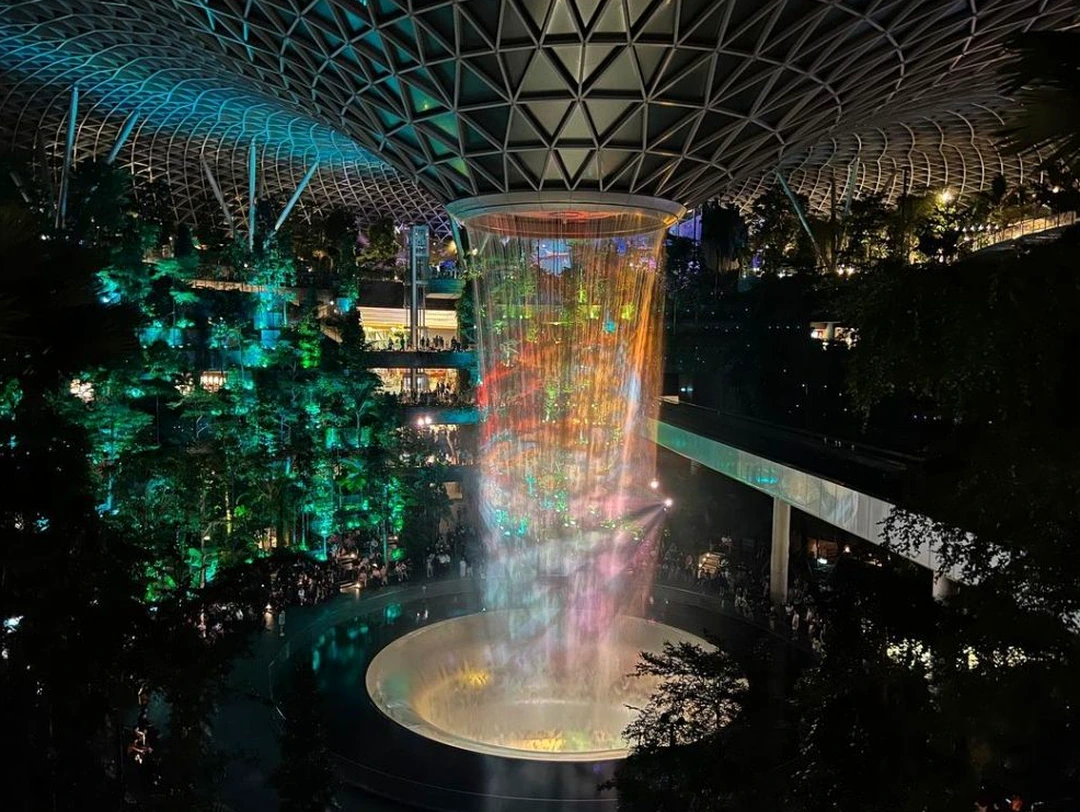
The pinnacle of the nocturnal visual experience is the enchanting Light & Sound Show performed hourly from 8:00 PM to 10:00 PM every evening. As the opening musical notes resonate through the atrium, the 40-meter Rain Vortex instantly transforms into a colossal, funnel-shaped hydraulic projection screen suspended in mid-air. To achieve razor-sharp resolution on a constantly moving medium like falling water, lighting engineers mounted an array of ultra-high-powered laser projectors discreetly concealed across the surrounding mezzanine levels. Intersecting multidirectional beams weave across the cascading curtain, turning the rushing water into a vivid three-dimensional canvas. Central microprocessors modulate water discharge speeds and flow volumes in lockstep with the musical score, conjuring mesmerizing optical illusions: at one moment the waterfall appears frozen solid in mid-air, the next it bursts into dazzling geometric constellations, and suddenly it undulates like a luminescent ribbon of gold and emerald floating amidst a lush jungle.
The triumph of this live spectacle rests not only on laser artistry, but also on meticulous spatial acoustic engineering. Rather than generating the harsh reverberation typical of indoor entertainment complexes, the acoustic environment here is tuned for absolute auditory equilibrium. Deep beds of porous soil nourishing tens of thousands of tropical plants, paired with dense foliage canopies, act as massive natural sound absorbers that virtually eliminate echoes off metal and concrete. Meanwhile, the steady, low-frequency roar of water free-falling from the dome’s oculus produces a soothing blanket of white noise, gently washing away the daytime mechanical hum of the airport and giving way to an omnidirectional surround-sound system that immerses listeners in a pure, otherworldly soundscape.
Strolling through Jewel late at night offers a poetic, elevated indulgence where the boundary between man-made marvel and untamed nature dissolves. Visitors can walk leisurely across the Canopy Bridge suspended 23 meters above the forest floor, feeling cool wisps of mist brush lightly against their skin thanks to the microclimate system holding steady around 24°C. From this breathtaking vantage point, looking upward reveals the star-studded tropical night sky through crystal-clear glass; gazing outward catches SkyTrain shuttles gliding silently through delicate mist; and peering below unveils the glowing abyss of the illuminated waterfall. It is a seamless symphony of cutting-edge performance technology, contemporary landscape aesthetics, and futuristic urban rhythm that lingers deeply in every traveler’s memory ahead of a long-haul flight.
Transcending the confines of a mere aviation transit hub, Jewel Changi Airport unfolds a grand culinary landscape boasting over one hundred acclaimed restaurants and eateries, celebrating the authentic flavors of the Lion City’s four cultural pillars: Peranakan, Malay, Chinese, and South Indian. Beneath tropical canopies and cool mist drifting off the Rain Vortex, dining here becomes a sensory journey through centuries of maritime migration along the Strait of Malacca. Within this magnificent setting, gastronomy is never detached from the rainforest ecosystem; rather, it vividly mirrors the native flora flourishing around the grand central oculus.
The most luminous and refined expression of this cultural fusion is celebrated at Violet Oon Singapore, gracing Level 2 of the complex. This temple of Peranakan cuisine embodies the historic union between early Chinese merchants and indigenous Malay women centuries ago. The soul of Nyonya cooking here lies in hand-pounding aromatic rempah spice pastes in granite mortars, followed by hours of slow simmering over low heat. The iconic signature dish that both challenges and captivates discerning palates is Buah Keluak Ayam—chicken braised with pitch-black nuts harvested from the kepayang tree deep within mangrove swamps. Through days of meticulous boiling and ash-curing to remove natural toxins, the nut’s kernel transforms into a rich, velvety paste offering a delicate bitterness layered with earthy notes of dark chocolate, melding seamlessly into a luscious, spiced gravy. Alongside it, the celebrated Dry Laksa presents a culinary tour de force: fresh rice noodles wok-tossed until fluffy and infused with dried shrimp sambal, rich coconut milk, and finely shredded laksa leaves that awaken every sense.
The vibrancy of local cuisine here is deeply intertwined with indigenous tropical herbs. Pandan leaf extract imparts not only an elegant emerald hue, but also a sweet, vanilla-like fragrance to steaming claypot rice and chewy traditional kueh pastries. Meanwhile, the foundational trio of pungent galangal, bruised fresh lemongrass, and crushed kaffir lime leaves forms the aromatic backbone of complex curry gravies and classic Malay beef rendang. Across the levels, diners can also savor iconic coastal flavors at Jumbo Seafood, where colossal mud crabs bathe in a glossy, sweet-and-savory chili sauce ribboned with delicate wisps of egg.
Alongside regal feasts, Jewel Changi faithfully preserves the warm nostalgia of everyday local life through heritage institution Killiney Kopitiam. Here, traditional Nanyang coffee is still brewed meticulously through coarse cotton filter socks, yielding a dark, full-bodied cup fragrant with butter-roasted beans. A quintessential local breakfast is incomplete without crisp toasted bread slathered with rich duck-egg and pandan kaya jam, layered with a thick slab of cold butter, and served alongside warm soft-boiled eggs seasoned with dark soy sauce and freshly ground white pepper.
Notably, across bustling food halls like Food Junction and traditional Kopitiam spaces, visitors will witness a uniquely Singaporean sociological phenomenon: the local custom of “choping.” Rather than assigning someone to stand guard over a table, locals simply place a pocket pack of tissues, a compact umbrella, or a business card onto the tabletop before calmly joining the queue to order. This seemingly simple grassroots habit stands as living proof of civic order, deep social trust, and a distinct urban grace amidst one of Asia’s fastest-paced modern metropolises.
Exploring the architectural masterpiece of Jewel Changi Airport rewards those who understand the operational rhythm and spatial layout of one of the world’s most sophisticated multi-use transit hubs. One of the complex’s most welcoming, people-centric features is that its public concourses and the entire Shiseido Forest Valley remain open 24 hours a day, 365 days a year, with zero admission fee. Travelers arriving late at night or transiting at dawn can freely immerse themselves in the soothing roar of water cascading from the glass dome. Conversely, the dining precincts and retail paradise housing hundreds of renowned brands operate during standard hours from 10:00 AM to 10:00 PM Singapore Standard Time, though several convenience supermarkets and fast-food outlets remain open around the clock to serve long-haul passengers. Perched peacefully on the topmost level, Canopy Park operates a tiered ticketing structure starting from 8 SGD for general admission—granting access to the foggy bowls and giant slides—up to 59 SGD for an all-inclusive bundle featuring the suspended glass-bottomed Canopy Bridge, the mesmerizing Mirror Maze, and the giant Sky Nets suspended high in mid-air. Keeping track of each zone’s operating hours is essential for pacing your visit effortlessly.
Transit connections to this toroidal landmark are engineered with trademark Singaporean precision, reflecting world-class infrastructure planning. The Mass Rapid Transit (MRT) subway line brings passengers straight to Changi Airport Station (CG2/CG1) on the East-West Line branch; from the station concourse, travelers simply follow clear bilingual signage to reach air-conditioned pedestrian link bridges connecting Terminals 2 and 3 directly to Jewel’s Level 2 entrance within a few minutes’ stroll. For those opting for surface travel via public bus, major routes including 24, 27, 34, 36, 53, 110, and 858 all stop directly at the Terminal 1 basement bus bay, situated right beneath Jewel. For transit passengers with only a few hours to spare who prefer not to haul heavy bags, a dedicated 24-hour baggage storage facility on Level 1 near the East Gateway offers convenient time-based luggage safekeeping, freeing travelers to explore completely unencumbered.
Stepping inside Jewel Changi Airport also makes every visitor a steward of public order and ecological preservation under Singapore’s strict public hygiene regulations. Littering, spitting, and smoking are strictly prohibited throughout the entire enclosed, air-conditioned complex; guests wishing to smoke must use designated outdoor smoking areas on Level 1. The ecological integrity of the Shiseido Forest Valley is likewise safeguarded with utmost care: visitors are strictly forbidden from picking flowers, snapping branches, or stepping off the winding timber-decked trails that weave through the tropical woodland, protecting both rare botanical specimens and engineered soil beds. As for photography, guests are warmly welcome to use personal smartphones and handheld cameras to capture breathtaking moments beside the waterfall; however, setting up stationary tripods along walkways or conducting organized commercial filming requires prior written approval from Changi Airport Group (CAG) to ensure smooth pedestrian flow and public safety.
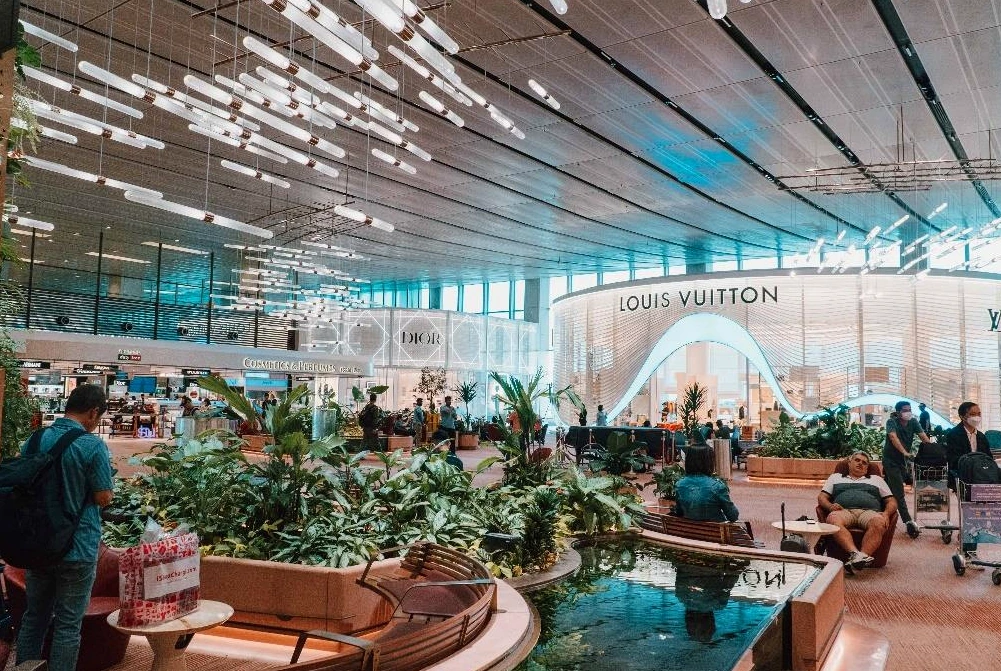
Field insights from seasoned travelers reveal that the golden window for admiring the waterfall’s majesty in relative serenity is between 9:00 AM and 11:00 AM, when the cascade surges into full flow beneath morning sunbeams streaming through the glass roof while foot traffic remains light. Once twilight descends, the atrium transforms dramatically for the dazzling Light & Sound Show projected across the colossal water curtain at 8:00 PM, 9:00 PM, and 10:00 PM. To secure an unobstructed prime viewing spot, an insider tip is to arrive at least fifteen minutes early along the Level 2 or Level 3 balcony railings, where sweeping sightlines across the entire dome and plunging vortex frame truly unforgettable photographs. Mastering these practical details will help you make the most of your visit, turning an airport stopover into an unforgettable highlight when joining an all-inclusive Singapore – Malaysia twin-country tour to experience the finest cultural and natural wonders of the Strait of Malacca.