Beneath the mist-shrouded silhouette of Mount Pilatus and the jade-green waters of Lake Lucerne, the wooden Chapel Bridge (Kapellbrücke) and its Octagonal Water Tower (Wasserturm) stand tall like silent witnesses to the passage of medieval time. The origins of this celebrated landmark are deeply intertwined with the turbulent geopolitical landscape of the early Swiss Confederation in the fourteenth century, a period when the alliance of the Four Forest Cantons was resolutely fortifying its borders against the expansionist pressures of the Habsburg Empire. To complete the defensive ring of fortifications surrounding the city and establish a strategic transit artery across the rushing Reuss River, the city-state authorities of Lucerne decided to construct a sturdy, covered oak footbridge. Modern dendrochronological dating reveals that the oldest timber beams were felled around the 1330s to 1340s, before the bridge span was officially completed and put into steady operation in 1365.
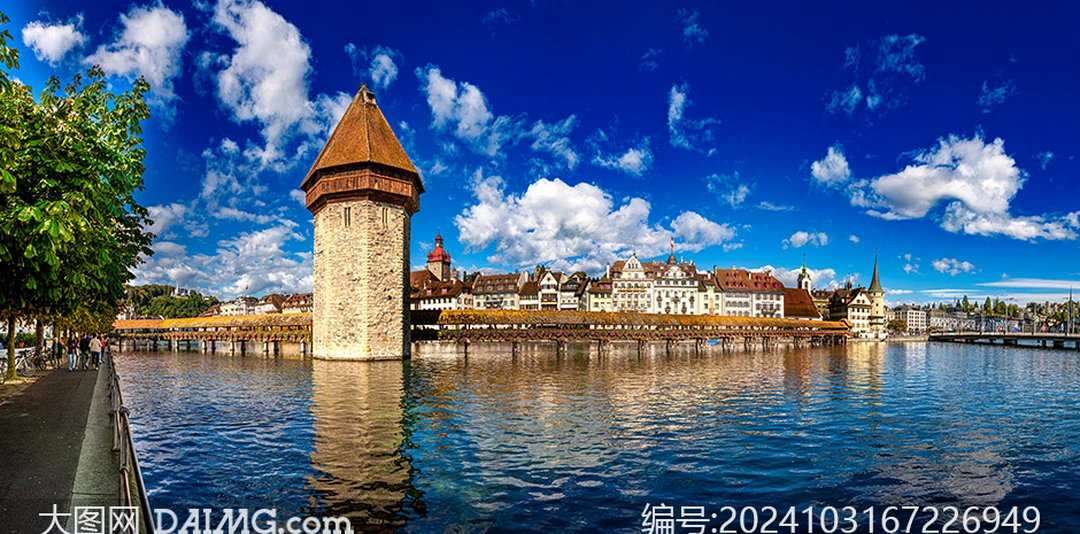
Winding diagonally across the Reuss, the bridge not only served to connect the historic old town nestled beside St. Leodegar Abbey on the right bank with the newly emerging, bustling commercial quarters on the left bank, but also functioned as a one-of-a-kind floating fortress. Its steeply pitched tiled roof and high wooden parapets were engineered to shield crossbowmen and sentries from volleys of arrows and projectiles fired by enemies advancing from the lake. The local German name Kapellbrücke originates from the presence of St. Peter’s Chapel (St. Peterskapelle)—an elegant sanctuary erected around 1485 right beside the right-bank bridgehead, where every medieval wayfarer or warrior would pause to bow their head and pray for divine protection before crossing the river.
Standing beside the wooden bridge is the Octagonal Water Tower (Wasserturm), a formidable structure of fieldstone and mortar rising more than thirty-four meters from the riverbed. Intriguingly, this massive octagonal tower predates the bridge spanning past it, having been built around 1300 as a freestanding watchtower within Lucerne’s waterfront fortification system. Over centuries of shifting Alpine history, the tower shouldered a succession of complex, enigmatic duties: from a beacon outpost and navigational lighthouse to the city-state’s treasury vault and secret archive repository. During the darker chapters of the Late Middle Ages, the subterranean chambers beneath the tower’s base were even converted into a notorious dungeon and isolated torture chamber, while the dry attic room above was stocked with strategic barrels of gunpowder for municipal defense.
Although it weathered countless religious wars and historic floods for hundreds of years, this priceless heritage ensemble faced its most devastating tragedy in the modern era. On the fateful night of August 18, 1993, a fire suddenly broke out beneath the bridge, swiftly turning the centuries-old wooden span into a towering inferno before the stunned and helpless eyes of local residents. The catastrophic blaze completely consumed two-thirds of the historic timber structure and destroyed 86 of the 111 original seventeenth-century triangular gable paintings—which depicted heroic legends and the civic chronicles of Lucerne. Nevertheless, the sturdy stone Octagonal Water Tower stood firm amidst the surrounding smoke and flames, preserving its structural core intact.
In the wake of this profound national heritage loss, a massive and remarkably swift reconstruction campaign was launched immediately under the strict supervision of Switzerland’s foremost conservation experts. Thanks to detailed architectural blueprints and meticulously preserved archaeological records, the bridge was faithfully rebuilt down to every mortise-and-tenon joint using authentic medieval carpentry techniques, officially reopening to the public in April 1994. Today, the Kapellbrücke and Wasserturm still cast their majestic reflections upon the Reuss, bearing both the storied scars of history and the enduring spirit of Lucerne’s rebirth.
Situated at a hydrologically unique confluence in central Switzerland, the Chapel Bridge and Octagonal Water Tower command the exact bottleneck where the vast mirror of Lake Lucerne (Vierwaldstättersee) abruptly narrows, funneling its entire torrential outflow into the channel of the Reuss River. Geomorphologically, Lucerne lies within a deep pre-Alpine trough carved meticulously through Pleistocene glacial cycles, leaving behind a complex subterranean bed of compressed cobbles and alluvial sediment. At this natural outflow threshold of the lake basin, the tranquil emerald-green waters suddenly convert their potential energy into swift undercurrents of intense hydrodynamic pressure, posing an immense structural engineering challenge for medieval bridge builders.
Rather than opting for a straight, perpendicular crossing to minimize construction distance as conventional academic logic might dictate, master engineers of old devised an empirically driven, zigzagging layout. The body of the Kapellbrücke traces a graceful dogleg curve, deftly avoiding deep eddies while anchoring securely onto natural alluvial bars and solid submerged bedrock shelves beneath the Reuss. This angled alignment simultaneously deflected and dissipated the lateral thrust of glacial meltwater surges pouring out of the lake, while adapting flexibly to the irregular, indented contours of the historic riverbanks. Each oak and fir pile pier was driven to distribute structural loads with exquisite precision, turning the unpredictability of the swift current into a yielding hydraulic counterweight that has sustainably supported this enduring wooden sculpture for centuries.
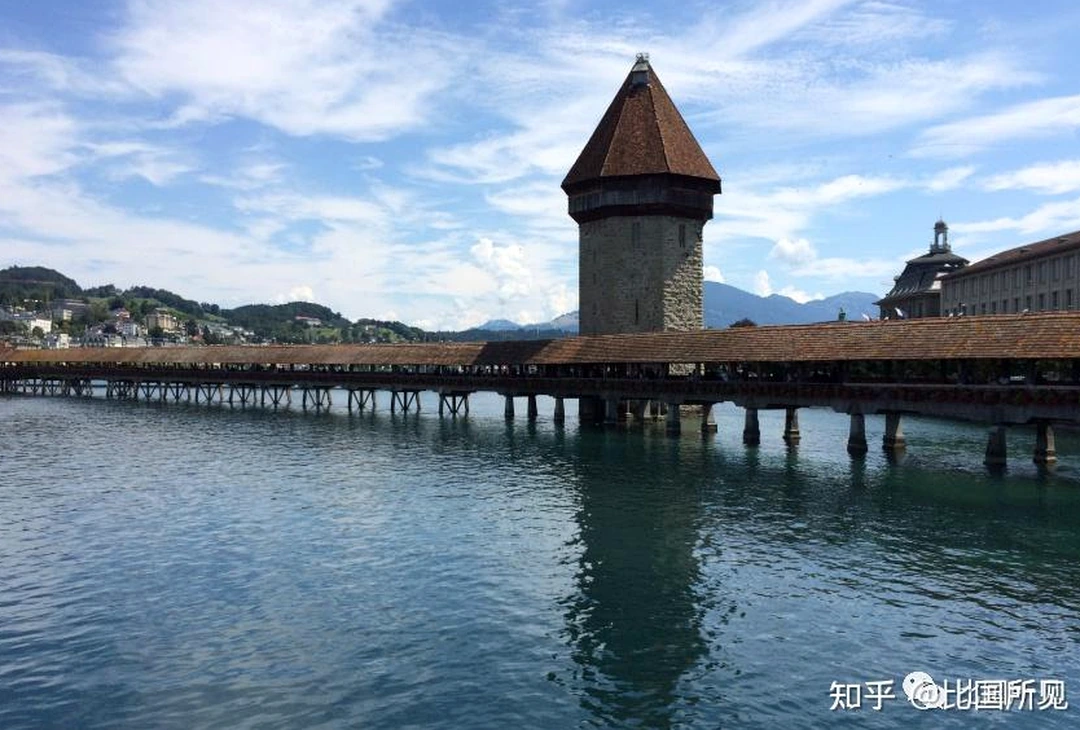
From the perspective of urban spatial organization, the bridge spanning the water functioned as an organic artery binding together the two social halves of the medieval city-state. Its northeastern bridgehead anchored the historic seat of administrative power and commerce, where the venerable Town Hall stood beside the bustling Kornmarkt grain market square; meanwhile, its southwestern end opened directly onto the Jesuit Church ensemble and the theater district, the emerging cultural and spiritual hub of the expanding town. The covered bridge formed an ingenious linear architectural boundary, cleanly separating the broad, open bay of Lake Lucerne from the narrower, fortified urban river corridor. Strolling beneath the shade of its steeply pitched timber rafters, pedestrians glide through a transitional spatial gallery—sheltered from the swirling waters below yet intimately connected to the civic pulse of both riverbanks.
The spiritual focal point anchoring this entire aquatic landscape is the Octagonal Water Tower, a rugged sandstone bastion rooted majestically in the middle of the Reuss. Serving as an absolute vertical benchmark, this stoic octagonal prism acts both as a visual anchor balancing the slender horizontal ribbon of the wooden bridge and as a dramatic framing device opening onto the grand Alpine panorama. Through the openings between the wooden balustrades, sightlines are impeccably framed toward regal mountain massifs: the jagged, legend-steeped ridges of Mount Pilatus, the graceful, sun-drenched slopes of Mount Rigi, and the sheer limestone cliffs of the Bürgenstock reflected in the crystal-clear water. This synergy of glacial topography, medieval hydraulic engineering, and scenic urban planning transforms the site into an indivisible geo-cultural entity.
Admiring the Kapellbrücke from either bank of the Reuss, one cannot help but marvel at a masterpiece representing the pinnacle of medieval Alpine carpentry and river-crossing engineering. The structure is an exemplary synthesis of Late Gothic architectural language and the utilitarian demands of a civic and secular defensive work. The bridge’s skeleton operates on a traditional post-and-beam frame system known in German as a Ständer-Träger-Konstruktion. The entire superstructure is borne by foundations of ancient, water-resistant oak pilings driven deep into the gravelly riverbed of the Reuss, while load-bearing beams, cross-ties, and handrails capitalize on the tensile resilience of native softwoods such as fir and spruce harvested from the snow-clad forests of Central Switzerland. Sheltering the entire length of the walkway is a low-slung saddle roof clad in tens of thousands of deep-red terracotta beaver-tail tiles, creating an enclosed gallery that protected the timber grain from frost and snow while providing a secure military evacuation corridor in centuries past.
In terms of physical dimensions, the extant bridge measures exactly 204.7 meters in total length, tracing a gentle, strategically deliberate bend linking the north and south banks of the Reuss. This current length actually represents a notable reduction from its original span of over 270 meters, following successive municipal river-embankment regulation and shoreline expansion projects carried out in 1833, 1835, and 1838. Despite having its landward approaches shortened, the bridge maintains its poised, free-spanning stance above the water, supporting the footsteps of millions of visitors without relying on modern industrial metal fasteners—depending entirely on the intricate wood-joinery artistry perfected by fourteenth-century master carpenters.
Right at the bend of the bridge rises its steadfast anchor: the Octagonal Water Tower, a stone outpost possessing a uniquely irregular octagonal footprint. Towering to a height of 34.5 meters, the keep visually commands the slender wooden bridge beside it. Its outer shell is constructed from rough-hewn limestone blocks combined with Nagelfluh conglomerate—a sedimentary rock characteristic of the pre-Alpine basin—forming formidable ground-level walls measuring up to 1.5 meters thick to withstand the impact of medieval siege weaponry. Capping the summit is a steep, tiled tented roof that once served both as a fire watchtower and long-range military lookout over Lake Lucerne, while sealing off the interior chambers formerly utilized as the city-state’s municipal archive, interrogation room, and prison dungeon.
If the timber and stone structure embodies defensive might, the space beneath the bridge’s eaves is a priceless open-air art gallery housing a unique cycle of triangular roof-truss paintings known as the Reuss-Giebelbilder. Commissioned by the Lucerne City Council in the early seventeenth century, this ambitious artistic undertaking was designed and executed by the renowned painter Hans Heinrich Wägmann and his workshop over an extended period from 1611 to 1635. Out of the original 158 wooden panels mounted prominently in the triangular spaces formed by the rafters and tie-beams of the roof vault, 147 original and restored paintings survive today despite the vicissitudes of history, turning every stroll across the bridge into an enchanting journey upstream through collective memory.
Stylistically, Hans Heinrich Wägmann’s works vividly illustrate the dramatic transitional idiom between Late Renaissance and Early Baroque art, where chiaroscuro lighting, volumetric form, and dynamic figure compositions are brought to life upon spruce wood panels. The thematic program of the cycle is divided with rigorous ideological symmetry: one half chronicles the heroic history of Switzerland and the triumphant founding battles of the Old Swiss Confederacy, while the other half vividly portrays the hagiographies and martyrdoms of Lucerne’s two patron saints, Saint Leodegar and Saint Maurice. Each painting is accompanied by explanatory verses and the coats of arms of the prominent patrician families who sponsored its creation, forming an unrivaled visual epic spanning the clear mountain river.
As twilight gradually fades behind the layered silhouettes of Mount Pilatus and Mount Rigi, the surface of Lake Lucerne and the gentle current of the Reuss undergo a captivating visual transformation. In stark contrast to the glaring, mechanized light displays of modern metropolises, the illumination scheme enveloping the Chapel Bridge and the Octagonal Water Tower is rooted in a rigorous and refined philosophy of heritage preservation. The entire ensemble eschews harsh, high-powered floodlights; instead, urban lighting designers installed discreet recessed LED fixtures tuned to a warm amber color temperature that faithfully evokes the flickering glow of medieval torches. Beams of indirect light wash upward from the weathered oak deck, filtering through the rustic wooden balustrades to illuminate the triangular gable trusses, turning the bridge’s two-hundred-meter span into a quiet ribbon of warm light draped across the crystal-clear water. Meanwhile, subtle uplighting accentuates the rough-hewn limestone facets of the thirty-four-meter Water Tower, casting its monumental reflection onto the calm river surface like a giant mirror to create an atmospheric tableau suspended between reality and living history.
Strolling across the bridge deck after nightfall offers a deeply contemplative experience, where time seems to slow with every soft footstep echoing on the aged timber planks. The covered interior feels wholly insulated from the bustling modern world outside; gentle shadows cocoon more than a hundred seventeenth-century triangular paintings by Hans Heinrich Wägmann, revealing muted, time-aged pigments recounting the legends of patron saints Leodegar and Maurice alongside the storied annals of Canton Lucerne. From lush window boxes of vibrant geraniums cascading along both sides of the bridge, an herbal fragrance mingles with the crisp lake breeze drifting in from the Vierwaldstättersee. Each crooked turn of the bridge—originally conceived for tactical defense—creates shifting cinematic perspectives by night, alternating between the solemn enclosure of the stone octagonal keep and sudden, sweeping vistas across the shimmering, wave-dappled bay.
This nocturnal panorama achieves the pinnacle of a total work of art thanks to the remarkable dialogue between the two banks of the Reuss. Standing at the centuries-old wooden railing and gazing toward the south bank, visitors behold the Culture and Convention Center Lucerne (KKL), a masterpiece by acclaimed architect Jean Nouvel. Its vast copper roof cantilevers dozens of meters out over the lake like a sleek mechanical wing, absorbing the glow from its modern glass facades and reflecting it back onto the water in a silent, dramatic conversation between fourteenth-century defensive carpentry and twenty-first-century futuristic design. On evenings during the Lucerne Festival, the lake basin surrounding the bridge transforms into a giant acoustic resonator; symphonic strains of Gustav Mahler or Ludwig van Beethoven drift out from the celebrated KKL concert hall, gliding across the ripples to blend with the gentle lapping of water against the ancient timber pilings, weaving an atmosphere of sublime artistic refinement found almost nowhere else on earth.
Nightlife around the Chapel Bridge grows even richer and more authentic as crowds gravitate toward the cobblestone promenades along the Rathausquai embankment. Rustic oak tables outside traditional taverns glow warmly beneath flickering lanterns, where diners can gaze upon the proud silhouette of the Water Tower against a velvety night sky while savoring genuine Swiss gastronomy—from bubbling pots of creamy cheese fondue infused with Chasselas white wine to sizzling grilled veal sausages paired with golden, crisp rösti. During the traditional Fasnacht carnival season, the tranquil riverside nights erupt into an exuberant celebration of folk culture. At this time, the area around the bridge becomes a grand open-air stage for Guggenmusik brass bands dressed in grotesque costumes and haunting wooden masks, sending booming rhythms echoing beneath the historic timber rafters and turning Lucerne’s night into an unforgettable sensory festival of myth and memory.
Along both banks of the Reuss where the wooden Kapellbrücke spans the river, Lucerne’s timeless civic rhythm is expressed not only through moss-dappled tiled roofs and the towering Water Tower, but also in a deeply rooted culinary heritage cultivated over centuries. During the Middle Ages, the waterfront around the bridgeheads served as a bustling landing for merchant vessels, bringing together bountiful harvests from the calm waters of Lake Lucerne and sprawling farms nestled beneath the snow-capped Alps. Through the passage of eras, historic burgher inns and ancient guildhalls hugging the water’s edge have faithfully kept their hearth fires burning, crafting a gastronomic experience imbued with the refined, gracious character of Canton Lucerne.
The crowning jewel of local gastronomy here is Luzerner Chügelipastete, the celebrated puff-pastry vol-au-vent that every discerning traveler longs to sample upon arriving in the lakeside historic capital. Originating from lavish banquets hosted by nobility and merchant guild members during the spring carnival festivities, this dish demands exacting culinary craftsmanship. A flaky puff-pastry shell is baked until risen like a golden crown, encasing a rich, aromatic filling of tender minced veal meatballs, sautéed fresh mushrooms, and sweet, wine-soaked raisins. Everything is bound together in a velvety white cream sauce delicately spiced with nutmeg, achieving a classic harmony of savory richness, earthy depth, and subtle sweetness.

Beyond elaborate savory specialties, a culinary stroll through Lucerne’s Old Town also leads travelers to the warming spice of Luzerner Lebkuchen. Distinct from conventional Central European gingerbread, this heirloom confection is kneaded from fine flour, sweet honey, rich fresh milk, and a signature spice symphony of cloves, cinnamon, star anise, and concentrated Swiss pear juice. Tucked away in the cobblestone lanes near the Kapellbrücke bridgeheads, centuries-old artisan bakeries still press the dough into carved wooden molds featuring snowflakes and the city coat of arms, wafting warm herbal aromas into the crisp lakeside mist. Complementing these treats is the craft brewing heritage of the famed Eichhof brewery, which draws upon pristine mountain water from Mount Pilatus to brew golden lagers preserving traditional fermentation methods passed down from past centuries.
To fully experience the patrician elegance of Lucerne’s golden age, an essential stop is Zunfthaus zu Waag, the historic guildhall presiding over the venerable Weinmarkt (Wine Market Square). Stepping across its threshold beneath solemn Gothic arches and wall frescoes depicting the prosperous era of Lucerne’s merchants, guests are transported into a bygone world of flickering candlelight and polished oak paneling. Here, slow-braised meats and aged alpine cheeses are served with stately refinement, paired harmoniously with premier Swiss wines cultivated on the sunlit slopes surrounding the lake.
Right along the left bank of the Reuss, the historic Hotel des Balances strikes another exalted note in riverside dining. Once serving as the town hall, financial exchange, and hall of justice before transforming into a distinguished sanctuary welcoming heads of state and European royalty, the property boasts balconies overhanging the emerald river. Seated on the terrace at sunset, listening to church bells chiming in concert with the gentle lapping of water beneath the wooden bridge, diners can savor delicate pan-seared lake fish while watching the Water Tower’s reflection shimmer across the waves—experiencing a seamless union of cultural depth and Switzerland’s unhurried art of living.
Lucerne’s welcoming, unhurried spirit is clearly reflected in the open accessibility of the Chapel Bridge (Kapellbrücke). Serving as a commercial and defensive link across the Reuss since the Middle Ages, the oldest covered wooden bridge on the Old Continent remains completely free and open year-round, with no gates, turnstiles, or admission fees for pedestrians. Visitors are welcome to stroll across its dark timber planks at any hour of the day or night to immerse themselves in its historic ambiance. However, the Octagonal Water Tower (Wasserturm) rising amidst the current—a landmark that once served as a defensive watchtower, dungeon, and cantonal treasury—is not generally open to the public, as it remains under heritage conservation and serves as the traditional guild headquarters of the Lucerne Artillery Association (Artillerieverein Luzern). Even so, admiring this massive stone bastion with its moss-flecked sandstone blocks and octagonal spire mirrored in the clear river water from just a few paces away offers a deeply memorable visual encounter.
To capture the full magic of the bridge’s architecture and natural lighting, timing your visit plays a pivotal role in the overall experience. Early morning, just as the thin mist over the Reuss begins to lift beneath the golden rays of sunrise cresting the Alps, offers the purest natural illumination. This quiet hour is ideal for gazing upward at leisure to inspect the intricate restored details of the seventeenth-century triangular paintings suspended beneath the rafters—works celebrating patron saints Saint Leodegar and Saint Maurice alongside the martial triumphs of the early Swiss Confederates. Conversely, dusk—when the afterglow of sunset yields to the Blue Hour—cloaks the monument in an entirely different allure. The waters of the Reuss deepen to a tranquil midnight blue while artistic lighting along the bridge deck and tower walls weaves warm golden reflections across the river, creating a luminous tableau straight out of Swiss legend.
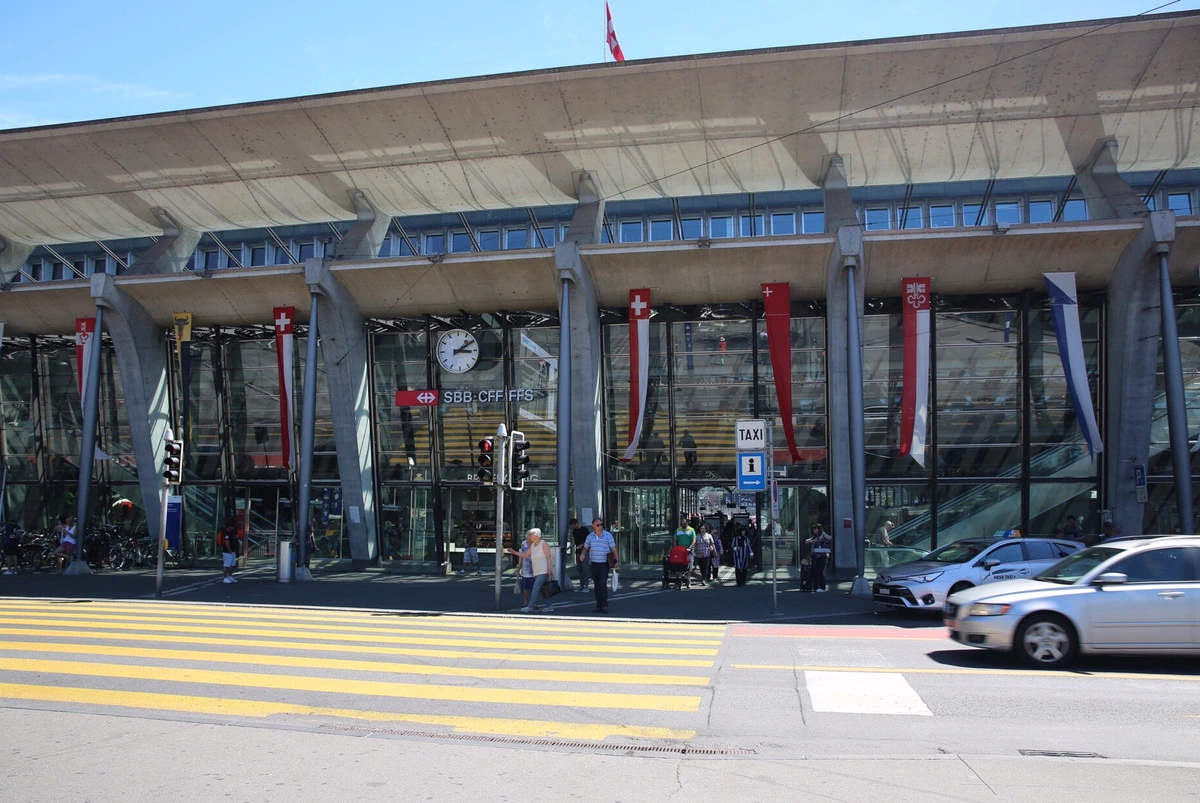
Switzerland’s world-renowned transport infrastructure makes reaching this historic landmark effortless. From Lucerne’s main railway station (Bahnhof Luzern), situated right beside the iconic KKL cultural center, visitors need only take a leisurely two-hundred-meter stroll to reach the western bridgehead. The Swiss Federal Railways (SBB) network operates with clockwork precision, offering frequent connections from Zurich in just forty-five minutes, or from Bern and Basel in roughly one hour. Because the entire Lucerne Old Town (Altstadt) on the north bank is designated as a pedestrian-only zone to preserve its cobblestone streets and historic timber architecture, travelers arriving by private car are advised to park in the underground Bahnhofparking garage adjacent to the station before setting out on foot to explore both banks of the river.
An insider tip for discerning travelers is to begin your walk from the northern bridgehead, anchored strikingly beside the historic twelfth-century St. Peter’s Chapel (St. Peters-Kapelle), and stroll gradually southward. This direction not only follows the chronological narrative sequence of the overhead gable paintings, but also unfolds a breathtaking vista few places can rival: pausing midway along the zigzagging bridge and looking out through the aged wooden balustrades across the flowing Reuss, with the legendary snow-dusted peak of Mount Pilatus rising majestically into the clouds in the distance. This grand panorama has remained virtually unchanged for four centuries, serving as a timeless reminder of the sublime harmony between human craftsmanship and extraordinary Alpine nature. To plan seamlessly and experience such time-honored landmarks to the fullest, travelers can explore all-inclusive European tour itineraries thoughtfully curated for depth and memorable discovery.