In the final years of the fourteenth century, amid the fertile plains of Lombardy torn by fierce power struggles, a landmark religious monument was born—not merely out of pure faith, but also from towering political ambition. In 1386, Lord Gian Galeazzo Visconti—who had just consolidated absolute family control and been granted the title of Vicario Imperiale (Imperial Vicar) of the Holy Roman Empire—laid the first foundation stones for a basilica dedicated to the Nativity of Saint Mary (Santa Maria Nascente). Gian Galeazzo’s vision went far beyond an ordinary diocesan church; he sought to erect a magnificent wonder capable of asserting Milan’s stature as a formidable geopolitical hub and the future capital of a unified, independent Italian kingdom. To bring this unprecedented megaproject to life, the Veneranda Fabbrica del Duomo was established in 1387 as a dedicated institution overseeing design, construction, and finance, operating independently as a standardized and enduring administrative body for hundreds of years.
The lifeblood sustaining this monumental endeavor flowed through a rigorous taxation system and the devotion of the faithful. Enormous funds were raised through local customs duties (dazi) levied on food, wine, and goods passing through the city gates, intertwined with donations ranging from noble patrons to humble citizens. Notably, the history of construction logistics here is bound to the famous acronym AUF—short for the Latin phrase Ad Usum Fabricae (For the Use of the Cathedral Workshop). Every block of pinkish-white marble quarried from Candoglia in the Val d’Ossola, floated down the Toce River, across Lake Maggiore, and into the Navigli canal network to dock right in the heart of the city, was stamped with the letters AUF to exempt it from all tolls and waterway taxes. That abbreviation eventually entered everyday Italian parlance, becoming a popular idiom symbolizing anything provided completely free of charge for a noble common purpose.
Beyond sheer material endurance, Duomo di Milano served as an intellectual battleground and a crossroads for Europe’s most fiercely opposing artistic philosophies. From the very outset, Gian Galeazzo Visconti decided to abandon traditional Lombard terracotta brick in favor of the flamboyant Northern Gothic style. A roster of distinguished foreign master engineers and architects was summoned to Milan, notably Nicolas de Bonaventure from Paris and Heinrich Parler of Schwäbisch Gmünd. The arrival of these northern masters sparked bitter philosophical clashes with local Italian builders—most famously the historic debate between the geometric proportions of ad quadratum (rooted in the stable square structure favored by Italians) and ad triangulum (based on the equilateral triangle symbolizing the Holy Trinity in the Franco-German Gothic tradition). Those intense geometric and theological dialogues forged a one-of-a-kind architectural hybrid: retaining the expansive, grounded poise of the Mediterranean while soaring skyward with dense clusters of spires imbued with the spirit of the snow-laden forests of Gaul and Germania.
Duomo di Milano’s nearly six-century construction journey faithfully mirrors every historical upheaval across the Apennine Peninsula. Entering the sixteenth and seventeenth centuries, the Counter-Reformation under the spiritual leadership of the austere Archbishop Carlo Borromeo reshaped the sacred interior in accordance with the decrees of the Council of Trent. Under the direction of architect Pellegrino Tibaldi and later Francesco Maria Richini, the cathedral acquired additional layers of Late Renaissance and aristocratic Baroque aesthetics across its nave and grand portals. Even so, work on the facade stalled for centuries due to budget shortfalls and conflicting blueprints, until an earth-shaking historical figure stepped onto the scene: Emperor Napoleon Bonaparte. Ahead of his 1805 coronation as King of Italy with the famed Iron Crown of Lombardy beneath the cathedral’s vaults, Napoleon issued an urgent decree compelling the imperial treasury to fund the completion of the main facade in a Neo-Gothic style harmonized with Neoclassicism.
This grand symphony in stone officially concluded in 1965, when the final bronze portal sculpted by artist Luciano Minguzzi was set into place, bringing more than five hundred and seventy years of relentless craftsmanship to completion. Every pinnacle and bas-relief is steeped in the sweat and devotion of dozens of generations of artisans across the Visconti and Sforza dynasties, Spanish and Austrian rule, and finally the unification of Italy. That enduring crystallization of history, art, and civic structure earned the historic heart of Milan and the cathedral’s millennial legacy inscription on the UNESCO World Heritage List in 1980, standing tall as an immortal testament to humanity’s yearning to touch eternal beauty.
Viewed through the lens of geography and urban morphology, Duomo di Milano stands squarely at the heart of the fertile Po Valley alluvial plain (Pianura Padana). This very site once served as the sacred intersection of the ancient Roman grid system (centuriazione) of legendary Mediolanum, where centripetal thoroughfares converged to form the epicenter of political authority and religious worship millennia ago. Resting upon a solid bed of Quaternary alluvial sediment deposited over tens of thousands of years of geological formation, the cathedral’s foundations act like a colossal anchor driven deep into the earth, supporting an estimated mass of hundreds of thousands of tons without settling amidst the shifting hydrology of the underground waterways crisscrossing beneath Lombardy’s capital.
The starting point of the cathedral’s engineering marvel lies in a revolutionary choice of building material. At the time, virtually all religious and civic structures across Lombardy remained strictly loyal to traditional fired red brick—the humble, abundant material of the lower Po region. Yet to fulfill his ambition of achieving timeless divine beauty, Lord Gian Galeazzo Visconti and the Fabbrica del Duomo administration rejected terracotta brick in favor of a single regal stone: Candoglia marble (marmo di Candoglia), quarried from the sheer cliffs of Val d’Ossola in the Alps. This metamorphic limestone possesses an exceptionally dense crystalline structure resilient against harsh weather, featuring an ivory-white hue laced with delicate rose veins that shift magically in tone with every angle of sunlight from dawn until dusk.
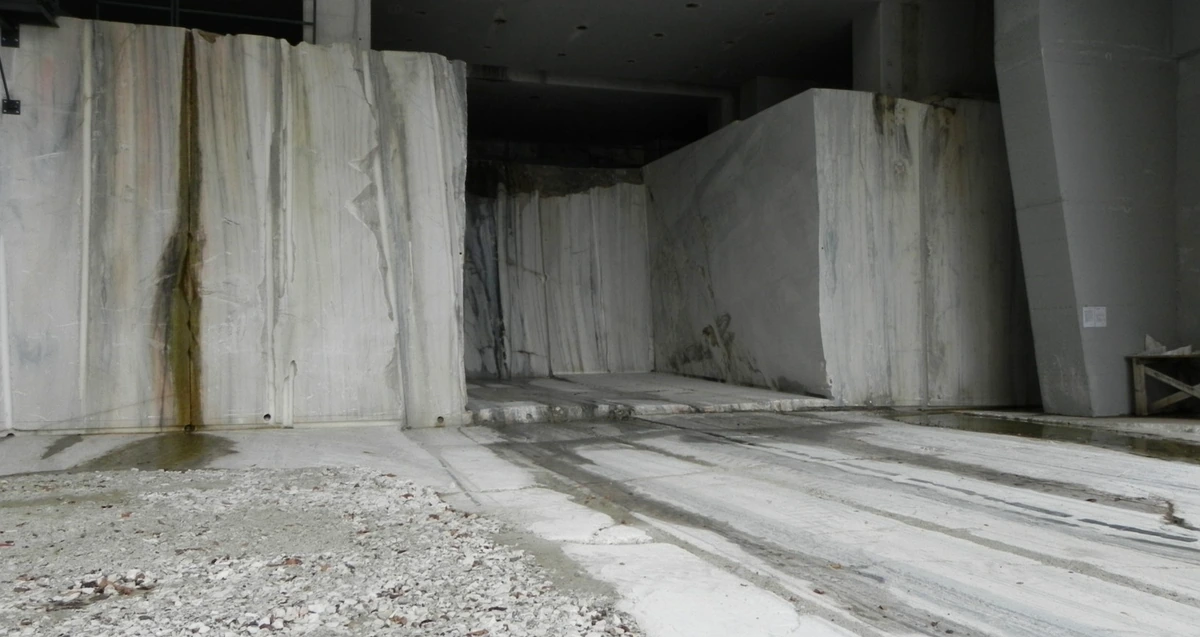
To transport millions of multi-ton stone blocks across nearly one hundred kilometers of rugged terrain from the Candoglia quarry to the city center, the Milanese engineered one of the most sophisticated medieval waterborne logistics networks in existence. Once rough-hewn at the quarry, monolithic slabs were floated down the Toce River, across Lake Maggiore, down the Ticino River, and into the intricate man-made network of Navigli canals. Thanks to advanced water-level navigation locks and special tax-exempt transport privileges bearing the engraved abbreviation “A.U.F.” (Ad Usum Fabricae – Reserved for the Construction of the Cathedral, the origin of the Italian idiom “ad ufo” meaning free of charge), marble-laden barges could dock right at the Santo Stefano basin, just a few hundred meters from the construction site. This seamless, closed-loop waterway system not only solved an immense heavy-transport challenge but also laid the groundwork for the golden age of Milan’s canal network.
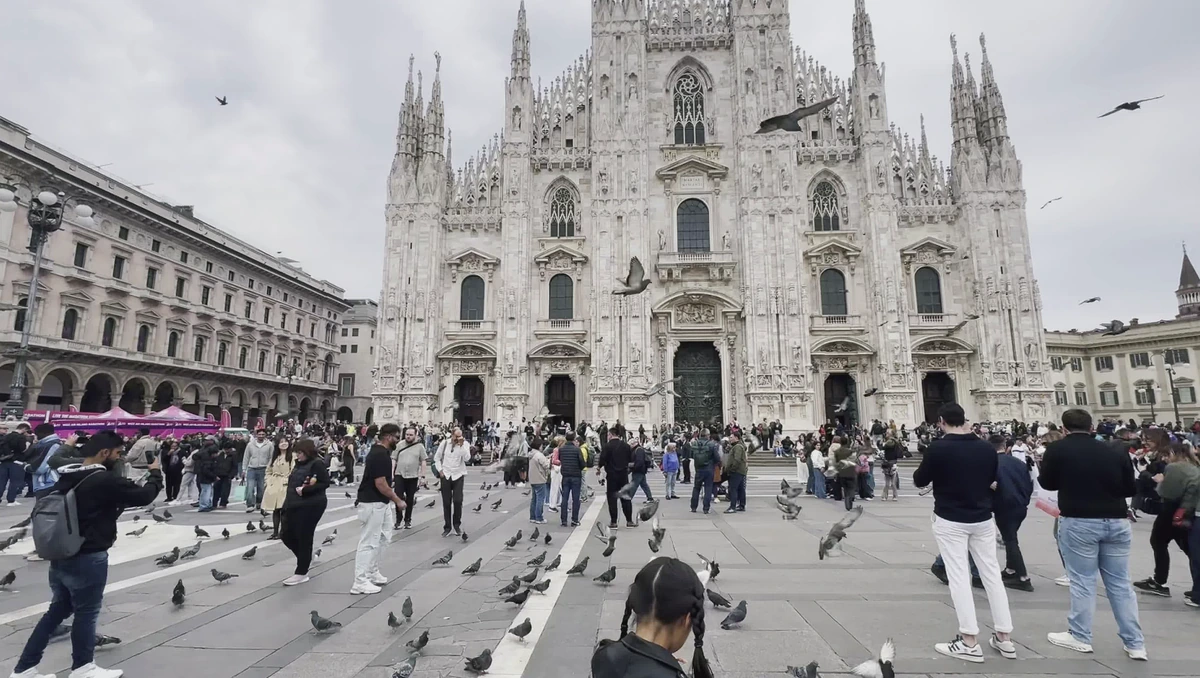
The sweeping urban landscape surrounding the cathedral today is the result of a bold nineteenth-century urban renewal project designed by the brilliant architect Giuseppe Mengoni. Prior to that era, the church was hemmed in by labyrinthine rows of houses, makeshift markets, and densely packed medieval structures that severely obstructed views of the monument. Mengoni’s sweeping master plan cleared away the cramped old quarters to carve out the vast rectangular Piazza del Duomo, while opening a grand axial vista linking directly to the glass-and-iron vaulted Galleria Vittorio Emanuele II shopping arcade, begun in 1867. The dramatic contrast between the symmetrical Neoclassical porticoes framing the square and the sky-piercing Gothic facade created an explosive visual impact, elevating Duomo di Milano into a supreme spatial focal point illuminating the entire Po plain.
Seen from Piazza del Duomo, the cathedral rises like a mountain of blush-tinted white marble, representing the pinnacle fusion of Northern Europe’s Flamboyant Gothic style and the stately equilibrium of Italian classical art. Its architectural scale ranks among the most astonishing in Christendom, boasting an immense capacity of up to 40,000 worshippers and a monumental Latin cross floor plan. The interior stretches across five cavernous aisles supported by 52 colossal stone pillars symbolizing the 52 weeks of the astronomical year. Each colonnade rises straight toward the soaring vaults like petrified ancient redwoods, their capitals intricately carved into miniature tabernacles housing statues of saints that draw both the eye and the human spirit heavenward.
What gives Duomo di Milano its unmatched visual splendor is its exterior ensemble, often likened to an endless forest of marble. Encircling the cathedral is an array of exactly 135 spires piercing the sky, paired with a dense sculptural program of more than 3,400 masterfully carved statues. From mythical gargoyles guarding the drainage system and winged angels to countless devout saints and classical historical figures, every piece was painstakingly chiseled from famed Candoglia marble. Stonecarving here reached extraordinary refinement, transforming heavy blocks weighing tens of tons into delicate stone lacework as supple as silk in the wind.
At the highest point of the entire architectural axis, atop the central spire rising 108.5 meters above ground, stands the gilded bronze statue of La Madonnina—the soul and supreme sacred protector of Milan. Completed in 1774 through the collaboration of sculptor Giuseppe Perego and goldsmith Carlo Belli, the statue depicts the Virgin Mary extending her arms in an embrace over all of Lombardy. This image lives deeply in local consciousness through the beloved Milanese saying “Milan col cor in man” (“Milan with its heart in its hand”), signifying a city that offers its open heart with generosity and grace. The radiant gold gleaming from the Virgin against the azure sky was not merely an aesthetic zenith; for centuries it served as an unwritten urban height limit, whereby no building in the fashion capital was permitted to rise above her gaze.
The spatial grandeur of this masterpiece would be incomplete without its open-air rooftop terraces spanning roughly 1,530 square meters. Paved flat with massive marble slabs, the sloped roof unfolds as a one-of-a-kind aerial architectural labyrinth. Strolling at this elevation, visitors wander among rhythmically arching flying buttresses, touch intricate bas-reliefs on the spires within arm’s reach, and take in sweeping panoramic views stretching across the bustling metropolis all the way to the snow-capped Alps on the horizon. The seamless interplay between Gothic structural engineering and expansive contemplation turns every step across the rooftop into a breathtaking visual art experience.
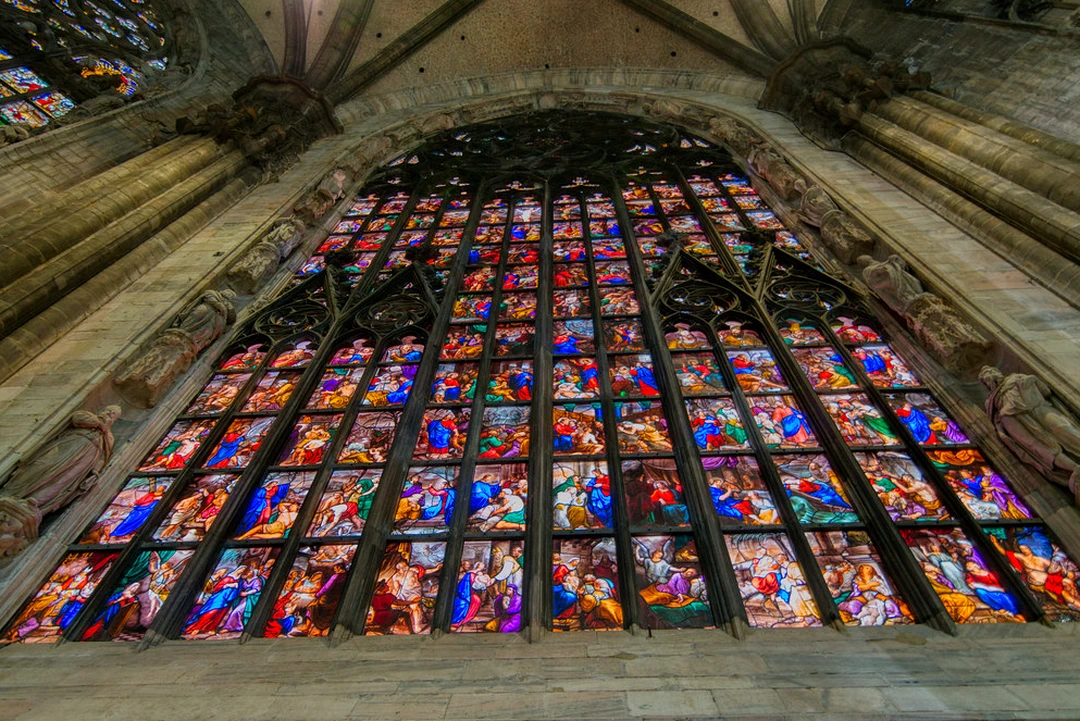
Stepping across the threshold into the interior, an atmosphere of solemn reverence immediately envelops visitors through magical light filtering in via colossal stained-glass windows. Crafted continuously across generations from the fifteenth through the twentieth centuries, each luminous panel vividly recounts scenes from the Old and New Testaments in jewel-toned brilliance. Moving toward the transept, visitors come face to face with the renowned marble statue of San Bartolomeo scorticato (Saint Bartholomew Flayed), sculpted by master Marco d’Agrate in 1562. Astonishing in its anatomical precision, the work portrays Saint Bartholomew standing in serene contemplation with his own flayed skin draped casually over his shoulders like a martyr’s cloak. Deeper beneath the nave lies the solemn crypt housing the sacred relics of former archbishops, preserving layers of spiritual heritage across centuries of Western history.
When the final golden rays of sunset dip behind Lombardy’s historic tiled rooftops, Piazza del Duomo sheds the brisk pace of a financial powerhouse to enter its most enchanting visual spectacle. Orchestrated by master architectural lighting engineers, thousands of precision-angled high-tech luminaires awaken the latent splendor of Candoglia marble. Quarried from Val d’Ossola with its signature pinkish-white and gray-veined hue, the stone glows like an immense crystal against the night sky. Every fine vein, famed stone-lace motif, 135 spires, and over 3,400 intricate sculptures are cast in deep, high-contrast shadow, creating dramatic three-dimensional depth. Perched atop the 108.5-meter main spire, the gold-leaf bronze Madonnina shines radiantly like a spiritual beacon illuminating every avenue of the fashion capital, watching over its citizens through centuries of changing times.
Nightfall is also the moment when the spaces around the cathedral and the adjoining glass-vaulted Galleria Vittorio Emanuele II transform into Europe’s most glamorous “public drawing room.” The quintessential Mediterranean movida nightlife pulses through every corner, blurring the line between sacred reverence and high-society glamour in an atmosphere of effortless elegance. Travelers and locals stroll across dark stone flagstones, listening to the soaring melodies of street violinists blending with the deep tolling of bronze bells from the belfry, creating a vibrant and captivating urban symphony.
Amid this nocturnal tableau, traditional culinary culture takes center stage as an irresistible indulgence, epitomized by the historic café Camparino in Galleria. Standing proudly at a prime corner overlooking the entire Duomo facade since Gaspare Campari opened its doors in 1860, this landmark is revered as the birthplace of Milan’s aperitivo culture. Beneath opulent wood-paneled vaults and Art Nouveau mosaics by master painter Cesare Tallone, guests can sip a sparkling ruby-red Campari Seltz bursting with bittersweet botanicals or a classic Negroni. Enjoying a signature aperitif alongside salted roasted hazelnuts and aged Parmigiano Reggiano while gazing through glass windows at the Duomo’s forest of spires rising against the velvety night sky offers the ultimate sensory immersion into the Italian art of slow living.
Beyond culinary pleasures, Piazza del Duomo by night serves as a monumental open-air stage for world-class cultural events. Every Feast of Saint Ambrose on December 7—honoring the city’s patron saint and marking the prestigious season opening of Teatro alla Scala—the entire square is bathed in solemn festive illumination and vibrant historical pageants. On balmy summer evenings, the cathedral provides a resonant backdrop for free open-air concerts by the Filarmonica della Scala orchestra, where Giuseppe Verdi’s immortal scores echo across every marble crevice. Especially during Milan Fashion Week, the centuries-old Gothic cathedral stands as a proud witness to glamorous galas and contemporary light-art installations, where ancient artisanal mastery and haute couture converge in intoxicating harmony.
As Duomo di Milano’s spires carve into the azure sky, the shadow of this Candoglia marble masterpiece also shelters one of Northern Italy’s proudest royal culinary traditions. Authentic Milanese cuisine did not originate in humble street stalls, but rather took root in the lavish court banquets of the ruling Visconti and Sforza dynasties. Breaking entirely from the Mediterranean stereotype drenched in olive oil and ripe tomatoes, Lombard gastronomy celebrates the velvety richness of fine butter, the deep umami of slow-simmered beef marrow, and the regal gold of saffron threads—creating a flavor profile both aristocratic and deeply soulful.
The sacred imprint of the cathedral shines brightest in a classic plate of Risotto alla Milanese. According to lively goliardic folklore, the dish’s halo-like golden hue originated inside the Duomo’s own stained-glass workshop in the sixteenth century. Flemish glassmakers working there regularly mixed powdered saffron (zafferano) into their pigments to achieve shimmering gold tones for the cathedral’s luminous windows. As a playful prank during the wedding banquet of the master glassmaker’s daughter, a pinch of saffron was stirred into a pot of bone-marrow rice—accidentally giving birth to the city’s signature dish. Plump Carnaroli rice grains absorb rich meat stock, melding seamlessly with velvety beef marrow (midollo di bue) and Parmigiano-Reggiano through the skilled mantecatura whipping technique to deliver a melt-in-your-mouth texture like royal silk.
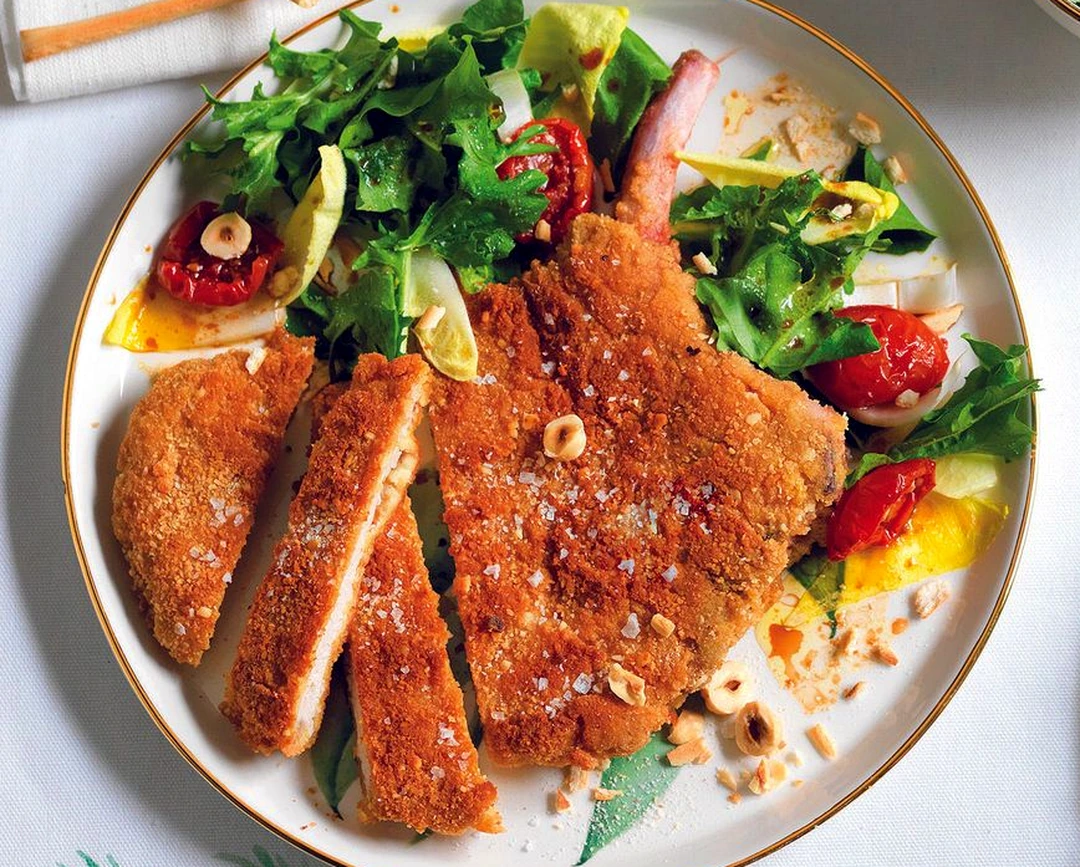
Accompanying this golden risotto is the legendary veal duo that has captivated aristocrats for generations: Costoletta alla Milanese and Ossobuco con la Gremolada. The bone-in milk-fed veal chop (Costoletta) is gently pounded to tenderize the meat while preserving its proper thickness, dipped in fresh egg, coated in crisp breadcrumbs, and fried in clarified butter (burro chiarificato) until the crust turns crisp amber-gold while the center remains juicy and rosy pink. Conversely, Ossobuco is an ode to slow braising: cross-cut veal shanks brimming with rich marrow are simmered gently with white wine and sweet aromatic vegetables before being finished with fresh gremolada made from grated lemon zest, finely chopped parsley, and crushed garlic. The unctuous richness of fall-off-the-bone meat balanced against the bright citrus lift of gremolada creates extraordinary harmony when paired with a forkful of fragrant saffron risotto.
When winter descends upon Piazza del Duomo, the sweet aroma of Panettone drifts through historic alleyways, awakening memories of the fifteenth-century Renaissance. Legend traces its origin to Castello Sforzesco under Duke Ludovico il Moro: when the main dessert burned during a grand Christmas feast, a young kitchen boy named Toni rescued the banquet by kneading leftover natural sourdough starter (pasta madre) with fresh butter, eggs, raisins, and candied orange and citron peel. That miraculous combination won over the discerning duke, giving rise to “Pane di Toni”—today’s Panettone. Nurtured through dozens of hours of natural fermentation and slow baking, each loaf pulls apart in cloud-light strands fragrant with sweet butter and concentrated candied fruit, enduring as Milan’s cherished spiritual gift and festive culinary heirloom.
Exploring the culinary heritage around the Duomo is incomplete without the refined ritual of aperitivo beneath the majestic glass dome of Galleria Vittorio Emanuele II. Inside Camparino in Galleria, founded by Davide Campari, or the nostalgic elegance of Ristorante Zucca—once a gathering spot for famed composers like Giuseppe Verdi and prominent literary figures—time seems to stand still. Amid the delicate clink of crystal glasses, sipping deep crimson Campari Bitter blended with sparkling wine or spiced vermouth while admiring Art Nouveau mosaics shimmering in late-afternoon light filtered through the glass dome, one truly understands that cuisine here is far more than sustenance—it is an immortal part of glamorous Milan’s soul.
The journey to the heart of Lombardy brings travelers to Piazza del Duomo, nestled gracefully at postal code 20122 Milano MI. To behold this white marble masterpiece, the fastest and most convenient mode of transit is the Metropolitana di Milano subway network. Simply take either Linea M1 (Red Line) running east-west or Linea M3 (Yellow Line) running north-south, and alight directly at the central Duomo station. The instant you ascend the underground station stairs, the expansive stone square opens dramatically before you, revealing the soaring Gothic cathedral rising like a carved white mountain in the heart of the vibrant metropolis.
The Cathedral welcomes worshippers and visitors daily from 08:00 to 19:00, with final entry at 18:10. Meanwhile, opening hours for the open-air Rooftop Terraces (Terrazze) and the underground Archaeological Area shift seasonally according to daylight hours. The most magical moment to step onto the rooftop marble slabs is late afternoon, when sunset bathes the gilded bronze Madonnina and all 135 spires in warm amber hues, transforming the skyline into an unforgettable, ethereal panorama.
To save time and avoid waiting in long queues under the sun, booking e-tickets online prior to your visit is an essential insider tip. The smartest options are combo passes such as the Duomo Pass Lift (taking a modern elevator to the rooftop) or the Duomo Pass Stairs (climbing over two hundred historic stone steps). These all-access passes unlock four sacred spaces: the vast, tranquil Cathedral interior, the panoramic Rooftop Terraces, the Duomo Museum inside Palazzo Reale housing original wooden architectural models and sculptures, and the underground Archaeological Area—revealing the fourth-century foundations of the Basilica of Santa Tecla and the Baptistery of San Giovanni alle Fonti, the sacred site where Bishop Ambrose baptized Saint Augustine in 387 AD.
Because this is an active liturgical sanctuary preserving more than six centuries of living faith, a strict dress code is enforced by cathedral staff. Both men and women must dress modestly, ensuring shoulders are fully covered and hems extend below the knees; sleeveless tops, shorts, and skirts above the knee are turned away at the entrance checkpoints. In addition, multi-layered security screening with metal detectors and stationed police requires all visitors to undergo bag inspections. Travelers should pack light and avoid bringing bulky backpacks, rolling suitcases, large tripods, or sharp metal objects to ensure smooth and rapid entry.
A great insider tip for travelers hoping to experience the cathedral’s transcendent stillness is to arrive right at the 08:00 opening hour, while Milan’s morning mist still lingers and tour groups have yet to descend. After admiring the cathedral, a bold espresso sipped standing at a classic Italian coffee bar or a piping-hot, mozzarella-filled panzerotto picked up just off the square completes an idyllic morning. For those eager to immerse themselves in the rich cultural and historical depths of this heritage destination without worrying about travel logistics, booking all-inclusive European tour packages offers the most effortless and rewarding way to experience the soul of Italy’s fashion capital.