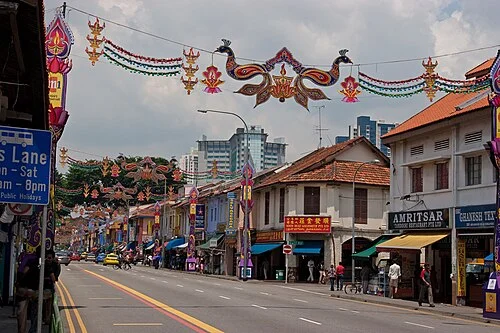
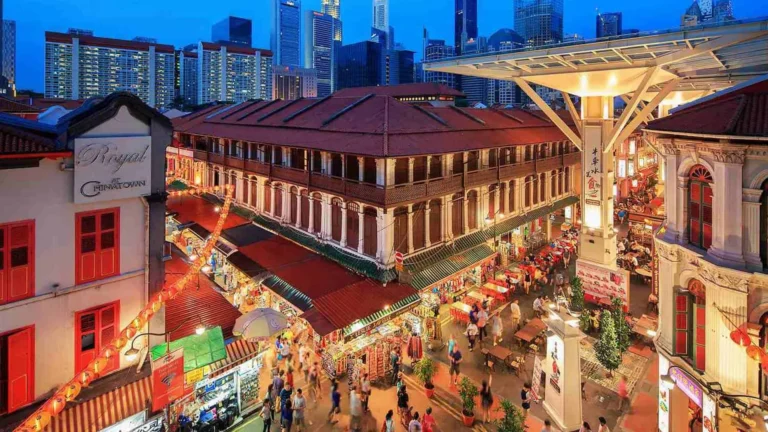
The birth of the wondrous Gardens by the Bay complex is closely intertwined with the transformative destiny of the Lion City, rooted in a visionary, century-spanning urban planning philosophy. Turning back the clock to the turbulent late 1960s—shortly after Singapore separated from the Federation of Malaysia to become a fledgling independent nation confronting formidable geopolitical challenges and scarce natural resources—the late Prime Minister Lee Kuan Yew pioneered the strategy of building a “Garden City.” At the time, greening concrete street corners was far more than a measure to purify the air or enhance urban aesthetics; it was a strategic masterstroke aimed at cultivating a healthy living environment, affirming national vitality, and attracting international investment to the tropical island.
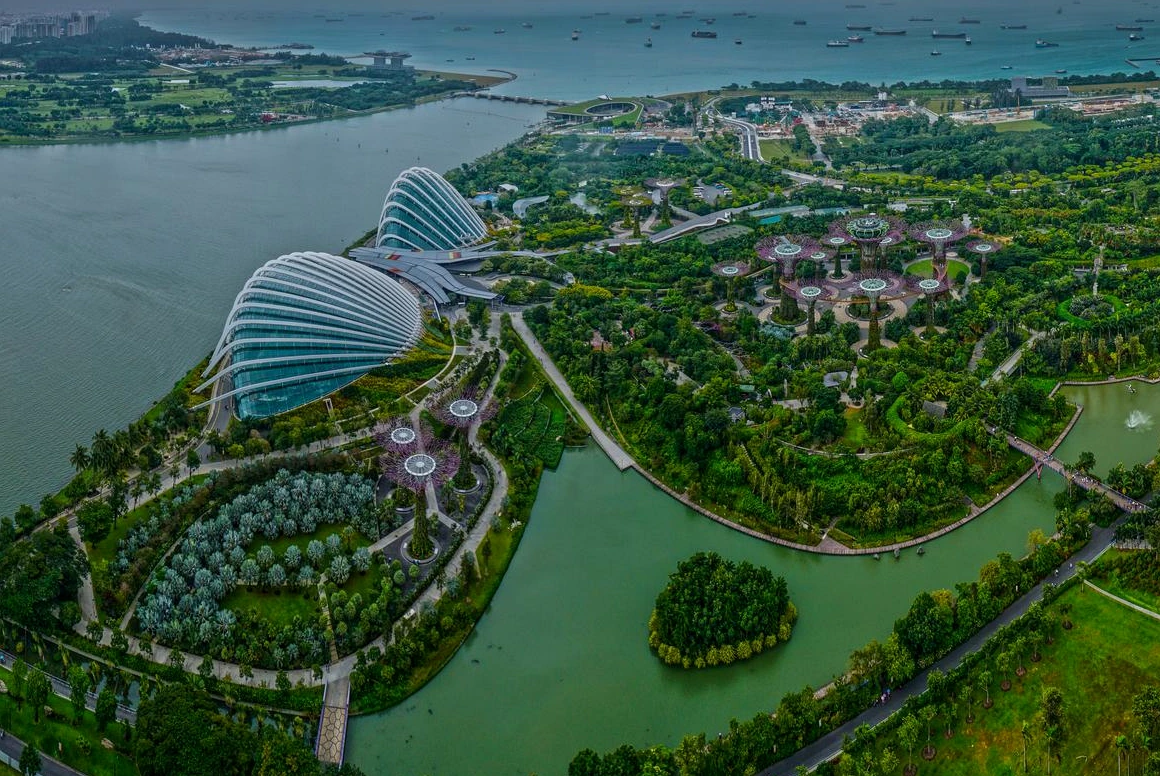
Entering the new era of the twenty-first century, once Singapore had risen to become one of the most prosperous financial and commercial hubs on the Malay Peninsula, the nation’s ecological ambition was elevated to an even grander scale. During his 2005 National Day Rally speech, Prime Minister Lee Hsien Loong officially unveiled a revolutionary shift: transforming Singapore from a “Garden City” into a “City in a Garden.” The centerpiece of this master plan was the comprehensive redevelopment and expansion of the Marina Bay area, turning reclaimed coastal land facing the Singapore Strait into a lush, verdant public realm where pristine nature harmonizes seamlessly with futuristic architecture.
To source humanity’s most groundbreaking ideas for this landmark project of the century, Singapore’s Ministry of National Development and the National Parks Board launched an international master plan design competition of unprecedented scale in January 2006. The event drew more than 170 entries from 70 landscape firms across 35 countries spanning five continents. Outshining prestigious global contenders, the poetic design by UK-based landscape architecture firm Grant Associates won the master plan commission for the expansive Bay South Garden—anchored by the fantastical Supertree cluster—alongside design studio Gustafson Porter + Bowman, which took charge of Bay East Garden with sweeping views across the Marina Bay skyline.
In November 2007, construction officially broke ground on reclaimed land with a colossal total investment reaching SGD 1.035 billion, marking one of the costliest and most intricate ecological engineering feats in the island nation’s modern history. Despite complex geotechnical challenges posed by newly reclaimed marine clay soil, thousands of world-leading engineers and landscape specialists worked tirelessly to recreate a majestic tropical ecosystem paired with a one-of-a-kind renewable energy infrastructure. On June 29, 2012, Gardens by the Bay held its official ribbon-cutting ceremony presided over by Prime Minister Lee Hsien Loong, opening its gates to the world to marvel at the pinnacle of synergy between nature and human ingenuity. The landmark quickly surpassed 50 million visitors by the end of 2018, cementing its status as an enduring ecological icon that placed Singapore firmly on the global architectural map.
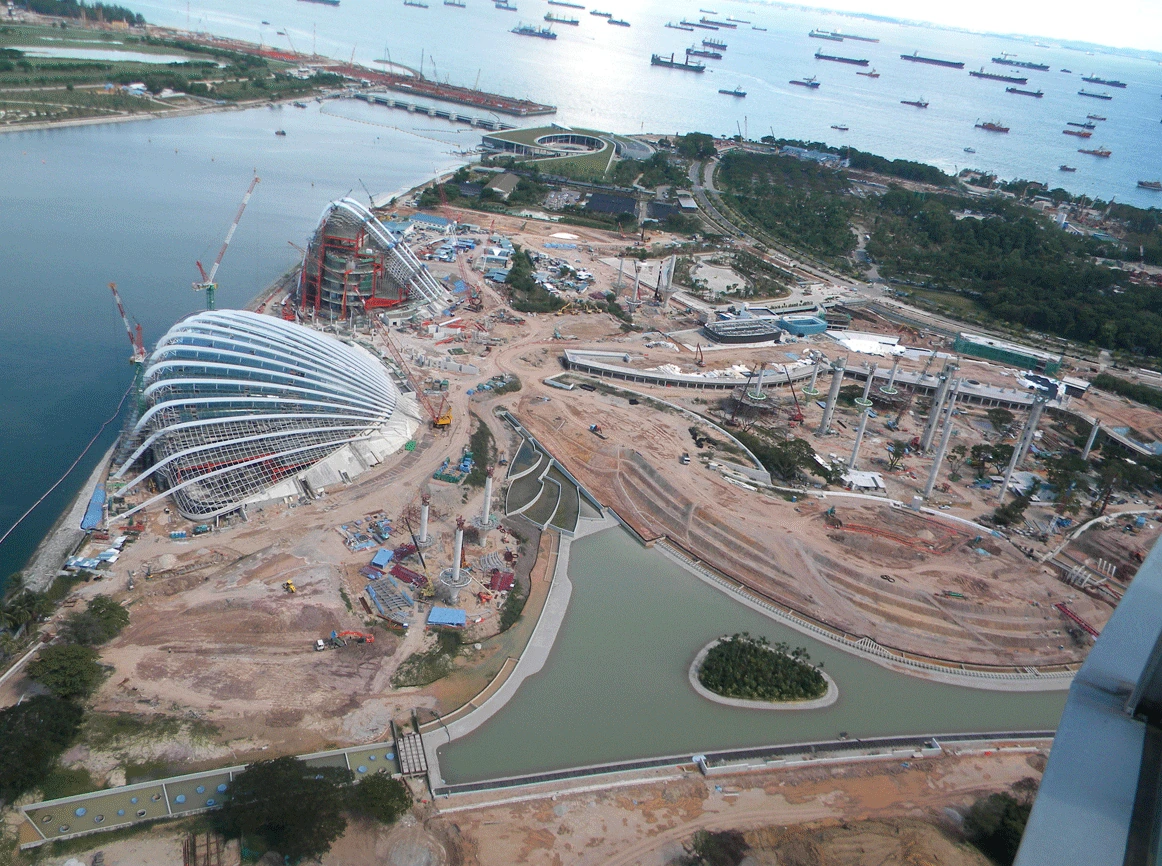
From a geographical and urban-planning perspective, the entire 101-hectare expanse of Gardens by the Bay is an extraordinary feat of geological reclamation, formed entirely through large-scale land reclamation campaigns in the Marina Bay basin during the 1970s and 1980s. Beneath today’s lush green carpet lies a highly complex stratigraphy, where soft native marine clay once submerged on the ocean floor was compacted and fortified with millions of cubic meters of engineered sand fill. Through the lens of contemporary landscape feng shui in the Lion City, this stretch of land occupies an auspicious “water-gathering, wealth-generating” formation, serving as an ecological screen standing guard at the gateway to Marina Bay. Where ocean currents meet the freshwater Marina Reservoir, the complex tempers fierce maritime energy into gentle, life-giving vitality that shelters and nourishes the thriving central financial district right next door.
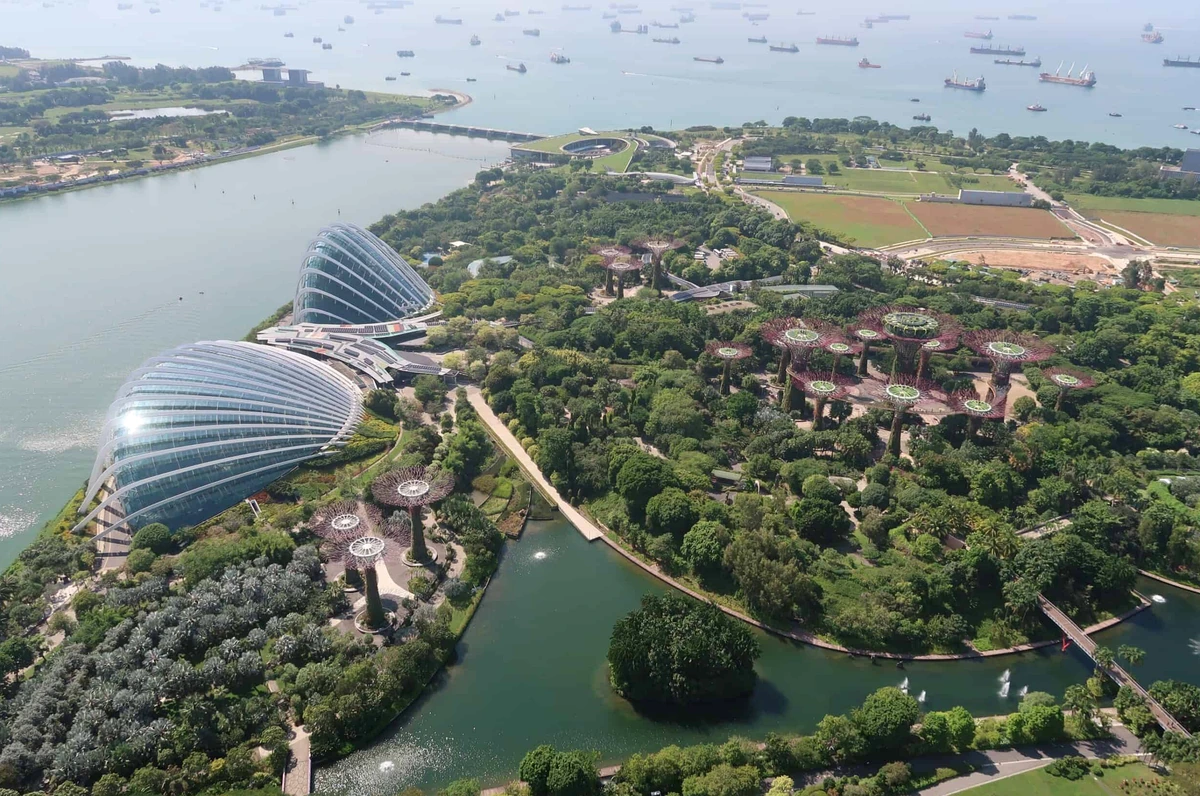
Bay South, the heart of the grand park, refuses to be constrained by the monotonous flat plane of artificial reclaimed land; instead, landscape architects sculpted it into a lyrical, undulating topography. Gently rolling man-made hills alternate with serene valleys precisely aligned with equatorial monsoon winds, channeling cool sea breezes off the Singapore Strait to dissipate accumulated urban heat. These artificial elevation shifts not only foster diverse microclimates for distinct plant communities, but also establish breathtaking visual corridors. Standing atop the gentle slopes, visitors’ gazes are drawn seamlessly across vibrant floral carpets straight toward the towering skyscrapers of the Central Business District and the iconic silhouette of Marina Bay.
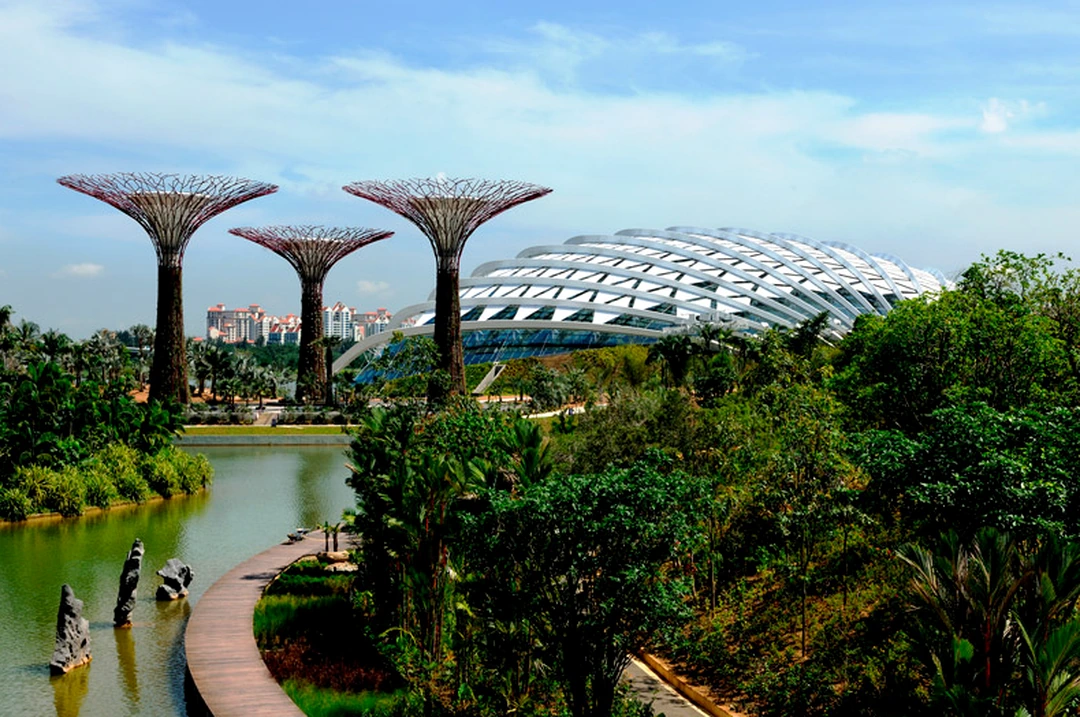
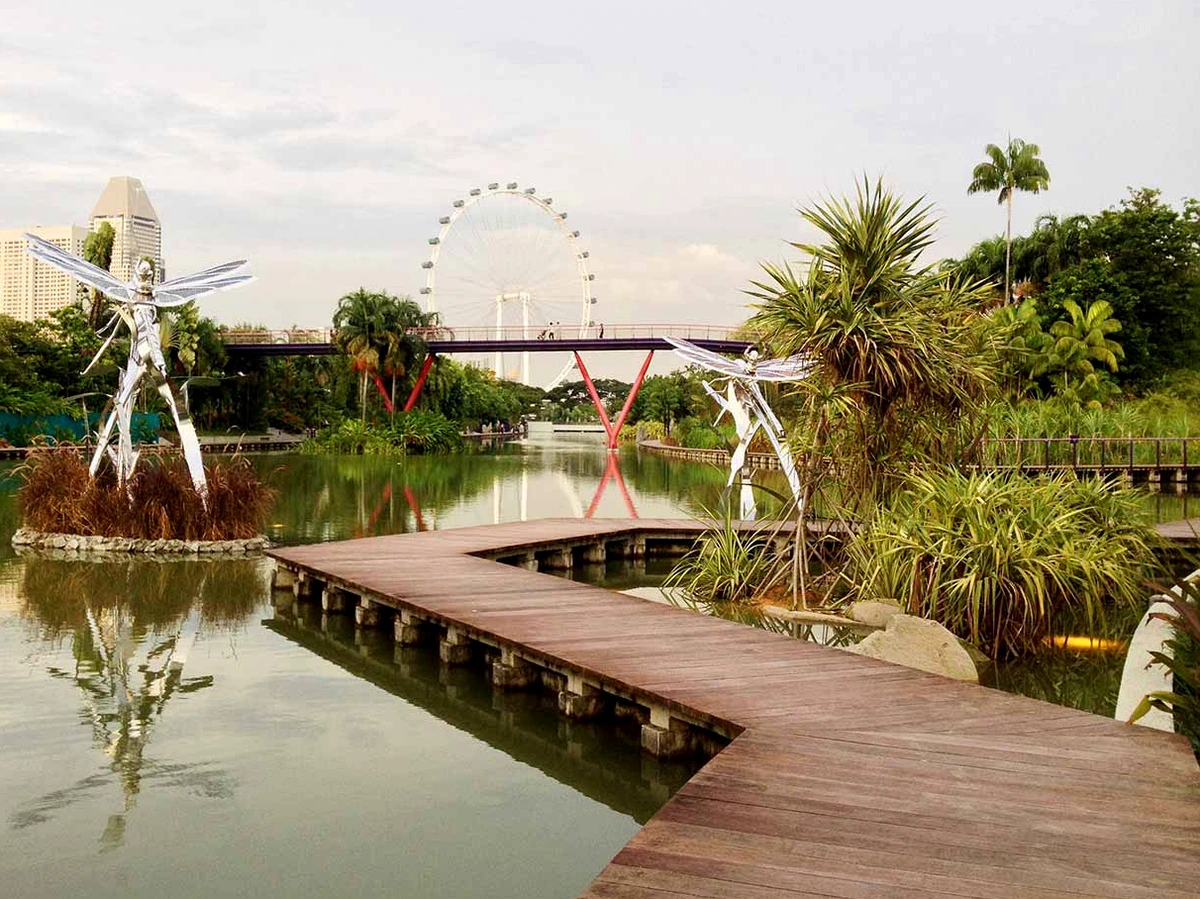
The subterranean lifeblood sustaining the vibrancy of this entire wonderland is a closed-loop freshwater ecosystem anchored by two expansive water bodies: Dragonfly Lake and Kingfisher Lake. Engineered as constructed wetlands performing biological filtration, these two scenic lakes capture all stormwater runoff across the park. Rather than relying on industrial chemical treatments, the system harnesses the natural symbiosis of dense native aquatic flora lining the banks—most notably cattails (Typha) and common reeds (Phragmites). The intricate root systems of these plants act as superlative natural filters, trapping suspended sediments, absorbing excess nutrients, and neutralizing harmful bacteria to deliver crystal-clear water before any surplus flows into Marina Reservoir.
This self-sustaining closed hydrological cycle supplies pure irrigation water for more than 1.5 million plants spanning 200 rare tropical species thriving on reclaimed soil. The masterly fusion of landscape feng shui artistry, complex coastal reclamation engineering, and sustainable aquatic technology has transformed what was once windswept, salty reclaimed ground into a radiant ecological sanctuary where the boundary between human craftsmanship and natural law seems to dissolve completely.
At the focal point of Bay South, futuristic architectural brilliance merges with tropical ecological engineering to create one of the most awe-inspiring spatial complexes in the contemporary world. Crafted by renowned British architectural practice WilkinsonEyre alongside master structural engineers, the twin-domed Cooled Conservatories emerge along the waterfront like two colossal glass seashells resting on their sides. The revolutionary breakthrough of this design lies in its free-spanning curved steel gridshell structure, which eliminates heavy interior support columns altogether—maximizing sightlines and freeing up tens of thousands of square meters of exhibition space beneath a canopy of pure natural daylight.
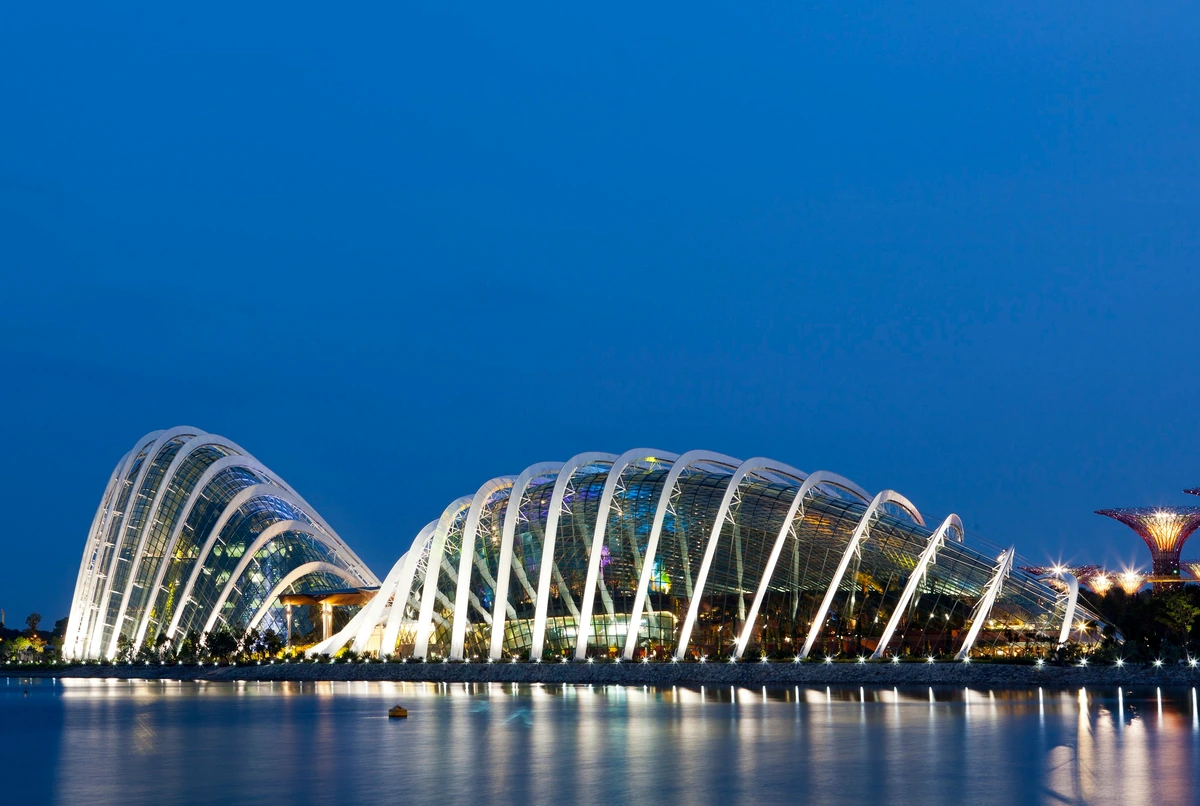
Reigning over the south side is the 1.2-hectare masterpiece Flower Dome, which earned a Guinness World Record in 2015 as the largest glass greenhouse on Earth. This cavernous space is far more than a botanical exhibition hall; it is a marvel of artificial microclimate engineering, where underground chilled-water pipes and specialized spectrally selective glass maintain a constant cool-dry temperature of 23°C to 25°C with 60% to 80% relative humidity. Thanks to this sophisticated technological shield, tens of thousands of rare plants from arid Mediterranean regions, semi-arid southwestern Australia, coastal Chile, and the South African plateau bud and bloom in vibrant color year-round right in the heart of a hot, humid equatorial monsoon climate.
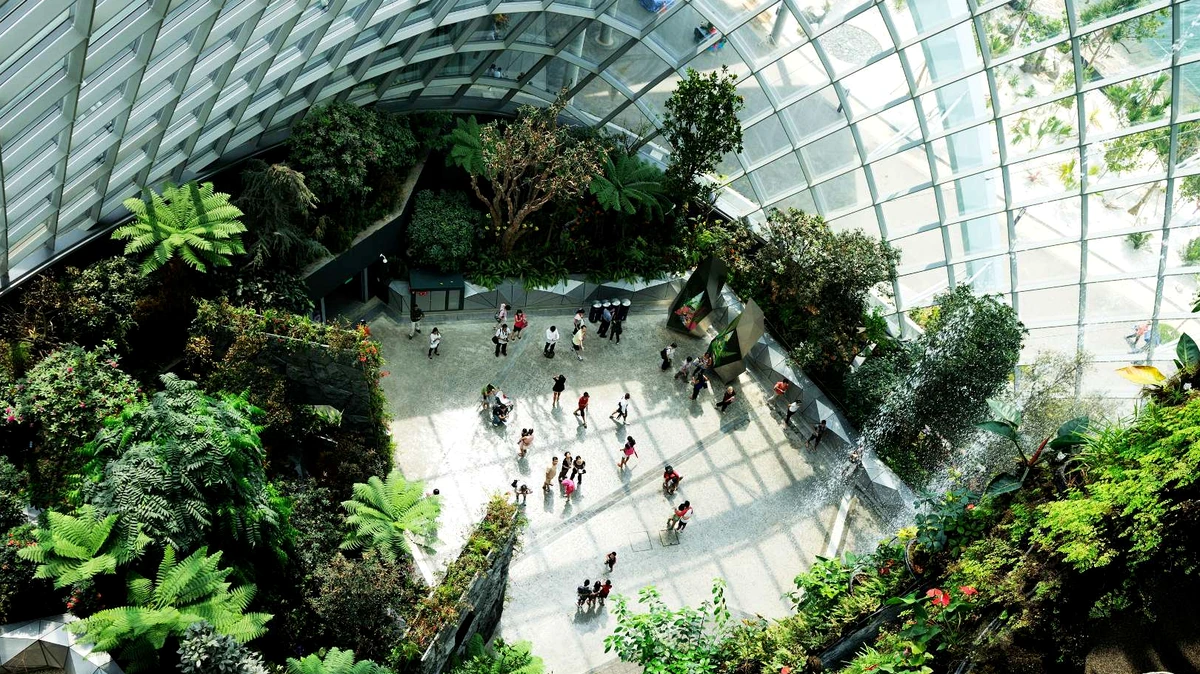
Right next door, the 0.8-hectare Cloud Forest—whose glass dome soars to 58 meters—transports visitors into an entirely contrasting reality: a mist-shrouded tropical montane forest found at elevations of 1,000 to 3,000 meters above sea level. The soul of this ecological sanctuary is the towering 35-meter Cloud Mountain, where a foaming waterfall plunges dramatically from the summit to form one of the world’s tallest indoor waterfalls, infusing the air with ethereal wisps of mist. From inside the man-made mountain core, dedicated elevators whisk visitors to the peak for a leisurely stroll along two breathtaking aerial walkways: the Cloud Walk and the Crest Walk. These slender steel bridges hang suspended in midair, hugging cliff faces carpeted in orchids, epiphytic ferns, and carnivorous pitcher plants, allowing travelers to observe ecological stratification from the upper forest canopy all the way down to the dense jungle floor.
Stepping out of the climate-controlled embrace of the two glass domes, the outdoor landscape is immediately dominated by the majestic Supertree Grove, home to 12 of the park’s 18 “Supertrees,” ranging in height from 25 meters (roughly a nine-story building) to 50 meters (equivalent to a 16-story skyscraper). Structurally, each Supertree is built around a high-strength reinforced concrete core wrapped in a stainless-steel frame shaped like a flaring, funnel-canopied tree trunk fitted with specialized planting panels. Over 160,000 epiphytic plants representing more than 200 species—including tropical orchids, dense bromeliads, and bird’s-nest ferns—transform rigid steel columns into soaring living vertical gardens.
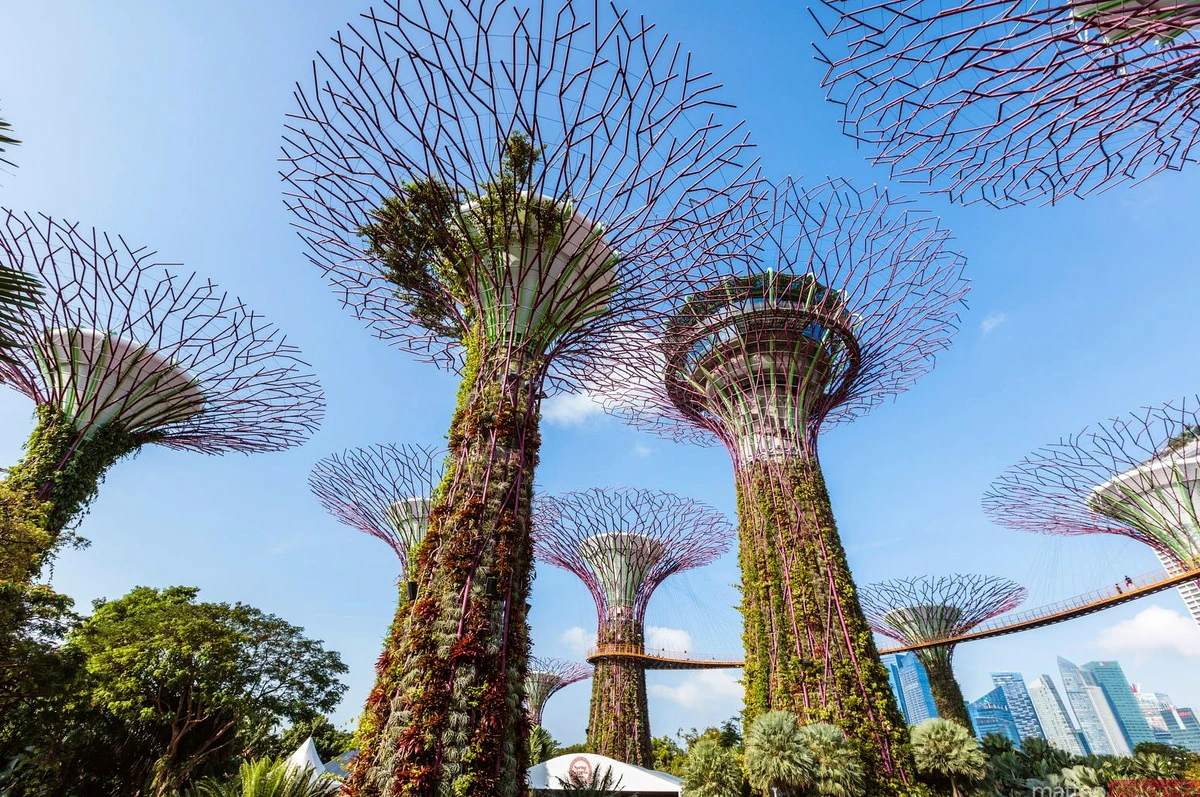
Even more remarkably, these towering green structures do far more than dazzle the eye—they serve as artificial lungs driving the entire energy cycle of the complex. The crowns of the tallest Supertrees are fitted with solar photovoltaic panels that harvest energy to power nighttime illumination, while their trunks act as rainwater-harvesting funnels feeding the closed-loop irrigation system. Better still, several Supertrees double as cleverly disguised exhaust stacks connected to an underground biomass energy plant, venting warm air expelled by the chillers cooling the two conservatories high into the sky. Suspended between two colossal Supertrees at a height of 22 meters is the 128-meter-long OCBC Skyway, where visitors can feel cool bay breezes rustling through artificial foliage while taking in sweeping panoramas of this futuristic urban landscape.
As sunset settles over Marina Bay, bathing the waterfront landmarks in shades of amber and violet, the Supertree Grove undergoes a breathtaking visual and emotional metamorphosis. Guided by the masterful lighting designers at Speirs + Major, nightfall brings not quiet darkness, but a velvety backdrop that awakens a multidimensional universe of light. Tens of thousands of advanced LED fixtures, intricately woven along the steel exoskeletons and tucked between layers of epiphytic plants across the twelve giant Supertrees, ignite with radiant vitality. Rising 25 to 50 meters tall, the structures shed their daytime stillness to become living towers of light, swaying in harmony with the evening breeze and unveiling one of the Lion City’s most dazzling nocturnal spectacles.
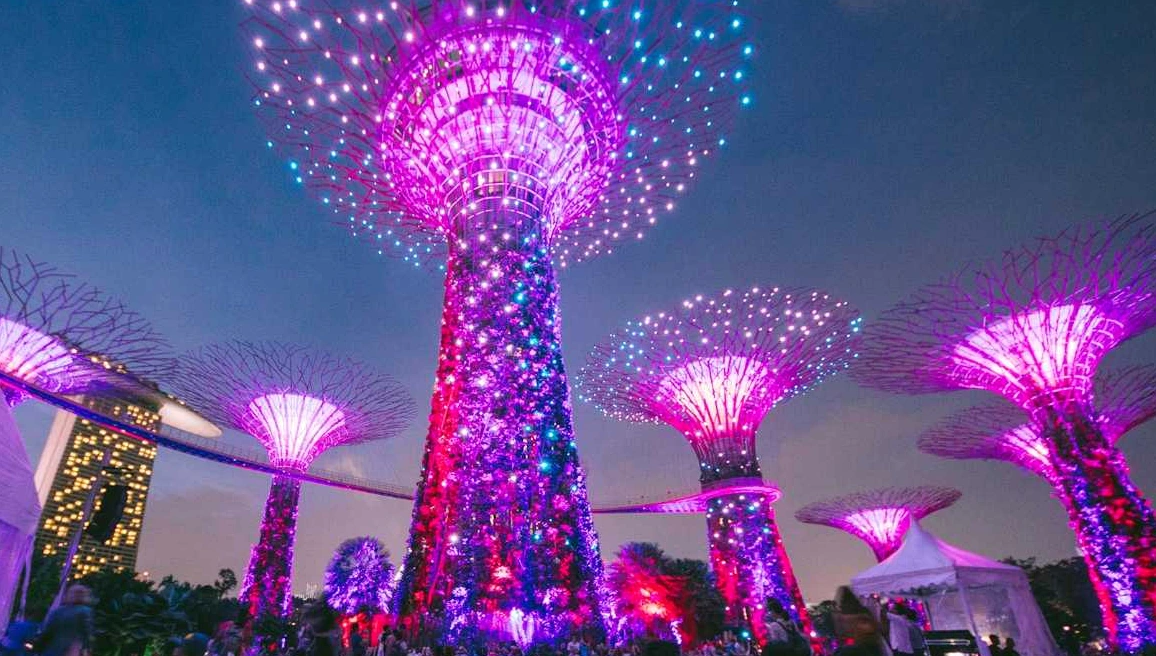
The undisputed highlight after dark is Garden Rhapsody, the signature light-and-sound extravaganza staged twice nightly at 7:45 PM and 8:45 PM local time. Far more than routine architectural lighting, this open-air show is a symphony choreographed down to the millisecond between digital lighting programming and orchestral scores. Audio is delivered via high-end directional speakers discreetly concealed behind blankets of ferns, orchids, and climbing vines, enveloping the entire plaza in surround sound without a single piece of unsightly hardware in sight. From sweeping Hollywood film scores and dramatic Broadway showtunes to world folk medleys, every musical note triggers a synchronized shift in color across the Supertrees. Rainforest emerald melts into mystical violet before erupting into volcanic crimson-orange and regal gold, turning the night sky into an enchanting 360-degree kinetic canvas.
Watching Garden Rhapsody offers a rare sense of freedom that breaks entirely away from conventional theater seating. Thousands of travelers from every corner of the globe gather organically, claiming a relaxed spot on gently curved stone benches or stretching out directly on the grass and granite paving of the central plaza. Lying back and gazing straight up at the night sky grants an unobstructed view of the giant canopies spreading overhead like natural parasols, where beams of light interlace, chase, and dance like fallen stars. Amid cool breezes drifting in from the bay, the collective breathing of the crowd seems to synchronize with the pulse of the lights, forging a profound emotional resonance between humanity and a visionary ecological creation.
From an urban-design perspective, the show at Supertree Grove also enters into a striking visual dialogue with the three towers and sky-park ship of Marina Bay Sands looming behind it. While the iconic resort radiates the crisp silver-white glow of a thriving financial capital, the Supertrees below pulse with warm, organic, almost surreal chromatic energy. This union of contemporary lighting art and lush tropical flora underscores the depth of Singapore’s urban philosophy: a city that never sleeps yet never exhausts nature, where vibrant nightlife is powered by green technology and every hour of darkness becomes an endlessly captivating work of art.
Framed by soaring glass domes and lush botanical wonders, Gardens by the Bay is not merely a triumph of green technology—it is also a refined culinary haven celebrating the Lion City’s rich multicultural heritage. Beneath the shade of its futuristic structures, travelers are guided on a flavorful journey through layered gastronomic traditions blending Chinese finesse, rustic Malay soul, aromatic Indian spice, and the closely guarded culinary artistry of the Peranakans. Every dining corner here serves as a bridge between past and present, where decades-old family recipes are honored alongside the cosmopolitan pulse of Marina Bay.
Along the breezy eastern waterfront promenade, Satay by the Bay unfolds as a rustic open-air culinary oasis that vividly recreates the nostalgic atmosphere of the legendary mid-twentieth-century Satay Club along the bay. Here, the crackle of glowing charcoal mingles with fragrant plumes of smoke carrying the mouthwatering aroma of golden-brown grilled skewers. Tender slices of chicken, beef, or mutton are generously marinated in turmeric, fresh lemongrass, cumin, and coriander before being charred directly over live embers. The crowning glory of the dish is a bowl of velvety peanut sauce simmered with tangy tamarind pulp, red chilies, and coarsely crushed roasted peanuts, served alongside snowy cubes of ketupat rice cakes wrapped in palm leaves and crisp cucumber slices—a harmonious symphony of rich, nutty, sweet, and spicy tropical flavors.
Alongside these famed satay skewers, the culinary landscape treats food lovers to bowls of iconic Peranakan Laksa swimming in golden coconut-milk broth infused with dried shrimp, fish cake, and the unmistakable fragrance of laksa leaves, as well as authentic Hainanese Chicken Rice featuring succulent poached chicken paired with fragrant rice cooked in chicken stock and crushed ginger. Stepping away from this open-air haven toward the Supertree Grove, diners encounter Jurassic Nest Food Hall—a one-of-a-kind dining venue pairing lifelike animatronic dinosaurs with celebrated street-food stalls honored with Michelin Bib Gourmand distinctions. Savoring time-honored culinary heritage amid dramatic dinosaur roars and towering botanical canopies delivers a dining experience that is equal parts whimsical and deeply rooted in cultural preservation.
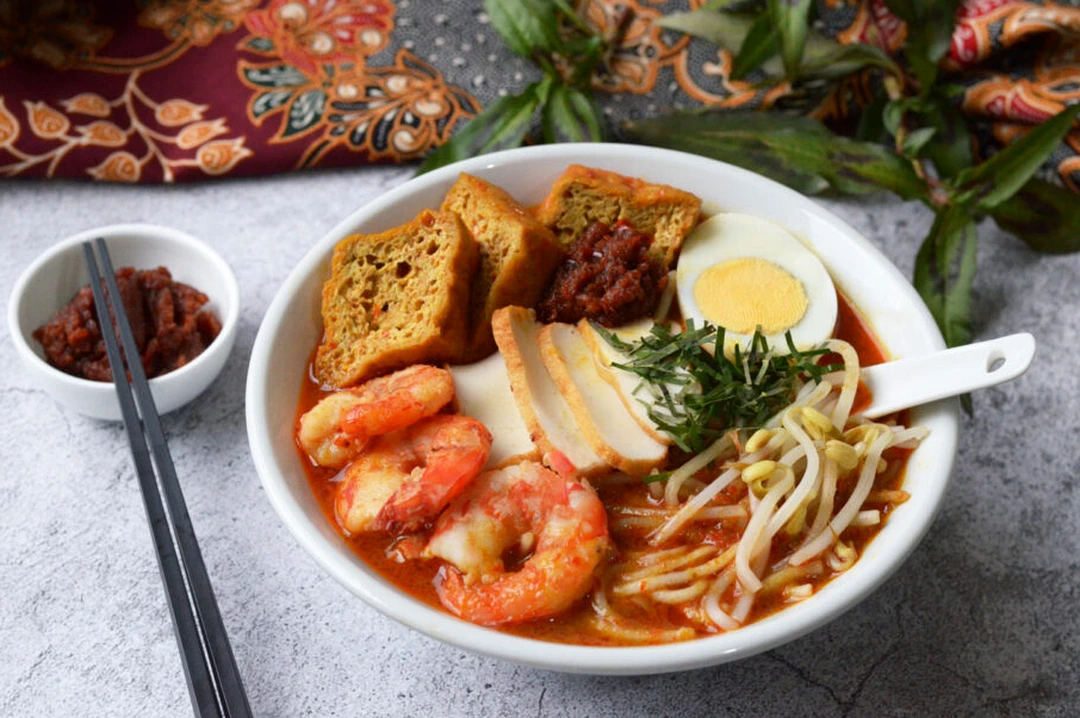
The unforgettable depth of the local flavors gathered within this ecological complex stems from the masterful use of foundational regional ingredients refined across generations. Foremost among them is rempah—the indispensable hand-pounded spice paste at the heart of every Straits stew and curry, where galangal, fresh turmeric, shallots, garlic, dried chilies, and candlenuts are painstakingly ground in a stone mortar and slowly fried in hot oil until deeply fragrant and the spice oil separates cleanly. Alongside it stands vibrant green pandan leaf, prized as the emerald jewel of Eastern aromatics, used to impart natural vanilla-like fragrance to sticky rice, steamed rice, and jellied desserts, harmonizing effortlessly with the deep, smoky caramel sweetness of gula melaka palm sugar. These layered aromas do far more than awaken the palate—they encapsulate the cultural memory of generations of immigrants, enduring gracefully inside Asia’s premier futuristic landmark.
To experience the full splendor of this futuristic eco-architectural marvel beside Marina Bay, visitors should familiarize themselves with the operating hours and spatial layout of each zone. The outdoor core—including the Supertree Grove and the aquatic ecosystems of Dragonfly Lake and Kingfisher Lake—is open completely free of charge from 5:00 AM to 2:00 AM daily, making it ideal for peaceful early-morning walks or taking in the dazzling nocturnal light shows. By contrast, the two enclosed, climate-controlled glass conservatories, Flower Dome and Cloud Forest, welcome guests from 9:00 AM to 9:00 PM, with last admission at 8:00 PM. For travelers eager to stroll along the 22-meter-high OCBC Skyway or ascend to the Supertree Observatory perched atop the tallest Supertree, operating hours likewise run from 9:00 AM to 9:00 PM daily, though ticketing and entry close at 8:30 PM to ensure operational safety.
In terms of admission costs, a combined ticket for both the Flower Dome and Cloud Forest conservatories is priced at around SGD 53 per adult. Elevated experiences such as the OCBC Skyway or the Supertree Observatory carry separate admission fees of approximately SGD 14 each. To avoid lengthy queues during peak hours and help park management regulate visitor flow inside the enclosed biodomes, booking tickets online in advance through the official portal is strongly recommended. Securing reservations ahead of time also ensures a seamless itinerary and prevents the disappointment of sold-out time slots during vibrant holiday periods.
Singapore’s renowned public transit network makes reaching the gardens remarkably effortless and fast. The MRT subway system is the most popular mode of travel, with Bayfront MRT Station serving as the primary interchange hub connecting both the Circle Line (CE1) and the Downtown Line (DT16). Upon stepping off the train at Bayfront Station, passengers simply follow the underground pedestrian linkway via Exit B straight into the garden grounds without worrying about sun or rain. Additionally, the opening of Gardens by the Bay MRT Station on the Thomson-East Coast Line (TE22) provides an airy, convenient gateway right beside the lakes and the southern entrance of the complex.
Thoughtful attire and an understanding of public etiquette will make your visit all the more rewarding. The outdoor equatorial climate calls for lightweight, breathable clothing and comfortable walking shoes suited for covering kilometers of garden trails. However, once you pass through the airlock doors into the domed conservatories, temperatures are maintained at a crisp 23°C with high artificial humidity to nurture temperate and cloud-forest flora; packing a light windbreaker or shawl is therefore essential to avoid a sudden chill.
Furthermore, respecting Singapore’s strict environmental laws is non-negotiable, including absolute prohibitions against littering, picking flowers or breaking branches, and smoking outside clearly marked designated areas. In particular, when strolling through the Heritage Gardens celebrating Singapore’s four major cultural traditions—Chinese, Malay, Indian, and Colonial—visitors should maintain a respectful demeanor around sculptures and plantings carrying deep spiritual significance. For the opportunity to experience this ecological masterpiece alongside legendary landmarks at the maritime crossroads of Southeast Asia with seamless, top-tier service, travelers can join the Luxury 6D5N Singapore – Malaysia Tour.