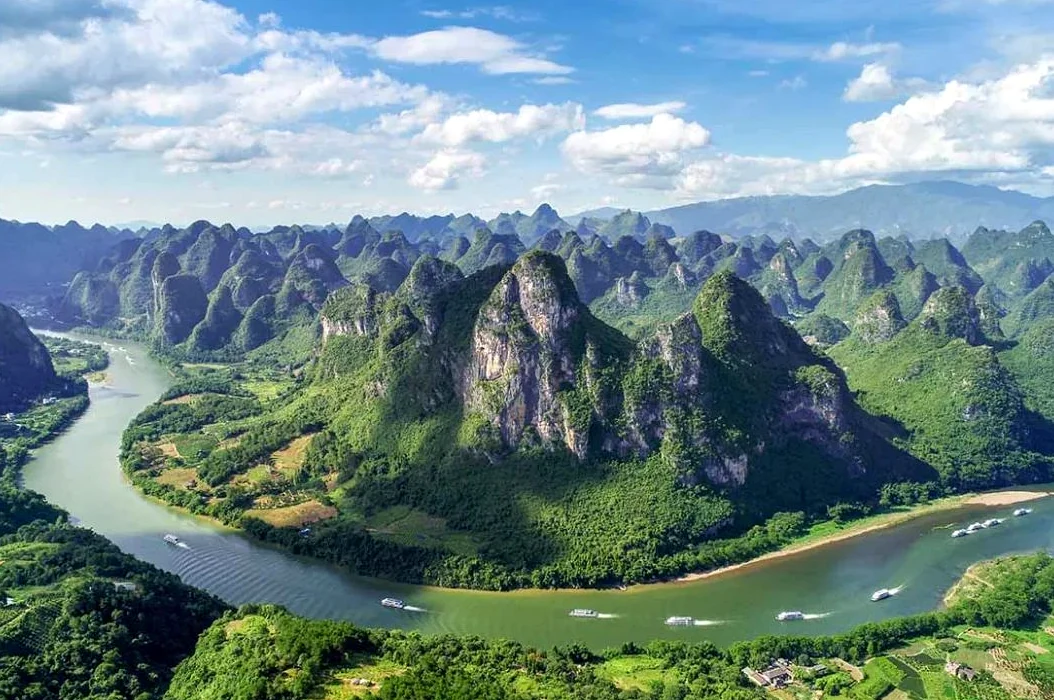
Having undergone millions of years of majestic geological formation, the pristine Guilin – Yangshuo region was originally the ancient homeland of the Baiyue tribes. Winding serenely through undulating karst limestone ranges, the Li River is not merely a masterpiece bestowed by nature; since the dawn of history, it has served as a vital waterway artery linking the fertile Pearl River network in the south with the vast Yangtze River basin in the Central Plains. This strategic geopolitical and commercial position placed the river at the very heart of power shifts and territorial expansion strategies across successive northern feudal dynasties.
The historical turning point that integrated the Li River basin into the flow of Chinese civilization began during the Qin Dynasty (221 BCE – 206 BCE). Driven by his ambition to conquer the Lingnan peoples, in 214 BCE, Emperor Qin Shi Huang issued an imperial decree ordering Inspector Lu Bi to oversee tens of thousands of laborers in excavating the Lingqu Canal (灵渠) in Xing’an County, part of modern-day Guilin. This hydraulic engineering marvel cut through the mountains to connect the northbound Xiang River with the southbound headwaters of the Li River, completing an uninterrupted waterway network that allowed Qin armies to continuously transport military supplies and provisions deep into the southern frontier. From that moment on, the Li River officially became a strategic waterway, transforming a wild, miasma-shrouded frontier into a steadfast outpost of the central government for centuries.
Entering its golden age under the Tang and Song dynasties (618 – 1279), Guilin rose to become the premier political, military, and cultural center of the Lingnan region. The ethereal, otherworldly beauty of karst peaks mirrored in the emerald waters of the Li River inspired boundless creativity among demoted scholars and traveling officials passing through. Illustrious literati such as Han Yu (韩愈), Liu Zongyuan (柳宗元), and the great poet Su Dongpo (苏轼) all left their footprints and immortal verses here. Among them, Han Yu’s celebrated line—”The river is like a belt of blue-green silk, the mountains like hairpins of emerald jade”—perfectly encapsulated the soul of this landscape, laying the poetic foundation that carried the Li River’s fame across classical literary circles.
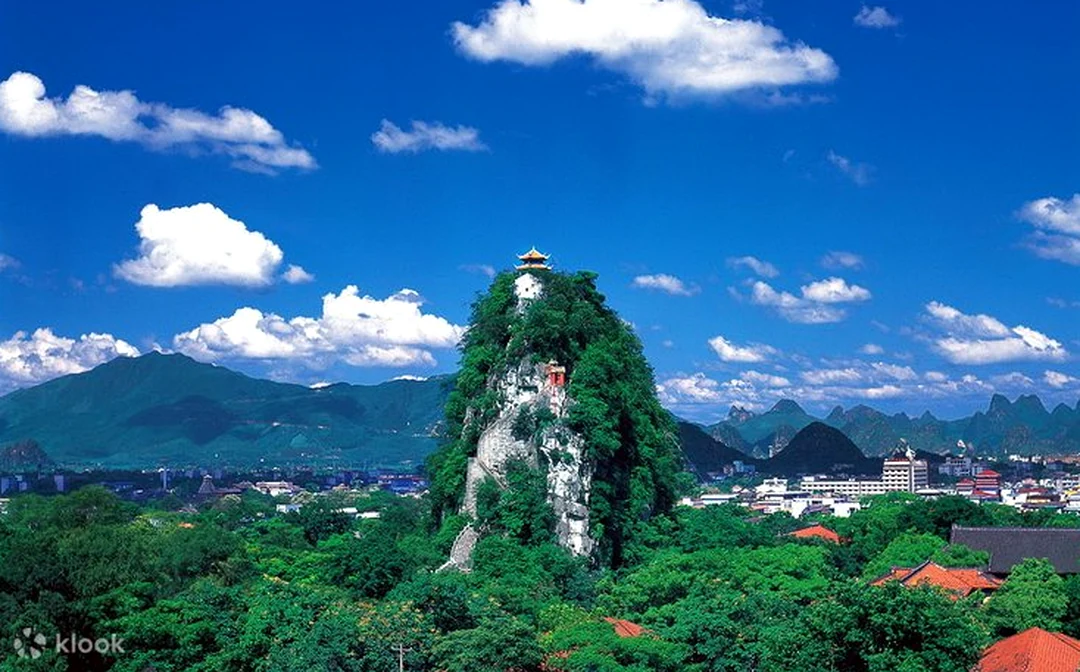
By the Ming and Qing dynasties (1368 – 1912), the region’s prominence was further solidified when the Ming imperial court established a princely fiefdom in Guilin. The magnificent Jingjiang Princes’ Palace was constructed at the foot of Solitary Beauty Peak (Duxiu Peak), turning the city into the supreme seat of power governing the southern borderlands. Throughout this era, the Li River continued to serve as a vital artery for commerce and imperial pageantry, witnessing splendid dragon boats and bustling merchant fleets plying its waters, depositing layer upon layer of ancient urban cultural heritage along both banks.
Stepping into the turbulent twentieth century, the Guilin – Yangshuo region became an important revolutionary base and a venue for hosting numerous heads of state and high-level international diplomatic delegations, most notably the inspection tours and landscape conservation directives led by Premier Zhou Enlai. The pinnacle of cultural and scenic recognition occurred when the iconic stretch of the Li River curving around majestic karst peaks—between the ancient town of Xingping and Yangshuo—was chosen to grace the reverse side of the 20-yuan Renminbi banknote starting in 1999. This nationally symbolic honor not only immortalized the river’s millennia-old historical value, but also positioned the Li River cruise brand globally as an archetypal scenic masterpiece of the East.
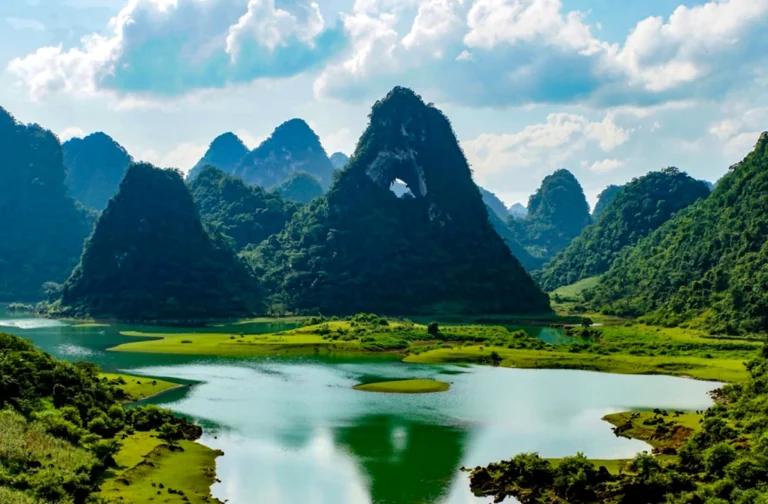
Since time immemorial, the geomantic veins of the Li River have been hailed by ancients as the supreme masterpiece of Eastern natural feng shui, where the miraculous harmony between mountain formations and water currents converges completely. Over hundreds of millions of years of geological evolution since the Devonian period, pure limestone strata here underwent continuous erosion by groundwater and a humid tropical climate, giving birth to a cluster of tower and cone karst landforms unique in the world. From a traditional feng shui perspective, the alluvial course of the Li River—winding gracefully like an emerald silk ribbon—guides the dragon veins and gathers vital energy, while tens of thousands of limestone peaks soaring straight into the azure sky act as tiered screens that “shelter the wind and accumulate qi,” protecting the entire fertile Lingnan heartland. Crystal-clear waters revealing pebble-strewn riverbeds meander smoothly without ever surging violently, gently depositing silt so that vital energy condenses permanently, creating an expansive meditative sanctuary right here on earth.
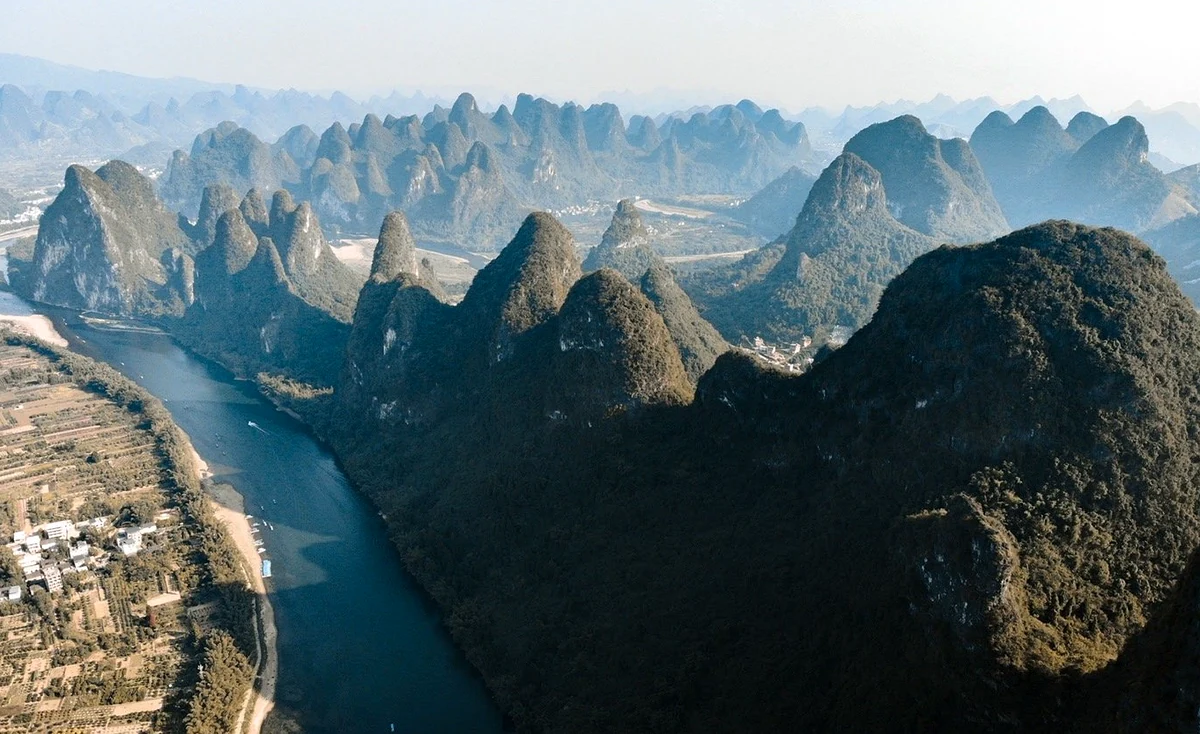
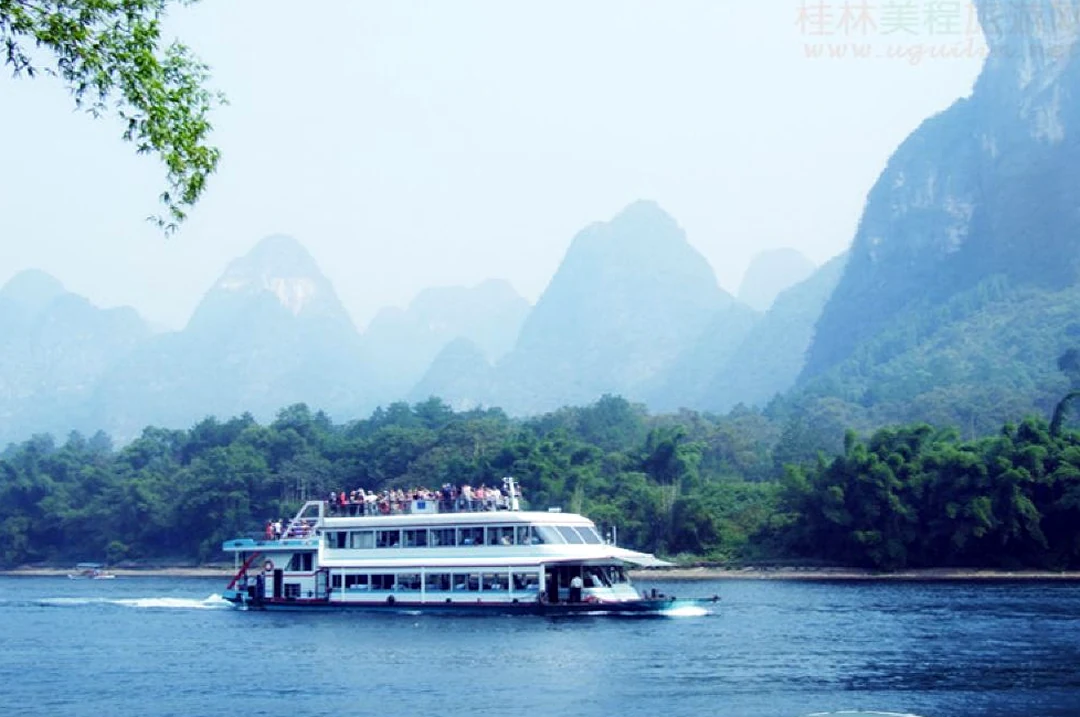
To sustainably showcase and preserve this geological treasure, the waterway network along the Li River has been scientifically zoned and planned, divided into specialized sightseeing itineraries with distinct distances and modes of immersion. The Grand Cruise route—stretching from Mopanshan or Zhujiang Pier downstream to Yangshuo Pier—is the most classic journey, requiring four to four-and-a-half hours of continuous sailing aboard international-standard luxury cruise vessels. This route is likened to unfurling an endless vertical scroll painting titled the “Gallery of Mountains and Waters,” where every bend reveals a breathtaking visual marvel. Travelers glide past the towering Nine Horses Fresco Hill—where contrasting mineral deposits and moss across the limestone cliff form the mystical silhouettes of nine galloping steeds—before drifting across the mirror-calm waters of Yellow Cloth Shoal, whose mountain reflections in the jade waves are forever immortalized on the reverse of the famous 20-yuan banknote.
In contrast to the stately pace of the Grand Cruise, the Essence Drift route linking the vital river section from Yangdi Pier to the ancient town of Xingping offers a closer, more rustic perspective. Lasting roughly one-and-a-half to two hours, this segment operates primarily via motorized bamboo rafts equipped with quiet electric engines, allowing vessels to skim right above the water’s surface and carry travelers right up to the base of cliffs draped in native flora to listen to the gentle murmur of water and watch schools of fish dart across the riverbed. Meanwhile, the Guilin Urban Cruise condenses the city’s highlights into a compact one-hour itinerary departing from the foot of Liberation Bridge, gliding past the iconic Elephant Trunk Hill—shaped like a celestial elephant dipping its trunk to drink at the river confluence—before gazing up at the imposing Fubo Hill, steeped in legends of Han Dynasty General Ma Yuan firing arrows to quell rebellions, vividly capturing the deep historical layers woven into the urban landscape.
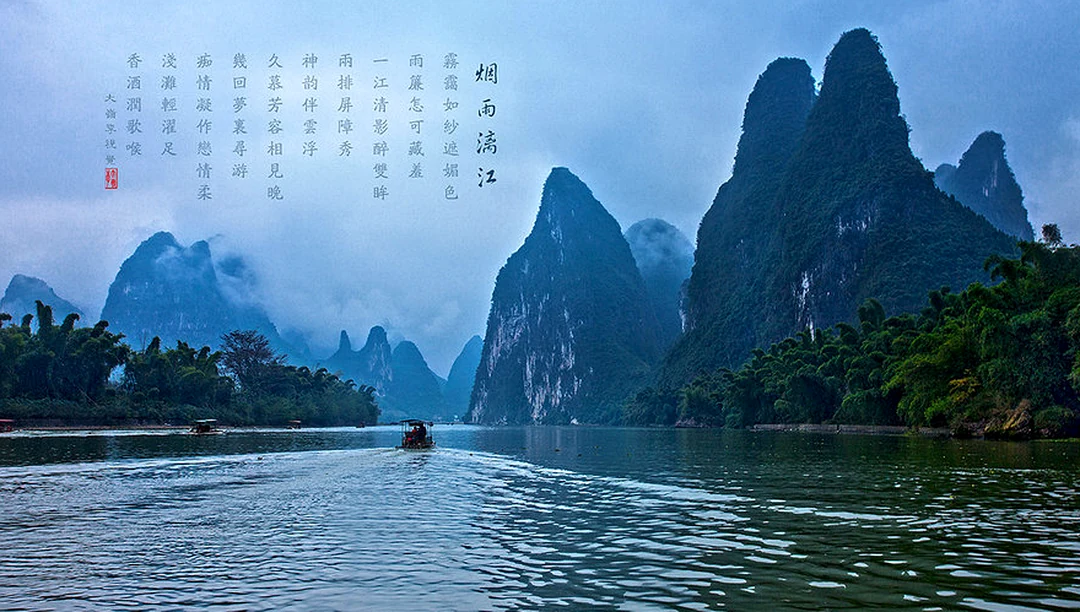
The scenery along the Li River also shifts ceaselessly with the rhythm of the four seasons, evoking starkly contrasting aesthetic emotions. Spring, spanning from March to May, shrouds the river in the enchanting veil of “Misty Rain on the Li River,” as early seasonal drizzles and low-hanging fog cling halfway up the karst spires, transforming the entire panorama into a half-real, half-ethereal Song Dynasty ink-wash painting. Conversely, when the weather transitions into autumn from September to November, the air turns crisp and dry beneath cloudless skies; during this period, both riverbanks burst into rich golden hues as ripe rice paddies cast their reflections onto glass-clear waters, offering ideal conditions for leisurely voyages amidst pure, refreshing air.
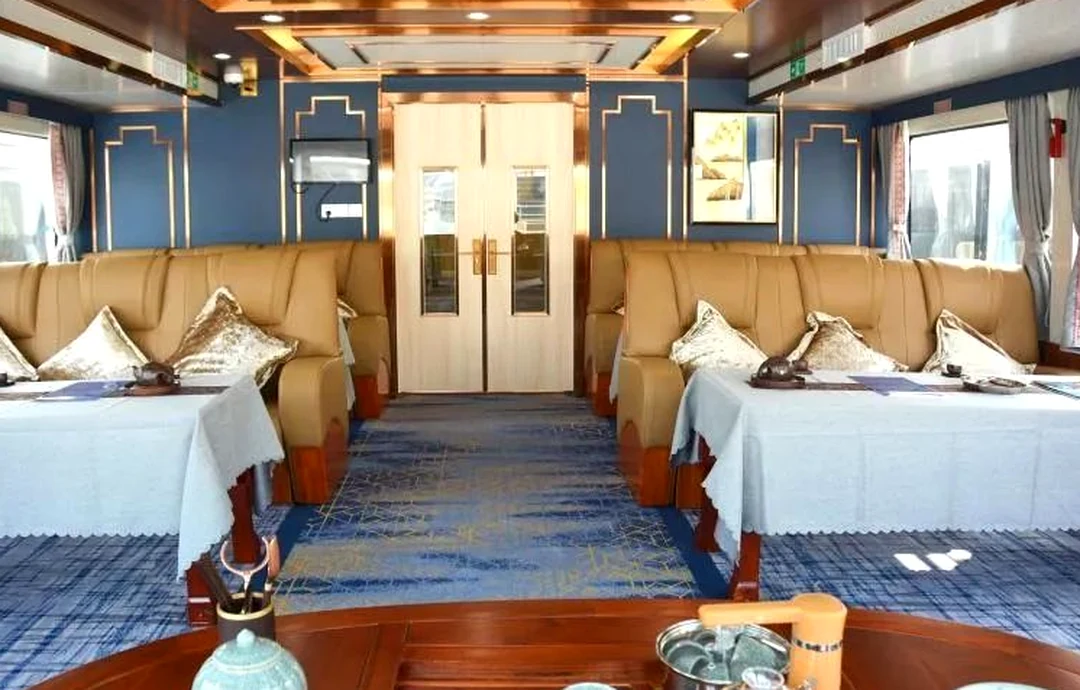
The curated scenic experience along the Li River basin from Guilin down to Yangshuo is underpinned by a meticulously engineered transport infrastructure master plan. Serving as the vital artery connecting the southwestern hinterland with the southern coast is the Guiyang–Guangzhou High-Speed Railway (Guiguang HSR), an engineering feat carved straight through complex karst geology to deliver travelers directly to this scenic gateway. At key inland river terminals such as Zhujiang and Mopanshan piers, multi-level boarding facilities are organized to manage massive passenger flows without disrupting the ecological landscape. Three- and four-star luxury cruise liners serving the main route boast impressive dimensions with capacities ranging from 300 to 500 passengers, featuring three above-deck viewing levels fitted with soundproofed carpeted floors and enclosed by expansive panoramic glass windows designed to frame the endless sea of emerald peaks.
Alongside the modernity of large-scale cruise liners is an ingenious evolution in the craftsmanship of traditional local watercraft. The iconic bamboo rafts long associated with old fishermen along the Yulong River and the shores of Xingping have entered a new era of fabrication aimed at conserving the karst heritage. Rather than natural bamboo poles that decay easily and rely on manual punting, artisanal boatyards in Yangshuo now utilize heavy-duty composite tubing molded with realistic bamboo-grain textures or reinforced aluminum alloys curved sharply upward like swallow tails. Polluting, noisy internal combustion engines have been completely replaced by zero-emission electric propulsion motors operating silently beneath the waterline. This transformation ensures safe load-bearing capacity while eliminating mechanical vibrations that could harm sedimentary limestone cave structures hundreds of millions of years old.
Settlement patterns along both banks of the Li River deeply embody classical Lingnan architectural philosophy, characterized by the serene, dignified “whitewashed walls and dark-tiled roofs” aesthetic. In centuries-old villages such as Jiuxian and Langzishan, traditional three-bay residences stand proudly with pure white lime walls harmonizing against undulating layers of ash-gray yin-yang roof tiles. Gable peaks are accented by stepped fire-shield walls—known as horse-head walls—that both prevent the spread of fire and channel auspicious feng shui breezes from the valley floor. The entire interior load-bearing framework is crafted exclusively using traditional mortise-and-tenon joinery from solid ironwood and fir timber, without a single metal nail. Lingnan woodcarvers breathed life into every partition, lattice window, and roof beam through intricate reliefs of birds and flowers, rolling clouds, and river folklore, lending profound cultural depth along the ancient ferry crossings.
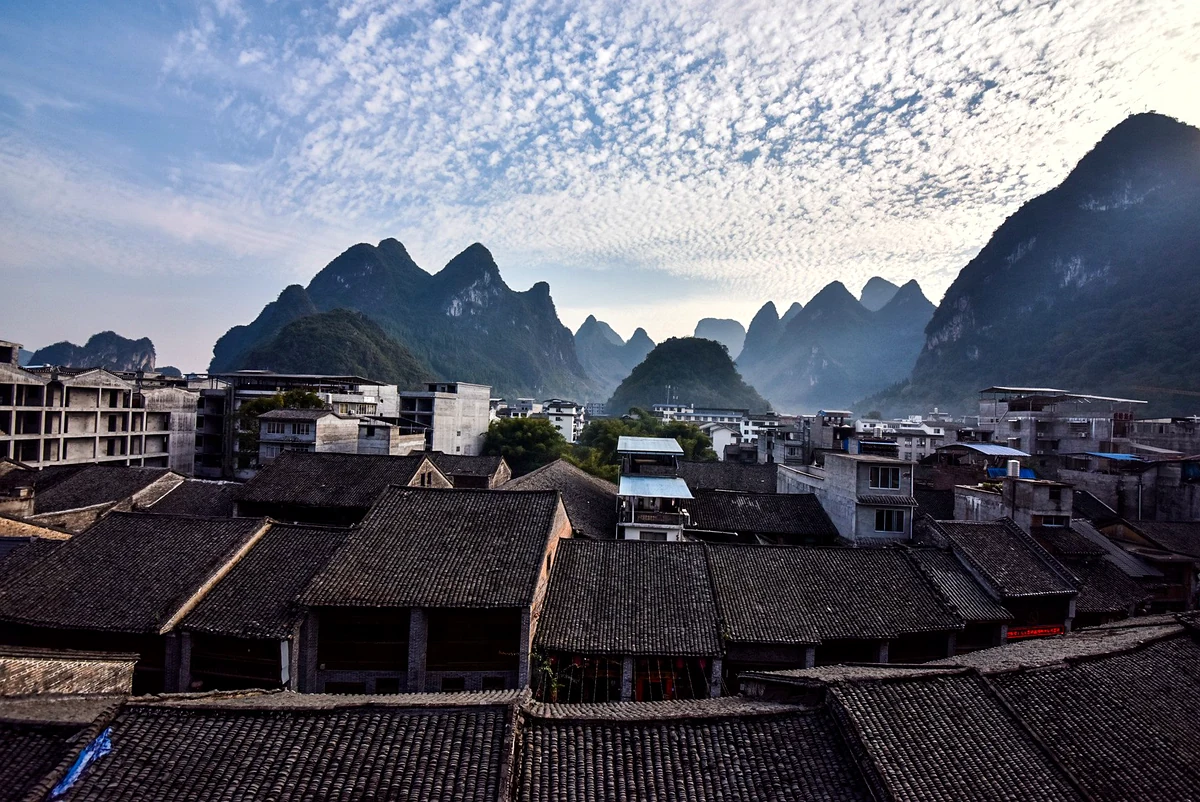
The sublimation of spatial design is also brilliantly expressed in the wave of contemporary eco-resort architecture across the Yangshuo valley. Exemplified by acclaimed adaptive-reuse masterpieces converted from abandoned 1960s sugar mill ruins and intimate riverside retreats, the design vocabulary honors local authenticity by utilizing rough-hewn natural laterite stone, exposed clay bricks, and reclaimed regional timber. Low-rise structures are oriented with meticulous attention to wind corridors and shadow angles so they dissolve seamlessly into the surrounding vertical karst towers, ensuring concrete never overwhelms nature. Expansive frameless tempered glass panels create a visual effect that erases the boundary between cozy interiors and dreamy exteriors, transforming the entire Li River basin and its undulating mountain ranges into a living, breathing natural ink-wash screen.
As twilight gradually descends behind the overlapping limestone peaks, the Li River sheds its serene daytime elegance to don an enchanting nocturnal cloak, unveiling a mesmerizing symphony of light and sound. The focal point of Yangshuo’s nightlife lies at a sweeping river bend near the Tianyuan confluence, where acclaimed director Zhang Yimou, alongside collaborators Wang Chaoge and Fan Yue, created the world’s first natural landscape live-action spectacle: Impression Liu Sanjie. Breaking away entirely from conventional four-walled theaters, the production utilizes two full kilometers of calm Li River waters as its natural stage and borrows twelve towering karst peaks on the horizon as its eternal backdrop. High-powered floodlights are cleverly concealed behind bamboo groves and rock crevices; once illuminated, they transform the looming peaks into glowing emerald screens against the pitch-black night, shimmering across the jade waters below.
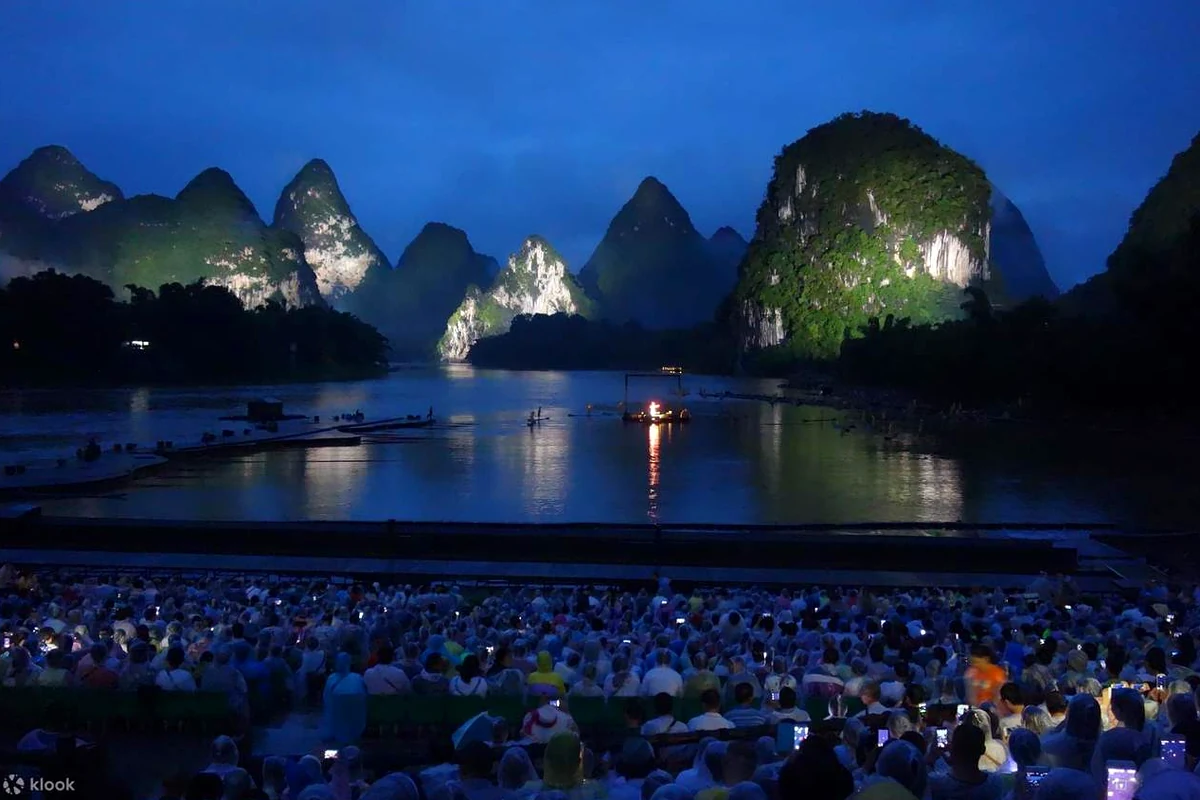
The vitality of this grand live-action spectacle lies not only in its cutting-edge visual technology, but also in the living cultural spirit of ethnic minorities across the Liangguang region, including the Zhuang, Miao, Yao, and Dong peoples. The majority of the more than six hundred performers are local fishermen from neighboring villages who row boats and cast nets by day, then step onto the aquatic stage by night as authentic folk artists. Clear antiphonal mountain folk songs echo across the valley in harmony with hundreds of bamboo rafts slicing through the waves, while crimson fishing nets are flung skyward like ribbons of fire streaking across the night sky, reenacting the legend of the clever, steadfast Song Fairy Liu Sanjie. Amid the vast nocturnal stillness, the pure voice of a Zhuang maiden rising beside a giant glowing crescent moon floating over the water creates an intensely aesthetic sequence that dissolves the boundary between reality and illusion, humanity and the cosmos.
Leaving behind the solemn, epic atmosphere of the open-air theater, the nocturnal flow guides visitors back toward the town center to immerse themselves in the vibrant, bustling energy of West Street (Yangshuo West Street). Boasting more than 1,400 years of history dating back to the Sui Dynasty, this ancient bluestone-paved street has evolved into a unique East-meets-West cultural crossroads nestled beneath karst cliffs. Beneath moss-covered Ming and Qing tiled roofs, rows of traditional red lanterns mingle with the vibrant neon glow of art cafés, acoustic bars, and international restaurants. The air here is perpetually perfumed with sweet osmanthus blossoms and the irresistible aroma of Yangshuo’s signature Beer Fish—fresh fish caught straight from the Li River, braised over roaring flames in an iron wok with local beer, tomatoes, and bell peppers, served alongside stuffed river snails bursting with bold, spicy southern flavors.
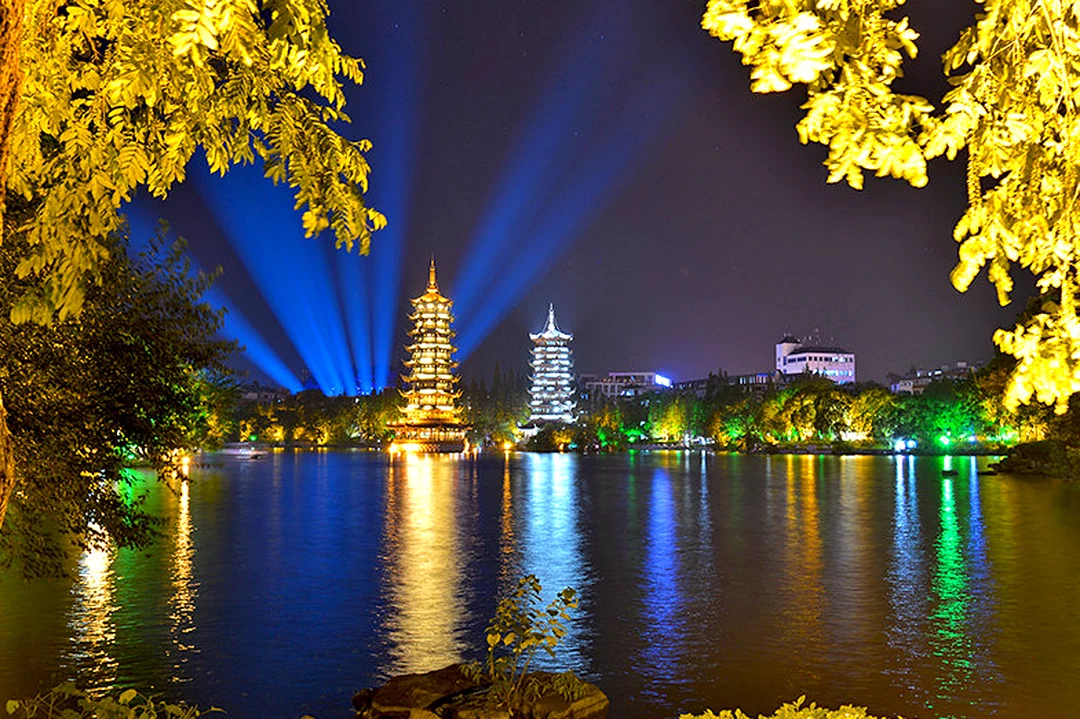
For souls seeking a more expansive, tranquil ambiance, experiencing the Li River by night aboard urban cruises in Guilin city offers an entirely different charm. Along the scenic circuit connecting Two Rivers and Four Lakes (Liangjiang Sihu), historic landmarks such as the Sun and Moon Twin Pagodas on Banyan Lake (Ronghu) shine resplendently through intricate gold- and silver-toned illumination. Cruise boats glide smoothly beneath stone bridges modeled after classic world arch bridges, carrying passengers between willow-draped banks shimmering with ethereal reflections, where the haunting melody of a bamboo flute drifting across the water leaves an unforgettable sense of nostalgia at the heart of a thousand-year-old landscape city.
Sailing down the Li River is not merely a visual excursion through a scenic wonderland, but also a deep exploration into the culinary heritage of Guilin and Yangshuo. Situated at a cultural crossroads blending the refined subtlety of classical Lingnan gastronomy with the bold, rustic flavors of Zhuang, Yao, and Miao mountain villages, the local cuisine carries centuries of historical memory. The soul of daily dining begins with a bowl of Guilin Rice Noodles (桂林米粉), a humble staple dating back to the Qin Dynasty when northern soldiers crossed the Nanling Mountains to excavate the Lingqu Canal. The secret of the dish lies hidden in its heirloom “lu shui” (herbal brine), simmered day and night from beef and pork marrow bones infused with over twenty Chinese medicinal herbs and spices, including black cardamom, cloves, amomum fruit, cassia bark, and star anise. Springy, snow-white round rice noodles are tossed with tender slices of sweet char siu pork, crispy-skinned roast pork, crunchy golden peanuts, and a spoonful of fiery Guilin chili sauce—one of the famed “Three Treasures of Guilin” passed down for generations alongside Sanhua Rice Liquor and fermented bean curd.
Leaving the ferry piers for the heart of the ancient town, the Li River bestows upon Yangshuo a culinary masterpiece renowned across southern China: Yangshuo Beer Fish (阳朔啤酒鱼). Originating in rustic riverside taverns along West Street, this dish celebrates the pure sweetness of sword carp or bighead carp freshly netted from the river’s clear, gravel-bedded waters. What gives this heirloom recipe its signature character is the technique of leaving the fish’s shimmering scales completely intact during preparation. Skilled chefs plunge the whole fish into a cast-iron wok brimming with bubbling rapeseed oil, frying it until the scales flare open and turn jade-crisp before lowering the heat to braise it slowly with aromatic local beer, wedges of ripe tomatoes, fresh bird’s-eye chilies, and artisanal fermented soy sauce. Rising beer steam infuses the tender white flesh with rich malty notes, eliminating any hint of muddiness while turning the crispy scales into a fascinating textural delight savored in the cool evening breeze along the Li River.
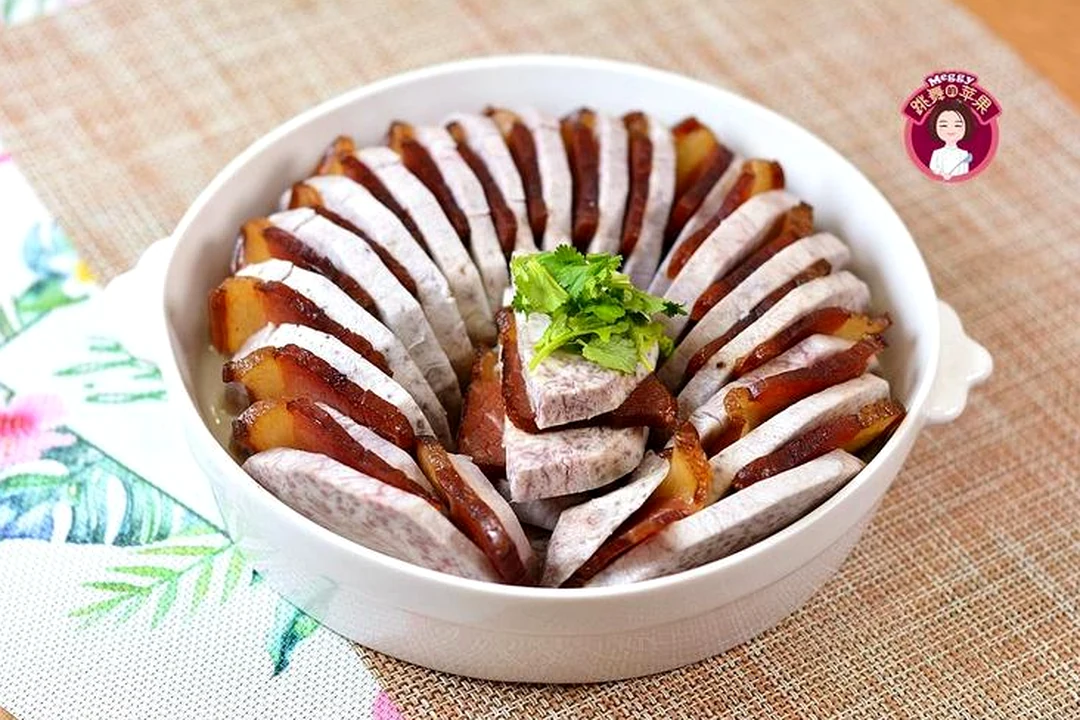
Alongside free-spirited river flavors, the depth of Lingnan royal gastronomy is vividly captured in braised pork belly and preserved-olive roast duck steamed with Lipu Taro (荔浦芋). Once a prized imperial tribute presented to the Qianlong Emperor during the Qing Dynasty, taro cultivated in Lipu County became famous across the realm for its purple-marbled flesh, which releases a fragrance reminiscent of upland sticky rice and a uniquely creamy, nutty texture when cooked. Local culinary artisans slice the taro into uniform slabs and layer them rhythmically with rich, succulent pork belly or sweet-and-savory roast duck marinated with black olives. The dish is steamed for hours inside bamboo baskets, allowing rendered duck fat and the tangy-sweet essence of black olives to permeate the fluffy taro, achieving a sublime harmony on the palate without ever feeling overly heavy.
This symphony of flavors concludes on a refined note symbolizing a thousand-year-old forest of sweet osmanthus: Osmanthus Cake (桂花糕). Every autumn, when golden osmanthus blossoms blanket the limestone crevices and reflect in the jade-green waters below, locals carefully hand-pick fresh petals still glistening with morning dew to steep in pure wildflower honey. Fine white glutinous rice flour is blended harmoniously with osmanthus honey and pure rock sugar, pressed into carved wooden molds, and steamed over billowing vapor. Chewy, soft, and infused with a delicate herbal fragrance, a slice of osmanthus cake enjoyed slowly alongside a cup of green tea harvested from Yangshuo’s mist-shrouded peaks leaves a clean, lingering sweetness that encapsulates the romantic soul of Guilin.
Embarking on a Li River waterway journey begins with understanding the operating rhythms of its piers and vessels. For the major four-hour cruise sailing downstream from urban Guilin to Lianhua Pier in Yangshuo County, three- and four-star cruise liners typically depart in a fixed morning window between 9:00 AM and 9:30 AM daily—from Mopanshan Pier for domestic travelers or the international-standard Zhujiang Pier. Travelers hoping to skim close to the water’s surface aboard motorized bamboo rafts along the Yangdi – Nine Horses Fresco Hill stretch or on the Yulong River tributary should note that rafting stations generally open at 7:30 AM and cease ticket sales after 5:30 PM at dusk to ensure river safety.
Regarding travel routes and entry formalities, Guilin currently offers a 144-hour visa-free transit policy for citizens of 53 countries arriving via Liangjiang International Airport. For Vietnamese travelers in particular, reaching this scenic paradise is remarkably convenient thanks to border-pass tourism policies or group visas processed through the Friendship Pass (Huu Nghi Quan in Lang Son) and Mong Cai (Quang Ninh) international land border gates. From Nanning City, travelers need only about two-and-a-half hours aboard a high-speed bullet train to arrive directly at Guilin Station, where dedicated pier shuttles or tour coaches provide seamless transfers to the riverside terminals.
Seasonal weather patterns in the Lingnan region create distinct transformations along the Li River throughout the four seasons. The most idyllic periods for an unforgettable voyage are spring (March to May), when morning mist drapes the limestone ranges to create the ethereal “Misty Rain on the Li River” tableau, and autumn (September to November), when crisp skies prevail and the water turns mirror-calm and crystal clear. Conversely, travelers should exercise caution and avoid peak flood season from June to August, as torrential upstream rains can cause water levels to surge abruptly, turning the river muddy red with silt and prompting maritime authorities to suspend all cruise ships and bamboo rafts to prevent capsizing risks.
Sightseeing costs on the river vary clearly according to comfort levels and personal preferences. A standard three-star cruise ticket generally ranges from 215 to 270 RMB, while a four-star cruise inclusive of a buffet lunch costs between 360 and 450 RMB per trip. For complete peace of mind, discerning travelers are strongly advised to prioritize pure, no-shopping tour packages and firmly avoid ultra-cheap or “zero-dollar” tours notorious for pressuring guests into purchasing overpriced jade, silk, or substandard herbal remedies at disguised retail stops.
Packing for a scenic voyage along the Li River also calls for thoughtful preparation of personal essentials. If you plan to hike up to panoramic viewpoints such as the rugged Laozhai Hill or the majestic Moon Hill, sturdy athletic shoes with reliable grip are mandatory for navigating sharp karst limestone rocks. Additionally, due to noticeable day-to-night temperature swings and brisk breezes funneling through the river gorge, bringing a lightweight windbreaker, a natural-fiber scarf, a waterproof pouch for electronics, and small-denomination cash to tip local Zhuang raft punters will make your journey all the more enjoyable. To experience this sublime natural masterpiece without worrying about complex logistics, booking a professionally curated all-inclusive tour package is the ideal way to unlock a effortless, relaxing getaway amidst awe-inspiring scenery.