In the winter of 1394—the third year of the reign of King Taejo Yi Seong-gye—the quiet land of Hanyang nestled at the foot of Mount Baegaksan awakened to the resounding commands breaking ground on a monumental royal complex. That moment marked the birth of Gyeongbokgung Palace (景福宫), the first and grandest primary royal palace among the Five Grand Palaces of the Joseon dynasty. Leading its architectural master plan and naming was none other than the founding statesman and eminent Neo-Confucian scholar Jeong Do-jeon. Drawing inspiration from a classical verse in the Classic of Poetry wishing “great felicity for ten thousand years,” Jeong Do-jeon bestowed the two characters Gyeongbok—”Greatly Blessed”—as a sacred invocation for radiant glory, endurance, and boundless fortune upon the royal house and its people.
Guided by Jeong Do-jeon’s design steeped in East Asian geomancy and orthodox Neo-Confucian philosophy, Gyeongbokgung Palace was laid out along a textbook north–south axial alignment—backed by towering Mount Baegak and facing out toward the tranquil Han River with Mount Namsan in the distance. Every courtyard and pavilion operated along a straight ceremonial axis where royal authority found expression through strict hierarchical order separating public state affairs from secluded inner quarters. Yet Joseon’s history was never an unbroken calm, and Gyeongbokgung’s fate remained bound to the dramatic upheavals and enduring scars of an entire nation.
The first great tragedy struck in the summer of 1592, when the flames of the Imjin War (1592–1598) launched by Toyotomi Hideyoshi swept across the Korean Peninsula. Amid the devastation of war, Gyeongbokgung was burned completely to the ground in a towering inferno, leaving behind only scorched stone column bases and bare foundations amid encroaching weeds. Catastrophic destruction and a depleted state treasury left the Joseon court unable to rebuild, forcing subsequent monarchs to relocate court governance to Changdeokgung Palace. For 273 long, moss-grown years, the dynasty’s highest sanctuary stood abandoned as a solemn reminder of wartime turmoil.
Not until 1867, during the reign of King Gojong, did the flame of revival blaze back to life under the iron-willed direction of Heungseon Daewongun, the king’s father and prince regent. Determined to restore royal majesty, the Daewongun launched an unprecedented reconstruction effort across the peninsula. Tens of thousands of the finest artisans, stonemasons, and master carpenters from all eight provinces were summoned to the capital alongside prized red pine timber hauled down from the mountains of Gangwon. After years of tireless labor, a magnificent Gyeongbokgung rose anew on a monumental scale of 330 buildings encompassing 5,792 grand rooms, faithfully recapturing its original splendor.
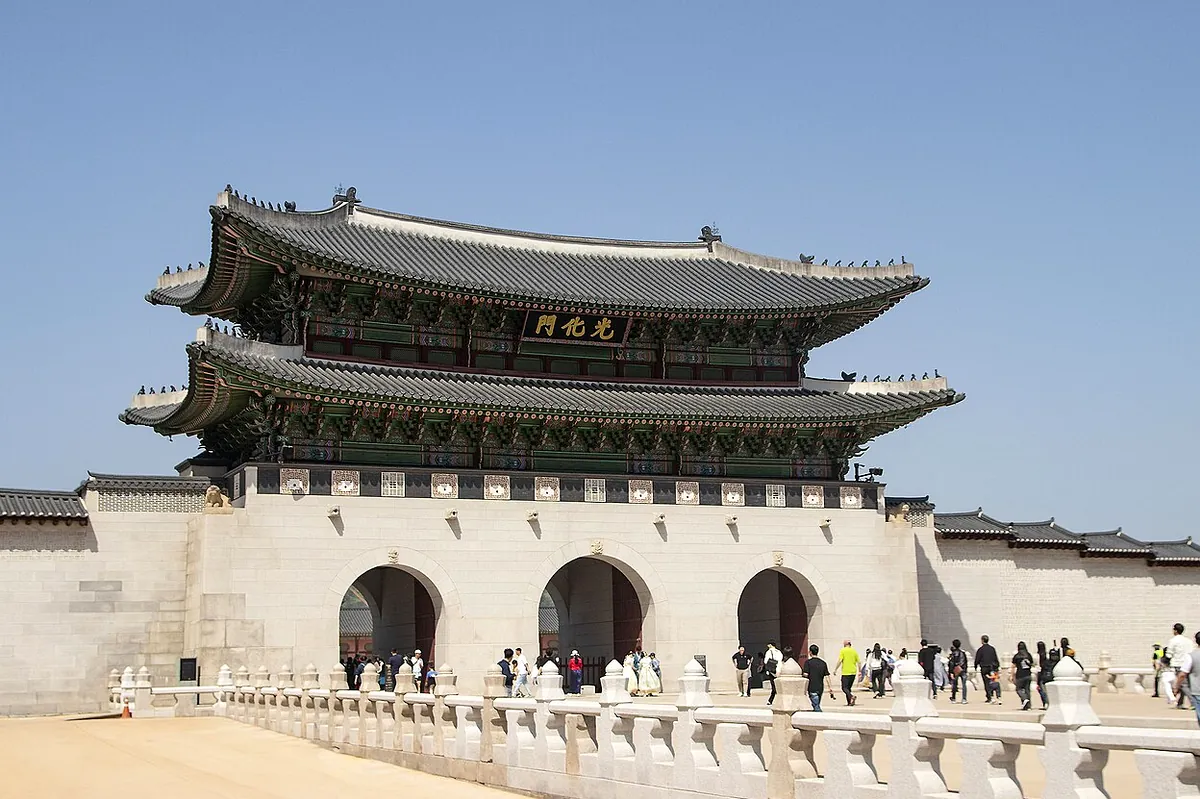
Even so, that brilliant renaissance proved short-lived in the face of colonial aggression. Following the tragic 1895 incident at Okhoru Pavilion that claimed the life of Empress Myeongseong, the Joseon court entered a steep decline. Cultural devastation peaked during the Japanese colonial period (1910–1945), when occupying authorities demolished more than ninety percent of the original palace halls and auctioned off historic pavilions as civilian building materials. Most painfully of all, in 1926, a massive concrete Japanese Government-General Building was erected directly in front of Geunjeongjeon Hall—severing the sacred geomantic axis linking Gwanghwamun Gate with Mount Baegak in a direct blow to Korean national pride.
Following decades of national division and post-war rebuilding, a resilient new chapter opened for Gyeongbokgung. Since 1990, the South Korean government has pursued a multi-phase national restoration master plan. A historic turning point arrived when the Japanese Government-General Building was completely dismantled, erasing a symbol of humiliation and reopening the clear sweep of the original ceremonial axis. To date, roughly 25% to 30% of the historic complex—comprising hundreds of core halls and gates—has been faithfully restored using traditional mortise-and-tenon joinery and authentic granite masonry. Today, every timber beam and weathered roof tile at Gyeongbokgung stands not only as the rebirth of an architectural masterpiece, but as an enduring testament to a nation’s cultural resilience.
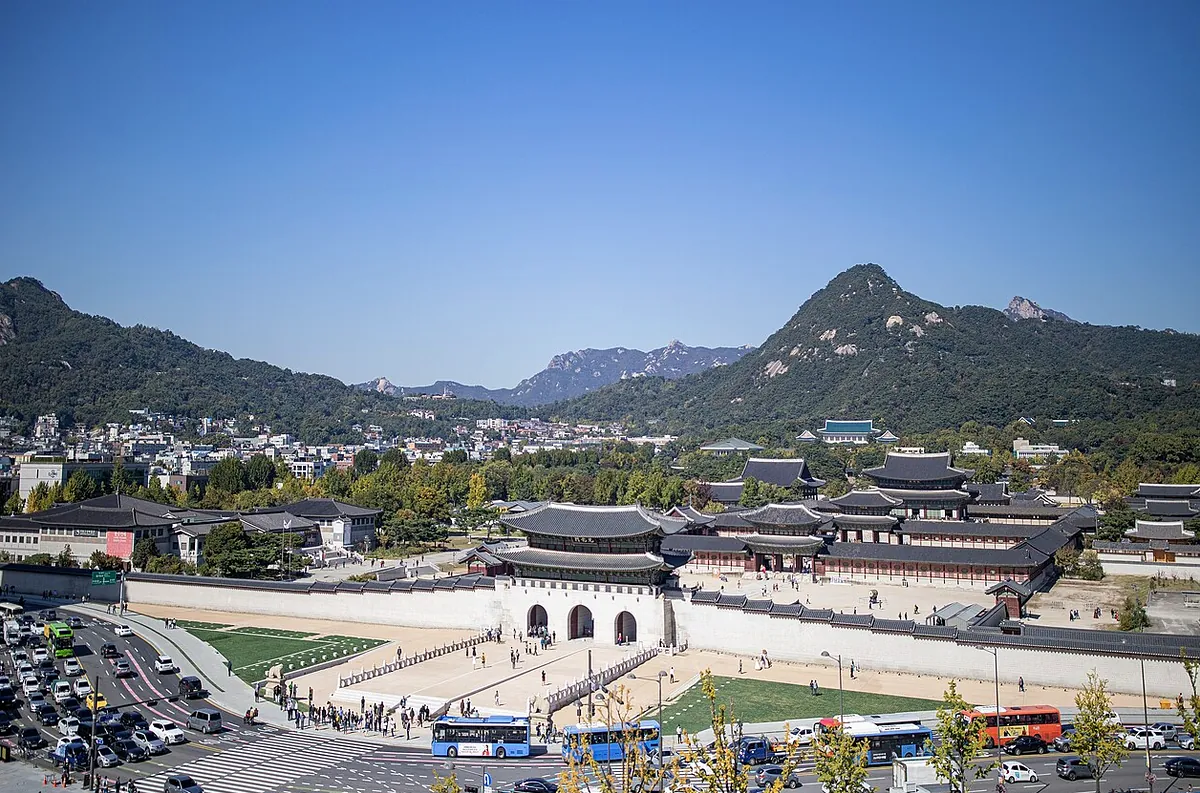
Located in the historic heart of Jongno District, Gyeongbokgung Palace is far more than the flagship royal complex of the Joseon dynasty—it is a masterwork uniting East Asian geomancy with classical Book of Changes cosmology. When King Taejo Yi Seong-gye relocated the capital from Gaegyeong to Hanyang, founding strategist Jeong Do-jeon personally surveyed the surrounding mountains and waterways to anchor the entire city plan in cosmic balance. Oriented strictly along a north–south meridian, the palace rests firmly against the granite slopes of Mount Bugaksan—the guardian Black Tortoise shielding the capital from northern winds—while looking toward Mount Namsan to the south as a protective natural screen. Flanked by gentle Mount Naksan as the Azure Dragon on the east and rugged Mount Inwangsan as the White Tiger on the west, this classic four-guardian configuration gathers vital energy along the winding Cheonggyecheon Stream before flowing into the mighty Han River.
From the sacred throne room inside Geunjeongjeon Hall, the central ceremonial axis extends straight through Gwanghwamun Gate to connect seamlessly with modern Seoul’s civic core. This commanding setting makes the palace a living crossroads where centuries-old heritage meets vibrant contemporary city life. Stepping just beyond the palace walls, visitors can explore neighboring cultural treasures—from the curved tiled roofs of Bukchon Hanok Village, once home to Joseon’s yangban aristocracy, to nostalgic stone lanes lined with traditional teahouses in Samcheong-dong, the hanji paper and calligraphy galleries of Insadong, and the sweeping public plaza of Gwanghwamun Square out front—forming a seamless cultural landscape honoring the palace’s enduring centrality.
Inside the imposing palace walls, Joseon landscape design reaches poetic heights through broad man-made ponds woven gracefully between state halls and royal living quarters. Foremost among them is mirror-still Gyeonghoeru Pond, cradling the majestic two-story banquet pavilion where kings hosted foreign envoys and state celebrations. Beyond cooling the palace microclimate, the broad sheet of water mirrors the dramatic granite ridges of Mount Inwangsan to the west in a textbook example of classical “borrowed scenery.” Deeper inside the tranquil rear garden, a fragrant lotus pond embraces the graceful hexagonal pavilion of Hyangwonjeong on a small islet linked to the northern bank by the slender wooden Chwihyanggyo Bridge. Here, nature shifts dramatically with every season: cherry blossoms and purple azaleas burst into bloom in spring; weeping willows and lotus blossoms shade summer waters; crimson maples and golden ginkgos cloak the grounds in autumn; and crisp white snow blankets curved roof tiles in winter, wrapping the royal grounds in timeless stillness.
Nestled in the premier geomantic setting of historic Hanyang, Gyeongbokgung Palace embodies strict East Asian spatial hierarchy, anchored against Mount Bugaksan and oriented toward the broad Han River. Its master plan adheres rigorously to a north–south central axis reflecting moral order and sovereign authority under the Joseon dynasty. Every gate, courtyard, and inner hall unfolds in deliberate spatial progression, revealing the grandest architectural ensemble in Korean history.
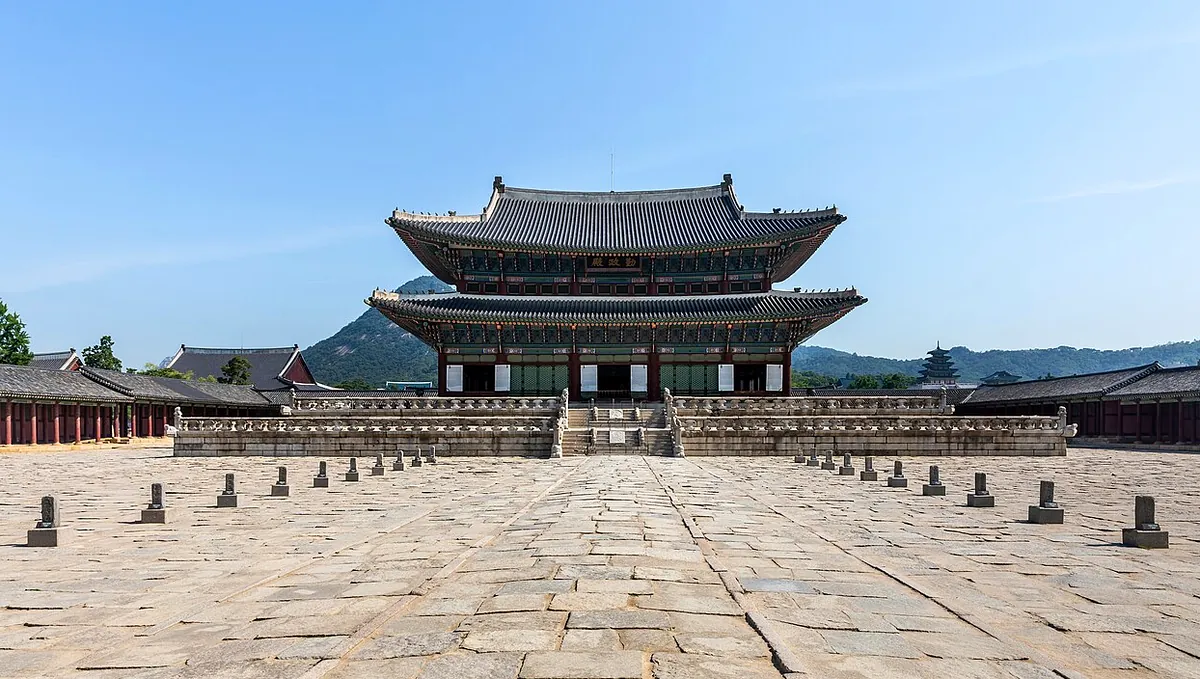
Standing guard at the southern entrance is Gwanghwamun Gate, pierced by three sturdy granite arches—the central portal reserved exclusively for the king’s palanquin, flanked by side arches for royal family members and court officials. Crossing expansive stone-paved courtyards brings visitors straight to the seat of supreme state power: Geunjeongjeon Hall. As the largest wooden throne hall in the palace, it rises proudly atop a two-tiered granite platform (woldae) dressed with rough-hewn stone surfaces intentionally designed to diffuse bright sunlight and reduce glare for officials standing in morning assembly. Along the granite balustrades sit finely carved guardian figures of the Four Directional Deities and Twelve Zodiac Animals, standing watch over royal authority. Directly behind stands Sajeongjeon Hall, a quieter council chamber where the monarch met daily with scholars of the Hall of Worthies to debate statecraft and policy at dawn.
The boundary between public state governance and private royal life is marked by ornamental brick walls leading into the northern residential quarters. Gangnyeongjeon Hall, the king’s bedchamber, features a distinctive architectural detail: it lacks a central ridge beam so nothing presses down upon the sovereign’s symbolic energy, while its floor plan divides into nine square chambers heated from below by traditional ondol underfloor flues. Immediately behind lies Gyotaejeon Hall, the queen’s residence, whose name symbolizes the harmonious union of heaven and earth. Its crowning highlight is the terraced Amisan Garden out back, adorned with four hexagonal red-brick chimneys intricately carved with lotuses, plum blossoms, chrysanthemums, and auspicious birds wishing longevity and prosperity upon the royal lineage.
Beyond formal walled courtyards, Gyeongbokgung’s leisure pavilions celebrate open harmony between architecture and nature. Rising like a grand lotus blossom above a rectangular pond, Gyeonghoeru Pavilion hosted royal banquets and diplomatic receptions. Forty-eight monolithic stone pillars support this two-story structure following the classical principle of “round heaven, square earth”—with cylindrical inner columns symbolizing the boundless sky and square outer pillars representing the supportive earth. Further north in quiet seclusion, Hyangwonjeong Pavilion charms visitors as an intimate two-story hexagonal gazebo set atop a circular island amid fragrant lotus blooms, reached via the gracefully arched wooden Chwihyanggyo Bridge where monarchs once set aside affairs of state to enjoy poetry and painting.
Restoring this solemn grandeur after centuries of upheaval required deep scholarship alongside mastery of traditional building arts. Tens of thousands of rare Geumgang red pine timbers harvested from old-growth forests in Gangwon were carefully selected and joined through precision mortise-and-tenon carpentry without a single metal nail. Hand-fired clay roof tiles laid along sweeping eaves curve upward like outstretched wings against the blue sky, embodying the pinnacle of East Asian royal aesthetics—at once graceful and commanding.
The deep, resonant boom of ceremonial drums echoing across the stone forecourt of Gwanghwamun Gate serves as a living bridge across time, heralding one of Gyeongbokgung’s most captivating spectacles: the Royal Guard Changing Ceremony (Sumunjang Gyodaesik). Rooted in military reforms enacted under King Yejong in the late 15th century to safeguard the royal compound, this historic ritual is reenacted with meticulous authenticity twice daily at 10:00 AM and 2:00 PM—except on Tuesdays, when the palace closes for weekly maintenance. Beneath the open sky of old Hanseong, formations of royal guards march in disciplined cadence, bringing the martial dignity of Joseon palace sentries vividly back to life.
Historical fidelity shines through every detail of attire and military protocol. The Chief Gatekeeper and royal guards wear striking traditional uniforms in primary five-element hues—deep indigo, vermilion red, and royal gold—armed with quivers, broadswords, or polearms glinting in the breeze. The ceremonial inspection of sunpae—inscribed wooden pass tablets verifying officer credentials at the palace gates—unfolds with solemn precision to the stirring calls of conch shells and long brass horns. For twenty minutes, the broad courtyard in front of the vermilion gate transforms into an authentic Joseon parade ground right in the heart of modern Seoul.
When sunset settles behind Mount Inwangsan on the palace’s western flank, Gyeongbokgung sheds its daytime formality for the enchanting stillness of seasonal night openings. Offered only during select windows with strictly limited tickets, nocturnal admission feels like a rare invitation into a living historical storybook. Rather than harsh modern floodlights, curators employ warm, indirect golden illumination tracing granite walkways and palace eaves, complemented by traditional blue-and-red silk lanterns (cheongsachorong) guiding visitors quietly through serene courtyards far removed from city bustle.
Gyeongbokgung’s nocturnal beauty reaches its emotional peak at Gyeonghoeru Pavilion and Hyangwonjeong reflected across mirror-calm waters. Supported by forty-eight stone columns, Gyeonghoeru casts a shimmering reflection onto the pond below as subtle uplighting highlights upswept eaves and vibrant five-color dancheong painted brackets. Further north, hexagonal Hyangwonjeong and the slender wooden Chwihyanggyo Bridge drift softly in evening mist, glowing like a priceless royal ink-wash painting. Surrounded only by wind rustling through centuries-old pines and golden light dancing across ancient stonework, royal elegance feels suspended in time.
Stepping out from Gyeongbokgung’s stately granite courtyards and sweeping tiled roofs, cultural discovery continues into a rich culinary neighborhood encircling the palace walls. The streets around Gyeongbokgung have long served as a meeting ground between Joseon royal court gastronomy and beloved everyday fare of old Hanyang. Stone-paved lanes in Jahamun-ro, Seochon, and Samcheong-dong preserve not only tranquil hanok architecture, but also multi-generational family recipes turning every meal into an intimate conversation with Korean culinary history.
Just steps from Gyeongbokgung Subway Station, Tosokchon Samgyetang stands as an enduring culinary institution—famed enough to have been a regular favorite of late President Roh Moo-hyun alongside visiting dignitaries. Housed inside a sprawling multi-wing traditional hanok complex with a shaded inner courtyard, its signature ginseng chicken soup follows strict royal wellness traditions. Chefs select tender 40-day-old spring chickens stuffed with glutinous rice, sweet chestnuts, Gyeongsan jujubes, ginkgo nuts, whole garlic cloves, and a prized four-year-old Geumsan ginseng root at peak potency. Simmered for hours in broth enriched with more than thirty traditional herbs, each portion arrives bubbling furiously in an earthenware ttukbaegi pot, releasing fragrant clouds of ginseng steam over milky, velvety broth.
Along the palace’s western wall, a five-minute stroll from Yeongchumun Gate leads to Tongin Traditional Market, a lively neighborhood market dating back to the 1940s. Visitors flock here for its celebrated Dosirak Cafe lunchbox experience: exchange cash at the market kiosk for a string of replica brass coins (yeopjeon) and an empty black lacquer tray. Strolling past steaming stalls with coins in hand, you can fill your tray with local classics—including Tongin’s signature gireum tteokbokki (rice cakes pan-fried in chili oil on shallow cast-iron griddles until crisp outside and chewy inside rather than simmered in heavy sauce), glossy sesame-scented japchae glass noodles, crispy pan-fried mandu dumplings, and skewered odeng fish cakes steeped in sweet, steaming seafood broth.
Rounding out Seoul’s royal palace food trail is a quiet pause in Samcheong-dong along the palace’s northeastern stone wall. Tucked beneath ancient ginkgo trees inside traditional wooden houses, heritage teahouses preserve the unhurried tea culture of Joseon yangban scholars. Savor rich, mahogany-hued daechucha (jujube tea simmered for half a day for deep natural warmth) or fragrant gukhwacha brewed from wild autumn chrysanthemums, paired with hand-pounded chewy tteok rice cakes and crisp hangwa confections glazed with grain syrup and toasted sesame seeds—leaving a soothing herbal finish accompanied by the gentle chime of wooden wind bells.
Reaching the heart of the Joseon dynasty is effortless via Seoul’s world-class subway network. Seoul Metro Line 3 brings passengers directly to Gyeongbokgung Station: Exit 5 leads straight to the forecourt of the National Palace Museum with sweeping views of the southwestern grounds, while Exit 3 opens onto historic lanes lined with traditional hanbok rental boutiques. Coming from central downtown, Line 5 to Gwanghwamun Station (Exit 2) offers an unforgettable visual approach—walking up broad Sejong-daero past imposing statues of King Sejong the Great and Admiral Yi Sun-sin before entering straight through Gwanghwamun Gate as sleek financial towers give way to centuries-old stone ramparts.
To make the most of your visit, keep the palace’s operating schedule in mind. Gyeongbokgung opens daily at 9:00 AM and closes between 5:00 PM and 6:30 PM depending on the season, with last admission one hour prior to closing. One essential rule every traveler must note: the palace closes every Tuesday for regular maintenance (or the following day if Tuesday falls on a public holiday). Early morning right at opening or early afternoon—timed to catch the famous Sumunjang Royal Guard Changing Ceremony at Heungnyemun Plaza—offers the best atmosphere and photography light.
One of Gyeongbokgung’s most beloved cultural policies is 100% free admission (regularly 3,000 KRW for adults) for visitors wearing traditional hanbok. Dressing in an elegant jeogori jacket and flowing chima skirt—or a traditional durumagi overcoat and baji trousers—not only grants complimentary entry through a dedicated gate lane, but turns your walk across Geunjeongjeon’s granite courtyard, beside Gyeonghoeru Pond, and past carved guardian balustrades into a vivid step back in time.
However, this extraordinary cultural experience can easily be cut short by bargain-basement package tours that rush guests through Gyeongbokgung in a frantic 30 to 40 minutes just to squeeze in mandatory stops at closed commercial shopping centers. To truly absorb the serene majesty of a royal complex spanning more than forty hectares, travelers need at least 2 to 2.5 unhurried hours to admire intricate wooden joinery and listen to wind rustling through ancient trees. Choosing a thoughtfully paced, strictly no-shopping all-inclusive tour package ensures you experience the art, architecture, and living history of Joseon royalty to the fullest.