Along the more than 6,300-kilometer course of the mighty Yangtze River, the dramatic stretch winding through the Three Gorges region from Fuling to Yichang stands as an epic written in stone and water across Chinese civilization. Here, three legendary gorges—precipitous Qutang Gorge, cloud-shrouded Wu Gorge, and turbulent Xiling Gorge—form not only a breathtaking landscape of peaks and rushing currents, but also a cradle of ancient cultural heritage. From prehistoric times marked by the Daxi culture through the Xia and Shang dynasties, this rugged corridor nurtured thriving ancient communities, giving rise to the profound Ba-Shu culture and the romantic Chu civilization. By the Spring and Autumn and Warring States periods, the strategic terrain of Xiling Gorge served as a vital military defense line witnessing fierce struggles for supremacy between the rival states of Qin and Chu.
As the wheel of history turned into the turbulent Three Kingdoms era, the Three Gorges became a dramatic stage immortalizing towering historical figures. Perched high above the swirling currents at the entrance to Qutang Gorge, Baidicheng (White Emperor City) was where Liu Bei retreated after military defeat and breathed his last after entrusting his young son to Chancellor Zhuge Liang. Beneath the fortress cliffs, rushing river waters once bore the imprint of Zhuge Liang’s enigmatic Eight-Trigram Stone Maze, while farther downstream echoed the legacy of Zhou Yu’s fiery triumph at the Battle of Red Cliffs against Cao Cao’s vast armada. Along both riverbanks—from mystical Fengdu with its legends of the underworld to ancient frontier watchtowers—every cliff face is steeped in dynastic drama and heroic spirit.
During the golden Tang and Song dynasties, this dramatic river corridor transformed into East Asia’s greatest highway of classical poetry. Sheer sky-piercing cliffs and drifting morning mists inspired China’s finest literary masters. Pardoned from exile, the “Immortal Poet” Li Bai sailed downstream through the gorges, composing his immortal verse bidding farewell at dawn to White Emperor City amid rose-tinted clouds and gliding past endless gibbon calls echoing from both shores. Meanwhile, the “Poet Sage” Du Fu spent years residing in Kuizhou beside Qutang Gorge, weaving deeply moving verses of human compassion, while Bai Juyi, Wang Anshi, and Su Dongpo immortalized the ever-shifting clouds and rains of Mount Wu—enshrining the Three Gorges forever in the romantic imagination of East Asia.
Entering the modern era, the age-old aspiration to tame the river’s devastating annual floods downstream sparked an engineering marvel of historic proportions. In 1919, revolutionary leader Sun Yat-sen first outlined the concept of damming the Yangtze River for hydroelectric power in his work *The International Development of China*. Decades later, after swimming across the Yangtze, Chairman Mao Zedong penned bold verses envisioning a stone wall rising to hold back the clouds and rains of Mount Wu, creating a tranquil lake amid deep gorges. On April 3, 1992, at the Fifth Session of the Seventh National People’s Congress, the Three Gorges Hydroelectric Project was officially approved following years of intense scientific, engineering, and environmental debate.
On December 14, 1994, this project of the century officially broke ground at Zhongbao Island in Sandouping Town, Yichang City, Hubei Province. Taming the river unfolded across demanding milestones, beginning with the first successful river closure in 1997. By 2003, the second river closure was completed and reservoir impoundment reached 135 meters, bringing the first turbine generators online. Construction of the colossal concrete gravity dam—standing 185 meters tall and stretching 2,309 meters across—was completed in 2006, with the entire monumental project reaching full completion in 2010. Backed by a total investment of 203 billion RMB, the facility not only set global records for hydroelectric output, but entailed the historic relocation of over 1.24 million local residents, forever reshaping the geography, economy, and human landscape of the ancient Three Gorges.
Stretching like an emerald ribbon slicing through rugged mountains in central China, the Three Gorges Dam occupies a strategic chokepoint anchored between two major hubs: Yichang City in Hubei Province to the east and the misty mountain metropolis of Chongqing to the west. Viewed through traditional Chinese geomancy, the Yangtze resembles a mighty dragon vein descending from the snow-clad Qinghai-Tibet Plateau and surging toward fertile plains through three formidable gorges—Qutang Gorge rising like a celestial gate, Wu Gorge veiled in swirling mist, and Xiling Gorge studded with jagged shoals. Ancient geographers hailed the dam’s setting as a classic “coiling dragon and crouching tiger” formation, where opposing mountain ranges close together like a natural screen—gathering boundless vital water energy from the west while regulating river flow to safeguard harvests across the fertile Central China Plain.
The dramatic interplay between million-year-old karst canyons and modern mega-infrastructure represents an extraordinary feat of civil engineering. Conquering sheer cliffs that once daunted travelers for millennia, the Hefei–Wuhan–Yichang high-speed rail corridor—operating at speeds of 250 to 350 km/h—has trimmed travel time from Wuhan to Yichang to just 1 hour and 45 minutes. Even more remarkable is the Chongqing–Wanzhou–Yichang rail line, where nearly 90 percent of the route runs across soaring viaducts and deep tunnels bored straight through limestone mountains, connecting the two economic poles in roughly two hours. Running parallel through the mountains, the G50 Shanghai–Chongqing Expressway spans deep gorges via world-renowned suspension bridges such as the Sidu River Bridge, granting swift, safe access to the vast reservoir region.
Guided by the region’s dramatic topography, Three Gorges sightseeing unfolds through deeply evocative cultural river journeys. At the heart of this timeless voyage are five-star luxury river cruisers—such as Century Cruises, President Cruises, and Victoria Cruises—gliding smoothly across tranquil reservoir waters past storied landmarks: from mystical Fengdu Ghost City and historic Wanzhou port through the layered peaks of Wu Gorge, sweeping onward through Qutang and Xiling Gorges before docking at Yichang. Along the way, smaller excursion boats venture into poetic side tributaries like pristine Shennv Stream (Goddess Stream), beneath the twelve mist-wrapped peaks of Mount Wu, or ashore at ancient Baidicheng where Liu Bei’s poignant farewell unfolded during the Three Kingdoms period.
At the dam site itself in Yichang, engineering and geological tours ascend Tanziling Ridge for sweeping panoramic views of the massive concrete dam wall and its monumental five-tier ship lock system, before pausing at the 185 Viewing Platform—level with the crest of the dam where upstream reservoir waters stretch to the horizon. Balancing industrial scale with timeless rural heritage is the Tribe of the Three Gorges scenic reserve, where Huangjin Stream murmurs past traditional stilted Tujia wooden homes. The landscape transforms dramatically with the seasons: in autumn from September to November, crimson foliage sets cliffside forests ablaze above emerald waters, while spring in March and April parts morning mists to reveal delicate peach blossoms straight out of a classical ink-wash painting.
Viewed across the wide expanse of Xiling Gorge, the Three Gorges Dam rises like a modern Great Wall of reinforced concrete spanning the surging Yangtze. Measuring a record-setting 2,335 meters in overall axis length with a crest elevation of 185 meters above sea level, this concrete gravity dam holds back tens of billions of cubic meters of water flowing down from the Tibetan Plateau. Its engineering grandeur lies not only in tens of millions of cubic meters of concrete pressing firmly into solid granite bedrock, but in the synchronized choreography of bottom outlets, deep spillway gates, and subterranean turbine halls converting the river’s immense kinetic force into clean electricity powering vast swaths of China.
The hydraulic and mechanical marvel that astonishes engineers worldwide is the five-stage double-lane ship lock system, widely hailed as humanity’s grandest water staircase. To lift and lower vessels displacing up to 10,000 tons across an astonishing 113-meter water-level drop between upstream and downstream, engineers carved a colossal hydraulic corridor directly through solid mountain rock. As ships enter each sealed lock chamber, giant culvert valves automatically equalize water levels using the principle of communicating vessels, raising or lowering ships step by step across five massive tiers over several hours—an unforgettable spectacle as ocean-going vessels glide effortlessly between towering man-made canyon walls.
Crowning the highest vantage point overlooking the entire complex is the Tanziling Observation Deck, a postmodern viewing pavilion modeled after the dam’s profile alongside a meteorological radar dome reaching toward the sky. Perched atop the hill that once served as the project’s construction command headquarters, this spiral-terraced viewpoint offers a commanding 360-degree panorama contrasting the mirror-calm expanse of the upstream Three Gorges Reservoir on one side against thundering whitewater roaring through spillway gates downstream.
The spatial tapestry of the Three Gorges landscape extends far beyond modern concrete engineering into rich layers of regional history and living culture. Right at the entrance to Qutang Gorge, historic Baidicheng clings proudly to a precipitous bluff, preserving intricate Ming and Qing dynasty wooden temple halls. Moss-covered upturned eaves, gray brick archways, and shrines honoring Liu Bei and Zhuge Liang vividly evoke the tragic drama of the Three Kingdoms era—creating a poetic dialogue between a tranquil island-bound heritage town and an extraordinary feat of modern hydropower engineering.
Continuing upstream along the river corridor leads into the surreal eight-dimensional cityscape of Chongqing. Multi-tiered architecture clings vertically to steep mountain slopes, woven together by five-level highway interchanges and the famous monorail passing straight through the middle of the nineteen-story Liziba residential building. Glittering glass skyscrapers interlaced with thousand-year-old stone stairways and neon reflections dancing on night waters turn the upper Three Gorges gateway into an unmistakable futuristic living museum.
To bring this landmark project of the century to completion, the Chinese government mobilized an actual total investment of approximately 203 billion RMB, ranking among the largest infrastructure undertakings in human history. Accompanying this monumental investment was an unprecedented human migration in which more than 1.24 million residents across two municipalities, eleven counties, and over a hundred riverside towns relocated from ancestral homes to make way for reservoir impoundment—underscoring both the scale of transformation and the determination of a civilization harnessing nature on a grand scale.
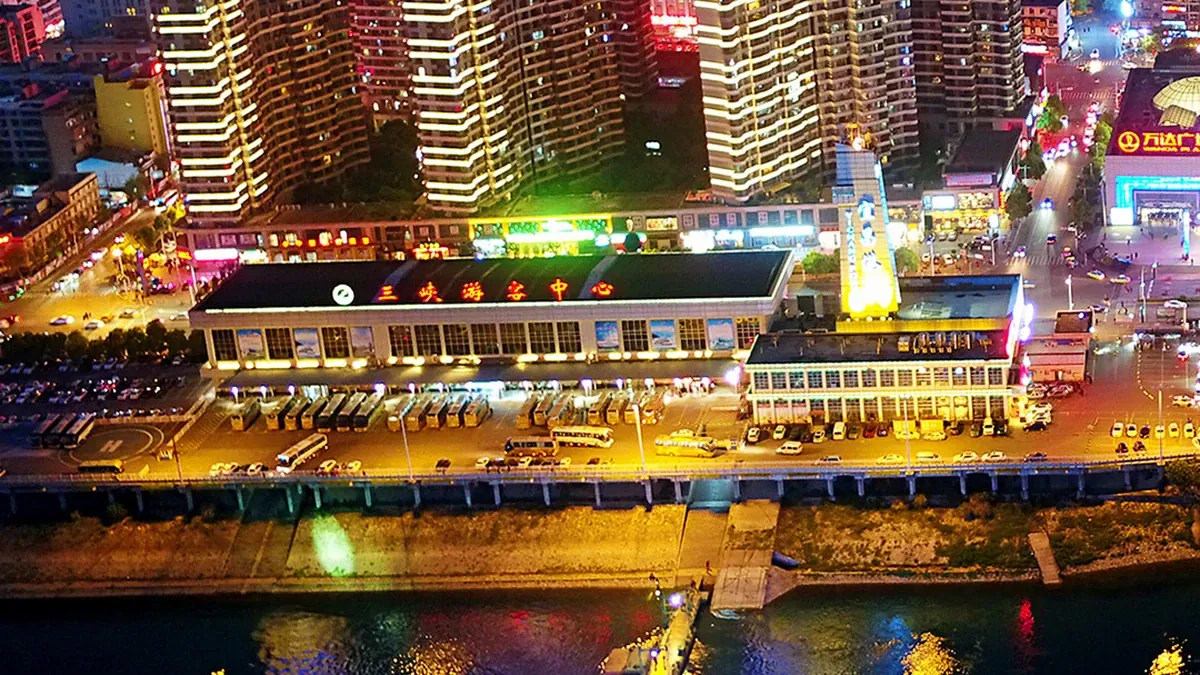
As indigo twilight drapes over the upper Yangtze, the cultural landscape of the Three Gorges undergoes a dramatic metamorphosis—from classical ink-wash mountain scenery into a multi-layered visual universe where cyberpunk futurism meets millennia of history. Nocturnal journeys frequently begin where the emerald Jialing River merges into the silt-laden Yangtze right beneath bustling Chaotianmen Dock. Chongqing rises like a colossal three-dimensional vertical labyrinth glowing in the dark, with tens of thousands of multi-colored LEDs outlining cable-stayed bridges, sheer skyscraper clusters, and elevated transit lines threading through residential towers at Liziba Station. Clinging to a steep cliffside, the traditional stilted wooden complex of Hongyadong blazes like a golden fairytale citadel reflected in rippling river currents, composing a dazzling overture before cruise ships weigh anchor and glide into the quiet depths of the gorges.
Leaving behind the electric pulse of the vertical metropolis, five-star river cruisers carry passengers deep into Qutang and Wu Gorges, unveiling an entirely contrasting realm where artificial neon yields to primordial stillness. Amid vast canyon shadows, sheer limestone walls soar hundreds of meters toward a star-strewn sky, leaving only the ethereal silhouette of Goddess Peak etched beneath silver moonlight gleaming off glassy waters. Crisp mountain breezes sweep across open decks carrying the pure scent of ancient forests, awakening the same timeless nostalgia that moved Tang and Song masters—Li Bai, Du Fu, and Su Shi—as they sailed through these storied narrows centuries ago.
The crowning highlight of nocturnal life along the Three Gorges lies in grand open-air live spectacles staged directly upon the river and towering canyon walls. Along the Fengjie stretch opposite dramatic Kui Gate, the live water-stage production *”Return to the Three Gorges”* turns the Yangtze itself into an immense floating theater, projecting high-powered laser imagery directly onto soaring natural cliff faces. Immortal poems of White Emperor City, haunting gibbon cries echoing across canyon walls, and the heroic spirit of the Three Kingdoms come vividly to life through expressive choreography and hydraulic stagecraft, dissolving the boundary between a thousand-year past and the living present.
In neighboring Zhongxian County, the 180-degree rotating amphitheater of *”Beacon Fires of the Three Kingdoms”* immerses audiences in the dramatic Battle of Yiling and the unwavering loyalty of Guan Yu, uniting hundreds of warhorses and performers in fiery naval and cavalry reenactments. Even aboard cruising vessels gliding through the night, three-dimensional VR and AR immersive heritage experiences allow passengers to witness the flaming naval clash at Red Cliffs or visualize the historic river closures that raised the Three Gorges Dam’s millions of tons of concrete across the Yangtze.
Late evening aboard ship winds down in serene reflection on deck, savoring local specialties such as Wushan grilled fish fragrant with numbing Ba-Shu Sichuan peppercorns alongside steaming Longjing green tea or a warming sip of aged Luzhou Laojiao spirit. Beneath the quiet silhouette of the world’s largest hydroelectric marvel, with a crescent moon suspended above rugged canyon ridges, the eternal Yangtze flows steadily onward—carrying rich silt and endless epics through a legendary land.
Straddling the transitional corridor between the fertile Sichuan Basin and the lush Jianghan Plain, the Three Gorges region is not only a geological masterpiece, but a fascinating culinary crossroads. Here, two celebrated southern Chinese culinary traditions converge: the bold, fiery, numbing intensity of Ba-Shu cuisine represented by Chongqing, and the clean, delicate, ingredient-driven subtlety of Jing-Chu gastronomy from Hubei Province. Over thousands of years of river travel, boatmen, merchants, and cliffside villagers shaped a distinctive culinary repertoire—resilient enough to ward off damp mountain mists while preserving time-honored flavors simmered in clay pots and over glowing hearths.
The foremost culinary emblem of this great river is Three Gorges Live Yangtze Fish. Fish swimming upstream against the swift currents of Qutang, Wu, and Xiling Gorges develop remarkably firm, clean flesh brimming with natural sweetness and free of any muddy aftertaste. Local chefs honor this pristine river bounty through classic gentle steaming—preparing the fish simply with fine julienned ginger, sliced scallions, and a splash of aged Shaoxing wine to lift its delicate aroma. Brought steaming to the table, the jade-white fillets melt effortlessly on the tongue, leaving a pure, sweet finish reminiscent of glacial meltwater flowing down from distant snow peaks.
Offering a fiery counterpoint to delicately steamed river fish, traditional Chongqing hotpot erupts like a bold anthem chasing away the bone-chilling damp of mist-shrouded gorge mornings. Originating from hearty, economical meals cooked by historic Ba-Man boat trackers along riverbanks, authentic Three Gorges hotpot still centers on rich, bubbling beef tallow broth glowing crimson with renowned Xuanhan dried chilies. Its defining soul lies in vibrant green Sichuan peppercorns delivering an unmistakable tingling numbness across the palate—stimulating circulation and dispelling river chill after hours on deck. Swishing crisp beef tripe, thinly sliced beef, and freshly harvested mountain bamboo shoots through the aromatic, fiery broth lets diners taste the fierce resilience of river life amid towering cliffs.
Continuing downstream toward Yichang in historic Chu territory, palates are soothed by steaming clay pots of Hubei pork rib and lotus root soup. Unlike lotus cultivated in sandy plains, lotus roots harvested from mineral-rich silt beds in Yangtze river lakes feature a porous texture that turns naturally blush-pink, nutty, and wax-tender when slow-simmered. This cherished heirloom dish demands patient heat control, gently stewing choice pork ribs with angled slices of mature lotus root for hours inside traditional earthen clay pots. The resulting broth remains remarkably clear yet deeply sweet from bone marrow and earthy lotus—offering comforting warmth like a peaceful harbor after navigating turbulent rapids.
Rounding out a culinary journey through the gorges is Three Gorges Ciba—grilled sticky rice cakes steeped in rustic riverside charm. Crafted from plump, aromatic upland glutinous rice grown on steep mountain terraces, the steamed rice is hand-pounded with heavy wooden mallets in stone mortars until smooth, elastic, and supple. Round patties are then grilled directly over glowing charcoal until puffed and golden-crisp outside while staying soft and steaming within. Drizzled generously with thick, dark cane syrup boiled down from valley sugarcane and sprinkled with toasted sesame seeds, Ciba leaves a wholesome, nostalgic sweetness lingering in memory long after leaving the Yangtze.
Exploring this hydroelectric marvel and the grand scenery of the Yangtze has become far more accessible thanks to flexible entry policies. International travelers transiting through major aviation hubs such as Chongqing Jiangbei International Airport or Wuhan Tianhe International Airport can take advantage of the 144-hour visa-free transit policy to experience the Three Gorges corridor seamlessly, alongside convenient port-of-entry and simplified group visa procedures. From either Chongqing or Wuhan, frequent high-speed trains whisk travelers straight to key embarkation hubs such as Chaotianmen Pier or Yichang’s Three Gorges Pier, where river cruisers set sail into the heart of the world’s grandest river engineering landmark.
The Three Gorges Dam Scenic Area welcomes visitors daily from 8:00 AM to 5:30 PM, enforcing rigorous security screening comparable to international aviation standards to safeguard this vital national hydraulic facility. After completing baggage checks and facial recognition at the main visitor center, clean-energy shuttle buses transport guests sequentially across three signature viewpoints: Tanziling Ridge at 262 meters above sea level—crowned by a pavilion shaped like an ancient ritual vessel overlooking the five-tier ship locks; the 185 Viewing Platform, level with the top of the concrete dam wall beside the mirror-calm reservoir; and River Closure Memorial Park on the south bank, displaying massive concrete tetrapods used during the historic river damming.
One vital practical tip for travelers is recognizing and avoiding unusually cheap package tours that distort travel quality. Such commercial traps routinely slash valuable time admiring natural gorges in order to herd visitors through closed-door jade workshops, silk factories, or herbal medicine centers selling items at inflated prices. To preserve a relaxing, culturally enriching experience, choosing transparent, all-inclusive itineraries with a strict no-forced-shopping guarantee is essential for protecting your time and enjoying pure immersion in nature.
Cultural discovery across this canyon realm is complete only when paired with local Yangtze flavors—don’t miss steamed Three Gorges mandarin fish with pickled pepper sauce, smoky cured meats prepared by Tujia communities in the Badong mountains, or refreshing Yichang Peach Blossom noodles topped with tender bamboo shoots. Meanwhile, regional tourism is entering a sustainable new era with low-emission hybrid-electric and LNG-powered “green” river cruisers gliding silently through Wu Gorge, complemented by immersive Red Cliffs VR experiences and Wushan hot-spring wellness resorts.
To prepare effortlessly for a journey between towering river cliffs and experience this marvel of modern engineering in complete comfort, reviewing curated itineraries and expert guidance for a high-quality Three Gorges tour is the ideal first step toward an unforgettable voyage.