Standing proudly at the intersection where modern metropolitan life meets the millennia-old depth of Kunming, the Jinma Biji Pagodas are far more than a sightseeing stop—they represent a living witness to the ancient soul of Yunnan. This paired archway architectural complex has transcended the definition of a purely civilian decorative structure to become a sacred spiritual symbol, fusing geomantic aesthetics, ancient legends, and the dramatic ups and downs of a storied southern frontier.
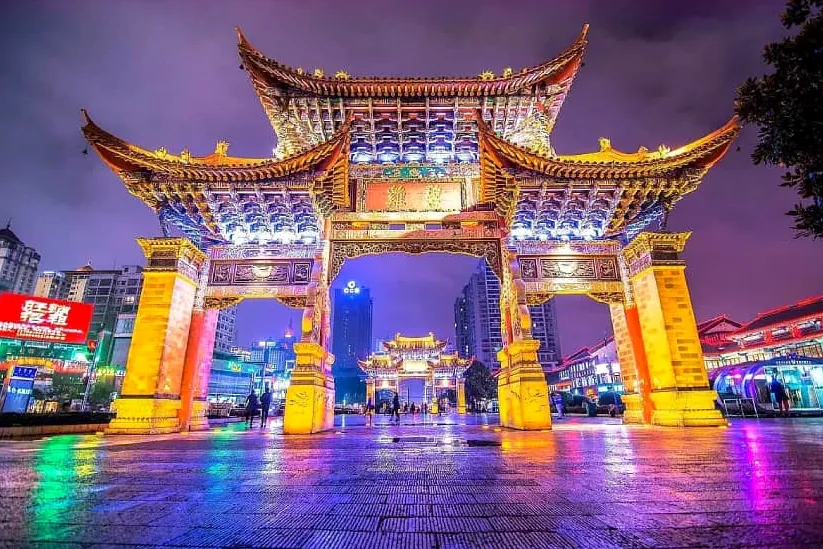
Rising majestically in the photograph are two venerable watchtowers built in the traditional “three bays, four pillars” architectural style, soaring high with gracefully layered, upward-curving eaves against an expansive sky. Sturdy vermilion pillars support intricate bracket systems (dougong), interlocking tier upon tier of red-and-gold painted timber joinery to exude the stately dignity of traditional East Asian woodwork. Beneath gilded horizontal inscribed boards bearing radiant characters, the wide stone-paved public square serves as a peaceful gathering space for locals and travelers alike, vividly capturing the seamless continuity between century-old historical heritage and today’s bustling urban pulse.
Legends surrounding Jinma (Golden Horse) and Biji (Jade Chicken) date back to the Former Han Dynasty, when Emperor Wu of Han heard tales that the distant frontier of Yunnan was home to a divine golden-maned horse and a luminous jade pheasant. He dispatched Censor Wang Bao on a lengthy imperial mission across thousands of miles of steep mountain passes to perform sacrificial rites and search for them. After more than a millennium of folkloric accumulation among ancient Dian ethnic groups, the Jinma and Biji archways were finally built of physical timber and stone during the Xuande reign of the Ming Dynasty along the east–west axis of the provincial capital. The Jinma Archway faces east, catching auspicious energy radiating from the majestic Jinma Mountain; meanwhile, the Biji Archway stands proudly facing west, corresponding to the rolling Biji Mountain beside expansive Dianchi Lake—creating the classical geomantic “left dragon, right tiger” formation safeguarding peace for all citizens.
The unique feature that established the archways’ legendary fame is a wondrous natural phenomenon known as the “Interplay of Gold and Jade” (Jinbi Jiaohui). During the autumn equinox in specific years governed by the sexagenary cycle, as the sun dips below the western mountains and the full moon rises on the eastern horizon, the setting sun casts Biji Archway’s shadow eastward while the bright moon casts Jinma Archway’s shadow westward. In the central square, the shadows of the two towers gradually approach one another, intertwining and merging into a single point to create a peerless, magical spectacle. The meticulous astronomical, solar, and optical calculations mastered by Ming dynasty architectural grandmasters not only demonstrated pinnacle arch-building craft, but also embodied the philosophical harmony of Yin and Yang, the eternal interplay of sun and moon enduring across the ages.
Despite enduring structural resilience, the Jinma Biji Pagodas could not escape the harsh scars of historical upheaval. During wartime turmoil in the Qing Dynasty under the Xianfeng and Tongzhi emperors, the ancient wooden structures were reduced to ashes by fire. It was not until the tenth year of the Guangxu reign that local officials and scholars across Yunnan raised funds and personally summoned artisans to faithfully rebuild the complex according to ancient designs, preserving the city’s architectural integrity. Having weathered the turbulent, smoke-filled second half of the twentieth century, and following multiple meticulous restorations along their historic coordinates, this celebrated landmark has risen majestically once again in the heart of the city. The enduring survival of the Jinma Biji Pagodas today affirms the unyielding vitality of a priceless heritage where every grain of timber and stone preserves Kunming’s thousand-year cultural memory.
Positioned right at the center of the spine connecting Kunming’s past and present, the Jinma Biji Pagodas are far more than a bustling commercial junction—they represent the pinnacle of traditional Chinese feng shui and urban planning. The site features a pair of symmetrical, towering archways constructed with graceful “three-bay, four-pillar” timber frames, adorned with intricate dragon and phoenix carvings painted vermilion and gold beneath jade-tiled curving eaves. The vast public square paved with light-gray granite lies peacefully between the two magnificent arched gateways, forming an expansive visual axis that captures magical twilight lighting—where the eastern Jinma and western Biji shadows stretch across the ground in an endless dialogue between sun and moon.
Viewed through macro feng shui principles, the auspicious location of this paired historic archway fully embodies the philosophy of “unity between heaven and humanity” tied to the natural landforms of the Kunming basin. The ancient city’s eastern flank leans against the majestic Jinma Mountain, undulating like a divine galloping steed, while its western side is sheltered by the imposing Biji Mountain, resembling the wings of a jade-green phoenix embracing the waters of Dianchi Lake. The convergence of these two mountain veins establishes the perfect “left dragon, right tiger” geographic axis. Master feng shui architects during the Ming Dynasty, under the Xuande reign, carefully measured along the legendary east–west axis when selecting this site, turning the monument into a natural compass gathering cosmic energy from distant mountains and rivers to warm the heart of the urban basin.
The wondrous apex of local terrain planning is the folkloric astronomical and optical phenomenon celebrated as the “Interplay of Gold and Jade” (Jinbi Jiaohui). Every sixty years during the sexagenary cycle, precisely on Mid-Autumn Festival when the full moon rises over eastern Jinma Mountain just as the glowing sun sets behind western Biji Mountain, the setting sun and moonlight shine from opposite directions through the gaps and eaves of the two gates. They cast lengthening shadows across the square until the shadows intersect and merge into a single form on the blue-brick plaza. This astonishing phenomenon demanded absolute precision down to the minute degree in calculating latitude and longitude, the height of distant mountain barriers, and the physical distance of the urban thoroughfare.
Alongside dual Yin-Yang forces, the natural landscape of the Kunming depression—nestled at nearly 2,000 meters above sea level—endows the Jinma Biji Pagodas district with the signature microclimate of the “Spring City.” With the Western Hills blunting cold northern gales and Dianchi Lake regulating humidity from the south, the area around the archways enjoys refreshing breezes and thriving native flora through all four seasons. Ancient phoenix trees cast shade across ancient green flagstones, harmonizing with underground springwaters originating from the Panlong River flowing beneath the historic foundations to create a rare ecological balance. The historic urban space is thus never stifling; instead, it circulates vital energy abundantly, sustaining prosperity across centuries of dynastic change.
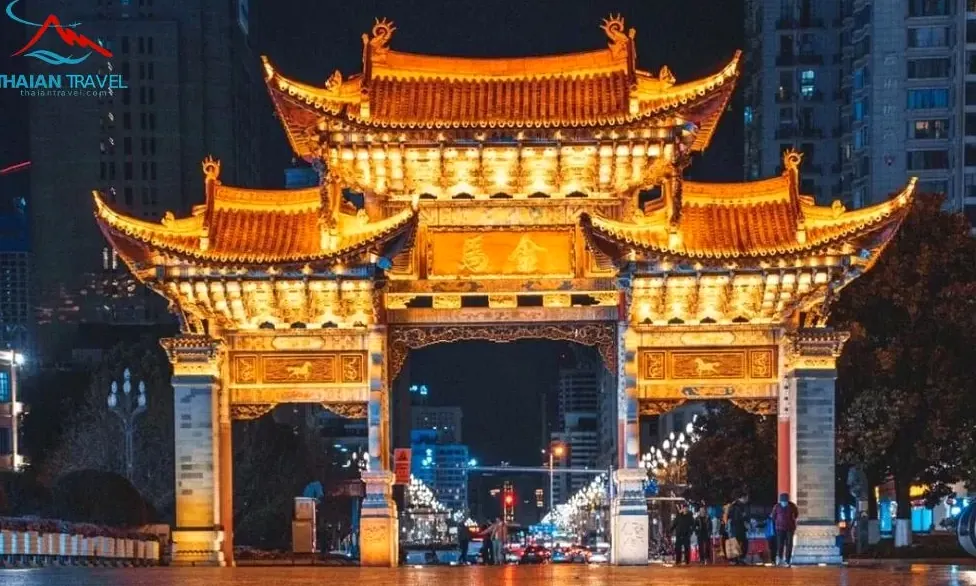
Standing impressively at the intersection of Kunming’s bustling Sanshi and Jinbi avenues, the Jinma Biji complex rises as a monumental architectural statement embodying the pinnacle temple-building craft of the central Yunnan plateau. The site’s spatial layout follows a strict east–west axis, comprising two magnificent parallel archways facing each other across an open public square. The eastern gate, named Jinma Archway (Golden Horse), welcomes the dawn from sacred Jinma Mountain, while the western gate, named Biji Archway (Jade Chicken), overlooks the sunset behind the Western Hills, where the mythical five-colored Biji phoenix once took flight. Separated by just a few dozen meters, the two structures create a breathtaking visual corridor that maintains the stately dignity of an ancient city gate while opening an airy cultural gathering space for bustling crowds.
The actual scale of each monumental archway reaches impressive technical benchmarks: approximately 12 meters in height and nearly 18 meters in span. The architecture adheres strictly to the classic Ming and Qing “three bays, four pillars, three roofs” format, relying entirely on load-bearing timber frame joinery locked together through traditional mortise-and-tenon craftsmanship without a single iron nail. The full weight of the soaring tiered roof is supported by multi-layered interlocking bracket systems (dougong) that neutralize seismic shock while displaying exquisite craftsmanship across intricately carved beams and rafters. Curved eaves tipped with blue-glazed tiles soar skyward like sweeping wings, accented by coiled dragon motifs, Dianchi cloud scrolls, and vermilion-and-gold paintwork—highlighting the horizontal boards engraved with the characters “Jinma” and “Biji” in powerful calligraphy carved deep into precious wood.
The crown jewel that elevates the Jinma Biji architecture into legend is the extraordinary mastery of astronomy and applied optics demonstrated by Ming dynasty master builders. Based on celestial coordinates and stellar orbital shifts, the two archways were calculated with absolute precision to produce the rare optical marvel known as the “Interplay of Gold and Jade.” Roughly every sixty years on the autumn equinox, as the sun sets in the western mountains just as the full moon rises over the eastern horizon, Biji Archway’s shadow stretches eastward to touch Jinma Archway’s westward shadow. Through smart lighting arrays and variable color temperature technology, modern lighting artists have permanently resurrected this mystical intersection of solar and lunar light, turning a Ming-dynasty architectural heritage into a living open-air light museum amid contemporary life.
Following centuries of historic trials—from initial construction under the Ming Xuande reign to destruction in the 1960s—the aspiration to resurrect Kunming’s millennial emblem never waned. A century-scale restoration project launched by local authorities with massive investment followed rigorous heritage research to faithfully rebuild the original appearance of both archways. The surrounding district was likewise redeveloped into a sturdy granite pedestrian square enclosed by traditional Yunnan merchants’ quarters featuring pitched gray-tile roofs and horseshoe gables. The blend of modern infrastructure investment and masterly antique preservation has restored Jinma Biji to its irreplaceable cultural heartland, safeguarding urban history amid contemporary development.
As dusk settles across the Dianchi basin, the Jinma Biji complex sheds its daylight solemnity to blossom into a hub of contemporary visual art. Standing symmetrically across the central axis, the two archways soar twelve meters high under warm golden and emerald lights washing over their tiered roofs. Every inch of vermilion-and-gold timberwork, complex interlocking brackets, and graceful upturned eaves glows sharply, casting magnificent reflections across the dark night sky. Shimmering light dances over the polished granite plaza, painting a splendid nocturnal picture that captivates every passing traveler.
Modern outdoor lighting here is far more than functional urban illumination—it is a landscape installation of profound artistic merit. Kunming urban planners artfully combined accent lighting and ambient washes to highlight neoclassical border-trade architectural details. Uplights at the base of columns illuminate bas-reliefs commemorating the Ancient Tea Horse Road and the legendary Yunnan–Vietnam Railway, while warm light glowing through wooden lattice windows mingles with colorful bilingual Chinese–Vietnamese signs—blending modern metropolitan flair with the quiet allure of a historic frontier town.
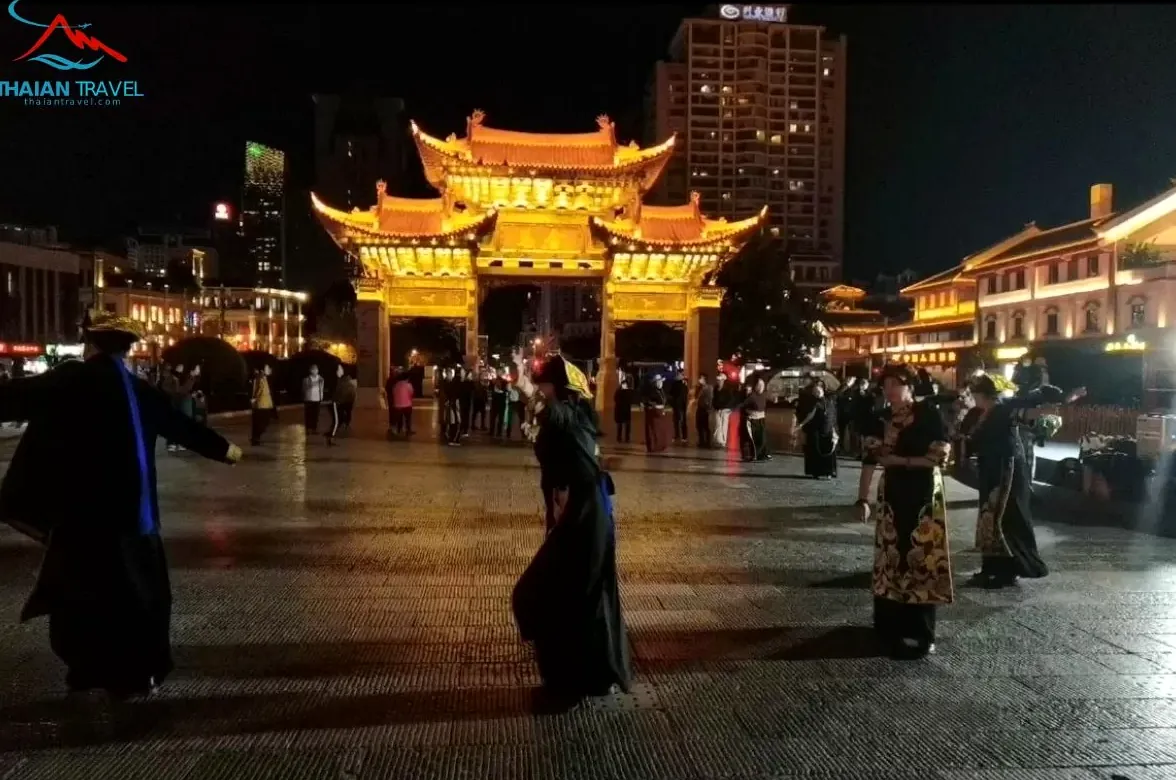
As night deepens, the open space beneath the two monumental towers transforms into a lively street-level performance stage. Without formal barriers or scripted stages, the public square operates as an organic musical river. Clear, soulful melodies from baowu gourd flutes and cucurbit flutes played by ethnic Yi and Bai musicians blend smoothly with acoustic guitar strums from young street buskers. In the adjacent open plaza, spirited Taxiu dances spontaneously form, where indigo garments embroidered with five-colored threads and chiming silver jewelry welcome curious travelers to join hands in a warm communal circle.
Nightlife expands further into a network of aromatic food stalls ringing the square. Warmth rises from grates grilling Erkuai rice cakes brushed with sesame paste, sweet floral notes of rose-infused pastries from Danfeng, and steam billowing from slow-simmered wild mushroom chicken hotpots from western Yunnan—crafting an irresistible sensory feast. Sitting quietly beneath a curved wooden eave at a traditional teahouse, sipping aged Pu-erh tea while watching crowds pass beneath glowing lanterns, visitors truly absorb the boundless prosperity and timeless romance of this legendary crossroads.
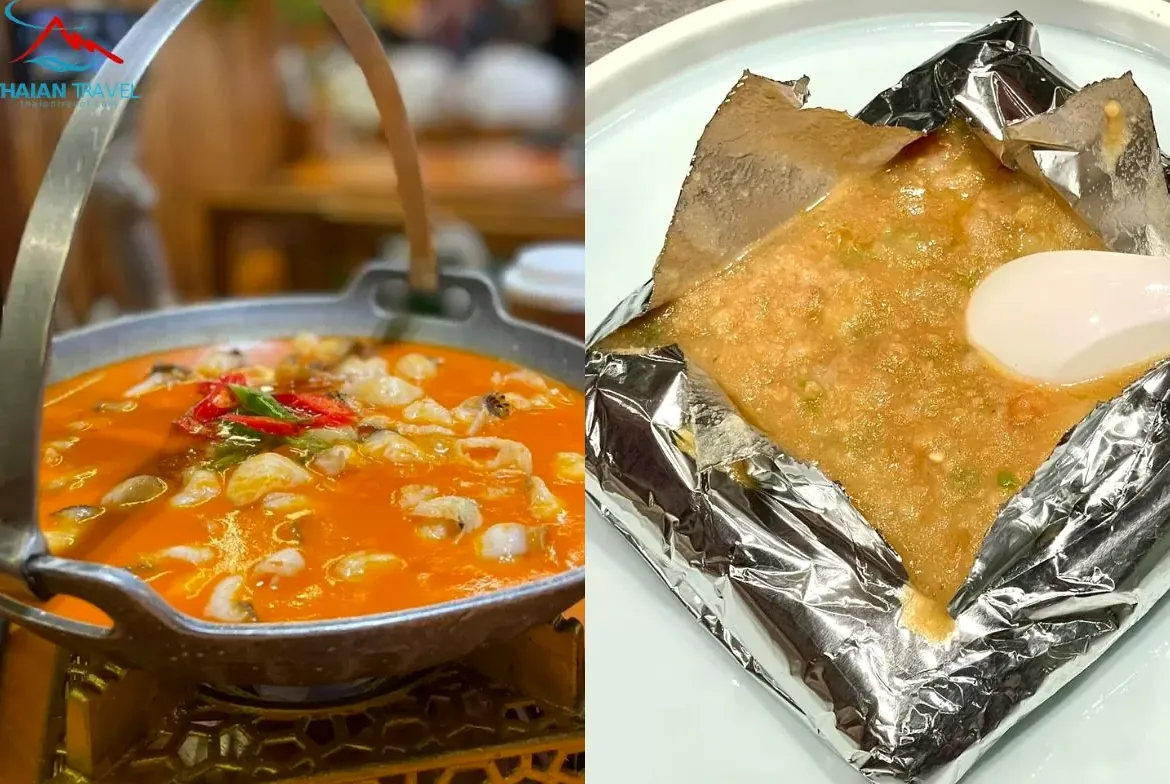
Dining around the Jinma Biji square has long been likened to a living heritage map, bringing together the finest culinary expressions of Yunnan across all four spring-like seasons. As twilight descends over the two magnificent archways, branching alleys like Tanyun Lane, Jingxing Lane, and the adjacent Kunming Old Street awaken in crimson lantern light and fragrant kitchen smoke from family-run eateries operating across generations. This culinary landscape not only satisfies passing appetites, but also serves as a folk museum reflecting the harmonious fusion of Dianchi Lake’s rich agricultural bounty and the multi-ethnic heritage of Yi, Bai, Hui, and Han communities over the centuries.
Reigning supreme in local culinary memory is Crossing-the-Bridge Rice Noodles (Guoqiao Mixian), an iconic dish tied to a touching Qing Dynasty legend from South Lake in Mengzi. The tale recalls a devoted wife crossing a long wooden bridge daily to deliver meals to her diligent studying husband; by topping rich broth—simmered for over ten hours from mature hen, pork bones, and beef marrow—with a thick seal of golden goose fat, she kept the broth boiling intensely underneath. At traditional teahouses around the Jinma Biji pagodas, enjoying Crossing-the-Bridge Rice Noodles is performed with ritualistic precision: diners add thin raw meat slices, fresh fish, quail eggs, and herbs sequentially into the rolling earthenware bowl before sliding in silky rice noodles handcrafted from high-altitude highland rice.
Wandering deeper into stone-paved alleys around Biji Archway, the rich aroma of grilled Erkuai over glowing charcoal embers catches the traveler’s attention. Dating back to the Ming Dynasty, this traditional snack uses white rice steamed and pounded in wooden mortars until delightfully chewy, then pressed flat into crescent moons resembling the waning moon. Grilled over live coals, the rice cake puffs up with the aroma of new harvest grain, brushed generously with spicy Yunnan bean paste and sweet malt syrup, sprinkled with toasted sesame seeds, and wrapped tightly around crispy crullers or pickled greens. Beside this rustic treat stands the rose flower cake (xianhua bing), an imperial tribute pastry once presented to Emperor Qianlong during the Qing Dynasty. Its flaky thousand-layer crust shatters gently to reveal a tender filling made from fresh, fragrant Dianzhong rose petals harvested at dawn, cured with wild honey and glutinous rice flour—delivering a clean, refined sweetness that enchants generations of literati.
The culinary map of the Jinma Biji district is further enriched by steam-pot chicken (qiguoji), utilizing characteristic purple pottery vessels from Jianshui featuring a unique central conical steam vent at the bottom of the pot. Free-range mountain chicken is chopped into neat cubes and arranged around the central tube alongside precious herbal tonics such as Wenshan Panax notoginseng, Zhaotong Gastrodia, and Angelica sinensis, without a single drop of added water. All the clear, sweet broth is distilled purely from rising steam over hours of slow simmering. By nightfall, after savoring pan-seared goat cheese (rubing) or stir-fried porcini mushrooms with fiery dried chilies, travelers often pause at an antique teahouse, sipping deep amber aged Pu-erh tea to savor the contemplative, time-honored flavor of Kunming.
The expansive Jinma Biji Square opens wide in the heart of modern Kunming, where two monumental archways soar like a magnificent bridge across time. At dusk, when smart multi-color uplights ignite, the entire multi-tiered bracket system and golden-tiled curving roofs stand out sharply against the deepening evening sky, reflecting off polished granite pavement busy with international visitors. Intricate carved rafter beams and gilded couplet boards transform the complex into a vibrant open-air cultural stage, where bustling metropolitan energy intertwines with the millennial sediment of the Nanzhao realm.
Regarding access, the Jinma Biji Square is a public open space accessible free of charge 24 hours a day without admission fees. However, the ideal window to experience the full architectural splendor runs from 4:30 PM to 10:00 PM, when architectural details remain distinct in fading daylight before glowing brilliantly under nightscape illumination. For transit, Kunming’s modern subway network makes getting there effortless: take Metro Line 3 to Wuhua Road Station or Metro Line 1 to Jinbi Square Station, and step straight out into the central plaza. Alternatively, central trunk bus lines including routes 3, 4, 62, 73, and A1 all feature stops named Jinma Fang right in front of the historic site.
For photography enthusiasts, the classic vantage point sits at the intersection between the two archways, where a wide-angle lens can capture both the western-facing Jinma Archway and the eastern-facing Biji Archway in a single twilight frame. If visiting during autumn equinox in a cyclic milestone year, you might witness the legendary “Interplay of Gold and Jade” as lunar and solar shadows interlace across the brick plaza. Afterward, walks easily extend to nearby pedestrian avenues such as vibrant Nanping Pedestrian Street, tree-shaded Jingxing Antique Street, or Nancheng Night Market, where visitors can enjoy a hot bowl of Jianshui Crossing-the-Bridge Rice Noodles or freshly baked rose flower pastries.
For border entry formalities and travel preparation, international travelers arriving in Kunming via Changshui International Airport or international rail links should ensure their passport remains valid for over six months alongside a valid tourist visa or applicable visa-free transit policy. Because cash is rarely used across urban China today, setting up mobile payment apps linked to international credit cards like Visa or Mastercard ahead of time is essential, alongside a reliable roaming data plan or eSIM for smooth navigation and digital translation. To ensure a seamless, well-paced journey without logistical stress, consider booking a professionally designed all-inclusive China tour package to unlock the timeless beauty of Kunming in comfort and style.