Rising majestically along the rugged junction of towering mountain ranges, Mount Dawei (Daweishan) stands like a mighty natural rampart sheltering the lush green plains below. The very name “Dawei”—meaning “Great Enclosure”—evokes a grand embrace of earth and sky, where hundreds of layered peaks encircle primeval valleys and endless subterranean springs. Shaped over tens of thousands of years of weathering and remarkable geological uplift, this highland massif is far more than a masterpiece of nature; it early on became a cradle preserving deep strata of cultural heritage, bearing witness to centuries of historical change across China’s ancient and medieval eras.
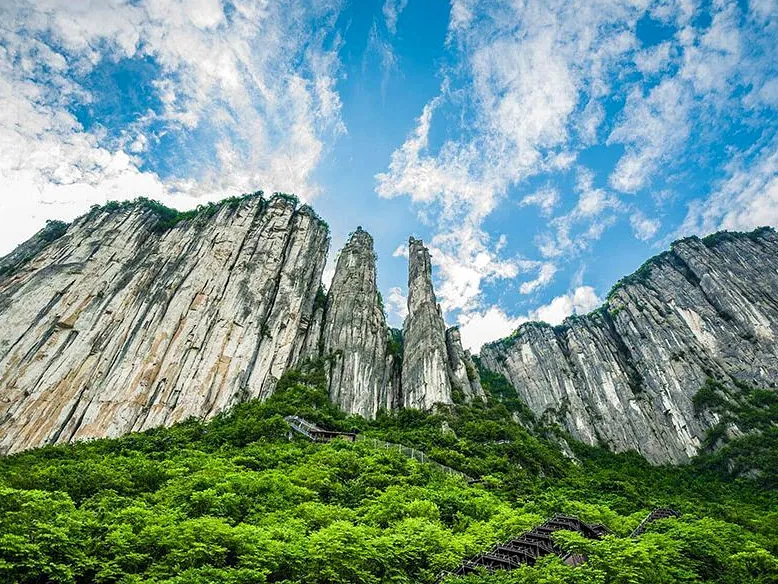
Viewed in panoramic sweep, towering peaks cloaked in the deep emerald of ancient primary forest appear and vanish amidst drifting billows of mountain mist. Weathered granite cliffs stand proudly exposed to mountain sun and wind, interwoven with dense carpets of vegetation stretching toward the distant horizon. This quiet, majestic spatial depth highlights the untamed, ethereal beauty of the range—resembling a classical ink-wash landscape painting that preserves the tranquil solitude and pure spiritual energy of nature since time immemorial.
Tracing back through ancient chronicles, this mountainous sanctuary first left a vivid imprint on historical records during the golden age of the Tang Dynasty. Under the Zhenguan and Kaiyuan reigns, the expansive serenity of these green peaks drew enlightened monks and reclusive poets seeking solitude away from worldly clamor. A convergence of Chan Buddhism and Daoist philosophy laid the foundation for hermitages, ancient monasteries, and Daoist temples rising beneath thousand-year-old pines and cypresses. Sheer granite cliff faces along mountain trails became canvases inscribed with verses and steles composed by sages of old, establishing Mount Dawei as a sacred retreat for scholars and spiritual seekers across successive eras.
During the transitions across the Song, Yuan, Ming, and Qing dynasties, the mountain assumed vital strategic importance as the region’s most formidable natural fortress. Rugged terrain, sheer precipices, and narrow defiles embodying the classic military maxim “one man at the pass can hold back ten thousand” turned the range into a key troop garrison and forward watchpost during periods of warfare and peasant uprisings. Remnants of winding bluestone courier trails, moss-draped field ramparts, and weathered stone steles tucked beneath old-growth forest canopy remain vivid testaments to those turbulent centuries.
Emerging from the mist of time and historical upheavals, the mountain range today embodies a living open-air museum of history and ecology. Oral legends of renowned generals guarding mountain passes and enlightened hermits blend seamlessly with ancient ruins amidst boundless woodland. That rich cultural depth infuses every stream and boulder with a living spirit, allowing every traveler who sets foot on its trails to feel the enduring pulse of the past echoing through mountain stillness.
Viewed through classical Chinese geomancy and regional topography, Mount Dawei serves as a majestic natural screen guarding the provincial border between Hunan and Jiangxi. Forming the northern anchor of the imposing Luoxiao Mountain range, the massif features an expansive basin encircled by dozens of layered peaks—fulfilling its name “Dawei” as a self-contained natural citadel built to gather vital energy and shelter against harsh winds. Vigorous mountain veins originate along solid granite ridges, wind through deep gorges, and descend into fertile valleys, giving birth to the pure headwaters of the famed Liuyang River. This harmonious interplay of embracing peaks and converging waters creates a mild, distinctive microclimate veiled in auspicious clouds year-round, nurturing lush biodiversity and an otherworldly sanctuary high above everyday life.
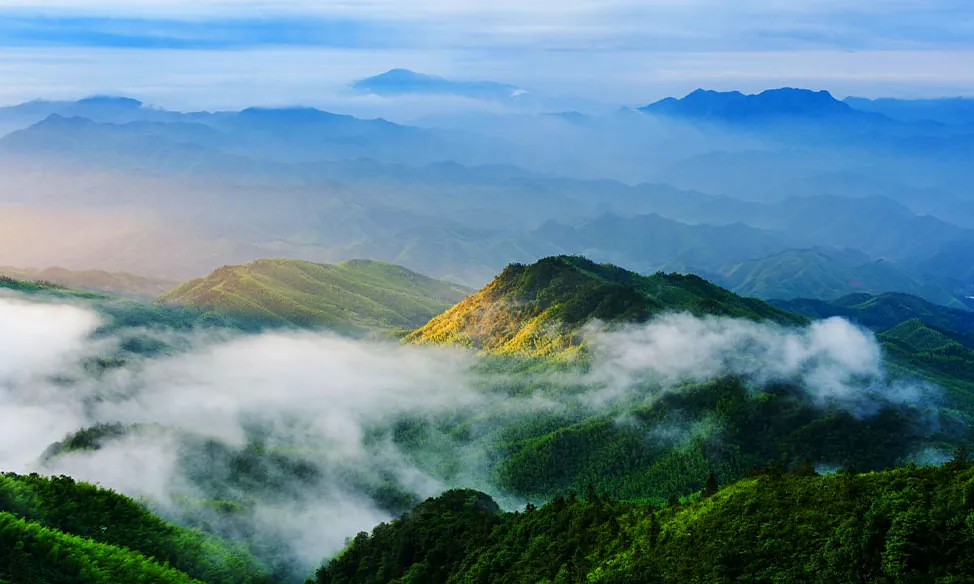
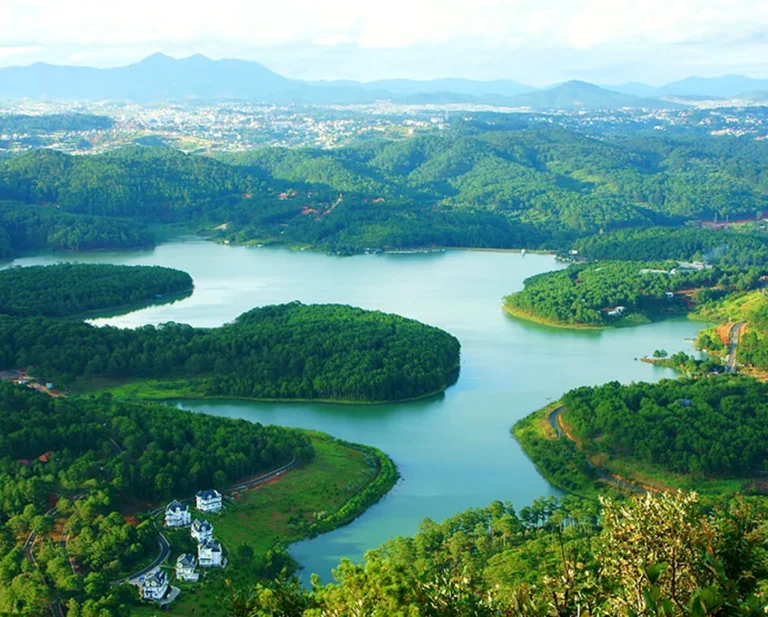
From high-elevation vantage points, Mount Dawei unfolds as a breathtaking panorama of rolling green ridges rising and dipping through billowing seas of cloud. Sheer granite walls soar into azure skies in graceful counterpoint to endless carpets of deep green forest draping every slope like velvet. Layered botanical zones ascend from the valley floor to the highest crests—where morning mist weaves through ancient tree canopies and untouched hollows—opening onto boundless vistas that make travelers feel as though they have stepped into an immortal mountain paradise at once majestic and profoundly peaceful.
Geomorphologically and geologically, the Mount Dawei massif was forged during ancient Yanshanian tectonic movements, producing a colossal granite batholith marked by dramatic relief and distinct vertical zonation. Its highest summit, Qixingling (Seven-Star Peak), reaches 1,607.9 meters above sea level, proudly claiming the title “First Peak of Eastern Hunan” for its commanding vistas across the eastern province. The terrain also preserves clear signatures of Quaternary glaciation, leaving giant boulder fields scattered along stream beds, gentle U-shaped valleys alternating with deep gorges, and roaring waterfalls cascading day and night. More than a thousand meters of elevation gain between base and summit generates diverse microclimatic zones ranging from humid subtropical foothills to crisp, dramatic alpine meadows.
Scientists regard the mountain’s natural ecosystem as a living “primeval genetic bank,” boasting an astonishing forest coverage rate of nearly 99.5% that functions as an invaluable green lung purifying the air. Mount Dawei’s old-growth forests shelter thousands of higher plant species and rare wildlife, including centuries-old trees anchored deep into granite cliffs. Most remarkable of all on slopes above 1,400 meters are rare high-altitude peat bogs alongside a vast “sea of wild azaleas” spanning tens of thousands of *mu*. Every late spring into early summer, tens of thousands of ancient azalea trees burst simultaneously into vivid crimson, peach-pink, and snow-white blooms—transforming cool gray granite ridges into dazzling ribbons of blossom draped across the clouds.
Spatial planning across the Mount Dawei scenic area unfolds across multiple harmonious tiers where human craftsmanship treads lightly amidst towering peaks. The forest park is organized into clear functional zones balancing strict primary-forest conservation with solemn cultural and spiritual exploration. Rising from the foothills to elevations exceeding a thousand meters, arterial scenic roads thread through deep valleys, guiding travelers across dramatic botanical transition zones before opening onto airy cloud-top meadows and ancient heritage sites steeped in millennial legend.
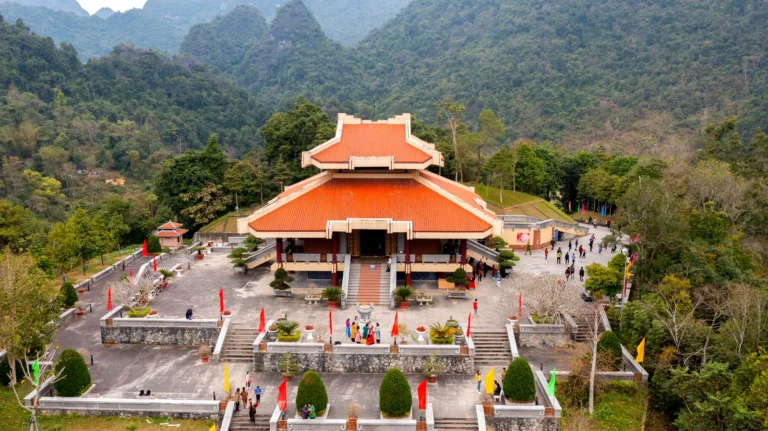
Nestled peacefully inside a mist-veiled valley, the historic monastery complex rises with upturned dark glazed-tile eaves contrasting striking against the deep green of ancient woodland. Timber corridors linking front and main halls follow strict classical symmetry, while moss-draped gray sandstone steps lead quietly through contemplative Zen courtyards. Every roof corner and ridge beam is carved with delicate cloud motifs, accompanied by the resonant chime of bronze temple bells drifting across the silent hills—creating an ethereal monastic sanctuary blended seamlessly into untamed wilderness.
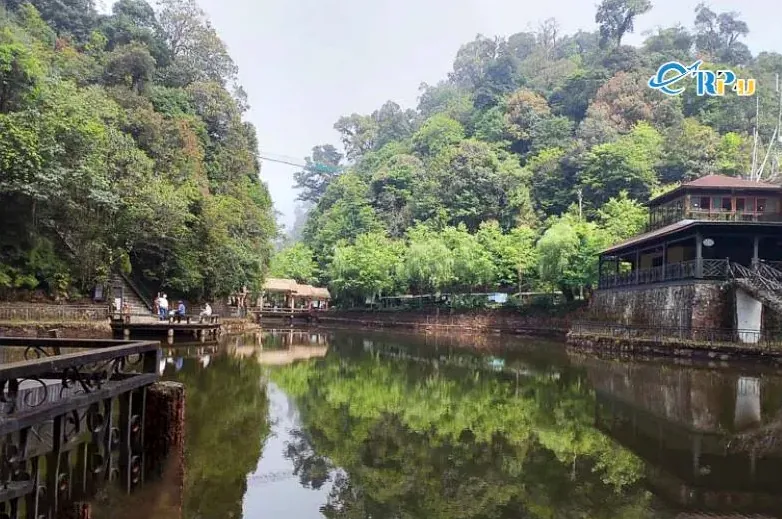
The crowning jewel of human architectural heritage here is ancient Yuquan Temple, a monument imbued with Tang–Song stylistic grace and built with sturdy columns of prized local hardwood. Following the principle of adapting harmoniously to nature, the main hall rests its foundation solidly against a sheer granite cliff face while looking directly out over a crystal-clear pond designed to gather vital energy. Multi-tiered *dougong* bracket sets interlock through precision wooden joinery without a single iron nail, enabling the temple to endure centuries of harsh mountain weather while showcasing the supreme woodworking mastery of ancient artisans.
Alongside its spiritual core, modern infrastructure at Mount Dawei achieves a triumph of low-impact ecological engineering. Elevated wooden skywalks stretching thousands of meters wind gracefully along the steep granite flanks of Qixingling Peak, allowing visitors to admire the vast sea of wild azaleas up close without disturbing fragile forest floor humus below. A closed-loop aerial cableway—whose support towers were transported and erected using manual methods to minimize forest clearing—glides smoothly across dramatic gorges in just ten minutes.
The visitor landscape is further complemented by thoughtfully integrated amenities, from high-altitude astronomical observation decks on windswept ridges to a visitor center crafted from natural stone and clear tempered glass. Dispersed spatial planning paired with closed-loop wastewater treatment makes Mount Dawei a model of sustainable eco-tourism where modern comfort harmonizes completely with the sacred breath of primeval nature.
When night descends across Mount Dawei’s layered ridges, the quiet woodland awakens in an enchanting symphony of contemporary visual art. In a gentle valley tucked beneath Qixingling Peak, an open-air live stage illuminates the forest as state-of-the-art laser beams and multicolored floodlights sweep through drifting mountain mist. Thousands of luminous hues light up waterside pavilions reflected in crystal ponds, culminating in Liuyang’s legendary fireworks bursting into glittering blossoms across the night sky—weaving an unforgettable nocturnal spectacle amidst untamed peaks.
Nightlife across this mountain plateau draws deeply from Liuyang’s thousand-year-old heritage as the birthplace of Chinese fireworks. Tradition holds that during the Tang Dynasty, fireworks pioneer Li Tian laid the foundations of pyrotechnic craft right in this region to ward off evil spirits and celebrate beauty. Honoring that legacy, live performances at Mount Dawei blend precision micro-pyrotechnics with 3D projection mapping directly onto natural granite cliffs and giant mist screens—bringing to life legends of Shennong tasting medicinal herbs in deep mountain valleys and local heroes reclaiming highland fields, dissolving boundaries between epic history and dramatic nature.
At elevations exceeding 1,600 meters above sea level, Qixingling Peak also becomes a celestial paradise for stargazers. Completely free from urban light pollution, alpine meadow campsites reveal the brilliant Milky Way arching across an ink-black sky. During overnight forest music and camping festivals, the warm glow of hundreds of illuminated tents blends with acoustic folk melodies and rushing streams echoing up from deep gorges—while low-altitude artistic fireworks choreographed to symphonic rhythms turn misty mountain nights into a sensory celebration.
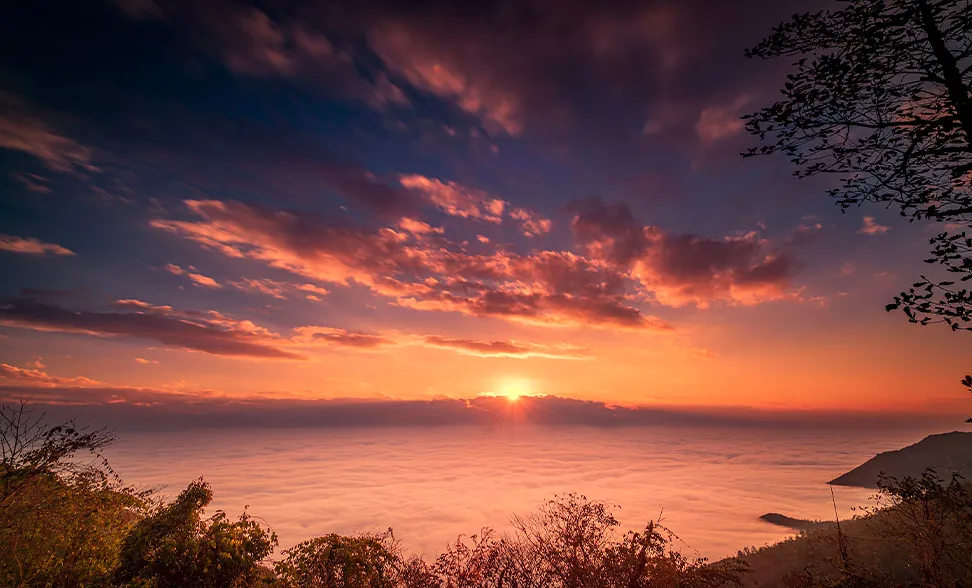
Concluding an evocative evening excursion, footsteps lead back to historic Hakka villages nestled around the foothills, where nighttime unfolds warmly around crackling pinewood hearths. In the crisp, mist-kissed air, lilting mountain folk songs drift across rustic wooden verandas, melting away travel fatigue. Gathering around glowing embers, guests savor steaming bowls of herbal-stewed free-range mountain chicken, sip fragrant wildflower honey wine infused with azalea blossoms, and nibble savory hearth-cured bacon—while family migration tales flow gently with the evening hearth smoke, leaving lasting memories of mountain warmth.
A journey to sacred Mount Dawei lingers in memory not only through endless seas of clouds and vibrant azaleas, but also through the celebrated mountain gastronomy of Liuyang. Inside historic hillside taverns, local flavors come alive in steaming clay pots stacked over glowing charcoal braziers. Rustic tables welcome guests with thin-sliced amber-red cured pork bacon (*larou*) marbled with translucent fat, freshly dug baby bamboo shoots retaining morning dew sweetness, and crispy pan-fried mountain stream fish tossed in fiery Hunan chili sauce—simple, hearty fare perfumed with crackling pinewood that warms the soul amidst drifting summit mist.
At the heart of local gastronomy lies the art of Liuyang Steaming (*Liuyang Zhengcai*), an intangible cultural heritage born over centuries from the fusion of Hakka migrant traditions and indigenous Hunan flavors. Unlike high-heat wok stir-frying common elsewhere in Chinese cuisine, Mount Dawei’s steaming tradition prizes patience and pure spring water vapor. Inside rustic cedarwood steamers or unglazed clay bowls, ingredients cook gently over boiling water without losing natural nutrients. A signature pairing of aged fermented Liuyang black beans (*douchi*), minced fiery bird’s-eye chilies, and drops of golden camellia oil elevates humble staples—such as steamed pork ribs, dried tofu, and tender eggplant—into deeply aromatic delicacies that awaken every sense.
Beyond steaming mastery, Mount Dawei’s 1,600-meter elevation bestows an abundant seasonal pantry. Spring brings sweet, tender wild bamboo shoots and wild shiitake mushrooms sprouting naturally on ancient beech trunks. Sleek, shimmering mountain stream fish caught by hand from icy rushing brooks boast firm, naturally sweet flesh completely free of muddy aftertaste. When winter blankets the forests in snow, Hakka households light slow-smoking fires fueled by sugarcane bagasse, fragrant rice husks, and cypress branches—hanging slabs of pork above hearths for months to absorb aromatic smoke and crisp highland chill before stir-frying with young leeks or pickled mountain greens.
To round out a mountain feast, few visitors miss a cup of Mount Dawei Cloud-Mist Tea harvested from ancient hillside tea bushes bathed year-round in white mountain mist. Its brisk initial astringency gives way to a deep, lingering sweetness, pairing wonderfully with golden wildflower honey wine or warming herbal-fermented glutinous rice wine. Unpretentious yet rooted in restorative wellness philosophy, Mount Dawei’s cuisine reflects centuries of harmonious living with untamed nature.
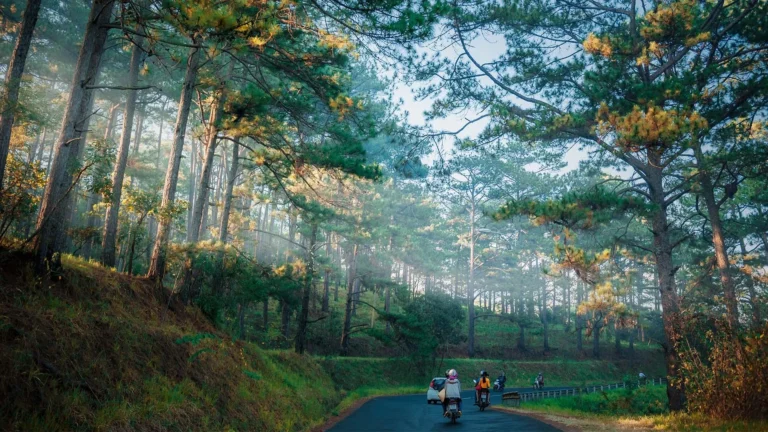
Winding mountainside roads guide travelers deep into the pristine expanse of Mount Dawei, where primary forest embraces every fold of the terrain. Smooth asphalt curves like a ribbon through deep emerald stands of ancient pines, cypresses, and rustling bamboo groves. In the distance, drifting clouds swirl gently around towering granite peaks, evoking the ethereal serenity of northeastern Hunan’s famed wonderland. Shafts of morning sunlight filter through dense canopies onto quiet roads, making every step along the mountain path feel effortlessly restorative.
For a smooth and rewarding visit, keep the scenic area’s seasonal rhythms in mind. Mount Dawei welcomes visitors year-round from 8:00 AM to 5:30 PM daily, with dedicated eco-shuttle buses operating continuously between the forest gate, the cableway station, and the trailhead for Qixingling Peak. The finest time to visit arrives in mid-spring from April through May, when more than ten thousand *mu* of wild mountain azaleas burst into crimson bloom across rocky slopes, transforming the range into a floral sea above the clouds. Come summer, average mountain temperatures hover comfortably between 20°C and 22°C, offering a refreshing cool-climate escape from central China’s summer heat.
Getting to Mount Dawei National Forest Park is convenient thanks to well-developed regional highways. Departing from central Changsha, drivers can follow the Changsha–Liuyang Expressway for roughly 110 kilometers, reaching the foothills in about 1.5 to 2 hours by car. Travelers relying on public transport can board daily express coaches from Changsha East Bus Station directly to Daweishan Town, where local buses or waiting taxis swiftly transfer visitors to the scenic area entrance.
Because Qixingling Peak rises to 1,608 meters above sea level, summit temperatures typically run six to eight degrees Celsius cooler than the base—making layered clothing, a windproof jacket, and high-traction hiking shoes essential for navigating steep stone steps around Baiyuan Waterfall and Chuanding Lake. International visitors should arrange a valid Chinese tourist visa at least thirty days prior to departure, and activate an international roaming package or eSIM alongside linking an international bank card to Alipay or WeChat Pay for seamless cashless transactions on the go.
Alongside breathtaking scenery, be sure to sample rustic Liuyang forest specialties—such as steamed fermented black-bean tofu with chilies, stir-fried fresh bamboo shoots with hearth-cured bacon, or a cup of sweet-finish Dawei Cloud-Mist Tea at cozy mountain rest stops. For first-time visitors to the historic Chu–Xiang cultural heartland looking to streamline transfers, accommodations, and park admissions, joining a thoughtfully arranged all-inclusive China tour package guarantees an effortless, enriching journey amidst emerald peaks and drifting clouds.