Nestled at the estuary where the vast Pearl River flows and deposits its silt, the city of Zhuhai spent centuries as nothing more than a peaceful coastal strip of fishing villages sheltered by the rolling waves of the Lingnan hills. A historical turning point unfolded when the area became one of the first special economic zones in mainland China, paving the way for a spectacular transformation from a quiet backwater into a dynamic economic hub. However, the city’s aspirations did not stop at trade figures or bustling ports. To create a spiritual symbol worthy of the millennial vision of the Guangdong-Hong Kong-Macao Greater Bay Area, the Zhuhai Grand Theater project—richly poetic and known as the Sun and Moon Shell (珠海大剧院)—was officially approved and commenced construction in 2010 on Yeli Island, marking the beginning of a new historical chapter in coastal architecture and culture.
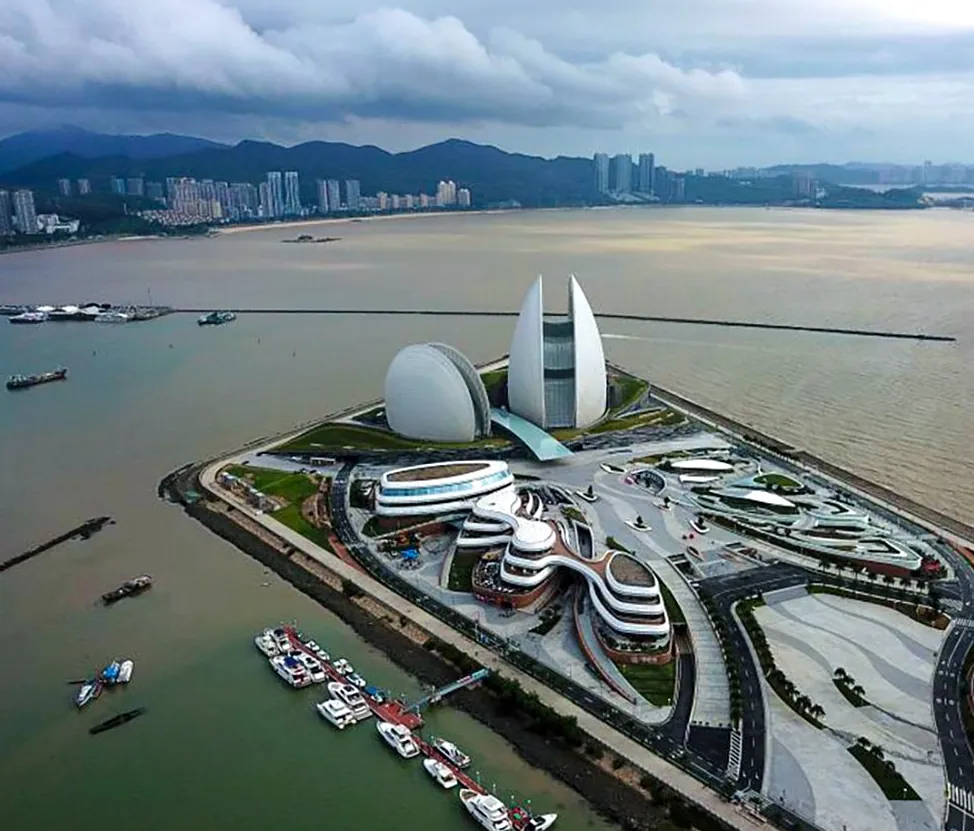
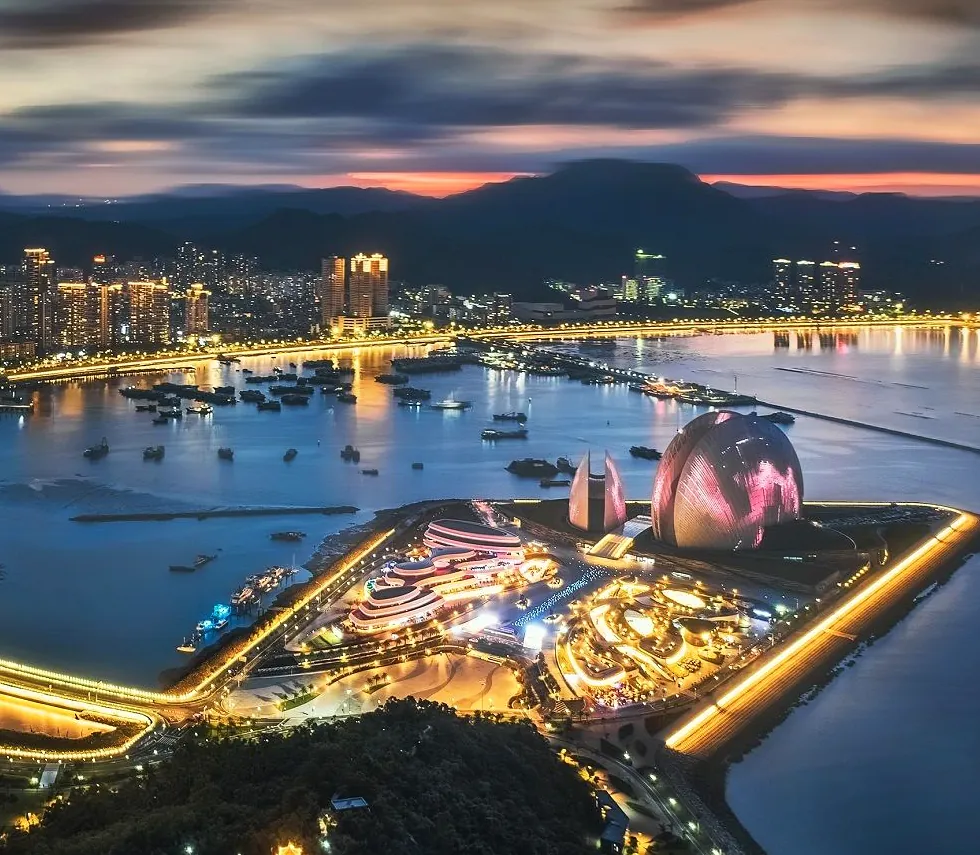
Observed from the expansive aerial perspective of a drone, the panoramic view of the Zhuhai Performing Arts Center emerges majestically, resembling a pair of giant pearlescent clam shells just barely opening amidst the vast waves of Xiangzhou Bay. The structure reigns proudly upon the rocky foundation of Yeli Island, completely embraced by the azure sea and connected to the mainland via the gracefully curving Qizhou Bridge. The two semi-circular dome blocks boast pearly white hues—one large, one small, leaning against each other—fully showcasing the aesthetic contrast between contemporary steel structural engineering and the pristine beauty of the ocean. This sweeping vantage point from the breezy expanse asserts the exclusive status of an architectural masterpiece at sea, where the boundary between human craftsmanship and natural scenery seems to completely dissolve into one.
The history of Zhuhai is intrinsically tied to the profound shifts of Lingnan culture, having witnessed thriving maritime exchanges since the Tang and Song dynasties along the Maritime Silk Road. During the Ming and Qing dynasties, this estuary served as a crucial frontline outpost guarding the Guangzhou Bay and fostering close ties with neighboring Macau. Through countless historical vicissitudes and the administrative redesign of the former Zhongshan County, Zhuhai rose to establish its independent status. The establishment of an international-standard performing arts center on Yeli Island is not merely an expansion of urban infrastructure, but a celebration of maritime heritage, linking the millennia-old maritime history of our ancestors with the global integration mindset of the new century.
The construction journey spanned over six arduous years, overcoming immense challenges regarding marine geology, tropical gales, and some of the world’s most stringent acoustic standards. On December 31, 2016, the Sun and Moon Shell officially cut its ribbon in eager anticipation by art scholars and the public throughout the Lingnan region. The New Year’s Eve concert held precisely at that historic transition moment made the structure the first operational coastal theater on mainland China. Urban researchers hailed this inauguration as a pivotal turning point, laying a solid foundation for the strategy of upgrading cultural infrastructure and acting as a catalyst to promote the integration of arts and cultural spaces among Guangdong, Hong Kong, and Macau.
Hidden behind the grand structure of the theater is a profound philosophy rooted in ancient texts and Eastern aesthetics. The name Sun and Moon Shell symbolizes the sun and the moon, while echoing ancient idioms about deep-sea pearls nurtured by the quintessence of the sun and moon. The larger shell symbol, standing ninety meters tall, represents the radiant sun, while the smaller sixty-meter shell symbolizes the pure, gentle moon. Amidst the ever-changing tides of times and the hustle and bustle of modern life, the architectural complex stands as a new historical witness, fully crystallizing the soul of the “city of a hundred islands,” where the millennia-old waves of the ocean settle into timeless artistic melodies.
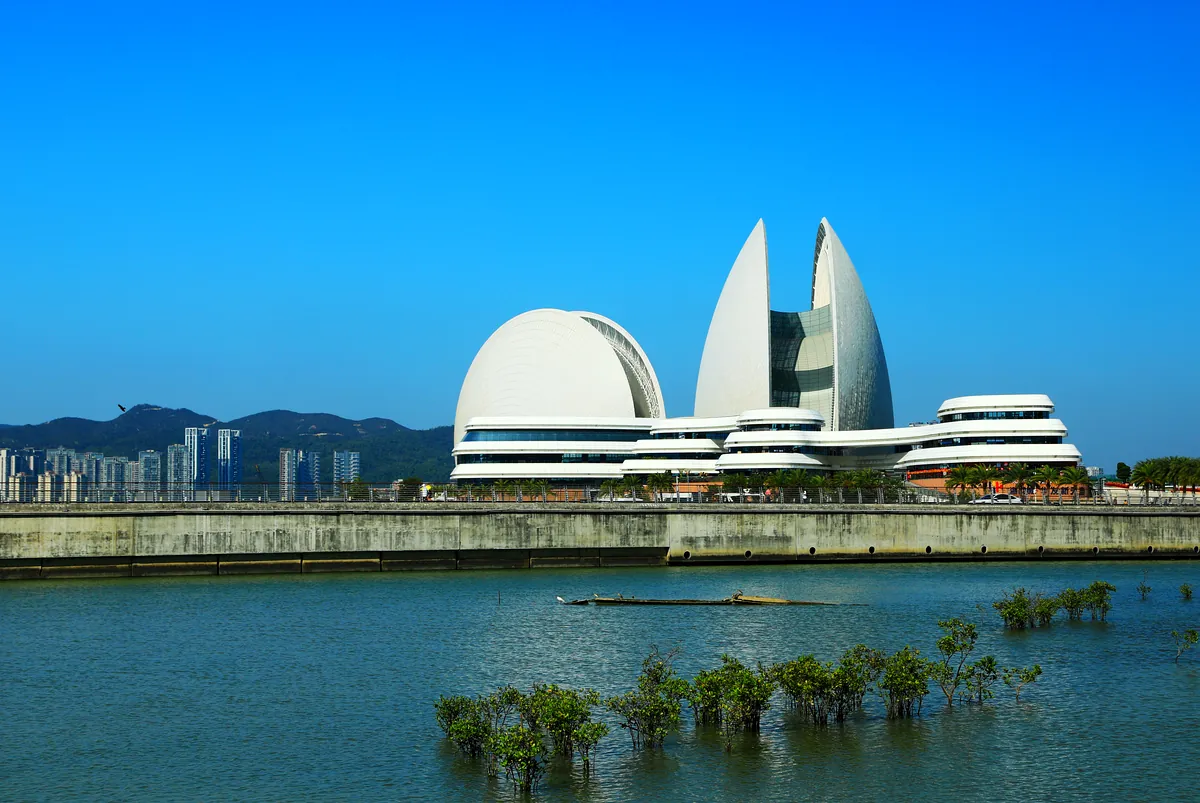
Viewed from high above or from the breezy Xiangzhou coastline, the Zhuhai Grand Theater complex rises imposingly amidst the waters of Yeli Island like an oceanic sculptural masterpiece. The dual architectural structures shaped like the Sun and Moon Shell twin clam shells are cloaked in pure pearlescent white, reaching proudly above the boundless jade expanse of the Pearl River estuary. Interspersed across the crystal-clear water is a pedestrian bridge winding softly like a silk ribbon connecting the mainland to the pearl island. During transitional moments of the day—when the sunset paints the sky in crimson or at the first light of dawn—the silhouettes of the two giant shell wings shimmer in the water below, painting an exquisite harmony between human creation and the pristine scenery of the South China Sea bay.
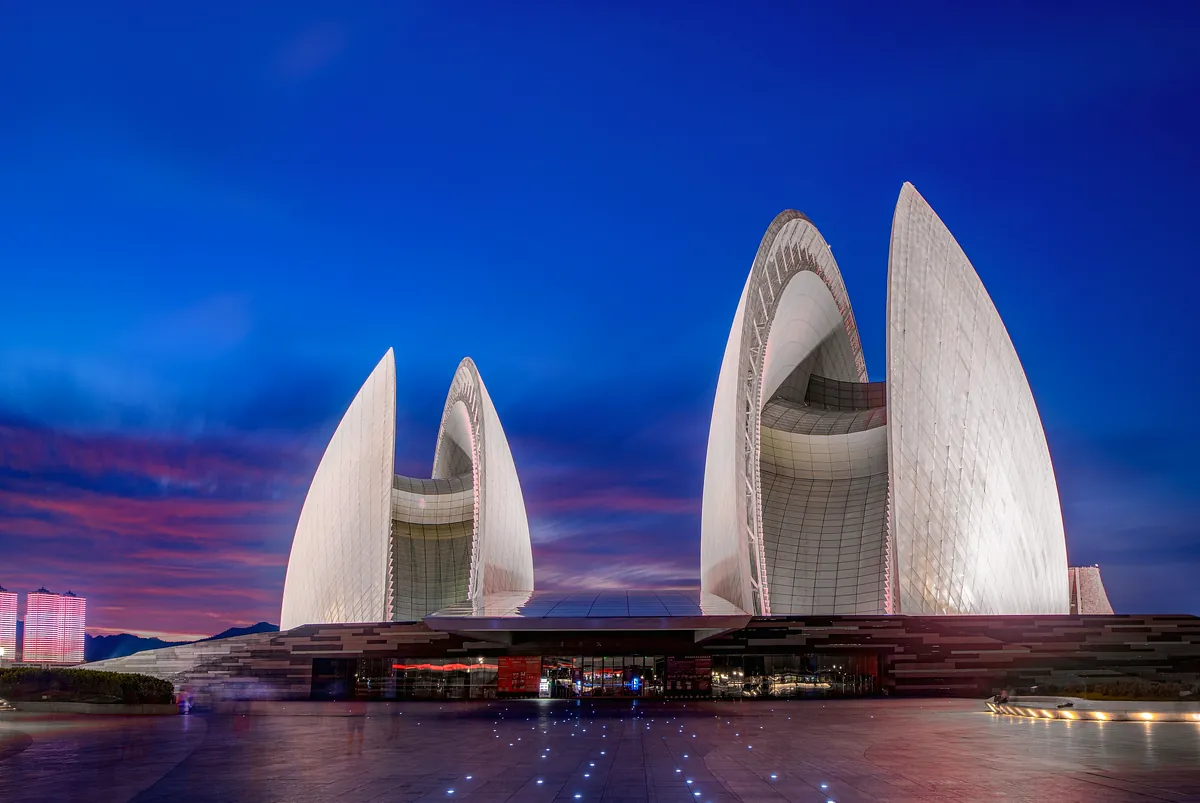
In traditional East Asian urban planning and feng shui, the impressive location of the Sun and Moon Shell Theater is considered by experts to be a rare site with a perfect “leaning against the mountain, facing the water, gathering wind and energy” configuration. Yeli Island is a natural pearl-like islet in the Xiangzhou District, shielded from behind by the sturdy dragon veins of the mainland, most notably the majestic Shijingshan and the rolling Phoenix Mountain ranges. The front of the structure opens up to capture the vital energy from the vast Lingdingyang Sea. According to Lingnan coastal feng shui, water represents wealth and the endless flow of wisdom and art; establishing a performance sanctuary at this “convergence of a hundred rivers” point not only preserves the inherent tranquility of Yeli Island but also heralds a lasting, prosperous era for the spiritual landscape of the entire coastline.
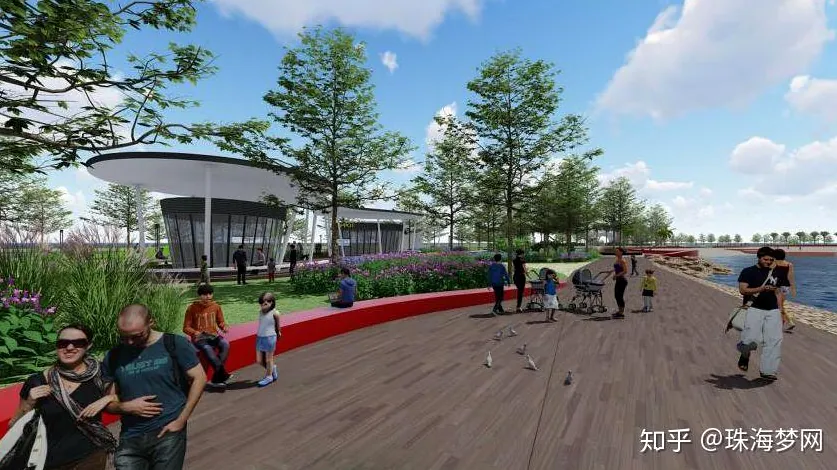
The historical uniqueness of the project lies in its ingenious terrain planning: it is the only large-scale theater in China built entirely on an offshore island. The infrastructure planning here skillfully resolves the conflict between modern performance functionality and the preservation of the natural ecological carpet. Instead of massive land reclamation, a soft connection system consisting of the Yeli Bridge and the Haiyan Bridge was established to directly link the island to the bustling Lovers’ Road coastal route. The pedestrian bridge serves not merely as a traffic artery but as a “psychological transition corridor.” As one strolls across the breezy sea-crossing bridge, the physical distance between the mainland and Yeli Island transforms into a symbolic boundary, washing away the noise and bustle of urban life and guiding visitors into a state of calm and purity before enjoying world-class art.
The natural landscape surrounding the structure carries the liberal breath of a subtropical maritime climate. The terrain of Yeli Island is organized in tiered levels, featuring a coastal ecological park filled with the shade of casuarina trees, lush salt-tolerant vegetation that remains green year-round, and natural rocky outcrops winding along the water’s edge. The seasonal tidal shifts and the southern sea breezes blowing through the bay create a cool, fresh microclimate distinct from the mainland. On moonlit nights or misty mornings, the contrast between the soft, rippling textures of the native vegetation and the solid, proud geometric structures of the two stone shells creates a harmonious landscape, turning the entire island into a jade gem shining brilliantly amidst the southern sea and sky.
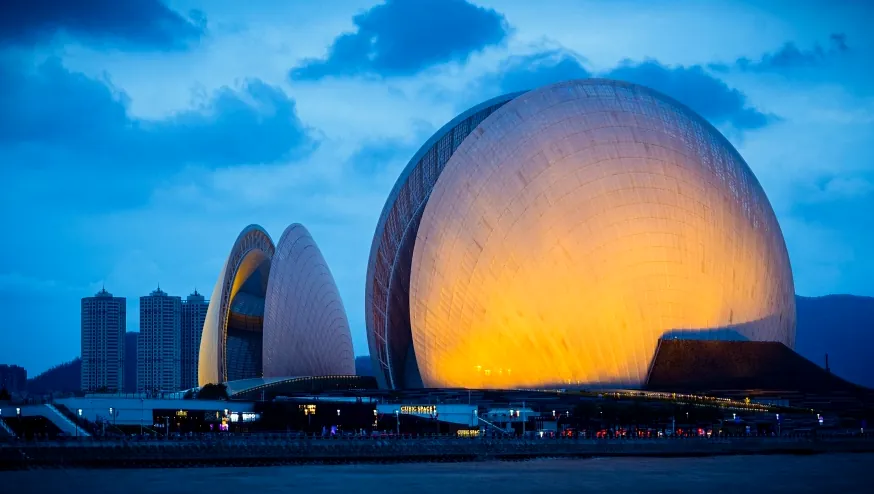
As the evening glow descends upon the South China Sea bay, the panoramic view of the Zhuhai Sun and Moon Bay Cultural and Art Center bursts into a surreal and magnificent beauty. Under a sunset that dyes the calm sea in shades of amber and deep purple, the two giant shell-shaped architectural blocks rise like treasures just washed ashore by the waves. The water reflects the soft curves of the two interlocking semi-circular shells, where the last light of the sunset blends with the first rays of light being activated, creating a spectacular architectural perspective between the vast nature and the talented hands of human creation.
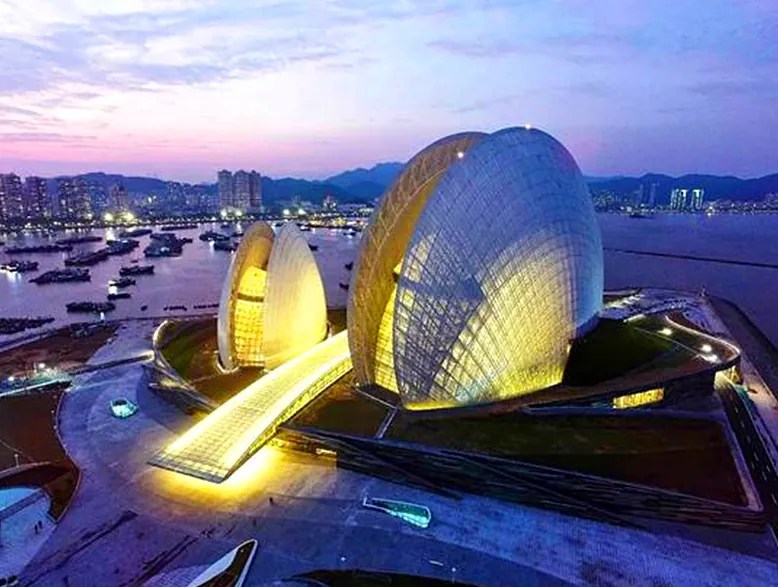
Originating from the philosophy of “the sun and moon rising together” from the depths of the sea, the project possesses a unique dual composition unparalleled in the world for an island theater. The architectural imagery is distilled from the semi-circular scallop shell – a marine creature symbolizing the abundance and purity of the Guangdong coast, while also visually evoking the birth of Venus in classical mythology. The two shell structures are standardly designated as the Sun Shell (larger) and the Moon Shell (smaller), forming a massive sculptural entity with a total floor area exceeding fifty thousand square meters. The staggered arrangement in height and tilt angle between the two structures not only optimizes sea breeze flow and reduces the impact of tropical storms but also creates a rhythmic visual dialogue between the land, the ocean, and the vast horizon.
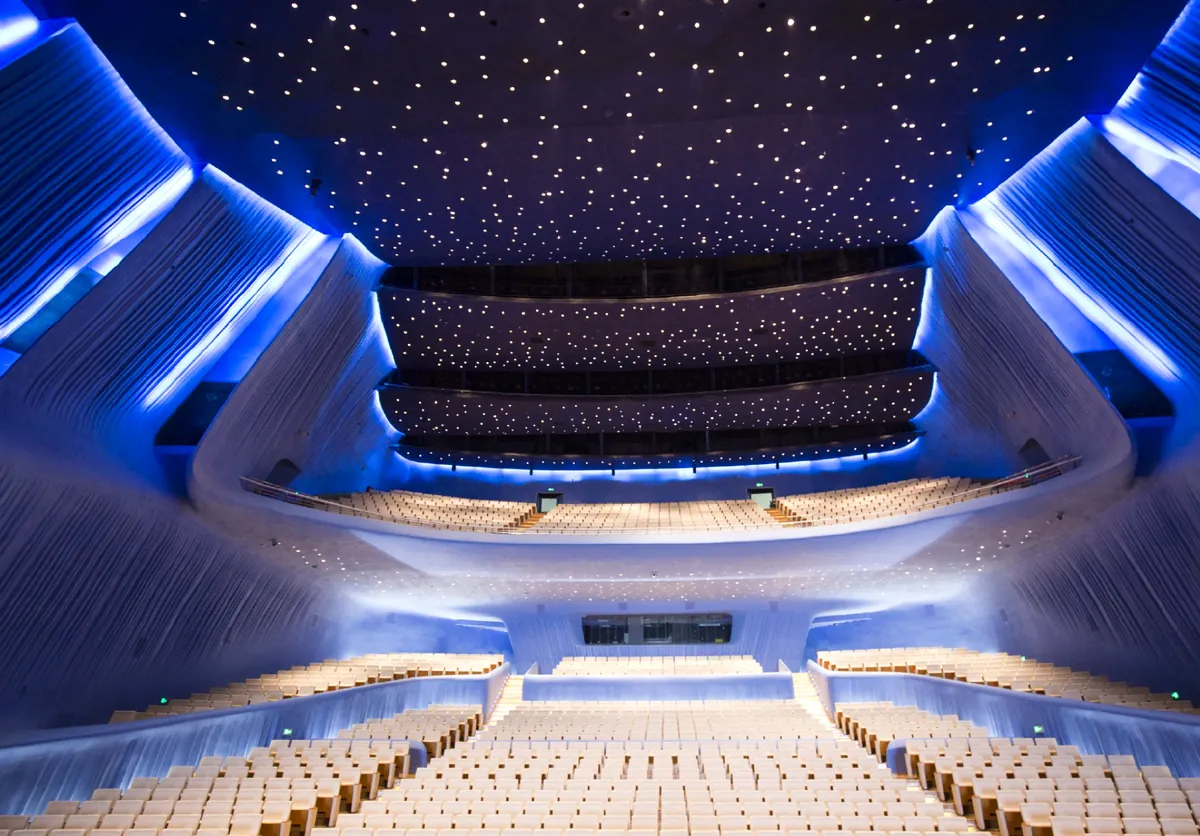
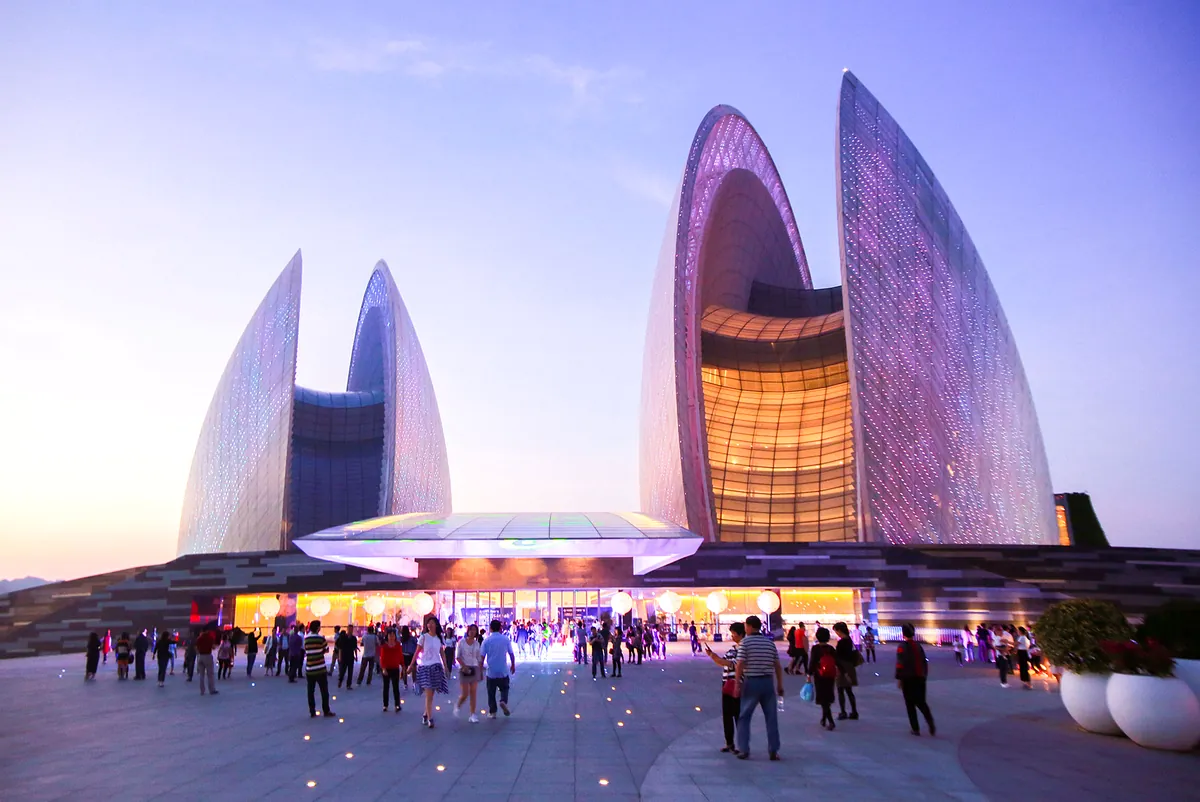
The Sun Shell represents yang energy, rising proudly to ninety meters amidst the sea and sky. Inside this majestic shell is the central Grand Theater with a capacity of 1,550 seats, designed in a classic horseshoe structure to minimize the distance from the auditorium to the stage. The entire interior space is precisely measured according to the strictest international acoustic standards, with reverberation times optimized to serve grand ballets, classic operas, and large-scale symphonic concerts without relying on electronic amplification systems. The tiered auditorium structure, undulating like crashing waves, combined with a system of sound-absorbing grooves and high-end acoustic diffusion panels, preserves the clarity and power of every note to the very last row.
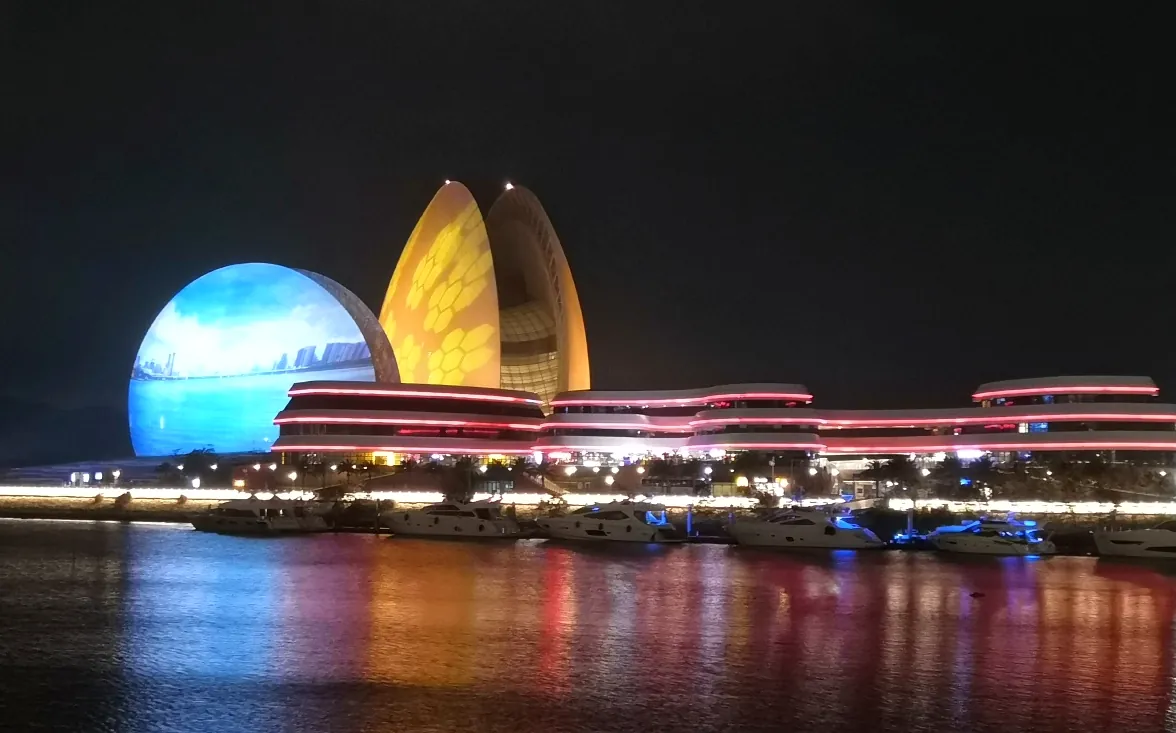
Nestled gracefully beside its giant sibling, the Moon Shell, which stands at sixty meters high, it serves as an exquisite multi-purpose theater with a capacity of five hundred and fifty spectators. Unlike the monumental and ceremonial grandeur of the Sun Shell, the Moon Shell is tailored to host spoken plays, chamber concerts, and contemporary art performances that require close-up intimacy and high expressiveness. Technically, the outer shell of both architectural clusters represents the pinnacle of modern spatial steel frame construction, enveloped by tens of thousands of specialized perforated aluminum panels capable of withstanding the extremely high salinity and humidity of the coastal climate. These microscopic perforations are meticulously arranged in a calculated density, ensuring natural ventilation while serving as a giant projection screen for the three-dimensional holographic LED lighting system, transforming the entire structure into a shimmering piece of bioluminescent light art against the night sky of Zhuhai.
The massive investment scale of the project does not stop at the two specialized theater blocks but also encompasses an ecosystem of public amenities sprawling across Yeli Island. The terraced plazas, coastal viewing promenades, and auxiliary arts service centers are seamlessly connected, creating an open complex that welcomes ocean breezes from all directions. The fusion of contemporary sculptural thinking and reclamation engineering has turned this complex into a sturdy mechanical wonder, ready to withstand high-level storms from the open sea while retaining its slender, ethereal grace like two seashells washed ashore on golden sands.
Viewed from a panoramic height at twilight, the Zhuhai Grand Theater emerges like a surreal sculptural wonder amidst the blue waters. The pair of giant clam shells—with the Sun Shell soaring 90 meters high and the modest Moon Shell beside it—catch the amber rays of the setting sun gilding Lingding Bay. The elegant curves of the double-shell structure stand out against the Yeli Island skyline, creating a magical harmony between futuristic architecture and the tranquil hues of the sea at dusk.
When darkness completely envelops the bay, the Sun and Moon Shells shed their solemn stone-and-glass demeanor to don a magnificently glowing optical gown. Tens of thousands of smart 3D LED bulbs hidden deep beneath the surface of the semi-translucent composite shell begin to activate in unison, transforming the entire structure into a giant dynamic light art installation hovering over the sea. The lighting here does not operate through simple static projection but flows according to sophisticated visual programming: sometimes simulating bioluminescent phenomena deep in the ocean, other times recreating a mystical Milky Way or mimicking the rolling rhythm of tidal waves. Thanks to special refraction effects, the two shell blocks resemble glowing pearls shining brightly in the dark night, creating a breathtaking visual focal point that can be fully captured from the opposite shore or from sightseeing cruises far out at sea.
Running parallel to this magical outer visual feast is the pinnacle artistic heartbeat pulsing within the auditoriums. The 1,550-seat grand theater and the 550-seat multi-purpose auditorium feature world-class electronic and mechanical acoustic systems, continually serving as a sacred performance venue for classic musicals, grand symphonies, and renowned dance troupes. The indoor performance space is completely soundproofed to preserve the purity of every acoustic vibration, yet as the auditorium doors open into the glass-enclosed polygonal lobby, audiences are instantly welcomed by panoramic ocean views shimmering with lights. The ingenious combination of classical performing arts and the real-life backdrop of the sea blurs the boundaries of a framed stage, offering the public an emotionally multi-dimensional viewing experience.
Nightlife on Yeli Island and the adjacent coastline also comes alive and vibrant thanks to this artistic vitality. Along the stone-paved walking path around the base of the theater, the fresh sea breeze dispels the daily sultriness, guiding visitors to stroll and admire the multicolored shimmering water scenery. Open-air cafes, relaxing beverage spaces, and stone steps right at the water’s edge are always bustling with visitors chatting, while photographers eagerly capture the exquisite reflection of the architecture on the waves. This area has naturally shaped itself into an elegant cultural hub for nightlife, a gathering place for locals and an unmissable stop for travelers passionate about coastal scenery.
As night falls, the luminous complex of the Sun and Moon Shells casts its reflection upon the deep bay, evoking the legend of the Zhuhai mermaid who offered a glowing pearl at the dawn of time. Amidst the tranquil canvas of the southern sea and sky, the structure stands like an artistic lighthouse, illuminating the horizon and perfectly crystallizing contemporary architectural brilliance with the boundless natural vitality of this vibrant delta.
Traveling along the coastline and the prosperous cities of the Lingnan region, visitors are not only captivated by the exquisite culinary arts but also overwhelmed by the iconic architectural landmarks rising amidst the urban landscape. The Nanning International Convention Center appears magnificent in the sunset glow, distinguished by its stylized dome structure resembling a twelve-petaled hibiscus flower blooming gracefully against an orange-red sky. The modern glass and steel frame reflects the splendid twilight, honoring local cultural identity while opening up a unique space for international economic, culinary, and cultural exchange, connecting the southern heritage sites into a vibrant and alluring whole.
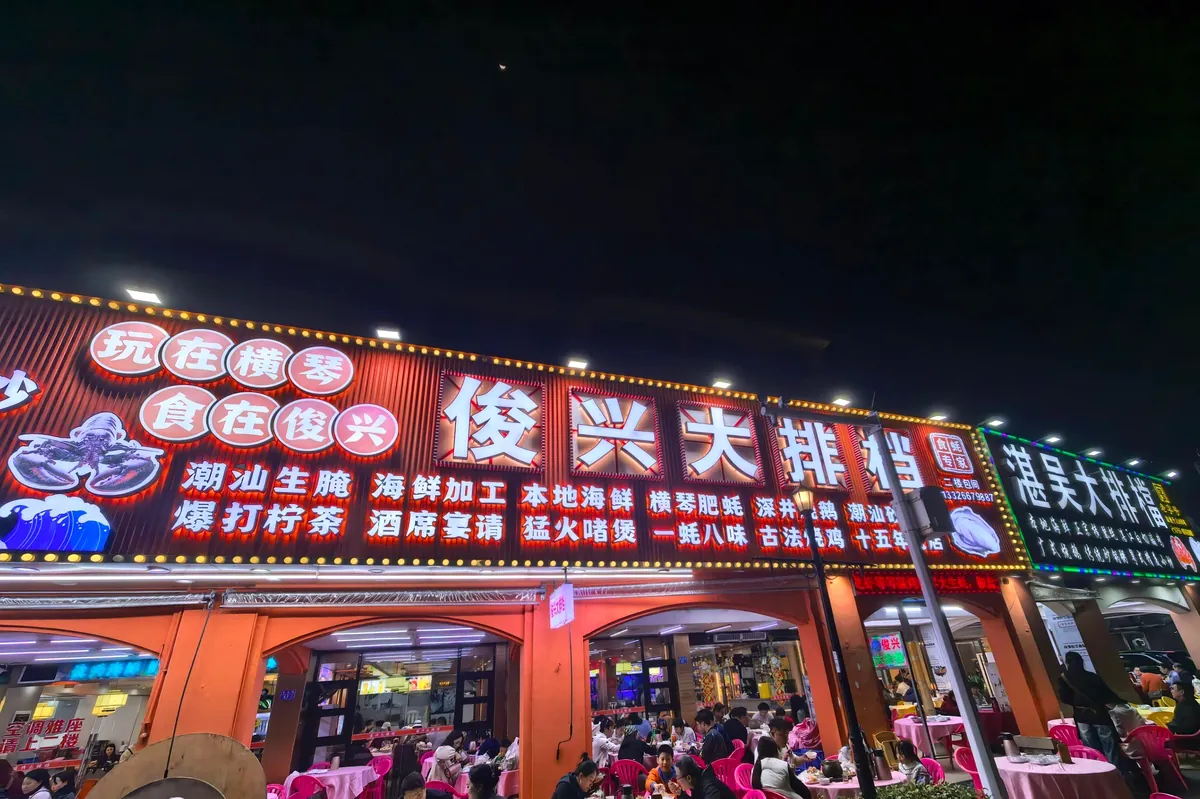
From the shared cultural currents of the southern coast, the culinary map surrounding the Sun and Moon Shells Theater on Yeli Island possesses a distinct character, rich with the flavors of the Zhuhai Bay. Favored by nature where the Pearl River estuary meets the South China Sea, the confluence of fresh silt-rich water and salty ocean currents creates the perfect mineral balance. Zhuhai boasts an abundant supply of seafood, with the renowned Hengqin oyster being the crown jewel. Oysters farmed in the brackish waters of Hengqin Island are famous for their impressive size, pearl-white flesh, firm texture, and a sweet, refreshing taste completely free of any fishy odor. Connoisseurs often enjoy them raw, chilled with a dash of premium soy sauce, or prepared in traditional ways: charcoal-grilled with minced garlic and chili, steamed with glass noodles and black bean sauce, or simmered in a smooth rice porridge, bringing out the full essence of this thousand-year-old delicacy.
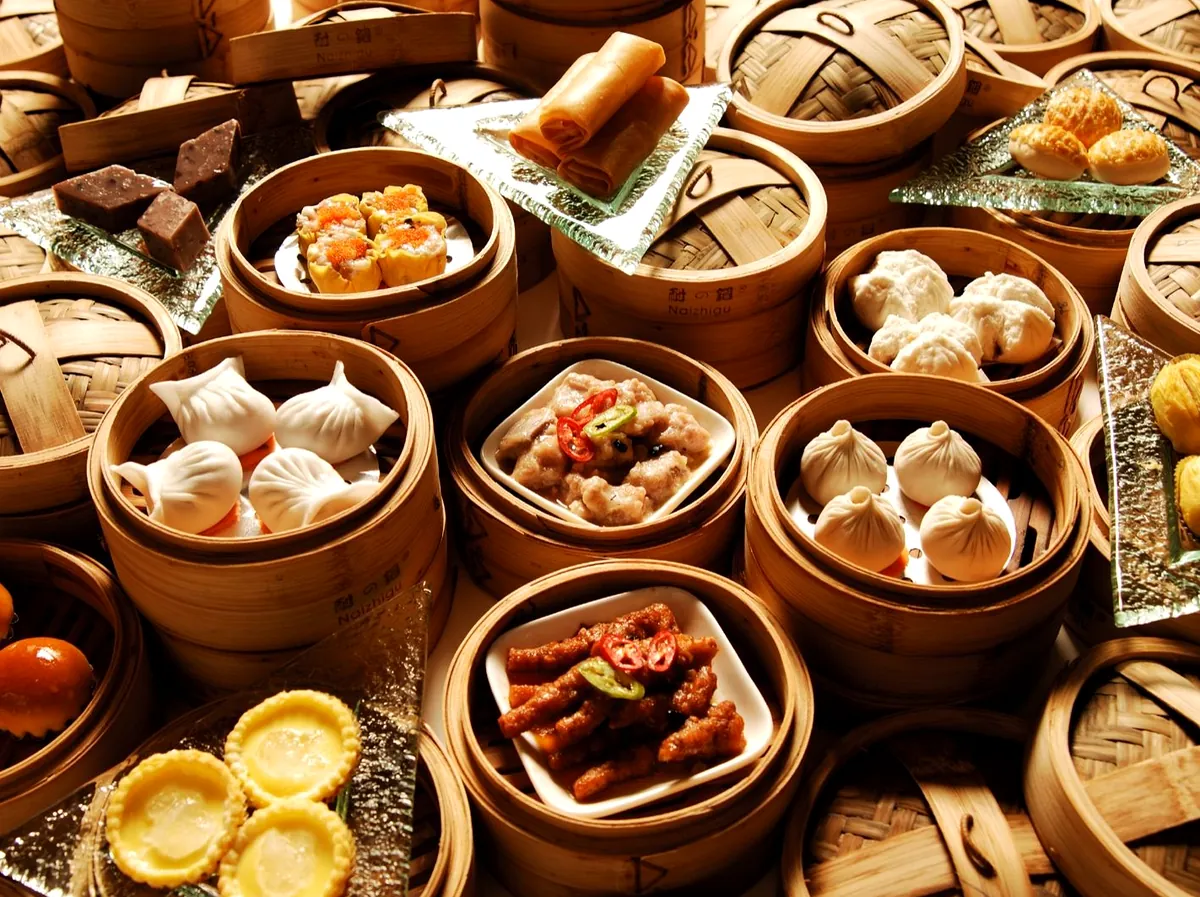
Beyond fresh seafood, the culinary culture around the Sun and Moon Shells Theater is woven with the traditional tea-drinking customs of Guangdong. After moments of admiring art beneath the pearl-shell domes, wanderers can easily find their way to long-standing taverns and teahouses along the Lovers’ Road. Here, the art of Dim Sum is celebrated as a living heritage, served in steaming bamboo baskets. Crystal shrimp dumplings with translucent wrappers encasing fresh, snappy shrimp; siu mai topped with golden crab roe; fluffy honey-glazed char siu bao; or braised chicken feet with black bean sauce—all are the culmination of the meticulous craftsmanship and seasoning techniques of culinary masters. A cup of aged Pu-erh or lightly orchid-scented Tieguanyin tea at a morning tea table not only awakens the palate but also perfectly reflects the serene, leisurely philosophy of the local residents.
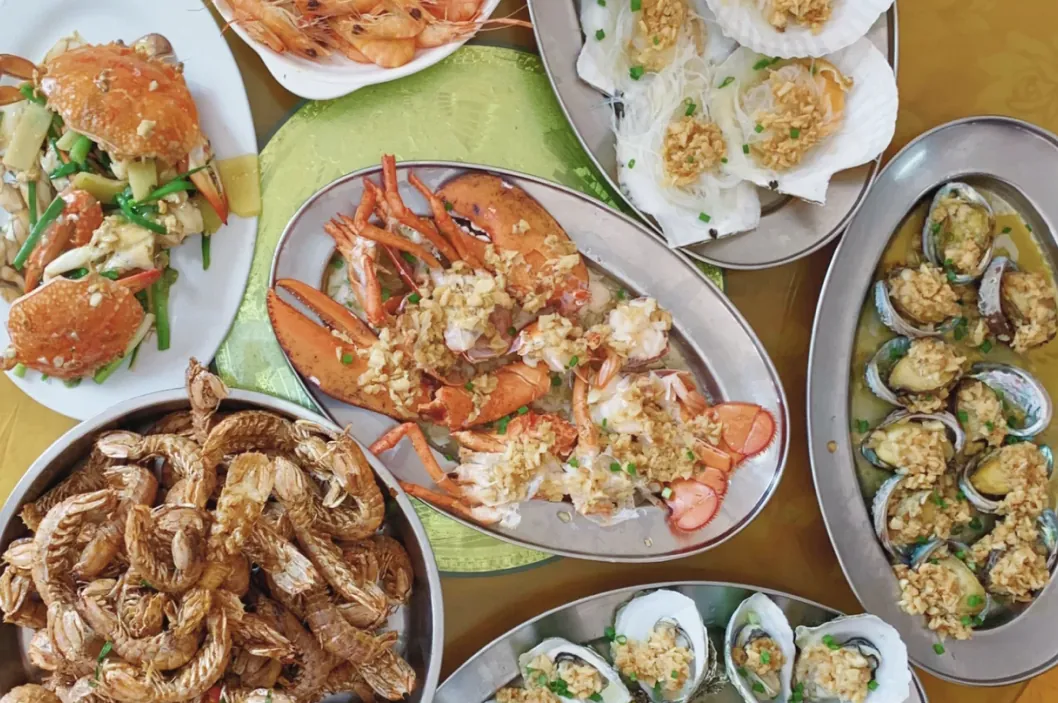
As night descends, the culinary scene around Yeli Island shifts to the vibrant rhythm of seaside night markets. Platters of stir-fried sea snails with basil, steamed flower crabs with peppercorns, salt-and-pepper mantis shrimp, and steamed grouper with ginger and scallions release enticing aromas into the sea breeze. Sitting by the bay, savoring legendary family-recipe dishes while watching the shimmering lights reflect off the two giant shells of the Sun and Moon Shells Theater, diners can feel the perfect harmony between visual aesthetics and the sublimation of taste in this southern coastal city.

The journey to admire the architectural masterpiece of the Sun and Moon Shells Theater would not be complete if travelers overlooked the renowned Lingnan culinary depth at the elegant restaurants around Yeli Island. Before the velvet curtain of the grand auditorium rises, the sensory experience begins with a plate of authentic Char Siu, sliced into uniform, square pieces. The meat is coated in a signature glossy crimson hue from maltose and fermented bean curd, accented with fragrant, caramelized charred edges achieved through precise charcoal grilling. Each tender, succulent slice of pork shoulder, marbled with thin, melting fat and balanced by a few sprigs of fresh green cilantro on top, offers a poetic prelude to a night of world-class art amidst the sound of the Zhuhai waves.
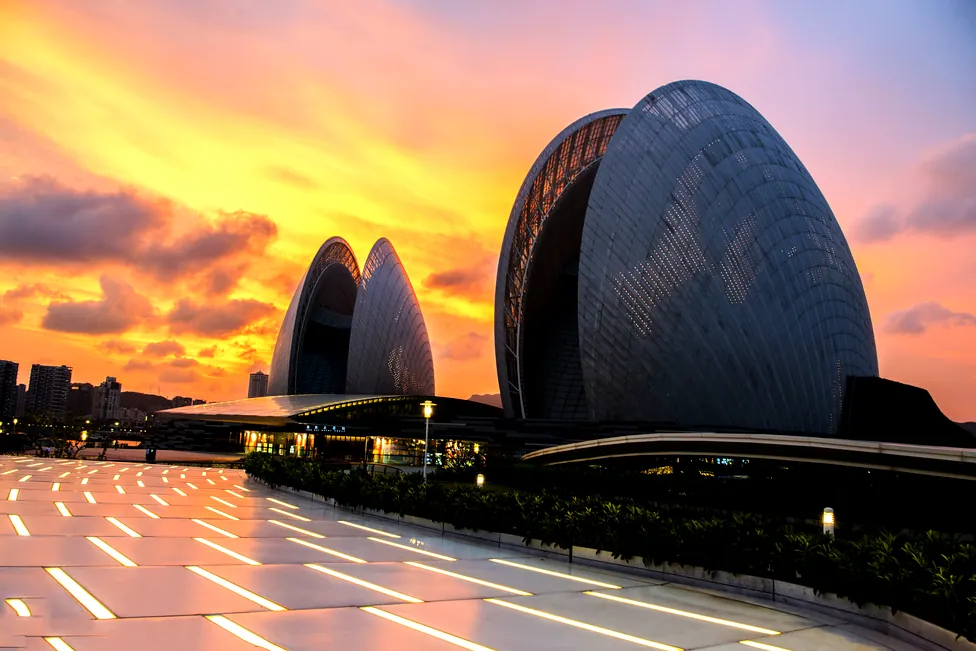
The most ideal time to fully admire the soul of the twin seashell architecture is during the sunset hours from 18:30 to 20:00. This is a magical moment when the setting sun casts its rays over the Lingsheng Bay, dyeing the semi-transparent frosted glass panels in shades of purple and orange, just before the 360-degree artistic lighting system awakens, transforming the two semi-circular structures into giant glowing pearls shining amidst the night sea. The coastal plaza grounds are open freely day and night for visitors to stroll and enjoy the breeze, while the main lobby and art exhibition halls typically welcome guests from 09:00 to 21:30 daily, adjusting flexibly according to the performance schedules of international operas or symphony concerts.
The transportation infrastructure connecting to Yeli Island is exceptionally modern, making Zhuhai a convenient stopover within the Guangdong – Hong Kong – Macao development triangle. Travelers departing from Guangzhou can catch the Guangzhou – Zhuhai high-speed intercity railway with a travel time of under an hour to Zhuhai Station, located right next to the Gongbei Port checkpoint. For those starting from Hong Kong or the Macau Peninsula, a spectacular 55-kilometer cross-sea journey across the magnificent HZMB (Hong Kong – Zhuhai – Macao Bridge) mega-project will bring shuttle buses to the Zhuhai artificial port in about forty minutes. From the city center, visitors simply need to catch the Lovers’ Road scenic bus route or app-based taxis via the Haiyan Bridge to step directly into the theater lobby.
Regarding immigration and stay procedures, international travelers should prepare a passport valid for at least six months along with a China tourist visa or take advantage of the 144-hour transit visa-free policy applicable at major ports of entry in the Greater Bay Area (GBA). When passing through border control gates at the HZMB port or Gongbei, having domestic payment apps and electronic health declarations pre-installed is crucial to save waiting time. Visitors planning to enjoy stage performances inside the 1,550-seat auditorium should book tickets online at least three weeks in advance and remember to dress politely and elegantly, avoiding shorts or slippers when entering the theater lobby.
To enjoy a leisurely and deeply enriching trip, modern travel trends recommend culture lovers choose itineraries adhering to the “Premium No-Shopping” standard. Resolutely eliminating forced shopping stops or commercialized souvenir shops preserves precious time for you to immerse yourself in the space where academic music, marine sculpture, and the serene lifestyle of Southern China’s most romantic city intertwine. To realize a flawless vacation with a meticulously designed itinerary tailored down to every detail, travelers can refer to the high-quality all-inclusive tour package.