In antiquity along the waterways of Jiangnan, Yangzhou’s Slender West Lake (Shou Xihu) began not as an isolated natural lake, but as an interconnected network of canals bound to the ancient river systems of the Sui and Tang dynasties. When Emperor Yang of Sui ordered the excavation of the Hangou section of the Grand Canal to link the imperial capital of Luoyang with the fertile south, natural waterways such as the Baozhang River were channeled together, forming a graceful basin embracing the western flank of ancient Yangzhou. Across the Song and Yuan dynasties, this waterway accumulated rich silt and cultural heritage alike, before reaching its most resplendent form during the Qing Dynasty—when the waterfront was artfully sculpted from a vital commercial canal into a classical landscape garden of imperial grandeur.
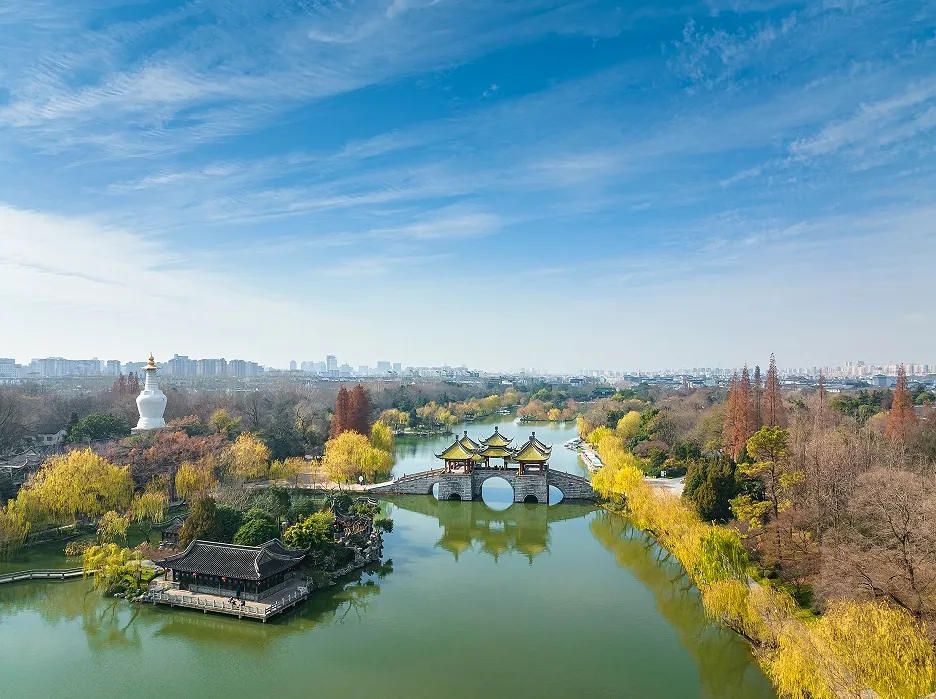
Viewed in sweeping panorama, Slender West Lake reveals golden hallmarks of classical Chinese architecture brought vividly to life like a master ink-wash painting. Most captivating is the stately Five-Pavilion Bridge (Wutingqiao) spanning a narrow strait, supporting five pavilions roofed in gleaming golden glazed tiles arranged like a blooming lotus floating upon broad waters. In the background along the western shore rises the White Pagoda (Baita), a pure white-brick Tibetan-style Buddhist stupa creating a striking visual dialogue with weeping emerald willows and lakeside pavilions. This seamless fusion of northern imperial majesty and southern Jiangnan garden delicacy radiates the unmistakable charm of this celebrated landmark.
The golden heyday of Slender West Lake was closely bound to the six famous Southern Inspection Tours of the Qianlong Emperor in the 18th century. At that time, Yangzhou stood as the wealthiest commercial and financial hub in the realm thanks to immense fortunes amassed by the Lianghuai salt merchants. To welcome the imperial entourage with unmatched splendor and refinement, Yangzhou’s wealthiest salt magnates poured personal fortunes into dredging and widening the lake, lining its banks with dressed granite embankments, and summoning master artisans from across the empire to construct imperial gardens, moon-viewing pavilions, and opulent temporary palaces. Legend recounts that after the Qianlong Emperor admired the White Pagoda in Beijing’s Beihai Park, Yangzhou merchants mobilized overnight to erect a matching White Pagoda along Slender West Lake in record time—vividly illustrating the extraordinary economic might and sophistication of the era’s elite.
The origin of the name “Slender West Lake” also carries an intriguing artistic dialogue with Hangzhou’s famed West Lake. Whereas Hangzhou’s landmark exudes lush, expansive beauty likened to the opulent grace of imperial consort Yang Guifei, Yangzhou’s winding waterway enchants with a long, sinuous, graceful silhouette compared to the slender elegance of classical beauty Zhao Feiyan. During the Qianlong reign, scholar-poet Wang Hang, boating across the lake’s drifting morning mists, penned timeless verses formally dubbing it “Slender West Lake” to celebrate its understated allure. The name captures both its physical geography—stretching over four kilometers long yet narrowing to less than a hundred meters wide in places—and the refined literati sensibility of a deeply cultured city.
Having weathered centuries of historical change, Slender West Lake today holds enduring global distinction as an integral component of the UNESCO World Heritage Grand Canal. Its tranquil waters stand as living proof of ancient Chinese mastery in water engineering and integrated landscape design. Beneath the shade of centuries-old trees, every stone arch, carved balustrade, and gentle ripple still whispers tales of gilded imperial barges of eras past—testifying to the timeless vitality of a cultural masterpiece.
Situated at the northwestern gateway of historic Yangzhou, Slender West Lake occupies an auspicious geomantic setting rare even among classical Jiangnan gardens. Resting gently at the foot of historic Shugang Hill and extending from ancient canal arteries, this meandering waterway embodies the classic Eastern feng shui ideal of “wind-sheltering, energy-gathering.” Rather than spreading into a vast open basin, the lake winds gracefully like a ribbon of silk, acting as a vital artery circulating harmonious energy throughout the heritage district. Backed by elevated hills to the north and embraced by long waters to the south, this classic “mountain-backed, water-facing” posture achieves ideal yin-yang balance, sheltering a tranquil garden sanctuary from urban bustle.
Gazing across the expansive water gardens, Slender West Lake unfolds with enchanting multi-layered depth characteristic of classical Eastern landscape design. Rising gracefully above calm jade-green waters is the Five-Pavilion Bridge with its five upturned golden roofs spanning a narrow channel like an open lotus blossom. In the distance, the slender White Pagoda ascends amid emerald pines and cypresses, harmonizing effortlessly with historic waterside pavilions in a serene dialogue between rockery artistry, reflective water, and human craft.
At the heart of the park’s enduring beauty lies the classical technique of “borrowed scenery” (jiejing), elevated to high visual art by Qing-dynasty garden masters. Financed generously by wealthy Huizhou salt merchants preparing for the Qianlong Emperor’s Southern Tours, the lake’s layout skillfully integrates distant landmarks into the viewer’s immediate frame. Most iconic is the White Pagoda modeled after the Tibetan stupa in Beijing’s Beihai Park, calibrated in proportion to blend seamlessly into Yangzhou’s intimate riverside setting. Every bridge arch and shoreline bend becomes a living picture frame—borrowing the misty green silhouette of Shugang Hill or capturing trailing willows and drifting clouds mirrored in clear water.
While Hangzhou’s West Lake captivates with boundless openness, Yangzhou’s lake celebrates the aesthetic ideal of “beauty in slenderness.” Its elongated waterway unfolds rhythmically around natural islets, narrow inlets, and arched stone bridges. This linear progression turns the park into an unrolling horizontal ink-wash scroll revealed scene by scene with every stroke of an oar. Rather than exposing every vista at once, scenery alternates artfully between intimate channels and open basins, drawing visitors on an endless poetic journey of discovery.
Complementing its winding contours is rich native flora and traditional rockery artistry. Along both banks, ancient weeping willows trail delicate branches beside vibrant peach blossoms, recreating idyllic scenes celebrated in hundreds of Tang and Song poems. Porous Taihu limestone boulders and imposing yellow-stone monoliths are masterfully stacked into miniature mountain ranges along the water’s edge. The delicate interplay of still water, rugged stone, and lush foliage creates a cool, pleasant microclimate—establishing Slender West Lake as an exemplar of classical Chinese waterscape gardening.
Stretching like a soft silk sash through the historic city, Slender West Lake’s spatial layout represents the summit of Ming-Qing landscape organization. Unlike the broad expanse of Hangzhou’s West Lake, Slender West Lake elongates its visual axis across a slender footprint, generating endless spatial surprises at every bend. Crafted by Jiangnan master garden designers with funding from High Qing salt merchants, the water basin, landscaped hills, and shoreline pavilions form a continuous waterside architectural ensemble where every stone bridge and glazed roof links natural beauty with human artistry.
Seen from above, Five-Pavilion Bridge rises like a giant lotus flower blooming across emerald waters, radiating regal splendor far beyond ordinary stone footbridges. Five upturned pavilions roofed in gleaming golden glazed tiles rest atop a sturdy white marble pier structure, uniting northern imperial grandeur with southern delicacy. Below, fifteen crescent-arched openings allow pleasure boats to glide effortlessly beneath while casting symmetrical reflections across still waters framed by lush greenery on both banks.
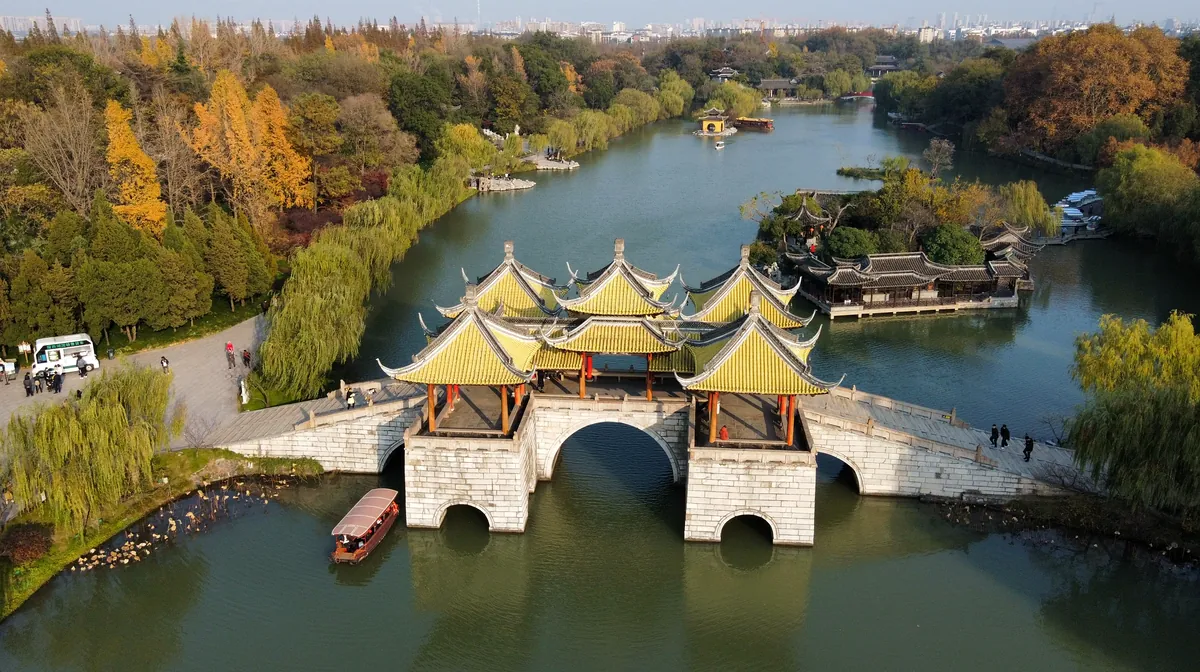
Built in the 22nd year of the Qianlong reign in anticipation of the emperor’s Southern Tour, Five-Pavilion Bridge—also formally named Lotus Bridge (Lianhuaqiao)—distills ancient bridge-building ingenuity. Its structural breakthrough lies in clever load distribution: longitudinal and transverse arches intersect to create fifteen navigable water passages opening in all directions. On Mid-Autumn full-moon nights, moonlight shines through each arch to cast fifteen shimmering lunar reflections upon the lake—creating the famed spectacle of “each arch holding a moon.” Intricate dragon-and-phoenix carvings and vermilion-and-gold painted rafters crown the pavilions above, forming an imperial garden vantage point brimming with Jiangnan grace.
Continuing northwest along the waterway leads to another immortal poetic icon: Twenty-Four Bridge (Ershisiqiao), celebrated in late-Tang poet Du Mu’s famous verse, *”On Twenty-Four Bridge under a bright moonlit night, where is the jade beauty teaching the bamboo flute?”* Crafted entirely from pure Hanbai white marble, this single-span semicircular arch incorporates the number twenty-four into every architectural dimension: 24 meters long, 2.4 meters wide, flanked by 24 cloud-carved balustrade pillars on each side, and approached by exactly 24 gentle stone steps at either end. Paired with neighboring Wangchun Pavilion and Xichun Tower, its harmonious geometry evokes lingering flute melodies drifting across reeds and weeping willows.
The scale and layout of Slender West Lake are calibrated carefully to enrich classic wooden boat excursions. Winding channels link nearby scenic gems—including the Angling Platform, Snow-Listening Pavilion, and the White Pagoda—applying classical garden principles of “borrowed scenery” and “shifting vistas with every step.” Recognized both as a National 5A Scenic Area and part of the Grand Canal World Heritage Site, modern conservation initiatives rigorously protect water ecology, maintain natural dredging, and preserve hand-laid stone embankments—keeping Slender West Lake a radiant open-air museum where imperial architecture meets southern riverine soul.
As nightfall settles over the historic city, Slender West Lake takes on the enchanting glow of a lantern-lit painting where boundaries between reality and dream dissolve. Historic bridges and waterside pavilions shimmer beneath warm artistic illumination reflected across glassy waters. In the distance, the slender White Pagoda rises amid quiet groves in silent dialogue with curved tiled roofs along the shore, while warm amber light from Wenchang Pavilion traces intricate carvings—creating an atmosphere at once regal and deeply meditative.
Drawing upon millennia of cultural heritage, Yangzhou employs interactive digital technologies including augmented reality (AR) and large-scale water-screen 3D projection mapping to recreate the Qianlong Emperor’s six Qing-dynasty Southern Tours. Along the illuminated waterway, multi-dimensional laser projections conjure gilded imperial barges gliding through drifting lake mist, accompanied by resonant pipa lutes, graceful court dances, and immersive surround sound—transporting visitors back to the opulent era when Yangzhou’s salt merchants turned every imperial visit into a grand theatrical spectacle.
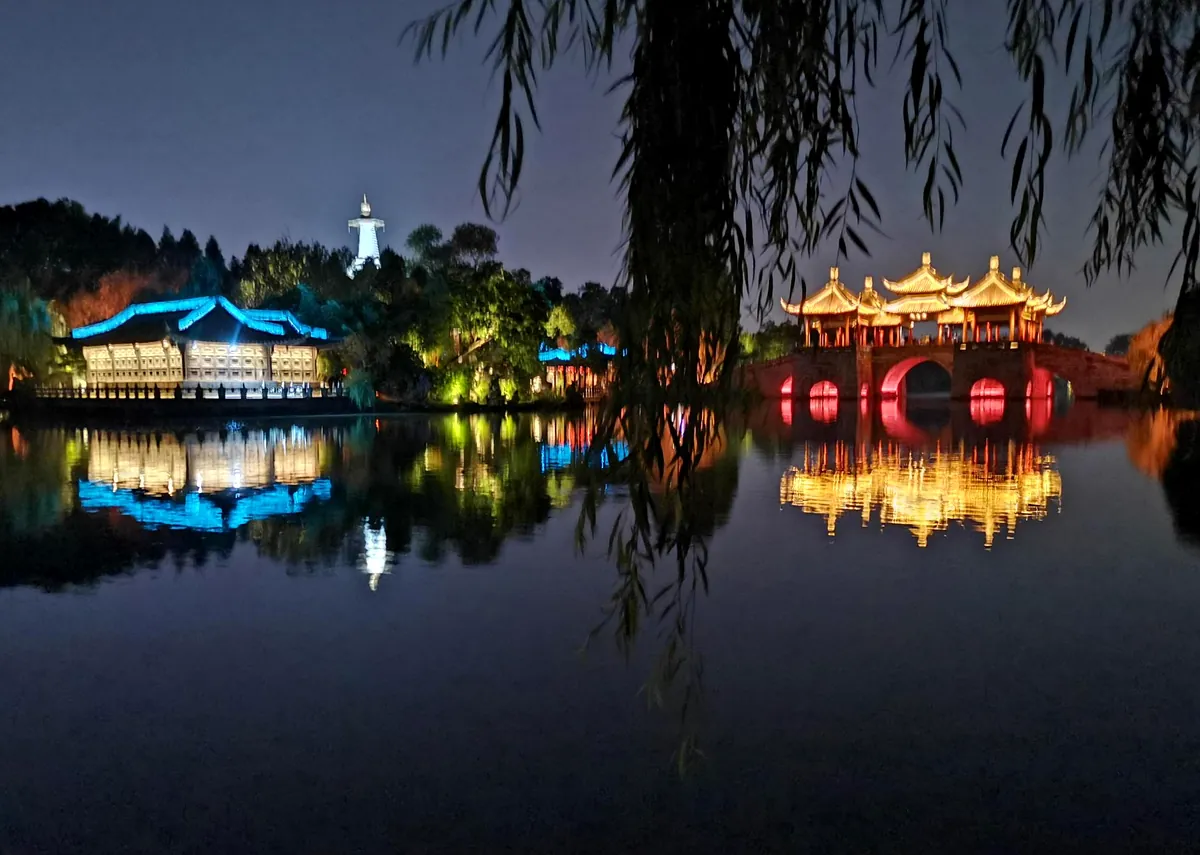
Yet the true magic of Slender West Lake late at night lies not merely in grand visual effects, but in the unhurried serenity of a quintessential “slow-living city.” Far removed from noisy commercial tourist strips, evenings here feel like a tranquil sanctuary. Along lakeside pavilions such as Little Gold Mountain and the Angling Platform, fresh green tea aroma wafts from wooden tea tables where visitors sip celebrated Lüyangchun tea, listen to distant bamboo flutes drifting across the water, and admire bright moonlight mirrored in the lake—recalling Tang poet Xu Ning’s famous praise that of all the moonlight under heaven, two-thirds belongs to Yangzhou.
Exploring Slender West Lake by night reaches perfection aboard traditional wooden boats gliding quietly beneath the arches of Five-Pavilion Bridge. Under jewel-like lantern glow, passengers enjoy classic Kunqu opera excerpts and traditional Yangzhou Pinghua storytelling—a national intangible cultural heritage prized for expressive, unhurried narrative art. This refined blend of architectural heritage, folk performance, and thoughtful lighting turns Slender West Lake after dark into a living open-air museum soothing away urban haste.
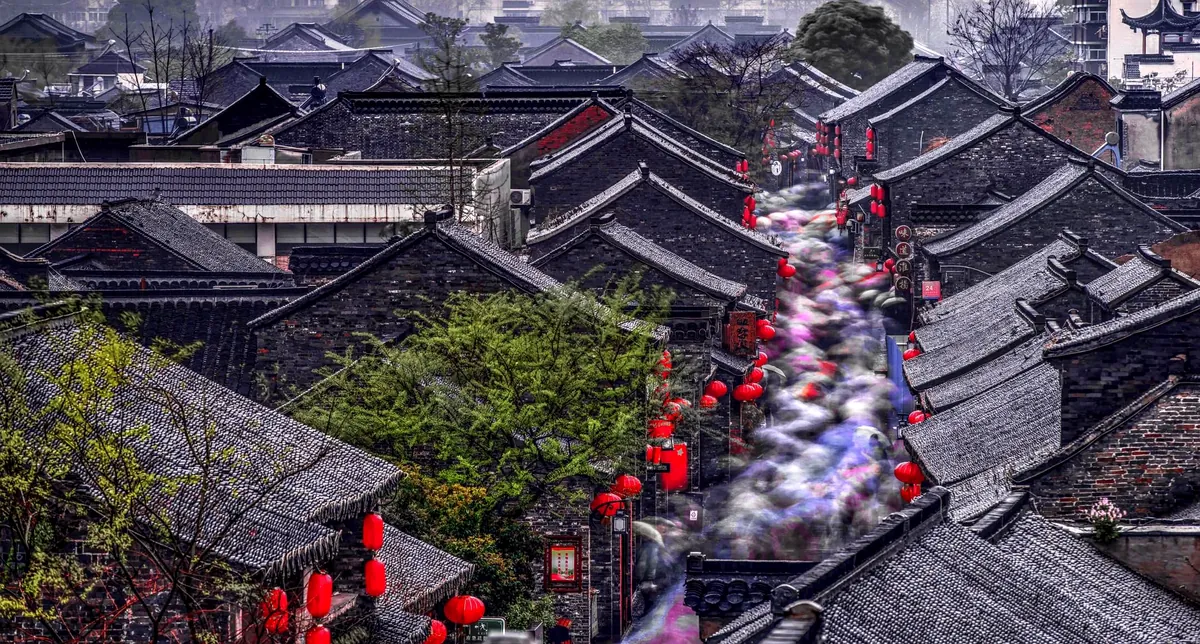
As twilight settles along both banks of Slender West Lake, Yangzhou’s storied sophistication gathers along lantern-lit culinary lanes such as Dongguan Street. Viewed from above, mossy yin-yang tiled roofs undulate beneath warm crimson lanterns strung along historic eaves, while long-exposure motion trails of strolling crowds capture the enduring vitality of a city once famed as the Qing Empire’s premier salt-merchant capital.
Celebrated as one of China’s Four Great Culinary Traditions, Huaiyang cuisine reached its highest artistic refinement in Yangzhou, nourished by Ming-Qing salt-merchant wealth and the Qianlong Emperor’s Southern Tours. Unlike the bold chili-pepper heat of Sichuan cooking or the pure sweetness of Cantonese fare, Yangzhou gastronomy honors the natural essence of fresh ingredients through extraordinary knife skills and subtle heat control—turning every dish into a refined work of literati culinary art.
The soul of local dining tradition is distilled in the beloved Yangzhou maxim: “morning skin wrapping water; evening water wrapping skin.” The morning half celebrates classic dim sum tea culture anchored by famed Crab Roe Soup Dumplings (Xiehuang Tangbao). Gossamer-thin wrappers encase savory broth simmered from marrow bones, pork tendons, and rich golden crab roe—savored carefully using a slender bamboo straw or by nibbling a tiny opening to sip the piping-hot broth before enjoying the tender filling alongside floral Lüyangchun green tea.
No showcase of Huaiyang mastery is complete without Clear-Simmered Lion’s Head Meatballs (Qingdun Shizitou), a storied dish tracing its roots to Tang-dynasty banquets. Never ground by machine, marbled pork belly is hand-minced with meticulous knife work into tiny cubes maintaining an ideal lean-to-fat ratio, then gently simmered for four to six hours with baby bok choy or spring bamboo shoots. Presented round and airy like a lion’s mane, each meatball melts on the tongue like first snow—clean, deeply savory, and remarkably light.
A culinary journey beside Slender West Lake would be incomplete without authentic Yangzhou Fried Rice—celebrated for “gold-wrapped silver” rice grains coated evenly in golden egg and studded with Jinhua ham, sweet shrimp, and fresh shiitake mushrooms—alongside Dazhu Gansi, where local pressed tofu is sliced by hand into hundreds of hair-thin threads simmered in rich chicken stock. Tasting Yangzhou’s classic specialties lets travelers experience centuries of refined Jiangnan culture distilled onto every plate.
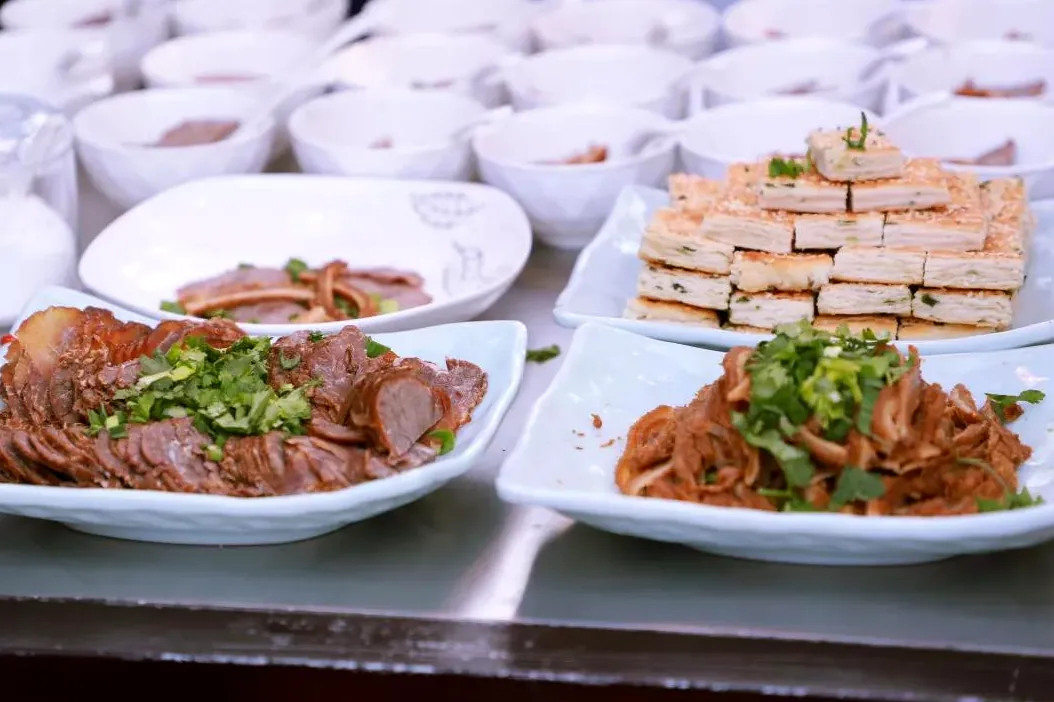
A classic “morning skin wrapping water” breakfast table at a historic teahouse beside Slender West Lake invites diners with signature Huaiyang delicacies: neatly sliced ruby-and-ivory cured pork (Yaorou), tender spiced tripe, towering Thousand-Layer Oil Cake (Qianceng Yougao) steamed into delicate flaky ribbons of lard and sugar, and white porcelain teacups awaiting fragrant green tea before a morning stroll through the gardens.
To experience Slender West Lake at its most enchanting, visit in March or April, fulfilling Tang poet Li Bai’s immortal line: *”In misty, blossom-filled March, sail down to Yangzhou.”* As spring arrives, both banks awaken in blush-pink peach blossoms, pure white cherry blooms, and soft mist drifting through trailing weeping willows mirrored in calm water. Daytime scenic hours typically run from 6:00 AM to 5:30 PM, followed by illuminated night-tour hours until 9:30 PM—allowing visitors to admire Five-Pavilion Bridge glowing beneath clear moonlight.
Modern high-speed rail makes reaching Slender West Lake effortless: sleek bullet trains arrive at Yangzhou East Station in roughly 1 hour and 45 minutes from Shanghai, or under an hour from neighboring Nanjing. Inside the city, dedicated tourist buses and ride-hailing taxis reach the South or West Gates—the most convenient entrances for boarding wooden boats or strolling classic gardens. International travelers should ensure valid entry visas are prepared in advance and link international bank cards to mobile payment apps for smooth ticketing and dining.
A golden rule for preserving the refined spirit of a Jiangnan journey is choosing immersive, pure-sightseeing itineraries free from forced commercial shopping traps that waste valuable time at artificial jade or silk outlets. Instead, fill your mornings listening to traditional storytelling over Lüyangchun tea at historic teahouses and savoring centuries-old garden vistas. Travelers planning a seamless, cultured Jiangnan escape can explore thoughtfully curated itineraries through a Yangzhou tour package to enjoy every poetic moment effortlessly.