The origins of Pingba Ancient Town are intertwined with the fiery military upheavals of the fourteenth year of the Hongwu era (1381) under the reign of Ming Taizu, Zhu Yuanzhang. After seizing the throne and sweeping the remnants of the Yuan dynasty from the Central Plains, the rugged southwestern lands of Yunnan and Guizhou still remained under the separatist claws of Mongol remnants led by Liangwang Basalawarmi. Recognizing the grave danger of division in the borderlands, Ming Taizu immediately issued an imperial edict to launch the grand “Conquer the South from the North” campaign, mobilizing three hundred thousand elite troops in a majestic westward march under the command of General Fu Youde, alongside Left Deputy General Lan Yu and Right Deputy General Mu Ying. After crushing the resistance forces in 1382, the Ming court did not withdraw its army; instead, it chose to implement a national policy of long-term stability and peace known as “Dispatching Northern Troops to Settle the South,” paired with an unprecedented “Military Colony System” (Tun Tian Zhi).
The strategy of “Seventy percent farming, thirty percent defense” clearly allocated seven parts of effort toward cultivating fields and reclaiming wasteland, while the remaining three parts maintained drills and guarded vital defense lines. Tens of thousands of soldiers’ families, artisans, distinguished noble clans, and merchants from prosperous Jiangnan regions such as Nanjing, Jiangxi, Anhui, and Zhejiang were either forced or encouraged to travel thousands of miles to settle down. Here, networks of military colonies, civilian colonies, and merchant colonies rapidly took shape, forging the unique Tunbao community. They were never an indigenous minority, but rather a subgroup of fourteenth-century ancient Han culture—loyal descendants who preserved the pure lifestyle of their old Jiangnan homeland, standing isolated amidst the Miao, Buyi, and Dong ethnic groups for over six hundred years like an “undying living fossil” defying the passage of time.
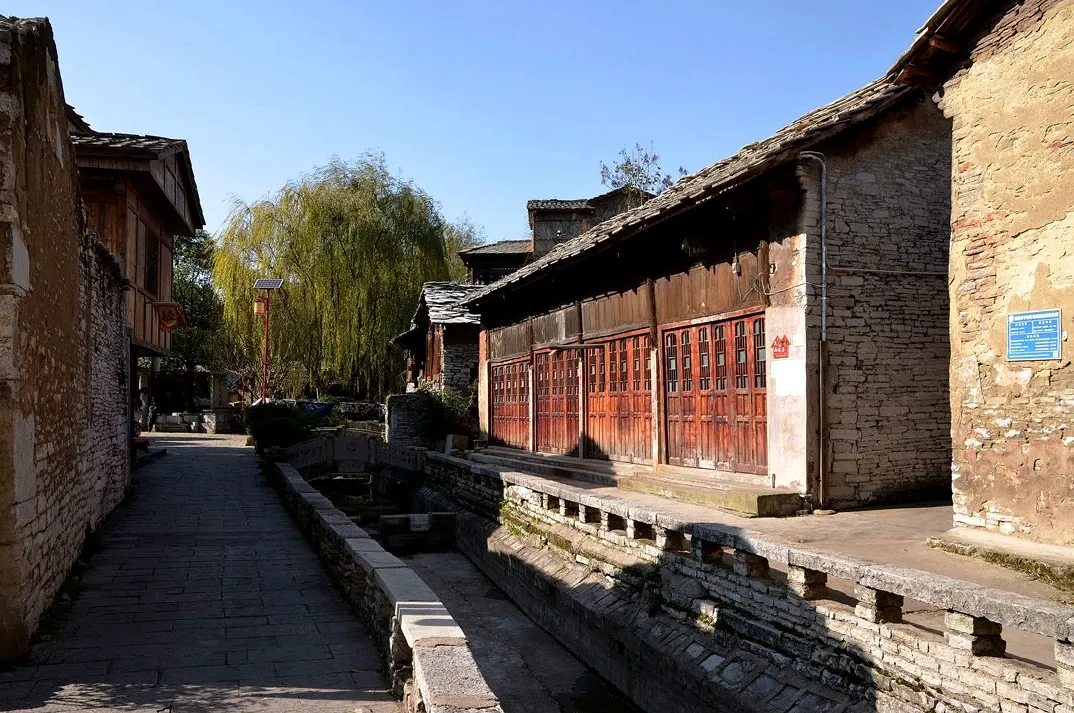
The imprint of garrisoned military culture blended harmoniously with the watery charm of Jiangnan is vividly present in every smooth, slate-paved ancient alley. On one side stand sturdy fortress-like walls built from gray sandstone fitting seamlessly with rustic wooden house frames, while directly opposite stretch rows of long houses with wooden facades dotted with subdued red doors, aligned alongside babbling stone water channels. Venturing deeper into the alleys, weeping willows trail gracefully beside the serene yin-yang tiled roofs of traditional structures, standing out against a backdrop of pristine blue sky and evoking the peaceful, poetic ambiance of a military village.
Through the vicissitudes of time, the destiny of the local people has also endured many harsh ups and downs. During the Ming dynasty, the Tunbao people held the prestigious status of military households, simultaneously farming and serving as outposts controlling the vital trade route into Yunnan. By the Manchu Qing dynasty, the “Replacing Indigenous Chieftains with Imperial Officials” policy under the Yongzheng reign abolished the hereditary garrison system and stripped away their inherent military privileges. Faced with the northern court’s aggressive forced assimilation campaign, the Tunbao community chose to safeguard their culture through strict endogamy and resolutely refused to shave their heads and hide their hair or don Manchu attire, preserving the pure heritage of their Great Ming ancestors with unwavering devotion.
This steadfast land also bears the marks of the legendary tycoon Shen Wantan. The immensely wealthy Jiangnan merchant of the Yuan-Ming transition period had funded military provisions and paid for a third of Nanjing’s city walls with silver; yet, this extreme wealth made him a thorn in Zhu Yuanzhang’s side, leading to the tragic confiscation of all his assets and banishment to barren Guizhou. Despite suffering exile, the traces of the Shen clan remain deeply etched in the Tianlong stronghold. Shen Mou, his second son, erected a grand estate, infusing the soft charm of a Jiangnan river town into the arid, rocky ramparts of the mountain region.
The most vivid and tangible heritage of their iron will to preserve their roots is the “Fengyang Hanfu” attire worn by Tunbao women every day. Legend has it that this garment mimics the homeland attire of Empress Ma from Fengyang, Anhui. The cross-collared long robe reaching to the knees—dyed in deep indigo or trimmed with exquisite brocade—is paired with a cascading black silk belt, hair coiled proudly into a high “little wooden rod” shape pinned with a silver hairpin, and on their feet are graceful, hand-stitched pointy-toed boat shoes that help them step steadily across treacherous cat-ear stone steps, affirming an undying Han spirit through centuries of weathering storms.
Located in Pingba district under the administration of Anshun prefecture-level city, Guizhou province, Tianlong Tunbao Ancient Town presents itself as a natural fortress meticulously carved by nature and humans into the karst terrain of the Southwest plateau. Situated at an average altitude of about 1,100 meters above sea level, this ancient settlement nestles within a fertile basin, sheltered on all four sides by steep, sharp limestone mountain masses. In terms of military feng shui, Tianlong Tunbao possesses a terrain of “backing the mountains and facing the water,” with its back firmly resting against the rugged Jiqing mountain range and its face turned toward gently sloping valleys welcoming the breeze. This coordinate makes it a prime defensive stronghold right at the bottleneck of the ancient arterial trade route connecting Guiyang and Kunming since feudal times. In ancient military thinking, this enclosed yet perilous terrain opened up an offensive and defensive posture of “advancing to attack, retreating to defend,” making it easy to deploy troops to intercept enemies from afar while facilitating retreat and defense thanks to layers of karst caves and natural cliffs.
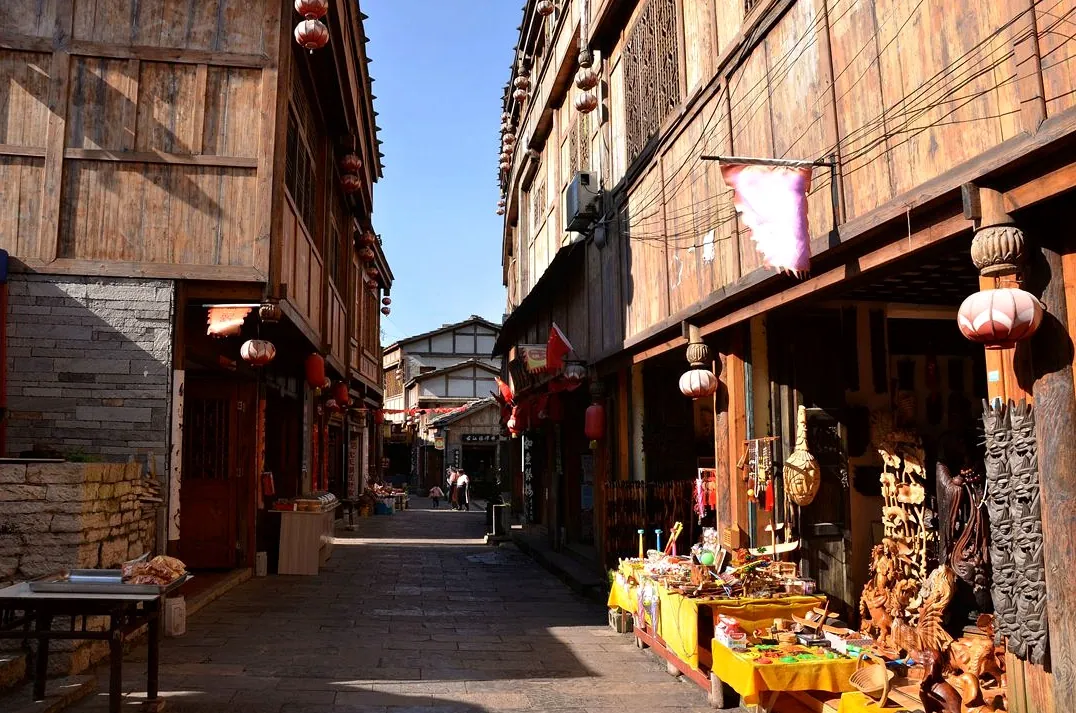
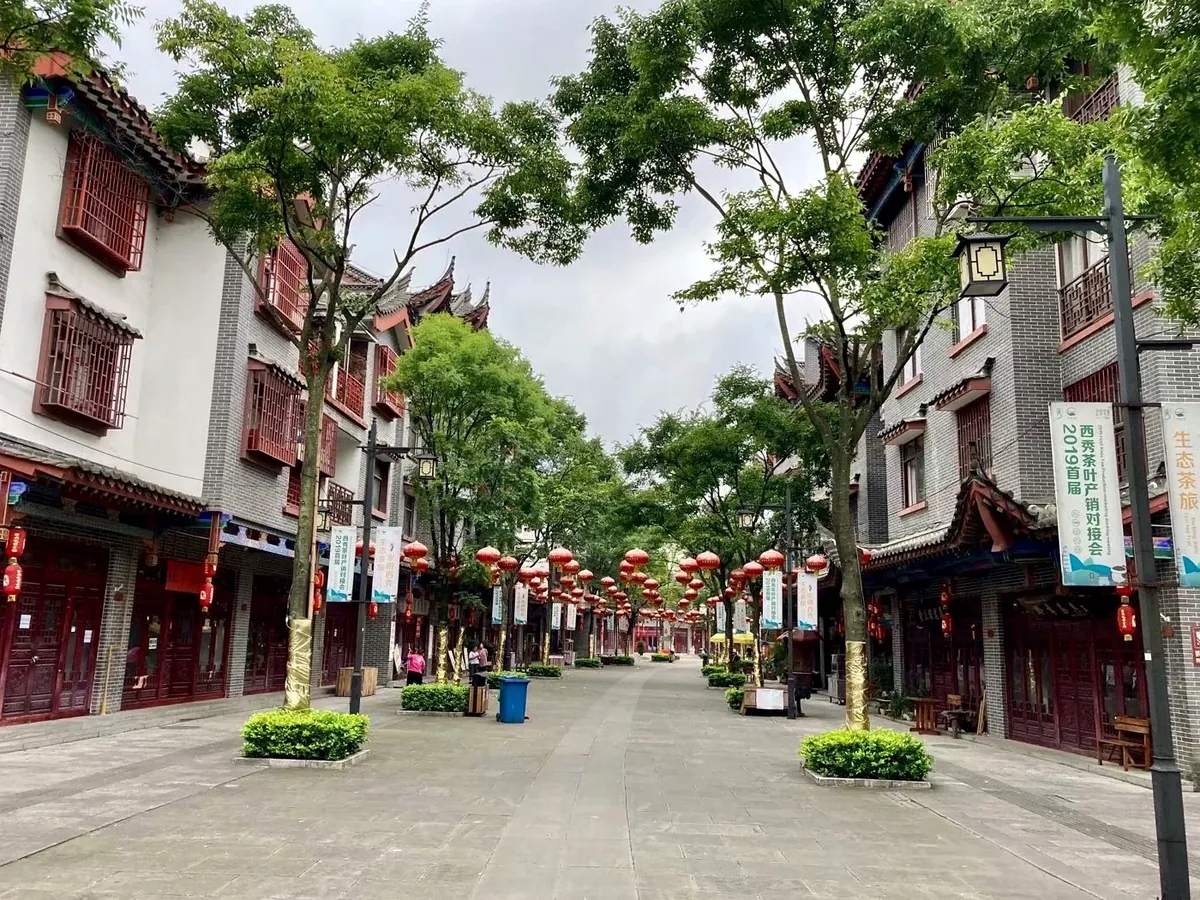
The harmonious blend of solid defensive structures and daily living spaces is clearly reflected in every deep alley of the ancient town. Following the internal herringbone streets, visitors will encounter narrow blue slate-paved paths undulating along slopes, flanked by traditional wooden and slate houses colored by time. Beneath subdued eaves dotted with bright red lanterns, small shops display various handicrafts, blue-trimmed floral embroidered garments of the Tunbao people, and rustic souvenirs right on the stone steps. The quiet atmosphere, scented only by kitchen smoke and the distant silhouettes of pedestrians, suggests a profound, slow-paced rhythm of life completely detached from the bustling world beyond the ancient city walls.
Thanks to its unique plateau coordinates, Zhenning, generally, and Tianlong Tunbao, in particular, fully inherit the privilege of a cool sub-tropical monsoon climate, earning this entire land the prestigious title of Guizhou’s “Summer Resort City”. Amidst the sweltering summer solstice days of the Asian continent, the average temperature in this mountainous sanctuary only hovers gently around 23°C to 25°C. Pure breezes weaving through the limestone canyons, combined with moderate humidity and dense vegetation, create a refreshingly invigorating atmosphere. The temperature variation between day and night is mild; mornings are draped in a lingering, wispy mist clinging to treetops, while nights turn as chilly as autumn, offering absolute peace of mind to distant travelers.
Not only boasting an isolated military-defense structure, Tianlong Tunbao also lies at the focal point of one of Southwest China’s most magnificent ecological and natural heritage arcs. Just a short distance from the ancient town is the sprawling Zhenning Cherry Blossom Farm, stretching endlessly along the banks of the azure Hongfeng Lake. Every March, the world’s largest cherry blossom farm with over 700,000 ancient trees bursts into bloom simultaneously, weaving a billowing ocean of pale pink floral clouds reflecting upon the tranquil water surface. Accompanying this poetic picture, within a radius of about 40 to 45 kilometers, are the presence of the premier scenic spot, the roaring Jiulong Waterfall cascading white water amidst the great forests, and the labyrinth of stalactites in the underground Longgong Cave (Dragon Palace Cave). The harmonious connection between mossy boulders, boundless flower forests, and majestic waterfalls transforms the Zhenning land into an exquisite intersection of nature’s creative craftsmanship and the enduring imprint of human culture.

Hidden among the undulating mountain ranges of the Southwest, the unique imprint of Tianlong Tunbao is fully crystallized in the architectural philosophy of “Stone Slab House”, an ultimate survival method summarized through the local proverb “Using stone as walls, using stone as tiles”. Ancient Tunbao craftsmen skillfully split each sedimentary limestone slab about two to three centimeters thin, overlapping them as roofs to shelter against rain and sun, completely replacing traditional fired tiles. The boundary walls enclosing each house are stacked from countless cleanly cut stone blocks, durably bonded with a mixture of slaked lime mixed with molasses and local sticky clay. This four-to-sixty-centimeter-thick wall not only creates a miraculous microclimate regulation property of “warm in winter and cool in summer”, but was also once a sturdy shield blocking fire arrows, signal bullets, and medieval weapon assaults.
The breath of military strategy deeply permeates every vascular space as the entire network of slate-paved alleys is planned in a zigzag “Ding” (T-shape) layout, embedded with countless sharp turns and treacherous dead ends. This layout intentionally eliminates straight roads, completely shattering the charging momentum of expeditionary cavalry while easily isolating and dividing enemy infantry into predetermined ambush sites. Every household wall facing the main route is deeply hollowed with funnel-shaped “shooting holes” (arrow slits) designed wide on the inside and narrow on the outside, allowing soldiers inside to freely maneuver their bow and arrow or matchlock ranges while making it difficult for outside enemies to launch a surprise attack. Alongside the enclosed Siheyuan (quadrangle) architecture characteristic of Jiangnan river dwellers reinforced with strict defensive features, towering three-to-four-story stone Diaolou (watchtowers) stand majestically guarding crucial intersections, acting as observation decks overlooking the entire ancient town’s stone-roofed battle formation.
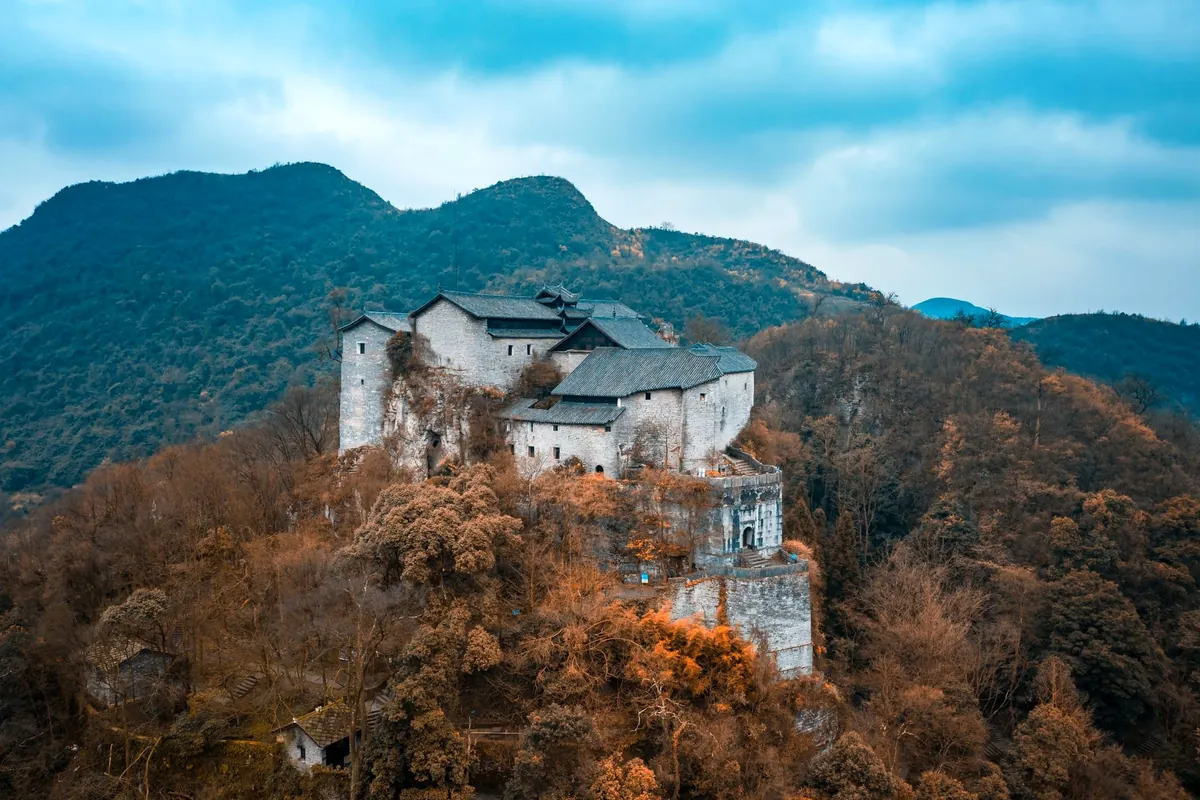
The pinnacle of the fusion between spiritual architecture and defensive fortifications is profoundly expressed at Wulong Temple (Five Dragons Temple), an ancient monastic complex founded in the late Ming dynasty standing impressively atop the perilous Jiqing Mountain peak. The temple is not merely a tranquil sanctuary of Zen Buddhism but also a high-level military defense fortress perched against a sheer cliff, worthy of being ranked as a National Key Cultural Relic. To preserve the original Ming dynasty structure against the passage of time, this place has pioneered the application of 3D LiDAR scanning technology to precisely digitize every stone grain and alleyway, while strictly planning a green traffic buffer zone, absolutely prohibiting internal combustion engine vehicles from moving within a two-kilometer radius to fully preserve the pristine atmosphere of the heritage.
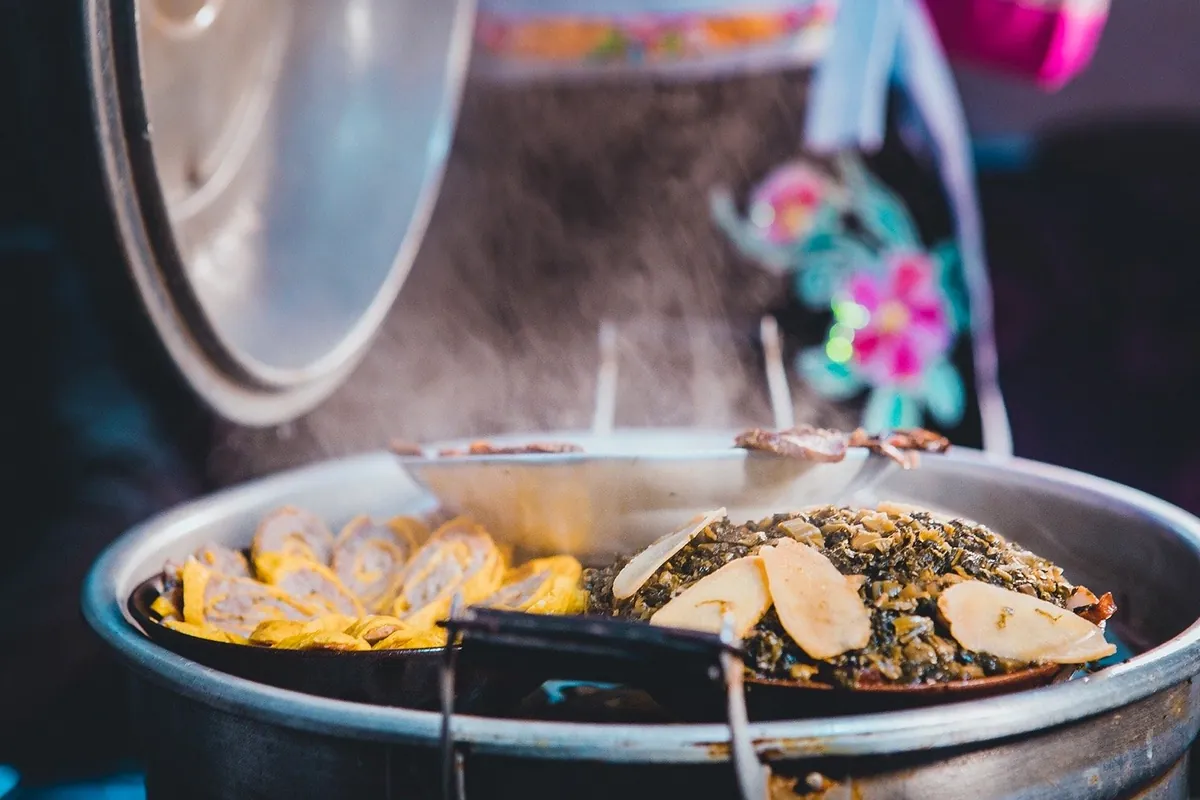
Alongside the art of sturdy stone defense, the daily life of the Ming garrison army’s descendants still completely preserves the rustic culinary flavors from their expeditionary nutritional roots. Kitchen smoke drifts lazily over the stone steps, revealing a large metal steamer with its lid slightly ajar, billowing with fragrant steam. Inside the steamer, on one side are golden, smooth, and delicately rolled egg rolls, placed next to lush green wild vegetables covering thinly sliced taro infused with countryside flavors. Standing behind the warm steam is the silhouette of a Tunbao woman dressed in traditional casual wear embroidered with pink and blue patterns, a testament to the endless continuation of indigenous culture through every simple lifestyle and dietary habit.
As twilight gradually fades behind the limestone mountain ranges surrounding Binh Ba, the military town of Tianlong Tunbao enters a mystical dimension—a place where night does not simply close the day, but instead awakens the soul of the land through the performing art of Dixi (Ground Opera). Hailed by researchers as a “living fossil of Chinese theatrical arts,” Dixi in Tianlong Tunbao is far more than ordinary entertainment; it is a vivid cultural reality rooted in the ancient “Nuoxi” ritual—a ceremony from antiquity designed to ward off evil spirits and plagues—seamlessly combined with the martial arts and tactical drills of the southern-conquering troops of the early Ming dynasty. Through more than six hundred years of weathering, the ancestral battle cries remain fully preserved, echoing through the heart of the sturdy stone alleys as night falls.
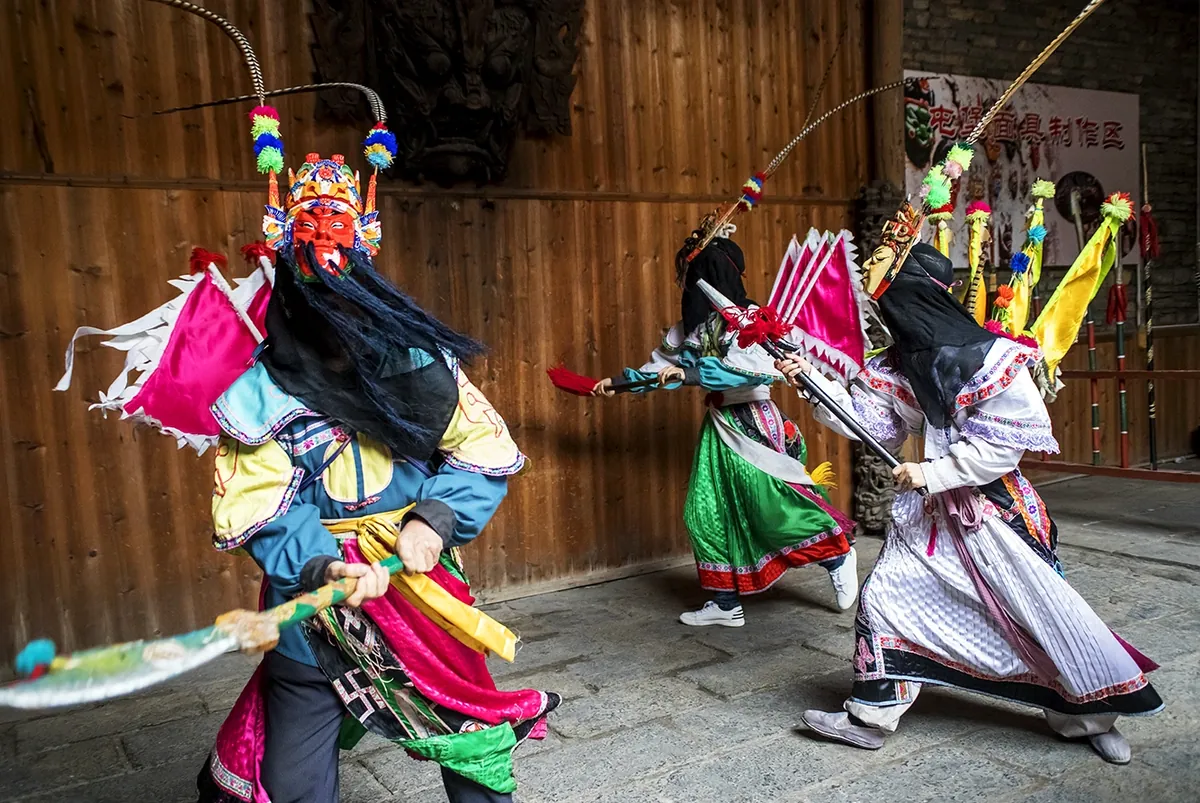
The core element behind the mesmerizing allure of Dixi is the facial makeup mask-carving art. Under flickering oil lamps or the blazing glow of night torches, each mask emerges with an imposing, majestic aura. Hand-carved entirely by local artisans from blocks of soft, resilient birch or poplar wood, these masks are meticulously coated with lacquer to distinctly differentiate five stylized character groups: dignified civil officials, valiant military generals, resolute veteran generals, brilliant young generals, and comical clowns. The unique, peerless peculiarity of Tunbao Dixi lies in its costuming rule: artisans do not wear the masks directly on their faces like in Peking Opera or other theatrical styles; instead, they secure the mask firmly against the forehead, letting a thin black gauze veil drape down from the eyelids to the chin. When entering a performance, the artist observes the external surroundings through this delicate layer of fabric, creating a bizarre visual effect as if the human self has hidden away to surrender the body to ancient divine generals.
With no need for velvety backstage wings or extravagant stages, the immersive performance space of Dixi consists of flat earthen courtyards or gray stone-paved plazas in the heart of the ancient town. The accompanying orchestra is streamlined to the absolute minimum following the principle of “One drum, one gong”—featuring only a single command drum guiding the rhythm alongside a resounding bronze gong. Despite the frugality of instruments, the resulting sound is as rapid and sharp as battlefield charges in the desert. Urged on by drums and gongs, performers with four Five Elements command flags strapped crosswise to their backs swiftly wield sabers, brandish spears, and thrust halberds in combat-intensive routines. The plots of the performances largely recreate heroic epic battle chapters drawn from Romance of the Three Kingdoms, Tales of the Sui and Tang Dynasties, Investiture of the Gods, and The Biography of Yue Fei. Every movement, offensive stance, and defensive posture hints at the siege and encirclement tactics of ancient vanguards, transforming the Tunbao night into a living museum of martial arts and folklore.
After the battle drums of Dixi subside, the night life in Tianlong Tunbao returns the space to a serene, melancholic, and enchanting atmosphere. Along the winding stone alleys, warm light emanates from red lanterns cast upon mossy gray stone walls and layered fish-scale tile roofs, creating a cinematic interplay of light and shadow. Ancient waystations and heritage tea houses keep their lights on to welcome travelers resting by steaming charcoal stoves, savoring cups of rustic, fragrant Dali tea and listening to elders converse about pioneering and settling down. The nightlife here reaches its dazzling peak during early-year festivals, lasting continuously from the first day to the fifteenth day of the first lunar month. In the chilly weather of the Lantern Festival, clans swing open their ancestral hall doors, ox-hide drums shake the air, and celebratory torches burn brightly through the night, fully recreating the martial spirit of an unbroken oasis of Great Ming civilization.
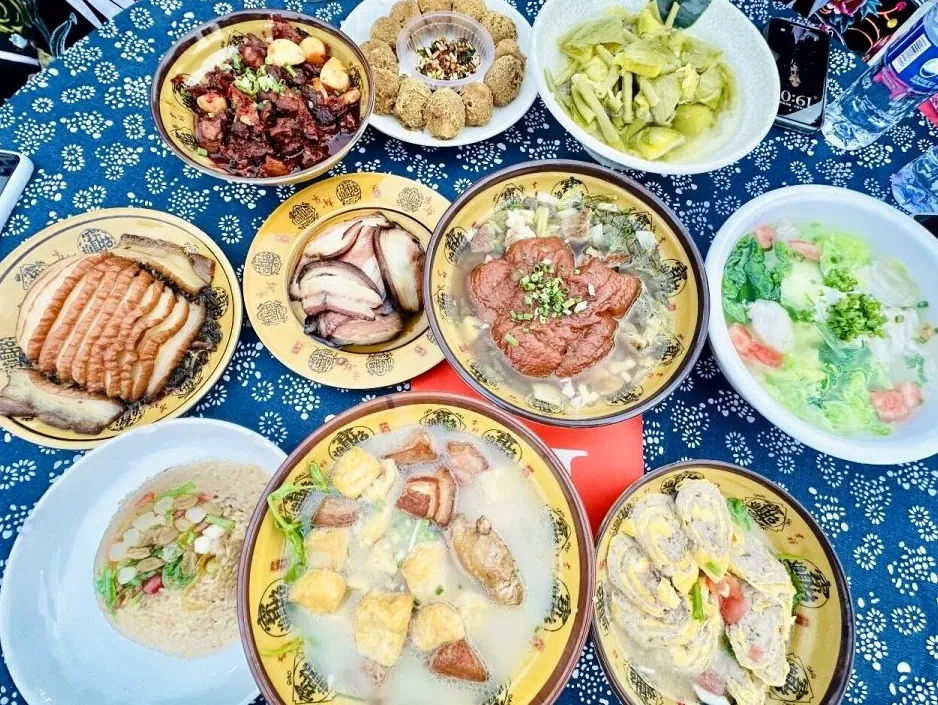
More than six centuries of settlement by Ming dynasty expeditionary troops in Binh Ba have not only carved a system of sturdy fortresses into the mountain stone but also forged a peerless Tunbao culinary heritage. The culinary philosophy here represents a wondrous intersection between the delicate simmering techniques and renowned savory-curing traditions of residents from the Yangtze River basin in ancient Jiangnan, paired with the deep-penetrating spiciness and characteristic mild fermented sour chili flavors of the Guizhou mountains. Soldiers of the past poured their homesickness into every clay pot, adapting local ingredients to create meals that both resonated with the flavors of their homeland and provided the physical endurance needed to withstand the harsh, vaporous mountain climate.
The culinary pinnacle of the Dunbao military garrison is the Dunbao Eight Great Bowls banquet, featuring eight large earthenware pot dishes that retain heat steadily. The feast faithfully recreates the victory banquet scene with a harmonious blend of savory dishes, stews, and cooling soups. Headlining the menu is the Dunbao Pork Trotter with Dried Bamboo Shoots, featuring top-grade dried bamboo shoots rolled and simmered to tenderness with rich pork trotters, followed by Dunbao Red Pork, thick-cut, square slices with a glossy red hue reminiscent of famous Suzhou braised pork yet packed with savory, firm meat. The banquet is further enriched by the nutty and rich Lao Han Stuffed Tofu packed with minced meat, crispy steamed pearl meatballs coated in chewy and fragrant glutinous rice, free-range chicken soup simmered with cardamom radiating a warm aroma, and sweet white radish soup for a cooling effect. Balancing the richness are a bowl of crispy stir-fried pork offal with pickled mustard greens and a unique bowl of smoked salted pork belly cooked with blood tofu, creating a hearty and robust symphony of military flavors.
Alongside the banquet, Pingba Ash-Cured Tofu represents the ingenious folk processing technique of the local residents. Fresh tofu, after being pressed dry of water, is buried directly into a layer of straw and herbal ash rich in natural alkalinity. This fermentation process stimulates probiotic activity, creating a firm, chewy, waxy-yellow outer crust while transforming the interior into a smooth, creamy texture resembling ripened fresh cheese. When consumed, each piece of tofu is placed directly over a low charcoal grill until the outer crust balloons and sizzles, then dipped generously into local chili salt to experience the superb contrast between the crispy, chewy exterior and the melt-in-your-mouth richness.
The breath of long military campaigns still lingers deeply in the Pingba Spicy Chicken dish. Local free-range chicken is chopped into small pieces, tossed in a blazing iron pan, and stir-fried with freshly pureed chili pepper blended with smashed garlic cloves and old ginger. The pungent and intense chili not only stimulates the palate but also acts as a natural preservation method, helping food last for days during troop movements. Similarly, Pipa Meat reflects ingenious winter food storage culture; whole pork blocks are skillfully deboned, marinated with fragrant Huadiao wine, glutinous rice flour, and secret herbs, then flattened into the shape of a pipa lute and hung to dry over a firewood-smoked attic throughout the freezing winter until the meat fibers turn a translucent dark red.
Closely tied to the ancient Dunbao flavor is the ritual of enjoying Thao Bong Tea, also known as the Post Station Great Bowl of Tea at roadside pavilions along the ancient stone paths. Locals fetch water from crystal-clear underground stone wells, boil it fiercely over firewood, and brew black tea extract from ancient tea trees on the cliffside, accented with a few wild chrysanthemums dried in the morning dew. The tea is poured generously into large, coarse pottery bowls, emitting steaming vapor with a mildly bitter yet sweet aftertaste, serving as a folk remedy to cool the body, unblock meridians, and cleanse away the damp cold of the mountainous region, leaving behind the rustic yet profound lingering taste of a six-hundred-year-old military garrison lifestyle.
The modern transportation system of Southwest China has brought the Tianlong Dunbao stone fortress out of the isolation of overlapping mountains, seamlessly connecting it with the trans-national high-speed railway network. Nestled peacefully right on the artery of the Hukun railway corridor connecting Shanghai to Kunming, the ancient town is just about fifteen kilometers from Pingba South Station, equivalent to a twenty-minute ride by local bus or taxi. Visitors departing from Guiyang North Station take only eighteen to twenty-four minutes on high-speed trains running at a frequency of twelve trips per day, or they can drop by Anshun West Station thirty-two kilometers away to catch trains heading toward Kunming South in under two hours. For those choosing road travel, the G60 Hukun Expressway leads straight to the Tianlong interchange, which is just fifteen hundred meters from the heritage site’s gate, while the Gui’an Expressway also shortens travel time from central Guiyang down to fifty minutes for the smooth sixty-five-kilometer journey.
For travelers departing from Vietnam, accessing Pingba is extremely convenient via two cross-border routes combining road border gates and high-speed rail networks. The first route starts from the Lao Cai International Border Gate to Hekou North, taking the CR200J train for three and a half hours to Kunming Station, then transferring to the high-speed railway from Kunming South to reach Pingba or Anshun in one hour and forty-five minutes, making the total journey barely close to seven hours. The second route, considered the optimal and smoothest choice for Northern travelers, begins from the Youyiguan Border Gate to Pingxiang, heading to Nanning East Station to catch the Gui-Nan high-speed train operating at a speed of 350 kilometers per hour. After just two hours and fifteen minutes gliding across green plains, the train will dock in Guiyang, opening up a half-hour high-speed drive to touch the mossy stone walls of the ancient outpost.
The most ideal time to admire the weather-beaten beauty of this military fortress falls in the spring of March and April, when brilliant cherry blossoms at the Pingba Farm bloom extensively around Hongfeng Lake, creating a spectacular contrast with the subdued nature of the Tianlong heritage. From June to August, this land transforms into a wonderful sanctuary to escape the harsh summer heat thanks to its cool plateau climate and various ticket-discount stimulus policies implemented by local authorities. Especially if visiting in the first lunar month, travelers can immerse themselves in the most sacred festival atmosphere of the year, witnessing authentic Di Xi opera performances echoing with gongs and drums amidst the cheers of villagers.
When stepping into the deep alleys of the ethnic minority villages, preparing a pair of shoes with high friction and non-slip soles is an absolute survival rule. This is because the entire system of stairs, narrow alleys, and communal courtyards is paved with green slate polished by six hundred years of wind and rain, covered with a layer of slippery, damp moss. In addition, travelers must engrave local etiquette into their minds: absolutely do not step on or sit on the stone thresholds and window sills of the ancient houses. Under the military defense perspective and family philosophy of the descendants of the Ming dynasty imperial guards, the threshold is not merely an architectural detail, but an inviolable boundary distinguishing safety from peril, and the dwelling place of ancestral spiritual energy that preserves the dignity of the entire clan.
For a truly fulfilling field trip, travelers need to stay alert to unusually cheap traps in the border tourism market, where cut-price itineraries often embed hours at commercial shopping spots to push Guizhou Gastrodia elata, adulterated Miao silver, synthetic rubber cushions, or local jade. Filtering and carefully choosing pure sightseeing itineraries without shopping will ensure you have a peaceful block of three to four hours, enough to fully listen to every tale of loyalty over a warm cup of pilot flower tea when joining a high-quality Guizhou tour.