Tucked behind trailing weeping willows and moss-draped walls in the heart of Chengdu, Jinli Ancient Street (锦里) is far more than a bustling commercial thoroughfare—it is a living chronicle of more than two millennia of history in the ancient Shu Kingdom. The origins of the name Jinli (“Brocade Neighborhood”) trace back to famed Shu brocade weaving dating from the pre-Qin era. Legend holds that the waters of the Jinjiang River flowing past this quarter contained unique mineral properties that gave freshly washed silk threads unmatched luster, sheen, and vibrancy. Around riverside weaving workshops, artisan guilds gradually clustered into a structured ward known as a “Li.” In the Eastern Jin geographical treatise *Chronicles of Huayang* (*Huayang Guo Zhi*), historian Chang Qu famously recorded, “Within the prefecture of Chengdu lies Jinli,” confirming that by the Western Han Dynasty (202 BC – 9 AD), this district had already flourished into one of the oldest and wealthiest commercial quarters in the Sichuan Basin.
As night falls, traditional multi-tiered pavilions take on stately grandeur with sweeping upturned eaves silhouetted against the dark sky. Along intricately carved wooden balconies, warm uplights illuminate a crimson-lacquered war drum inscribed with crisp white Chinese characters alongside an ancient weapon rack—evoking the heroic spirit of Three Kingdoms military watchtowers. High on breezy upper galleries, small groups of travelers pause to watch the lively crowds below, soaking in the shimmering beauty of architecture steeped in history.
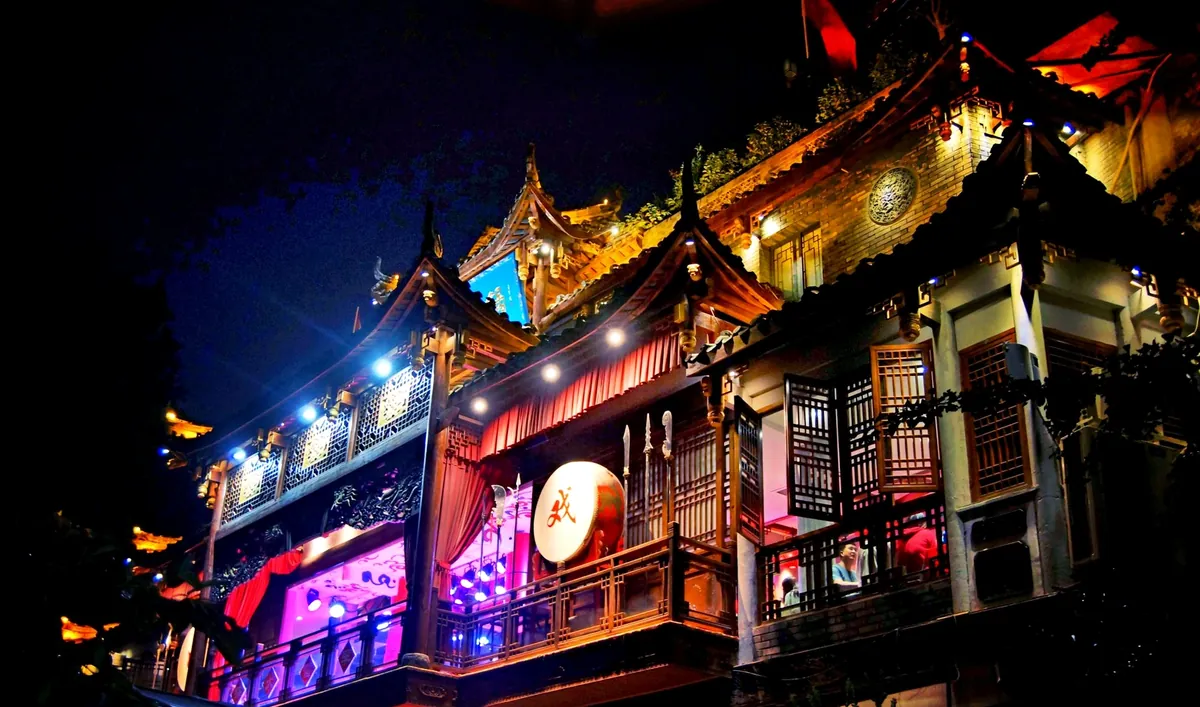
Powered by Chengdu’s well-developed “Night Economy” strategy, Jinli sustains a vibrant rhythm of commerce and festivity until midnight. Its historic setting has become a living stage for the Hanfu cultural renaissance: young visitors dressed in flowing Han- and Tang-dynasty robes stroll across arched stone bridges and lantern-lit lanes like classical court beauties or Shu-Han generals. Nostalgic charm blends naturally with modern augmented reality (AR) experiences, allowing visitors to scan visual markers to unlock historical reconstructions and interact virtually with Three Kingdoms figures right amid the lively streetscape.
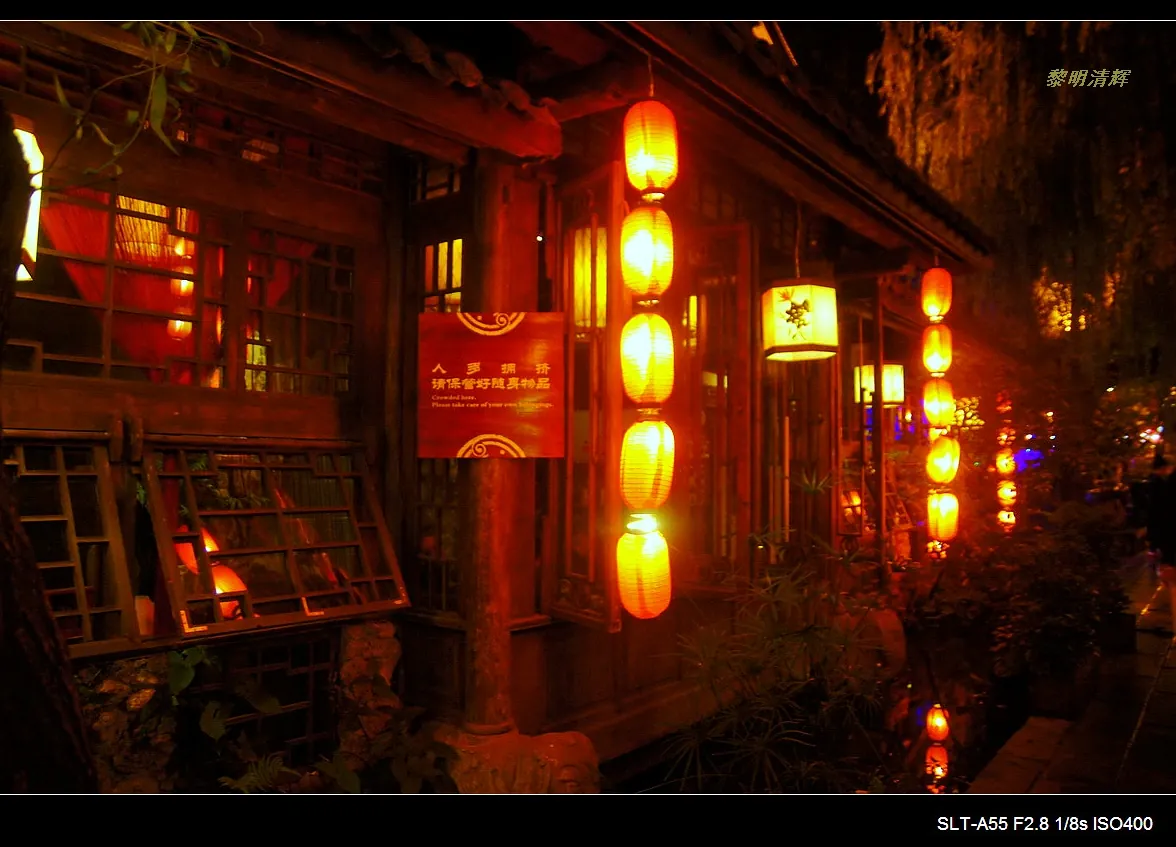
The artistic heart of Jinli’s nightlife beats inside storied heritage teahouses—most notably Yuelai Teahouse, a revered sanctuary of Sichuan folk opera. Seated in classic bamboo armchairs while sipping smoky Biluochun or fragrant Zhuyeqing green tea, guests experience Sichuan Opera—a national intangible cultural heritage—from just one or two meters away. The show reaches its climax with the legendary Bian Lian (face-changing) stunt, as performers swap dozens of brightly painted silk masks in the blink of an eye to express shifting emotions, paired with dramatic fire-spitting that lights up the entire timber pavilion in an unforgettable sensory spectacle.
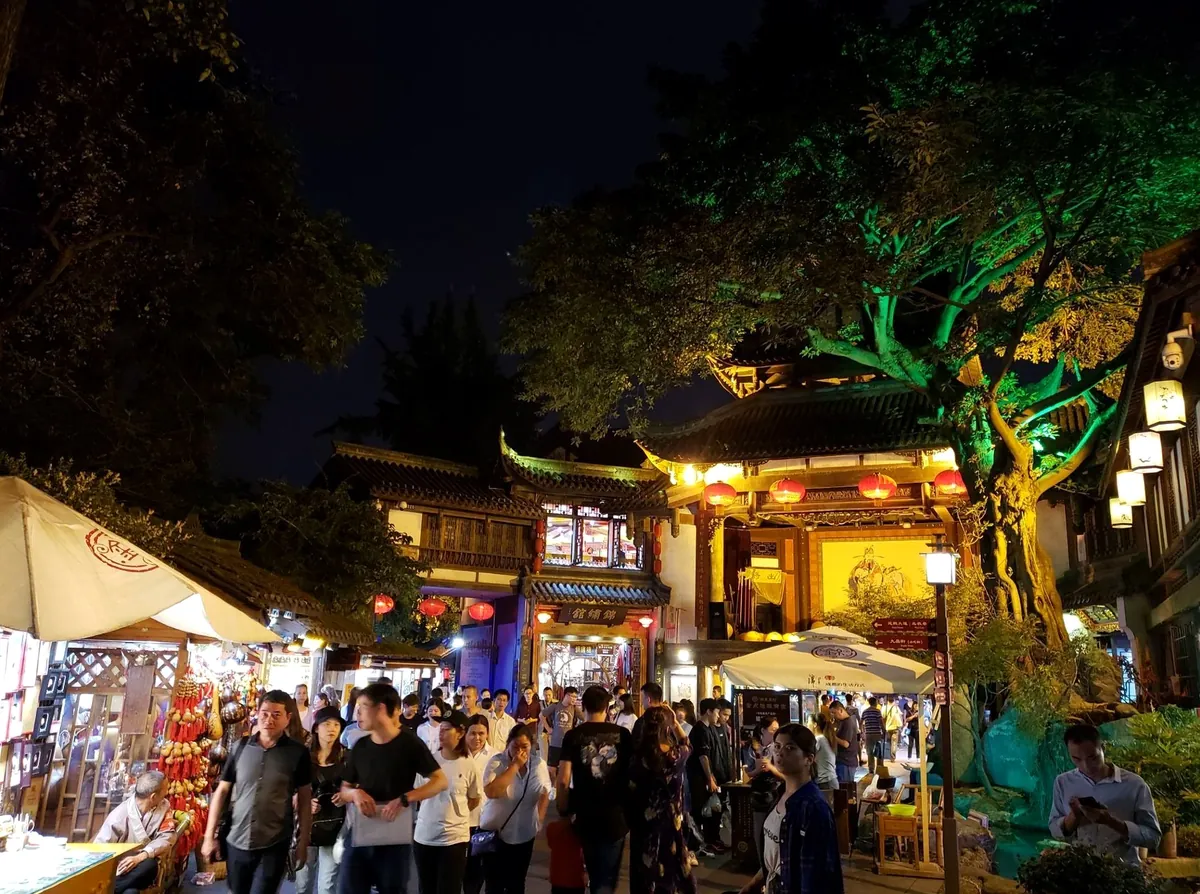
Amid lively music and glowing lights, Jinli’s corners also preserve a celebrated traditional wellness ritual known as Cai’er (artisanal ear-cleaning therapy). Tracing its roots to Ming-dynasty court relaxation practices, skilled practitioners wearing headlamps work delicately with downy goose-feather puffs, slender silver picks, and brass tuning forks. When struck gently, soft acoustic vibrations ripple soothingly along nerve pathways—delivering the unhurried, carefree enjoyment (“Bashu comfort”) that has defined Chengdu’s soul for a thousand years.
If Jinli’s architecture forms the frame preserving the spirit of the past, its Sichuan street gastronomy serves as the vibrant lifeblood nourishing the living memory of ancient Ba-Shu culture. Stepping across the threshold, visitors are immediately drawn into the aromatic labyrinth of Jiupin Snack Street—the culinary epicenter showcasing Southwest China’s most beloved street delicacies. Dining here goes far beyond fiery spices; it weaves together folk performance, heirloom herbal seasoning, and historical pride rooted in the Three Kingdoms era. Beneath plumes of fragrant steam rising from sizzling woks and crimson chili-oil cauldrons, every bite carries stories passed down across generations of Chengdu residents.
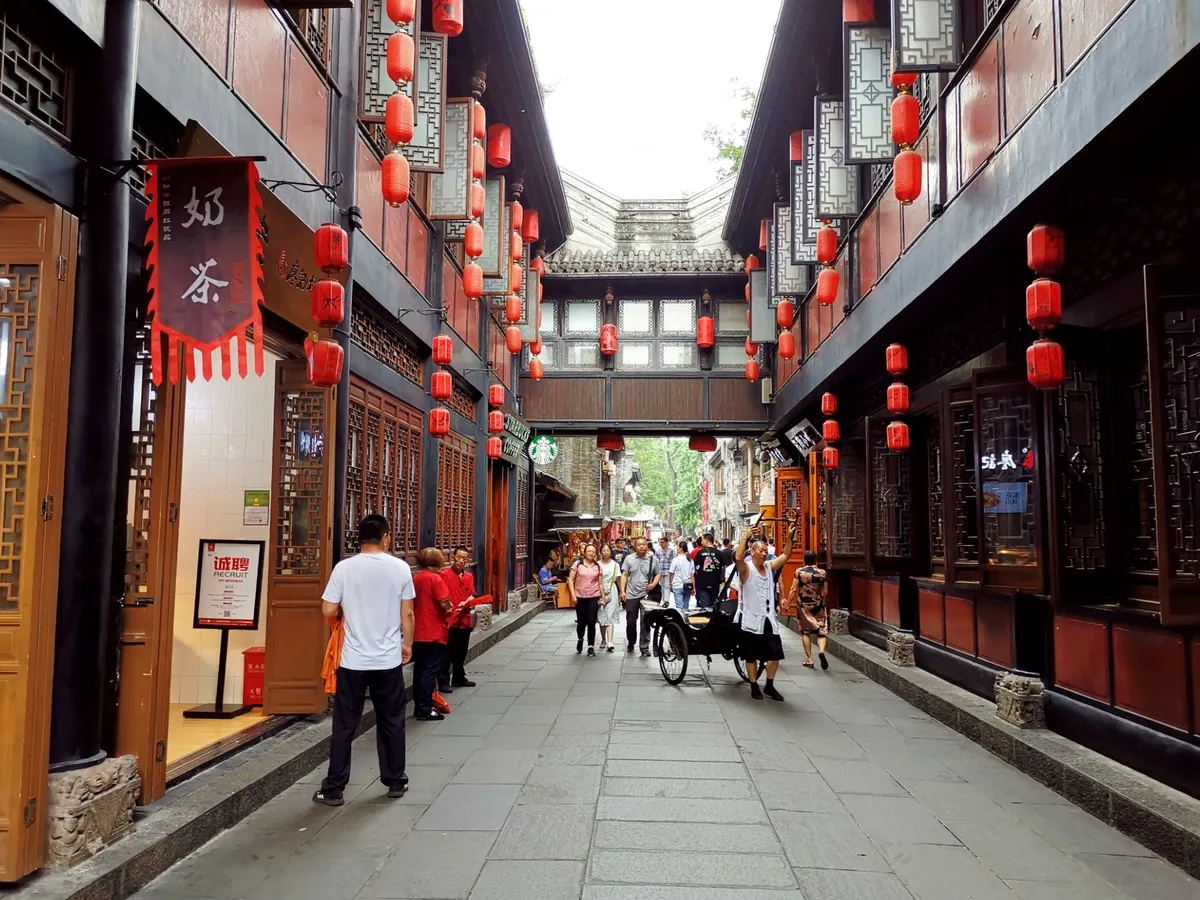
When evening settles in, the entire food alley glows beneath rows of warm red and amber lanterns suspended overhead. Flanking smooth flagstone lanes, traditional timber-framed buildings extend solemn tiled eaves adorned with calligraphy signboards and fluttering banners swaying gently in the night breeze. Crowds stroll leisurely past stalls brimming with savory treats, while spreading ancient trees at the far end cast soft shadows over a streetscape rich in heritage color.
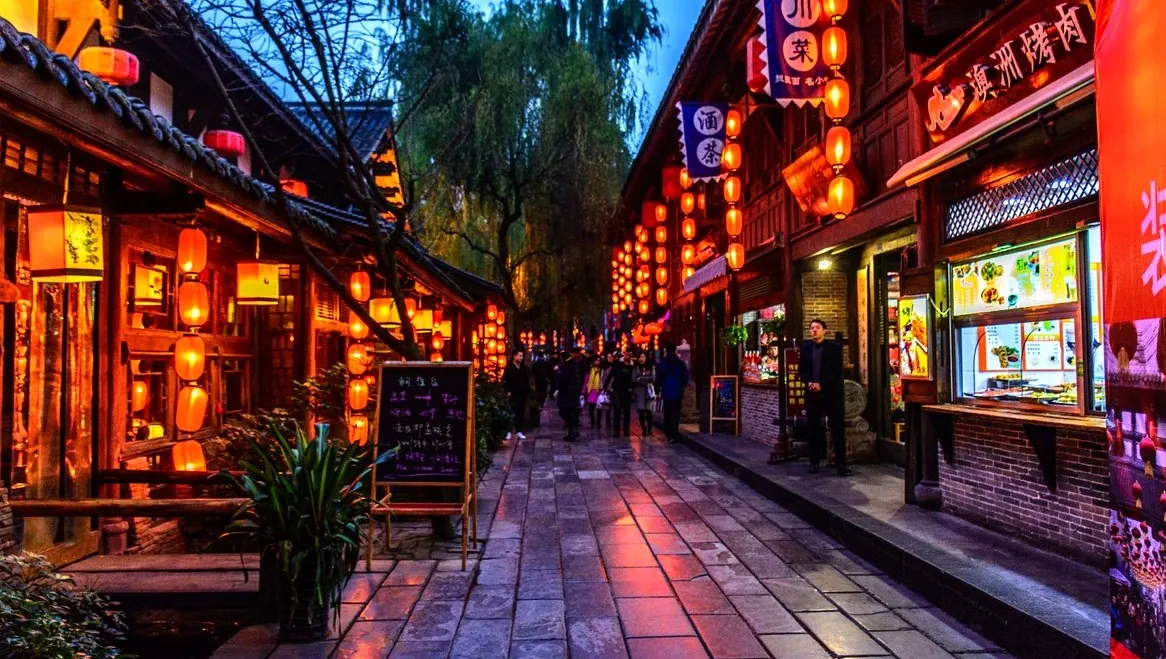
Amid the lively sounds of the food alley, no passerby can miss the crisp, resonant bangs ringing out from the Sandapao (“Three Cannonballs”) stall. This chewy glutinous rice delicacy blends culinary craft with theatrical rhythm: the artisan slams three balls of steamed sticky rice successively onto a gleaming brass platter—producing three loud drum-like booms—so the rebound launches the rice cakes straight into a tray of fragrant roasted soybean flour before they are drizzled generously with thick dark cane-sugar syrup. Nearby, Zhang Fei Beef pays tribute to the legendary Shu-Han general with cured beef featuring a rugged dark-roasted exterior reminiscent of Zhang Fei’s famously swarthy complexion, slicing open to reveal tender ruby-red meat infused with secret aromatic herbs.
Jinli’s culinary map continues with piping-hot Juntun Guokui flatbreads, where flaky laminated wheat dough encases savory minced pork or beef pan-fried to shattering golden crispness kissed with numbing Sichuan peppercorn. For adventurous palates seeking the bold heart of Chengdu flavor, Mala Spicy Rabbit Head is an iconic local specialty—slow-simmered for hours in fiery dried chili broth and prized Hanyuan peppercorns for an unforgettable tingling sensation. Paired alongside steaming bowls of Feichangfen (pork intestine sweet-potato glass noodles) swimming in rich marrow broth topped with crimson chili oil, every dish awakens the senses.
The air along Jinli stays warm with the rich fragrance of beef tallow, Sichuan pepper, and bird’s-eye chilies rising from bubbling hotpots and abundant Chuanchuanxiang skewer stalls tucked along street corners. To cool the rising wave of fiery spice, a chilled bowl of jade-clear Sichuan Bingfen (ice jelly) offers the ultimate yin-yang counterbalance. Refreshing herbal jelly submerged in sweet brown-sugar syrup and garnished with tangy hawthorn flakes, toasted sesame seeds, and crunchy peanuts instantly soothes the palate while leaving a clean, sweet finish.
Reaching Jinli’s nostalgic charm is effortless thanks to Southwest China’s modern transport network. Travelers flying from Hanoi or Ho Chi Minh City reach Chengdu Shuangliu International Airport in roughly 2 hours and 45 minutes to 3 hours and 30 minutes on direct flights, just 16 kilometers—or a 30-minute taxi ride—from the ancient street. Those landing at Chengdu Tianfu International Airport (65 kilometers away) can ride Metro Line 18 transferring to Metro Line 1 into central Chengdu in just over an hour. High-speed trains into Chengdu East Station link Chongqing in 62 minutes and Xi’an in just over three hours, while the Sichuan–Qinghai Railway connecting Chengdu to Zhenjiangguan Station in 1 hour and 40 minutes makes Jinli an ideal evening stopover before heading up to Jiuzhaigou. Within downtown Chengdu, simply take Metro Line 3 or Line 5 to Gaoshengqiao Station, take Exit D, and stroll 600 meters down Wuhouci Street straight to Jinli’s ceremonial entrance gate.
Entry procedures for Sichuan Province are increasingly streamlined thanks to China’s 144-hour visa-free transit policy for citizens of 54 eligible countries, ideal for short stopovers. Vietnamese travelers joining accredited tour groups of five or more can also utilize simplified electronic group visas requiring only passport scans with fast processing in four to seven business days. Jinli Ancient Street remains open 24 hours a day with completely free admission, allowing visitors to experience quiet dawn stillness or dazzling night festivities anytime—though historic teahouses, artisan studios, and street-food stalls are liveliest between 9:00 AM and midnight.
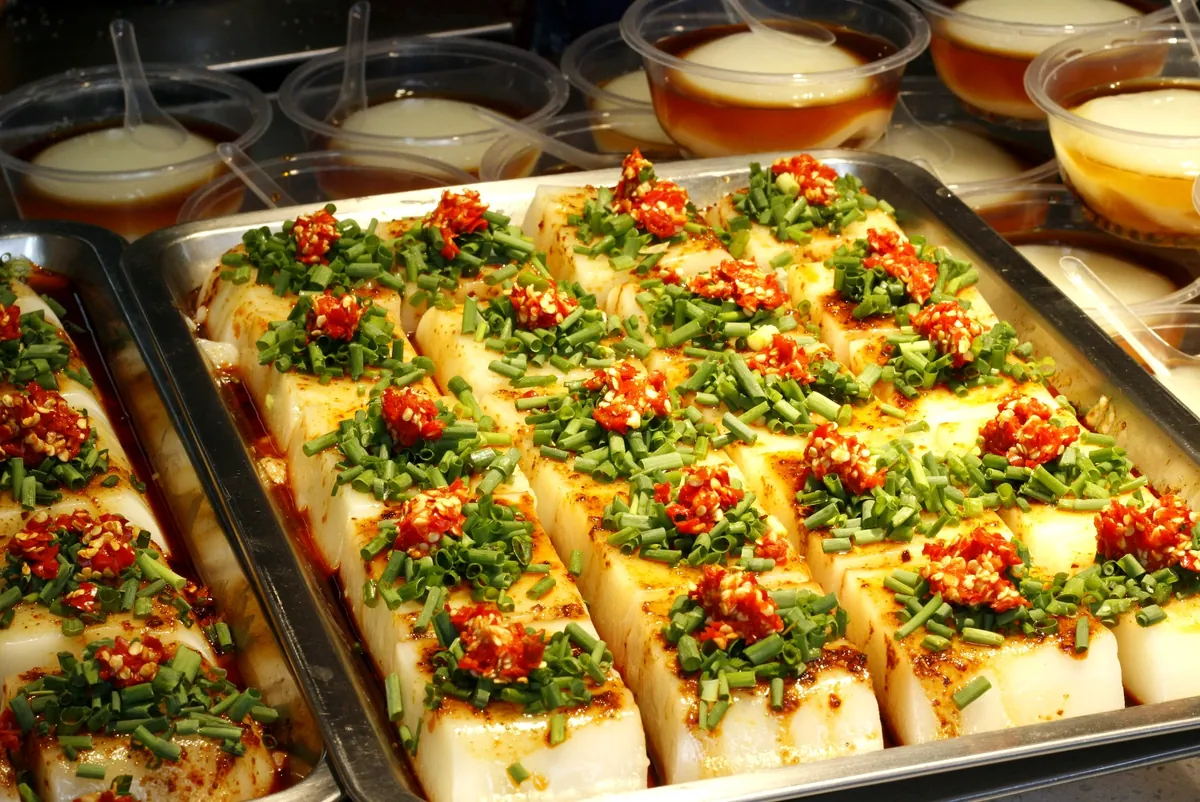
Stepping into Jinli’s food lanes, eyes are immediately drawn to neatly arranged trays featuring rectangular blocks of snow-white bean jelly or rice cake generously coated in vibrant crimson chili oil and fresh chopped green scallions. Directly behind those bold Ba-Shu savory plates sit rows of chilled ivory-clear ice-jelly dessert cups gleaming with rich amber cane syrup—a striking visual contrast of pure white, fiery red, and warm amber reflecting the yin-yang harmony at the heart of Sichuan street food.
To savor Jinli’s charm without exhaustion, stay alert against ultra-cheap subsidized tour traps. Forced-shopping itineraries often herd travelers through four or five jade, Tibetan silverware, herbal medicine, or latex outlets all day, only dropping exhausted guests at Jinli’s gate at 9:00 PM for a rushed 45-minute walk. Seasoned travelers prioritize pure-sightseeing tours free from forced shopping stops, ensuring a relaxed three- to four-hour window during the golden hours from 5:00 PM to 9:00 PM—plenty of time to watch sunset paint mossy roofs crimson, see thousands of lanterns ignite simultaneously, sip fragrant tea, and enjoy a full Sichuan Opera face-changing performance. To experience such an unhurried, culturally rich itinerary, consider joining a curated 6-day, 5-night Chengdu – Jiuzhaigou – Leshan Giant Buddha tour crafted for thoughtful, memorable travel.