Originating from the overlapping mountain ranges of the boundless western Hunan region in Hunan province, the Tuojiang River (陀江) has for centuries served as the sacred nurturing lifeline embracing the ancient town of Fenghuang. Hydrologically speaking, the river is the largest tributary of the Wushui River system, continuing its accumulated flow into the Yuanjiang River, merging into the waters of Dongting Lake before flowing down into the mighty Yangtze River. The entire journey of the Tuojiang is about 131 kilometers long with a basin spanning 1,291 square kilometers, of which the section winding through the core of the millennial heritage is approximately 6.8 kilometers long, resembling a soft emerald silk ribbon draped across the sedimentary layers of memory in China’s remote borderlands.
Tracing history back to the Tang Dynasty and the Five Dynasties and Ten Kingdoms period, the Tuojiang basin was originally a heavily fortified autonomous territory of the Miao and Tujia Tusi (native chieftains). In 686, during the second year of the Tuyigong era under Emperor Ruizong of Tang, the central court established Weiyang County along the riverbanks, officially implementing the strategy of “using barbarians to control barbarians” to stabilize the perilous border region. Entering the Ming Dynasty, during the Jiajing era from 1522 to the Wanli era in 1620, fierce armed uprisings by the Miao people broke out, forcing the feudal dynasty to build the Southern Hunan Miao Border Great Wall spanning over 190 kilometers to demarcate the boundary between the wild raw Miao and the submissive cooked Miao. At that time, the Tuojiang River became an inviolable natural boundary, as well as a vital military lifeline carrying provisions and naval troops to guard the entire frontier realm.
The appearance of the ancient town along the banks of the Tuojiang only truly took solid shape during the Qing Dynasty. In the 43rd year of the Kangxi era, namely 1704, General Tian Shuuntue relocated the county government office of Zhenyuan to Tuojiang town and began building earthen city walls. By the 56th year of the Qianlong era in 1791, in anticipation of the Miao uprisings from 1795 to 1797, all the earthen ramparts were solidly replaced with deep red sandstone, opening four gates (East, West, South, North) along with watchtowers along the riverbanks. Also during this period, the aggressive “Cai Tu Gui Liu” (replacement of native chieftains with imperial officials) policy under the Yongzheng Emperor officially abolished the hereditary power of the Tusi, completely integrating the Tuojiang territory into the centralized bureaucratic administrative machinery.
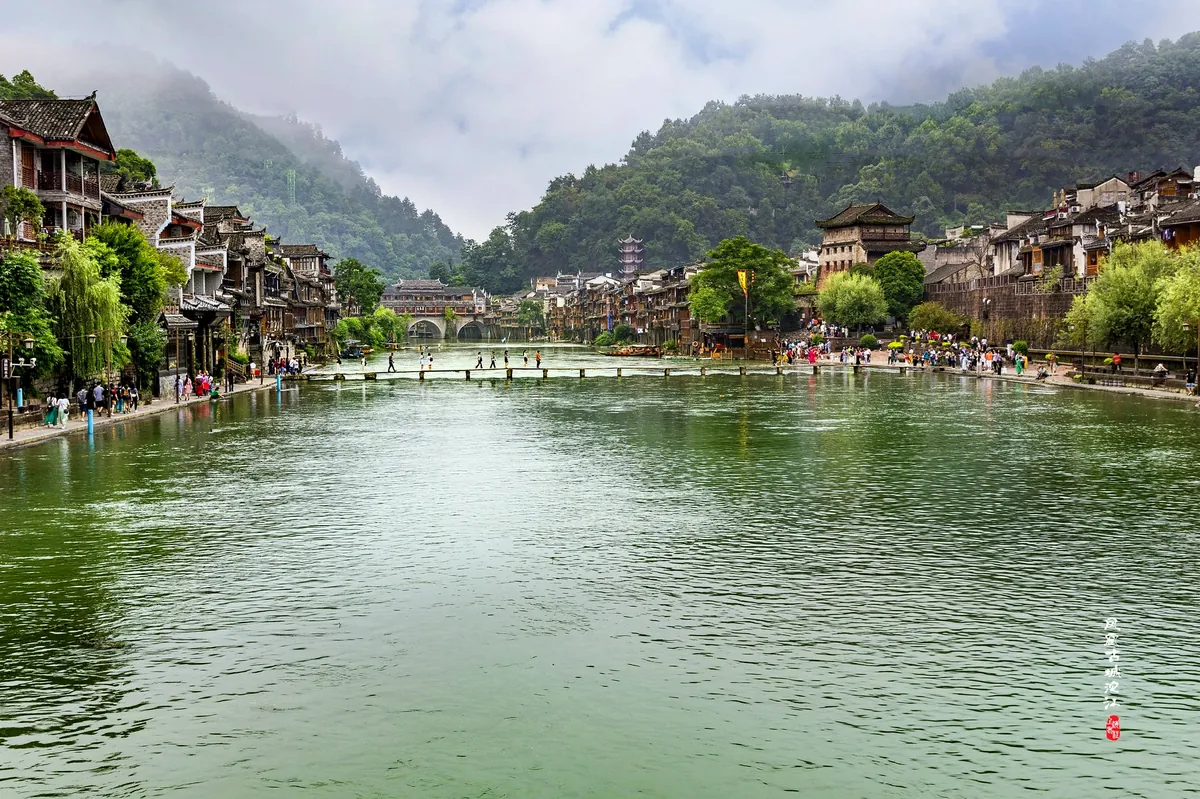
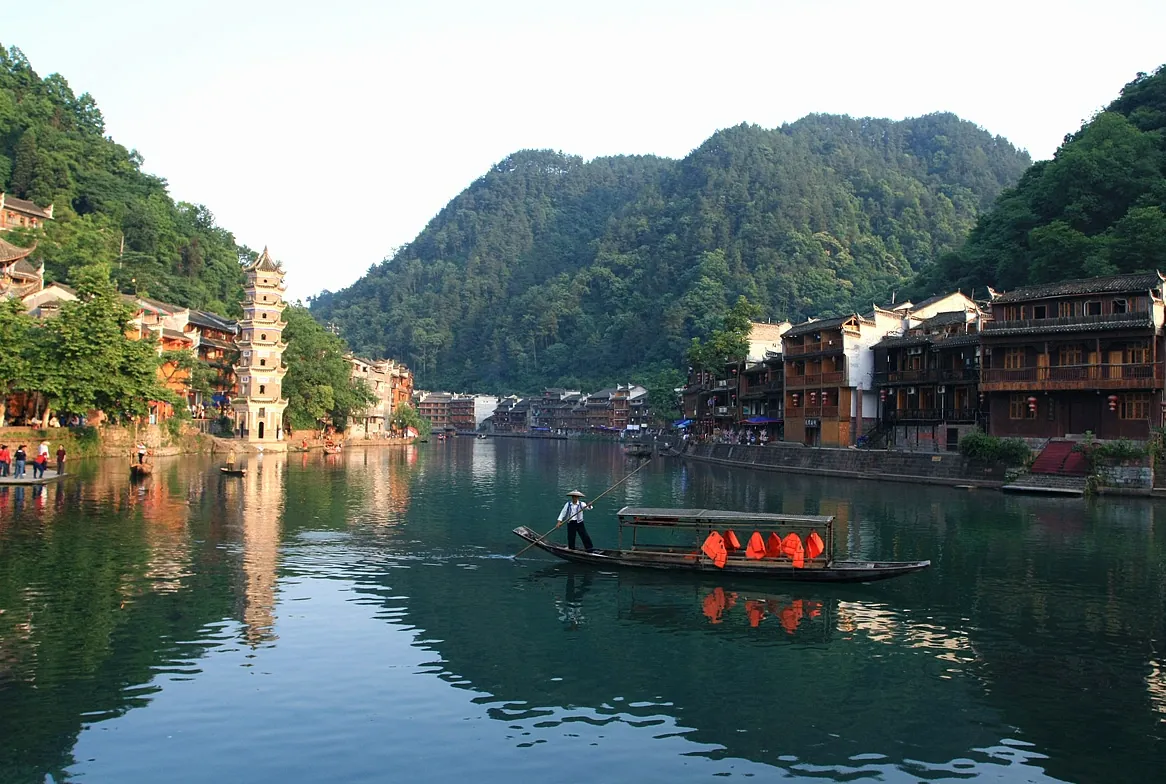
The panoramic view of the ancient town stretching along both banks of the Tuojiang appears serene with rows of traditional wooden stilt houses casting their reflections on the calm water, highlighted on the left bank by an elegant multi-tiered ancient pagoda soaring into the blue sky. Consecutive rows of moss-covered ancient buildings are interspersed with rustic wooden balconies hanging bright red lanterns, casting shimmering reflections along the undulating mountains covered in the lush green of the primeval forest. Amidst the serene river stretch, a boatman wearing a traditional conical hat leisurely rows a wooden oar, with bright orange life jackets neatly stacked on the boat’s edge, creating a vivid and exquisite brushstroke amidst the breathtaking, time-honored natural landscape.
Not merely a witness to wars and conflicts, the Tuojiang is also the cradle nurturing the literary soul of outstanding writers of the billion-strong nation. This riverside land gave birth to the great writer Shen Congwen, who carved the literary masterpiece monument “Border Town” and the collection of essays “Xiangxi“, bringing the image of the ferry wharf and the pure beauty of the local people into the world literary consciousness. This place was also the birthplace of Xiong Xiling, the first Prime Minister of the Republic of China era, and the endless inspiration for the master painter Huang Yongyu to design and sponsor the construction of classic stone bridges spanning the river such as Xue Bridge, Wu Bridge, and Feng Bridge. Cultural author Rewi Alley, upon setting foot on these waters, unhesitatingly praised it as the most beautiful small town in China, thereby giving birth to the immortal epitaph passed down through generations: “Pingyao in the North, Fenghuang in the South”.
Originating from the soaring slopes of Nanhuashan range—a mountain chain acting as a natural screen at the boundary where the Guizhou plateau and the vast Xiangxi forests meet—the Tuojiang River resembles a soft jade-green silk ribbon draped across the basin of the Fenghuang valley. Following the distinctive geological tectonic faults of northwestern Hunan, the water diligently carves through millions of years to create a perfect S-shaped winding form, embracing the ancient town complex in a solid, protective embrace. Within a stretch of about 6.8 km flowing through the core of the heritage area, the natural topography has created the classic “relying on mountains and facing water” topography in Eastern feng shui: taking the majestic, tranquil Nanhuashan mountains as the backing support behind, opening a spacious and clear vista in front facing the crystal-clear Tuojiang current, fully absorbing the prosperous energy of heaven and earth to shelter the village through hundreds of years of turbulent changes.
Geomorphologically, the Tuojiang River basin lies entirely within a complex fault-block karst structure, where the dissolution of limestone layers combined with alluvial sedimentation creates a uniquely distinctive riverbed. Beneath the calm water surface lies a bottom layer interwoven with polished pebbles and naturally deposited mineral mud, creating ideal conditions for native aquatic species to thrive and keeping the water’s clarity rarely seen. As it flows through each sloping section of the valley bed, the current shifts rhythmically from narrow, swift currents rushing past underwater rocks to widening its aperture, slowly caressing the Shawwan bend (沙湾). At the historic Shawwan bend, the river not only widens its surface to reduce the impact of upstream flood currents but also deposits alluvium, turning this place into a prosperous water transport transfer station in the past before continuing its journey downstream to merge with the majestic Wushui River system.
Nestled within a high-altitude subtropical monsoon climate zone where humidity remains consistently high year-round, the natural landscape along the banks of the Tuojiang River transforms magically with the rhythm of the four seasons. During the spring months from March to May, the intense evaporation occurring where the river’s water temperature meets the cool morning air creates dense, indigo-hued mists between 05:30 and 06:45 each morning. This ethereal fog clings low to the water’s surface, veiling lonely wooden boats and weeping willow branches, turning the real-world scenery into a vivid, deep-perspective ink wash painting where the boundary between reality and illusion seems to dissolve entirely.
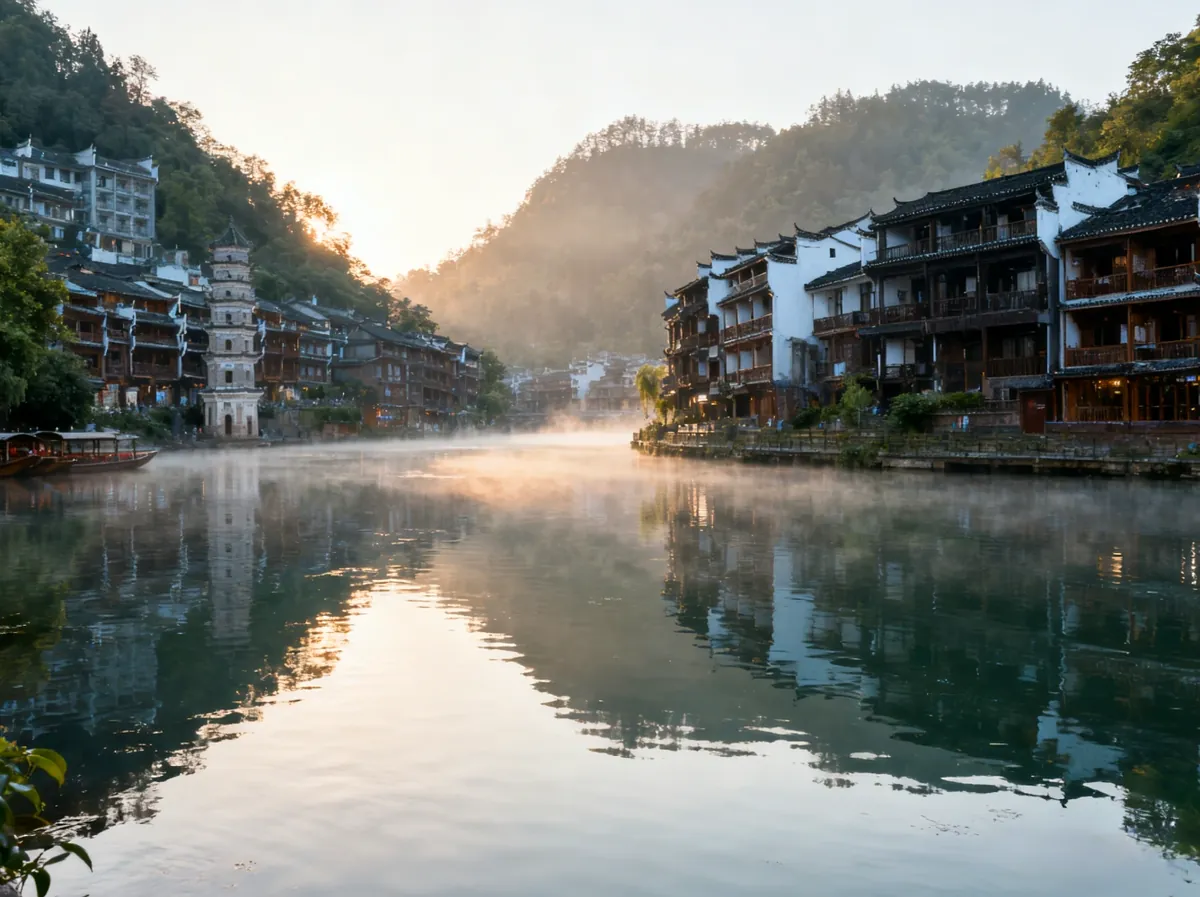
When the spring mist gives way to the crisp, dry air from September to November, the Tuojiang River dons a look of absolute clarity; with stable water levels, the river becomes a giant mirror reflecting the deep turquoise of the sky and clouds. In the freezing winter months, when temperatures drop to between 2°C and 8°C, cold air rushing from the Xiangxi canyons sometimes brings snow that blankets the area in white. Snowflakes settle on the yin-yang tiled roofs of the stilt houses (Diaojiaolou) perched precariously over the water, draping a silver coat over the fir wood pillars embedded deep in the riverbed, creating a symphony between the harshness of the highland geology and the timeless, pristine elegance of the local nature.
Viewed from the perspective of the ancient urban layout, the Tuojiang waterway is the backbone that has defined the planning and lifestyle of indigenous ethnic groups for centuries. Defining the appearance of both banks is the Diaojiaolou (吊脚楼) complex of the Miao and Tujia people—an architectural solution for hydrological adaptation that achieves perfection in both technical engineering and visual aesthetics. To adapt to the erratic flood levels of the river winding through the canyons, these traditional wooden stilt houses utilize the cantilever principle, extending half of the structure out over the water. The weight of these multi-story structures is firmly supported by a system of fir wood (杉木) piles driven deep into the submerged rock shelves along the bank; before being erected, this native timber undergoes a years-long process of soaking in mineral-rich silt to seal the wood grain, providing superior resistance to termites and rot against the erosion of time. Above the load-bearing frame are layers of mossy, gently sloping yin-yang tiled roofs, creating soft eaves that contrast with the somber wooden walls. The living space is strictly functional: the ground floor near the water is used for mooring boats and storing fishing tools; the second floor serves as the cozy family living area, opening onto a river-view veranda with intricately curved railings known as “Beauty’s Leaning Rail” (美人靠), where women can embroider and enjoy the scenery; while the airy, well-ventilated attic is reserved for storing food and dried grains through the storm seasons.
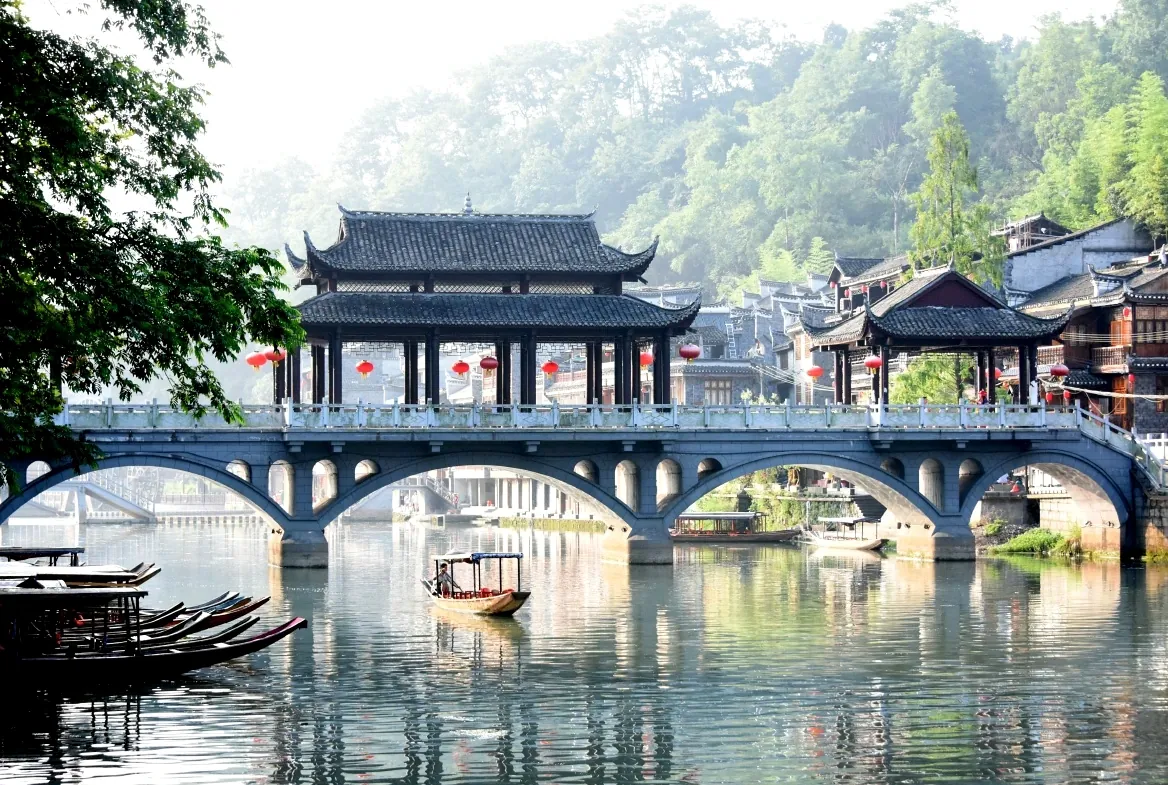
Continuing the series of Diaojiaolou are historical landmark structures crossing the river, the pinnacle of which is the Hongqiao Bridge (Rainbow Bridge), also known as the Wind and Rain Bridge. First built in the third year of the Hongwu reign of the Ming Dynasty (1370) and extensively renovated during the reign of the Qianlong Emperor of the Qing Dynasty, this two-story red sandstone bridge stands like an artistic fortress spanning the Tuojiang River. At the base of the bridge, three massive stone arches provide wide clearance for water flow, resiliently dividing the fierce currents during flood season to protect the banks. The superstructure of Hongqiao is designed in the traditional pavilion style; the first floor is a covered pedestrian bridge lined with bustling kiosks selling local handicrafts and herbs, while the second floor is a quiet, elegant cultural space displaying ancient calligraphy and paintings, hosting traditional tea ceremonies, and offering panoramic views of the river’s winding beauty.
Just a short paddle from Hongqiao is the Tuojiang Jumping Rock Bridge (沱江跳岩 – Tiaoyan), a primitive transportation relic that embodies sophisticated surveying logic. Created in the 43rd year of the Kangxi reign of the Qing Dynasty (1704), this structure consists of a system of hand-carved double stone pillars embedded deep into the shallow riverbed. A flat, square stone slab is placed on top of each pillar, with the distance between them calculated to match the stride of an adult. This unique, intermittent structure minimizes resistance to the current during floods while creating a highly rhythmic architectural accent, where the daily life of the townspeople is poetically and enduringly woven directly into the natural flow.
The intact preservation of the Tuojiang landscape axis stems not only from nature’s protection but also from landmark economic decisions. Entering the heritage tourism restructuring phase in 2001, the Fenghuang County government granted commercial exploitation rights for eight core heritage sites to the private sector for 833 million Yuan over a fifty-year term. The abundant financial resources from this transfer project paved the way for renovating the underground drainage system, reinforcing ancient stone embankments, and restoring the original appearance of hundreds of ancient stilt houses along the river according to strict heritage conservation standards. This synchronized operation and professional management bore fruit in 2024, when the Chinese Ministry of Culture and Tourism officially recognized Fenghuang Ancient Town and the Tuojiang River basin as a 5A-level National Scenic Area, affirming the peak status of an architectural complex that both preserves its ancient character and operates sustainably within the modern tourism economy.
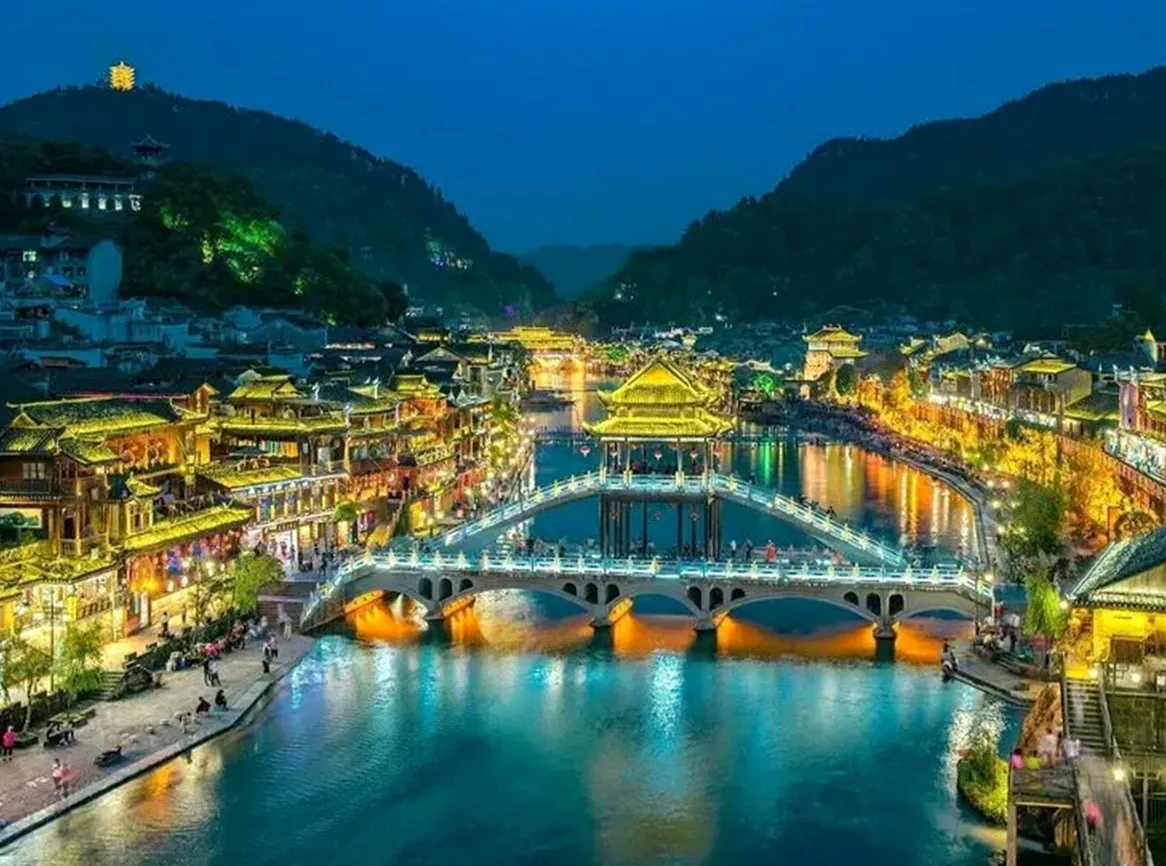
As the indigo twilight gradually descended upon the Xiangxi canyon, the Tuojiang River shed its solemn daytime antiquity to don a magnificent night robe, marking the monumental transformation of this heritage space through the ambitious Tuojiang night economy strategy. Meticulously shaped and continuously upgraded with a smart lighting ecosystem, the artistic lighting project here has transformed the entire six-point-eight-kilometer stretch of winding water, sheer limestone cliffs, mossy stone arched bridges, and the perilous Diaojiao Lou stilt houses into a multi-tiered visual live-action stage. The warm yellow glow of tens of thousands of traditional lanterns intertwines harmoniously with the LED spectrum band submerged beneath the riverbed, reflecting onto the azure water surface an illusory world resembling a landscape painting adorned with gold dust. This elaborate lighting creation not only delivers a visual feast for distant travelers but also generates a spectacular economic turning point, extending the average tourist stay duration from one-point-one days to two-point-three days, turning every overnight stay by the Tuojiang banks into an unforgettable, profound cultural experience.
The most precious highlight of the nightlife rhythm is the Tuojiang Bamboo Rafting journey, the pleasure of riding on dugout wooden boats gliding among shimmering waves. Priced at around one hundred and twenty-eight yuan, this night voyage is not merely a passive sightseeing tour but an elaborate interactive live performance. Amidst the hazy night mist blurring human figures and the magical light casting from the foundations of stilt houses, the pure image of Cuicui from Shen Congwen’s literary masterpiece Border Town suddenly materializes vividly through lighting art combined with resonant Miao ethnic folk tunes. The rhythmic sound of oars striking the water, the echoing antiphonal singing from rock crevices, and the silhouette of Cuicui waiting for her lover by the old ferry dock seem to blur all boundaries between reality and illusion, leading travelers’ minds astray into the Xiangxi cultural space of nearly a century ago.
Docking at the mossy stone banks, the onshore rhythm unveils a contrasting yet strangely harmonious soundscape blending nostalgia and the breath of the modern era. Along the blue slate-paved alleys running close to the water’s edge, the riverside bar street with poetic names like Youth Bar or Shen Listening to Music has become a sanctuary for kindred souls. Unlike the usual noise and bustle of modern metropolises, the establishments here choose a rustic performance style featuring the warm sounds of acoustic guitars, cajon drums blending with the soulful, rustic vocals of wandering troubadours. Long rows of red lanterns hanging under the eaves of Diaojiao Lou cast reflections on the dark water, creating an exquisite contrast between the stillness of the ancient river and the youthful vitality of contemporary life, where one can sip a cup of strong local rice wine and let all worries drift away with the slow-flowing current.
Despite shining brightly and brimming with commercial vitality, the Tuojiang night space still maintains strict ecological discipline to preserve the original character of the mountainous region. To balance tourism stimulation and the preservation of the aquatic ecosystem, the entire artistic lighting system on both riverbanks is operated according to strict time standards: simultaneously turning on at twilight dusk, which is around 5:30 PM in winter and 6:45 PM in summer, and turning off completely at exactly 11:30 PM. When these artificial light sources extinguish to honor the river’s sleep and minimize light pollution, Tuojiang returns its pristine, quiet night to the universe, leaving only the ivory moonlight illuminating the serene water and the chirping of insects amidst millennia-old wooden houses.
Along both banks of the Tuojiang River, as the blue mist drapes over the mossy tile roofs of the Diaojiao Lou rows, Xiangxi’s culinary flavors awaken through the evening kitchen smoke and the characteristic pungent aroma of chili peppers. This humid valley surrounded by overlapping mountain ranges has forged a unique culinary philosophy of the Miao and Tujia communities since ancient times: using spiciness, the refreshing acidity of natural fermentation, and wood-smoke flavors to dissipate heat and ward off wind-cold-dampness, turning every daily meal into a body-balancing remedy.
Reigning in the most revered position on the local feast tray is Blood Rice Cake (血粑鸭 – Xuebaya), the essence symbolizing the elaboration of Xiangxi delicacies. To make this famous dish, local chefs soak sticky, fragrant glutinous rice and mix it evenly with freshly collected duck blood, then steam it thoroughly until it forms firm, chewy blood-rice blocks. The cooled blood-rice blocks are cut into neat square cubes, dropped into a pan of sizzling hot oil to fry until the outer layer is crispy while the interior remains soft and moist. Next, tender free-range duck meat is chopped into bite-sized pieces, stir-fried in an iron pan over blazing fire, and simmered with the fried blood-rice cakes, bright red chili peppers, crushed old ginger, and tongue-numbing Sichuan peppercorns. The blood-rice pieces absorb the rich duck meat juices, blending into a pungent, spicy flavor that rushes up the nasal passages, creating an unforgettable, intense layer of taste.
The azure waters of the Tuojiang River not only provide a source of life but also generously bestow ingredients for Miao Family Sour Fish Soup (苗家酸汤鱼). Fresh batches of river carp or catfish just caught in the crystal-clear water by fishermen are meticulously cleaned, preserving their natural freshness and sweetness. The soul of the dish lies in the sour soup broth, naturally fermented according to a secret family recipe using rice water combined with wild tomatoes growing on mountain slopes, salt-pickled red peppers, and fragrant wild lemongrass grooves. The gentle, pure acidity and natural sweetness of the broth permeate every translucent white fish fillet, forming a shield protecting the internal organs, helping diners chase away the inherent humid cold of the river valley’s basin.
Besides the enthusiastic savory dishes, the riverside rhythm of life is also intimately connected to the rustic yet deeply resonant Rice Tofu (米豆腐). Premium white rice is thoroughly soaked in clear lime water, finely ground using a stone mill, and stirred steadily over low heat until the rice paste thickens into a smooth, glossy jade-yellow jelly block poured into molds to set. This dish once touched the hearts of millions of art lovers when it appeared poetically in the classic 1986 film “Hibiscus Town“. Neatly square-cut slices of rice tofu are placed neatly in a blue-glazed porcelain bowl, drenched in bright red satay chili oil sauce, sprinkled with finely chopped scallions, crispy crushed roasted peanuts, and a dash of sweet-and-sour vinegar-infused soy sauce. It offers a smooth, refreshing sensation on the tip of the tongue, leaving behind a lingering, passionate spicy aftertaste.
Stepping into the kitchen of any wooden house along the Tuojiang River, visitors easily encounter strings of Western Hunan Cured Pork (湘西腊肉) hanging from the rafters of the smoke-filled wood-burning attic. Thick strips of pork belly, sourced from free-range black pigs raised on the hillsides of the Miao people, are thoroughly marinated with coarse salt, leaf-fermented rice wine, and wild mountain peppers for half a month before being hung in the kitchen ceiling fueled year-round by pine wood and rice husks. Under the caressing herbal smoke day in and day out, the pork fat transforms to become as transparent as a sparkling piece of amber, while the lean meat shrinks into a ruby-red hue, naturally chewy and sweet, radiating a strong, rustic aroma of mountain straw and stubble.
Strolling along the bluestone-paved embankment as the ancient town lights up, the rhythmic sound of wooden pestles and a warm, fragrant aroma guide footsteps toward the Fenghuang Ginger Candy (凤凰姜糖) stalls. This centuries-old family-recipe delicacy originates deeply from the Qianlong Emperor’s era during the Qing Dynasty, meticulously cooked from pure cane sugar, wild forest honey, and the renowned spicy ginger of Western Hunan. The piping-hot maltose candy mass is hooked by artisans onto an upright nanmu wooden stake by the waterside, skillfully and swiftly stretched and folded hundreds of years—folded hundreds of times until the candy turns into a light, fluffy off-white color before being sliced diagonally into small pieces with copper scissors. Savoring the warm, spicy ginger candy and sipping a cup of Tieguanyin tea while sitting on a swaying wooden boat drifting down the chilly night waters of the Tuojiang River, travelers fully comprehend the rugged charm and warm hospitality of Western Hunan’s landscapes and people.
Kicking off the journey into the mountainous Western Hunan region, contemporary travelers can now access the Tuojiang River (沱江) basin via a modern and convenient transportation infrastructure system. The breakthrough highlight is the Zhang-Ji-Huai High-Speed Railway (张吉怀高铁) with a designed speed of up to 350 km/h, shortening travel time from Zhangjiajie Airport to Fenghuang Ancient Town Station to a mere 58 minutes, or connecting seamlessly from the provincial capital Changsha in about 2 hours and 15 minutes. Right upon stepping off the high-speed railway station, travelers are transferred directly to the central strip along the Tuojiang River via the Fenghuang Sightseeing Maglev Train (凤凰磁浮观光快线). This is the world’s first sightseeing maglev train service, boasting a length of 9.12 km and operating at a speed of 100 km/h, winding spectacularly through limestone valleys to offer travelers a panoramic view of the ancient town from above before gliding smoothly down to the waterside. Departing from Vietnam, travel enthusiasts can choose the overland route through the Friendship International Border Gate, take a bus to Nanning, and then connect to a high-speed train to Huaihua or Fenghuang with a total time of about 11 to 13 hours; or choose direct flights from Hanoi and Ho Chi Minh City to Zhangjiajie Hehua Airport (DYG) and then transfer to the high-speed railway.
Regarding entry and exit legal procedures, since Hunan province lies deep in the interior of China rather than bordering borderlands, visitors are strictly required to have a regular passport valid for at least six months along with a valid visa. You can use a Group Visa sponsored by official travel agencies or apply for an individual tourist visa (Visa L). It should be noted that a Border Pass has no legal validity for traveling and staying in this region.
Since the local authorities abolished the policy of charging entrance tickets to the ancient town, the entire system of bluestone pedestrian walkways running along both banks of the Tuojiang River has been completely open free of charge day and night, granting travelers the absolute freedom to immerse themselves in the dreamy, misty scenery. Visitors only need to purchase tickets when visiting independent ancient residences such as the Former Residence of Shen Congwen, the Yang Family Ancestral Hall, or when stepping onto traditional wooden dugout canoes to enjoy the Tuojiang Drifting (沱江泛舟) voyage, with costs ranging from 85 to 128 Yuan per trip depending on the daytime or nighttime itinerary. When dusk falls and lanterns brightly illuminate both sides of the Diaojiao Buildings (Stilt Houses), the traditional costume rental service for Miao and Tujia ethnic minority girls, accompanied by personal photographers, operates vibrantly with negotiated prices commonly ranging from 200 to 400 Yuan per package. Nevertheless, travelers should vigilantly check the transaction contract carefully, clearly stipulating the number of post-processed photos and the clause for handing over all high-resolution raw photo files to avoid unnecessary disputes.
A vital piece of advice for travelers is to heighten vigilance against “cheap tour” or “zero-dollar” tour traps advertised with surreal costs of just four to five million VND. These itineraries essentially cut out almost all free time to admire the Tuojiang River in order to herd customers into isolated shopping workshops. Here, participants are easily psychologically manipulated into spending money on handmade Miao silver products that actually contain toxic zinc alloys, participating in Western Hunan Traditional Chinese Medicine pulse-taking and prescription sessions fabricated with illnesses to sell exorbitant herbs, or purchasing memory foam latex mattresses at prices many times their actual value. To fully enjoy the pristine cultural flavor and leisurely admire the charming landscapes, the wisest choice is to register for pure exploration “No Shopping” (纯玩团) itineraries with transparent costs ranging from 9.5 to 14.5 million VND. To thoroughly prepare for your excursion along this famous historic river, you can immediately check out the experience-rich practical itinerary at the Zhangjiajie – Fenghuang Ancient Town – National Forest Park – Miao Village 6D5N Tour.