Amid the bustling pulse of coastal Pattaya—a city known worldwide as an entertainment metropolis that never sleeps—Wat Yansangwararam emerges as a quiet, contemplative note, a spiritual sanctuary of national stature. The temple is far more than a mere religious architectural structure; it stands as a living testament to a remarkable chapter of history during the reign of King Rama IX, the monarch revered by the Thai people as a living saint. Officially established in 1976, Wat Yansangwararam carries a noble mission as a First-Class Royal Temple, or Woramahawihan, a title affirming its supreme standing within the Thai Buddhist hierarchy.
The name Wat Yansangwararam is no coincidence; rather, it is the crystallization of the profound reverence King Rama IX held for Supreme Patriarch Somdet Phra Yanasangworn, the highest spiritual leader of Thai Buddhism at the time. By bestowing the title of this esteemed Patriarch upon the temple, the King forged an enduring spiritual bond, transforming the site into a symbol of harmony between the monarchy and the Sangha. Against the shifting backdrop of the 1970s, as Thailand stood on the threshold of rapid economic and social transformation, establishing a major Buddhist center in Eastern Thailand fulfilled King Rama IX’s heartfelt aspiration to preserve core Buddhist values while providing a steadfast spiritual anchor for the people.
Looking back at the sweep of history, the founding of Wat Yansangwararam was closely tied to the King’s strategic vision for developing the Chonburi region. Far beyond a place of worship, the temple was designed as a cultural and educational complex where Buddhist moral values could be practiced and shared. Under King Rama IX’s reign, the temple became a focal point for community development projects, where the monarch frequently visited to listen to the concerns of local residents and offer guidance on agriculture and natural resource conservation. Every inch of soil and every tree here breathes the philosophy of the “Sufficiency Economy” diligently cultivated by the King, turning the grounds into an exemplary model of sustainable development rooted in spirituality.
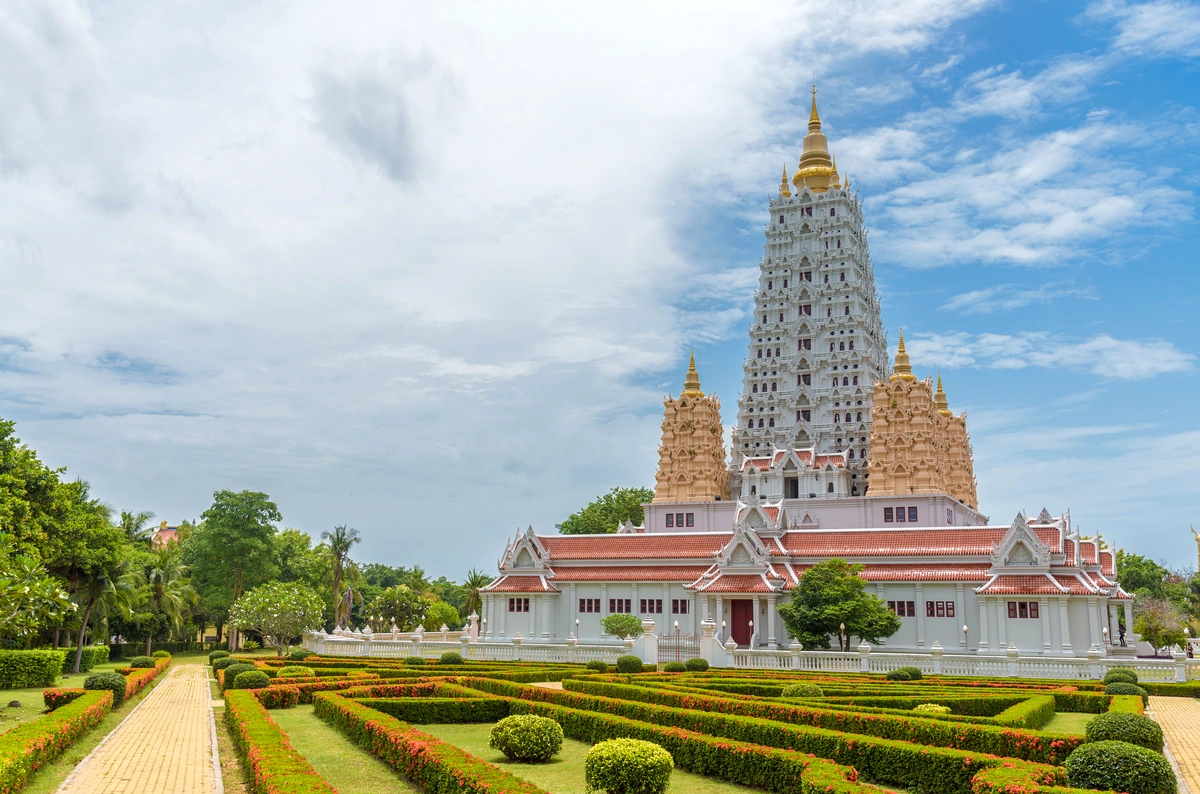
Wat Yansangwararam’s presence on Thailand’s spiritual map also affirms the endurance of traditional values in the face of modernization. Over the decades, the temple has witnessed the changing tides of history—from periods of political uncertainty to Pattaya’s dramatic economic leaps—while steadfastly preserving its innate serenity. Successive senior monks and caretakers have worked tirelessly to uphold the spirit entrusted by King Rama IX: a sanctuary where people can rediscover inner peace, and where wisdom and compassion are nurtured. For this reason, Wat Yansangwararam is not merely an architectural heritage site, but a chronicle written in stone and spirit, preserving the full imprint of a glorious reign and the devotion of a monarch who always placed his people at the heart of every decision.
Today, stepping into the expansive grounds of Wat Yansangwararam, visitors do more than admire the beauty of sweeping temple roofs and majestic Buddha statues—they touch a proud chapter of Thai national history. Every corner here tells a story of the intersection between past and present, faith and reality, creating a cultural space rich in identity. This is the priceless legacy left behind by King Rama IX, proof that no matter how times change, humanitarian and spiritual values remain a guiding beacon for a nation’s progress.
Wat Yansangwararam is more than a religious complex; it is a masterpiece of master planning positioned on one of the most auspicious feng shui sites in Tambon Huai Yai, Bang Lamung District, Chonburi Province. Viewed through the lens of human geography, the temple occupies a classic “backed by mountains, facing water” setting, where low hills embrace a lush green valley, forming a protective crescent that channels spiritual energy from the surrounding ranges down toward the Huai Tu Reservoir. In Thai spatial philosophy, selecting this site went well beyond convenient access; it involved careful calculation of energy flows, with the waters of Huai Tu Reservoir acting as a vast “water-gathering basin” that retains auspicious vitality across the entire architectural complex spanning over 145 acres.
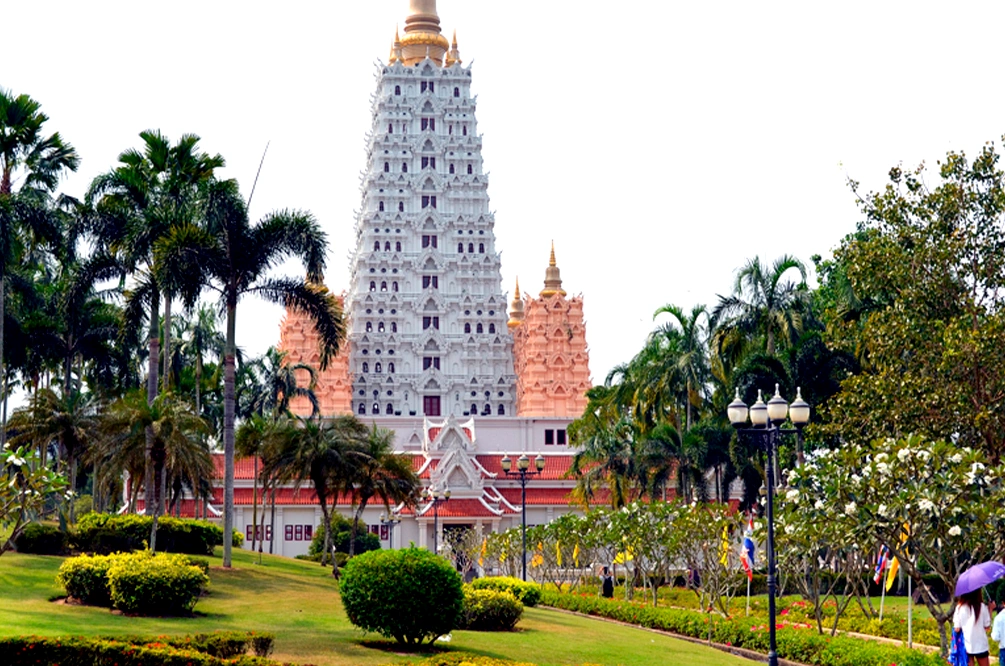
The master plan of Wat Yansangwararam was a complex architectural undertaking requiring a harmonious integration of three core functional zones: the Buddhist ceremonial area, the monastic quarters, and the community development projects initiated by the Thai Royal Family. Architects and geomancy masters of the era skillfully followed the natural contours of the hills without leveling or disrupting the original geological structure. Instead, they used varying terrain elevations to stratify the space. Principal structures were positioned along distinct elevation axes, creating a graceful visual rhythm in which each vantage point offers a transition between spiritual tiers. This layout not only provides essential privacy for monastic practice but also ensures seamless connectivity via natural stone pathways winding gently along the slopes.
From a technical standpoint, the construction of Wat Yansangwararam showcases a synthesis of modern engineering and traditional Rattanakosin aesthetic principles. Materials were chosen not only for durability but also for their ability to harmonize with the tones of the native landscape. Pristine white walls, multi-tiered roofs glazed in brilliant gold, and intricate carvings in precious timber were all engineered to withstand the rigors of Chonburi’s tropical monsoon climate. Notably, the drainage and water-management system fed by Huai Tu Reservoir was designed as an integral part of the landscape, with small channels dug to irrigate the rare botanical ecosystem surrounding the temple. This represents a sustainable equilibrium between architecture and nature, where humanity does not impose its will upon the land but coexists symbiotically with the environment.
The distinctive landscape of Wat Yansangwararam is further shaped by meditation gardens where native trees—such as Bodhi trees, Sala trees, and a variety of tropical blooms—are meticulously tended. These green expanses act not only as “lungs” regulating the microclimate across the entire complex, but also as vital pockets of stillness for the soul. The pairing of monumental, solid architectural forms with the soft, shifting textures of lush vegetation composes an enchanting scenic tableau. When sunset descends, reflecting off the surface of Huai Tu Reservoir onto the gilded temple roofs, the entire complex seems to glow, creating an ethereal visual effect that affirms the strategic foresight of the temple’s founders. This absolute respect for natural topography has made Wat Yansangwararam a model of sustainable planning, where every brick and every tree tells a story of the interplay between human devotion and the timeless beauty of creation.
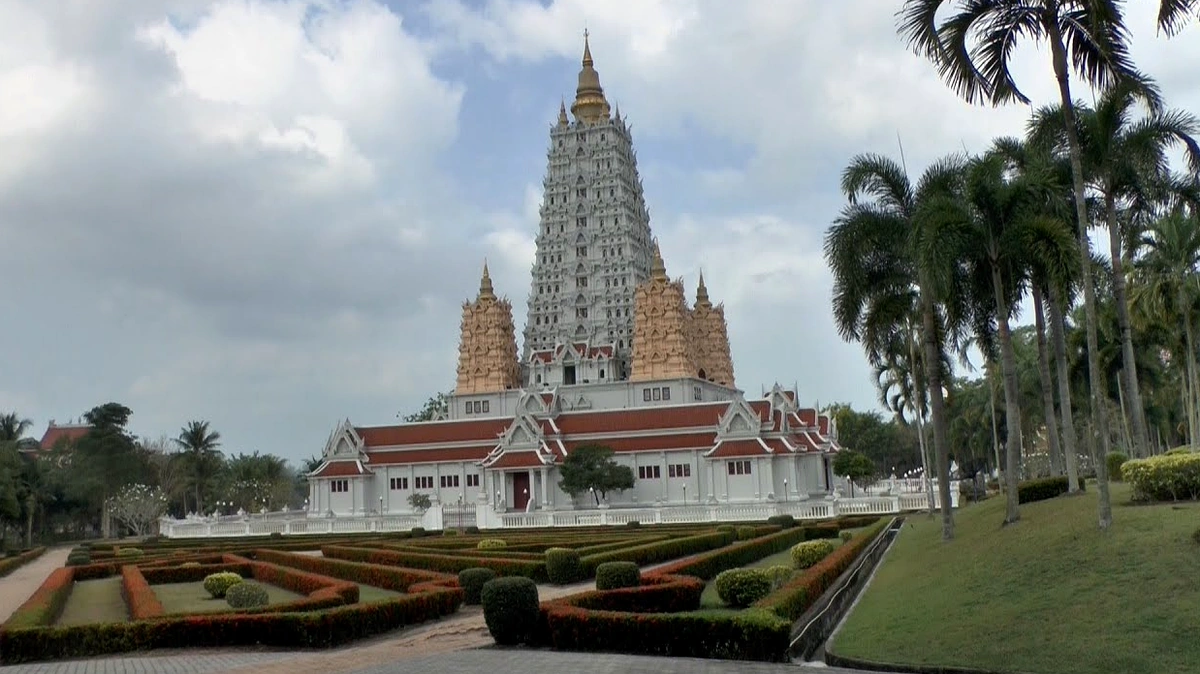
Wat Yansangwararam is not merely a spiritual sanctuary; it is a living architectural museum where Thai royal aesthetics come to life through a bold East-West cultural synthesis. Sprawling across more than 145 acres, the grounds are laid out according to strict feng shui philosophy, maximizing the mountain-and-water setting of the Sattahip area to cultivate a tranquil energy field completely insulated from Pattaya’s bustle. Every structure in the complex testifies to master craftsmanship, with architects carefully calculating the load-bearing capacity of each stone block, the overhang of the tiled roofs, and coastal wind patterns to guarantee lasting resilience against the harsh tropical monsoon climate.
At the heart of the complex stands Phra Borommathat Chedi Maha Chakri Phiphat, a masterpiece of modern Thai architecture built to enshrine relics of the Buddha. Rather than adhering strictly to classical conventions, this stupa embraces a refined, dignified aesthetic defined by crisp geometric lines. Surface craftsmanship pairs high-strength materials with pure gold-leaf ornamentation, producing a dazzling visual effect under the sunlight. Its true subtlety lies in the interior spatial arrangement, where natural daylight is channeled through architectural openings to create a mystical atmosphere that exalts the sacred relics placed at its center.
Contrasting with the pure Thai elegance of the stupa, Viharn Sien unfolds as a resplendent chapter of Chinese architectural artistry. Far more than a ceremonial hall, it serves as a vast repository of antiquities housing thousands of priceless artifacts dating from the Qing Dynasty and earlier eras. Sweeping glazed-tile roofs, columns carved with coiling dragons, and intricate stone wall reliefs were all crafted by master artisans brought in from mainland China. The presence of Viharn Sien within Wat Yansangwararam delivers a message of cultural harmony, honoring and preserving East Asian aesthetic traditions inside a spiritual landmark of the Land of Smiles.
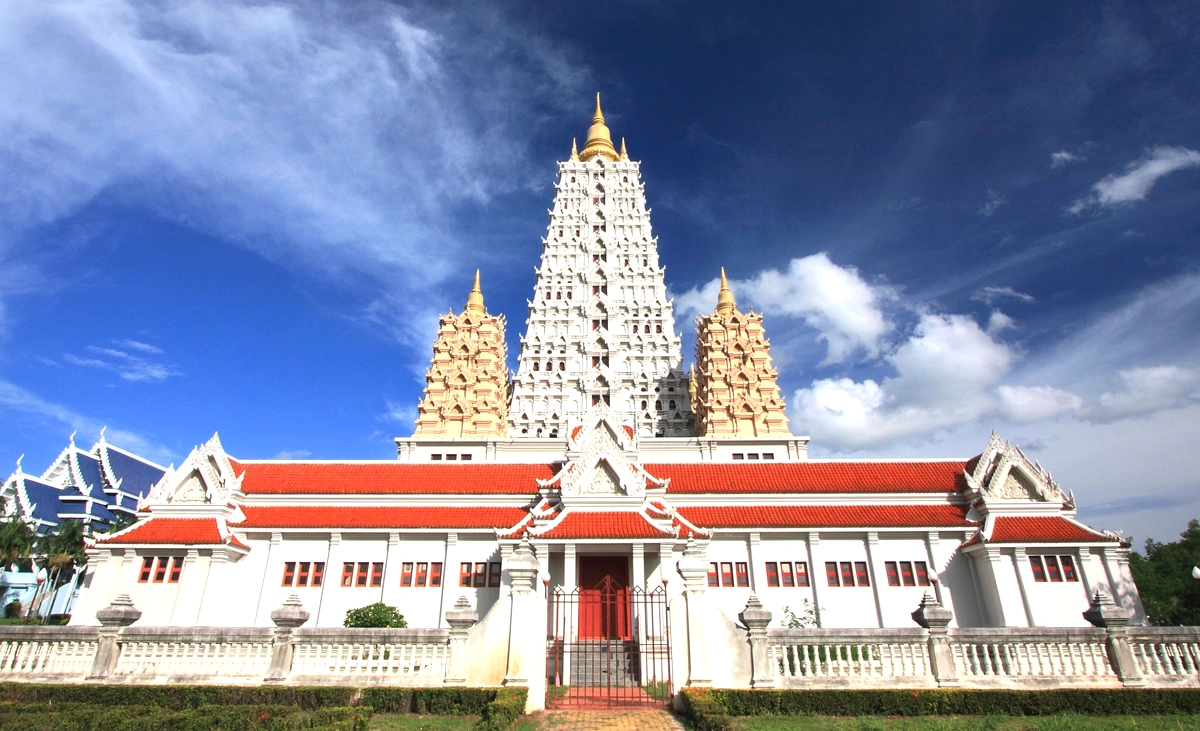
Alongside it, the Mandapa—the pavilion housing the Buddha’s Footprint—evokes a distinct sense of serenity. Its design emphasizes absolute balance, featuring an open-air layout that promotes natural airflow to temper the coastal heat. Wood carvings adorning the doors and window frames serve not merely as decoration, but as philosophical lessons on human existence conveyed by artisans through lotus motifs and traditional Buddhist iconography. Combining aged hardwoods with traditional mortise-and-tenon joinery enables the structure to stand firm for decades without metal nails or screws, reflecting the sustainable ingenuity of traditional builders.
The physical scale of Wat Yansangwararam is further expanded by a network of artificial lakes and royal-style manicured gardens. These bodies of water not only regulate the microclimate and provide essential ambient humidity for the wooden structures, but also act as mirrors reflecting the beauty of the temples, composing an idyllic natural vista. The union of modern construction engineering, coastal climate adaptability, and unwavering reverence for traditional artistry has established Wat Yansangwararam as an architectural benchmark. Strolling through its zones, one feels this refinement deeply—where craftsmanship extends far beyond surface ornament, permeating every load-bearing beam, every brick, and every breath of the tranquil air.
When twilight descends and restores a hushed stillness to the Bang Lamung valley, Wat Yansangwararam transforms from a Buddhist sanctuary into a mesmerizing installation of light art. Unlike the noise and clamor of central Pattaya roughly 20 kilometers away, nighttime here is defined by absolute tranquility, where every beam of light shimmering off Huai Tu Reservoir carries a message of enlightenment and peace. This is no venue for loud live spectacles backed by electronic soundtracks; rather, it is a “stage” for the soul, illuminated to highlight the refined architectural lines of the Chakri Dynasty—particularly the interplay between traditional Thai forms and classical Chinese accents at Viharn Sien.
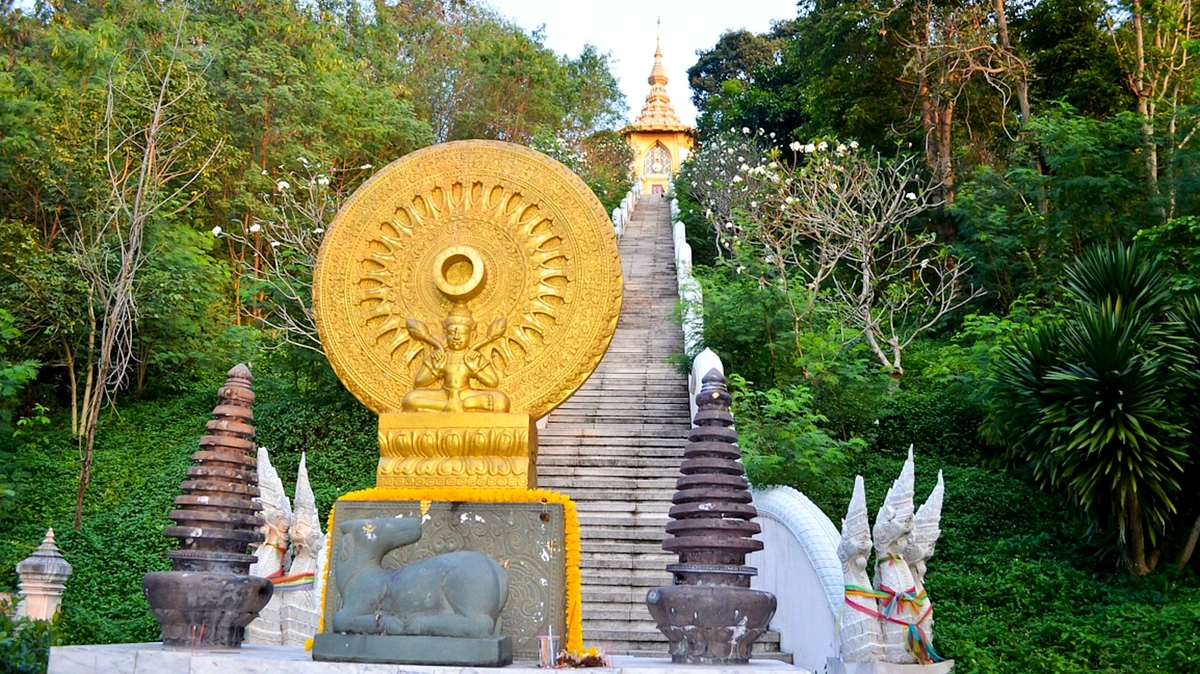
Beneath the clear moonlight, Huai Tu Reservoir acts like an immense mirror, reflecting the image of Chedi Phra Borommathat—home to the Buddha’s relics—in an ethereal, shimmering glow. Warm golden lighting is positioned with restraint, diffusing gently without glare to accentuate the intricate carvings along the sweeping eaves. In this setting, visitors can practice walking meditation (chankamana) beneath ancient canopies, where cool mist rising from the water mingles with the valley’s evening breeze to cleanse the spirit. It is the ideal hour to experience the fusion of architecture and Buddhist philosophy, when every vantage point becomes a living, breathtaking scenic tableau.
The nocturnal artistic experience at Wat Yan also extends to the Viharn Sien precinct, which houses thousands of priceless antiques from imperial Chinese dynasties. Under soft, atmospheric illumination, bronze statues, porcelains, and stone sculptures seem to take on a life of their own. Strolling through these grounds after dark feels like stepping back in time, where cultural treasures have remained intact across decades. There are no glaring neon signs and no thumping music—only the rustle of wind through bamboo groves and the soft chime of temple bells drifting from the eaves, weaving a symphony of stillness.
For souls seeking equilibrium, sitting in meditation beside Huai Tu Reservoir in the dim nocturnal glow is an irreplaceable experience. The quiet of Wat Yan at night is never empty; it is brimming with restorative energy. In designing the lighting system for the complex, artisans and architects drew inspiration from the philosophy of the “light of wisdom,” calibrating every beam to guide visitors from architectural curiosity toward inward reflection. Monuments like the stupa and ceremonial halls cease to be mere inert concrete; bathed in night light, they become spiritual beacons illuminating each individual’s path inward.
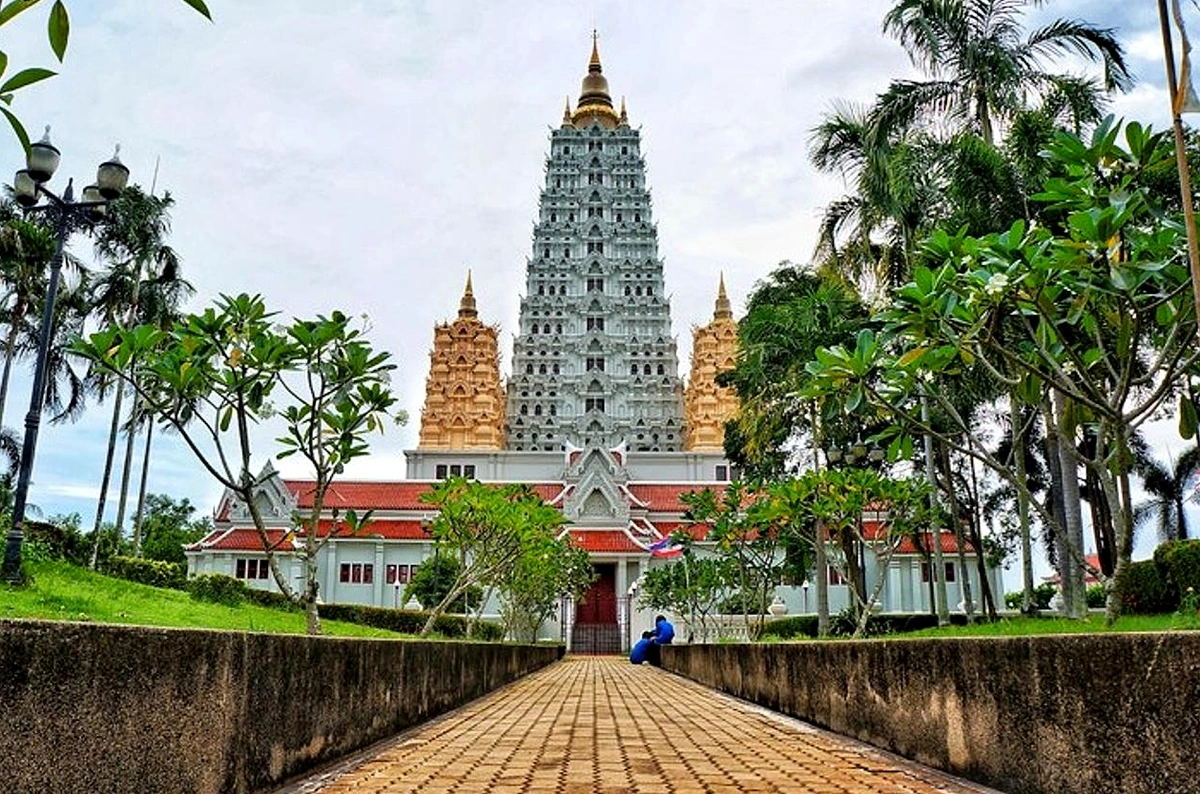
As night settles in, the surroundings of Wat Yan also offer an ideal setting to savor traditional herbal teas harvested directly from the meditation gardens on the grounds, prized for their delicate, soothing aroma. Sipping a warm cup of tea in the crisp valley air while watching lights dance across the reservoir allows travelers to shed the worries of modern life. This is the finest “live performance” Wat Yansangwararam offers to those who cherish stillness—an art of living that no artificial lighting effect can ever replicate.
Paying homage to the magnificent spiritual monuments of Wat Yansangwararam not only offers a tranquil space for contemplation, but also opens the door to discovering the rich culinary heritage of Chonburi. Positioned at a gateway linking monastic serenity with the vibrant coastal life of Eastern Thailand, the area surrounding the temple has long been a renowned hub of local gastronomy, preserving heirloom flavors refined over generations. For discerning travelers, sampling the dishes here goes far beyond satisfying hunger—it is a way to connect deeply with the culture, terroir, and spirit of the region’s people.
When morning sunlight first touches the gilded temple roofs, traditional food stalls near the entrance begin filling the air with rich aromas. One unmissable experience is tasting sour mackerel soup, known locally as Kaeng Som Pla Too. This dish captures the essence of coastal Chonburi, pairing freshly caught Gulf of Thailand mackerel with a bright, tangy broth made from ripe tamarind and the fiery kick of freshly pounded chilies. The harmony between the fish’s natural sweetness and the depth of aromatic herbs creates an unforgettable flavor profile, vividly reflecting the Thai culinary philosophy of balancing yin and yang. Alongside it, stir-fried squid with holy basil is another standout specialty: tender, crisp squid flash-fried over high heat with fragrant basil leaves and bird’s-eye chilies delivers an explosion of flavor that awakens every sense.
The culinary scene around Wat Yansangwararam also preserves rustic traditional snacks that remain an indelible part of local childhood memories. Right near the entrance to the complex, visitors can easily spot Khanom Chak—sweet cakes wrapped in nipa palm leaves and grilled over glowing charcoal until fragrant with grated coconut and palm sugar. Each compact, chewy parcel embodies meticulous care and warm hospitality. Nearby, skillets of golden Khanom Krok—coconut rice pancakes crispy on the outside yet soft and creamy within—are perpetual favorites among visitors. The artistry behind these street foods lies not only in their ingredients, but in the devotion of the vendors who have safeguarded family recipes for decades, turning every bite into a miniature culinary work steeped in cultural meaning.
Even more remarkably, much of the produce supplying these stalls comes directly from the royal project orchards located within the expansive grounds of the area. These model farms practice sustainable agriculture guided by the late King Rama IX’s Sufficiency Economy philosophy. As a result, fresh fruit here consistently boasts a clean sweetness, juiciness, and pure flavor of the land. Enjoying a plate of ripe golden mangoes or freshly picked mangosteens beneath the shade of ancient trees around the temple evokes a rare sense of relaxation—a direct bond between people and nature, cultural heritage and fertile soil. Every dish and snack at Wat Yansangwararam tells its own story of tradition meeting modernity, spirituality meeting everyday life, adding a vital piece to the colorful cultural mosaic of legendary Chonburi.
To make your journey to Wat Yansangwararam truly seamless and meaningful, having solid logistical details in hand is essential. Because the temple is both an architectural landmark and a monument of devotion to King Rama IX, visiting calls for thoughtful preparation in both mindset and itinerary. Regarding opening hours, the temple grounds welcome visitors daily from 08:00 to 17:00. Visiting within these hours lets you enjoy the peaceful atmosphere while avoiding the peak afternoon heat of Eastern Thailand, leaving ample time to explore key landmarks such as Chedi Phra Borommathat and the Chinese-style pavilion Viharn Sien.
Getting to Wat Yansangwararam is straightforward when departing from central Pattaya. The most common route follows Highway 3 (Sukhumvit Road) heading south. After traveling roughly 15 to 20 kilometers, turn left onto Route 332. This scenic road winds through peaceful countryside, allowing you to feel the gradual shift from the lively beachfront city to a tranquil monastic sanctuary. For travelers without private transport, hiring a private taxi or songthaew is the best option, as regular public transit routes generally do not run all the way to the temple gates. Admission to the temple grounds is free for all visitors, a generous policy aimed at sharing Buddhist values and royal heritage with the public. However, certain special exhibition halls or museums housing rare antiquities within the complex may charge a modest admission fee to support conservation efforts, so carrying small-denomination cash is recommended.
One crucial aspect every traveler must keep in mind is proper etiquette and dress code. Wat Yansangwararam enshrines sacred relics and stands as a symbol of the Thai Royal Family, so reverence is paramount. Visitors must never wear shorts, sleeveless tops, short skirts, or revealing clothing when entering the temple grounds. Opt for modest, respectful attire that covers both shoulders and knees to show respect for local culture. Maintaining quiet is also an unspoken rule to preserve peace for those praying or meditating. Alcohol, intoxicants, and disorderly behavior are strictly prohibited anywhere within the sanctuary. All restricted zones, management signage, and royal protocols must be observed carefully to ensure your visit proceeds smoothly without unintended missteps.
To capture memorable photographs while maintaining proper decorum, pay close attention to signs indicating where photography is permitted. A helpful tip is to arrive early in the morning, when the sunlight is gentle and crowds are sparse, making it easy to frame clean shots of the sweeping rooflines and serene Buddha images. Be sure to bring drinking water and a hat, as the temple complex is vast and walking between zones under the tropical sun can be tiring. If you are looking for a well-structured itinerary that optimizes travel time and immerses you in the cultural highlights here, consider exploring our 5D4N Bangkok – Pattaya tour for seamless transportation and in-depth cultural insights from a local guide.