Resting quietly in the vast Junggar Basin of the historic Western Regions, Urho Ghost City (乌尔禾魔鬼城) emerges not as a human-built monument of brick, stone, or royal dynasties, but as a grand geological site holding millions of years of Earth’s history. From a geological perspective, this land’s origin story begins in the Late Cretaceous epoch—roughly 100 million years ago—and extends into the Paleocene. At that primeval dawn, it was not a barren desert, but an expansive freshwater lake basin with a warm, fertile climate. Lush lakeside vegetation once nurtured giant sauropod dinosaurs like Wuerhosaurus alongside flying pterosaurs such as Junggaripterus gliding across ancient skies, leaving behind priceless fossils embedded in layers of claystone and sandstone.
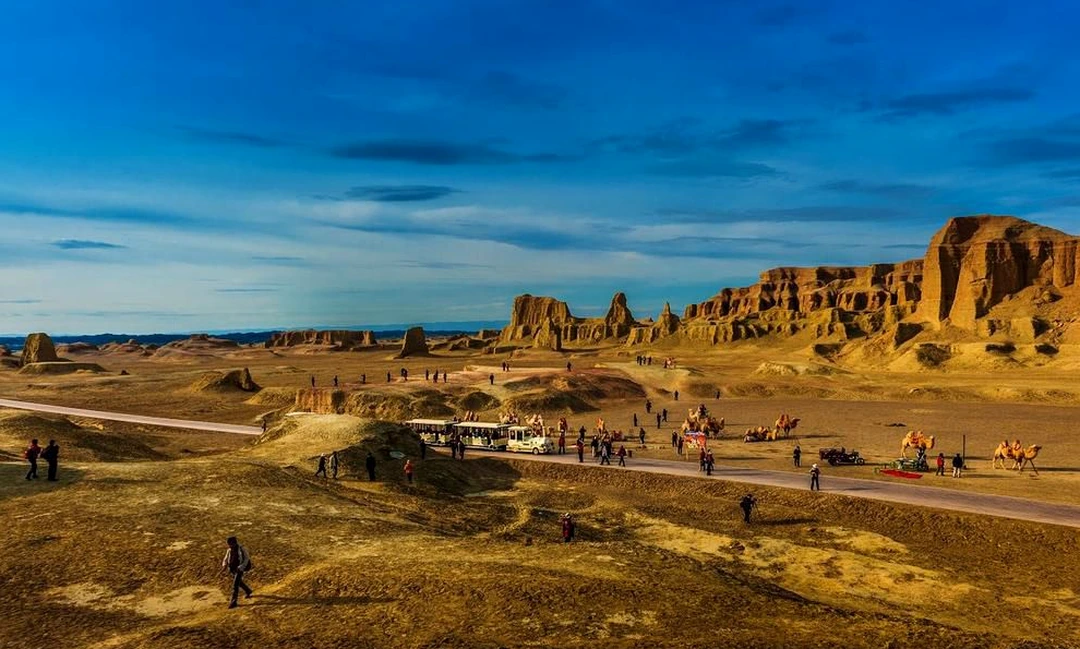
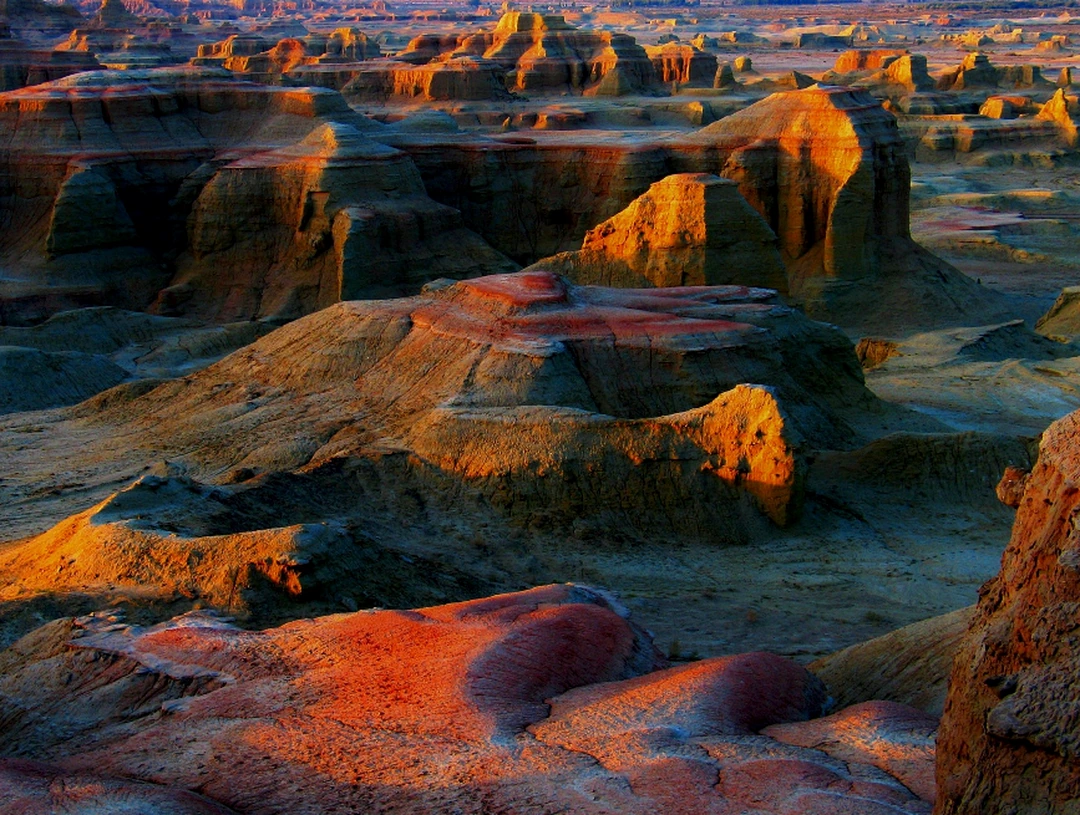
Dramatic planetary shifts began when the great Himalayan orogeny surged upward, lifting the entire basin and draining the ancient freshwater lake. Over tens of millions of years, receding waters gave way to the relentless carving and sculpting power of nature. Roaring northwest winds combined with intermittent flash-flood erosion stripped away softer rock layers, chiseling out a majestic Yardang landscape. Multi-hued sedimentary formations weathered into countless eerie shapes resembling crumbling temples, ancient spires, or shadowy thousand-year-old fortresses standing tall in empty space.
As humans began leaving footprints across this frontier land, Urho Ghost City took on rich layers of culture and history. Positioned along the corridor of the fabled Northern Silk Road, it once witnessed countless merchant caravans, warhorses, and expeditionary forces crossing the desert. During the flourishing Tang dynasty, this vast frontier inspired endless frontier poetry. Renowned scholar-poet Cen Shen—an official who marched twice into the Western Regions with military campaigns—left behind immortal verses capturing the boundless, harsh, yet wondrously surreal scenery here. His footsteps and those of Tang soldiers pressed into the sands of history, turning this silent land into part of medieval Chinese poetic heritage.
The very name of the site holds a fascinating cultural contrast between nomadic peoples who once roamed the land. In Mongolian, “Urho” (乌尔禾) carries a gentle, verdant meaning—”place with many trees”—a linguistic memory of when the area was cloaked in dense lakeside forests. By contrast, nomadic Kazakhs herding livestock through narrow gaps in the eroded clay hills called the place “Saitan” or “Kuerjian,” meaning a realm where “spirits or demons run wild.” That is because whenever strong winds howl through the narrow channels of the Yardang ridges, compressed air produces moaning, wailing, and echoing sounds like thousands of ancient spirits crying out—turning the landscape into a “Ghost City” that feels at once somber and timelessly mysterious.
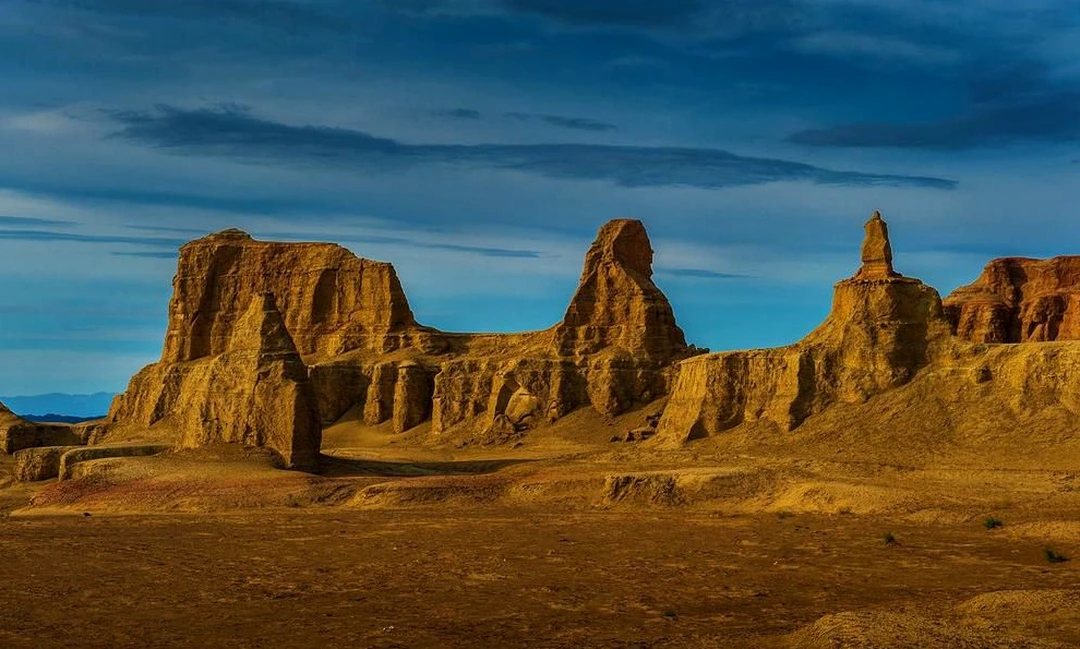
In terms of terrain and natural layout, Urho Ghost City sits in a remarkable geo-ecological spot on the northwestern rim of the vast Junggar Basin, straddling the lower reaches of the Jiamu River—also recorded in local gazetteers as the Tuogan River—within the administrative boundary of Karamay City in the Xinjiang Uyghur Autonomous Region. Spanning more than 100 square kilometers, the terrain has the sweeping yet solitary poise of a grand geomantic board, shaped from countless wind-eroded Yardang mounds over millions of years of weathering. Seen from above, the entire expanse looks like a petrified ancient metropolis where fractured clay ridges weave through an arid desert basin, creating a space charged with primeval energy that is both grand and darkly enigmatic.
The core force behind Urho’s unmistakable identity is the interplay between a temperate arid desert climate and complex local aerodynamics. Lying right beside a major northwestern wind gap—a geographical funnel between high mountain ranges and a low basin—the area frequently experiences a pronounced Venturi effect. When fast-moving desert winds are squeezed through narrow passages between earth-and-stone mounds, air pressure drops sharply and airflow speed surges, turning the whole valley into a giant natural violin. Wind whistles through every nook and cranny, brushing hollow rock cavities and sheer walls to release haunting sounds—at times rolling like ocean waves, at others sharp and eerie like spirits crying across the wild air.
Set within the harsh ecosystem of a temperate desert, plant life at Urho Ghost City still pulses with resilient vitality through drought-tolerant flora. Spotted across grayish reddish-brown clay and drifting sand is the desert saxaul (Haloxylon ammodendron), whose roots plunge dozens of meters deep in search of scarce groundwater. Alongside it, red tamarisk shrubs (Tamarix ramosissima) glowing rosy in autumn and sharp-spined camel thorn interlock to form natural biological barriers against encroaching sand and dust. This hardy vegetation not only helps stabilize microclimates, but also brings subtle touches of artistic color to a stark geological setting.
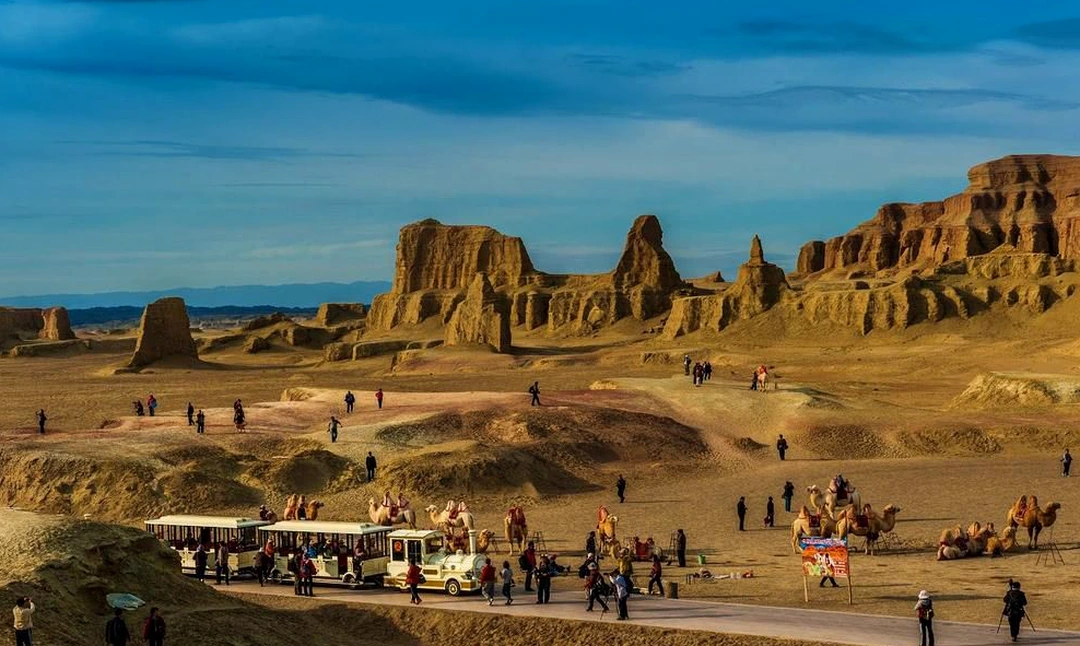
Regarding conservation planning and technical zoning, to permanently protect fragile geological structures made of easily fractured mudstone and conglomerate, Urho Ghost City is organized into three strict protection tiers: a core strict-preservation zone, a surrounding ecological buffer zone, and a closed-loop viewing route system. Within the core zone, wind-carved wonders such as the mysterious Buddha Caves or the towering Nine Dragons Ridge—mounds shaped like nine dragons stretching out into the desert—are kept in an unspoiled state. All visitor experiences are routed along closed viewing paths combining eco-friendly electric shuttle vehicles and elevated wooden walkways above ground. This engineering approach prevents direct foot trampling on sensitive strata while letting visitors admire the spectacle of the site without harming its natural geological balance.
Stepping into the heart of the Junggar Basin, the sheer scale of Urho Ghost City feels less like an ordinary architectural ruin and more like a natural megacity rising out of the Northern Xinjiang wilderness. Across dozens of square kilometers, the Yardang terrain forms a sweeping architectural ensemble with dramatic ups and downs, immediately giving onlookers the sensation of standing before a forgotten ancient civilization. Nature’s spatial composition at Urho achieves a striking sense of proportion, where flat avenues cut between rows of natural “buildings,” suggesting an urban plan laid out by master architects.
Viewed through geology and natural architecture, the secret lies in a distinctive layered structure researchers call “hard cap, soft base” (硬顶软底). The uppermost crown of each Yardang block is capped by a firmly cemented pebble-and-gravel crust able to withstand rain, sun, and climatic weathering across countless eras. Beneath and in between lie softer, more pliable layers of mudstone and sandstone in shades ranging from warm reddish-brown to muted bluish-gray. This contrast in material durability is the key mechanism: as fierce desert winds sweep across the basin, the softer base is steadily hollowed and sculpted away while the harder cap acts like a sturdy roof, keeping the formation from collapsing outright.
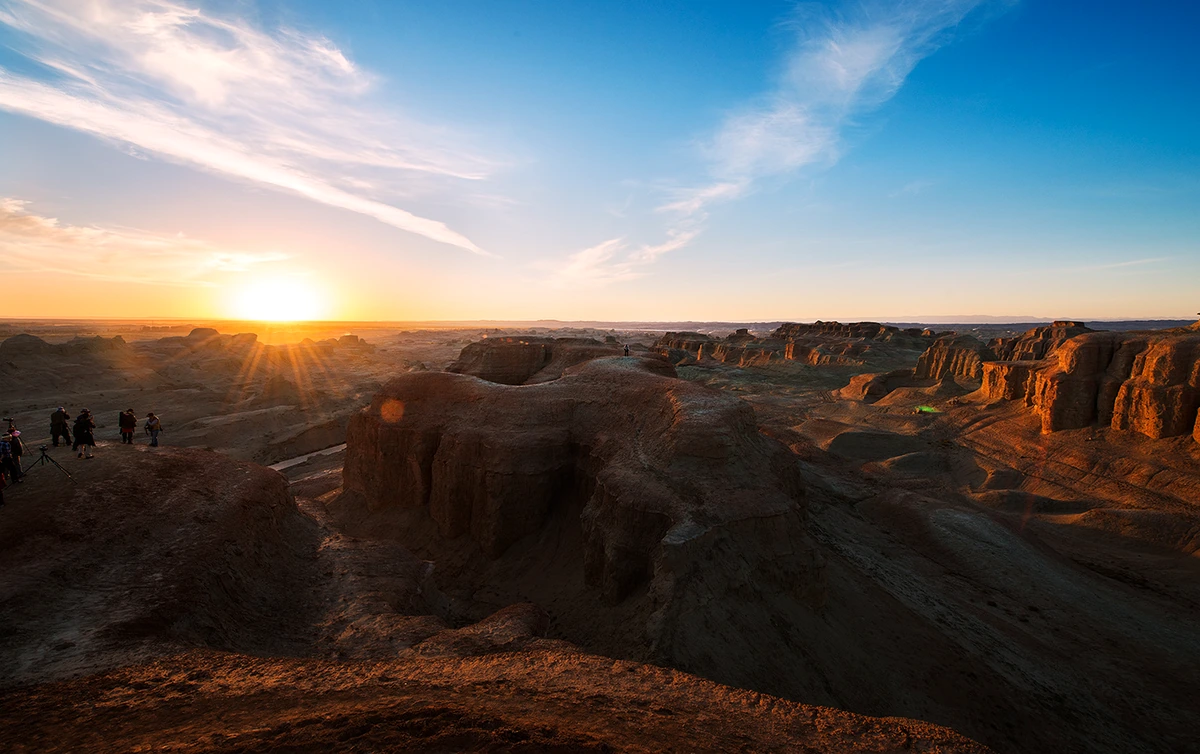
Thanks to this intricate natural erosion process, Urho’s real-world scale shifts into a varied architectural maze filled with lifelike forms. Sheer cliffs reaching up to a hundred meters rise straight into blue skies, evoking the fortified walls of ancient city-states. Deeper inside the ghost city, visitors easily spot standalone rock pillars resembling solemn shrines, defensive fortresses complete with embrasures, or tall watchtowers standing silently on guard over the wilds. Far from monotonous, each natural structure carries layered rhythmic forms that surpass any human-built palace in sheer scale.
Nature’s artistry here is not limited to grand silhouettes; it shows up sharply on every centimeter of material surface. Under the persistent scouring of fine sand carried in swirling winds, Urho’s sandstone and mudstone develop intricate weathering patterns—astonishingly detailed honeycomb pitting, deep parallel flutes, or gentle ripples across dry rock faces. Up close, these surfaces look as alive as antique woodcarvings or stone reliefs chiseled by skilled craftsmen.
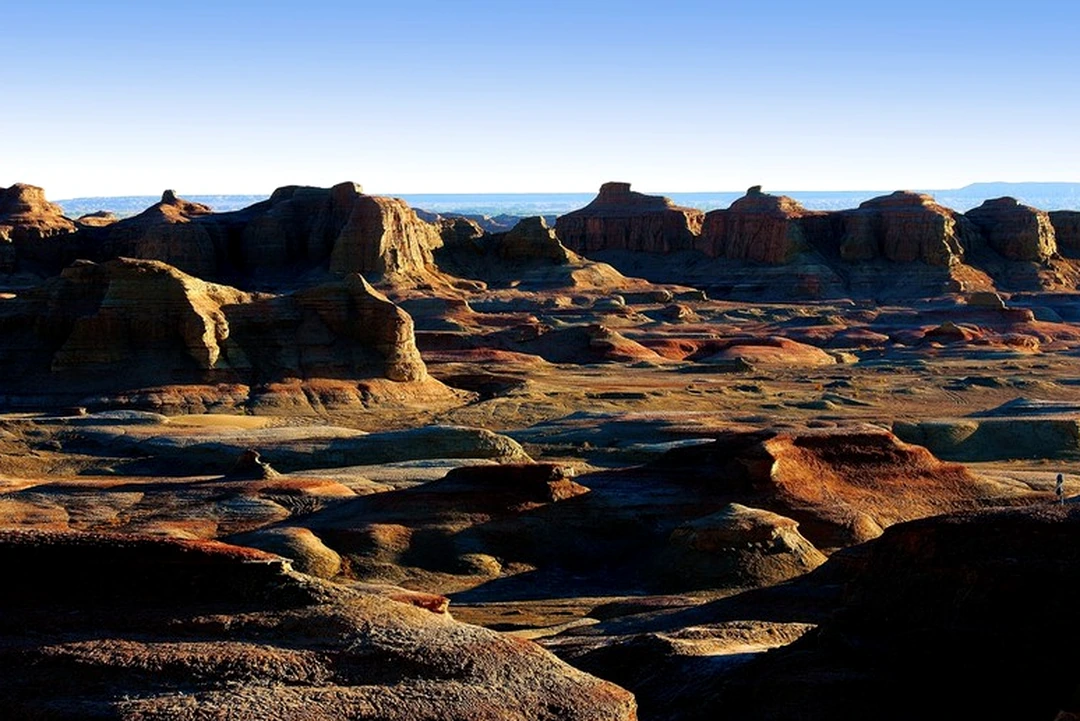
The spatial structure of Urho Ghost City is further elevated by the magical interplay between light and geological hues. At dawn or dusk, reddish-brown and bluish-gray rock bands catch the sun and radiate a warm, captivating glow, sharpening angular edges and deep shadows inside narrow clefts. Rather than dead silence, the site is a vast acoustic theater where wind whistling through deep grooves hums low, resonant notes—completing a natural architectural masterpiece grand in scale and fine in detail, truly a treasure of the Earth.
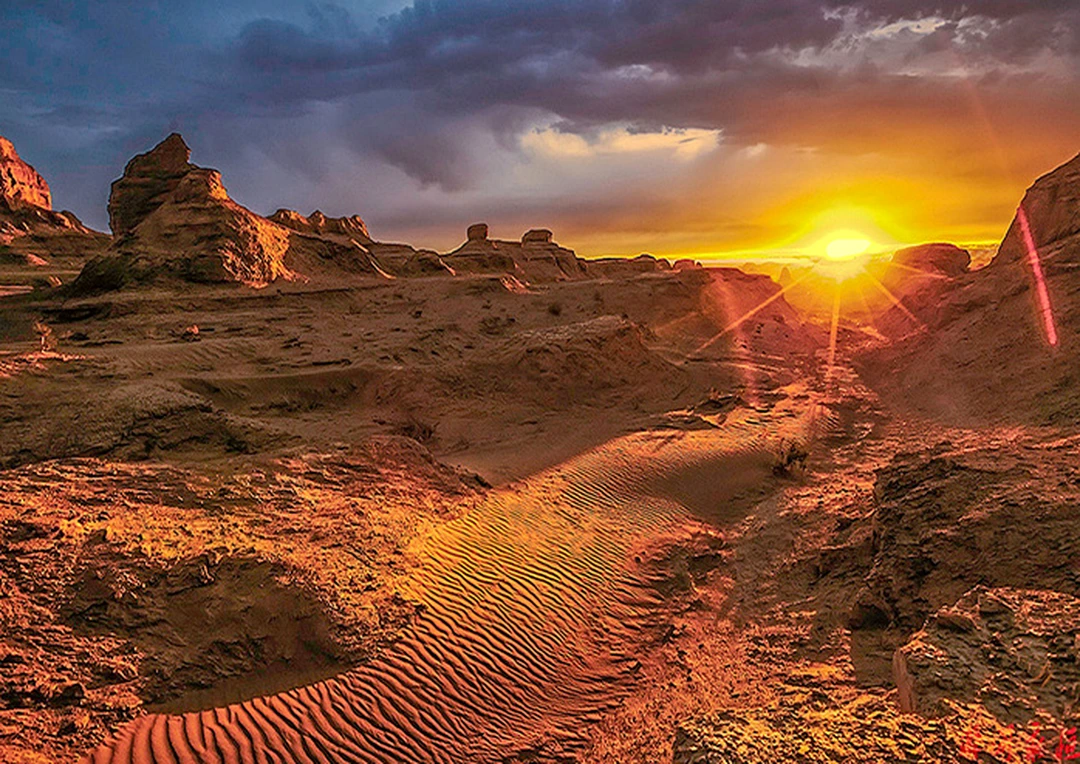
When sunset casts its last rays across the Junggar Basin, Urho’s rugged Yardang terrain does not fade into empty quiet; instead, it transforms into an eerie, captivating visual art space. Contemporary light engineering breathes fresh life into the strangely shaped rocks through low-glare wall washers and concealed fixtures tucked into crevices. Rather than overusing harsh high-intensity lights that disrupt natural circadian rhythms, designers applied dynamic 3D projection mapping dominated by cool hues like mysterious cobalt blue and moody green, contrasted with warm amber tracing multi-million-year-old weathering veins. This dance of light and shadow highlights the proud ruins of the desert landscape while respecting night-sky protection principles—bringing Urho close to Dark Sky Park standards, where visitors can enjoy illuminated groundscapes and look up at the Milky Way arching across a vast sky.
The emotional centerpiece of nightlife at this fabled site is a large-scale live performance show titled “Night of the Ghost City.” Using the sweeping Yardang terrain as a natural backdrop, the production blends live theater, 3D holographic imagery, and vivid light choreography from hundreds of drones in the night sky. Through carefully staged acts, the show takes audiences back to prehistoric times with legends of ancient dinosaurs that once ruled the basin, and onward to camel bells echoing across the Silk Road linking Eurasian civilizations. In particular, a segment portraying the arduous yet heroic history of Karamay’s early oil pioneers captures human resilience against harsh nature, lending historical depth and poignant humanity to the desert night.
Stepping out of the grand live show, visitors join lively evening energy at the “Karamay Night” cultural street right outside the scenic area entrance. Here, vibrant Kazakh nomadic culture comes alive through expressive two-stringed dombra melodies and the artistic heritage of Aken Aitys—witty, improvisational folk poetic duels. At the center of the night street blazes a bonfire where guests join hands with local young men and women in joyful circle dances beneath the stars. The experience is made even richer by distinctive Western Regions flavors: aromatic lamb skewers roasted on red willow branches, golden-crusted naan fresh from the oven, savory poluo (pilaf), and rich salted milk tea. Together, folk music, traditional food, and bonfire warmth turn an Urho night into an unforgettable sensory feast in the desert.
Nestled peacefully at the crossroads of ancient nomadic routes, Urho’s cuisine is more than bodily nourishment; it is a living chronicle of warm mingling between Kazakh steppe culture, free-spirited Mongolian influences, and refined culinary craft from Han and Hui communities. Amid sweeping expanses of clay towers compressed over millions of years of weathering, local flavors carry the unmistakable character of the desert—raw and authentic, yet rich with heritage. Every dish reflects a philosophy of living in tune with nature, where bounty from wide grasslands and glacial meltwater inspires local cooks generation after generation.

At the peak of Urho food culture are hand-boiled lamb (beshbarmak) and steppe sausage (qazy)—the crowning pride of semi-desert residents. Lamb is carefully chosen from free-ranging flocks on the famed Bayinbuluke grassland or local pastures, where sheep graze wild herbs daily and drink pure spring water. As a result, Urho lamb achieves an ideal firm texture—rich and savory without strong gaminess. Locals keep preparation remarkably minimal: fresh lamb is seasoned simply with coarse mineral salt and thinly sliced onions (piyazi). As the pot simmers over glowing embers, the meat’s natural sweetness mingles with the gentle bite of onion, delivering a pure, refined taste.
Beyond traditional boiling, Urho’s meat-roasting craft is a lively chorus of smoke and flame. Standouts include red-willow lamb skewers (hongliu kaorou / 红柳烤肉) and famed whole roasted lamb. Local cooks sharpen fresh red-willow twigs to skewer alternating bites of lean meat and fat. Set over charcoal made from fruitwoods like apple or apricot, heat draws out natural herbal oils from the fresh willow into every fiber of meat. Subtle resinous fragrance mingling with rich lamb fat sizzling over hot coals creates a one-of-a-kind aroma; straight from the grill, it gleams golden—crisp outside and juicy within—leaving a lingering, memorable finish.
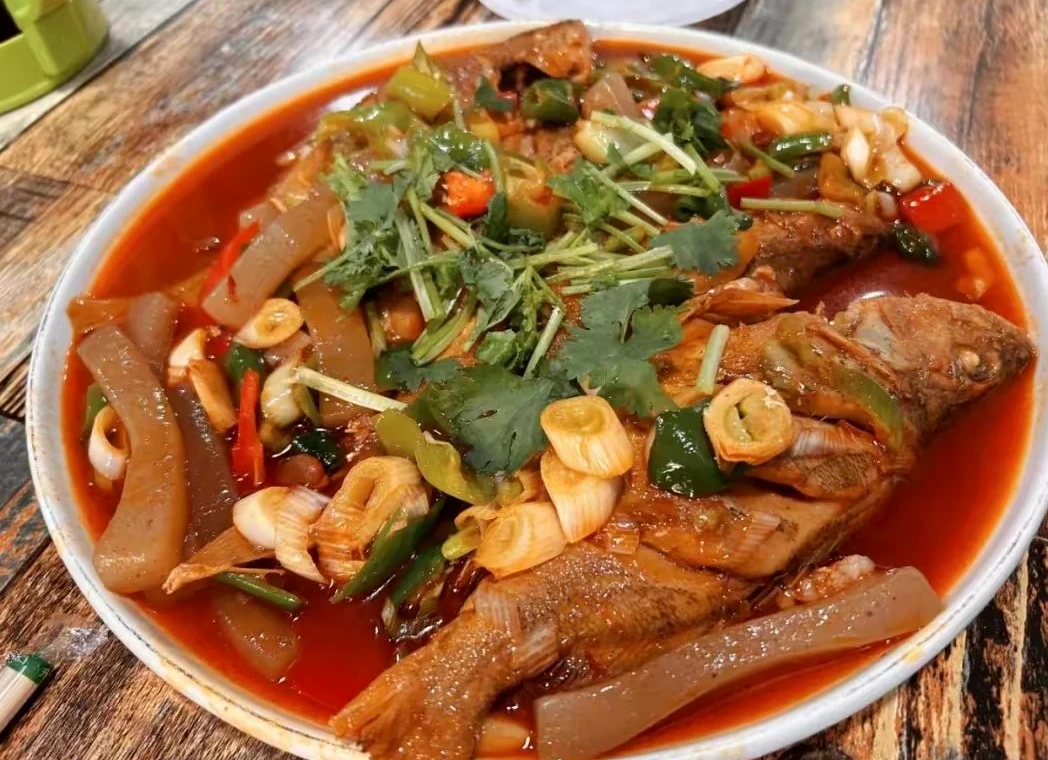
Urho’s culinary map is further enriched by prized aquatic fare from the nearby Jiamu River. Cold, clear glacial meltwater offers an ideal habitat for sought-after cold-water species such as hewu fish or high-altitude whitefish. The cold-water flesh is prized for being firm, sweet, and nutrient-dense, prepared by local households in savory clay-pot braises or lightly steamed with ginger and lemongrass to keep its clean natural taste. Pairing desert-inflected flavors with fresh sweetness from the Jiamu River creates a distinctive yin–yang balance on visitor menus in Ghost City.
Rounding out Urho’s flavors are everyday dishes tied to free-spirited nomadic life. Naryn—hand-cut noodles tossed with shredded lamb and rich broth—always warms travelers after hours out in the desert wind. Inside traditional yurts, guests often sip steaming salted milk tea brewed from fermented brick tea and fresh grassland milk, served alongside golden fried baursak dough puffs that are crisp outside and soft inside. Together they create a warm cultural setting where local hospitality eases the crisp chill of an Urho desert night.
Knowing operating hours and optimal light windows is essential for viewing Urho Ghost City’s dramatic Yardang formations. Under park management rules, opening hours adjust seasonally to match shifting daylight cycles in Xinjiang. During peak season from May through October, the scenic area opens at 08:00 and closes at 20:30; during off-peak season from November through April of the following year, visiting hours run from 10:00 to 18:30. According to seasoned geographical photographers and local experts, the golden moment to capture the area’s eerie allure is the two hours before sunset. As low afternoon sun slants across ancient clay spires, sharp contrasts of light and shadow emerge, crafting a dramatic visual spectacle.
Getting to Urho takes thoughtful route planning to make the most of travel time. The most convenient starting point is flying into the international airport or arriving by train in Ürümqi or the oil city of Karamay. From there, travelers drive or ride along National Highway G217—one of northwestern China’s scenic arteries cutting across sweeping Gobi expanses—for roughly 3.5 to 4 hours. Upon reaching the scenic area gate, private cars are strictly banned to protect the fragile Cretaceous-era Yardang core; visitors must transfer to eco-friendly electric shuttles or dedicated mini-trains to head deeper into the desert.
Entry and administrative procedures at Urho Ghost City follow strict local safety and management protocols. All visitors must book real-name tickets using a passport or valid ID at least 24 hours in advance through the management authority’s official digital mini-program. Alongside paperwork comes strict adherence to “Leave No Trace” heritage rules. Because Yardang formations were shaped by millions of years of desert wind erosion, they are highly sensitive to human impact; climbing on mounds, carving inscriptions, or damaging rock strata is strictly forbidden and subject to severe legal penalties from local authorities.
Harsh continental climate conditions in the Junggar Basin call for careful clothing and gear choices on every trip. Because day-to-night temperature swings at Urho are dramatic, travelers are advised to dress in layers so they can easily add or remove garments as weather shifts. In addition, the desert sees strong solar radiation and brisk winds carrying dry dust. Essentials for your daypack include a wide-brim hat with a chin strap, high-UV sunglasses, high-SPF sunscreen, plus a versatile neck gaiter or buff and a dust mask to protect your airways while exploring.
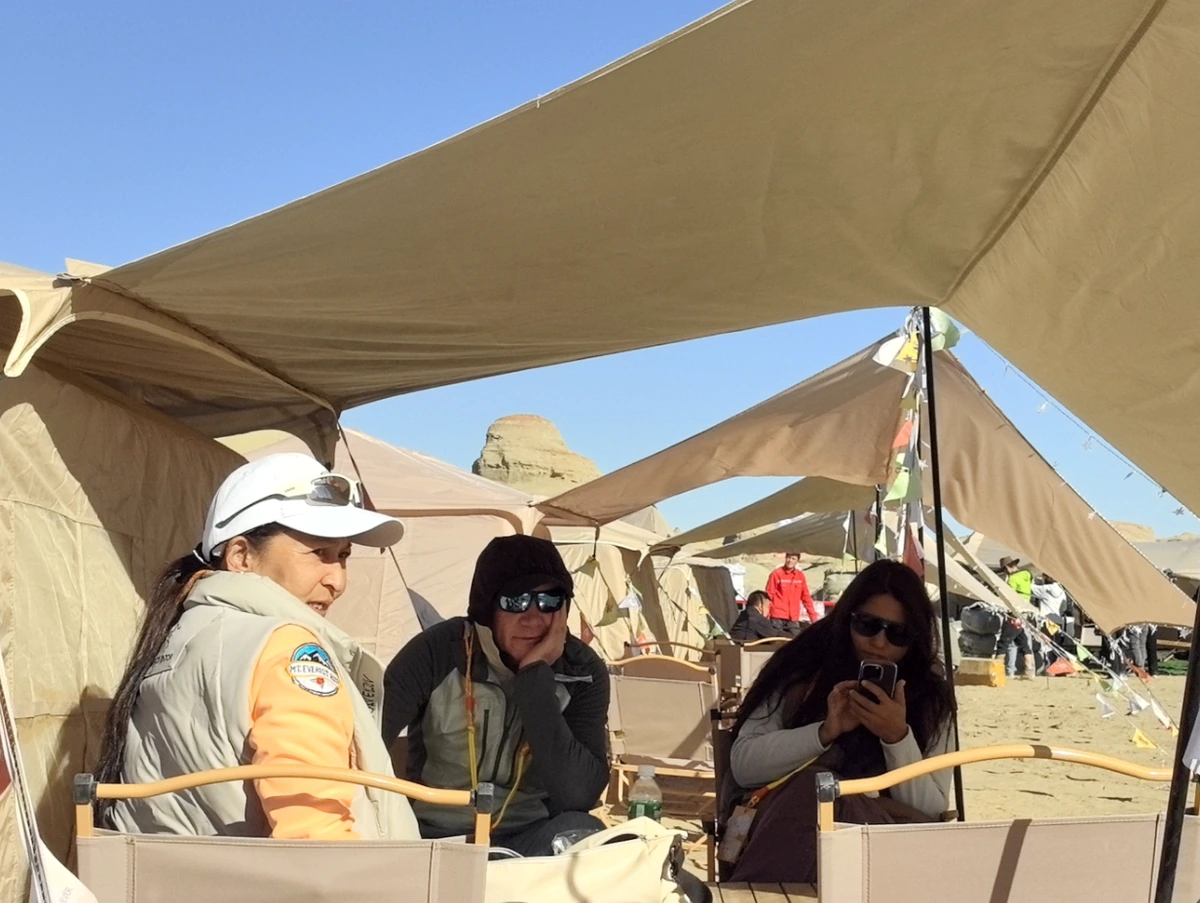
Exploring Urho’s wild, grand landscape feels even more rewarding when safety guidelines meet an appreciation for local culture. If you are looking for a way to experience Xinjiang with efficient travel pacing and international-standard logistics—without getting bogged down in complex bookings—choosing a complete tour package offers an easy, unhurried way to take in this fabled region.