From the perspective of Joseon dynasty urban geomancy, the presence of Cheonggyecheon Stream is intimately bound to the destiny of the royal capital Hanyang (Hanseong, the forerunner of modern-day Seoul). In 1394, when the dynasty’s founder—King Taejo (Yi Seong-gye)—decided to relocate the capital from Gaegyeong to this new territory, the imperial feng shui layout was anchored by four guardian mountains: the White Tiger to the west resting upon Inwangsan Mountain, the Azure Dragon along the eastern flank supported by Naksan Mountain, the Black Tortoise guarding the north at Bukaksan Peak, and the Vermilion Bird standing sentinel to the south at Namsan Mountain. Nestled right at the central artery of this basin lay a natural watercourse collecting rainwater and subterranean springs cascading down from those sacred slopes, before curving eastward into Jungnangcheon Stream and merging into the broad Han River. Capital residents of that era called this waterway by the unassuming name Gaecheon (“Open Stream”), signifying a channel carved into the earth that served a vital role as a natural drainage network protecting the entire inner royal city.
Yet this primordial stream was not always tranquil. Due to its shallow bed and torrential summer monsoons, the early capital repeatedly suffered devastating floods that inundated streets and swept away countless commoners’ homes. Recognizing the peril to his subjects and the stability of the dynasty, King Taejong (Yi Bang-won, r. 1400–1418) mobilized tens of thousands of soldiers and corvée laborers to conduct the first large-scale dredging campaigns, deepening the channel and raising sturdy earthen embankments along both banks. The most decisive historical milestone in feudal hydraulic engineering occurred in 1773 under King Yeongjo. The benevolent monarch deployed over two hundred thousand laborers in a massive months-long renovation project, straightening the watercourse and lining its entire embankment with exquisitely hand-hewn granite blocks. This celebrated feat of water management was meticulously inscribed on the ancient stone stele Gaecheonyukgijeokbi, marking an era when Gaecheon evolved from a mere drainage ditch into an exemplary public architectural landmark dividing the northern residential quarters of the yangban aristocracy from the southern districts of merchants and commoners.
Entering the twentieth century, national turmoil ushered in the darkest chapter in the stream’s history. During the Japanese colonial occupation of the Korean Peninsula (1910–1945), the name Gaecheon was officially abolished by colonial authorities and renamed Cheonggyecheon (“Clear Valley Stream”)—an ironic moniker for a waterway buckling under industrial wastewater from forced urbanization. This wound deepened after the flames of the Korean War (1950–1953) devastated the peninsula. Tens of thousands of impoverished war refugees flooded into the capital, erecting precarious makeshift shantytowns (panjachon) out of scrap wood and rusted sheet metal along both banks. Foul odors, refuse, and disease turned the once-graceful stream into a festering scar at the heart of a war-ravaged Seoul.
Determined to erase remnants of poverty and accelerate rapid national reconstruction, the Seoul municipal government launched a radical turning point in 1958 by encasing the entire streambed beneath massive concrete slabs. Subsequently, in 1971 under President Park Chung-hee, the 5.8-kilometer Cheonggye Elevated Highway rose atop colossal reinforced concrete pillars directly over the buried watercourse. This concrete armor and exhaust-choked overpass were once hailed as the pinnacle of the “Miracle on the Han River,” yet they simultaneously imprisoned the soul of Cheonggyecheon in subterranean darkness for more than three decades.
It was not until July 2003 that an unprecedented urban paradigm shift was spearheaded by then-Mayor of Seoul Lee Myung-bak. Defying intense engineering skepticism and severe traffic concerns, the Cheonggyecheon Restoration Project dismantled the entire elevated highway system, stripping away millions of tons of asphalt and concrete to return sunlight to the ancient waterway. On October 1, 2005, the project was officially inaugurated amid the jubilation of millions of citizens, unveiling a pristine ribbon of clear water winding nearly 11 kilometers past soaring skyscrapers—completing an extraordinary cycle from imperial geomantic origins, through historical tragedy, to proud rebirth as an enduring symbol of national resilience.
Viewed through traditional East Asian geomancy, the Joseon dynasty’s selection of ancient Hanyang—predecessor to glittering modern Seoul—represented a masterwork of Pungsu-jiri principles. Within a capital basin enclosed by four inner guardian mountains, Cheonggyecheon held an unmatched position as a natural waterway functioning as Myeongdang-su—auspicious water flowing across the front of royal palaces to gather vital energy and shelter wind. Rising from pure rocky springs on majestic Inwangsan to the west and the slopes of Bukaksan to the north, the stream winds onward to receive tributaries from Namsan to the south, flowing west to east through the urban core before joining Jungnangcheon and ultimately emptying into the mighty Hangang River. In classical Korean human geography, a city destined for enduring prosperity required a setting backed by mountains and facing pure water; Cheonggyecheon completed that indispensable geomantic equation, cleansing stagnant air and moderating the microclimate for both royal courts and bustling neighborhoods.
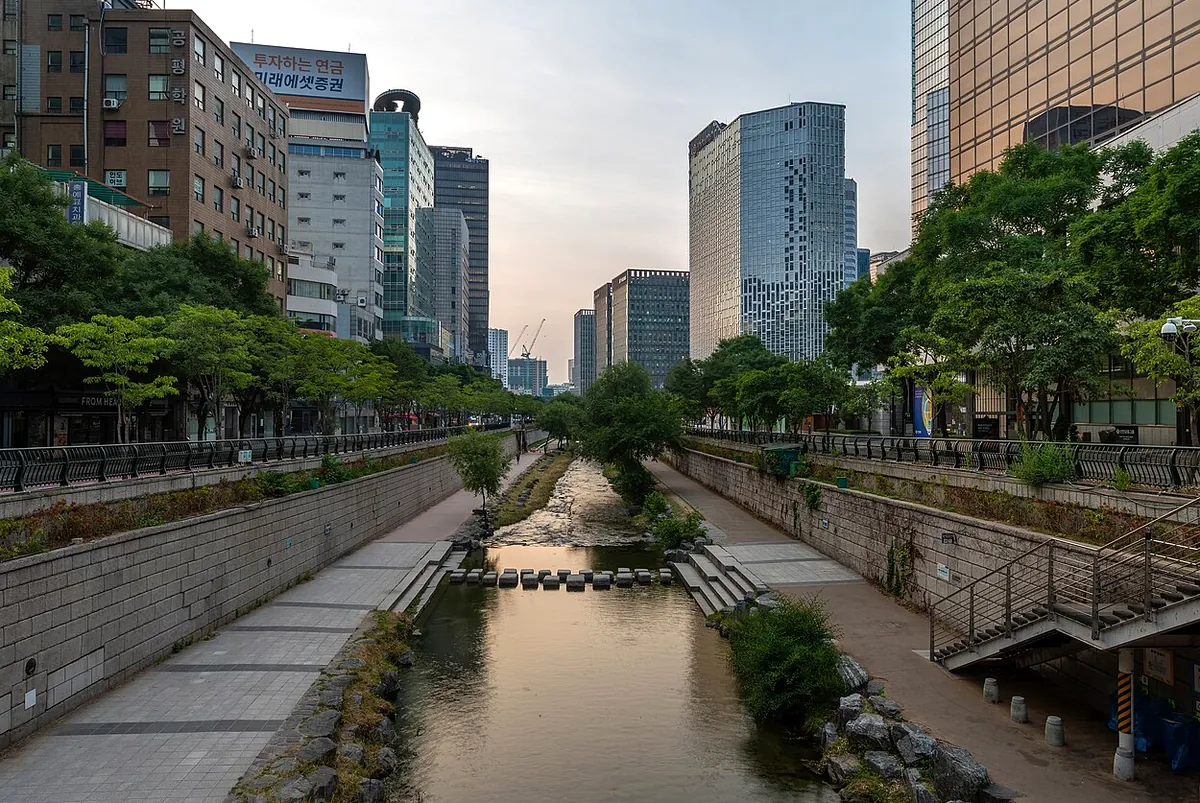
In the modern era, the natural sunken topography of the stream valley not only preserves its vital flood-control drainage capacity, but has also been sculpted into a lush green ecological corridor nestled four to five meters below street level. This distinctive terraced elevation insulates streamside promenades completely from traffic noise and vehicular exhaust along the bustling boulevards overhead. Lining both reinforced stone embankments is rich native flora—from swaying reeds and natural water-filtering aquatic plants to weeping willows shading artificial cobblestone rapids. The stream acts as a giant open-air cooling system, lowering average ambient temperatures in the concrete downtown core by two to three degrees Celsius on sweltering summer afternoons while fostering a thriving habitat drawing birds, fish, and aquatic life back into the heart of one of Asia’s most dynamic megacities.
Seamless connectivity and effortless accessibility stand out as hallmarks of urban design integrating this historic stream into daily city life. Surrounding the waterway is one of Seoul’s densest subway networks, allowing visitors to reach stone steps descending to the water’s edge within minutes. From Gwanghwamun Station on Line 5, a leisurely 150-meter stroll brings travelers right to the headwaters at Cheonggye Plaza. Meanwhile, other major hubs—including Jonggak Station on Line 1, Euljiro 1-ga Station on the circular Line 2, and Dongdaemun Station connecting Lines 1 and 4—all lie within an ideal 200- to 400-meter walk of the banks. Thoughtfully placed staircases and ramps beside more than twenty bridges make transitioning between underground transit and the tranquil waterside effortless.
This prime geographic position transforms Cheonggyecheon into an invisible thread linking celebrated landmarks along a corridor where thousand-year heritage meets contemporary energy. Beginning at the ceremonial axis of Gwanghwamun Square with its solemn bronze statues of King Sejong the Great and Admiral Yi Sun-shin, visitors stroll gently toward the cascading waterfall of Cheonggye Plaza, where the stream emerges into daylight. From this emerald corridor, a ten-minute detour leads upward into the traditional ceramic studios and teahouses of Insadong, or onward to majestic Gyeongbokgung Palace and its grand changing of the guard ceremony. Further downstream, the waterway skirts century-old Gwangjang Traditional Market, fragrant with sizzling mung bean pancakes (bindaetteok) and steaming blood sausage (sundae), turning a streamside walk into a holistic cultural journey uniting nature, geomancy, and civic life.
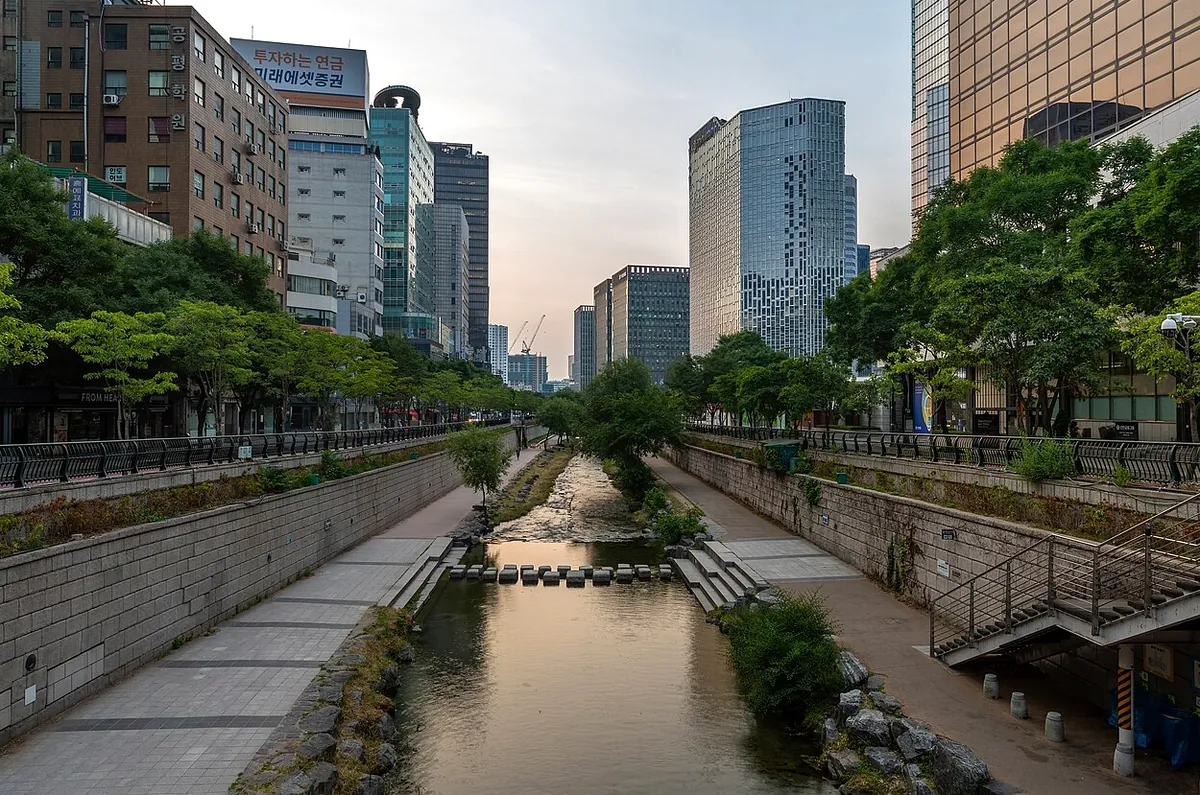
Celebrated as one of the most breathtaking urban renewal triumphs in twenty-first-century architectural history, the revival of Cheonggyecheon is closely linked to the strategic vision of former Seoul Mayor Lee Myung-bak. To wash away the grime of industrialization and dismantle the reinforced concrete viaduct that had weighed down this natural lifeline for decades, city authorities launched an unprecedented public works endeavor backed by a total investment of 386 billion KRW (approximately $380 million USD). After just two years and three months of round-the-clock construction, the project not only restored the watercourse by blending natural springs with modern water-recirculation engineering, but also opened a winding 10.84-kilometer sunken ecological corridor cutting across the vibrant heart of the capital and redefining humanity’s relationship with the urban environment.
The starting point of this grand scenic axis lies at Cheonggye Plaza, a spacious public square designed like a cultural harbor opening onto a serene aquatic world amid the bustling metropolis. At its centerpiece, visitors’ eyes are immediately drawn to the striking sculpture titled Spring, a monumental creation by renowned artists Claes Oldenburg and Coosje van Bruggen. Shaped like a giant spiral seashell soaring skyward in vibrant blue and red hues echoing the Taegeuk motif, the sculpture serves as an artistic manifesto symbolizing eternal rebirth, primal vitality, and ceaseless motion. From its base, water cascades down tiered natural stone steps into a murmuring waterfall, dissolving city clamor and guiding visitors down into the sunken stream corridor.
Along the length of the waterway, architectural expression shifts gracefully beneath each bridge spanning the banks—most notably Gwanggyo Bridge. This landmark exemplifies seamless harmony between Joseon-era architectural heritage and modern infrastructure engineering. Architects painstakingly preserved centuries-old original stone piers, pairing them artfully with sturdy steel girders and recessed architectural lighting. Stepping beneath Gwanggyo Bridge feels like entering a shaded open-air museum, where historic stone arches recall the days when Hanyang townsfolk gathered here to wash laundry and socialize, even as they effortlessly support busy modern traffic overhead without any sense of confinement.
The cultural depth of the landscape reaches a crescendo at the Wall of Hope and History, home to a monumental ceramic mural recreating the celebrated Banchado royal painting. Assembled from tens of thousands of high-fired glazed ceramic tiles, this intricate work vividly depicts the grand royal procession of Joseon King Jeongjo escorting Lady Hyegyeonggung Hong to visit Crown Prince Sado’s tomb at Hwaseong Fortress. Rows of armored soldiers, mounted royal guards, and court officials in traditional robes appear in crisp detail, turning a quiet stone embankment into an open-air chronicle where courtly artistry blends seamlessly with every traveler’s footsteps.
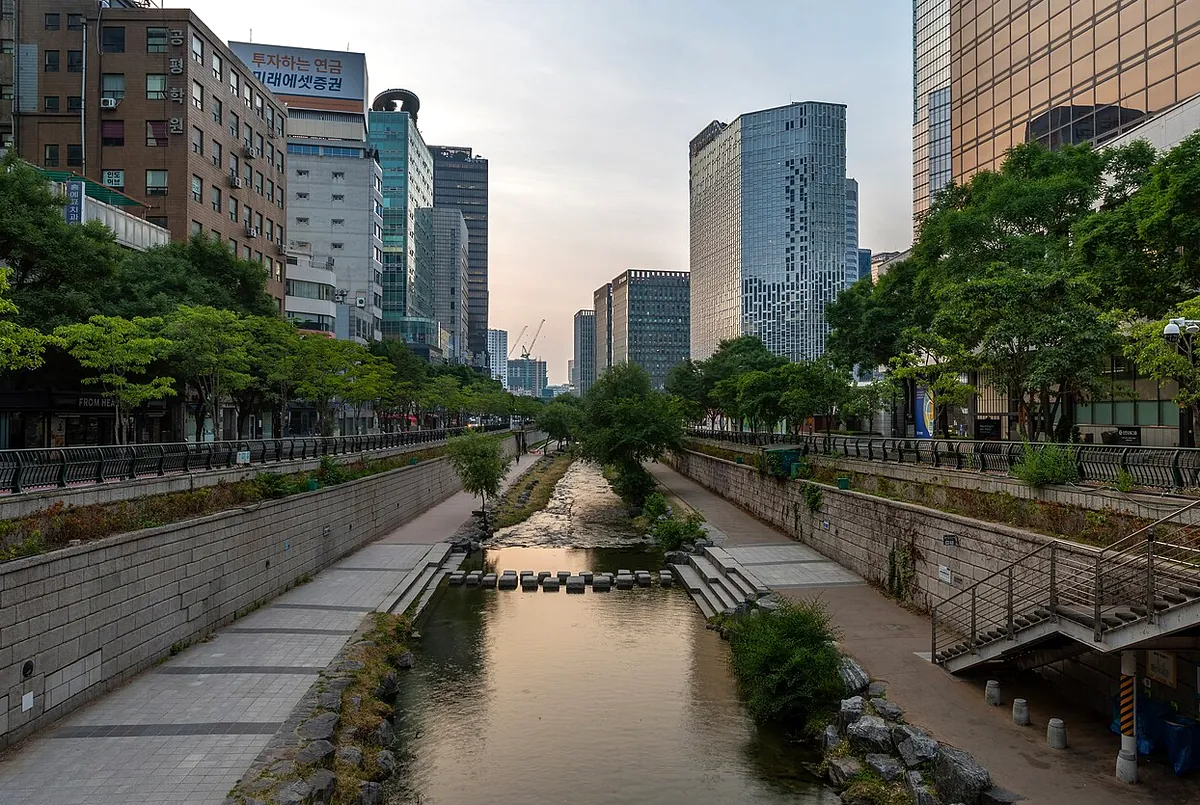
The overall spatial architecture of Cheonggyecheon embodies multi-tiered urban design, lowering the streambed well below street grade to generate a naturally cool microclimate capable of reducing downtown surface temperatures by three to five degrees Celsius in summer. Gently sloped stone embankments interspersed with native aquatic vegetation not only bio-filter the water, but also transform the entire ten-kilometer corridor into a soft ecological oasis—proving that top-tier metropolitan development can flourish hand in hand with heritage preservation and urban nature.
As twilight settles over the broad avenues of Jongno and Jung-gu, Cheonggyecheon Stream (清溪川) sheds the quiet calm of a daytime ecological park to transform into a vibrant live-action stage in the heart of Seoul. Nestled between towering concrete edifices symbolizing financial and administrative power, the sunken channel becomes an enchanting canyon of light where honking horns and office rush give way to rippling water and a soothing symphony of contemporary illumination.
The nocturnal allure of Cheonggyecheon stems from an intelligent ecological lighting design calibrated to every microclimate zone and water reflection angle. Thousands of recessed wall and submerged underwater color-changing LEDs shine upward through layers of river pebbles, creating shimmering refractive patterns resembling millions of drifting stars. Along sloped basalt stone embankments, indirect optical strips softly guide each step without casting light pollution onto native flora or disturbing freshwater fish habitats. Beneath historic bridge arches—especially Gwangtonggyo, the largest stone bridge of the Joseon era, which lay buried underground for decades—architectural lighting highlights raw chisel marks on ancient relief stones, turning heritage masonry into a magnificent light installation.
Visual excitement peaks every November during the Seoul Lantern Festival, when more than a kilometer of the waterway starting from Cheonggye Plaza becomes a floating museum of light. Hundreds of monumental handcrafted lanterns fashioned from traditional Hanji (韓紙) mulberry paper glow brilliantly atop the cool circulating waters. Strolling along the banks, visitors admire Korean folktales, royal processions, mythical guardian creatures such as Haetae, and contemporary icons brought to life through the warm translucent glow of traditional paper. The contrast between soft eastern lantern light and towering glass curtain walls of multinational corporations flanking both sides creates a surreal atmosphere found almost nowhere else.
Beyond landscape architecture, Cheonggyecheon after dark reflects the distinctive dating and relaxation culture of the Land of Kimchi. Young locals and couples gather here after work to practice “mulmung”—a peaceful meditative state of sitting with feet dangling above the illuminated, gently flowing water. Blending into the evening ambiance are intimate acoustic busking performances beside Gwanggyo Bridge, mini fountain shows enhanced by modern laser mapping, and the savory aroma of mung bean pancakes wafting over from neighboring Gwangjang Market—weaving together a multisensory experience that captivates every visitor to the capital.
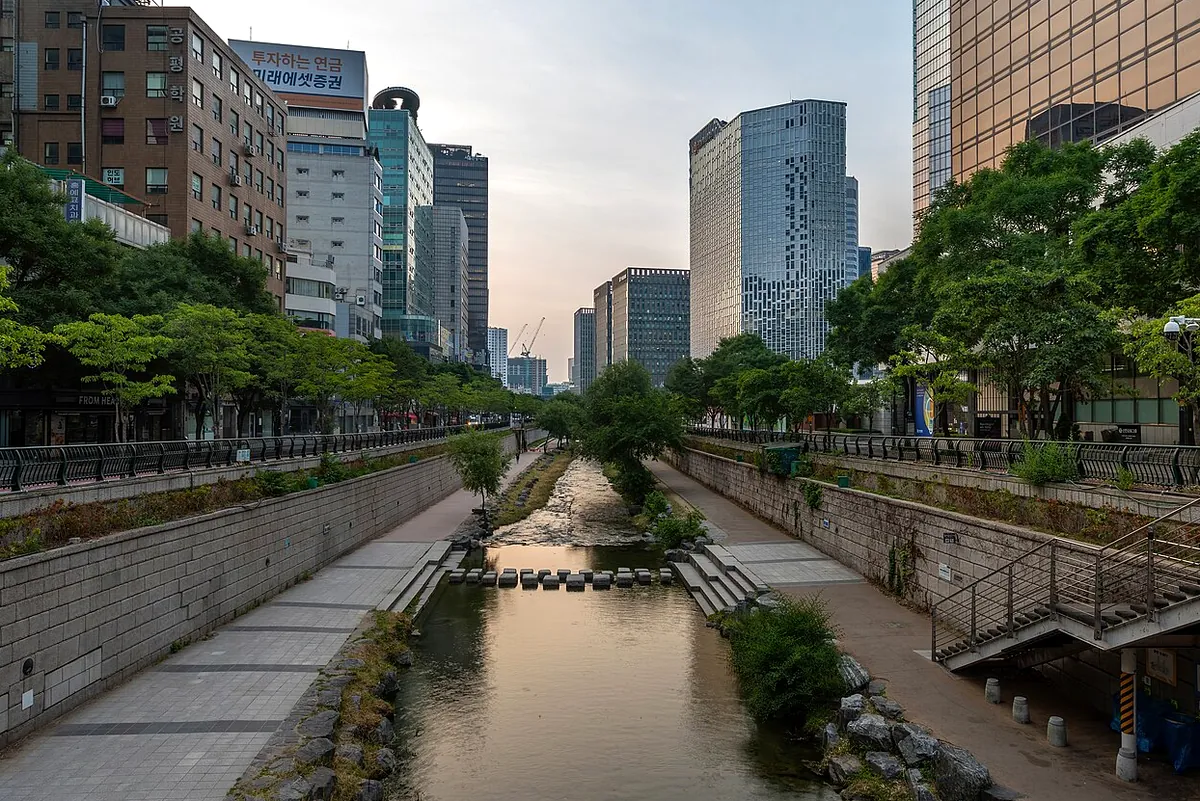
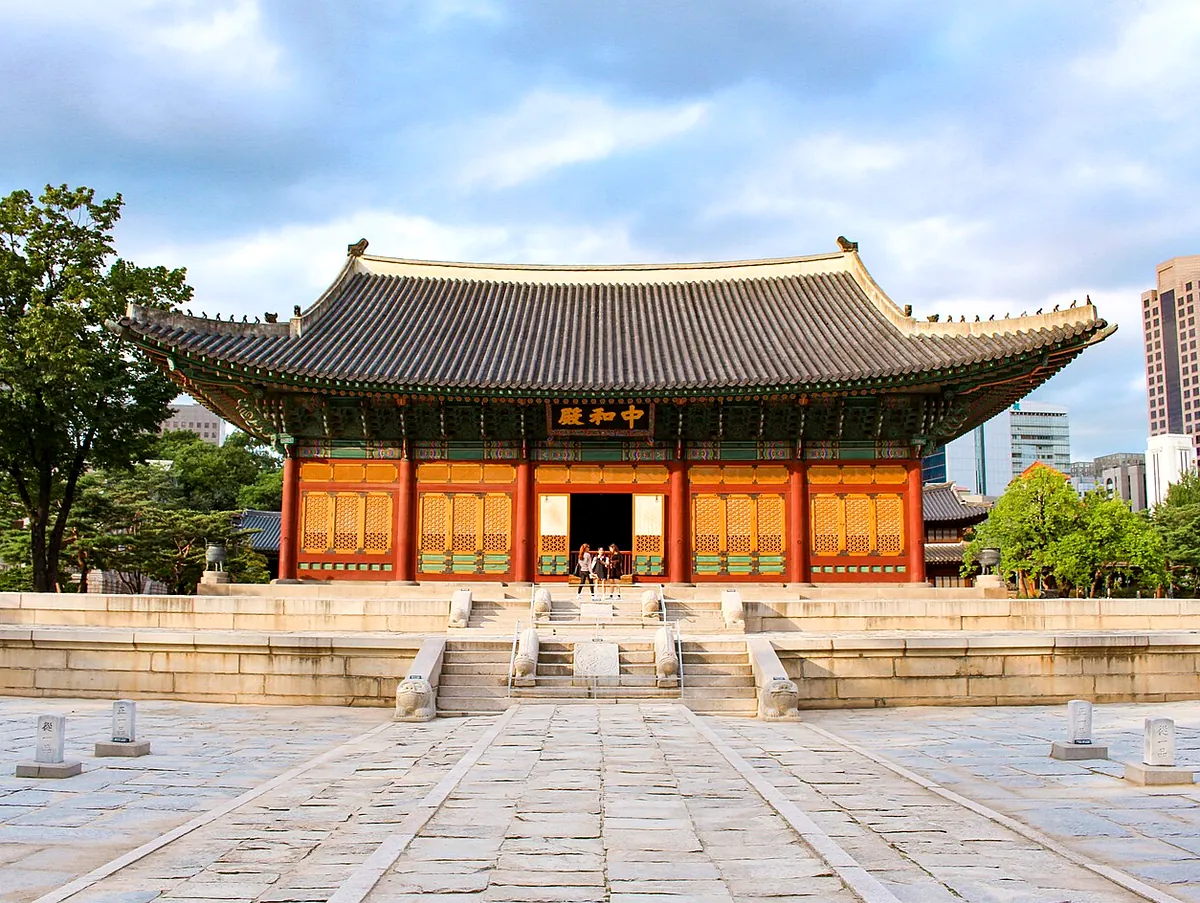
When dusk settles over the waters of Cheonggyecheon, cool mist rising from the streambed serves merely as an overture to a feast for every sense. The historical current of Cheonggyecheon carries not only architectural transformation, but also sustains one of Seoul’s richest traditional culinary belts. Stepping off the serene basalt flagstones of the canal and walking just three hundred meters north brings travelers into the colorful, aroma-filled labyrinth of Gwangjang Market—Korea’s first permanent traditional market with over a century of history. Here, authentic local food culture springs to life across tightly packed communal benches, sizzling cast-iron griddles, and wisps of savory smoke beneath warm golden lights.
Reigning supreme in the culinary imagination of visitors to the ancient stream is bindaetteok, the famous crispy fried mung bean pancake. Entirely distinct from modern wheat-flour batters, plump whole mung beans are soaked until tender and stone-ground by hand on granite millstones right on site, preserving their rich, nutty starch. The thick mung bean batter is folded with crisp bean sprouts, fresh scallions, and seasoned minced pork before hitting bubbling hot oil. Lifted out in a glorious golden-amber hue, each pancake boasts an astonishingly crisp crust guarding a fluffy, savory interior that never feels heavy. Priced modestly between 5,000 and 10,000 KRW, a piping-hot plate of bindaetteok dipped in tangy onion-infused soy sauce alongside a chilled bowl of lightly effervescent makgeolli rice wine delivers the quintessential flavor every walker along Cheonggyecheon craves.
Venturing deeper into the market’s web of narrow alleys reveals a clever specialty known as mayak gimbap. In Korean, “mayak” humorously evokes irresistible addictiveness—a playful nod to how hard it is to stop eating these bite-sized mini rice rolls. Each slender roll, roughly the thickness of an index finger, wraps lightly sautéed julienned carrots, crisp sweet pickled radish (danmuji), and fresh spinach inside sesame-oil-brushed rice and glossy roasted seaweed. The true soul of the dish lies in its dipping sauce—a punchy blend of yellow mustard, vinegar, and sugar that awakens the palate the instant it touches the tongue.
Right beside the lively gimbap stalls lies Yukhoe Alley—a paradise for gourmets seeking the pinnacle of fresh raw beef. Master chefs skillfully trim ruby-red beef into uniform matchstick strips, tossing them lightly with cold-pressed sesame oil, pure sea salt, and cracked black pepper. Plated artfully like a blooming flower, the beef is crowned with a glossy raw egg yolk and nestled over crisp, juicy slices of Korean pear. Mixing everything together coats every tender strand of beef in velvety richness, contrasting poetically with the icy crunch of sweet pear for an unforgettable harmony of textures.
Leaving the bustling energy of Gwangjang Market to stroll along the stone banks toward historic Jongno, the culinary atmosphere shifts to a deeper, heartier register at Dae-han-mok-chal grilled meat alley and jokbal stalls tucked beneath historic bridges. Here, steaming cauldrons of herbal braised pork trotters have simmered continuously for over four decades. House-secret broths infused with cassia bark, star anise, licorice root, and aromatic herbs penetrate deep into the meat, turning the skin a glossy mahogany brown that melts effortlessly on the tongue while keeping the tendons pleasantly chewy. Thickly sliced jokbal wrapped with raw garlic, green chili, fragrant perilla leaves, and a dab of savory salted shrimp paste (saeujeot) has remained a cherished after-work ritual for generations of Seoulites beside peaceful Cheonggyecheon.
Designed as an open linear park accessible free of charge 24 hours a day, Cheonggyecheon grants pedestrians the privilege of witnessing nature’s seasonal transformations in the middle of the city at any hour. While cool flowing water welcomes visitors year-round, the finest season to experience the ancient stream’s full poetic charm is autumn, from September through November, when maple and ginkgo trees lining both banks blaze in crimson and gold, casting reflections across crystal-clear waters. Springtime from April to May offers equally enchanting scenery as pale pink cherry blossoms drift gently on the breeze, creating a romantic contrast against surrounding corporate glass skyscrapers.
Because the entire route from Cheonggye Plaza downstream to Jungnangcheon stretches nearly 11 kilometers, wearing supportive walking shoes with reliable traction and cushioning is essential to keep your feet comfortable across natural stone pavers and rustic stepping-stone bridges. Another fascinating natural trait of Cheonggyecheon is its localized microclimate: continuous flowing water combined with a sunken channel well below street level keeps temperatures roughly 2 to 3 degrees Celsius cooler than the avenues above. During evening hours or transitional seasons, breezes funneling through the open corridor can bring a sudden chill, making a light windbreaker or scarf a wise companion for comfortable nighttime light-art walks.
Seoul’s renowned public transit system makes reaching any section of the stream effortless. To admire the spiral Spring tower and illuminated fountain at the source, take Subway Line 5 to Gwanghwamun Station and exit via Exit 5, placing you steps from the plaza. For the midstream cultural zone featuring lively civic energy and historic Gwangtonggyo Bridge, Line 1’s Jonggak Station and Line 2’s Euljiro 1-ga Station both offer exits leading directly to the waterside promenade. Downstream near Dongdaemun Market and major fashion malls, Dongdaemun Station at the interchange of Lines 1 and 4 serves as the ideal gateway to pair scenic strolls with authentic local street food.
Beyond transit logistics, thoughtful itinerary planning plays a crucial role in preserving an authentic cultural experience. First-time visitors to Korea often fall into the trap of budget package tours that slash actual sightseeing time in favor of mandatory stops at designated shopping centers, leaving precious little time for a leisurely walk along historic Cheonggyecheon. Choosing pure cultural itineraries with zero forced shopping lets you set your own unhurried pace—admiring every ceramic panel of King Jeongjo’s royal Banchado procession or savoring a warm cup of coffee beside murmuring waters. To enjoy a deeply enriching journey with seamless logistics and ample time to explore every historic landmark of ancient Hanyang, explore the all-inclusive South Korea tour packages curated specifically for heritage lovers.