In the heart of the sun-drenched, windswept Arabian Peninsula—where endless stretches of barren sand dunes and modest fishing villages along Dubai Creek once relied on traditional pearl diving—a modern architectural marvel was conceived from the extraordinary vision of far-sighted rulers. The ideological foundation for the emirate’s rise traces back to the governing philosophy of the late Sheikh Rashid bin Saeed Al Maktoum, who foresaw the finite nature of oil reserves early on and mapped out an economic diversification strategy to transform an arid outpost into a hub of international commerce. That resolute pioneering spirit was carried forward and brilliantly realized by his son, Sheikh Mohammed bin Rashid Al Maktoum, Vice President and Prime Minister of the United Arab Emirates and Ruler of Dubai. His audacity to imagine what no one else dared to envision laid the groundwork for a monumental urban transformation aimed at placing Dubai squarely atop the global tourism and cultural map.
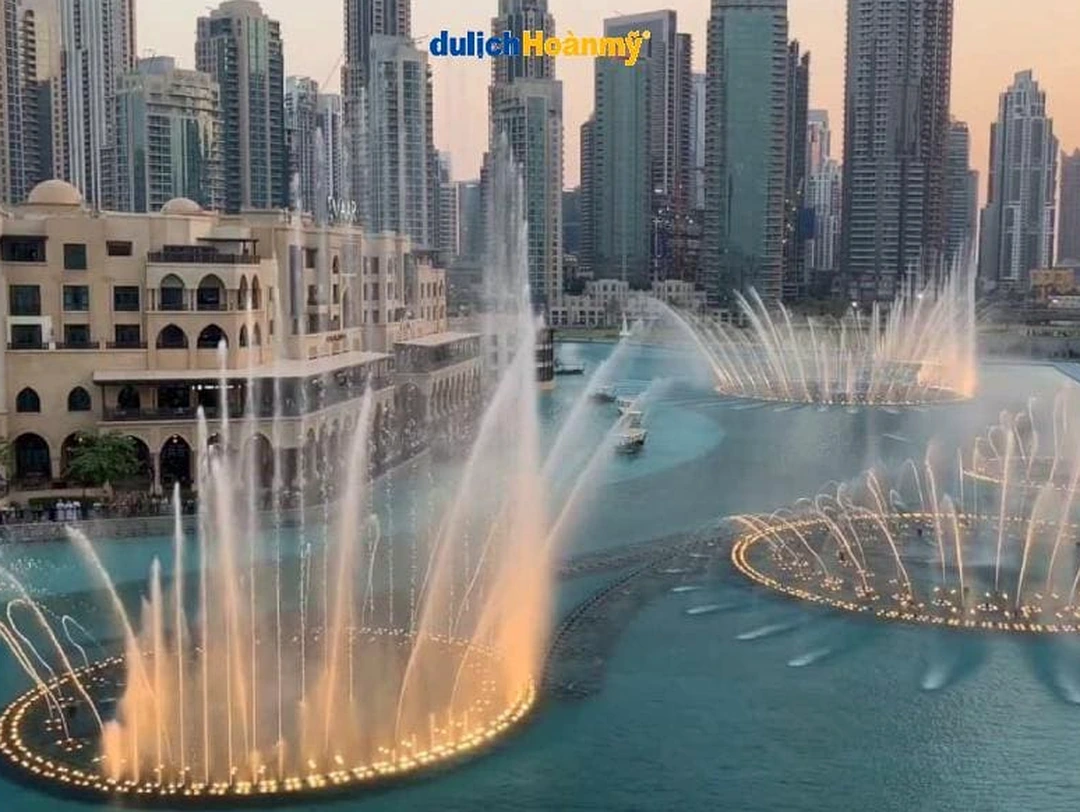
Bringing that grand vision to life, in 2006 the Middle East’s leading real estate developer, Emaar Properties, officially launched the Downtown Dubai megaproject with the ambition of creating a thriving urban heart spanning more than two square kilometers. At the center of this world-class master plan, the 30-acre man-made Burj Lake was excavated out of the desert floor to serve as a shimmering mirror reflecting the neighboring Burj Khalifa skyscraper. Positioned at the focal point of this vast artificial lake, The Dubai Fountain was conceived not merely as an opulent landscape feature, but as an iconic engineering masterpiece harmonizing hydrology, light, and world-class music to honor the sacred value of water in a land of scorching sands.
Yet the road to shaping this magnificent landmark was far from smooth, facing one of the harshest tests in modern history. Just as cutting-edge pneumatic pistons and high-pressure nozzles were undergoing intricate fabrication and assembly, the 2008 global financial crisis swept across capital markets, paralyzing countless real estate megaprojects worldwide and dealing a heavy blow to the Gulf region. Defying the skepticism of international observers, Dubai’s royal leadership and Emaar Properties stood firm, safeguarding a dedicated budget of 800 million UAE dirhams—roughly 218 million US dollars—to keep fountain construction moving around the clock. Such unwavering perseverance in the face of economic adversity testified to the iron will and resilience of a nation determined to claim its place of prosperity.
The sweet reward arrived on May 8, 2009, when The Dubai Fountain was officially inaugurated in a dazzling ceremony that captivated tens of thousands of local residents and international visitors gathered along the banks of Burj Lake. The moment the first jets of water pierced the tranquil surface and soared skyward to an epic musical score also marked the synchronized opening of The Dubai Mall, creating an unprecedented retail and entertainment complex. Notably, the fountain show debuted to the public a full six months before the Burj Khalifa opened its doors—serving as a radiant overture heralding a new era for this land of a thousand and one nights.
Through the passage of time and shifting global tides, the landmark has not only maintained its status as the world’s largest choreographed fountain system, but has also become a living monument to Dubai’s miraculous metamorphosis. Its fluid yet powerful aquatic choreography at the base of the world’s tallest tower stands as a bold declaration of boundless human ingenuity, turning harsh desert geography and financial turbulence into an enduring artistic legacy.
Located at the exact geographic coordinates of 25.1972° N, 55.2744° E in the bustling heart of Downtown Dubai, the fountain commands the expanse of the artificial بحيرة برج خليفة الاصطناعية (Burj Lake), spanning 12 hectares—or exactly 30 acres. Viewed through the lens of contemporary urban geography and spatial harmony, this setting occupies a prime position where water gathers energy. Belonging naturally to an arid coastal desert plain directly influenced by the Persian Gulf, this terrain was once blanketed solely by blistering sand and relentless sun. Introducing an expansive body of water right at the foot of the towering Burj Khalifa established a seamless elemental balance: the sky-piercing spire channels bold upward energy, while the calm, yielding lake collects and nurtures vitality—transforming desert austerity into the most prosperous oasis in the Arabian world.
The spatial layout of Burj Lake was calculated down to every visual angle to celebrate the contrast between nature and human craftsmanship. Framing the broad expanse of water is a lush, undulating green promenade where mature date palms, manicured lawns, and vibrant floral trellises weave gracefully together, softening the sheer glass and concrete facades of The Dubai Mall and the traditional Souk Al Bahar. The lakeside embankment follows natural, sweeping curves, opening onto a stone-paved waterfront walkway stretching for kilometers. This multi-tiered layout invites layered perspectives, allowing visitors at ground level, atop arched wooden bridges, or on high-rise balconies mid-sky to take in sweeping panoramas of the water.
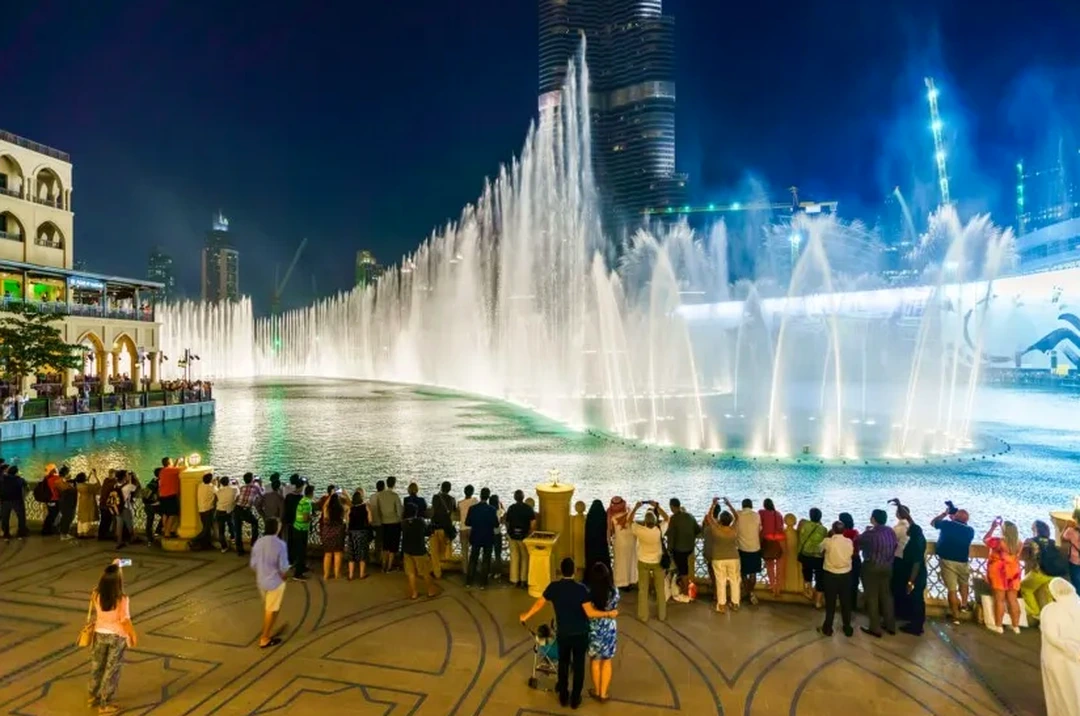
Operating a 12-hectare water body in a subtropical desert climate poses a formidable hydraulic engineering challenge, as scorching summer temperatures drive exponential evaporation rates. To prevent resource loss, the entire lake runs on a closed-loop recirculation process equipped with multi-stage, high-tech filtration membranes. Replenishment water is drawn primarily from condensate recovered from the massive air-conditioning systems of the Burj Khalifa, then routed through biological treatment and sedimentation stages to strip away suspended desert sand. This molecular filtration mechanism prevents algae growth and musty odors without excessive chemical treatments, keeping the water crystal clear and emerald-hued as it mirrors the Arabian sky even on the driest days.
Concealed beneath the tranquil lakebed lies an intricate mechanical matrix stretching 275 meters in length, built from specialized nozzles forged from ultra-corrosion-resistant alloys. Engineered with agile swivel joints and extreme-pressure pneumatic chambers, these nozzles withstand desert gusts laden with thick dust and sand. The tiered nozzle array ranges from nimble directional arms that sculpt rippling waves to ultra-high-pressure shooters capable of launching colossal water columns straight into the air to the height of a 50-story building. Every discharge valve and hydraulic sensor is orchestrated by a central computer network running real-time differential algorithms—ensuring that even when desert winds shift abruptly, the water’s choreography retains pinpoint accuracy, grace, and rhythm.
Commanding the 30-acre artificial Burj Lake in the glittering heart of Dubai, The Dubai Fountain stands as a monument to the seamless union of peak hydraulic mechanical engineering and contemporary spatial artistry. The entire installation was created by WET Design, the acclaimed California-based firm behind many of the planet’s most legendary water features. Backed by a total investment of 800 million dirhams—approximately 218 million US dollars—this is far more than a secondary landscape ornament for the Burj Khalifa; it is an independent hydrodynamic marvel whose sheer scale astonishes the global architectural community.
From a structural and morphological standpoint, the fountain system spans an overall length of 275 meters, stretching across an axis equivalent to two regulation football pitches laid end to end. Its floor plan is a tightly geometric yet deeply musical composition consisting of five hydraulic circles of varying diameters, interwoven with two sweeping arcs that curve gracefully across the lake. Combining parabolic curves with tangential arcs allows water trajectories to shift endlessly—creating deep, layered visual patterns when viewed from elevated observation decks while delivering an awe-inspiring experience up close along the waterfront promenade.
Hidden beneath the surface of Burj Lake is a titanic propulsion network governed entirely by pneumatic valves and extreme-pressure jet pumps. The fountain is outfitted with specialized launch assemblies graded from compact mini-shooters and super-shooters to extreme shooters capable of instant air compression to hurl 22,000 gallons—roughly 83,000 liters—of water into the air in a split second. When fired at full capacity, the central water column slices through the night sky to a breathtaking height of 150 to 152.4 meters, matching a 50-story skyscraper. Every discharge booms like deep subterranean thunder, sending a captivating acoustic vibration rippling across Downtown’s canyon of concrete and glass.
Beyond mechanical lift, the fountain’s expressive language is elevated by one of the world’s most advanced optical systems. WET Design integrated 6,600 proprietary WET Superlights working in concert with 25 full-spectrum color projectors and high-intensity focused laser arrays. This optoelectronic system delivers extraordinary processing power, generating more than 25,000 lighting variations synchronized down to the millisecond. As monochromatic beams and shifting color spectra illuminate millions of suspended water droplets, a colossal luminous silk tapestry is woven in mid-air. The fountain’s brilliance and lumen output are so intense that its beam of light can be spotted clearly from over 30 kilometers away—and is even visible as a twinkling beacon from orbital space.
The fountain’s pinnacle craftsmanship also lies in its fluid mechanical movement powered by servo-regulated pressure valves and multi-axis rotating nozzles. Guided by sophisticated computer algorithms, streams of water sway and curl gracefully—vividly mimicking everything from the delicate poise of a ballerina and wind-rippled Arabian sand dunes to surging waves crashing to a driving beat. This vast electromechanical architecture operates continuously in treated water, setting an extraordinary benchmark for material durability, corrosion resistance, and precision engineering.
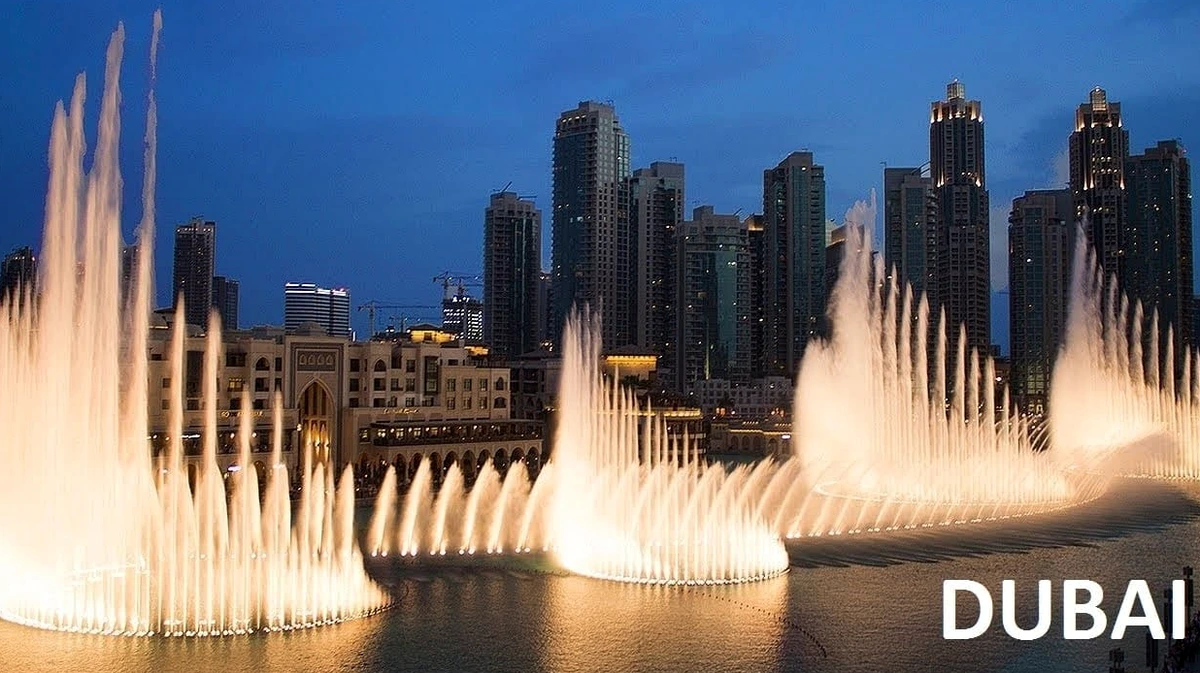
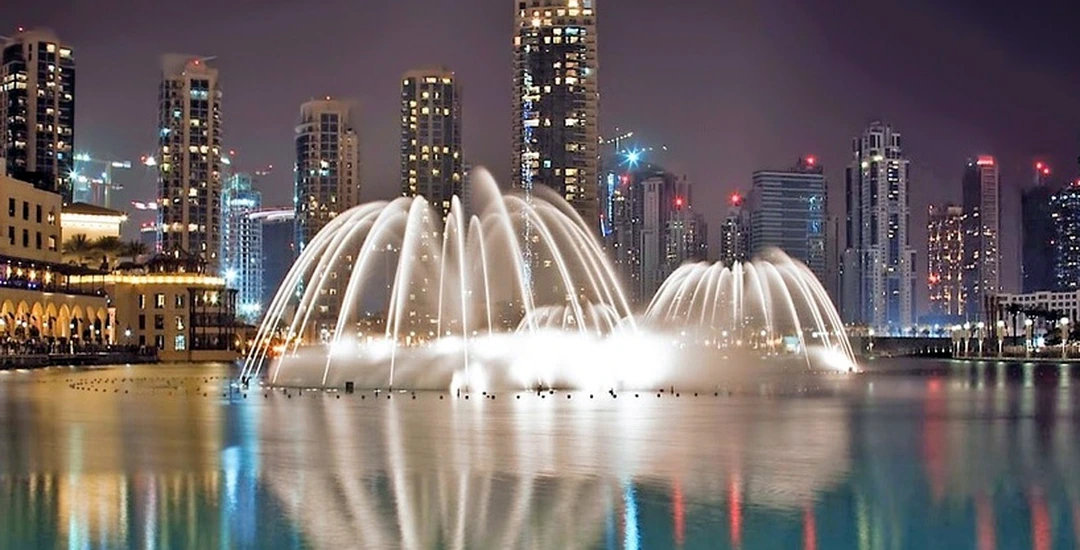
As the fiery orange glow of dusk fades behind distant sand dunes along the Persian Gulf, the glassy 30-acre expanse of بحيرة برج خليفة (Burj Khalifa Lake) transforms into one of the planet’s most spectacular open-air stages. Nightlife around Downtown Dubai begins not with raucous noise, but with spellbinding quiet as twilight stains towering glass facades in shades of violet. Beneath the world’s tallest tower, the vast artificial lake acts like a silvered mirror cradling poetic architectural contrasts: on one side stands the traditional Arabian fortress charm of Souk Al Bahar in warm sandstone tones, and opposite rises the endless glamour and grandeur of The Dubai Mall waterfront. Strollers from every continent walk along quartz-paved promenades, breathing in the gentle evening breeze carrying a hint of sea moisture as they patiently await the moment the water erupts into a symphony of sound and light.
The instant the first musical note rings out across the acoustically calibrated surround-sound speakers lining the lakefront, the entire nightscape ignites in a dazzling visual spectacle. More than 6,600 high-intensity WET Superlights and dozens of powerful underwater color projectors fire in unison, turning surging jets of water into ethereal ribbons of luminescence. Light from the lake does not shine alone; it dances in organic harmony with the monumental LED facade spanning the entire height of the Burj Khalifa. The fountain’s central beam shoots straight into the heavens—visible from over 30 kilometers offshore—like a modern-day lighthouse conversing with the stars. Foaming white plumes soaring hundreds of meters high merge with shifting waves of light to create a multi-layered tableau where the boundaries between water, fire, and darkness dissolve completely.
What gives each performance its true soul lies not merely in electromechanical precision, but in the artistic curation and orchestration of globally iconic music. Audiences may find themselves deeply moved by the poignant, stirring strains of “Mawtini” (موطني)—an unofficial anthem cherished across generations in the Arab world—only to be swept up minutes later by the jubilant, infectious drumbeats of “Boshret Kheir” (بشرة خير). Far beyond Middle Eastern musical heritage, this aquatic stage warmly embraces Western classical masterpieces, soaring operatic arias, timeless symphonic works, and contemporary hits that thrill tens of thousands of hearts. Each piece features its own bespoke water choreography: flowing like the billowing abaya of a desert maiden one moment, then surging with the thunderous power of purebred Arabian steeds galloping across windswept dunes the next.
To immerse yourself fully in this live open-air spectacle, you can choose from vantage points infused with authentic local character. Riding aboard a traditional wooden Abra boat gliding gently across the lake lets you feel cool, fine mist brushing your skin while hearing the visceral roar of hydraulic water cannons booming from below. For a more serene vantage point, open-air terraces at lakeside Levantine restaurants offer refined comfort—letting you sip cardamom-scented Gahwa coffee and savor aromatic Arabian grilled specialties while taking in uninterrupted panoramic views of the glittering nightscape. As the evening deepens, shimmering reflections on the water mingle with captivated crowds, weaving a festive atmosphere at once grand, awe-inspiring, and deeply romantic—leaving an indelible imprint on everyone who pauses by its shores.
Once the grand musical finale settles back into the tranquil waters of Burj Lake, admiring this man-made wonder transitions effortlessly into a captivating culinary journey across the dining venues surrounding دبي مول (The Dubai Mall). Amid sophisticated surroundings reflecting the silhouette of the neighboring skyscraper, traditional Emirati and Arabian Peninsula cuisine serves as a vital cultural bridge—inviting diners past modern glitz into humble yet profound Bedouin roots preserved through generations-old family recipes.
The defining centerpiece of a regal Middle Eastern feast is المجبوس (Majboos), an enduring emblem of abundance and hospitality. Premium basmati rice is simmered in rich lamb or chicken broth infused with a proprietary bezar spice blend of cardamom, cloves, cinnamon, saffron, and coriander seeds. The secret behind Majboos’s unmistakable flavor profile lies in dried black desert limes (loomi); pierced and simmered directly in the pot, loomi releases a crisp tang laced with smoky warmth that cuts cleanly through rich meat juices, leaving a deeply savory, comforting finish.
Alongside fragrant platters of spiced rice stands the revered الهريس (Harees), a UNESCO-recognized culinary treasure that graces every Ramadan table and royal celebration. This dish demands extraordinary patience: whole-grain wheat is slow-cooked with meat for hours in specialized clay pots buried over glowing embers, then beaten vigorously with a traditional wooden paddle (mikhbath) until grain and meat meld into a uniform, velvety porridge. A ladle of golden clarified butter (ghee) is drizzled across the top just before serving, imparting delicate richness and awakening the comforting essence of Gulf heritage cuisine.
The culinary exploration around the lake continues with the intriguing sweet-and-savory interplay of البلاليت (Baleelat). Delicate strands of vermicelli are lightly toasted until golden brown, then simmered with cane sugar, rosewater, precious saffron threads, and a touch of warm cardamom. This inventive pairing reaches its peak when the chef crowns the sweet noodles with a thin omelet seasoned with salt and turmeric—creating a memorable contrast of tender, sweet, and savory notes that reflects the ancient desert tribes’ philosophy of flavor balance.
Concluding an evening feast beside the shimmering water is a platter of famed اللقيمات (Luqaimat), bite-sized pastries likened to golden pearls of the Arabian Nights. Pillowy rounds of yeasted dough are dropped into hot oil until their exteriors turn glossy and crisp—cracking lightly with each bite to reveal an airy interior subtly fragrant with fermented milk. Each golden sphere is generously glazed with dark, lustrous date syrup (dibs) and sprinkled with toasted sesame seeds. Sipping golden, cardamom-infused Gahwa poured from an intricately engraved dallah pot completes an experience that feels both royal and warmly rustic at the threshold of a modern wonder.
To experience this aquatic masterpiece in Downtown Dubai to the fullest, knowing the daily performance schedule is the key to a seamless visit. The Dubai Fountain maintains a flexible day-and-night show cycle attuned to the rhythm of desert life. During the afternoon, visitors can catch two regular shows at 1:00 PM and 1:30 PM. On sacred Fridays—the day of congregational Jumu’ah prayers across the Islamic world—an additional afternoon performance is added at 2:00 PM to accommodate worshippers and weekend visitors alike. Once sunset paints the Persian Gulf horizon violet, Burj Lake enters its most dazzling evening program from 6:00 PM to 11:00 PM. Every 30 minutes, the night erupts with thousands of soaring water jets choreographed to an entirely new musical piece, turning every brief wait into an exciting artistic surprise.
Reaching this glittering oasis is remarkably straightforward thanks to the emirate’s ultra-modern transit infrastructure. The fastest and most convenient route for independent travelers is the Dubai Metro Red Line. After alighting at the Burj Khalifa / Dubai Mall station, passengers never have to step out into the desert heat; instead, they walk straight through the air-conditioned glass Link Bridge—an elevated, climate-controlled skywalk leading directly into the heart of The Dubai Mall. From the world’s busiest shopping destination, clear, elegant signage guides visitors smoothly out to the expansive waterfront plaza, where cool breezes off Burj Lake wash away any travel fatigue.
In terms of cost, this visual extravaganza is wonderfully democratic, offering spectacular views from the public waterfront promenades completely free of charge. However, if you want an exclusive vantage point where fine mist brushes your skin up close, two reasonably priced add-on experiences are well worth considering. The Dubai Fountain Boardwalk is a floating walkway stretching like a sleek ribbon across the lake, bringing spectators within just nine meters of the fountain’s core. Alternatively, stepping aboard a traditional wooden Abra boat—the historic river vessel of the Emirates—offers nostalgic charm as it glides across the 30-acre lake, framing the dancing water against shimmering skyscraper reflections.
Alongside planning your timing, respecting local cultural etiquette is essential when visiting this world-renowned landmark. While Dubai is remarkably cosmopolitan and modern, it remains rooted in deep Islamic values, requesting visitors to dress modestly and respectfully—ideally covering shoulders and knees in all open public spaces. Around the lakefront promenade and Souk Al Bahar bridge, strict no-smoking and anti-littering rules are closely enforced to preserve the pristine beauty of the shared environment. As an insider tip, reserving an outdoor terrace table at one of the lakeside Middle Eastern restaurants about 45 minutes before showtime lets you relax over fragrant mint tea while enjoying unobstructed front-row views without navigating dense crowds.
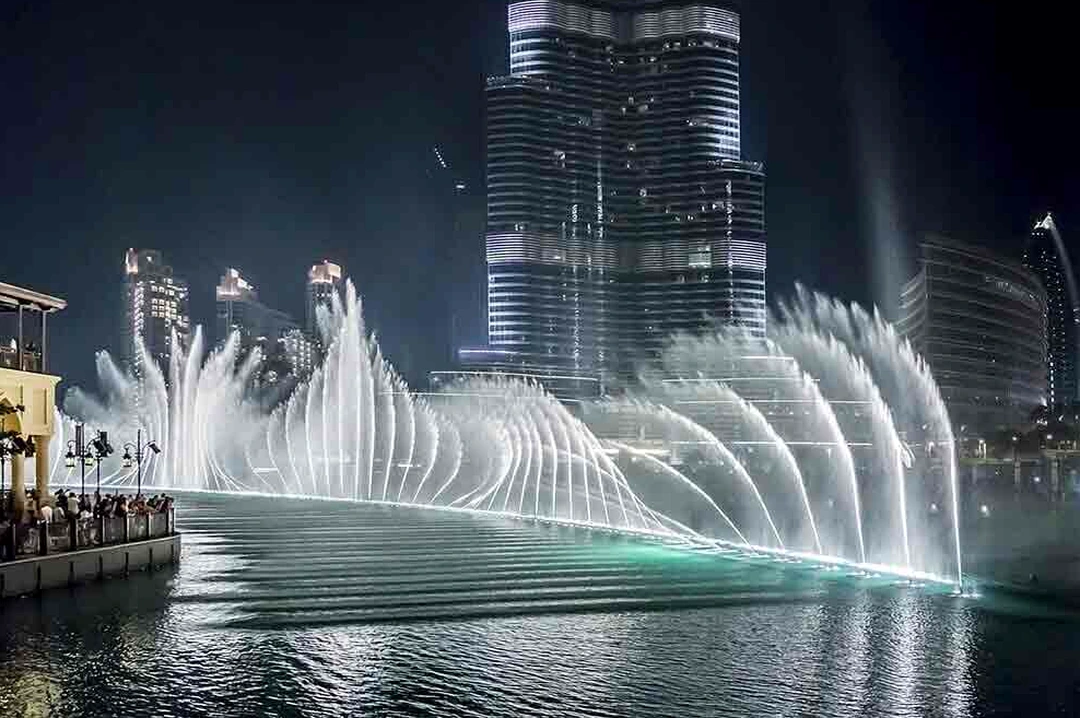
As its majestic melodies echo across the golden desert, this grand fountain show stands not only as a triumph of mechanical engineering, but as the proud love song of a city that dares to turn the impossible into reality. To witness this breathtaking symphony of light and water without worrying about itineraries, reservations, or transfers, travelers can join a curated all-inclusive Dubai – Abu Dhabi tour package, where every detail is thoughtfully crafted to turn your Arabian dream into an unforgettable memory.