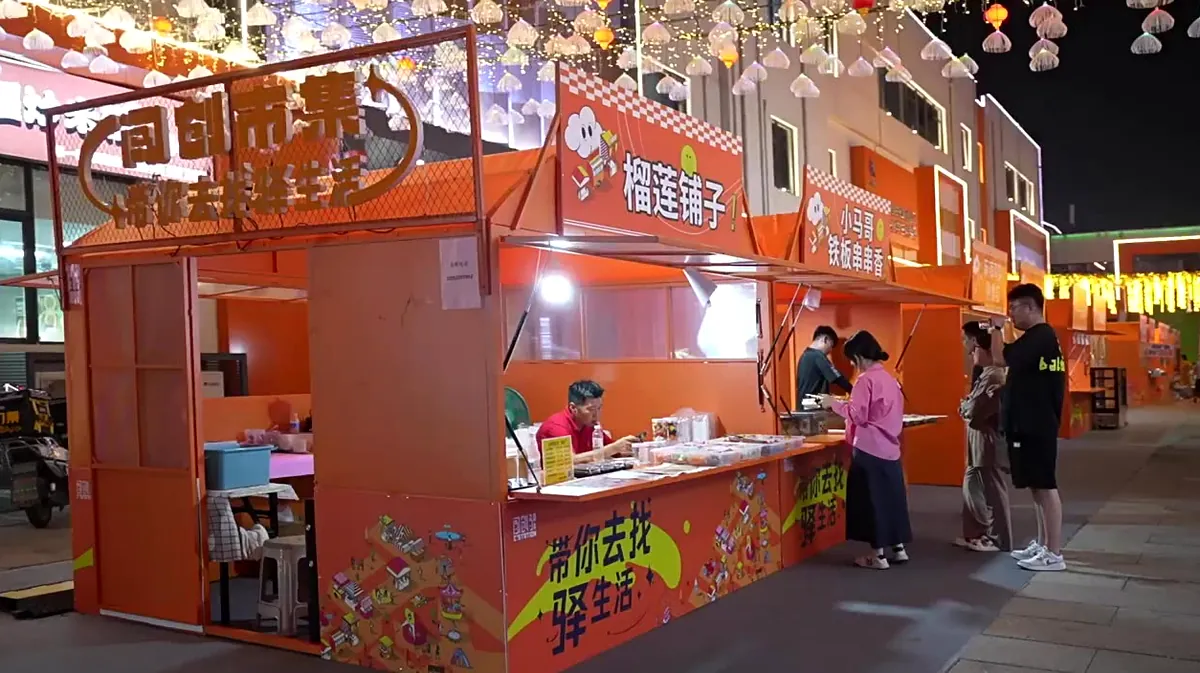
When night falls and the sunset gives way to countless dazzling lanterns, night food streets—known in ancient Eastern texts as Dạ thị (夜市)—truly awaken, opening a vibrant and enchanting cultural dimension. Far more than just a stop to satisfy the palates of street food enthusiasts, the night food street has long served as a profound mirror reflecting the economic pulse, customs, and evolution of prosperous cities through millennia of change.
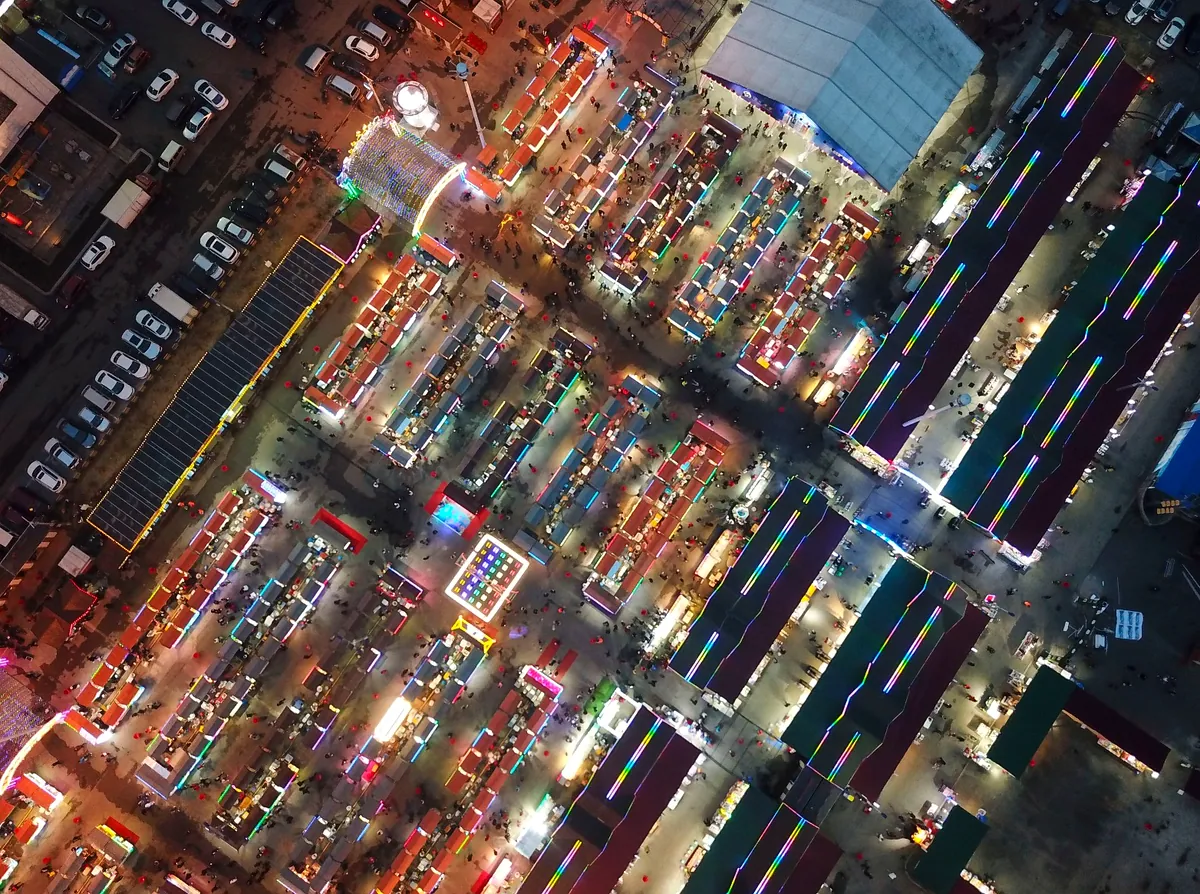
Viewed from an overhead angle, the night market resembles a glittering, colorful panorama standing out against the tranquil backdrop of the urban night. Rows of white-canopied stalls are laid out in straight, neatly arranged grid patterns, brightly illuminated by multi-colored LED systems that cast a warm, inviting glow. Bustling pedestrian walkways sit alongside orderly parking lots, bearing witness to an outdoor culinary space that successfully preserves traditional liveliness while embracing the disciplined, civilized breath of modern life.
Turning the pages of ancient chronicles, the origins of the night market are closely linked to profound socio-economic and institutional changes during the Tang Dynasty (618–907). During this period, the capital Chang’an was designed with an extremely strict ward system, where the boundaries between residential areas and marketplaces were firmly sealed off once the evening curfew drum sounded. The curfew, known as tiāo jìn (宵禁), acted as an iron wall halting all commercial activities as darkness fell. However, the extraordinary development of silk trade and surging population density quietly broke down these rigid feudal rules. Along river ports, postal stations, and bustling artisan wards outside the center, street vendors and late-night taverns began to pop up to serve distant merchants, laying the initial bricks for a night business model that defied the taboo.
Entering the Song Dynasty (960–1279), night markets officially entered their most brilliant golden era as the imperial court relaxed and eventually completely abolished the curfew. The capital Bianjing (modern-day Kaifeng) became a sleepless metropolis where commodity economics boomed to such an extent that night markets operated around the clock until the third and fourth watches of the night. The bustling atmosphere of taverns, teahouses, dim sum counters, pastry stalls, and steaming grilled fish was immortally captured by master painter Zhang Zeduan in his silk masterpiece “Along the River During the Qingming Festival”. Every brushstroke depicts the lively interaction among scholars, small merchants, and commoners along the Bian River, transforming the night culinary space into the soul of Song dynasty urban culture, transcending mere trade to become a refined way of life.
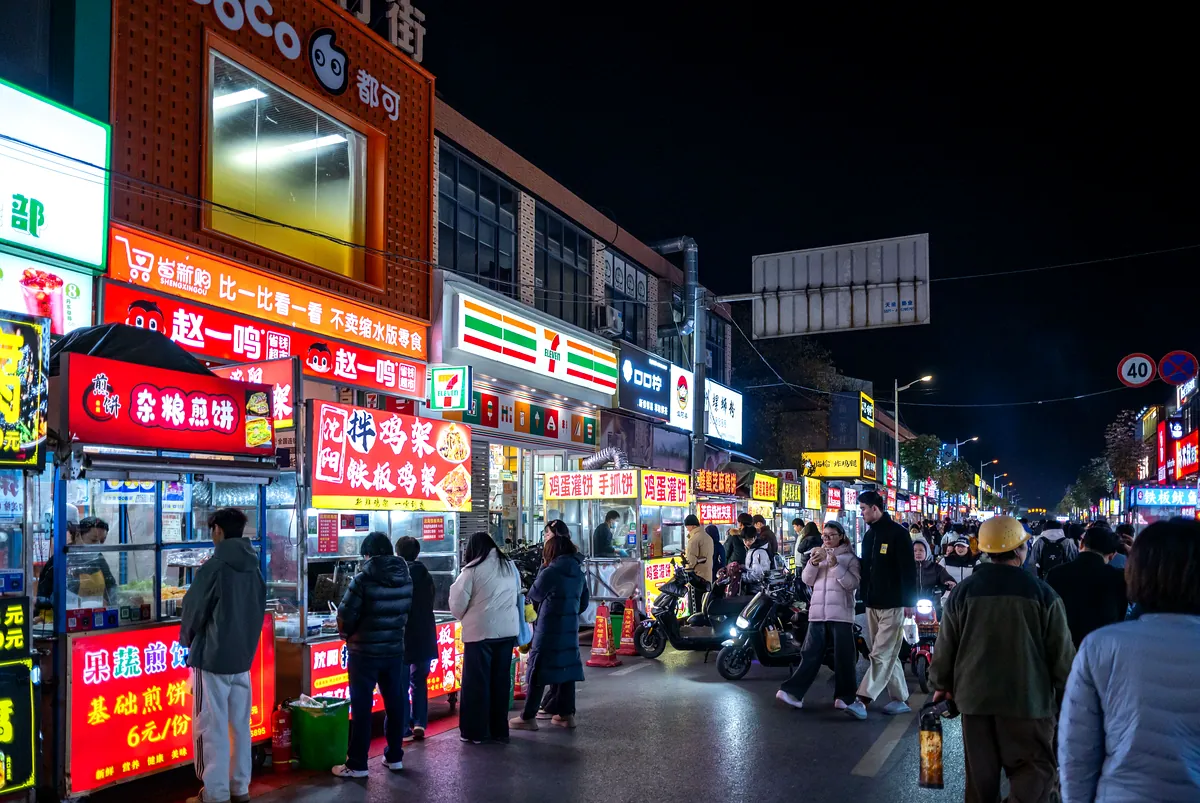
Through many historical ups and downs, the intrinsic vitality of the night food street has not faded but continuously adapted to the tides of globalization. Since 2019, China’s State Council officially issued guiding documents, elevating night markets from spontaneous business models into a strategic pillar of the national “Night Economy”. This policy has not only unlocked massive domestic consumer resources but also restructured urban spaces, turning ordinary snack streets into high-end cultural industry and experiential tourism hubs. Through well-planned layouts, contemporary night markets preserve the thousand-year-old culinary essence while creating a shining symbol for the enduring vitality of Asian urban life.
In Eastern geomancy (feng shui) and imperial capital planning, nighttime commercial spaces have always been shaped around the principle of “gathering energy to generate wealth.” Where crowds gather like invisible flowing streams, auspicious energy accumulates for the entire land. Since ancient times, night markets cleverly chose landforms close to rivers or situated at vital intersections connecting water transport routes and pedestrian postal roads. In the modern era of urbanization, this landscape feng shui philosophy has not faded away but has been flexibly transformed into the art of public space planning, where picturesque natural landscapes harmonize seamlessly with advanced logistics transport infrastructure.
The characteristic atmosphere of a bustling night food street opens up a vibrant space filled with sound and brilliant light. Along the solid stone-paved thoroughfare, a series of closely packed food stalls continuously glow with fire, emitting fragrant, steaming plumes mixed with captivating, spicy aromas. Above, countless storefront signs with Chinese characters glow brilliantly in shades of red, yellow, and orange, casting their light down on locals and travelers strolling by, stopping to savor unique street food flavors.
}
A survey of key nocturnal economy networks reveals a strategic topographical planning vision, as most renowned culinary streets are located at central transport hubs, maintaining a golden distance of no more than a fifteen-minute journey from high-speed railway stations. This rapid connectivity infrastructure ensures a seamless flow of passengers, turning each night market into a giant “tourist funnel” the moment they step off the train. The western corridor, featuring millennia-old mega-cities such as Chengdu, Chongqing, and Xi’an, nestles within basin topography and shielding high mountains, creating warm culinary valleys that trap the cozy, steaming vitality of tongue-numbing spicy hotpot amidst the misty night. Conversely, the eastern corridor, represented typically by Shanghai and Hangzhou, develops along fertile delta plains where canal systems and open riverbanks welcome refreshing breezes, offering an expansive terrain for waterfront food streets.
The eastern and western axes blend together to form the backbone framework supporting the entire large-scale nocturnal economy network. At the micro-level, each culinary alley adheres to a strict layered structure to balance Yin and Yang: nighttime inherently possesses a Yin attribute, thus the flickering fire from stoves and the vibrant red of traditional lanterns represent Yang energy, establishing a perfect energetic equilibrium. The street length typically meanders smoothly rather than extending in a straight line, designed to reduce drafts and invite diners to savor the scenery in tranquility. The harmonious combination of bountiful natural terrain, high-speed transit anchors, and spatial arrangement art transforms night food streets into vibrant cultural landscape masterpieces that endure through the breath of time.
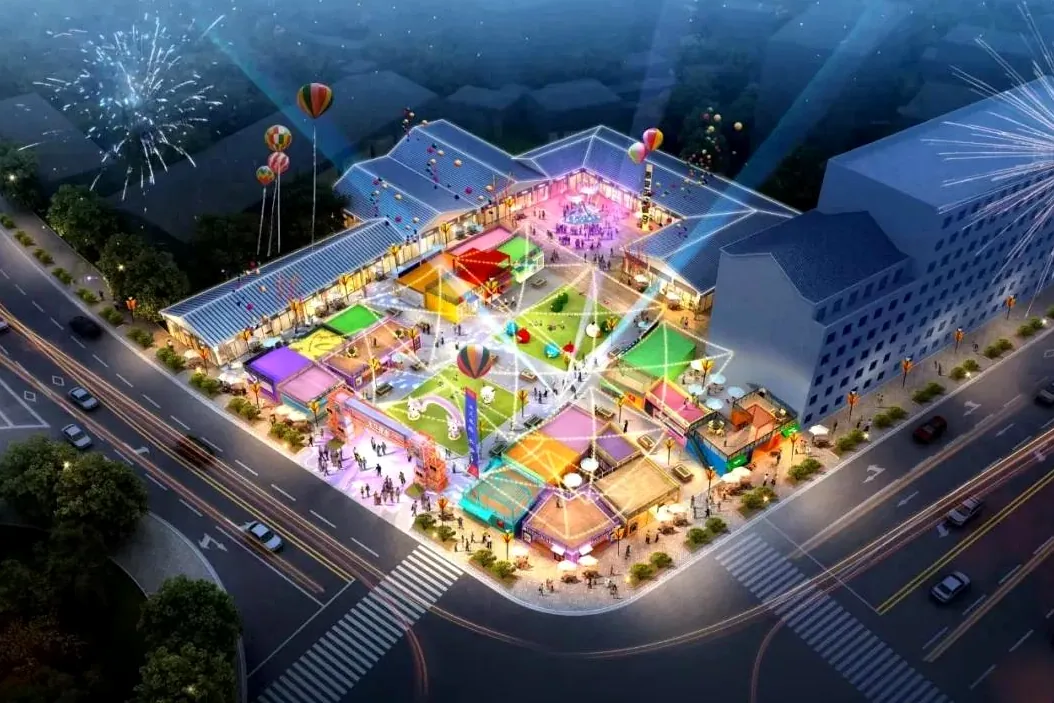
From an elevated perspective of contemporary urban planning drawings, a commercial and night dining complex emerges as a vibrant oasis located right at a bustling intersection. The spatial structure expands horizontally with a lush green lawn at the center acting as an ecological breathing space, surrounded by clusters of brightly colored stalls arranged in layers along a radial axis. Artistic decorative lighting and indirect illumination strips bordering the pedestrian paths celebrate the prosperous nightlife while skillfully directing pedestrians between dining areas and public art appreciation zones.
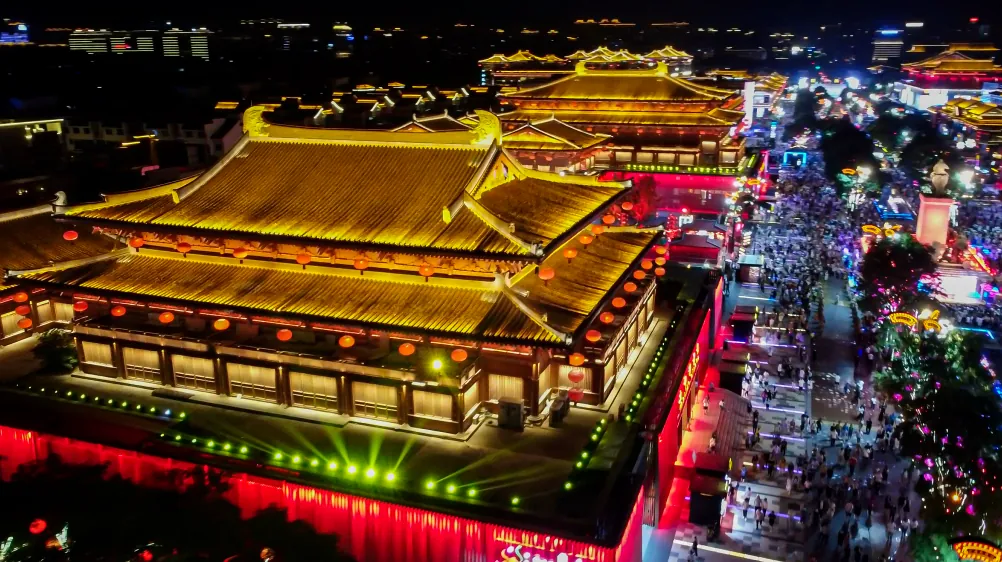
The spectacular transformation of modern night markets stems from shedding spontaneous setups to adopt a top-tier restored architectural language (仿古建筑). A prime example of this school is the Great Tang All Day Mall complex in the ancient capital of Xi’an, which magnificently recreates the appearance of the Tang Dynasty metropolis along a vertical spatial axis thousands of meters long. Architects have combined standard traditional Dougong brackets, curved glazed tile roofs, and vermilion-painted, gold-leafed pillars with hidden, ultra-durable load-bearing steel structures inside. The ingenious blend of advanced optical lighting, water curtain performances, and classical pavilion silhouettes creates an authentic “time-travel” experience, turning every stroll of travelers into a journey back in time to the most prosperous era of East Asian history.
Behind this nostalgic beauty lies scientific spatial planning thinking, solving the challenge of accommodating hundreds of thousands of visitors each night without causing localized congestion. The main thoroughfare is always designed with a generous width of twenty to fifty meters, separated into rhythmically tiered bands: the central axis is reserved for art parades and interactive landscape blocks, while the two wings feature closely packed kiosks exhaling enticing aromas. The flow of visitors is regulated by the principle of a “continuous return loop”, guiding footsteps from classic traditional culinary areas like Xi’an mutton soup and Shanghai soup dumplings through tea master stations, and expanding toward outdoor poetry appreciation plazas.
Actual investment scales for modern night dining complexes often reach hundreds of millions of yuan, mostly submerged deep beneath retro granite paving slabs. Underground infrastructure is synchronized with automatic grease separation systems, vacuum-pressure waste collection networks, and central gas pipelines, completely eliminating the smoke, dust, and dampness typically found in traditional night markets. Alongside this is an advanced digital coordination platform, where all business operations run via high-speed telecommunications networks and cashless payment protocols such as Alipay and WeChat Pay. With just a quick QR code scan on a handheld device, visitors can pay for anything from casual candied hawthorn skewers to elaborate imperial banquet sets, creating a civilized, transparent, and completely safe nighttime commercial environment.
It is evident that modern night food streets are not merely places to satisfy the palates of food lovers, but have been elevated into a marvel combining classical architectural aesthetics and new-century urban technological capacity. The delicate intersection between enduring cultural nostalgia and the vibrant pulse of the nocturnal economy is the ultimate explanation for the formidable vitality of these all-night mega markets.
As dusk retreats completely behind the moss-covered tiled roofs, the atmosphere of the night food street undergoes a spectacular transformation, shedding its daytime solemnity to don the vibrant appearance of a grand theater of light. The concept of night markets originated during the Tang and Song dynasties, when night curfews were gradually relaxed to accommodate urban livelihoods. Through centuries of evolution, this nocturnal rhythm is no longer merely an economic activity, but has blossomed into a multi-layered aesthetic experience where light, sound, and flavor intertwine to fully awaken the vitality of a city that never sleeps.
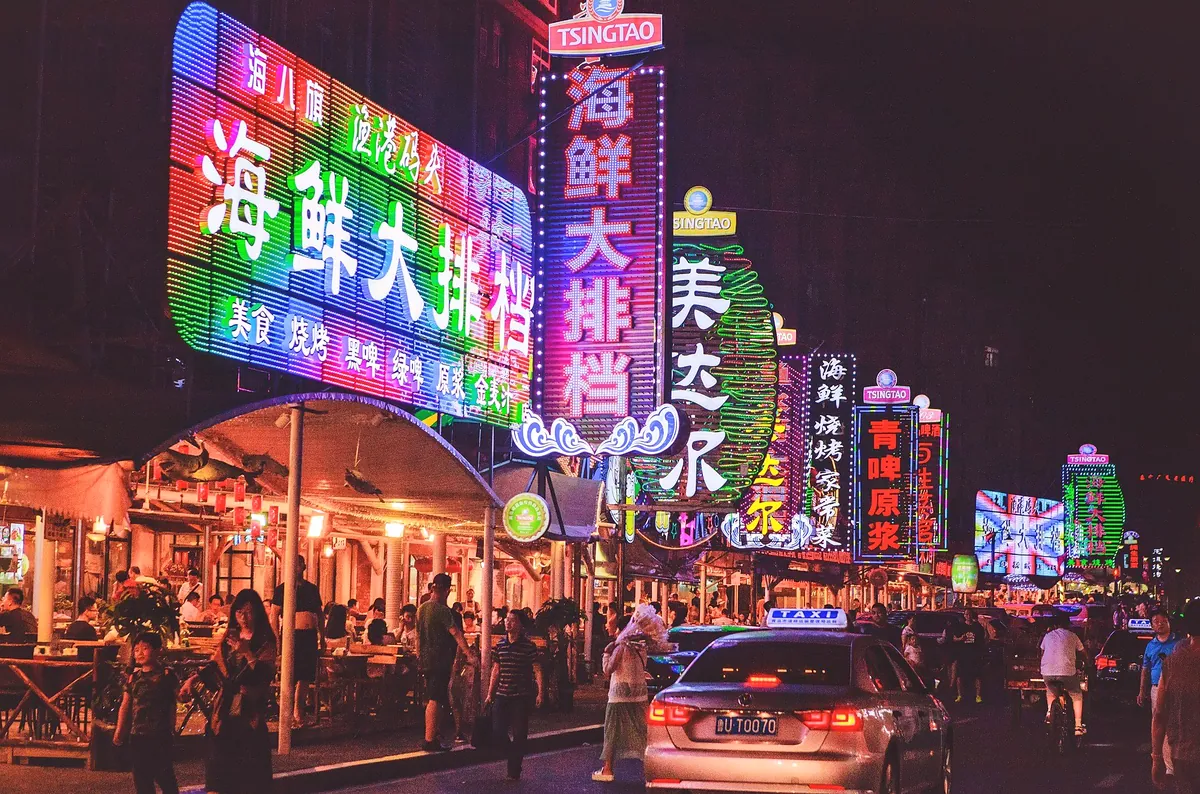
Right along the central axis of the culinary street, nocturnal vitality unfolds overwhelmingly under a fascinating contrast of hues. Along both sides of the bustling street, numerous multicolored neon signs glow brilliantly, casting vibrant crimson and warm golden glows onto the smooth asphalt. At the outdoor dining tables, groups of diners gather to enjoy steaming hot local delicacies, their chatter mingling with the sizzle from stirring pans to create a lively street symphony. At the same time, a taxi glides slowly past the strolling crowd, reflecting shimmering optical halos on its body, capturing the relentless momentum of a vibrant nocturnal culinary hub.
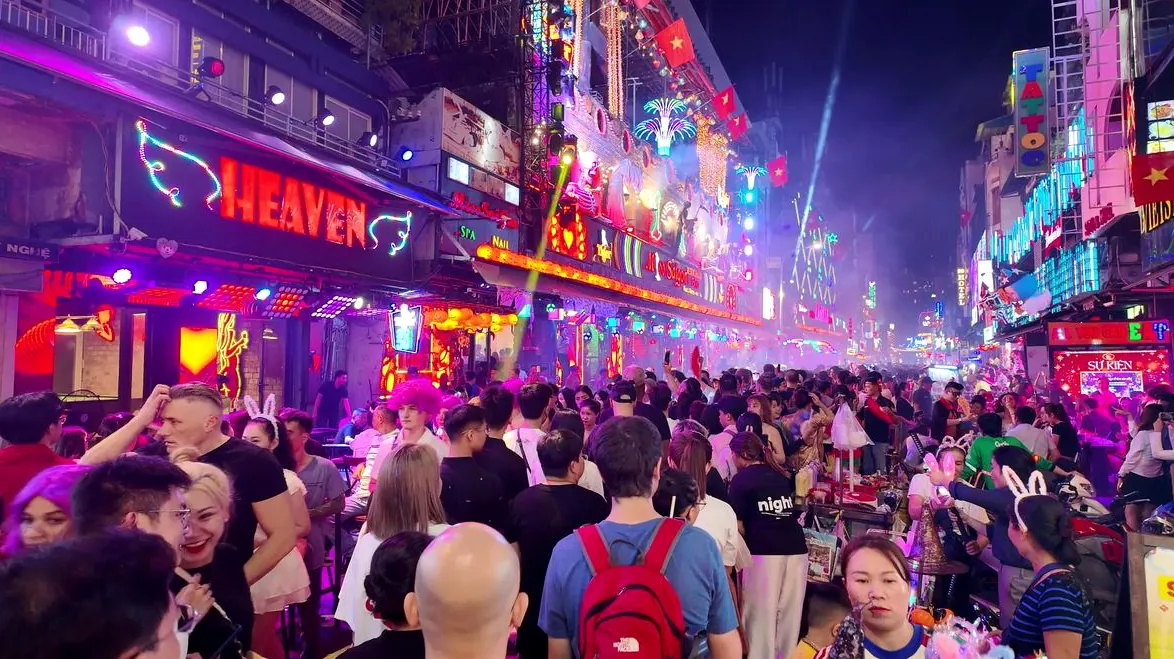
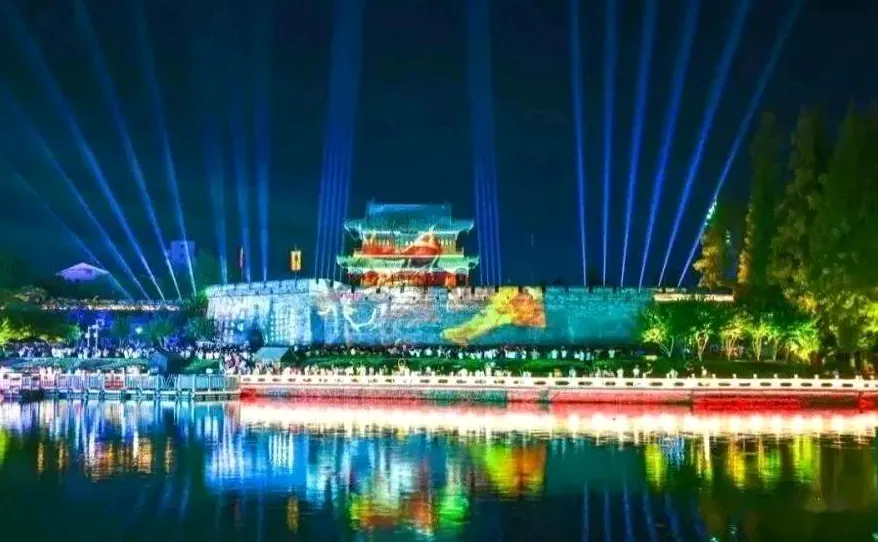
The breakthrough highlight shaping this modern nocturnal space is the subtle intervention of visual lighting art and 3D mapping projection technology. Ancient walls, gate arches, and centuries-old gray brick facades suddenly transform into massive projection screens. Thanks to precise architectural modeling down to every detail and molding line, ancient founding legends, historical tales of royal delicacies, and the turbulent events of ancient trading ports are vividly recreated. Laser lights interwoven with smart directional spotlights not only honor the classical architectural forms but also segment the spatial flow, guiding travelers’ footsteps from the bustling dining area into immersive artistic performance corners.
Running parallel to lighting technology are live-action performances organically integrated into the nightlife’s pulse. Without barriers or stages separated from the audience, performers embody historical figures, blending directly into the strolling crowds. Amidst the alluring aromas of dimsum steamers, sizzling barbecued meats, and traditional bone-broth stocks, visitors unexpectedly encounter classic opera excerpts accompanied by crisp clappers and resonant erhu melodies, or skilled fire-breathing and lion-dragon dance performances that fully recreate the festive atmosphere of prosperous dynasties. This seamless intersection between folk performance arts and humble culinary life turns every stroll into a voyage exploring the collective memory of the land.
The heartbeat of the nighttime economy here has transcended standard consumer models to become an in-depth cultural ecosystem. The resonance between live performances, modern lighting technology, and indigenous culinary essences creates a consummate visual and gustatory experience. For cultural researchers or nomadic souls seeking historical depth, this nocturnal space serves as the most vivid archive, where millennium-old traditional values are preserved, regenerated, and magnificently elevated under the contemporary night sky.
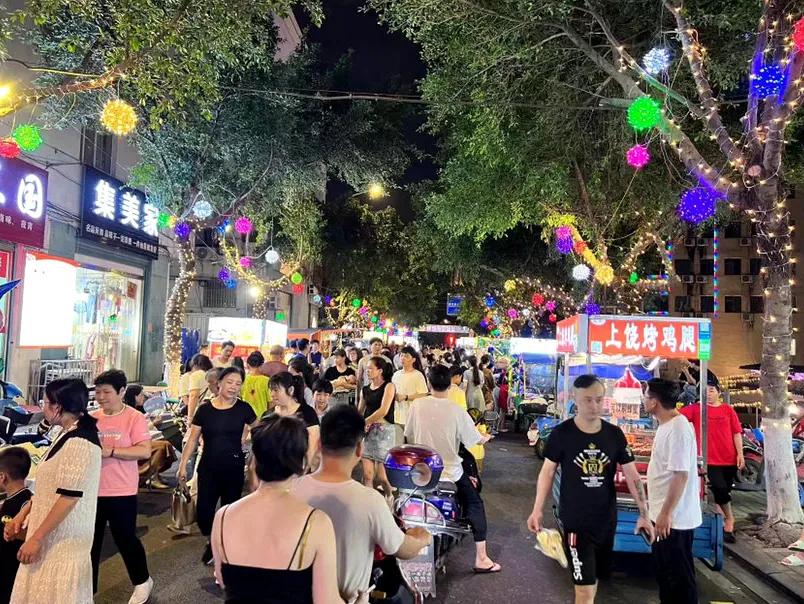
As dusk settles over the ancient streets, the glow from strings of brilliant lanterns signals the magical transformation of local Chinese life. The picture of the night food street emerges vividly with dozens of smoking, closely packed stalls exhaling the fragrant aromas of pungent spices and scallion oil sizzling on cast-iron pans. Crowds of busy people leisurely stroll beneath leafy green canopies, where colorful decorative lights are artfully strung, draping shimmering halos that envelop diners. The clatter of knives and cutting boards, lively cooking sounds, and murmuring laughter combine to create a night market portrait imbued with human breath, vividly etching out long-standing traditional cultural flavors.
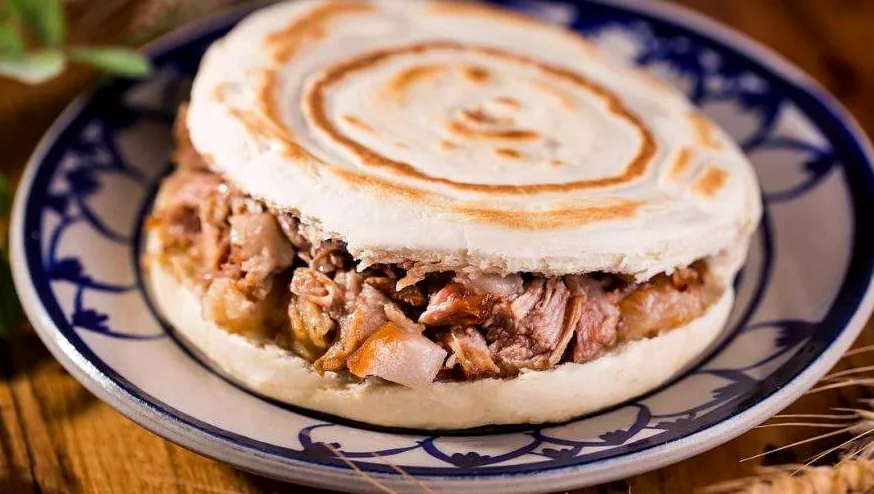
Heading back to the Northwest region, the millennium-old ancient capital of Xi’an welcomes food connoisseurs with its legendary Roujiamo burger—a delicacy likened to the oldest hamburger of Eastern civilization with origins dating back to the Warring States period. Baked over glowing charcoal, the crust is crispy on the outside yet soft and spongy inside, enclosing pork belly or beef stewed for hours in a traditional broth containing over twenty herbs such as star anise, clove, cinnamon, and Dahurian angelica root. Alongside this, Biangbiang noodles feature wide, hand-rolled strands as thick as a Tang dynasty official’s belt, pleasantly chewy against fiery red Qinchuan chili powder and sizzling hot oil poured directly over them, carrying deep historical memories hidden within one of the most complex Chinese characters, symbolizing the rhythmic pestle pounding in ancient rural villages.
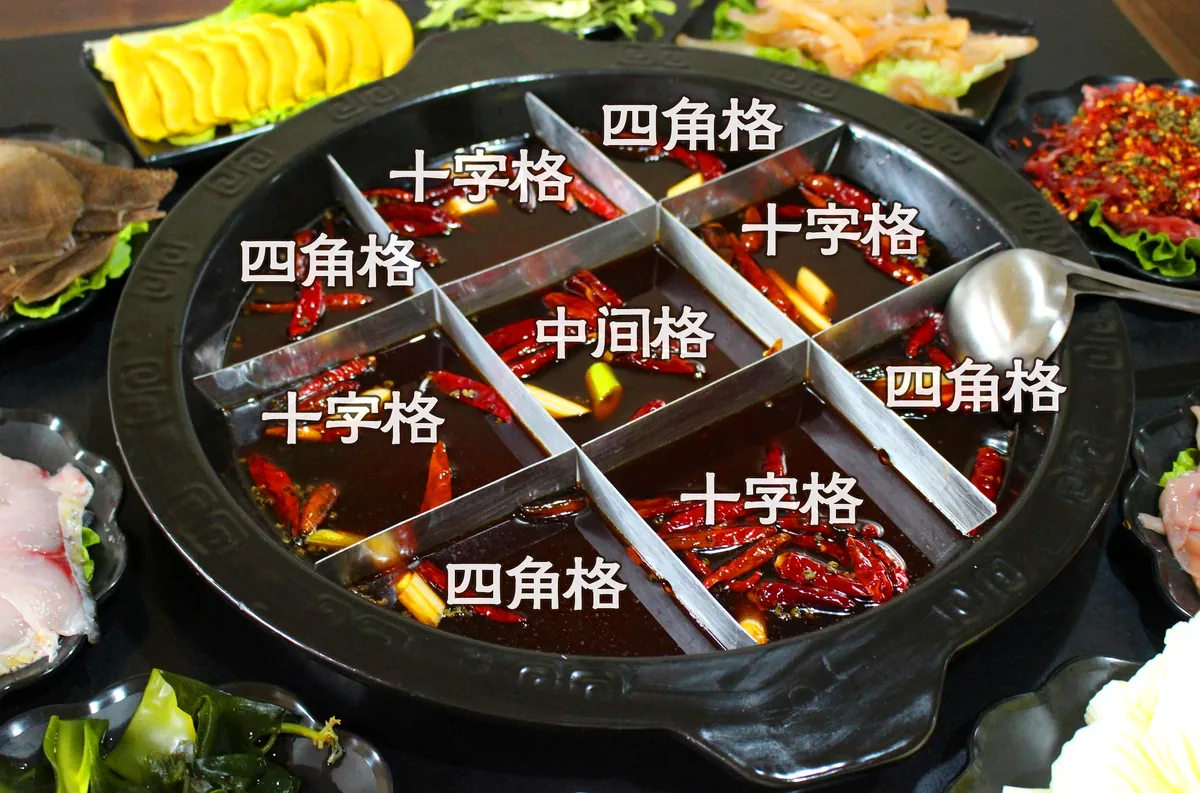
Heading down towards the rugged mountainous Southwest, Chongqing’s night market mesmerizes travelers with the intensely numbing and spicy flavors of the Jiugongge nine-grid hot pot, a heritage rooted in the grueling lives of boat trackers along the Yangtze and Jialing Rivers during the Qing dynasty. The round iron pot is ingeniously divided into nine separate squares by interwoven metal bars, each section boasting entirely different boiling temperatures and functions to precisely cook specific ingredients: the central compartment features the most intense fire, ideal for blanching fresh beef tripe and throat for fifteen seconds, while the surrounding compartments maintain a gentle simmer to tenderize duck blood, beef tendon, and soft tofu. The broth is crafted from pure beef tallow blended with sun-dried chili peppers and legendary Sichuan peppercorns, creating a warming, numbing spice that wards off the damp chill of heavy foggy nights.
Leaving behind the fiery basin to seek the refined elegance of the Jiangnan coastal region, Shanghai captivates visitors in its breezy alleys with delicate Xiaolongbao soup dumplings. This time-honored craft requires dumpling artisans to roll the dough until it is as thin as cicada wings yet resilient enough to hold the savory minced pork filling and rich aspic soup derived from gelatinous pork skin. Every petite dumpling is meticulously pleated with precisely eighteen folds before being placed into bamboo steamers to cook over billows of steaming vapor. Astute gourmands always follow an elegant ritual: gently lifting the dumpling with chopsticks onto a ceramic spoon, biting a tiny corner to sip the sweet, intensely flavored broth, and then dipping it into Zhenjiang black vinegar garnished with a few warm strands of fresh ginger.
The profound mindset shift among today’s discerning travelers is vividly reflected in their rejection of lavish banquets in enclosed restaurants in favor of the authentic roots of street food. Sitting on rustic stools along the roadside, listening to multi-generational family recipes shared by veteran chefs, travelers truly touch the soul of a culinary civilization spanning millennia, where every rustic flavor encapsulates a philosophy of life and a deep harmony with nature.
As dusk fades, the vibrant heartbeat of the night markets awakens. Most nocturnal culinary streets open around 5:30 PM and extend until 1:00 or 2:00 AM the following morning, with certain stalls operating round-the-clock to cater to late-night diners. To fully absorb the bustling atmosphere without excessive crowding, the ideal time to visit is between 7:00 PM and 9:00 PM. This is when kitchen stalls blaze with fire, freshly delivered ingredients arrive at their peak, and the rich aromas of spices begin to fill every alleyway.
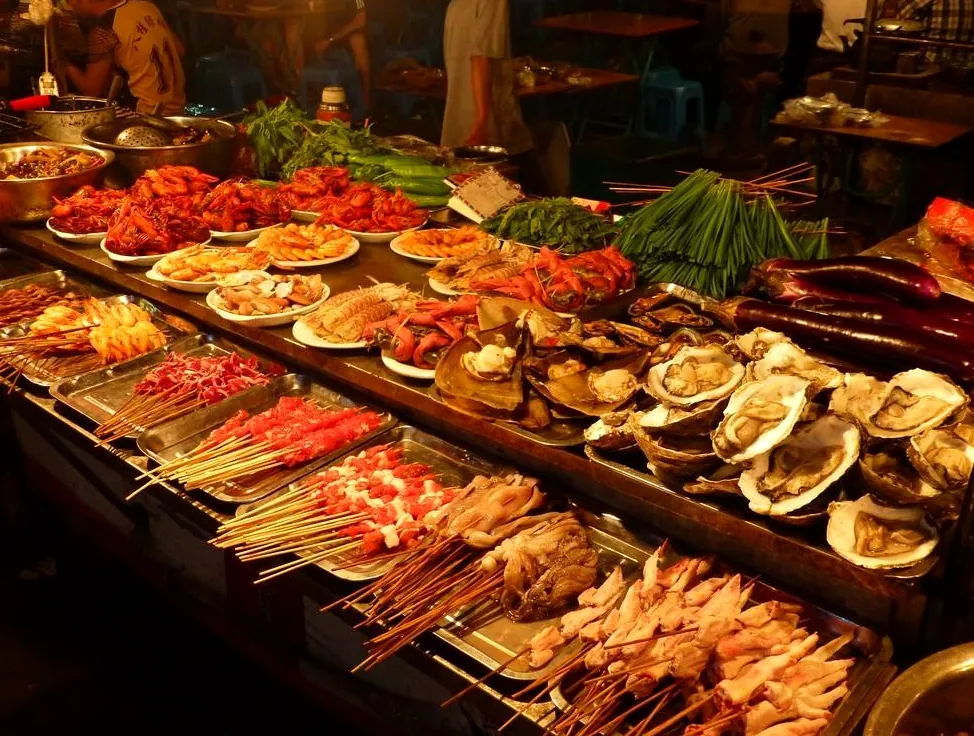
Right at the heart of the market, street food stalls instantly catch the eye with eye-catching displays of fresh seafood such as prawns, clams, oysters, and octopus, alongside skewers of meat ready for grilling. Plump oysters and glossy squid skewers are neatly layered on beds of pristine crushed ice alongside crimson skewers of lamb and beef heavily marinated in Sichuan peppercorns and cumin seeds. When a customer stops to make a selection, the chef swiftly places the skewers onto a glowing charcoal grill, where the sizzle of melting fat and the fragrant, signature spicy smoke intensely stimulate the appetite of anyone passing by.
Public transportation is the most convenient and cost-effective way to access the night markets. Most renowned night markets are impressively located near major subway stations or large bus stops. However, travelers should note that metro lines typically stop operating between 10:30 PM and 11:30 PM. If you plan to stay out later to experience the late-night dining culture, pre-installing local ride-hailing apps integrated with precise GPS maps will ensure a safe and smooth journey back to your hotel, avoiding overcharges from unmetered rogue taxis.
An essential standard when experiencing modern night food streets is the fully cashless payment culture. Nearly one hundred percent of food stalls, from small dumpling carts to large barbecue venues, transact via static QR codes through China’s two dominant super-apps, Alipay and WeChat Pay. International travelers should proactively link their overseas credit cards to these apps prior to the trip for seamless payments. At the same time, checking reviews on local lifestyle platforms like Meituan or Dianping will serve as an excellent guide to locate authentic family-run eateries, preview transparent pricing, and avoid tourist traps.
In addition to preparing complete immigration procedures and carrying personal documents at all times, travelers should carefully select their destinations. Instead of getting bogged down in overly commercialized pedestrian streets filled with mass-produced souvenir goods, seek out local night markets hidden behind ancient alleys to enjoy affordable prices and experience the true essence of daily life. For those visiting the populous nation for the first time and looking for a rich, relaxing culinary journey without the hassle of forced shopping stops, choosing pure exploration itineraries through a high-quality all-inclusive tour package will be the perfect solution to fully savor the brilliant nighttime culinary essence.