Location and History of Hai Phong Opera House
According to the Hai Phong Museum, Hai Phong City was established on July 19, 1888, by decree of the President of France and was classified alongside Hanoi and Saigon. Also during these years, the French promoted the construction of Hai Phong Port. After establishing the pier between 1885 and 1887, the French installed a drainage system on the Cam River, established warehouses, and placed navigational markers at Hon Dau to guide ships entering and leaving. Thus, by the end of the 19th century, Hai Phong had become a major seaport and an industrial center in Northern Vietnam.
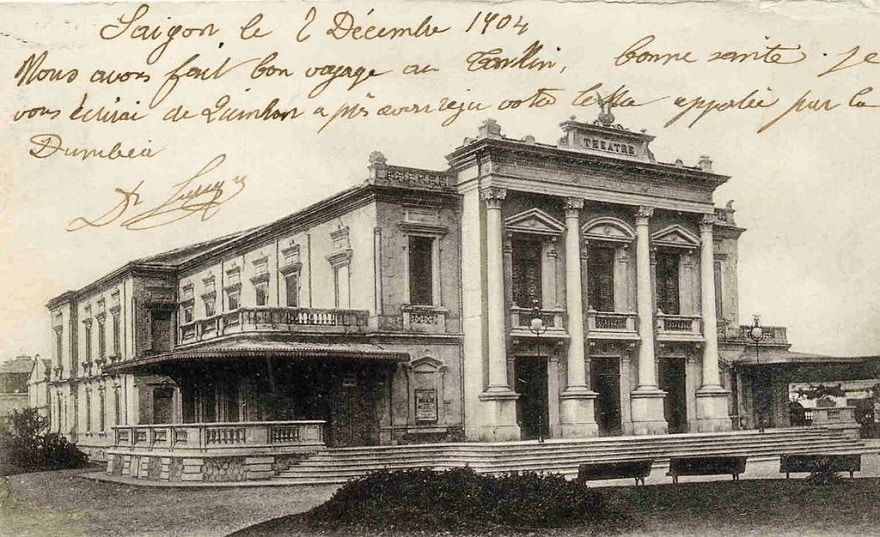
Hai Phong Opera House 1 century ago
Alongside building the city, the French also constructed cultural venues to serve the entertainment of French capitalists, native mandarins, and the Vietnamese bourgeoisie. The demand for art and cultural appreciation among this group grew increasingly strong, necessitating a theater. The establishment of the Hai Phong Opera House was an inevitable need.
Hai Phong Opera House was built in the inner-city center, at the junction of the European quarter, Chinese quarter, and Vietnamese quarter according to the French government’s urban plan. The chosen construction site was the elevated, spacious marketplace of the ancient village of An Bien. The theater was called the “Western Theater” (Nha Hat Tay) because it was designed in French architectural style, distinct from traditional Vietnamese theaters such as tuong, cheo, or cai luong theaters. The name “Western Theater” emerged in 1919, when Vietnamese people first gained admission to watch performances here. Previously, the theater exclusively served the French and hosted opera, concerts, and plays performed by touring artists from France. Traditional Vietnamese theaters were typically built in stilt-house styles with tiled or thatched roofs, featuring high, wide stages surrounded by audience seating. Construction on the Hai Phong Opera House began in 1904 and was completed in 1912.
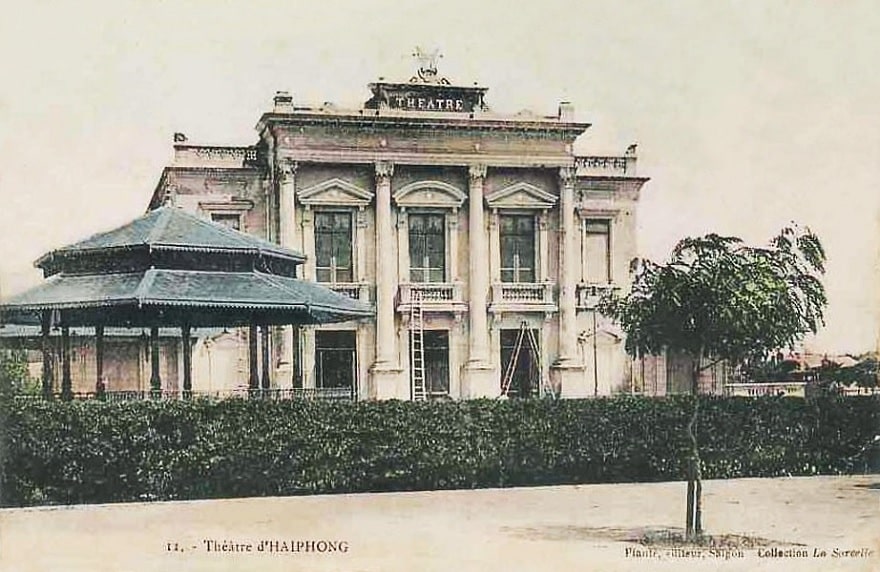
The building was stylishly designed after the prototype of the Paris Opera House, with construction materials imported from France. Construction was carried out by Vietnamese artisans and laborers under the direction of French architects
The construction process of the theater was no easy feat. Designers and workers faced numerous difficulties such as shortages of materials, tools, funding, and labor. Furthermore, the theater faced opposition from local residents because it occupied the area of the ancient market and served as a symbol of French oppression. The theater was built after the prototype of the Paris Opera House, featuring unique decorative motifs and bas-reliefs arranged harmoniously with high artistic value. It was constructed using materials such as stone, brick, iron, cement, and glass imported from France, and was equipped with electrical, water, and sound systems considered modern for that era.
Hai Phong Opera House is not merely an eye-catching architectural work, but also a historical landmark tied to pivotal events of the Vietnamese nation. The theater witnessed the first public rally of the Viet Minh in 1945, where Ho Chi Minh spoke about the political situation and called on the entire population to rise up and reclaim freedom. This rally attracted thousands of participants and generated immense pressure on the French authorities. The theater also became a battleground during the conflict between the Viet Minh and French forces in 1946, when Viet Minh soldiers shelled the theater to halt the French army’s advance. This battle inflicted heavy damage on the theater and resulted in many deaths and injuries. The theater was also burned down during the Vietnam War and was reconstructed in 1973. Today, the theater retains its original architecture and serves as the venue for major cultural and political events in Hai Phong City.
Architecture and Interior of Hai Phong Opera House
Hai Phong Opera House was designed in the Baroque architectural style, an artistic architectural movement that originated in Italy before spreading to Austria, Spain, and parts of France. The theater was elaborately and stylishly designed after the prototype of the Paris Opera House, with building materials imported directly from France. Decorated with unique patterns and bas-reliefs in a harmonious layout of high artistic merit, the theater is shaped like the letter U, with two wings projecting outward on either side.
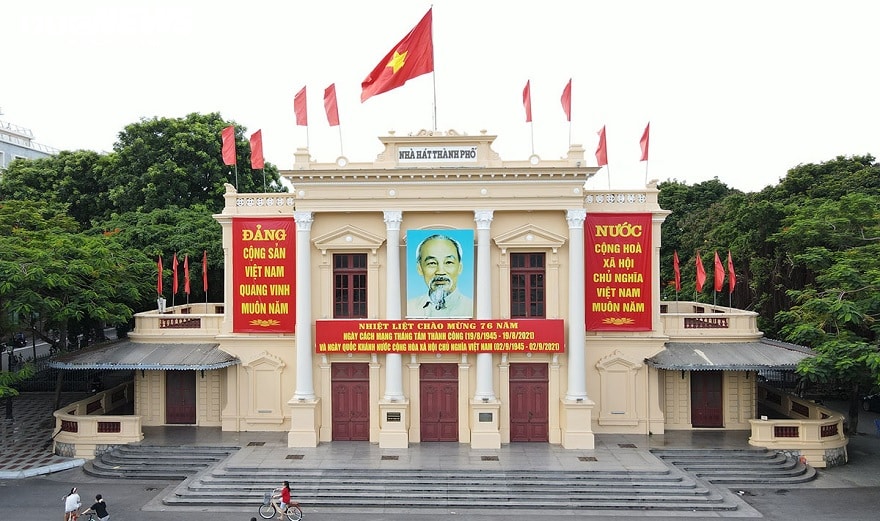
Facade of the Opera House
The theater’s facade features three main entrances designed in a classical style, comprising three main doors and two side doors. The doorways are adorned with stone columns and floral bas-reliefs. Above each door sits a woodcut carving depicting famous French artists such as Molière, Racine, Corneille, and others. Crowning the facade is a grand dome surrounded by statues of goddesses and crystal lamps. The theater’s facade stands 18 meters high and 87 meters wide.
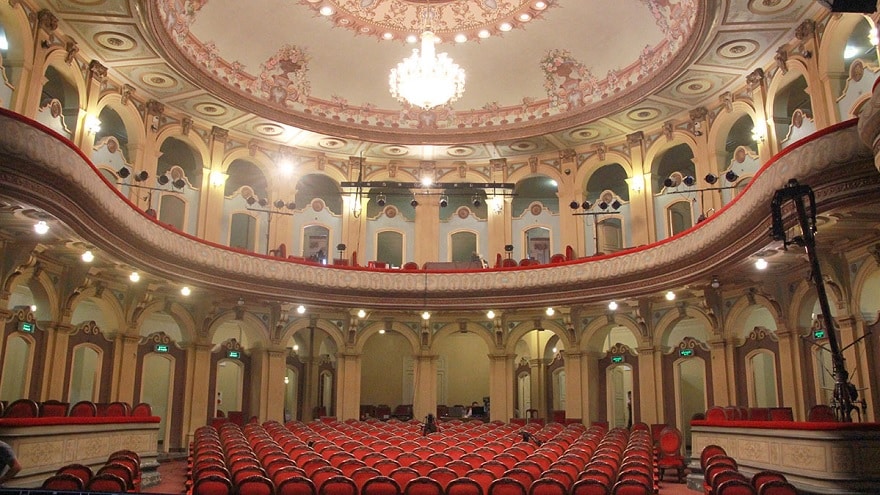
Auditorium area with a capacity of 400 guests
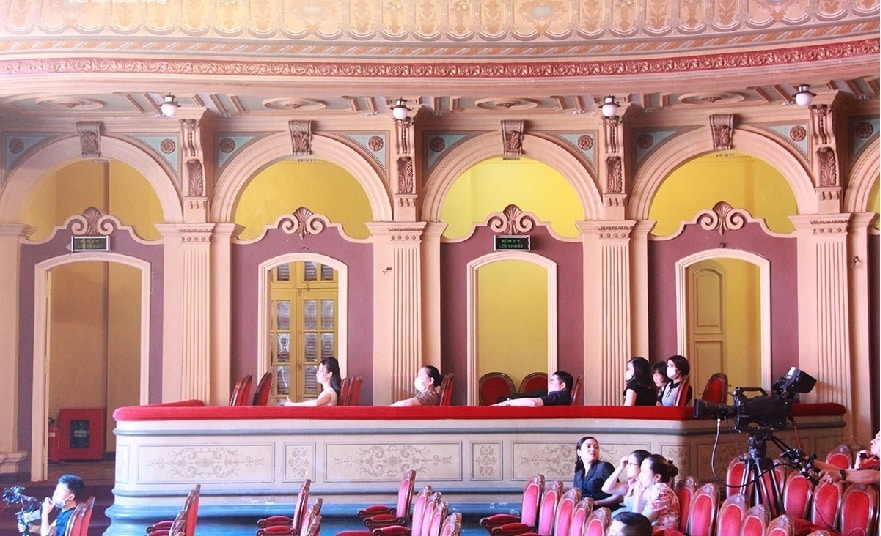
Along both sides of the 1st-floor auditorium and 2nd-floor balcony are numerous box seats designed for families or groups wishing to enjoy performances together.
Stepping inside the theater, you will be overwhelmed by the splendor and luxury of its interior. The grand lobby spans 900 square meters and can accommodate around 400 spectators. Designed in the Baroque style with intricate, eye-catching details, the lobby features pale yellow painted walls adorned with murals depicting landscapes and artistic performances. The ceiling is embellished with ornate patterns and magnificent chandeliers, while two spiral staircases lead from the lobby to the upper floors.
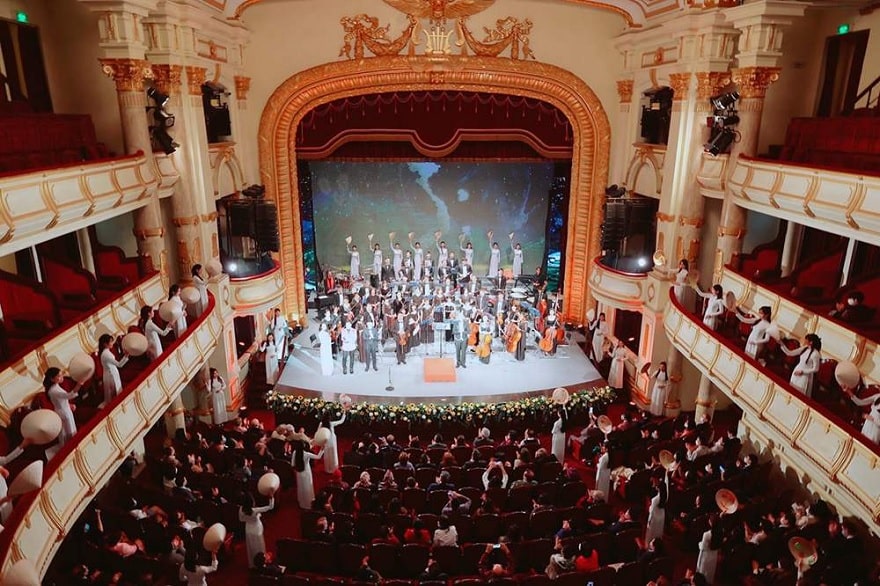
Stage area
The stage area is undivided by floors, rising openly from the platform straight up to the ceiling and roof structure. Measuring 12 meters wide and 9 meters deep, the space above the stage houses the electrical and air-conditioning systems for the entire theater. Roman-style doorways lead from the stage into the backstage area, dressing rooms, performers’ lounges, and technical control rooms for stage technicians. The stage follows a rectangular layout, fronted by an orchestra pit where musicians perform.
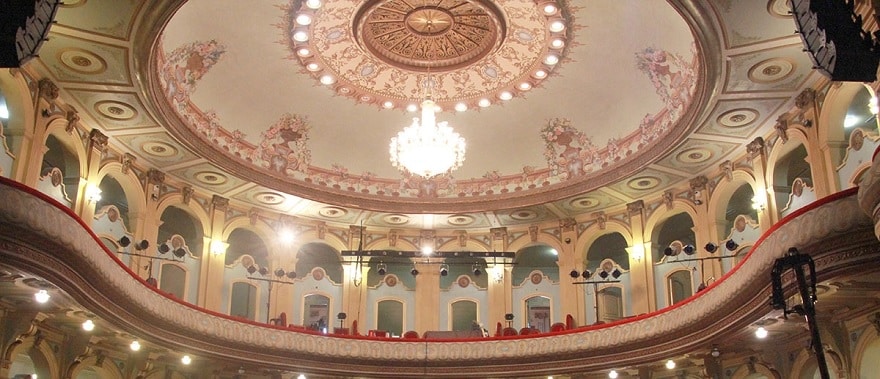
Auditorium dome inside the theater
To suit the artistic function of the theater, the auditorium area has no ceiling separating the two tiers, opening continuously from the floor up to the dome. Characteristic of Western architecture, this vaulted dome creates a spacious effect while serving as a canvas where painters showcase their talent through ceiling murals. The high, expansive dome allows sound to resonate and soar, diffusing music evenly to every spectator and listener.
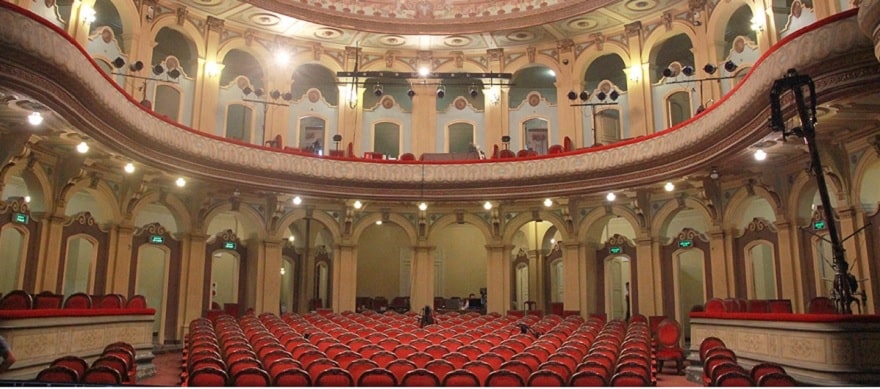
The auditorium features an open circular arc layout, with the open end connecting to the stage via the proscenium arch. Inside the auditorium sits a system of roughly 350 red wool-upholstered wooden seats.
The architecture of Hai Phong Opera House is not merely an exquisite work of art, but also a symbol of the history and culture of Hai Phong City. The theater has witnessed numerous pivotal events of the nation and the city, from the August Revolution uprising to the Indochina War. It also serves as the venue for major cultural and political activities in Hai Phong City, contributing to the development of local arts and tourism.
Activities at Hai Phong Opera House
Hai Phong Opera House served as a cultural and political hub during the French colonial era and for the wealthy elite of the port city. During that period, only renowned domestic and French theater troupes were permitted to perform at the venue. Today, however, the theater has become much more accessible, hosting and commemorating numerous major holidays, cultural activities, events, and festivals. For instance, you will have the opportunity to gain deeper insight into the cultural and spiritual life of Vietnamese people when visiting the theater on New Year’s Eve.
Visiting Hai Phong Opera House, you not only explore French architecture and impressive decor adorned with magnificent paintings, but also enjoy captivating performances such as hat tuong (classical Sino-Vietnamese opera), hat cheo (traditional Northern Vietnamese folk opera), cai luong (reformed Southern folk theater), and various musical concerts. Hai Phong Opera House is also a wonderful venue for Vietnamese music concerts including ca tru (ceremonial singing), modernized traditional folk music blending Western and Vietnamese styles, quan ho (folk duet singing), hat chau van (spiritual medium singing), and other popular songs.
Hai Phong Opera House is located at 65 Hoang Van Thu Street, Hai Phong City, and is open Monday through Sunday from 7:30 AM to 5:00 PM. When visiting the theater, if you have any questions or wish to learn more, you can obtain free information from the Visitor Information Office, where you may also request guided tour services.