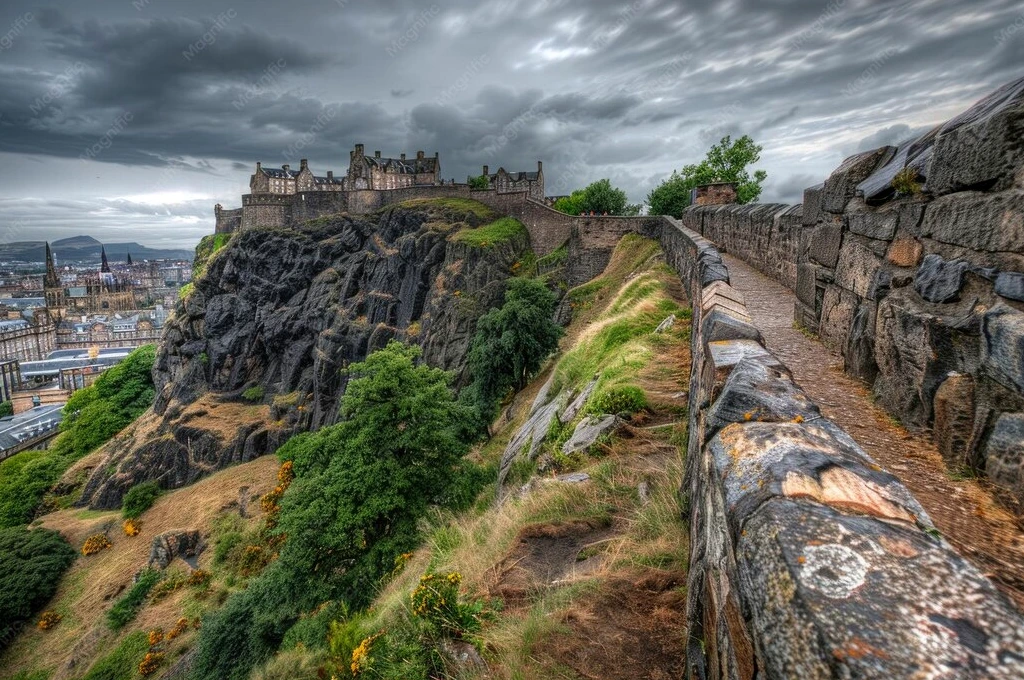
Tracing the chronicles back to the dawn of northern British history, the fortress perched atop Castle Rock—a million-year-old volcanic plug rising dramatically above the Scottish skies—already bore the footprints of human habitation in the Late Bronze Age, estimated around 850 BC. Its formidable terrain, featuring sheer cliffs on three sides and only a single gentle slope leading up to the summit, early on turned this site into an impregnable natural military stronghold. In ancient Brittonic epics, this fortified refuge was known by the Celtic name Din Eidyn, meaning “Fortress of Eidyn.” As Angles pushed across the southern frontier during the Anglo-Saxon period, the name gradually shifted to Edinburh, planting the seed for one of the Old Continent’s most splendid historic capitals. Every layer of time here is more than mere earth and stone; it is the keeper of a proud nation’s soul that never submitted.
Entering the medieval feudal era, the fortress officially transformed into the supreme seat of power for Scotland’s illustrious royal dynasties. The oldest surviving architectural relic within the walls is St Margaret’s Chapel, built during the reign of King David I between 1124 and 1153 in honor of his mother, Queen Margaret—later canonized for her noble virtues. Through shifting tides of fortune, from the Dunkeld dynasty through Balliol to the illustrious Bruce dynasty, the castle became a focal point of the bloody and fiery Wars of Scottish Independence. There were moments when invading southern armies razed the stronghold to break enemy resolve, yet King David II later poured every effort into rebuilding the citadel and raising the sturdy David’s Tower, ushering in a proud renaissance of sovereign kingship in the North.
The zenith of royal architecture and courtly culture is closely tied to the Stewart dynasty, as monarchs James IV and James V continually expanded the castle and completed the Great Hall with its intricate oak timber roof beams—a feat of engineering for its time, hosting royal banquets and sittings of the Parliament of Scotland. Within the thick stone walls of the Royal Palace, a fateful milestone of British history unfolded in 1566 when Mary, Queen of Scots, gave birth to the infant Prince James VI. That pivotal event paved the way for the Union of the Crowns of England and Scotland in 1603, when the young prince ascended the throne at Westminster as King James I of a united realm.
Even so, glory always intertwined with tragic grandeur along the gentle incline of the Royal Mile linking the castle to the Palace of Holyroodhouse. The fierce Lang Siege from 1571 to 1573 rained artillery fire that left much of the medieval fortifications in ruins, compelling royal architects to overhaul the fortress into a modern defensive complex anchored by the imposing semicircular Half Moon Battery. Later, amid the geopolitical upheavals of the Jacobite risings of 1715 and 1745 aimed at restoring the exiled Stewart line, the stone citadel still stood firm as an unyielding defensive linchpin. That vast body of records, royal decrees, and campaign accounts is preserved today at the National Records of Scotland, standing testament to an enduring emblem of power woven into the national spirit.
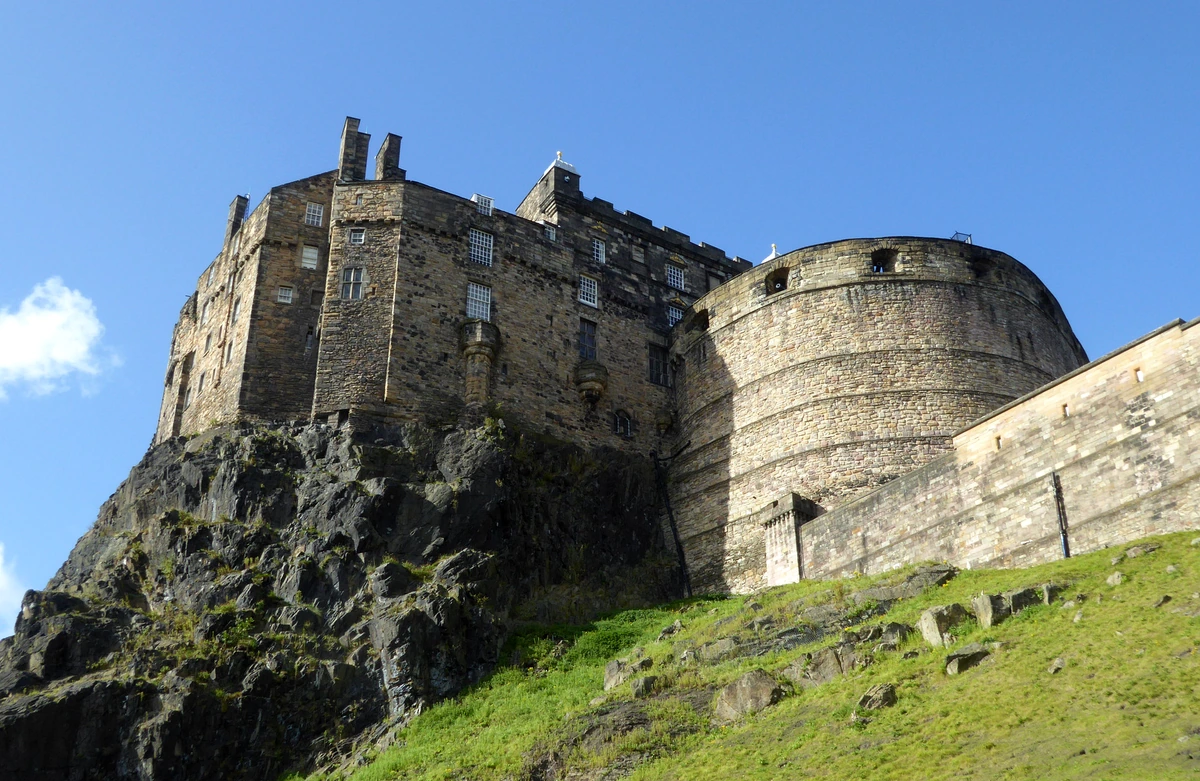
Formed from cooled magma of an ancient Carboniferous volcano more than 350 million years ago, the towering basalt mass of Castle Rock is the geological root and geomantic soul of the entire Edinburgh capital complex. Scoured by powerful Quaternary glaciers, nature carved a textbook geomorphological “crag-and-tail” formation. At the crag end rises a natural bastion of near-vertical dark grey basalt cliffs climbing more than 80 meters above the surrounding valley on its northern, western, and southern faces. The commanding site resembles a giant eagle perched on an isolated crag, overlooking the fertile Lothian plain and the Firth of Forth to form an impenetrable shield against military advances from the south.
The brilliance of Edinburgh’s urban planning lies in its complete reliance on natural geology. The gentle tail sloping eastward from Castle Rock formed a single ridge stretching exactly one ancient Scottish mile—about 1.81 km—down to the level ground where the Palace of Holyroodhouse stands. This natural spine gave rise to the Royal Mile. To further strengthen the fortress’s defenses in the mid-15th century under King James II of Scotland, a dam was built across a low-lying marsh north of the castle walls to hold back a stream, creating the artificial Nor’ Loch. This stagnant, boggy basin with a deep, treacherous bed not only served as a natural moat separating the castle from the northern hills, but also isolated the old town from the outside world for centuries.
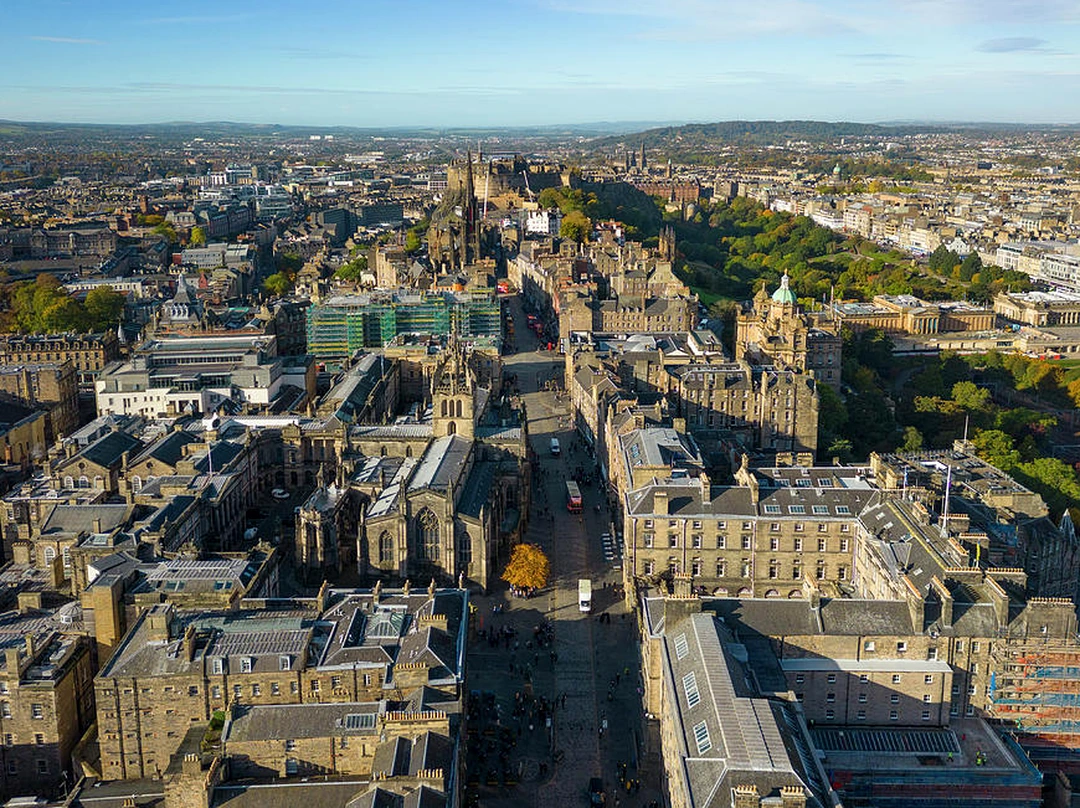
Caught between rugged topography and strict defensive needs, Edinburgh’s urban engineering took a singular path in European history. After the devastating defeat of Scottish forces by the English at the Battle of Flodden in 1513, where King James IV fell heroically, fear of invasion prompted burgh authorities to hastily construct the Flodden Wall enclosing the entire Old Town. Hemmed in within that stone perimeter—and blocked at either end by Castle Rock’s basalt drop-offs and the stagnant Nor’ Loch—the city had virtually no room to expand outward. Faced with surging population density and refugees arriving from conflict zones, architects and builders of the era turned to the only viable option for survival: building vertically toward the sky.
Out of that spatial gridlock, some of the world’s earliest multi-story apartment blocks, known locally as “lands,” rose along both sides of the Royal Mile. Anchored on sturdy sandstone foundations driven deep into bedrock with heavy aged-oak timber frames, these “lands” climbed 10 to 14 stories high, creating canyon-like streets that blocked out direct sunlight. Edinburgh’s cityscape took on a striking layered character: deep below ran narrow, steep, winding alleyways called “closes” and “wynds,” where damp northern mist mingled with the scent of peat smoke, while high above, nobles and commoners lived stacked beneath shared roofs. Ancient basalt strata paired with this unusual vertical stacking turned Edinburgh Castle and the Royal Mile into a grand stone fortress crystallizing Scotland’s weathered memories.
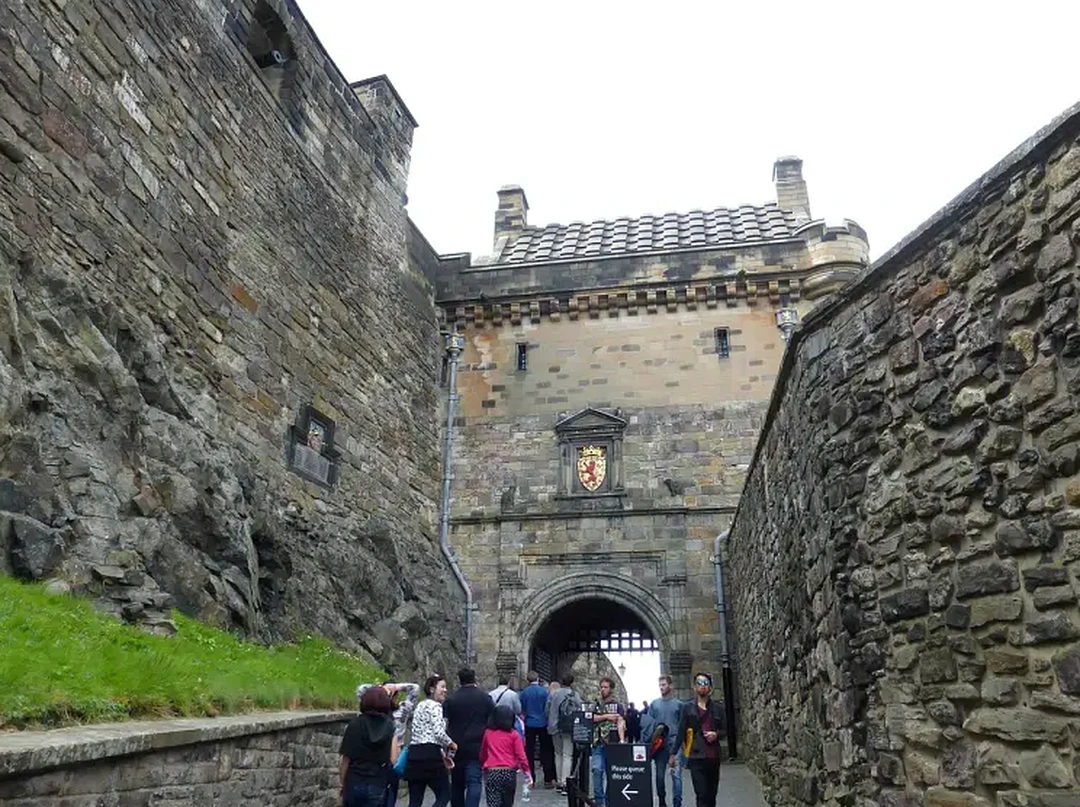
Commanding the summit of the ancient volcanic vent at Castle Rock, Edinburgh Castle unfolds as a monumental military complex with defensive tiers stepped along the steep natural terrain. Across centuries of fierce sieges, it evolved from an early medieval timber stronghold into one of Europe’s finest stone fortresses. Right from the main approach, visitors face the imposing Portcullis Gate, where a tall Gothic stone arch frames a heavy iron portcullis dropped vertically to trap any assaulting force. Behind the ramparts stands the massive semicircular Half Moon Battery, begun between 1573 and 1588 under Regent Morton to rebuild artillery defenses after the bloody Lang Siege. This thick curved stone wall not only provided an ideal gun platform facing east, but also encased and concealed beneath ground level the ruined remains of the great David’s Tower. Nearby, Argyle Battery and Mills Mount Battery thrust their cannons out into the breezy air, commanding sweeping views across the misty Firth of Forth.
The craftsmanship and durability of the fortress complex stem from careful selection of premier local materials alongside long-distance maritime trade. Its grand curtain walls and royal palace blocks use Carboniferous sandstone quarried from the renowned Craigleith quarry, prized for its fine, tight grain and signature ash-grey hue that hardens further over time upon exposure to air. These sandstone blocks were paired with jet-black whinstone basalt quarried directly from the local volcanic crags, bound through freezing winters with traditional slaked lime mortar mixed with coarse river sand. High on the steep pitched roofs, Scottish craftsmen laid tens of thousands of dark slates from the island of Easdale, creating an enduring armor against driving North Sea rain. Beneath the stately palace vaults lie heavy load-bearing roof trusses crafted from prime Baltic pine, shipped across the sea by sailing vessels for royal buildings.
From the foot of the castle, the urban spine of Scotland’s capital extends along the legendary Royal Mile, spanning roughly 1.8 km—one ancient Scottish mile—to link the two supreme emblems of authority: Edinburgh Castle and the Palace of Holyroodhouse. This arterial route divides into four continuous stretches with ever-shifting spatial rhythm: starting down the rugged Castlehill slope, opening through the bustling Lawnmarket cloth market, continuing along lively High Street, and settling into historic Canongate. High Street’s visual centerpiece is St Giles’ Cathedral, whose carved stone crown spire rises against slate-blue skies beside the Mercat Cross topped with a carved unicorn, where royal proclamations and historic sentences once rang out before the populace.
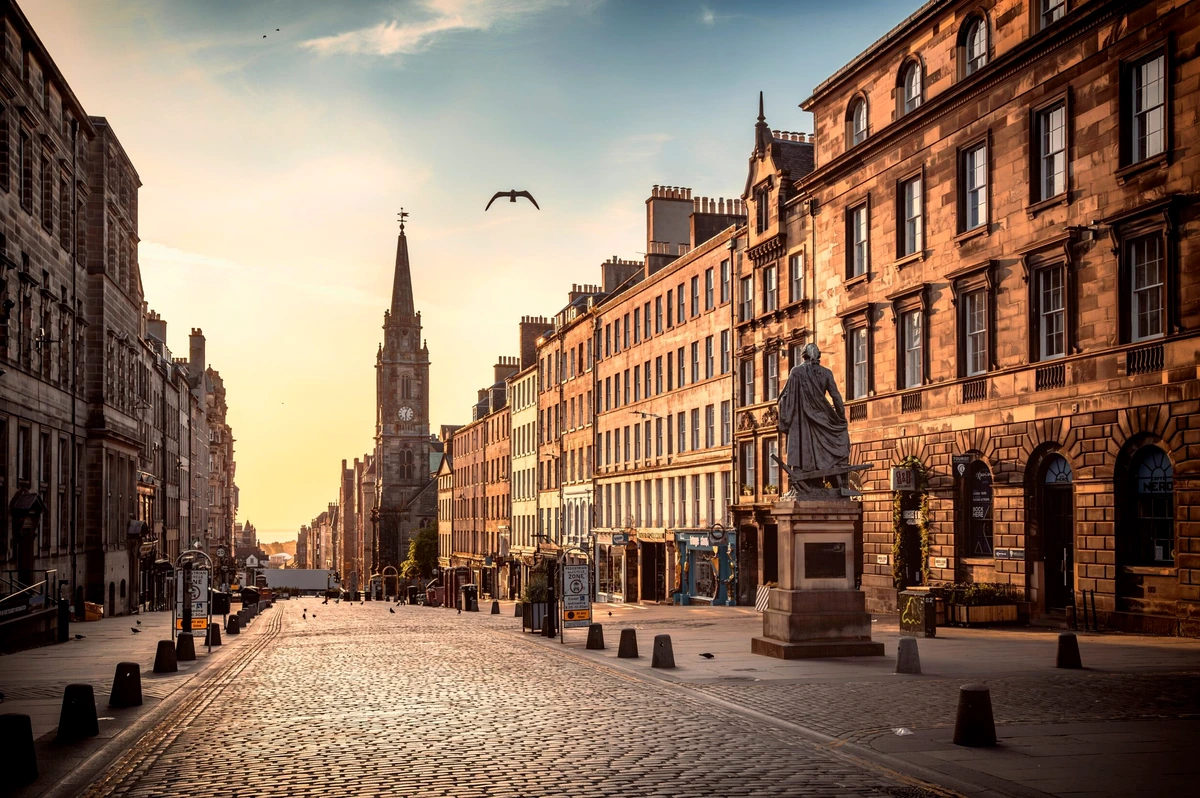
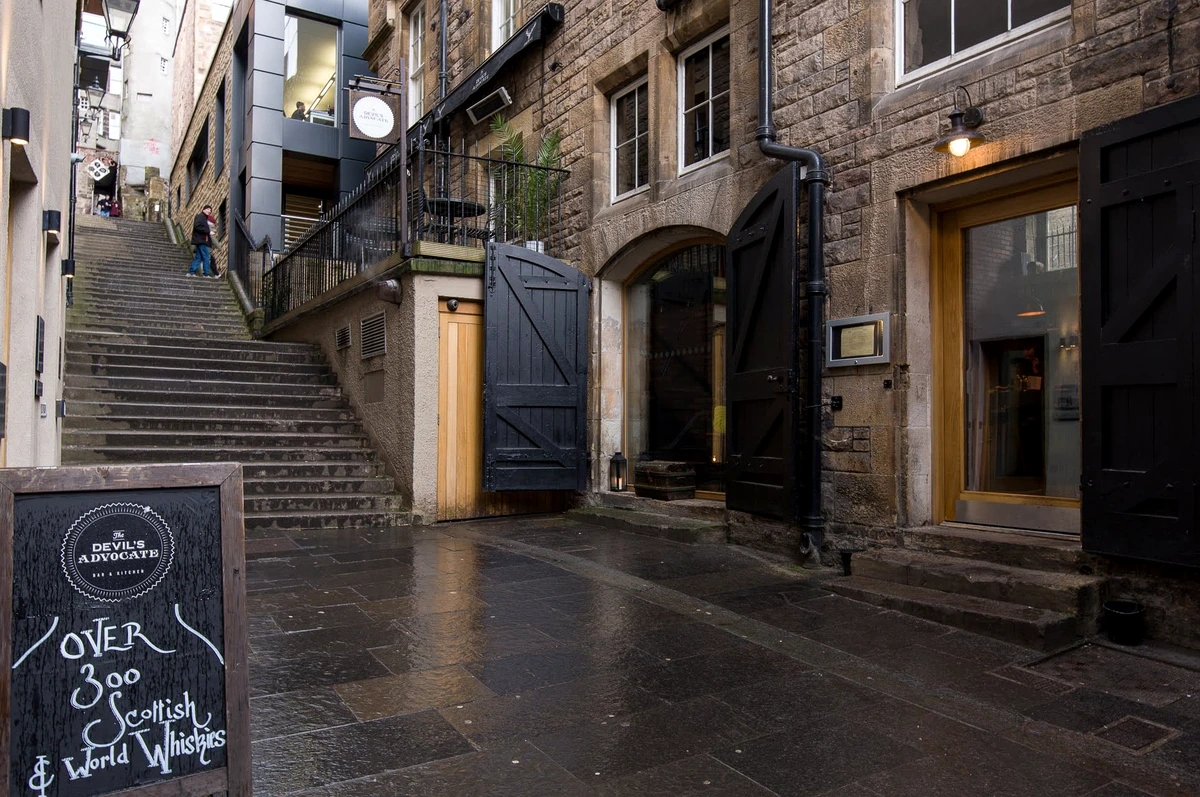
The spatial layout of the Royal Mile preserves a distinctive medieval herringbone-like street pattern, where grand multi-story tenement facades are pierced by scores of steep, shadowy alleyways called “closes” and “wynds.” Narrow passages barely wide enough for two walkers to pass—such as Advocate’s Close or Brodie’s Close dropping sharply toward the northern valley—open dramatic, cinematic glimpses of the distant firth. This masterly interplay of towering rough-stone housing blocks wrapping around tucked-away cobbled courtyards reflects both population pressure inside old Edinburgh’s protective walls and an ingenious architectural response to steep terrain.
Once dusk fades behind distant hills and cool mist from the Firth of Forth rolls into the valley, Edinburgh Castle and the Royal Mile undergo a dramatic shift in sight and mood. Daytime solemnity gives way to an atmospheric lighting showcase where contemporary illumination highlights layers of history. High-tech lighting blending warm energy-saving LEDs with crisp metal halide spotlights sits discreetly tucked within natural rock recesses. Warm gold and amber light cast upward from the base of million-year-old basalt cliffs onto the sturdy walls of the Half Moon Battery—built after the fierce 16th-century Lang Siege under Governor James Douglas, 4th Earl of Morton—accentuates weathered grey stone and makes the night-time fortress look like an ancient warship cutting through a sea of mist.
Sloping gently from the Esplanade down to the Palace of Holyroodhouse, the Royal Mile takes on a nostalgic glow from Victorian- and Georgian-style heritage streetlamps. Soft golden light reflects off time-worn cobblestones, guiding visitors into an unmistakably Scottish soundscape. Across windswept open squares and deep closes or wynds, the stirring, resonant notes of the Great Highland bagpipe ring out through the historic quarter. Performers in traditional tartan kilts play classic marches and poignant Jacobite airs, their pitch and projection amplified naturally by tall sandstone walls lining both sides of the street.
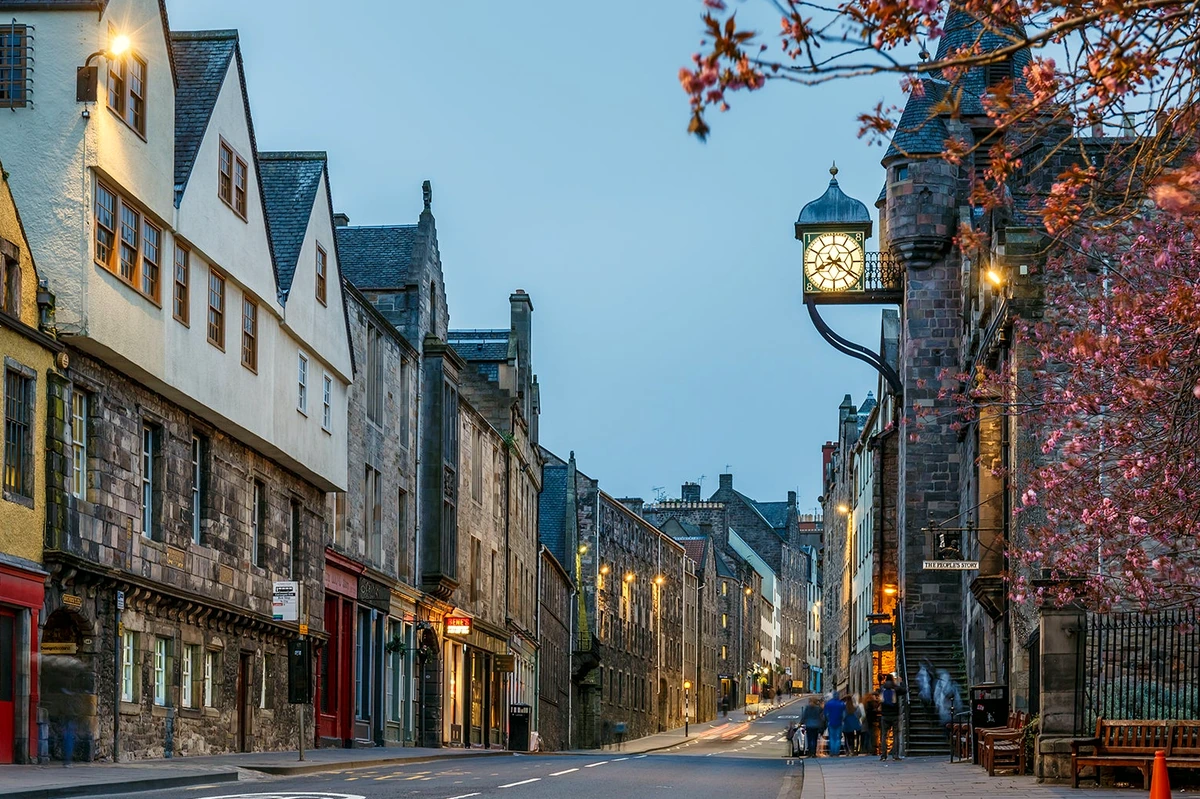
Nightlife in the Old Town is less raucous than deeply rooted inside centuries-old taverns such as The World’s End or The Ensign Ewart, once frequented by soldiers and thinkers of the Scottish Enlightenment. Amid smoke-darkened oak paneling and flickering candlelight, guests enjoy Single Malt Whisky—whether richly peated from Islay or fruity from Speyside—paired with traditional haggis served alongside mashed turnip and potato. Fiddle music blending with lively chatter creates a warm gathering that brings centuries of everyday Edinburgh life to vivid presence.
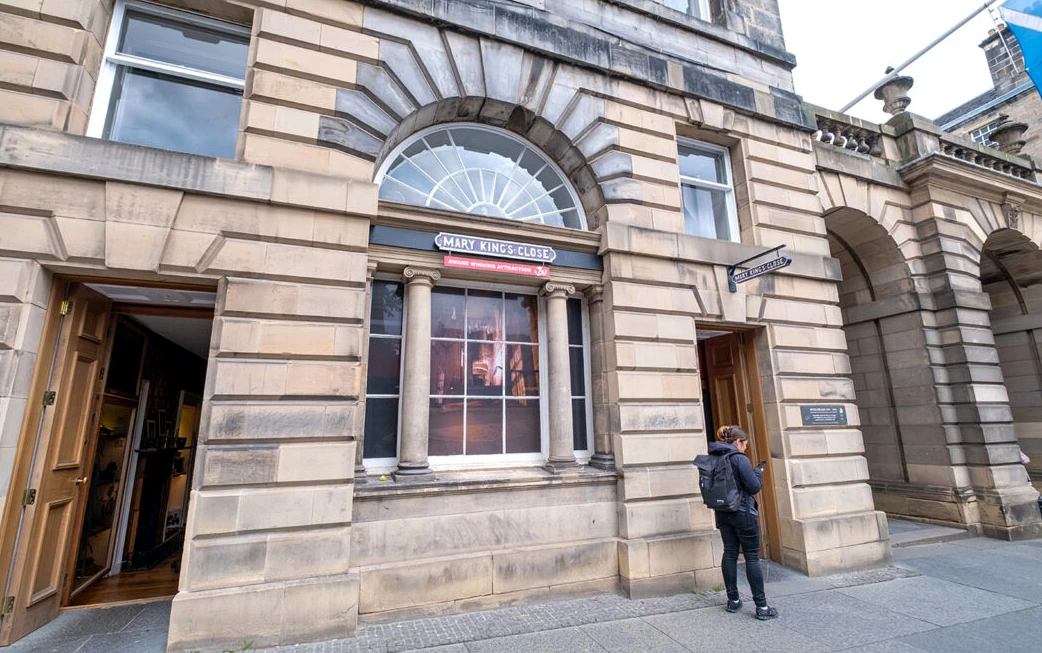
Among the most distinctive evening experiences in Edinburgh are after-hours tours exploring its mysterious subterranean world. The South Bridge Vaults—a network of 120 stone arches built beneath South Bridge in the late 18th century—and Mary King’s Close, sealed off from the 17th century following plague outbreaks, reveal a very different historical dimension. By the dim glow of handheld storm lanterns, visitors walk damp passages and cramped rooms once home to the destitute, artisans, and illicit distillers. Engaging storytelling and live interpretation bring to life poignant events and tales of 19th-century body-snatching for anatomy schools, turning the walk into a vivid chronicle steeped in the capital’s cultural and eerie lore.
Exploring Edinburgh feels incomplete without immersing yourself in its hearty yet refined culinary world, reflecting the interplay between the fertile Lothians coast and the resilient, open-hearted spirit of Scotland. Traditional Scottish cuisine was shaped by harsh winters and nutrient-rich local ingredients, maturing over centuries into a heritage that is at once rustic and proud. At its heart is haggis, the celebrated national dish hailed by poet Robert Burns as “Great chieftain o’ the puddin’-race.” Crafted from finely minced sheep’s heart, liver, and lungs combined with coarse Lothian oatmeal, suet, onion, black pepper, and warming spices, then packed into a sheep’s stomach and simmered, haggis delivers a rich, nutty, comforting flavor. Served royally alongside neeps and tatties—swede turnip and buttery mashed potato—it is often finished with a rich pan jus infused with fine single malt whisky.
Alongside haggis, cold-weather dining in Edinburgh is warmed by steaming pots of traditional soup in historic kitchens along Castle Rock’s slopes. Standout among them is Cullen skink, hailing from the northeast coast, made with oak-smoked finnan haddie haddock simmered gently with diced potatoes, sautéed onions, and rich cream for a velvety texture that awakens the palate. Equally historic is cock-a-leekie, a refined soup served at Stewart royal banquets since the 16th century, pairing tender chicken with sweet leeks and glossy prunes to balance deep stock sweetness with gentle dried-fruit tang. Travelers should also savor Arbroath smokies—whole haddock hot-smoked over hardwood on the North Sea coast—offering firm, glossy flesh perfumed with crisp sea air.
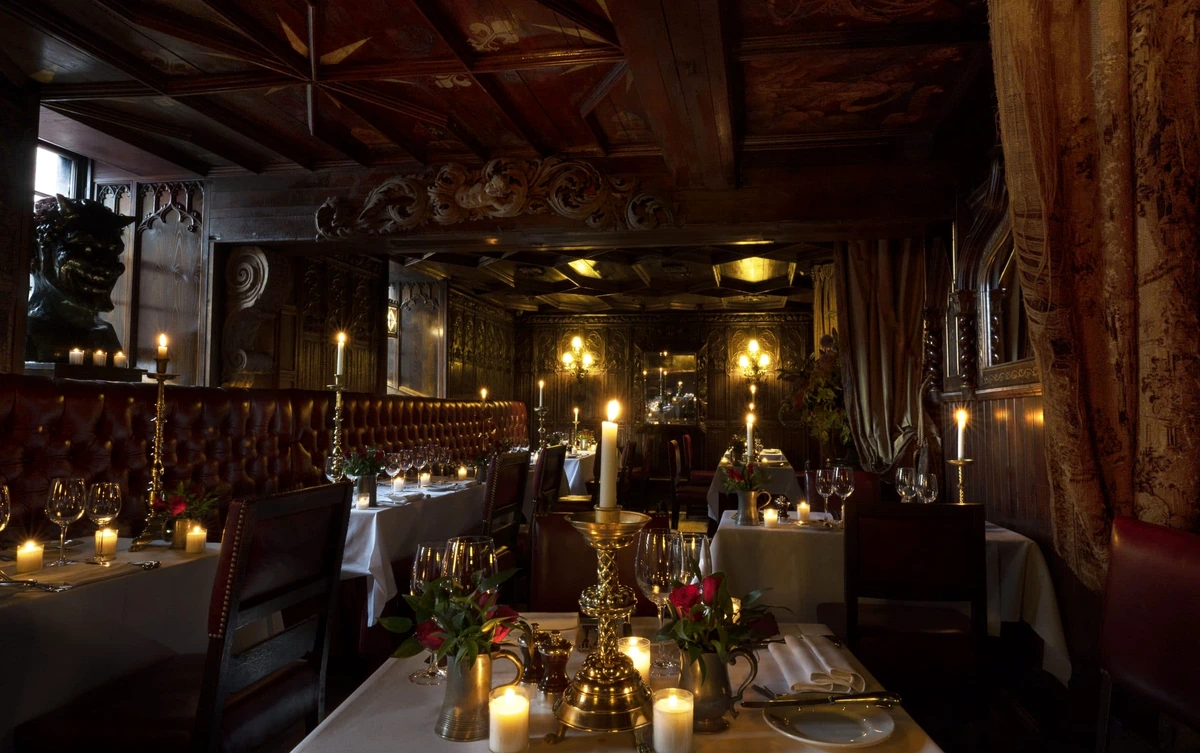
Edinburgh’s dining map reaches a glamorous peak right along the Royal Mile, where centuries of history meet top-tier gastronomy. Standing right beside the castle Esplanade, The Witchery by the Castle occupies Boswell’s Court, a 16th-century merchant mansion. Stepping through heavy timber doors feels like entering a moody Gothic sanctuary, with candlelight gleaming off carved antique oak paneling, painted armorial ceilings, and deep crimson velvet tables. The restaurant is a luxury showcase for wild Highland venison alongside fresh seafood platters featuring Loch Fyne rock oysters, Isle of Skye langoustines, and plump pan-seared scallops landed that day.
To reach Edinburgh’s everyday yet deeply atmospheric soul, walkers head down winding cobbled lanes to time-honored pubs. At Deacon Brodie’s Tavern—named after 18th-century Deacon William Brodie, famous for his double life as a respected citizen by day and daring burglar by night—the room buzzes with traditional top-fermented real ales hand-pumped from cellar oak casks. Meanwhile, The Bow Bar tucked along curving Victoria Street is a quiet haven for connoisseurs; its antique mahogany bar houses more than four hundred Scotch Single Malt Whiskies spanning classic regions, from the pungent peat smoke of Islay and heather-honey sweetness of Speyside to sharp, maritime notes from Scotland’s coasts.
Visiting the stone citadel atop volcanic Castle Rock calls for thoughtful planning to take in its cultural depth without logistics getting in the way. Historic Environment Scotland adjusts opening hours seasonally with northern daylight: in summer the castle welcomes visitors from 09:30 to 18:00, while in winter it closes earlier at 17:00, with last entry one hour before closing. Because indoor spaces such as the Royal Palace and Great Hall have limited capacity, booking a timed ticket online in advance is essential. That precaution matters even more in peak summer months—especially July and August—when the Edinburgh Festival Fringe and the Royal Edinburgh Military Tattoo turn the entire Old Town into a bustling stage packed with travelers from around the globe.
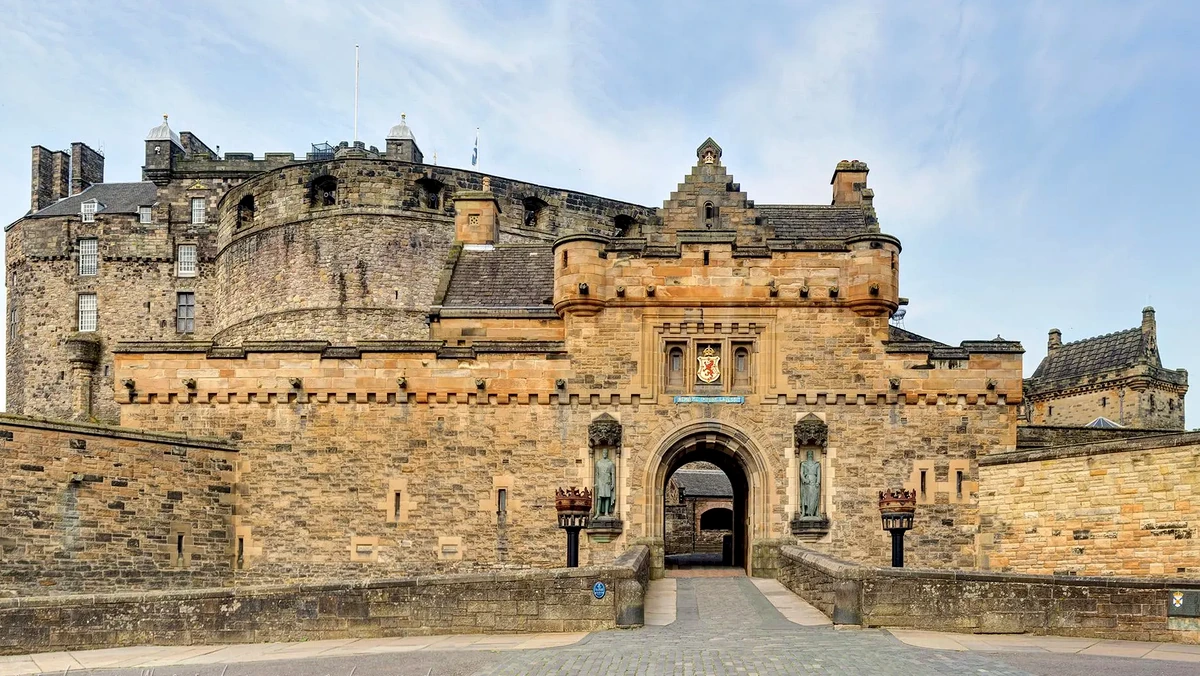
One of the liveliest daily time-honored moments not to miss is the One O’Clock Gun firing precisely at 13:00 each day from Mills Mount Battery. Except on Sundays, Christmas Day, and Good Friday, this booming cannon shot has sounded over the coastal air since 1861, when founder Thomas Grainger established it as an audible time signal so merchant ships anchored in the Firth of Forth could set their marine chronometers. To get a good view as the District Gunner of the Royal Regiment of Artillery loads the charge and fires, arrive at the castle esplanade at least twenty minutes early. The sharp report and white plume rising against Alba’s silver-grey sky leave a lasting impression—a tangible bridge between Victorian precision and modern life.
Reaching Edinburgh’s historic heart is straightforward thanks to modern public transit woven smoothly into the old city fabric. From Edinburgh Airport, Edinburgh Trams glide past outer districts straight to Princes Street or St Andrew Square in under forty minutes. Arriving by intercity rail, Edinburgh Waverley station—sitting right in the basin of the former Nor’ Loch—makes an ideal arrival point; stepping out the south exit and climbing the winding steps of Cockburn Street framed by Gothic Revival architecture brings you right onto the Royal Mile ridge. Fares on trams, Lothian Buses double-deckers, and local transit are generally reasonable, though exploring the heritage spine on foot is what truly uncovers its hidden cultural layers.
Still, steep gradients formed from basalt lava and uneven volcanic cobbles—commonly called setts—mean travelers should wear walking shoes with high-traction rubber soles to avoid slipping when damp mist settles. Branching off the Royal Mile is a web of scores of steep alleyways known as closes and wynds, such as Advocate’s Close or Lady Stair’s Close, leading into historic residential pockets. When strolling these quieter spots, visitors are encouraged to keep noise low and respect the privacy of residents living in centuries-old tenements. At gathering spots like Parliament Square or near philosopher David Hume’s statue, you will readily spot musicians in traditional tartan kilts playing the Great Highland bagpipe. Stopping to listen as mournful airs echo off old stone—and leaving a few coins in appreciation—is not only good manners, but a nod to the resilient Highland spirit.
To experience this captivating chronicle—from grand stone fortresses to atmospheric hidden lanes—without worrying about itinerary logistics, travelers can opt for a curated UK – Wales – Scotland tour to hear every chapter of its history told vividly and accurately.