Resting proudly on the high steps of the Snow Mountain plateau, Yamdrok Lake—written in Tibetan script as ཡར་འབྲོག་གཡུ་མཚོ། (Wylie transliteration: yar-‘brog g.yu-mtsho) and rendered in Chinese characters as 羊卓雍措 (Yangzhuo Yongcuo)—has long held status as one of Tibet’s most sacred and ancient coordinates. Its original meaning carries poetic depth: “Turquoise lake nestled beside high mountain pastures.” In Tibetan consciousness across millennia, deep blue waters sitting above 4,400 meters above sea level are more than a geographic feature; they are a current holding memories of shifting dynasties where secular authority, Buddhist spiritual currents, and early social norms of the roof of the world converge.
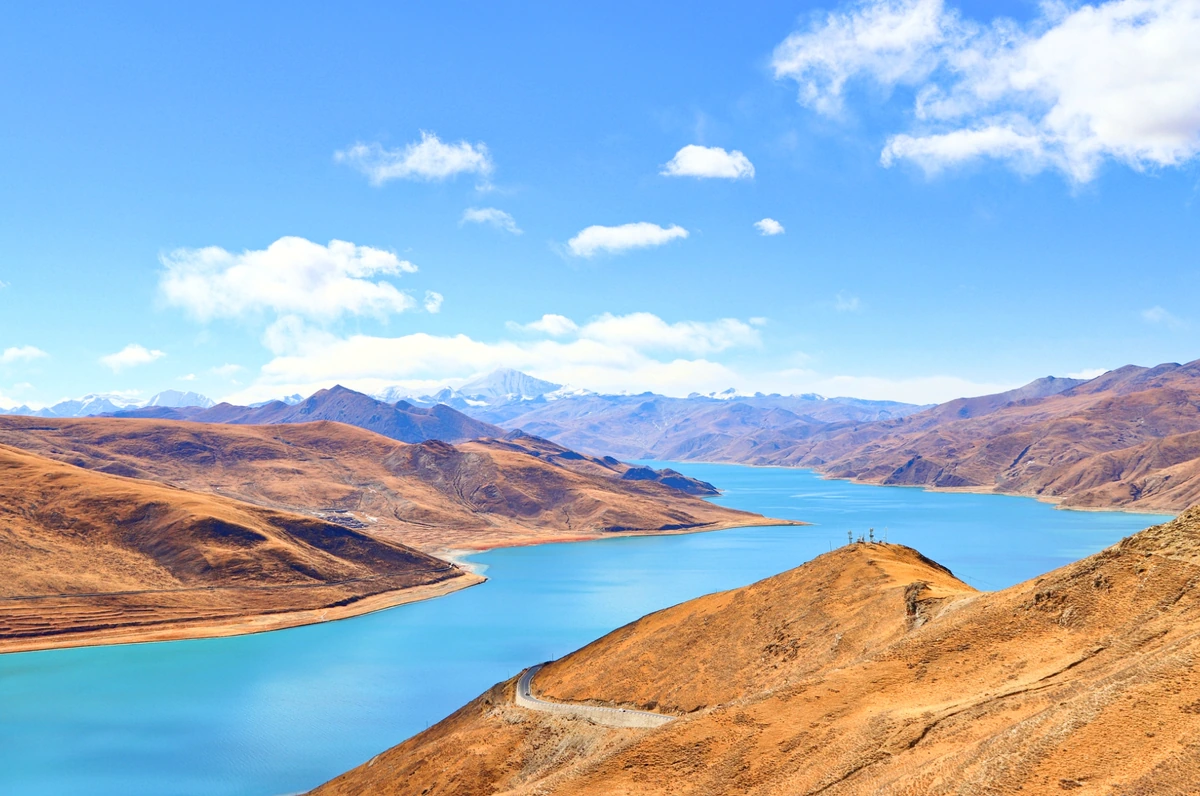
Tracing back to the Tibetan Empire (Tubote) flourishing from the seventh to ninth centuries, the basin around Yamdrok Lake played a strategic part in the geopolitics of the Tsenpo monarchs. Thanks to lush grazing nourished by pure glacial meltwater and cool summer weather, broad lakeshore areas were used as royal summer pastures and bases for raising and training warhorses. Spirited cavalry mounts trained across the Yamdrok highland formed a capable force helping defend frontiers and project imperial reach across Central Asia and western borders of the Tang Dynasty.
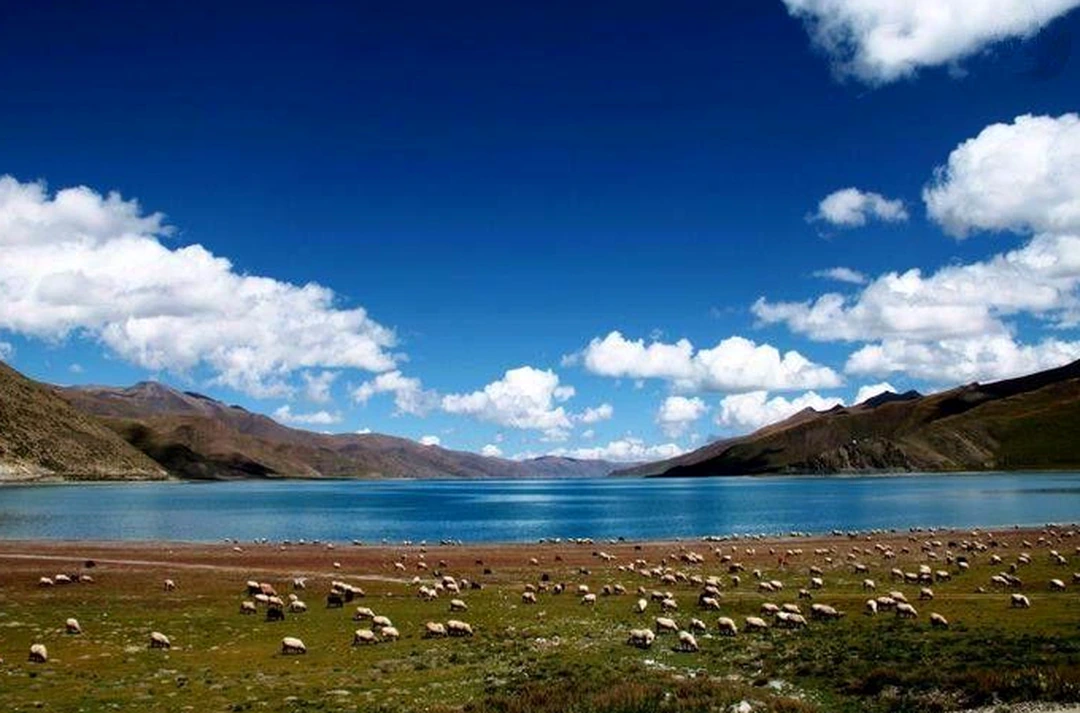
Entering the 1440s, Yamdrok Lake’s history saw a religious milestone with lasting meaning for Tibetan Tantric Buddhism. Along the southern shore, the first Dorje Phagmo, Chökyi Drönma, founded Samding Monastery (Samding Gompa). That event established a respected monastic center while marking the lineage of Tibet’s most prominent female tulku (reincarnate lama). Perched on a hill peninsula jutting into the lake, Samding became a symbol linking spiritual tradition with Yamdrok’s sacred setting, where the Dorje Phagmo lineage remained closely tied to the region’s spiritual lore.
Across subsequent eras, Yamdrok Lake’s special status was reinforced by official decrees and edicts. Historical records note that the Ganden Phodrang (Kashag) government issued decrees affirming water rights and tax exemptions for Samding Monastery. During the Qing Dynasty, imperial residents (Ambans) together with Dalai Lamas issued edicts prohibiting fishing in the lake and hunting waterfowl along its shores. These measures helped protect quiet sacred ground while acting as early conservation rules reflecting longstanding care for Yamdrok’s waters.
Located in Nagarze County within Shannan City, Tibet Autonomous Region, Yamdrok Lake—known in Chinese as 羊卓雍措 (Yangzhuo Yongcuo)—stands as a high-altitude geological feature at 4,441 meters above sea level. Spanning over 638 square kilometers of water surface, it is one of the largest inland brackish lakes on the Tibetan Plateau. Topographically, the basin sits within a complex tectonic rift zone between the southern slopes of the Nyainqêntanglha range and the northern flank of the Himalayas. High elevation, thin air, and glacial geology shape a dramatic highland setting molded over millions of years.
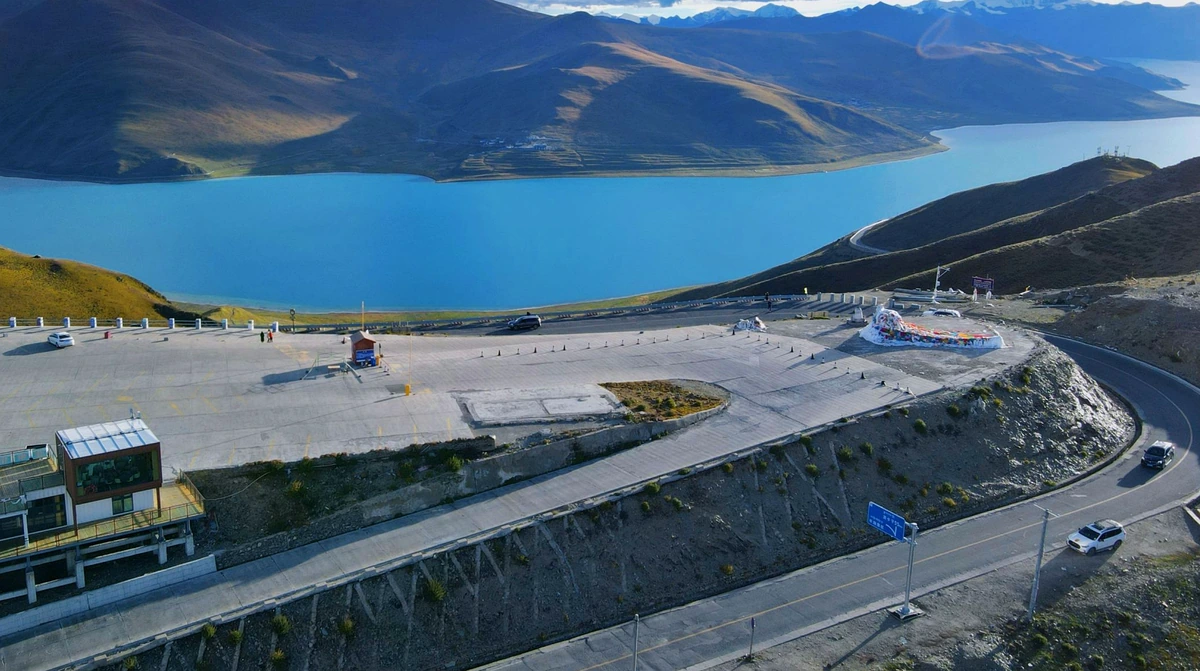
A standout trait of Yamdrok’s geomorphology is its highly indented shoreline stretching hundreds of kilometers. Viewed from high passes or above, the basin does not form a simple circle or oval, but branches out in an intricate, coral-like pattern. Deep blue inlets wind through rocky valleys and wrap around peninsulas, forming numerous coves and bays. This complex basin geometry shifts hues from turquoise and azure to deep indigo depending on sunlight angles, cloud cover, and dissolved minerals—looking from afar like a jewel set amid snow-dusted peaks.
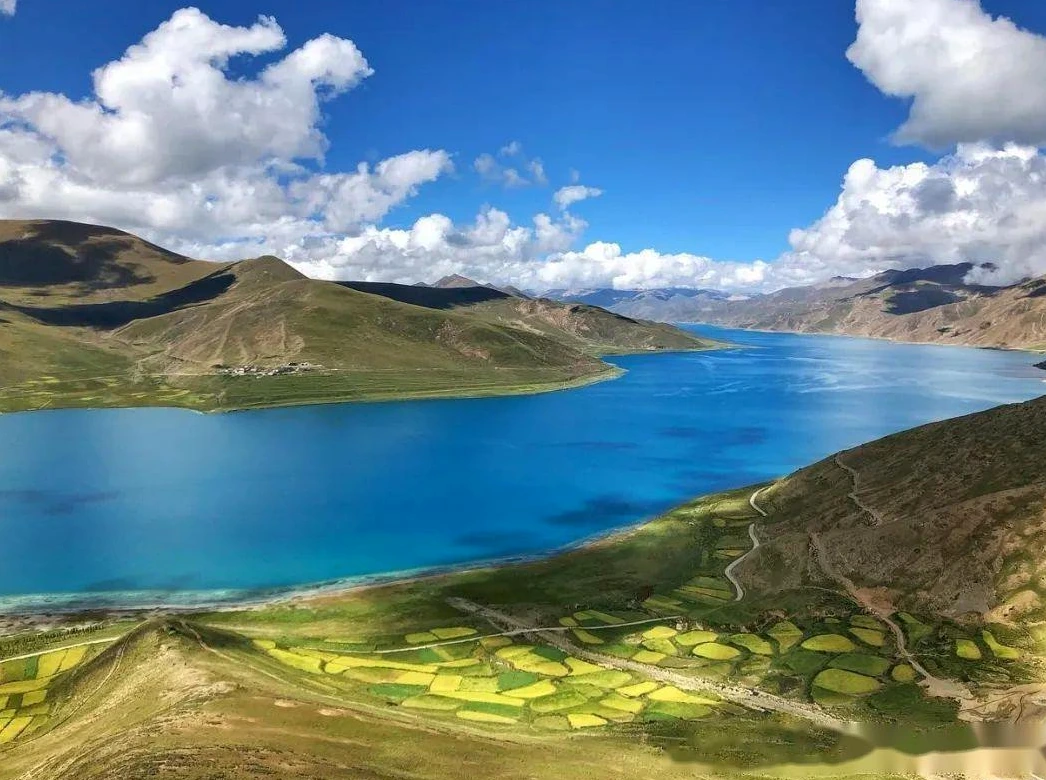
Beyond geomorphology, within the philosophy and cosmology of Tibetan Buddhism, Yamdrok’s setting and waters hold deep sacred meaning. It is revered as an abode of protective deities and counted among Tibet’s major “soul lakes” (“Lha-mtsho”). In local belief, Yamdrok’s calm, deep waters serve as a mirror of spiritual insight. Over centuries, lamas and high spiritual figures seeking a reincarnation (“yangsi”) have visited Yamdrok’s shores, reading reflections, ripples, and visions on the water as symbolic clues guiding their search.
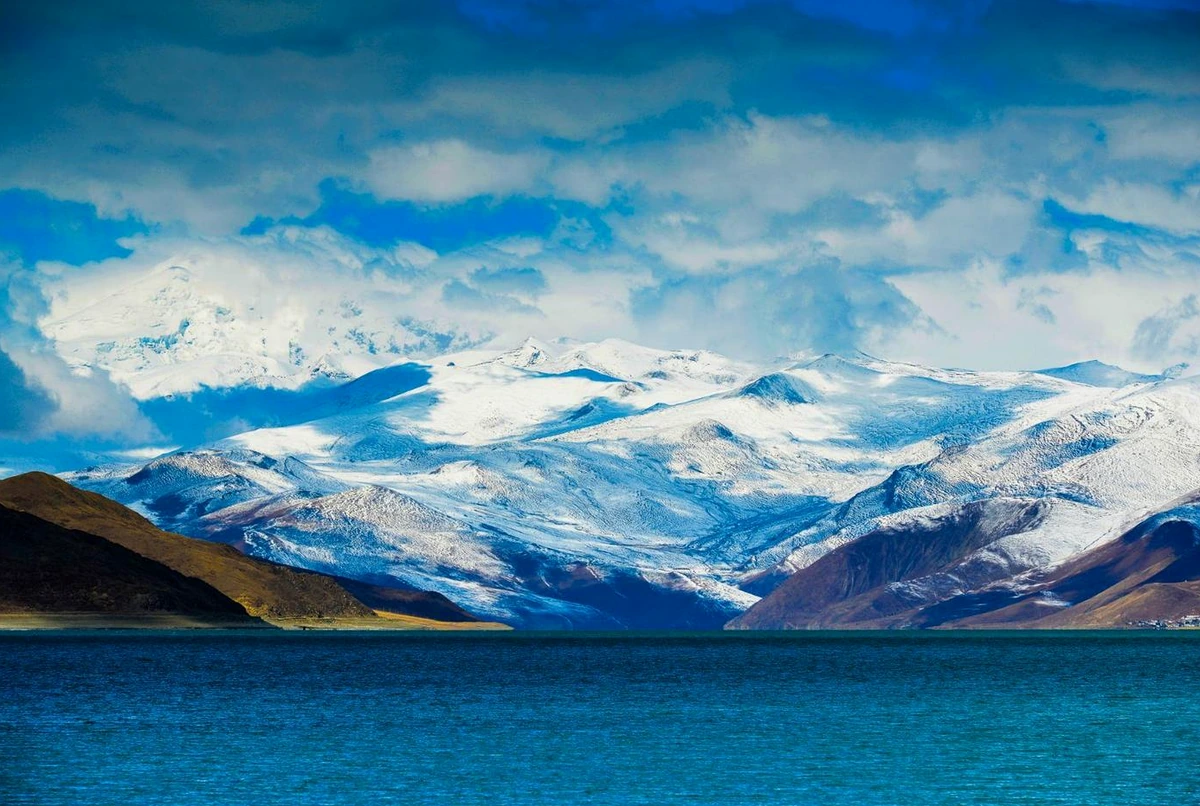
The union of high-altitude geology and deep faith makes Yamdrok an inseparable cultural landscape of the Tibetan Plateau. Surrounding snow peaks—notably towering Nojin Kangsang—feed glacial meltwater into the basin, sustaining ecological balance in this highland lake. Contrasts of snow white, stone gray, and turquoise water create a sweeping highland vista where every stretch of shore carries lore and quiet mountain presence.
Rising prominently on a rocky peninsula above Yamdrok Lake (羊卓雍措), Samding Monastery embodies traditional Tibetan architecture adapted to steep highland terrain. Seen from afar, the complex follows a terraced layout climbing natural slopes into a poised silhouette. Spaces are arranged in tiers reflecting Tibetan monastic hierarchy: lower levels hold assembly halls (“dukhang”) and monks’ quarters; middle levels house protector chapels; and upper chambers—catching sunlight and overlooking blue water—hold quarters associated with the Dorje Phagmo lineage in Tibet. Vertical arrangement makes efficient use of steep rock while creating a gradual ascent up the hillside.
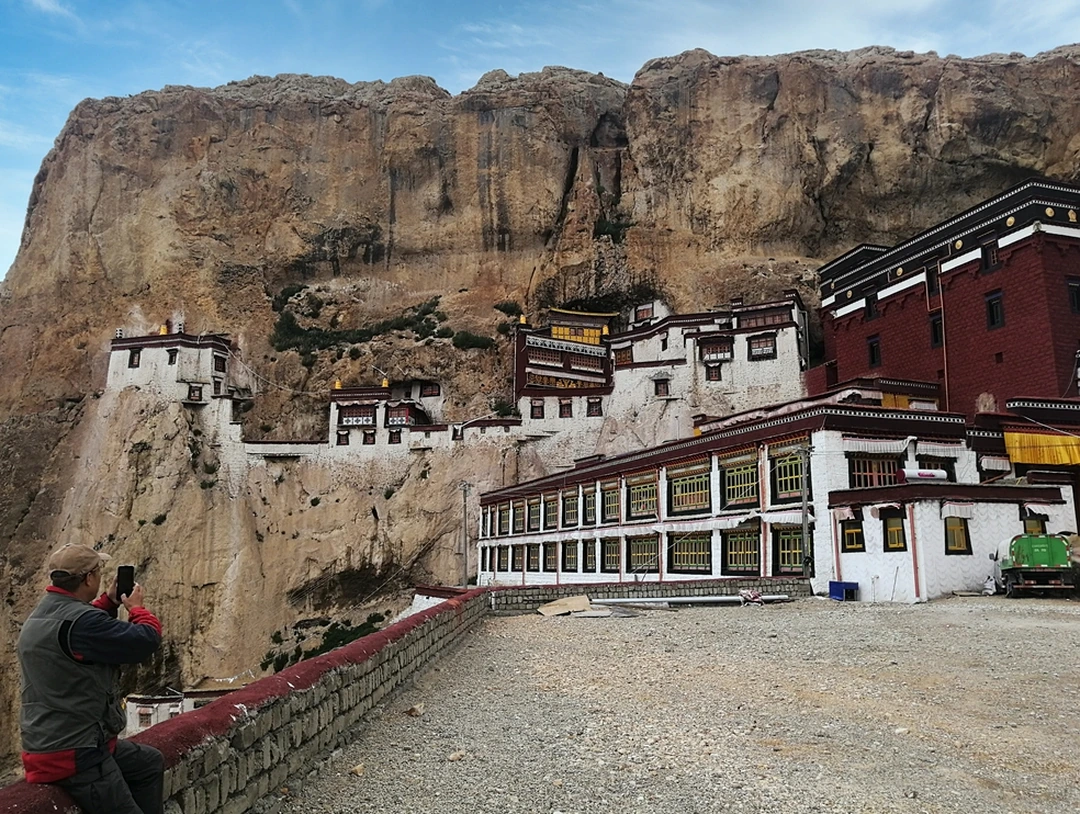
Key to Samding’s endurance above 4,400 meters over centuries is traditional Tibetan batter-wall construction (“shufen” / inward-tapering walls). Walls taper slightly inward as they rise, distributing weight cleanly while reaching 1.5 to 2 meters thick at the base like a sturdy bastion. Builders combined local materials—carefully dressed schist and granite on outer faces with compacted rammed earth and natural binders inside—giving structures durability against strong plateau winds and seismic shocks.
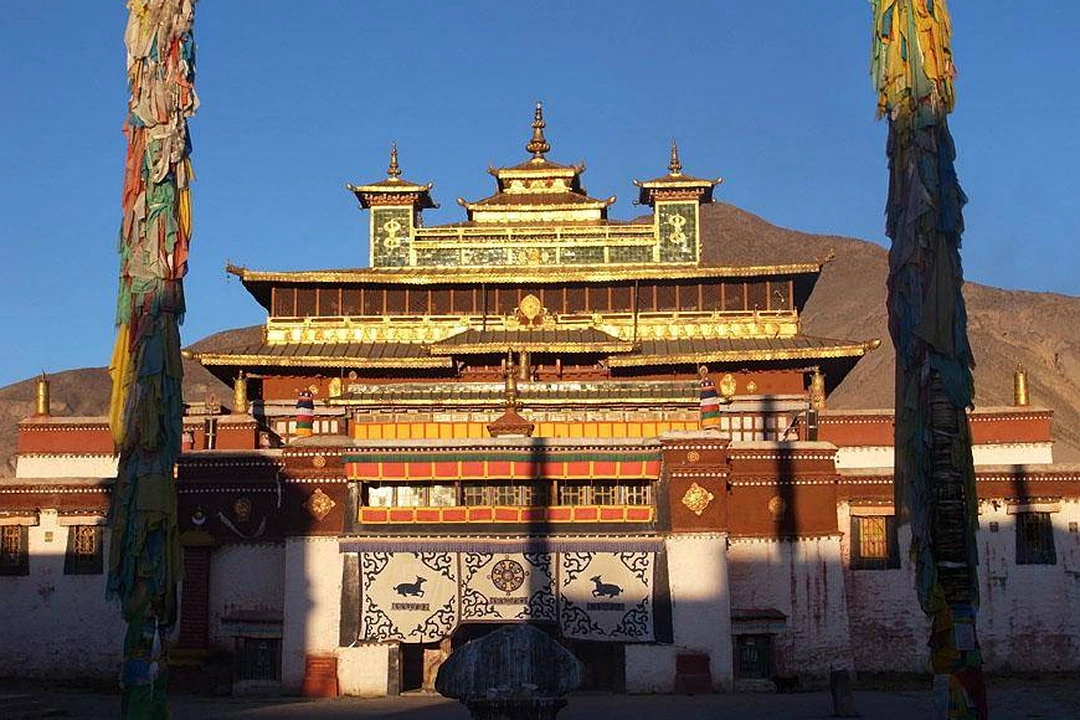
Passing through prayer-flag courtyards into the main assembly hall reveals refined interior craft. Load-bearing posts and crossbeams use Tibetan timber suited to dry highland air. Carved lotus capitals top pillars, while beams and ceilings carry mineral-pigment murals in blues, cinnabar reds, and golds. On the upper roof line, pitched eaves inspired by Han building forms meet gilded copper roofing typical of Tibetan sacred structures.
Under bright highland sun, gilded roof accents catch light above turquoise waters, giving Samding Monastery a clear architectural presence tied closely to the setting of Yamdrok Lake.
Unlike many commercial attractions after dark, evening life around Yamdrok Lake follows strict ecological conservation rules. National ecological redlines and carrying-capacity assessments prohibit high-output commercial lighting installations and sound-amplified spectacles around the core lake and lakeshore roads. This protects wildlife habitats and migration routes for species such as black-necked cranes, bar-headed geese, and Himalayan blue sheep while keeping light pollution low.
Minimal artificial lighting leaves Yamdrok’s night sky clear and unpolluted. Above 4,000 meters with crisp mountain air, the lake is a prized spot for stargazing and night-sky photography. After dark over snow peaks like Nojin Kangsang, stars shine brightly overhead and reflect across still water in deep highland quiet.
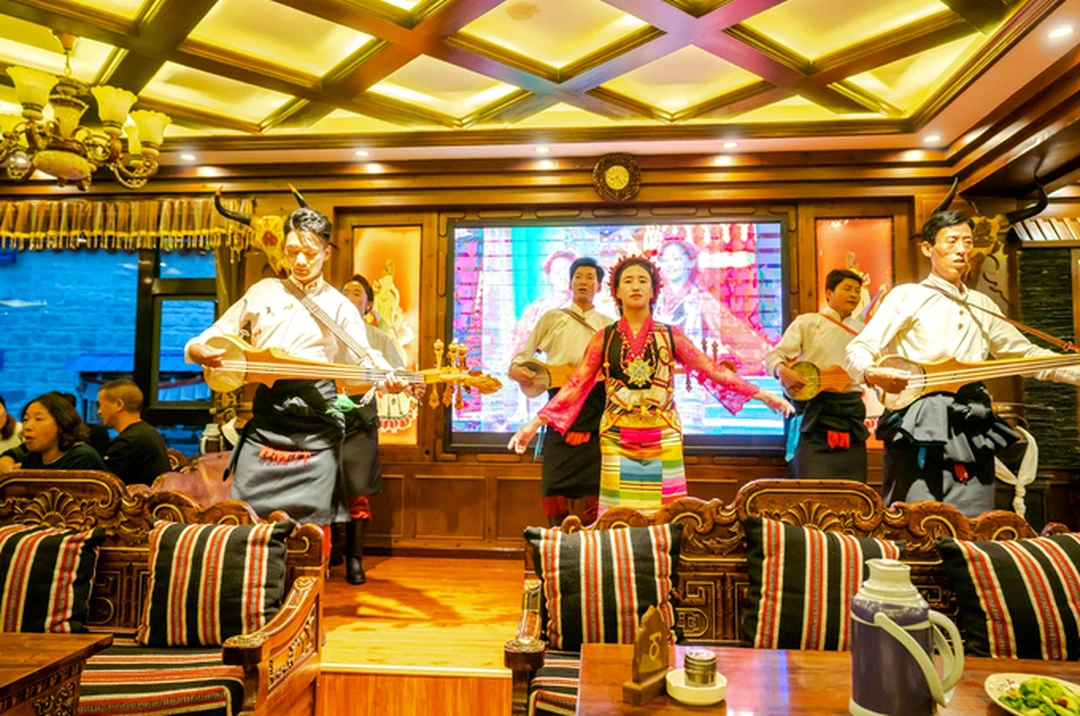
Instead of industrial stage shows, evening cultural life around Yamdrok focuses on understated local traditions with minimal environmental impact. Around Nagarze town and lakeshore villages, evening gatherings feature Tibetan circle dances (“guoxie”) and rhythmic foot-stomping dances (“duixie”) by warm fires. Unamplified Tibetan opera vocal singing and traditional yak-wool and sheep-wool weaving also keep local heritage alive.
Evening dining and gatherings around the lake feel unhurried and grounded in highland hospitality. Inside stone homes or teahouses, visitors sip hot butter tea, sample dried yak beef, and listen to elders share stories and legends tied to the lake and its protective spirits amid quiet mountain air.
Sitting between highland pastoral zones and fertile valleys, cuisine around Yamdrok Lake (羊卓雍措) reflects hardy highland living above 4,400 meters. Cold weather and thin air favor wholesome, energy-rich foods passed down through Nagarze households.
A notable local specialty is scaleless snow/highland carp (“Schizothoracinae” / naked carp) from cold waters. Slow-growing in icy mountain runoff, the fish yields firm, delicate flesh suited to light clear-broth stewing (“qingdun”) with mountain water, a pinch of salt, Tibetan white pepper, and wild scallion for a clean, warming broth after high-altitude travel.
Alongside fish, Nagarze Tibetan mutton is a staple highland dish. Sheep grazing on alpine pastures with wild herbs produce firm, flavorful meat with less gamey sharpness. Locals prepare it simply as boiled hand-held mutton (“shouzhua yangrou”) with salt and wild pepper or slow-simmered in a carved stone pot (“shiguo yangrou”) that holds steady warmth against chilly highland air.
Staples of highland food culture are tsampa and butter tea (“suyou cha” / “bod-ja”). Tsampa is roasted hulless barley (“qingke”) flour mixed with brick tea, yak milk, and yak butter churned smooth—providing steady energy in cold weather and offering a welcoming taste of Tibetan daily life in a Nagarze home or tent.
Visiting Yamdrok Lake (羊卓雍措) is generally most comfortable from May through October each year, when temperatures are milder, ice cover recedes, and water colors show vividly. Morning hours between 07:00 AM and 09:00 AM and late afternoon from 06:30 PM to 08:00 PM often offer soft light across water and distant snow peaks.
Located roughly 110 kilometers south of Lhasa—about a 2- to 2.5-hour drive—reaching Yamdrok involves crossing Gampa La pass at 4,990 meters above sea level. Winding switchbacks and steep grades call for a reliable 4WD vehicle and an experienced local driver familiar with high-pass weather and mountain roads.
For admission and permits, check-in points around the scenic lake area typically charge around 120 RMB per visitor at main viewpoints. In addition, itineraries heading deeper toward southern border areas of Tibet require arranging a Border Pass in advance through licensed operators so checkpoints pass smoothly.
Health and clothing preparation matter greatly at high altitude. With Gampa La pass sitting right near 5,000 meters, acute mountain sickness (AMS) is a real risk: pace movements slowly, avoid running or heavy lifting right after stepping out of the vehicle, and stay hydrated. Pack windproof outer layers, warm insulation, UV sunglasses, and high-SPF sunscreen for strong highland sun.
Respecting local spiritual customs is essential when visiting. Because Tibetans revere Yamdrok as a sacred lake, any circumambulation (“kora”) should follow a clockwise direction, and visitors must avoid wading, washing in the lake, leaving litter, or harming fish and aquatic life, which is strictly prohibited and deeply disrespectful to local belief.
Thoughtful preparation in clothing, pacing, and cultural respect helps make a trip to Yamdrok Lake smooth and memorable. For organized permits, transport, and high-altitude support, you can explore our 6-Day 5-Night Tibet Lhasa – Shigatse Tour to experience the highland scenery with confidence.