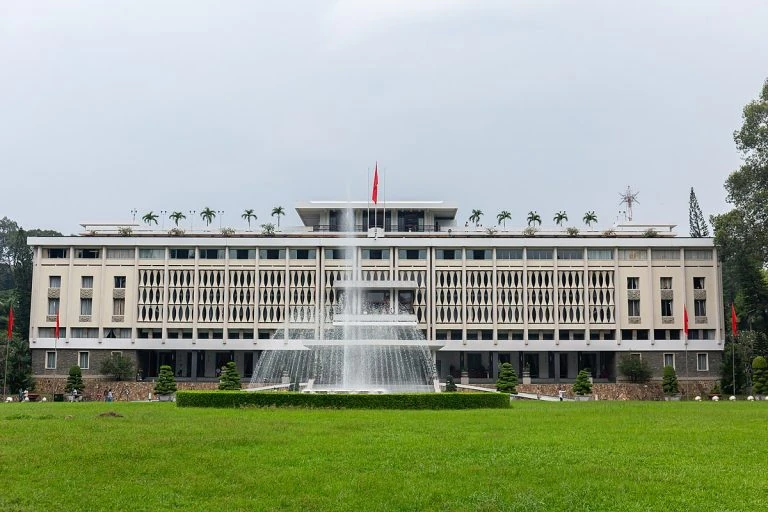
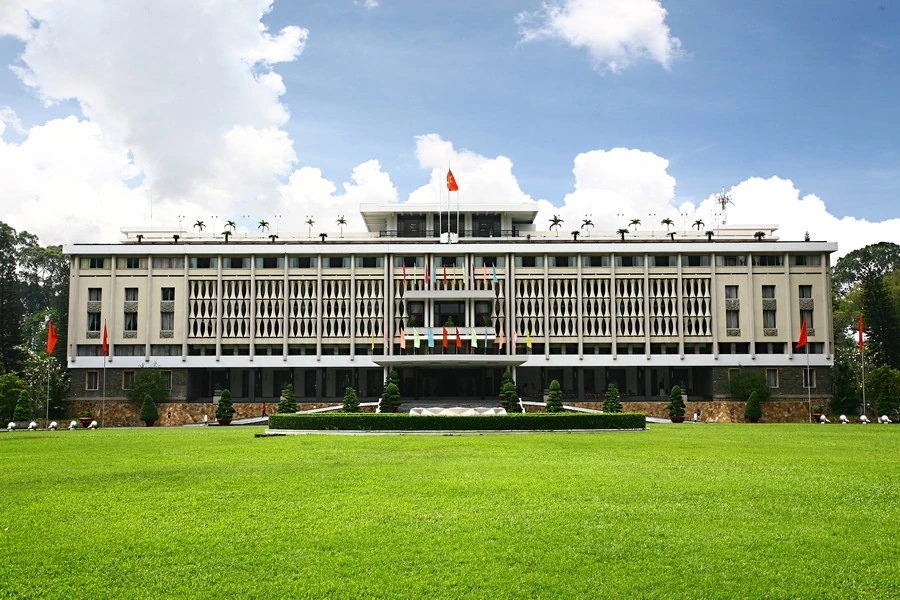
Located in the very heart of Ho Chi Minh City and nestled beneath the shade of towering heritage trees along Nam Ky Khoi Nghia Street, Independence Palace (now the Independence Palace – Reunification Hall Historical Relic) stands proudly as a monumental historical witness to 20th-century Vietnam. Beyond marking the sacred moment at noon on April 30, 1975, when the liberation flag fluttered atop its roof to herald the reunification of the country, Independence Palace is also a pinnacle of modernist architecture infused with Eastern philosophy by master architect Ngo Viet Thu.
1. The Masterful Architectural Imprint of Architect Ngo Viet Thu: Feng Shui Philosophy & Chinese Characters
Construction on the present-day Independence Palace began on July 1, 1962, and was inaugurated on October 31, 1966, on the former site of the French-colonial Norodom Palace. The design is the magnum opus of Architect Ngo Viet Thu—the first Vietnamese recipient of the prestigious Grand Prix de Rome.
What has earned the admiration of the international architectural community is how Ngo Viet Thu ingeniously wove auspicious Chinese character symbolism and Eastern philosophy into a modern reinforced-concrete structure:
- The Character CÁT (吉 – Auspiciousness): The overall floor plan of the Palace is shaped like the character Cát, symbolizing good fortune, luck, and prosperity for the nation.
- The Character KHẨU (口 – Mouth / Speech): The stately center of the building’s facade, formed by the ceremonial balcony and main entrance, creates the character Khẩu, championing freedom of speech and education.
- The Character TRUNG (中 – Center / Loyalty): The central flagpole rising from the roof, combined with the second-floor veranda, forms the character Trung, representing loyalty, integrity, and impartiality.
- The Character TAM (三 – Three): The horizontal lines of the tiered floors come together to form the character Tam, symbolizing the “Three Virtues”: Democracy, Rule of Law, and Order—or Benevolence, Wisdom, and Valor.
- The Character CHỦ (主 – Sovereignty / Master): When the character Tam is intersected by the central vertical axis, the entire structure rises into the character Chủ, affirming national independence and sovereignty.
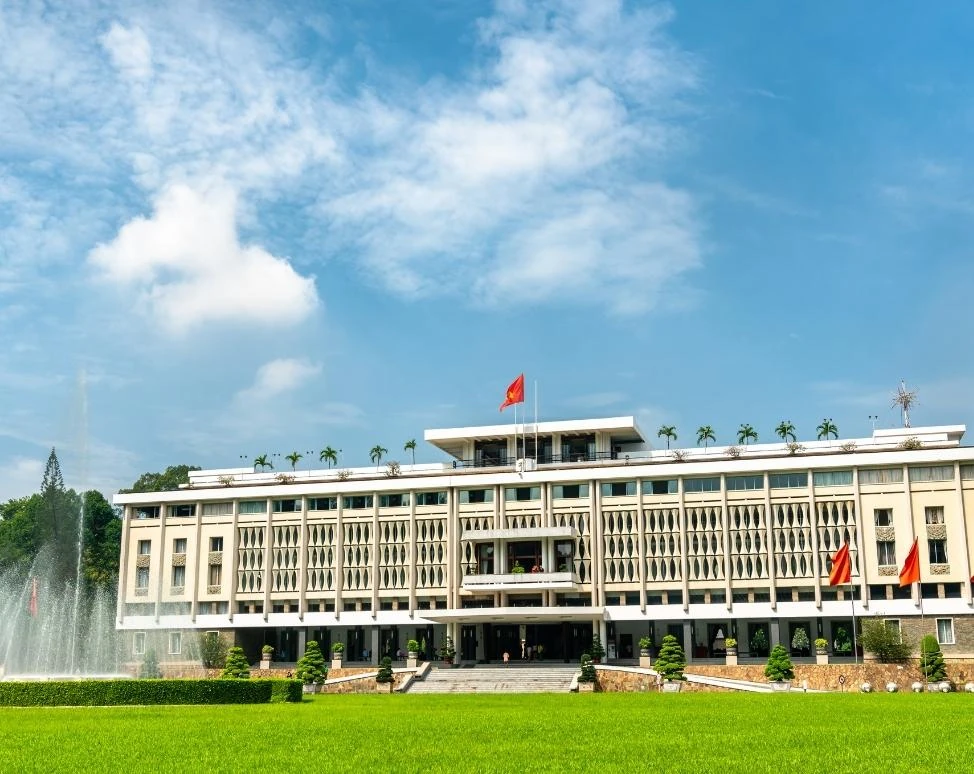
In addition to its calligraphic geometry, the second-floor veranda is adorned with precast concrete louvers sculpted to resemble slender bamboo joints (stone bamboo curtains). These elements both welcome cooling breezes and shield the interior from harsh tropical sunlight, while evoking the refined grace of a scholar-gentleman in traditional Vietnamese culture.
2. Exploring Over 100 Historic Rooms
Spanning a total floor area of 20,000 square meters, the Independence Palace building comprises three main floors, two mezzanines, a rooftop terrace, a ground floor, and two fortified basement levels, housing more than 100 rooms arranged for distinct official and residential functions:
- The Banquet Hall (Grand Hall): Used for state banquets and cabinet inaugurations with a capacity of several hundred guests, highlighted by an intricate tapestry depicting the scenic landscapes of Vietnam.
- The Cabinet Room & Credentials Presentation Room: Where heads of state and foreign ambassadors were received, paneled in precious hardwoods and furnished with finely handcrafted leather chairs. Dominating the main wall is the large-scale lacquer painting “Binh Ngo Dai Cao” (Proclamation of Victory over the Wu) by artist Nguyen Van Minh.
- The Presidential Family Quarters & Private Cinema: The daily living space of the President’s family, outfitted with the luxuries of the era, including a banquet room, a live music stage, and a modern private movie theater.
- Rooftop Terrace & Helipad: Home to a legendary UH-1 helicopter on display. Two red-painted circles on the rooftop deck still mark the exact impact points of bombs dropped by pilot Nguyen Thanh Trung on April 8, 1975—vivid testimony to pivotal moments in history.
3. The Fortified Underground Command Bunker System
One of the most captivating and mysterious highlights for visitors is the network of fortified bunkers buried deep beneath the Palace basement. Engineered to withstand heavy aerial bombs and artillery shelling, the complex is cast in thick reinforced concrete lined with radiation-shielding lead:
- Underground Military Operations Command Center: Housing massive tactical military maps, radar systems, and state-of-the-art radio communications equipment directly linked to the U.S. Embassy and tactical zones across the country.
- The President’s Backup Bedroom & Office: Fully equipped with toxic-gas filtration ventilation systems and secret escape tunnels leading out to major thoroughfares beyond the Palace grounds.
4. National Treasures: Tanks 390 & 843 from Noon on April 30, 1975
Out on the lush, tree-shaded front lawn of the Palace grounds, visitors can see up close two legendary tanks officially recognized by the Prime Minister as National Treasures:
- T-54B Tank No. 843: The tank that rammed the side gate of Independence Palace at 10:45 AM on April 30, 1975. Company Commander Bui Quang Than leaped from the vehicle carrying the flag of the National Liberation Front of South Vietnam and sprinted straight to the Palace rooftop to raise it.
- Type 59 Tank No. 390: Commanded by First Lieutenant Vu Dang Toan, this tank forcefully crashed through the heavy wrought-iron main gate of Independence Palace and rolled straight into the front courtyard, marking the complete and historic victory of the Ho Chi Minh Campaign.
5. Visitor Guide & Practical Tips
- Opening Hours: Independence Palace is open daily to visitors from 8:00 AM to 4:30 PM (including Saturdays, Sundays, and public holidays).
- Tickets & Audio Guides: Visitors are encouraged to rent a multilingual Audio Guide at the ticket counter to hear detailed, engaging historical stories behind every artifact and room.
- Dress Code & Etiquette: As a Special National Historical Relic, guests should dress respectfully, refrain from touching roped-off exhibits, and maintain quiet decorum throughout the grounds.
6. Special Historical Heritage Value & The “From Norodom Palace to Independence Palace” Exhibition
Alongside the grand main building, the Independence Palace grounds feature a premier thematic exhibition hall housed in a French-colonial villa at 108 Nguyen Du Street. The permanent exhibition, titled “From Norodom Palace to Independence Palace 1868 – 1966,” is a monumental historical showcase curated to modern international museological standards.
Stepping inside, visitors are guided through nearly a century of turbulent history in the Saigon – Gia Dinh region via hundreds of rare archival photographs, original artifacts, declassified maps, and vivid documentary footage. The exhibition chronicles every milestone—from the moment Governor of Cochinchina De La Grandière laid the cornerstone for Norodom Palace in 1868, the 1945 coup, and the 1954 Geneva Accords that divided the country, to the 1962 bombing that destroyed the left wing and prompted Ngo Dinh Diem’s administration to demolish the structure and build anew, culminating in the historic days of April 1975 that ended the protracted struggle and reunified the nation.
7. The Art of Vietnamese Materials & Traditional Handicrafts
Another remarkable hallmark of Architect Ngo Viet Thu’s brilliance is his seamless fusion of Western modern construction techniques with the masterful skill of traditional Vietnamese artisans, turning every interior detail of the Palace into a work of fine art:
- Traditional Lacquerware Art: The magnificent large-scale lacquer painting “Binh Ngo Dai Cao” in the Credentials Presentation Room, crafted with meticulous eggshell inlay, gold leaf, and silver leaf, captures the indomitable spirit of the 15th-century Lam Son uprising against the Ming invaders.
- Historical Oil Painting: The monumental oil painting “Son Ha Cam Tu” (Magnificent Mountains and Rivers) in the Banquet Hall, sketched and overseen by Architect Ngo Viet Thu himself, portrays the unbroken tapestry of beauty stretching across Northern, Central, and Southern Vietnam.
- Precious Domestic Hardwoods & Granite: Every table, chair, ceremonial cabinet, and wall panel is crafted from rare tropical hardwoods native to Vietnam’s forests, including Afzelia (go do), rosewood (cam lai), ebony (mun sung), and padauk (huong da). The floors and grand staircases are paved with natural granite quarried in Central Vietnam, lending an air of timeless luxury, luster, and enduring strength.
8. Ecological Landscape: A Green Lung in the Heart of a Bustling Metropolis
Independence Palace sits within a vast 12-hectare park-like estate designed as a miniature botanical garden right in the center of vibrant District 1. The gardens surrounding the Palace are home to thousands of prized heritage trees between 100 and 150 years old, including towering black star trees (sao den), ancient oil trees (dau rai), sprawling rain trees, and lush lawns of meticulously manicured Japanese velvet grass.
Amid the tropical heat of Southern Vietnam, stepping through the gates of Independence Palace immediately greets visitors with a wave of cool, fresh air and birdsong echoing from the high canopies. In front of the facade, a crescent-shaped pond with a blooming lotus fountain not only creates a serene, tranquil vista, but also functions as a natural air-conditioning system rooted in tropical microclimatic architecture.
9. Connecting Downtown Saigon’s Cultural Heritage Trail
Thanks to its prime location in the urban core, a visit to Independence Palace can easily be paired with nearby landmarks for a complete half-day walking tour of Saigon’s cultural and architectural heritage:
- Independence Palace (1 – 2 hours): Tour all the historic floors, explore the underground command bunkers, and see National Treasure Tanks 390 and 843.
- Notre Dame Cathedral & Central Post Office (300m away): Stroll along April 30th Park to admire the Gothic-Romanesque red Marseille-brick architecture of Notre Dame Cathedral and the soaring vaulted ceiling of the Central Post Office, designed with contributions from Gustave Eiffel.
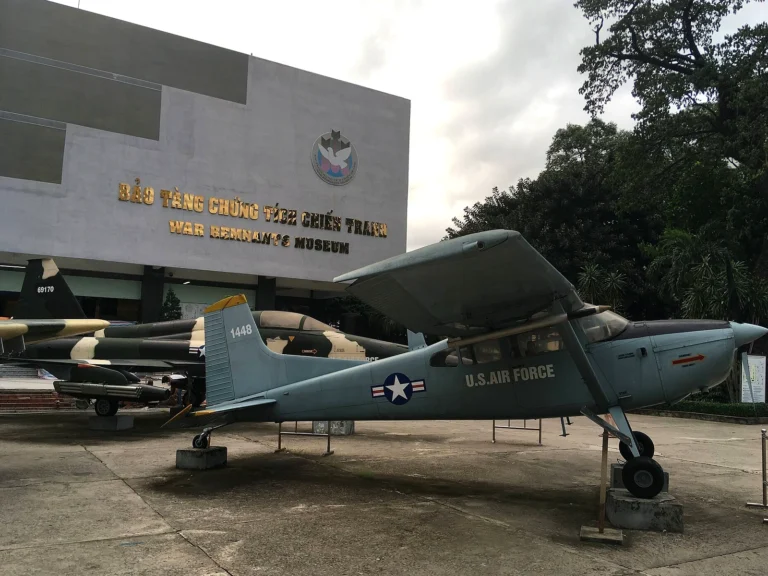
- War Remnants Museum (500m away): Walk over to Vo Van Tan Street for a deeper look at poignant historical documents and artifacts from Vietnam’s war for national liberation.
- Turtle Lake & Nguyen Hue Walking Street: Pause for traditional Saigon sidewalk coffee (ca phe bet) under the shade of leafy trees, or take an evening stroll to soak in the modern, energetic pulse of Vietnam’s southern metropolis.