In the rolling currents of Bangkok’s history, the Pratunam district—home to the Platinum Fashion Mall (白金时尚购物中心)—is not merely a commercial coordinate, but a living witness to the transformation from a vital waterway transport node into Southeast Asia’s busiest fashion hub. To understand the rise of this fashion “empire,” we must travel back in time to the reign of King Rama V (Chulalongkorn), the monarch who laid the foundation for the modernization of the Kingdom of Siam. At that time, Pratunam, local locals called “Thuy Mon” (Water Gate), served as the most important trade gateway connecting suburban areas with the royal center via the Saen Saep canal. Boats laden with agricultural produce, fabrics, and spices from neighboring provinces turned this into a bustling port, where the breath of early market economics began forming from wooden houses built right against the water’s edge.
Under Rama V’s reign, the excavation of the Saen Saep canal served not only irrigation purposes but also acted as a strategic waterway navigation artery, laying the groundwork for traditional markets to emerge. Small merchants of that era, primarily of Chinese descent, seized this prime location to erect temporary stalls, creating a spontaneous yet remarkably resilient trading ecosystem. Over decades, though Bangkok’s landscape altered drastically under urbanization’s impact, the “market” spirit of the Water Gate never vanished; it merely transitioned from wooden shacks along the canal into dense rows of kiosks within narrow alleys, where Thai silks and handcrafted garments began shaping Pratunam’s renown.
The true historical turning point arrived in 2005, when the Platinum Group decided to mark the end of the old-market era with a bold vision. Inaugurating the Platinum Fashion Mall was not simply a real estate project, but a revolution in fashion logistics thinking. With ambitions to make Pratunam the “heart” of the regional apparel industry, the group re-planned the entire space, integrating thousands of small merchants from traditional markets into a modern building where the scorching heat of alleys was replaced by central air conditioning, and cargo boats were replaced by multi-modal transport systems. This center’s birth marked the end of the “stalls on streets” era and opened an era of professional wholesale shopping malls where young designers and family tailoring workshops gained access to international markets.
Reviewing historical fluctuations, this district witnessed the rise and fall of generations of small merchants. Families attached to Pratunam since the canal era remained primary transportation routes have now become major business owners, managing fashion supply chains spanning the region. The name “Platinum” carries not only luxury connotations but also symbolizes the resilience of commercial values tempered through time. From rickety wooden houses by the Saen Saep canal to massive steel and glass structures today, the Platinum Fashion Mall crystallizes historical evolution where memories of ancient Bangkok quietly flow beneath the shell of a modern fashion logistics hub, continuing the chronicle of prosperity for the legendary Water Gate land.
Situated at the arterial intersection of Ratchathewi district, the Platinum Fashion Mall is not merely a shopping center, but an architectural entity shaped by Eastern feng shui principles blended with modern urban planning thinking. Viewed from human geography, this location is considered Bangkok’s premier auspicious “energy gathering point.” According to traditional feng shui concepts, “water manages wealth,” and Platinum fully leverages the flow of the Saen Saep canal—a canal dating back to King Rama III, dredged for military and trade purposes during the Siamese-Vietnamese wars of the 1830s. Positioning the architectural axis parallel to the canal is not just an engineering solution optimizing airflow circulation, but a subtle continuation of the “water embracing” terrain where winding waters cradle the structure, generating prosperous energy fields ensuring financial wealth flows unceasingly.

Regarding topographical planning, Platinum Fashion Mall is designed as a multi-tiered architectural block with total floor space exceeding 100,000 square meters, partitioned into functional zones based on the “layered” principles of traditional Thai markets. Architects cleverly transformed traditional wholesale market models—typically outdoors and vulnerable to tropical weather—into a controlled indoor climate space under strict temperature regulation. Engineering processes here are optimized to serve tens of thousands of daily visitors: escalators and elevators follow herringbone layouts allowing customer access to every stall without bottlenecks. Combining high-strength load-bearing steel frames with reflective glass cladding helps the structure stand firm amid bustling urban life while creating a “giant glass cage” visual effect maximizing natural daylight to highlight the vibrant colors of tens of thousands of fashion samples inside.
Platinum’s signature landscape lies not only in its massive exterior but also in interior spatial organization. Each floor is planned as an independent economic “cell” where walkways are meticulously calculated to generate maximum interaction between buyers and sellers. The architectural highlight rests on connections between the building and elevated pedestrian skywalks, forming an integrated transport system linking Platinum with neighboring malls like CentralWorld or Siam Paragon. This strategic urban planning move turns the district into a miniature “fashion city” blurring boundaries between public and commercial spaces. The presence of the Saen Saep canal right alongside, carrying long-tail boats back and forth, creates an intriguing contrast between bustling modern urban life inside and nostalgic old Bangkok charm.
Regarding infrastructural engineering, ventilation and fire safety systems at Platinum are designed to rigorous international standards, ensuring safety for thousands of small merchants operating warehouses right on-site. Arranging compact warehouses directly behind each stall is a planning specialty shortening logistics workflows, turning traditional wholesale market advantages into a modern fashion distribution center. Combining “water gathering” feng shui thinking with advanced construction engineering transforms Platinum Fashion Mall into a symbol of prosperity where historical currents and global commercial pulses merge, creating an irreplaceable landmark on Bangkok’s cultural and economic map.
In the heart of Bangkok, where traffic streams flow ceaselessly along Phetchaburi Avenue, the Platinum Fashion Mall looms as a powerful architectural entity redefining modern commercial space. While traditional markets like Chatuchak or Sampeng stretch horizontally, claiming vast open spaces, Platinum adopts an entirely different existence philosophy: the philosophy of vertical ascent. This structure exemplifies the “Vertical Market” model, a bold architectural solution adopted by Thai urban planners to resolve scarce and expensive downtown land constraints in the modernization era.
With total floor space exceeding 100,000 square meters, Platinum Fashion Mall is not merely a building, but a commercial ecosystem compressed into a massive architectural block. To realize this vision, engineers utilized steel frames combined with high-strength reinforced concrete, creating a sturdy skeleton capable of bearing the weight of thousands of merchants and massive cargo volumes circulating daily. The building facade combines large-format tempered glass panels and modern metal composite sheets. This cladding provides a sleek, luxurious exterior reflecting the Land of Smiles’ brilliant sunlight while acting as a thermal filter maintaining cool indoor environments amid Bangkok’s sultry heat and optimizing natural daylight for shopping corridors.

Stepping inside, visitors easily grow overwhelmed by spatial structures calculated meticulously down to centimeters. Floors are distributed under strict operational logic where every square meter maximizes display and commerce purposes. Walkways follow grid designs connecting small retail stalls into intricate yet scientific networks, allowing thousands of merchants to coexist and thrive within shared spaces. Spatial crafting art here relies not on elaborate decorations but functional minimalism. Every element from escalators, freight elevators to transfer zones is arranged so shopper and cargo flows avoid bottlenecks, operating smoothly like a giant machine.
Platinum Fashion Mall’s success lies in adapting to indigenous consumer culture. Although resembling international malls, its soul remains thoroughly traditional Thai market. Small stalls where merchants showcase fashion products from local workshops and trendsetting designs sit closely together, generating vibrant, intimate atmospheres. Here, space management art meets Bangkok residents’ persistent entrepreneurial spirit. Integrating food courts serving heirloom dishes like Pad Thai or Som Tam inside the building is also a strategic move retaining customers exploring this diverse shopping space.
From a cultural-historical perspective, Platinum Fashion Mall is not purely architectural, but mirrors Bangkok’s transition from an outdoor market city into a premier regional wholesale fashion hub. It reflects pragmatic yet creative Thai thinking facing urbanization pressures. Every floor and corridor tells stories of endeavor, of conquering space to generate economic value. With sustainable structures and impressive scale, this work affirms its status as the “heart” of the wholesale fashion industry where architecture houses goods and launches business dreams for thousands across Thailand.
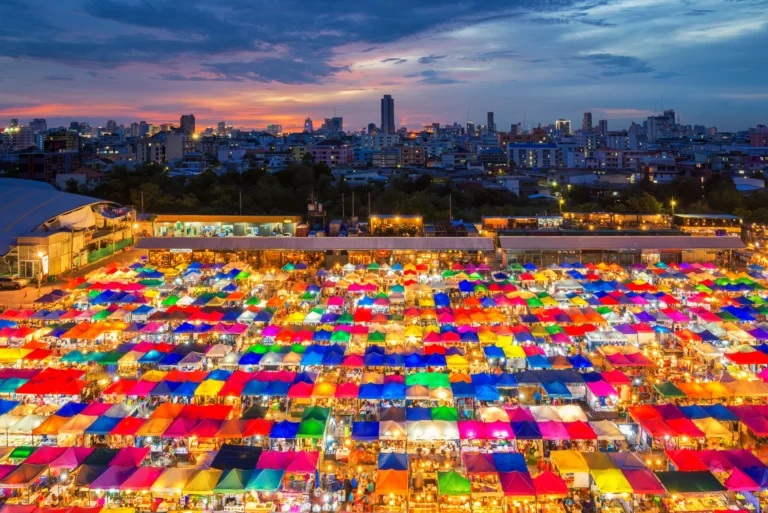
When dusk falls across Bangkok’s sky, yielding to deep purple tropical night shades, Platinum Fashion Mall transforms beyond an office-hour closing mall into a living entity, a lighting “lighthouse” in Ratchathewi district. Modern LED lighting blanketing the building facade serves decoration and acts as contemporary visual art, where light ribbons trace architectural structures, creating brilliant commercial spectra reflecting Thai fashion economic prosperity. Building light blends subtly with glowing neon signs of neighboring Pratunam night market, crafting multi-layered urban portraits where past and present, luxury and folk charm interweave spontaneously.
Emerging from the building’s air-conditioned interior, visitors plunge into “The Platinum Street Market,” an open space showcasing Bangkok’s nightlife fully. This doubles as a shopping venue and outdoor live stage where every step joins street cultural currents. Mobile stalls and food carts emitting fragrant aromas of Pad Thai, Som Tam, or smoking Moo Ping skewers generate characteristic flavor blends. Visitors seek wholesale fashion items and taste Bangkok’s nocturnal “soul”—a mix of merchants rushing to pack wholesale orders for Southeast Asia and travelers sipping Thai milk tea amid neon glow.

Lighting art here is designed to guide emotions. Neon ribbons along alleys and warm golden stall lights contrast artistically with Platinum’s cold, modern white light. This cross-fusion stems from exquisite urban planning where city officials and investors preserved traditional night market culture—dating back to Bangkok’s canal network era—alongside reinforced concrete architecture. This contrast turns surrounding Platinum into a living “museum” of urban life where street corners recount transformation tales of a sleepless city.
Dining experiences here are unmissable. Post-shopping strolls allow stops at tidy sidewalk eateries where local chefs preserve ancestral recipes. Dishes like fragrant spicy Tom Yum Goong or sweet mango sticky rice taste exceptional amid bustling atmospheres under glowing night markets. This connects people and spaces, modern lighting art and enduring culinary values. Platinum Fashion Mall’s nightlife avoids chaotic noise, embodying a resonant beauty where individuals find corners to contemplate a modern yet traditional Bangkok.
Late at night, when LED lighting shifts to energy-saving modes, the district retains fierce appeal. Merchants pack goods while small trucks transport cargo across provinces, creating tireless labor rhythms. That is Platinum Fashion Mall’s true pulse—elevating wholesale markets into cultural destinations where architecture and art merge into immersive experiences.
If Platinum Fashion Mall is Bangkok’s fashion heart, surrounding culinary zones act as lifeblood nourishing travelers and merchants. Food transcends mere taste satisfaction, serving as a “living fossil” preserving immigrant cultural fragments from the early 20th century. When Hainanese wave settlers arrived in Bangkok, they brought textile bolts, trading skills, and heirloom culinary heritages where ingredient refinement met elaborate cooking techniques, creating unique flavor maps in the Thai capital.
The primary touchpoint and constant symbol is Hainanese Chicken Rice, or Khao Man Gai. Amidst Pratunam’s bustling currents, Kuang Heng emerges as a historical witness where each chicken rice plate is a perseverance lesson. Chicken preparation balances traditional Chinese boiling methods with understanding Thai soils. Selected chickens boil in clear ginger-pandan broths keeping skin plump and glossy while meat remains moist and tender. Kuang Heng’s fame rests on fermented soybean sauces blended via heirloom formulas balancing salty, spicy fresh chili, and crushed ginger freshness. This evidences Chinese-Thai cultural integration where native ingredients are elevated by immigrant techniques, preserving originality across decades.
Culinary experiences around Platinum extend beyond old eateries into enchanting street food journeys. At sunset, food carts emit fragrant spice aromas from herbal chicken soups to Pad Thai cooked on large iron woks. Dishes carry intersection tales: chewy white rice noodles stir-fried with fresh shrimp, eggs, bean sprouts, tofu, and crushed roasted peanuts, creating signature Land of Smiles sour, spicy, salty, sweet profiles. Experiential culture rests on simple plastic stools where diners sit closely, sharing hot soups while observing bustling crowds—connecting past and present.
Traditional desserts like mango sticky rice or Thai sweet soups anchor Bangkok street cuisine. Sweet ripe mangoes paired with rich coconut milk and sticky glutinous rice create perfect finales. Second and third-generation immigrant vendors rise early to prep ingredients—selecting ripe mangoes and simmering coconut milk to silky perfection. Dedication preserves heirloom values in changing worlds. At Platinum Fashion Mall, visitors secure trendy attire and immerse in profound culinary cultures narrating immigrant assimilation and identity.
To conquer the Platinum Fashion Mall “sanctuary” smoothly, mastering operational rules is prerequisite. The mall opens at 9:00 AM and closes trade at 8:00 PM. Expert “shoppers” advise golden hours for browsing latest designs without crowds from 10:00 AM to 2:00 PM. Stalls complete restocks, offering airy spaces to access unique designs hidden during peak hours.
Regarding transit, Bangkok’s chronic traffic jams make BTS Skytrain optimal over taxis or tuk-tuks. Alight at Chit Lom station, strolling skywalks straight to the center. Walking avoids street chaos and offers urban views where skyscrapers mirror Saen Saep canals—historical testaments of early Rattanakosin waterways.
Inside, the “top-down” strategy optimizes energy. Skip ground-floor crowds by taking escalators to top floors and walking downward. This provides panoramic zone layouts—men’s, women’s, accessories, designer wear—preventing leg fatigue. Platinum is a wholesale paradise; partner with friends to buy 3+ items per style for attractive wholesale discounts compared to retail pricing.
Crucial tips involve tax refunds. Always carry passports. At stores displaying “VAT Refund for Tourists,” request tax forms during payment. Preparing ID accelerates processing and secures refunds at airports before leaving Thailand. In crowded spaces, safeguard personal assets: wear backpacks in front and secure wallets and phones.
Post-shopping, recharge at 6th-floor food courts offering Pad Thai, Tom Yum, or mango sticky rice cooked via heirloom recipes spanning decades. For deeper exploration combining culture and modernity, consult the Bangkok – Pattaya 5D4N tour for upscale services and expert local guidance.