The Pearl River Estuary (珠江口) has long served as a vital maritime artery, connecting the prosperous trading ports of Southern China to the open ocean and witnessing the ebb and flow of maritime history and coastal defense. By the late 20th century, as the wave of reform and opening-up transformed the eastern and western shores of Lingding Bay into one of the most vibrant economic hubs, the concept of a direct trans-sea transport link connecting Shenzhen and Zhongshan began to take shape in the 1980s. The strategic project known as the Shenzhen-Zhongshan Link (深中通道), a key segment of the G2518 Shenzhen-Cenxi National Expressway (深岑高速), is not merely a sea-crossing structure but a project with a historic mission: to close the loop of connectivity, break through natural barriers, and reshape the entire development landscape of the Guangdong-Hong Kong-Macao Greater Bay Area.
From 2008 to 2015, the project entered a period of intense technical debate, one of the most significant in the history of modern infrastructure construction. Experts were deeply divided between two schools of thought: the “All-bridge” approach, with its clear economic advantages and rapid construction schedule, versus the “Bridge-Island-Tunnel complex” approach. Faced with the critical requirement of ensuring absolute maritime safety for the Lingding Channel (伶仃航道)—a busy route for super-container ships weighing hundreds of thousands of tons entering the Port of Guangzhou—the Shenzhen Maritime Safety Administration and port authorities firmly advocated for an immersed tunnel solution to keep the water surface completely unobstructed. This historic decision paved the way for a technological revolution, accepting the challenge of underwater construction at unprecedented depths and scales.
Under the leadership of brilliant minds, the grand project gradually took shape from complex technical drawings. Chief Engineer and Project Manager Song Shengyou (宋神友), an alternate academician of the Chinese Academy of Engineering, along with Tunnel Design Director Chen Yue (陈越) and their team, inherited and significantly improved upon the technology used for the Hong Kong-Zhuhai-Macao Bridge. They directly commanded the campaign to conquer the sea, pioneering the use of a steel-shell and self-compacting concrete composite structure at a depth of 40 meters below the seabed. On December 21, 2016, the first giant steel pipe piles for the West Artificial Island were driven into the seabed, officially marking the start of full-scale construction on December 28, 2016. After milestones such as the assembly of tunnel segments in April 2018, the final closure of the immersed tunnel in June 2023, the completion of the main Shenzhen-Zhongshan bridge structure on November 28, 2023, and passing the national technical inspection on June 16, 2024, the route officially opened for commercial traffic at 15:00 on June 30, 2024, to the admiration of the international community.
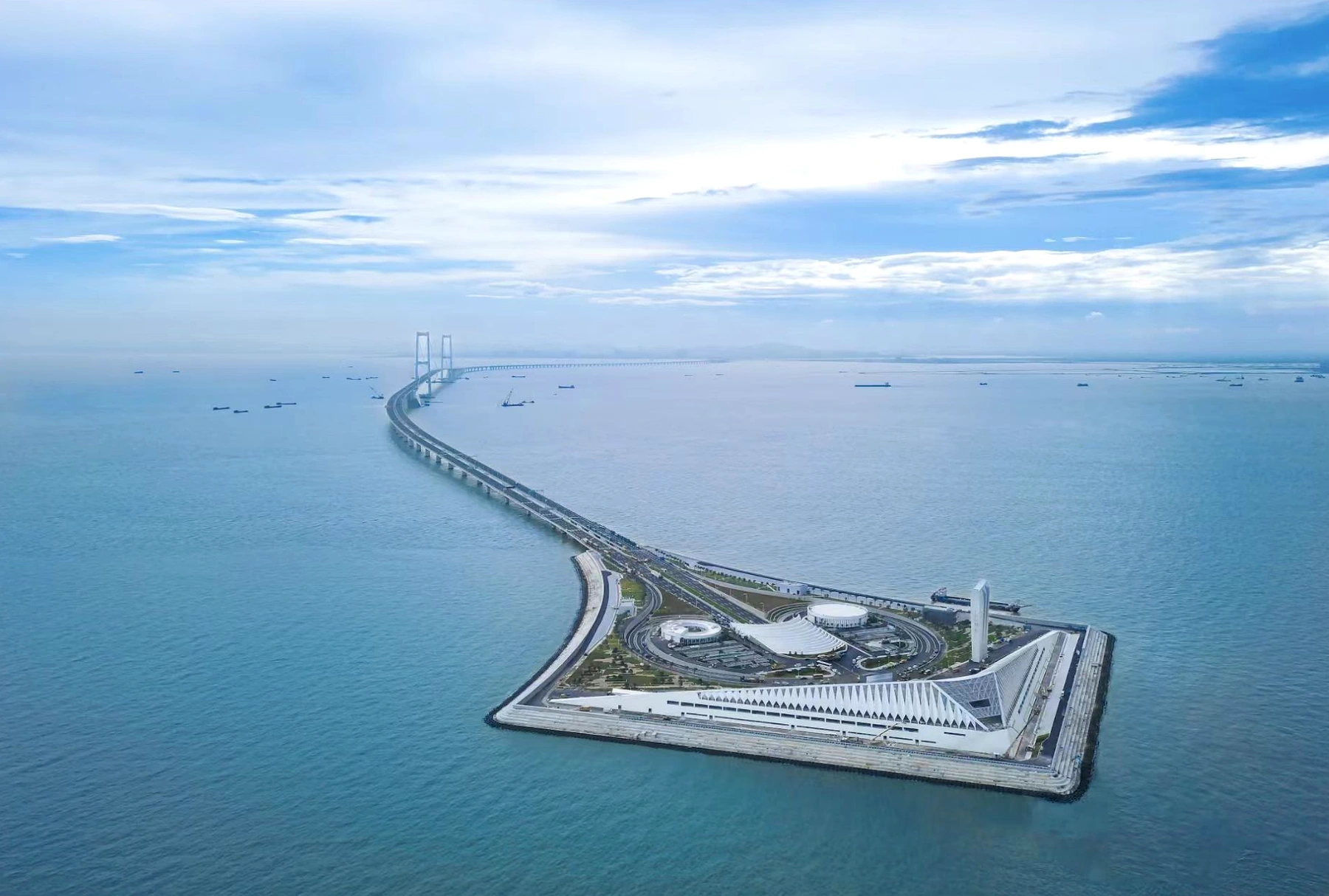
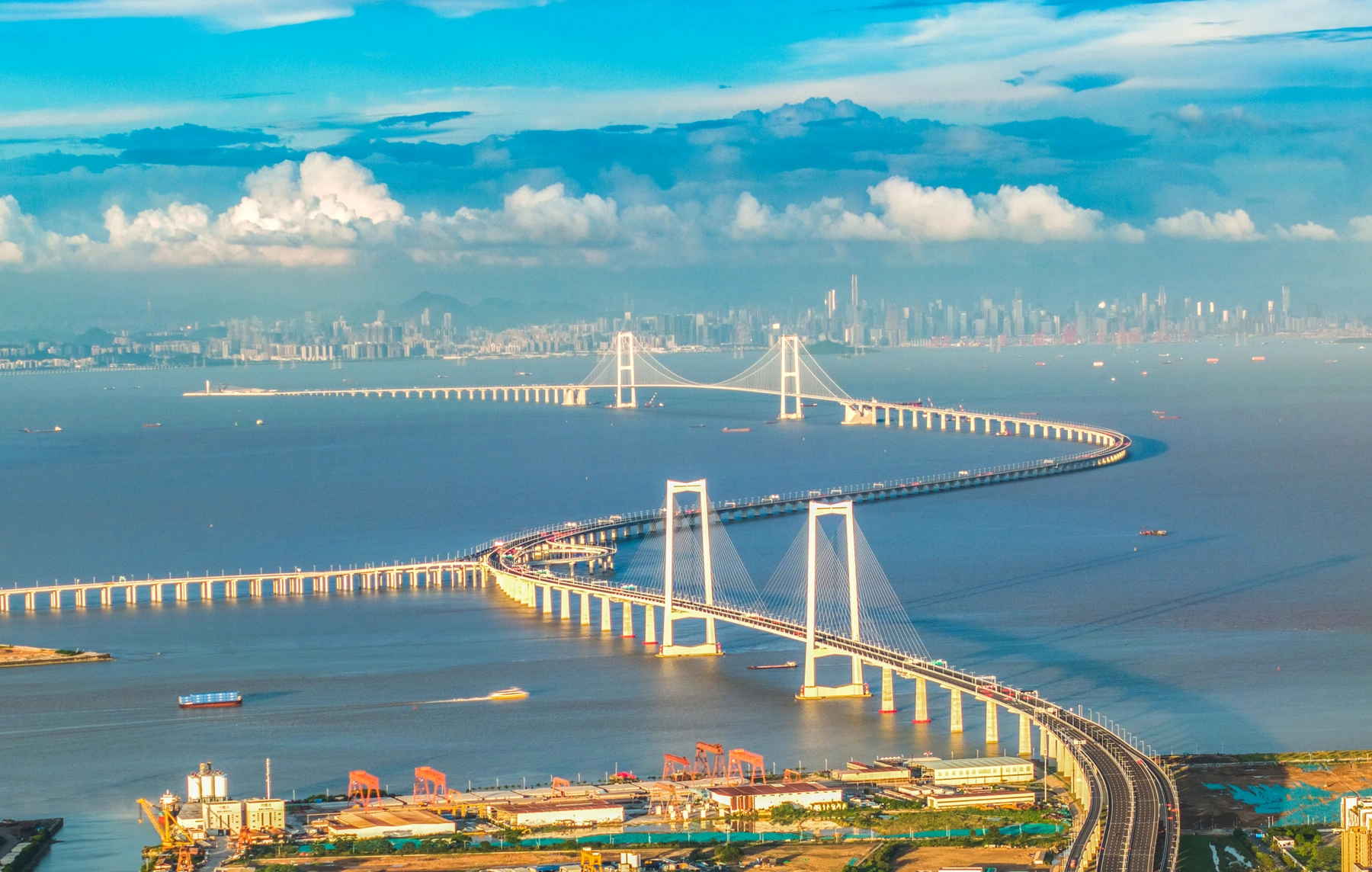
From an aerial perspective, the entire project appears magnificent, with a sea-crossing bridge winding gracefully out to sea, where the bridge deck gradually fades into the mist covering Lingding Bay. In the foreground, the bridge descends onto a massive artificial island shaped like a sharp triangle, resembling a giant battleship cutting through the waves. On the solid concrete island, modern architectural structures with exquisite curved lines stand out alongside a clear traffic distribution system and lush green landscapes. The surrounding sea is calm, dotted with cargo ships moving leisurely, painting a magnificent scene where human achievement harmonizes with the vast ocean.
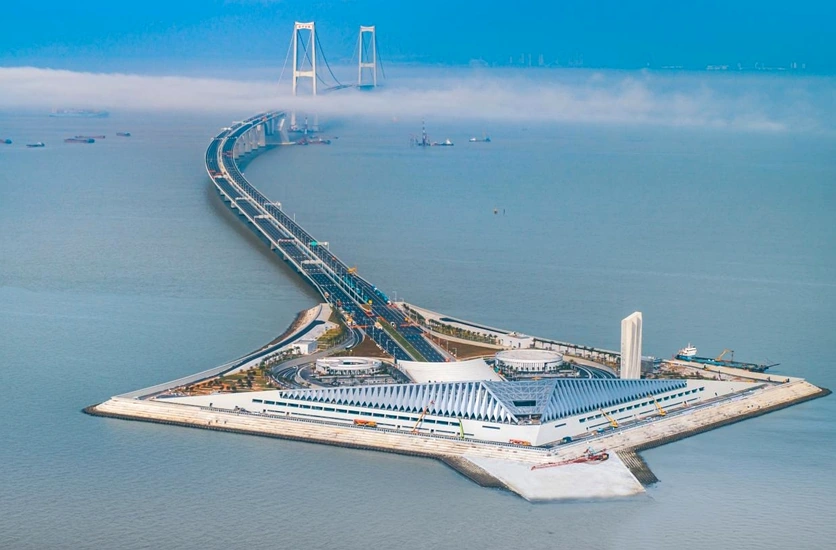
The operation of the 24km sea-crossing corridor has reduced inter-regional travel time from two hours to less than thirty minutes, opening a new chapter for economic and cultural integration on both sides of the Pearl River. Changing times and extraordinary construction capabilities have transformed the Lingding Bay, once associated with tragic poetry, into a brilliant symbol of scientific and technological power and the will to conquer the ocean.
Located precisely at the geometric center of the Guangdong-Hong Kong-Macao Greater Bay Area (粤港澳大湾区), the Shenzhen-Zhongshan Bridge occupies a rare geostrategic position, spanning the open waters of Lingding Bay at the Pearl River Estuary (珠江口). According to traditional Lingnan geomancy, the estuary where the sea meets the river is a place where energy gathers, where fertile silt from the mainland flows into the sea, carrying the prosperity of a thousand years. However, the vast waters of Lingding Bay have also historically created a natural barrier, completely separating the eastern and western shores of the delta into two worlds with vastly different rhythms of development.
The economic landscape here reflects a stark contrast: the East Wing shines with modern brilliance, with Shenzhen as a global hub for technological innovation, Hong Kong as an international financial center, and Dongguan as a renowned manufacturing powerhouse; meanwhile, the West Wing, including Zhongshan, Zhuhai, and Jiangmen, possesses a thousand-year cultural heritage and abundant land resources but has suffered from decades of isolation in terms of road connectivity. The birth of this grand infrastructure project acts like a massive “artificial dragon vein,” spanning the strait that has divided the region for millennia to directly channel prosperous energy from the East to awaken the rising potential of the West. This strategic sea-crossing not only resolves the geographical deadlock but also thoroughly relieves the pressure on the Humen Bridge bottleneck—which once struggled under the weight of over 150,000 vehicles per day—while sharing the load with the Nansha Bridge and comprehensively restructuring the economic spatial landscape of the entire Pearl River basin.
Viewed from the vast expanse above, the structure appears like a giant silk ribbon gracefully winding through the deep blue waters of the Lingdingyang Sea, with the pristine white suspension bridge towers standing proudly as a focal point against the sky. Each elegant bridge span supports a continuous flow of traffic, stretching toward the distant horizon where the silhouettes of modern skyscrapers emerge beneath a blue sky dotted with fluffy white clouds. Directly beneath the sturdy bridge deck, cargo ships diligently cut through the calm water, creating a harmonious contrast with the industrial complexes and bustling ports lining the coast.
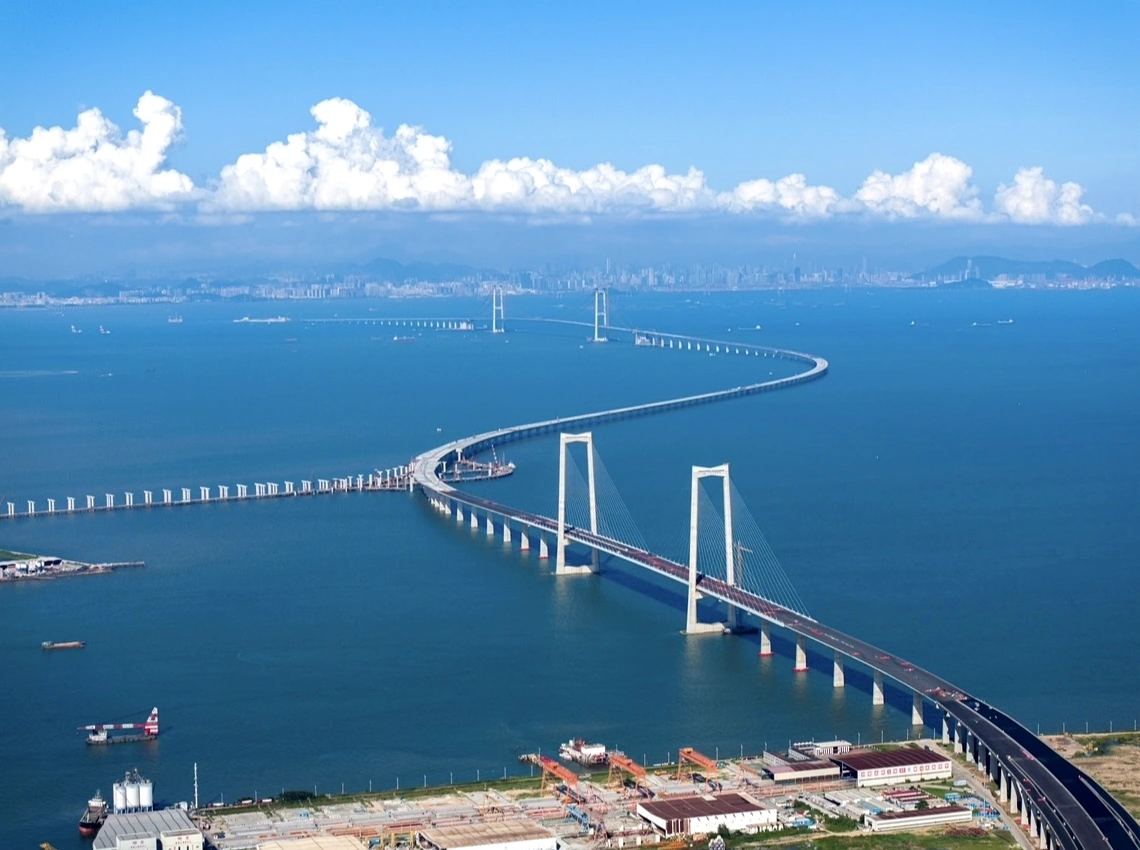
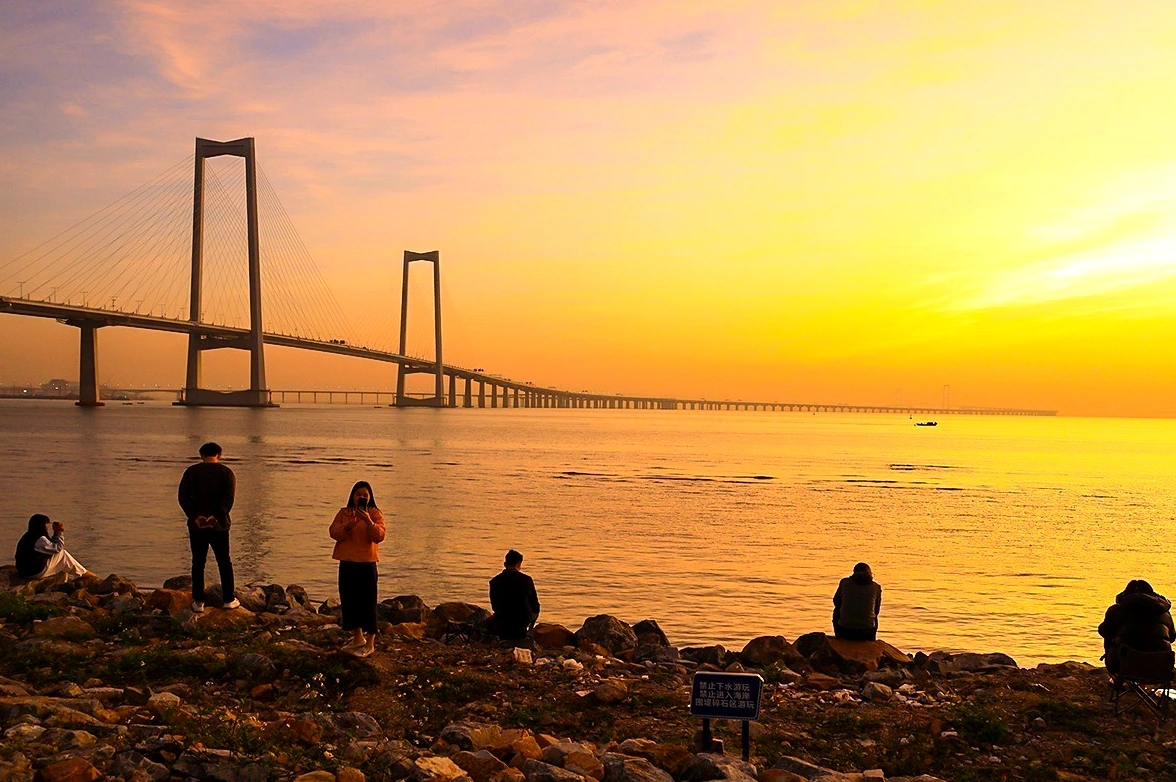
Beyond this engineering marvel, the natural landscape surrounding this sea-crossing route offers a breathtaking, expansive view of the tropical monsoon seascape. The journey across the Lingdingyang Sea is a spectacular visual experience, where the traveler’s gaze is completely liberated, embracing the busiest maritime gateway in the South China Sea and focusing on the magnificent Qianhai Bay. Strong sea breezes carrying a raw, salty scent blow through the steel bridge spans, blending with the brilliant sunset over the Pearl River Estuary to create a magnificent moment of harmony between human engineering excellence and the endless sea and sky.
In terms of contemporary marine engineering, the Shenzhen-Zhongshan Link (深中通道) is regarded by observers as an extraordinary architectural epic, with a total investment reaching 44.69 billion Yuan, approximately 6.2 billion USD. Stretching 24 kilometers across the turbulent waters of the Pearl River Estuary, the project not only establishes a standard eight-lane expressway with four lanes in each direction at a design speed of 100 km/h, but also sets an unprecedented precedent in world construction history: the integrated model of “Bridge – Island – Tunnel – Underwater Interchange.” The seamless connection between these distinct structural forms within a single project required century-defining spatial planning, transforming the entire structure into a unified infrastructure entity capable of withstanding severe seismic shocks and the destructive power of super typhoons at the bay entrance.
The spatial harmony of this sea-crossing boulevard begins with the magnificent bridge system, where the Shenzhen-Zhongshan Bridge (深中大桥) stands like a steel bow reaching across the vast ocean. This is the world’s longest offshore suspension bridge with a main span of 1,666 meters, anchored firmly by two massive 270-meter-tall reinforced concrete towers. The bridge’s vertical clearance reaches 76.5 meters—a record height equivalent to a thirty-story building above the water—allowing 300,000-ton container super-ships and 220,000 GT international luxury cruise liners to pass through without any obstacles. Continuing this graceful movement westward is the Zhongshan Bridge (中山大桥), a cable-stayed bridge with a 580-meter main span and a pair of V-shaped towers rising 213.5 meters high. The elegant V-shaped structure resembles giant hands supporting the fan-shaped cable system, creating a visual rhythm that is both refined and sturdy amidst the white-capped waves.
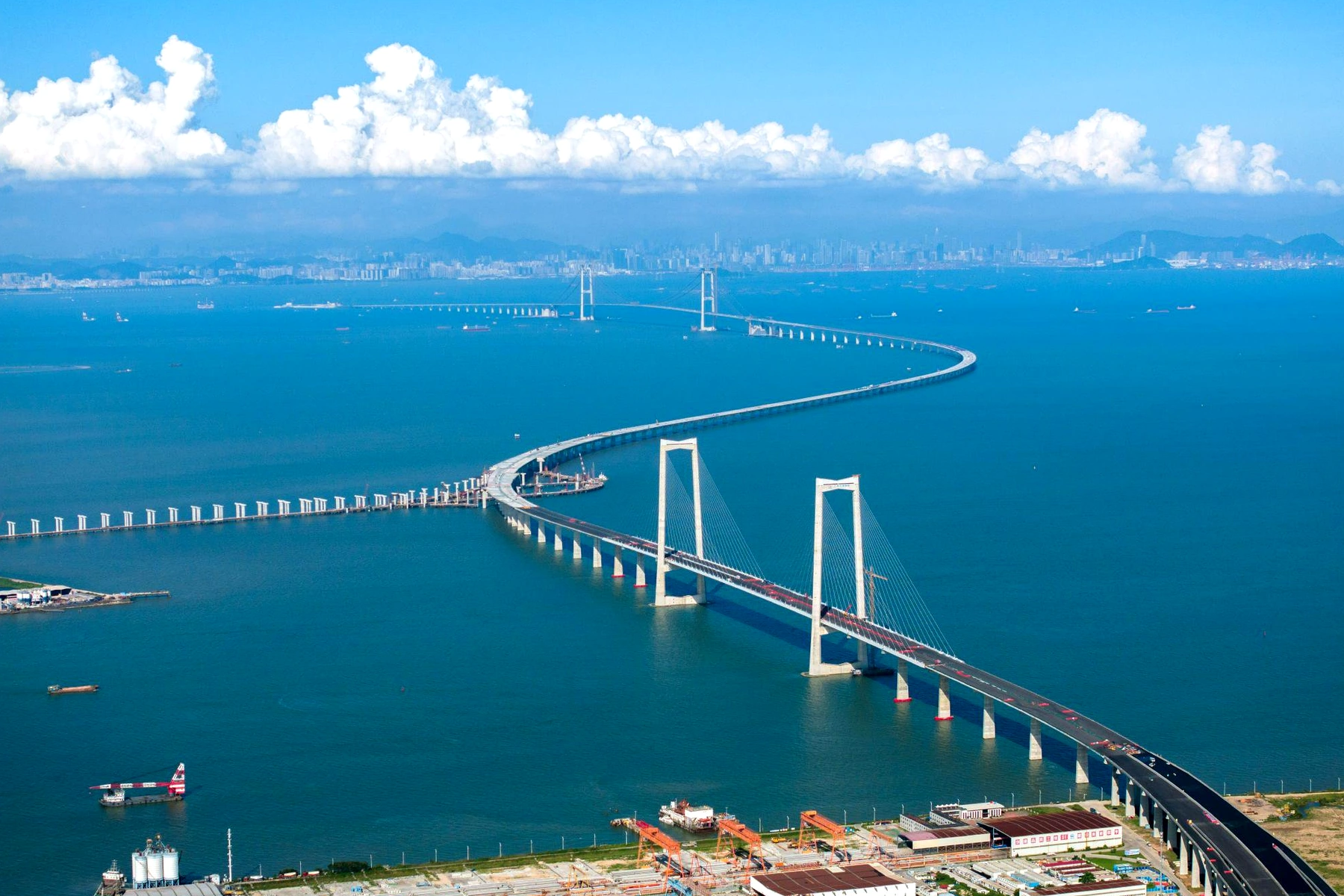
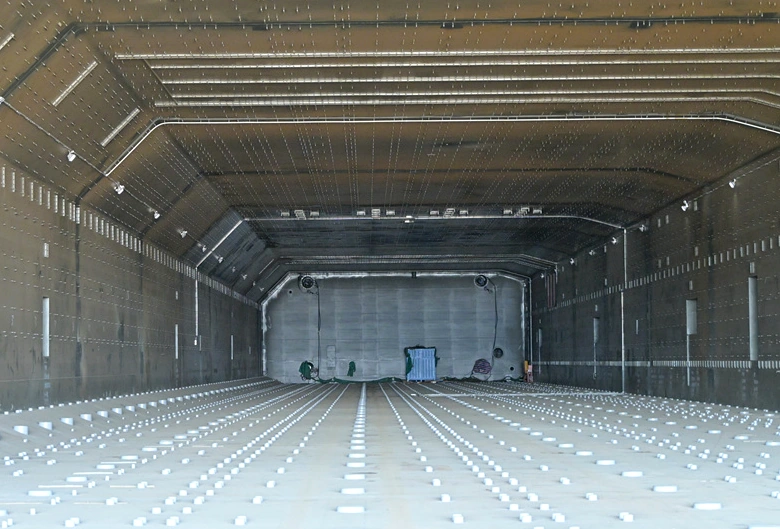
As the journey approaches the heart of the international shipping lane, the bridge deck gently lowers to make way for the 6,845-meter immersed tunnel (海底沉管隧道) – an engineering masterpiece located 40 meters deep beneath the ocean floor sediment. This underwater tunnel is intricately assembled from 32 standard segments, each 165 meters long with a massive displacement of 80,000 tons, equivalent to the weight of a super aircraft carrier. This is the world’s first eight-lane steel-shell immersed tube tunnel ever realized. By pumping specialized self-compacting concrete into the space between two high-strength steel shells, engineers created a sandwich structure that reduces weight compared to traditional concrete tunnels while possessing extraordinary bending strength and absolute waterproofing against the pressure of tens of tons of seawater per square meter.
To complete the spatial transition from the windy bridge spans to the deep underwater tunnel, a system of two artificial islands serves as both engineering fortresses and exquisite aesthetic highlights. The West Island (西人工岛), covering 137,000 square meters, is shaped like a kite catching the wind, firmly anchored by giant cylindrical steel pipe piles driven deep into the seabed. The island acts as an aerodynamic wave shield, functioning as a forced ventilation station, an intelligent operation monitoring center, and a 24/7 maritime rescue station. On the opposite shore, the East Island (东人工岛) marks the first underwater interchange on the planet, where the tunnel system integrates directly into the infrastructure network of Shenzhen Bao’an International Airport and the Yanjiang Expressway. The complex multi-level underwater traffic at the East Island is a testament to the pinnacle of spatial management, merging the sky, the sea, and the earth into a seamless and endless flow.
As the sunset begins to lean toward the horizon of the western Zhongshan shore during the twilight hours between 5:30 PM and 6:45 PM, the entire Lingdingyang sea area seems to drape itself in a silk cloak woven with magnificent copper-orange hues. This is the most glorious moment of the day to admire the architectural masterpiece of the Shenzhen-Zhongshan Link, as the final rays of the day sweep across, reflecting intensely against the reinforced concrete slabs and the towering bridge pylons standing amidst the waves. The vast expanse, which has witnessed so many historical shifts in the Pearl River Estuary, suddenly transforms into a multi-colored ink wash painting, where the boundary between human engineering and pristine nature blurs under the lenses of seasoned photographers.
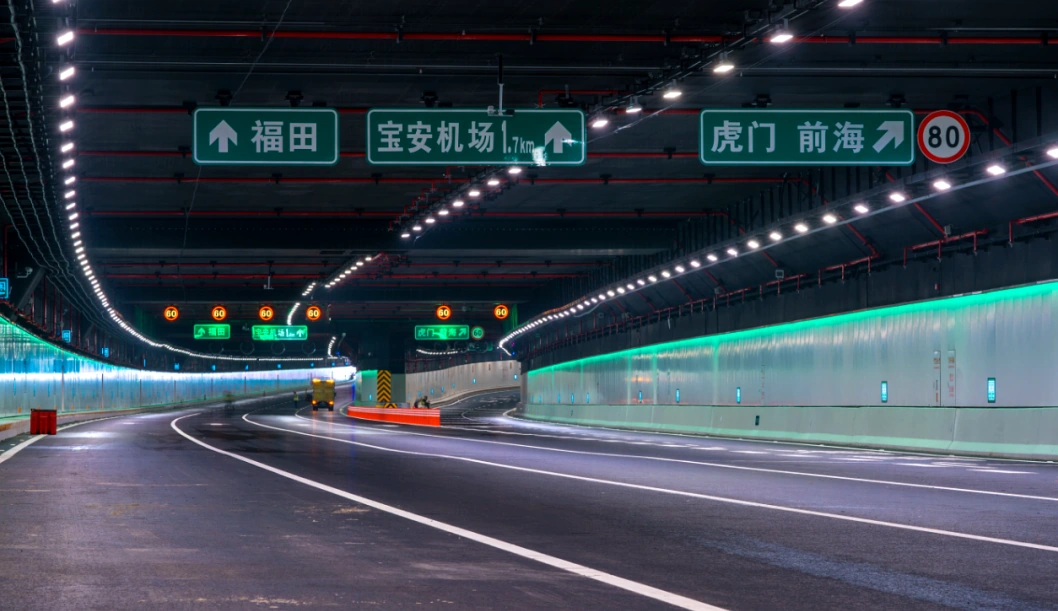
Leaving the water’s surface to venture deep into the ocean at a depth of forty meters, the journey through the immersed tunnel reveals a completely different visual dimension, where lighting technology is elevated into a subtle form of visual psychology. To effectively eliminate the claustrophobia that often plagues travelers in long undersea tunnels, engineers have integrated a smart spectrum lighting system capable of shifting flexibly in real-time. Through the rhythmic transition between the deep turquoise of the ocean, the warm golden hue of midday sun, and a gentle, pure white, this artificial light not only prevents eye fatigue for drivers after hours behind the wheel but also recreates the illusion of an open sky deep beneath the seabed, dispelling the heavy pressure of the massive water mass weighing down on the tunnel vault.
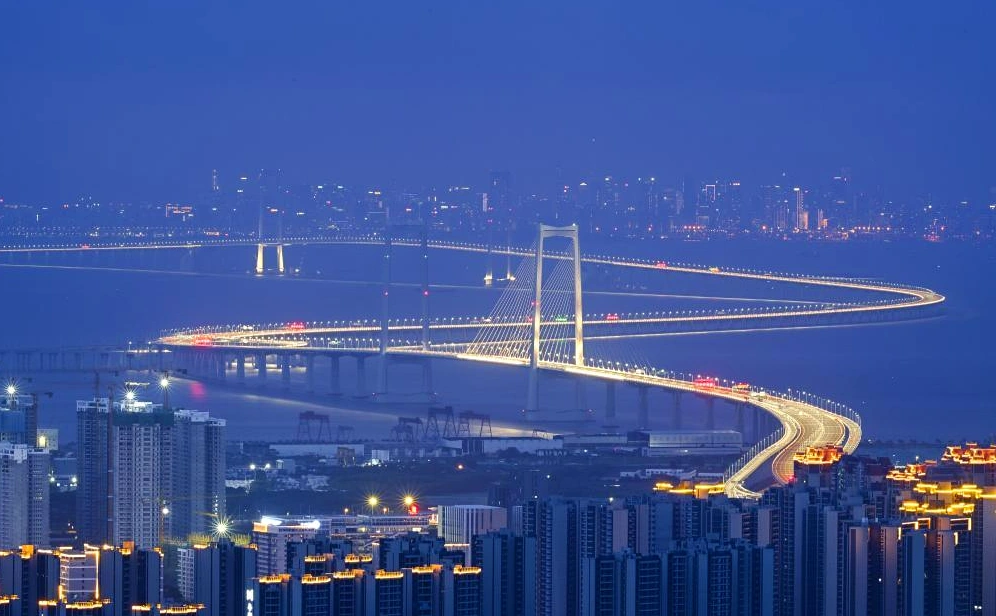
At exactly 7:30 PM each night, when darkness completely blankets the Lingdingyang sea, the grand project officially launches one of the most spectacular real-scene light shows in the Greater Bay Area. A computer-programmed matrix lighting system running along the massive suspension cables and the 270-meter-high main pylons of the Shenzhen-Zhongshan Bridge section ignites simultaneously, seamlessly connecting with the Zhongshan Bridge body to create a magnificent, glowing dragon-like trail winding through the night sea. The light beams shift rhythmically to every musical cadence, reflecting on the undulating water to create a mesmerizing visual effect, akin to an artificial galaxy dropped into the mortal realm, connecting the vibrant lifeblood between the prosperous eastern shore of Shenzhen and the ancient western shore of Zhongshan.
This vibrant nightlife is never interrupted or isolated in the middle of the sea, thanks to the presence of a densely deployed next-generation telecommunications network. Through a series of micro-base stations arranged along every cubic meter of the tunnel walls and bridge sides, ultra-high-speed, zero-latency data transmission turns the entire 24-kilometer route into a massive real-scene studio. Whether from inside a vehicle gliding smoothly beneath the sea or from a windy height overlooking the brilliant lighthouses, travelers can live-stream breathtaking moments of the light flow to all five continents, harmonizing with the relentless digital pulse of the prosperous bay area.
The completion of the 24km Shenzhen sea-crossing bridge not only reshapes the transportation landscape of the Greater Bay Area but also opens up a unique culinary journey known as the “one-hour food circle” between the two banks of the Pearl River Estuary. The Lingnan culinary culture, which has been enduring for thousands of years, has now become more vibrant than ever thanks to this undersea transport artery, allowing foodies to start their lunch in the tech hub of Shenzhen and, after just a few dozen minutes of gliding over the waves, sit back and relax in century-old family-run eateries in the heritage-rich land of Zhongshan.
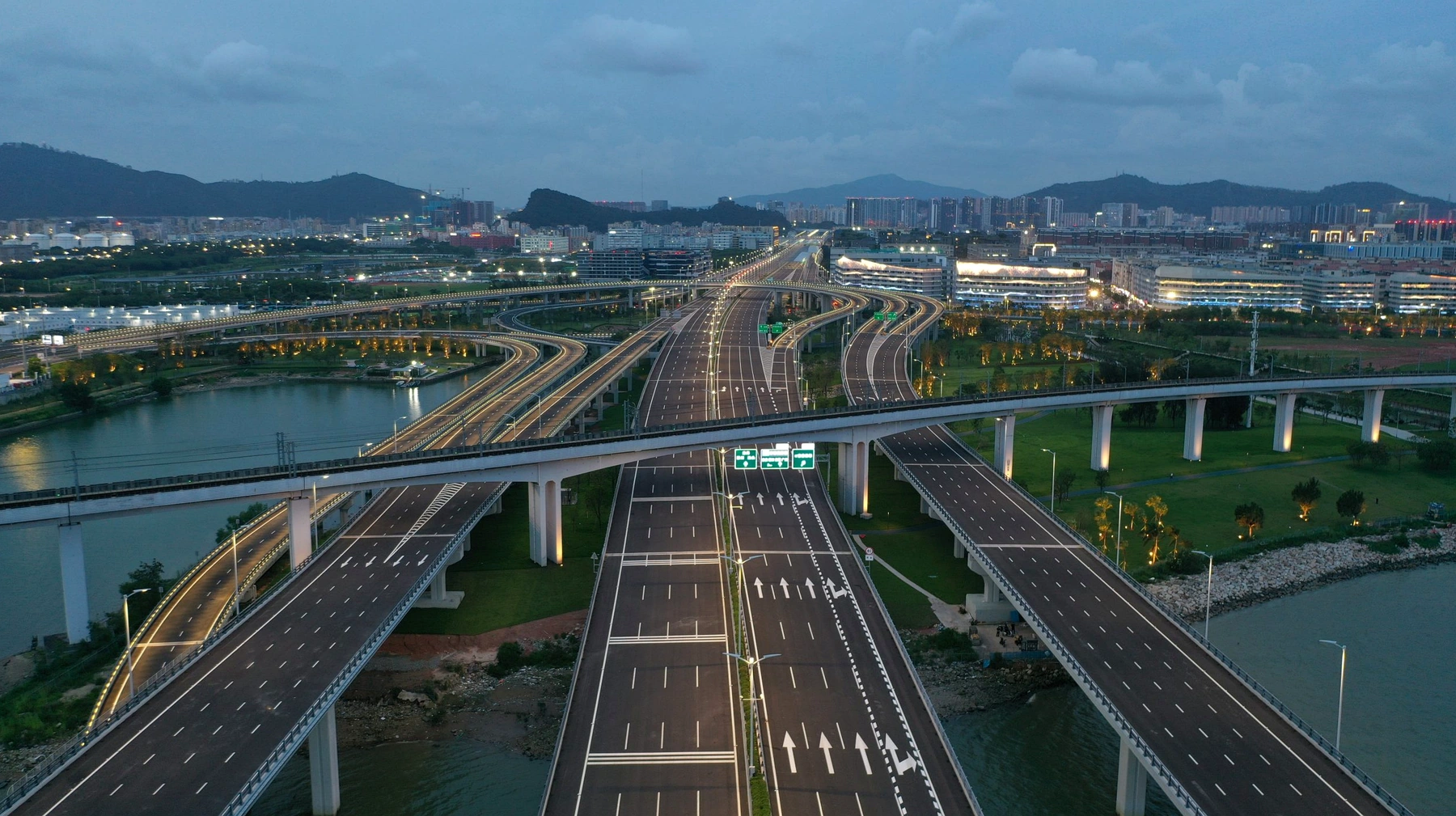
Viewed from an aerial perspective as sunset gives way to night, the interchange leading to the cross-sea bridge emerges like a mesmerizing wonder of light. The multi-level winding bridge ramps interweave seamlessly with tunnel entrances, casting a brilliant glow that reflects off the tranquil water and the lush green banks on either side. In the distance, the skyline is illuminated by a cluster of skyscrapers standing proudly beside mist-covered mountains, painting a perfect picture that bridges contemporary engineering marvels with the vibrant, bustling urban life of the night.
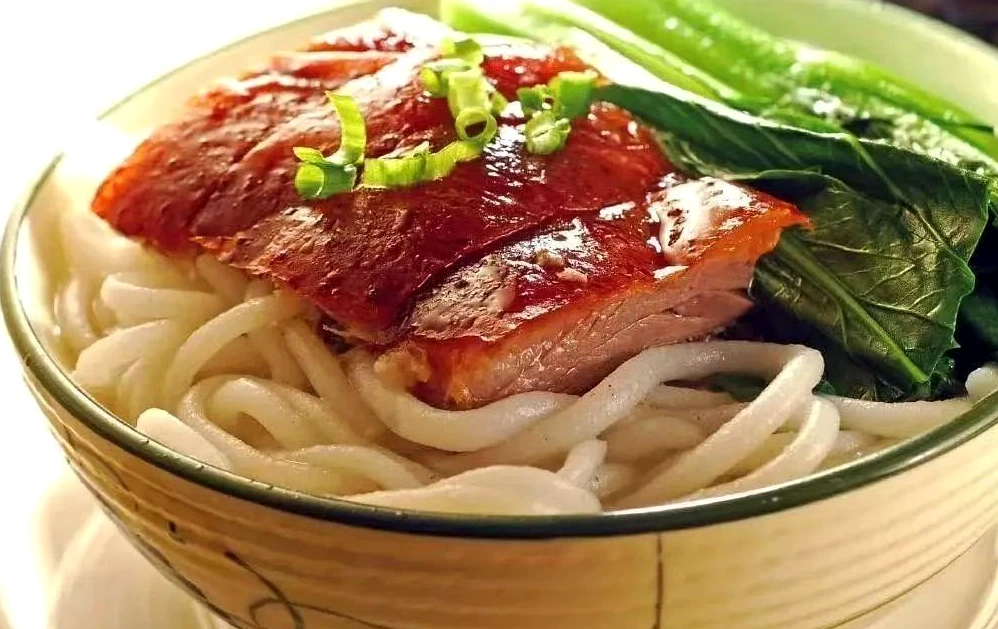
Arriving at the western Zhongshan shore, the first culinary masterpiece to captivate any discerning diner is the Shiqi squab. Originating from a breed meticulously cross-bred in 1915 between foreign carrier pigeons and local pigeons, these squabs are strictly selected at exactly twelve to thirteen days old, when the meat is at its most tender and succulent. Master chefs at renowned establishments like Shiqi Lao-Ge or Cui De Qiang parboil the squab in a secret family herbal broth, then continuously douse it in hot oil until the skin becomes taut, glossy, and as crispy as silk paper, all while sealing in every drop of sweet, savory juice inside. Besides the squab, Dongsheng crispy grass carp is a unique creation of the Pearl River Delta’s terroir. Thanks to a farming method in fast-flowing water and a diet consisting solely of fava beans for 120 days before harvest, the fish’s muscle structure undergoes a magical transformation, becoming firm and crunchy, similar to beef tendon. Thinly sliced fish fillets dropped into a clear, delicate hot pot broth or quickly stir-fried with ginger and scallions over high heat always provide a crunchy texture rarely found in any other aquatic species.
The western shore carries a sense of tranquility in a simple bowl of Tam Huong rice noodle soup, where chewy, fragrant rice noodles are submerged in a broth simmered from marrow bones and aromatic cardamom. Crossing to the eastern Shenzhen shore, the culinary map immediately shifts to the bold, hearty flavors of a modern port city. Here, the famous roast squab from Guangming Farm offers a perfect counterpoint to Shiqi with its dark reddish-brown caramelized skin, infused with rich, fatty flavors and a stimulating, numbing herbal aroma. Additionally, the brackish waters of Shajing leave a deep impression with their celebrated oysters—plump, juicy oysters grilled directly over glowing charcoal with scallion oil and minced garlic and chili, delivering the salty, refreshing essence of the open ocean right in the heart of the bustling bay.
The opening of the Shenzhen-Zhongshan corridor has sparked a true revolution in both geo-economics and travel experiences along the Pearl River estuary. While previously, the journey across the bottleneck at the historic Humen Bridge was frequently plagued by traffic jams lasting 120 to 180 minutes, travelers now take just 25 to 30 minutes to glide smoothly across the entire 24km route connecting the east and west banks. This mega-project operates 24/7, offering opportunities to witness the magical transformation of scenery from the radiant sunrise over Qianhai Bay to the brilliant LED lights winding like a dragon of fire through the night in the Lingdingyang waters.
For self-driving tourists or those renting private cars, the bridge toll is set at a flat rate of 66 RMB per trip (approximately 230,000 VND) for passenger vehicles with fewer than 9 seats. Meanwhile, the most economical and convenient option for independent travelers is the dedicated cross-sea express bus service running between Shenzhen and Zhongshan, with ticket prices ranging from 15 to 18 RMB per trip (approximately 52,000 to 63,000 VND) and a regular frequency of just 10 to 15 minutes per departure. A hallmark of the bay area’s digital infrastructure is the 100% cashless, non-stop toll collection system. All checkpoints operate via automatic ETC lanes or by scanning electronic payment codes via international WeChat Pay and Alipay linked to credit cards; therefore, having mobile data and pre-installed e-wallets is a mandatory requirement for all independent journeys.
Regarding immigration procedures, international tourists currently enjoy unprecedentedly flexible policies when visiting the Guangdong-Hong Kong-Macao Greater Bay Area. Most notable is the 144-hour visa-free transit policy applicable at Shenzhen Bao’an International Airport (airport code SZX), allowing for short-term entry to explore nearby infrastructure masterpieces. Additionally, foreign tour groups departing from Hong Kong Special Administrative Region or Macao through designated travel agencies are also eligible for the 144-hour Greater Bay Area visa-free travel scheme. Coupled with the expanded “Northbound” policy allowing vehicles with Hong Kong and Macao license plates to drive directly into the mainland, combining a multi-destination itinerary starting from the southern tip of Kowloon straight across the cross-sea bridge to Zhongshan has become incredibly seamless.
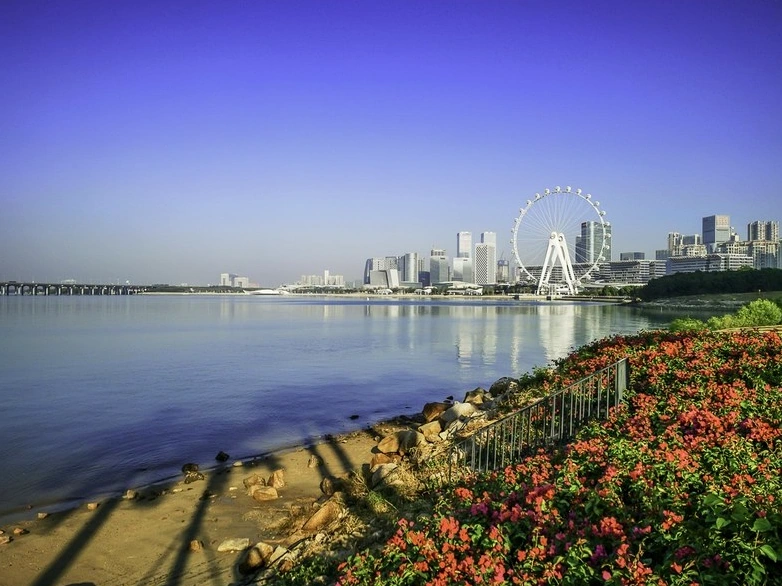
To capture the most spectacular shots of this century-defining project without violating traffic safety regulations on the main bridge lanes, identifying key ground-level observation points is crucial. On the Shenzhen east bank, Qianhai Bay Tide Park and the Xixiang Hilltop Observatory are two ideal spots to frame the massive tunnel entrance as it appears and disappears amidst the azure waters. Conversely, from the Zhongshan west bank, the breezy embankment of Cuiheng New District Coastal Park serves as the perfect grandstand to witness the towering Shenzhen-Zhongshan suspension bridge as it catches the sunset glow over the vast expanse of water.
While exploring this maritime mega-project is becoming a trendy experience, travelers should remain vigilant against the traps of “zero-dollar” budget tours. Many itineraries advertise surprisingly low costs, but in reality, they force passengers into 4 to 5 commercial stops to market artificial jade, latex mattresses, or low-quality cordyceps, wasting 6 to 8 precious hours of travel time. Instead, choosing specialized tours focused purely on architecture with no shopping stops—strictly adhering to Article 35 of the Tourism Law of the People’s Republic of China—will ensure a complete and worry-free sightseeing experience.
To enjoy a truly relaxing trip accompanied by a team of guides well-versed in local culture and professional logistics, travelers can proactively choose our all-inclusive tour packages specifically designed for this technological heritage route.