Nestled among the undulating mountain ranges of the northwest Guizhou plateau, the land known as Baili Azalea (Hundred-Mile Rhododendron) has, since the dawn of time, been far more than a natural masterpiece of countless blooming mountain flowers. It stands as a silent witness to profound layers of history and culture. Tracing back to the Pre-Tusi era before the 3rd century, this rugged terrain was once entirely encompassed within the territory of the ancient Yelang Kingdom during the Warring States period through the Western Han dynasty. Since ancient times, this has been the ancestral homeland of indigenous primitive tribes—the forerunners of today’s Yi and Miao ethnic groups—who made mountains their fortress and the radiant primeval forests their pure spiritual domain.
The first brilliant milestone recorded in official history here dates back to the Three Kingdoms period. In the 3rd year of Jianxing under the Shu Han dynasty (225 AD), Prime Minister Zhuge Liang personally led a grand army on a southern campaign to pacify the region. Upon advancing into the misty, perilous plains plagued by toxic vapors, Tethuo, the prominent chieftain of the Yi people at the time, proactively surrendered. He dedicated all his efforts to guiding the path and transporting military provisions, helping the Shu army traverse unpredictable and treacherous swamps. Deeply touched by the loyalty, righteousness, bravery, and resourcefulness of the local chieftain, Zhuge Liang solemnly bestowed upon Tethuo the title of Lord of Laidian Lumü. This historical turning point laid the very first foundation for the prosperous local autonomous system of the Te clan, enduring across the Jin, Tang, and even Song dynasties deep within these remote mountains.
Entering the Ming dynasty in the 14th century, this strip of land witnessed its most glorious golden age under the governance of the prestigious An family’s Shuixi Tusi regime. In the 14th year of Hongwu (1381), an extraordinary heroine emerged to alter the destiny of an entire borderland: Lady Tusi Shexiang, who served as the regent of Shuixi at a very young age. With exceptional strategic vision, she decided to submit to Ming Taizu Zhu Yuanzhang and achieved an immortal feat by ordering the opening of the Longchang Jiuyi vital route. The nine courier stations crossing the towering, perilous mountain passes of Dafang Prefecture not only connected the desolate Yunnan-Guizhou lands with the prosperous Central Plains, but also unlocked an endless source of cultural and commercial exchange. From this very legend, the folk tale of the “Drunken Nine Oxen” was born and passed down through generations. The story goes that the nine precious oxen selected by Lady Shexiang as tribute to the imperial court in Jinling, upon passing through the boundless, multi-colored cloud-like forests of Baili Azalea, were so enchanted by the radiant fragrance and beauty of the wild blossoms that they lay down on the ground, refusing to move another step and turning these mountains into a realm that is both tragic and poetic.
The vicissitudes of the era continued to shift dramatically during the Qing dynasty. By the 7th year of Yongzheng (1729 – 1730), Yunnan-Guizhou Governor-General Ortai aggressively implemented the “Gaitu Guiliu” (replacing native chieftains with imperial officials) policy to consolidate power under the central court. The hereditary Shuixi Tusi regime, which had lasted for a millennium, was completely abolished. The imperial court redrew administrative boundaries, establishing Dafang County and Qianxi Prefecture for direct imperial administration. Through countless historical upheavals, the ancient rhododendron forests have stood firm like a natural fortress, shielding the lives of indigenous residents through turbulent storms.
In modern times, in February 1936, amidst the fiery storms of the illustrious Long March, the Dafang region welcomed the footsteps of the Red Army’s 2nd and 6th Corps under the command of generals He Long and Xiao Ke. This place became the cradle for the establishment of the “Guizhou Provincial Anti-Japanese Alliance Revolutionary Government”. The dense, ancient rhododendron forests in the Pude sector served as a rugged guerrilla stronghold, sheltering the revolutionary forces during their most arduous days.
From a fierce battlefield and a secluded Tusi territory, this land opened a new page in its history in April 1987 when it was recognized as a provincial-level nature reserve, later upgraded to a National Forest Park in May 1993. A specialized management system took clear shape when the Baili Azalea Scenic Area Management Committee was officially established in 2007, serving as a leverage for this thousand-year forest to be honored as a National 5A Tourist Attraction in 2013, perfectly preserving its historical soul intertwined with miraculous nature.
Situated on the northwest plateau of Guizhou Province, the terrain of Baili Azalea resembles an exquisite ecological great wall stretching from 105°45′ to 106°04′ East longitude and 27°08′ to 27°20′ North latitude. Located in the perilous transitional border area between Dafang County and Qianxi county-level city under Bijie prefecture-level city, this region bears the distinct imprint of ancient Yangtze tectonic uplifts. Geographically and feng shui-wise, the mountain ranges here meander continuously, creating a natural screen to shield against cold northern winds while welcoming warm, humid air currents blowing from the south, turning the plateau basin into a mild, auspicious microclimate.
From a geological perspective, the magnificent appearance of the scenic spot is the result of tens of millions of years of refinement through the famous Yanshanian and Himalayan tectonic folding movements. The bedrock foundation is composed of Permian-Triassic limestone and dolomite interspersed with sturdy siliceous shale layers. Long-term karst weathering has dissolved minerals, nurturing a specialized mountainous red-yellow soil layer with very high acidity, featuring a pH ranging only from 4.5 to 5.5. Although this environment is rich in aluminum and iron yet poor in phosphorus nutrients—making the land barren for agriculture—it has become an ideal sanctuary for wild rhododendron populations to take root. This largest native primeval rhododendron forest in the Northern Hemisphere spans an area of 125.8 square kilometers, completely encompassed within a planned biosphere reserve totaling 697.17 square kilometers, with elevations undulating from 1,200 to 1,850 meters above sea level and a forest cover rate consistently maintained above 80%.
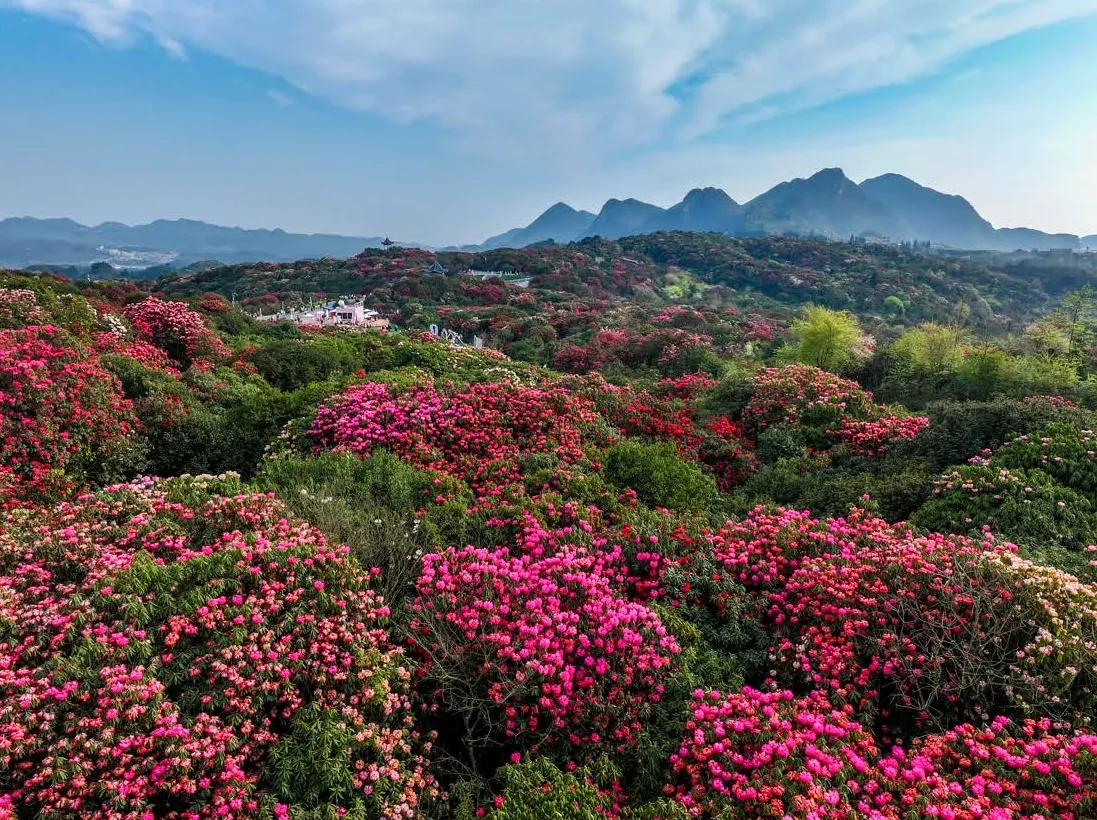
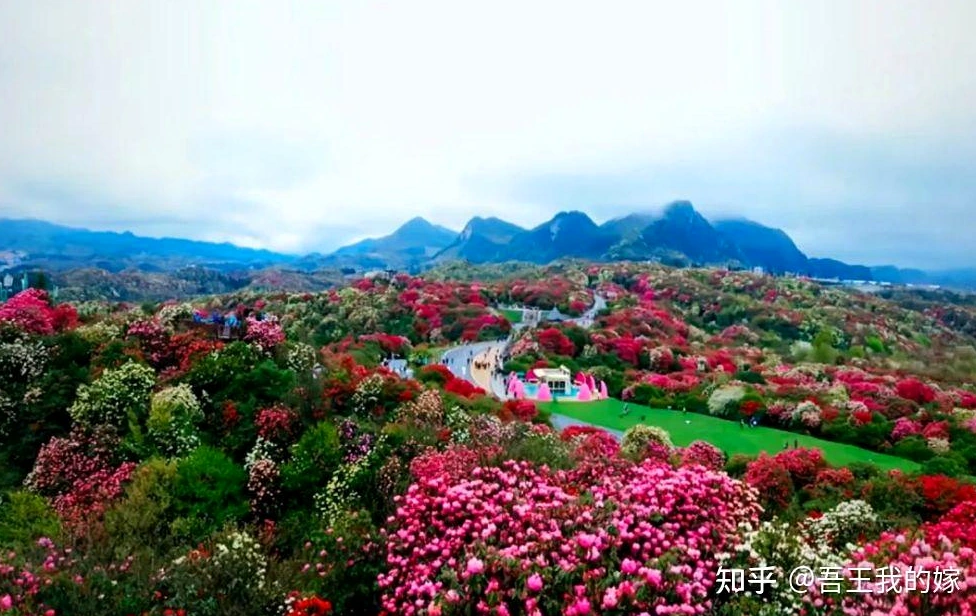
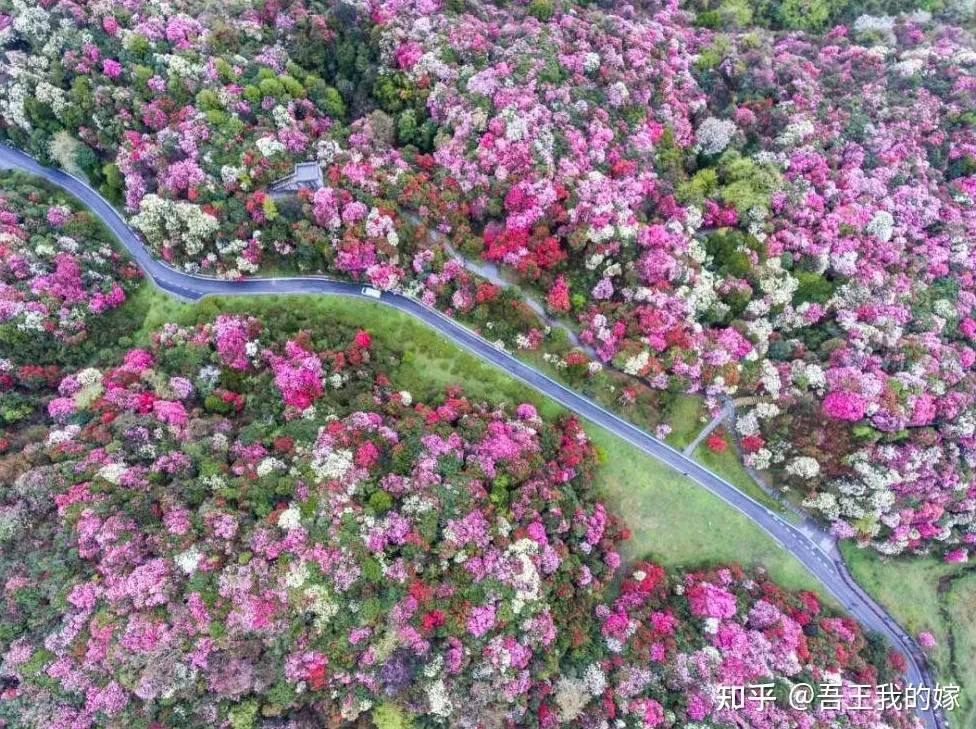
Looking out from the gentle slopes, the panoramic view of the vast flower valley is breathtaking, with countless endless rhododendron bushes in full, brilliant bloom. They harmoniously interweave elegant soft pink, passionate deep red, and pure, immaculate white. A winding trail, soft like a silk ribbon, runs through the heart of the valley, welcoming visitors as they stroll and admire the floating vegetation in the serene spring weather. Far on the horizon, majestic karst mountain ranges rise layered beneath a sky hazy with white clouds, weaving an open natural landscape that is both pristine and poetic.
The plant ecosystem at Baili Rhododendron is compared by international researchers to an invaluable open-air living gene museum. This land preserves 41 to 44 alpine evergreen rhododendron species, bringing together all 5 subgenera of rhododendrons distributed worldwide. The pinnacle of biological mystery here is the fascinating phenomenon known as “One Tree, Different Flowers” (一树不同花). Thanks to soil adaptation and natural cross-pollination over hundreds of years, on a single mossy ancient tree trunk, visitors can spot three to seven different flower colors blooming together on each branch, ranging from pale white, apricot yellow, and light pink to deep purple and dark red.
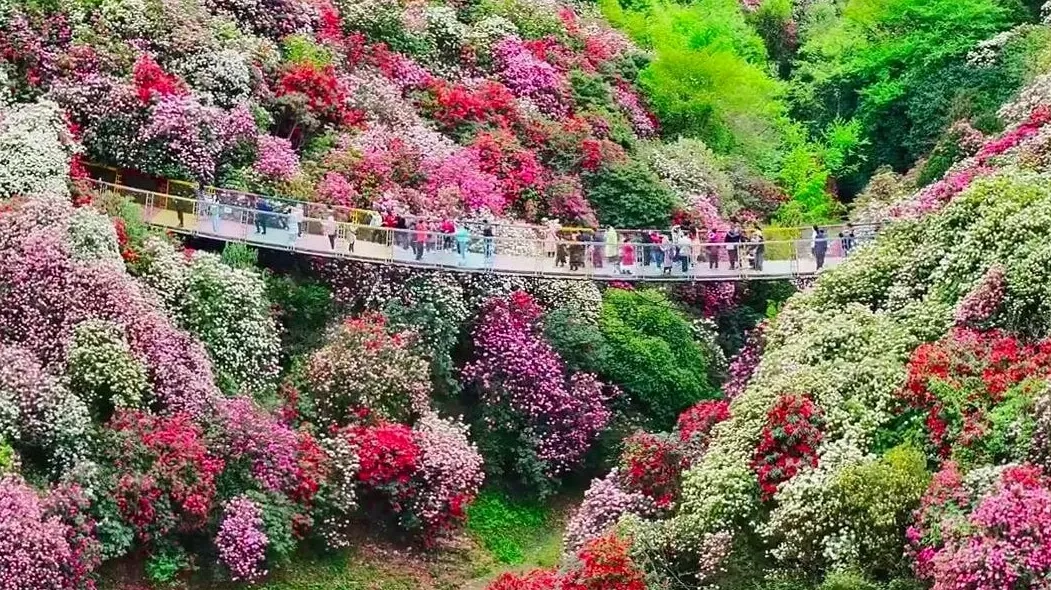
The landscape here is clearly divided into two distinct geomorphological areas with contrasting styles: the Pude zone and the Jinpo zone. The Pude zone resembles a natural fortress with rolling mountains, gathering towering ancient rhododendron trees aged 300 to 500 years old, highlighted by famous landmarks such as the multi-colored Wutai Road, the solemn Guohua Peak, or the charming Yucang Peak. In contrast, the Jinpo zone harbors the magnificence of deep valley gorges, where vast expanses of Rhododendron delavayi dye an entire corner of the sky brilliantly red. The dizzying highlight amidst this space is the Simaling suspension bridge spanning the deep canyon, connecting breathtaking landscapes like Baihuaping and Wanlingfeng, creating an epic epic between floral stones and southwestern mists.
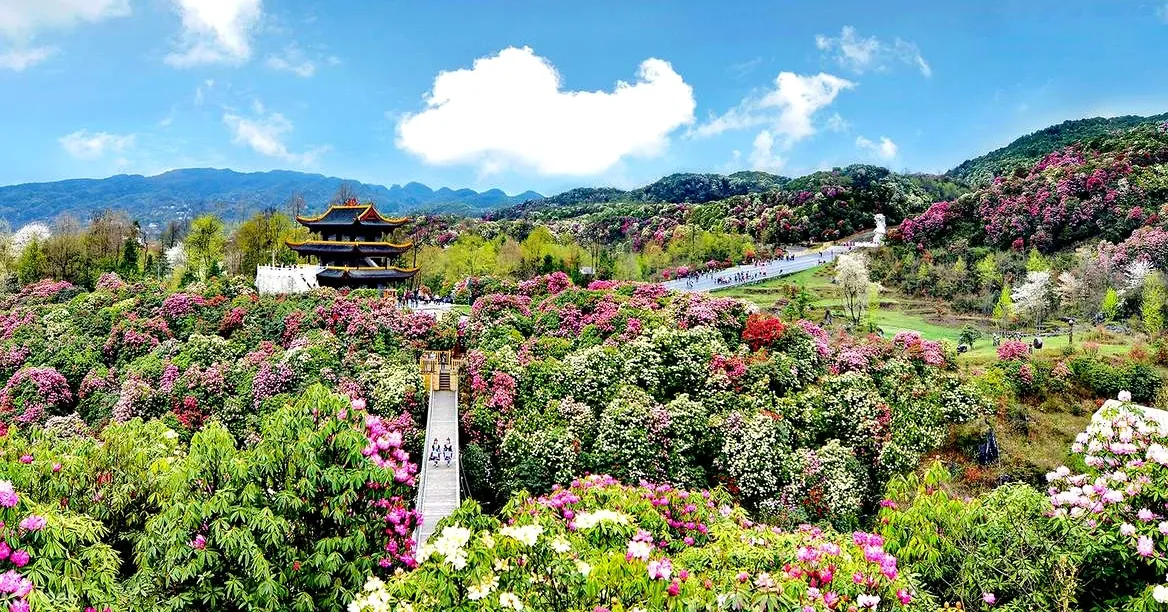
Nestled among the undulating mountains of the Qianxi plateau, the overall picture of Baili Rhododendron is not only shaped by the majestic pristine flower carpet but also leaves an enduring mark through the harmonious blend of traditional indigenous architectural heritage and cutting-edge contemporary spatial planning thinking. Against the backdrop of typical karst topography, the millennium-long cultural flow of native ethnic groups has created iconic residential structures and public works, represented by the Duomu architectural art of the Yi ethnic minority, clearly visible in the gateway system, viewing platforms, and resting corridors in the Pude zone. These works thoroughly utilize the enclosed mortise-and-tenon wooden load-bearing frame, combining traditional rammed earth methods with a thick layer of rammed earth mixed with concentrated molasses, stream pebbles, and chopped straw, creating a solid screen capable of absolute thermal insulation, blocking the freezing cold mists rolling up from the valley. At the top, the four-sided sloping roof casts a solemn shadow, covered with grayish-black yin-yang tiles and carved at the ridge ends with the image of a courageous goat-horn head – the totem spirit reigning in the cosmological consciousness of the Yi people. Every monolithic native forest wood porch column is painted with three sacred colors symbolizing a profound philosophy of life: the brilliant red of courageous fire, the glowing yellow representing the origin of fertile land, and the mysterious black settling into a noble, quietly eternal aesthetic.
Venturing deep into the Jinpo land and ancient villages along the slopes of the Dabie Mountains, the visual space shifts flexibly to the graceful, elegant charm of the Miao stilt house (Diaojiaolou) architecture. These stilt houses cling tightly to the steep limestone mountain slopes through a network of cleverly interwoven mortise bracing joints without relying on a single iron nail, demonstrating the pinnacle of folk carpentry art in rugged terrain. The most distinctive feature of the structure is the curved leaning balcony called “Beauty’s Lean” (Minyi Qiao), where Miao girls sit embroidering brocade costumes, serving both as a railing to catch fresh airflow from the dense forest and to thoroughly solve the moisture problem in the year-round humid, fog-shrouded climate of the primeval forest.
A perfect counterpart to the rustic traditional style is the landmark contemporary complex “One Hall, Two Centers” (Yi Guan Liang Zhong Xin), a massive core complex integrating the Rhododendron Museum, the Intangible Cultural Heritage Center, and the International Conference Center. The planning concept for this complex stems from the imagery of the World Garden, simulating blooming rhododendron flowers full of vitality with a large-span light steel dome frame structure combined with an intelligent ecological dichroic glass wall system. The specially manufactured glass not only optimizes natural light sources and regulates the indoor microclimate of the building, but also harmoniously reflects the changing colors of the flower forest across blooming seasons, resembling a green architectural sculpture emerging amidst the mountain valley.
}
The grandeur of the Baili Dujuan scenic area is measured by its rigorous infrastructure investment, covering a developed landscape area of 24.8 square kilometers. To connect the various zones without disturbing the sensitive ecosystem, a 48-kilometer ecological ring road with a 12-meter width was meticulously constructed. It utilizes modified asphalt with high shock-absorption properties to protect the shallow root systems of the rhododendrons. Interwoven into the wild green carpet is a network of elevated wooden boardwalks stretching for miles, supported by pillars that hover above the vegetation. This allows visitors to stroll through the canopy without the risk of trampling the flora, preserving the pristine beauty of this natural heritage for generations to come.
Unlike flashy tourist cities that showcase modern lighting technology, nights at Baili Dujuan open up a dimension of stillness and solemnity rooted in ecological principles. To establish strict conservation standards for the 125.8 km² biosphere buffer zone, the core ancient forest area is kept free of high-intensity lighting. Maintaining the quiet darkness of the wilderness is a humane approach to protecting natural biological rhythms, safeguarding the nocturnal foraging and pollination cycles of native insects, and nurturing the rest of millions of flowers after days of blooming under the sun and wind of the Guizhou plateau.
Leaving the quiet boundaries of the core reserve to enter traditional villages like Pudi, Jinpo, or Huashe, the night comes alive with the vibrant energy of the Yi and Miao people’s sacred fire. As the deep purple sunset fades behind the limestone mountains, a massive bonfire is lit in the central square, illuminating warm smiles and intricate hand-embroidered brocade patterns. Visitors are drawn into the magnetic pull of the rhythmic A-Xi-Tiao-Yue dance, harmonizing with the deep, resonant sounds of the bamboo Lusheng and the soulful Ba-Wu flute. The graceful bare feet of the local youth performing the traditional fire-jumping ritual not only serve to ward off the “forest spirits” but also act as an enduring tribute to Lady Shexiang—a Ming Dynasty heroine who opened trade routes and brought peace and prosperity to the entire Shui-Xi region.

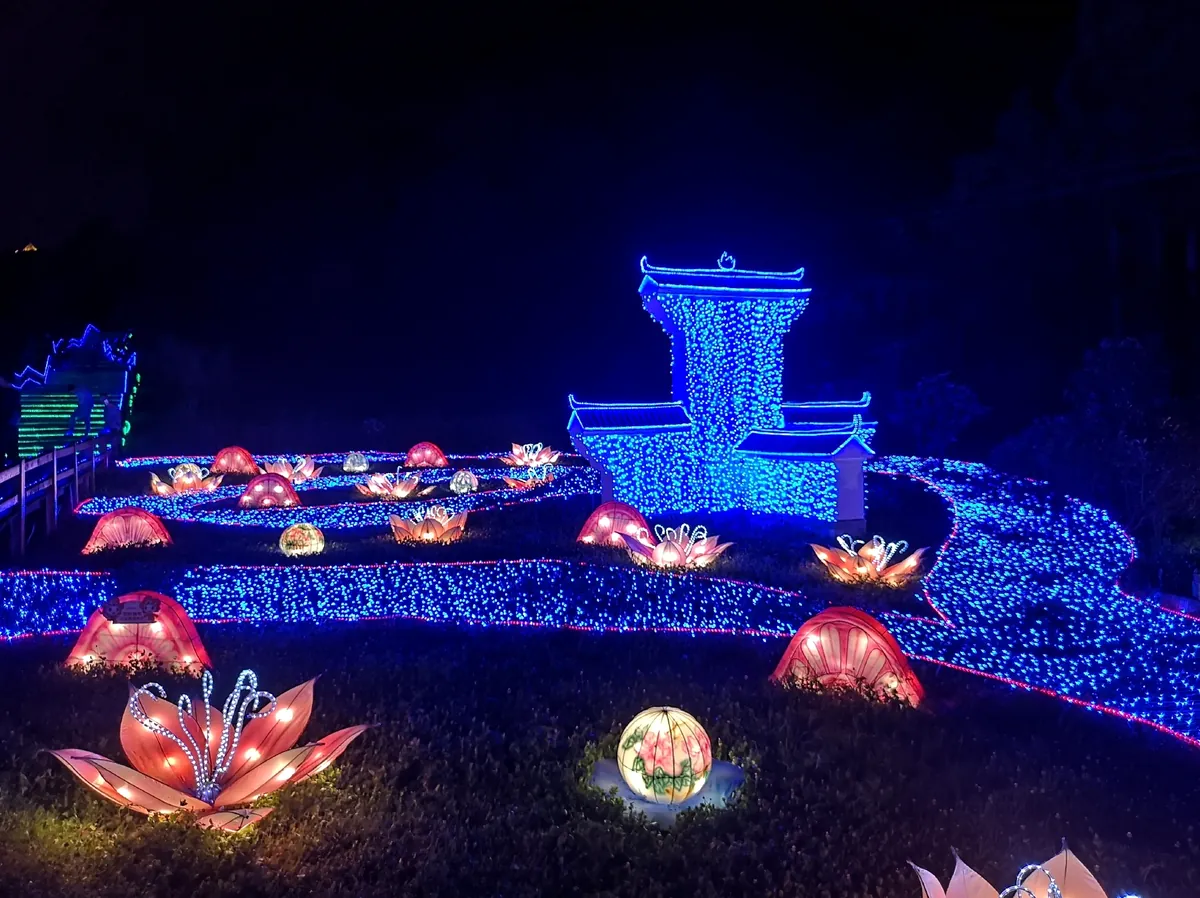
Stepping into the light art park in the buffer zone, visitors will be overwhelmed by a shimmering, ethereal visual ocean amidst the silent night. The entire space is elaborately created with thousands of blue LED strips winding along the walkways, elegantly draping over the majestic multi-story architecture in the background. Scattered throughout the foreground and along the paths are large lotus-shaped lanterns and stylized flower petals, glowing in shades of deep red, warm orange, soft pink, and pure white, turning the night into a magical dreamscape.
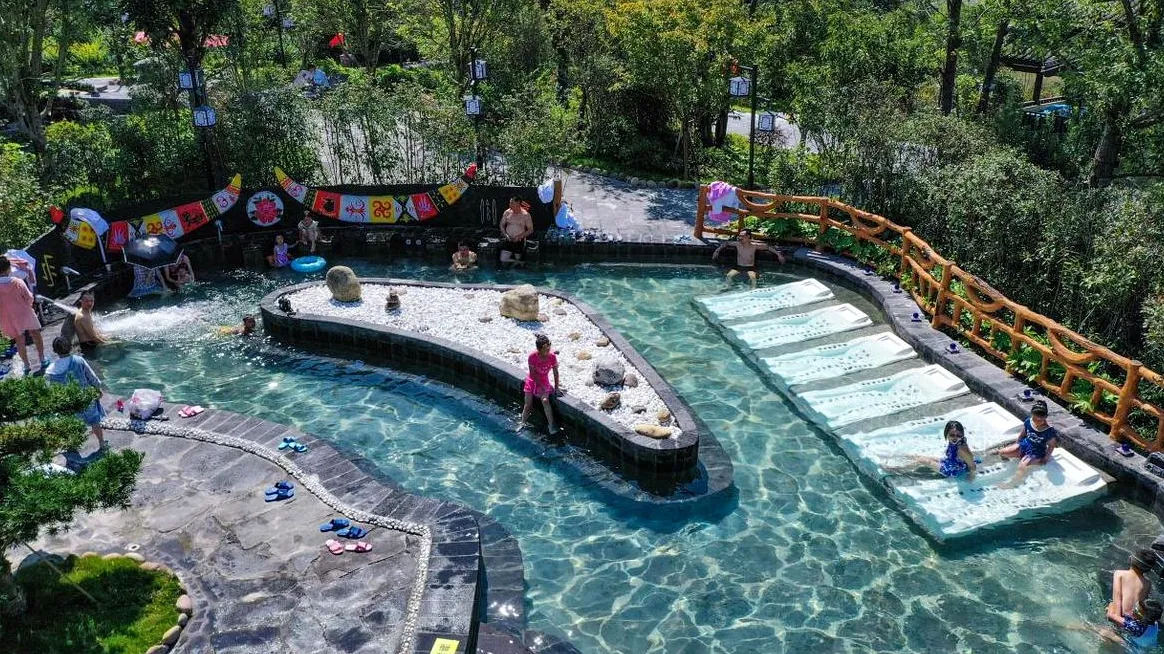
As night falls, the unique essence of isolated eco-resort living becomes clear at accommodations like Baili Feiba or the lodges in the Huashe area. Instead of bright artificial lights, local artisans have skillfully crafted handmade paper lanterns shaped like five-colored rhododendrons, casting a gentle golden glow along the paths leading to natural outdoor hot spring pools. Amidst the chilly plateau air, soaking in mineral-rich warm water under the ancient trees, listening to the chirping of insects, and gazing at the Milky Way stretching across the deep night sky brings absolute peace to the soul, perfectly capturing the harmony between thousand-year-old culture and the pristine breath of nature.
The cuisine of the Baili Dujuan region is not merely a fusion of rugged mountain produce and the cool, humid climate of the Guizhou plateau; it is the crystallization of a thousand-year cultural convergence between the ancient counties of Dafang and Qianxi in the Bijie district. Beneath the vibrant flower forests, local culinary art begins with a respect for the authenticity of time and ingredients, most notably the Dafang stinky tofu. Recognized as a culinary heritage dating back to the Ming Dynasty, each block of soft tofu undergoes a natural fermentation process using highland straw, developing a thin white mold before being placed on a grill over glowing charcoal. Under the smoldering heat, the outer layer becomes crispy and golden, contrasting perfectly with the creamy, buttery interior that melts on the tongue. The key to the dish’s captivating flavor is the famous Bijie “Tiao-Ba-La” dry chili powder, where the spicy, crispy heat blends with wild peppercorns and roasted salt, fully awakening the palate amidst the cold plateau mist.
Heading east of the rhododendron range, the Qianxi beef noodle soup reveals a culinary journey that demands the utmost patience from local artisans. The broth is kept at a rolling boil over charcoal fires for 18 continuous hours, simmered from select mountain beef bones and 22 natural herbs such as black cardamom, star anise, coriander seeds, and especially Daifang dried tangerine peel aged over many sunny seasons. The crystal-clear broth holds layers of deep, sweet essence, poured over thick, chewy rice noodles made using traditional artisanal fermentation methods. Thinly sliced, tender beef is blanched to perfection, accented by a vibrant, fragrant chili oil and fresh green onions, creating a steaming bowl that warms the traveler’s soul. Right next to this legendary noodle dish, the Qianxi cast-iron grill—also known as Luo Guo, a heritage dating back to the Qing Dynasty—is the centerpiece of cozy gatherings. The handcrafted cast-iron pan features a unique concave design with a raised center, allowing fat to drain to the edges, sizzling wild vegetables, freshly picked forest mushrooms, sliced tofu, and smoked mountain pork, all dipped in a rustic, flavorful five-spice chili salt.

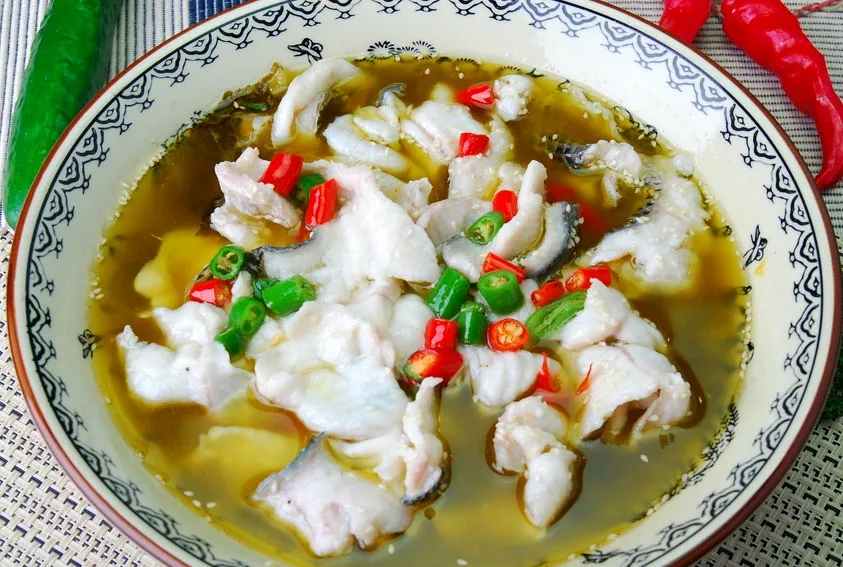
The wild and intense spirit of the Wumeng Mountains is elevated by the hands of the local indigenous tribes. The Miao-style sour fish soup is a testament to the mastery of natural fermentation, with its soul lying in the red or pink sour broth, aged for over 90 days in earthenware jars buried deep underground. Fermented from wild cherry tomatoes, fiery bird’s eye chilies, and highland sticky rice water, this crimson broth comes alive when seasoned with the essential oil of Litsea cubeba, known as ‘mang tang,’ which adds a refreshing, pungent aroma. Cooked with fresh carp caught from the rushing Wu River, featuring firm, snow-white, and succulent meat, the boiling soup brings an explosion of tangy, deep sweet, and lingering spicy notes. Meanwhile, the Yi people treat guests to their famous twice-cooked pork. Strips of firm, free-range highland black pork are boiled until just cooked, thinly sliced, and stir-fried in a red-hot cast-iron pan with local young garlic, crispy dried chilies, and thick, traditional fermented black bean paste, creating a rich, savory, and crispy flavor that is never greasy.
Closing this rich culinary journey at the horizon of red flowers is the elegant aftertaste of desserts that carry the pure breath of the mountains. Rhododendron flower pastries combined with highland buckwheat flour create crispy, thousand-layer cakes that are fragrant and refreshing, thanks to the gentle sweetness of forest honey infused with select rhododendron petals. Sipping on rhododendron medicinal wine, aged with nutrient-rich Cili fruits picked from wild hillsides, guests will feel the initial slight astringency transform into a warm, sweet sensation in the throat. This feast of flavors amidst the vast Baili Rhododendron forest not only nourishes the body but also preserves the very essence of a magnificent highland region, where people live in harmony with and cherish every generous gift of nature.
Located on the undulating plateaus of northwestern Guizhou, the biological rhythm of the Baili Rhododendron kingdom follows strict natural laws while possessing magnificent beauty. The annual blooming schedule is divided into three distinct stages that any savvy traveler should know. The early blooming stage occurs from March 10th to March 20th, when the first buds awaken after the freezing winter. Entering the peak blooming stage, which lasts from March 22nd to April 15th, the scenery reaches its glorious zenith with a vibrant coverage exceeding 95 percent of the primeval forest area, attracting the largest crowds of the year. After the peak, the fading stage from April 16th to April 30th brings a different, elegant charm, as millions of proud petals fall onto the hillsides, weaving endless multi-colored velvet carpets beneath the ancient trees.
The journey to this natural wonder from Vietnam is now extremely convenient thanks to China’s advanced high-speed rail network. Travelers departing from Hanoi can complete exit procedures at the Huu Nghi International Border Gate, take a bus to Nanning East Station, and board the Guiyang-Nanning high-speed rail line, which operates at a commercial speed of 350 km/h. After just two hours and 15 minutes of gliding smoothly through the mountains, the train arrives at Guiyang North Station; from here, passengers transfer to the Chengdu-Guiyang high-speed line for another 25 minutes to reach Qianxi Station, located 32 km from the Jinpo gate, or Dafang Station, 28 km from the Pudi gate, both of which are easily accessible by taxi or dedicated bus within 30 minutes. For those departing from Lao Cai, the route connecting through Kunming South Station and then switching to the Chengdu-Guiyang axis directly to Qianxi is also a beautifully scenic option. Additionally, air travel with direct or connecting flights landing at Guiyang Longdongbao International Airport allows travelers to rent a private vehicle and drive along the G56 Hangzhou-Ruili expressway, covering the 145 km distance in just one hour and 50 minutes to reach the forest’s edge.
To optimize the field experience in the vast scenic area, visitors should prepare in advance for the inter-district admission ticket fee of about one hundred and thirty yuan, along with an ecological shuttle bus ticket of about seventy yuan to ensure unlimited travel between stops. A smart one-day itinerary should start at seven-thirty in the morning at the West Gate of the Pudi sub-district to get ahead of the tourist crowds, taking the shuttle bus straight up to Guohua Peak to admire the sea of flowers appearing and disappearing in the floating early morning mist. Around nine-thirty, take a leisurely stroll along the Wutailu wooden boardwalk winding under the canopy of hundreds-of-year-old ancient flower trees. By noon, moving to the Jinpo sub-district for lunch and rest is an ideal choice, before crossing the Shimaling Suspension Bridge at thirteen-thirty to overlook the deep canyon framed by a vibrant ribbon of flowers. Before ending the journey, stop to capture stunning frames as the sunset falls over the Baihuaping Valley at around fifteen-thirty, and proactively exit the premises at seventeen-thirty to avoid localized traffic congestion on the mountain pass roads.
The crucial point determining the quality of the trip is recognizing and staying away from the rampant disguised zero-dong cheap tour traps. All-inclusive six-day-five-night programs offered at unusually low prices ranging from only six and a half million to nearly eight million VND are actually loss-cutting landtours, where the travel agency’s profit is traded by squeezing visitors into designated shopping spots in the outskirts of Guiyang or Anshun. Here, participants are often locked up for two hours in closed rooms to listen to sales pitches for latex mattresses, led into Miao silver processing workshops with prices inflated four to six times their true value, or faced with vague traditional medicine shops selling fake Gastrodia elata and caterpillar fungus. The painful consequence is that the time to admire Baili Dusujuan is miserably embezzled, leaving only about one to two hurried hours visiting secondary gates. Conversely, pure experiential journeys following the “Chunwan” standards usually cost between twelve and six million VND, accompanied by a legal commitment contract with no shopping stops, guaranteeing a full one to one-and-a-half days for visitors to freely explore the ecological depth of both famous sub-districts.
Located at an altitude varying from one thousand two hundred meters to one thousand eight hundred and fifty meters above sea level, the forest area possesses a high mountain microclimate with a daily and nightly temperature fluctuation of up to fifteen degrees Celsius. In the early morning and late afternoon, condensing moisture creates a thick layer of fog that makes the wooden steps slippery, requiring visitors to equip themselves with hiking boots with high friction soles and two-layer windproof waterproof jackets to keep warm. In particular, the huge density of pollen floating in the ancient forest space during the peak flowering season requires those with a history of respiratory allergies to proactively prepare medical face masks and backup nasal sprays. Thoroughly understanding the geographical and weather factors and choosing a transparent itinerary through a high-quality Guizhou tour will be the key to opening the door to fully appreciating the unique, endless rhododendron wonder on this auspicious land.