The sacred architectural complex of Pura Lempuyang—whose iconic structure is widely known across the international community as the Gates of Heaven—is perched on the western slope of Mount Lempuyang in the Karangasem regency of eastern Bali, Indonesia. The origin and evolution of this temple are deeply intertwined with the long arc of Hindu religious history across the Nusantara archipelago, reflecting cultural migrations from India through Java to Bali dating back to pre-classical antiquity. According to ancient inscriptions carved onto stone steles (Prasasti) discovered in the area, the upper temple precinct atop Mount Lempuyang stands among the oldest indigenous places of worship in Bali, predating the 10th century CE. Long before large-scale temple complexes emerged under the Gelgel Dynasty, this peak was revered as a cosmological axis where the earthly realm intersected with the abode of supreme deities in Hindu cosmology.
Within Bali’s Hindu temple hierarchy, Pura Lempuyang holds an exalted rank as one of the Sad Kahyangan Jagat—the six supreme directional sanctuaries believed to shield the island from calamity and maintain cosmic equilibrium. Historical chronicles record that the entire sacred complex comprises seven distinct temples ascending along the mountain ridge from the foothills to the highest sanctuary at 1,078 meters above sea level. Undertaking the pilgrimage up more than 1,700 steep stone steps to reach the summit sanctuary, Pura Lempuyang Luhur, is far more than a physical test of endurance; it carries profound spiritual significance as an inner journey of purification, symbolizing the devotee’s pursuit of truth and liberation from worldly impurities.
During the reign of the royal Gelgel Dynasty in the 15th and 16th centuries, the Lempuyang temple system underwent major restoration and expansion, marking a harmonious synthesis between orthodox Hinduism and indigenous ancestor and mountain worship. Religious scholars link the temple’s enduring prominence to Mpu Kuturan, an eminent Javanese sage who laid the foundations of contemporary Balinese Hindu religious and social order. Under the guidance of sages and spiritual leaders of that era, Lempuyang was consecrated as the eastern pillar of the island, guarded by Lord Iswara, the deity associated with the eastern direction and the color white within the nine-directional guardian pantheon, Dewata Nawa Sanga.
Across centuries of historical upheaval—from the decline of Hindu kingdoms in Java to Dutch colonial rule and the birth of the modern Republic of Indonesia—Pura Lempuyang has remained a vital anchor in the spiritual life of local Hindu communities. Periodic restorations have been carried out through collective contributions from surrounding villages, embodying the enduring vitality of gotong royong—the spirit of mutual aid and communal stewardship central to Balinese culture. The temple escaped significant destruction during historical conflicts thanks both to its rugged mountain setting and the deep reverence shown toward this sacred sanctuary by successive rulers.
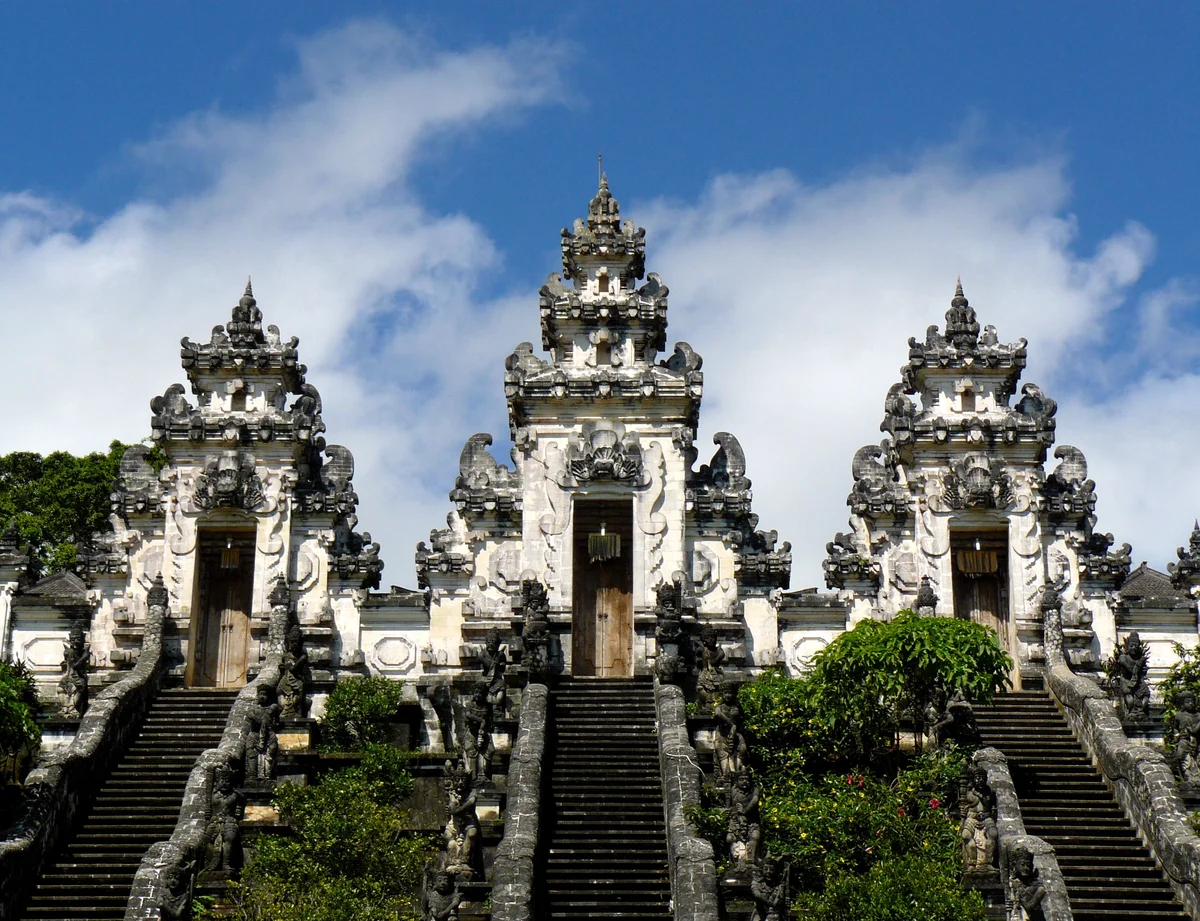
The most celebrated architectural feature in the complex is the grand gateway in the lower temple precinct, creating an unmistakable visual composition of twin symmetrical towers sculpted in traditional Balinese style. Reliefs carved across the gateway depict mythological motifs symbolizing the cosmic Mount Meru alongside Kala Makara—guardian figures meant to ward off negative forces and preserve the sanctity of the inner courtyard. Viewed through modern photography, this twin-gateway structure produces a striking mirror-reflection illusion through the skillful use of a hand-held mirror by local attendants, framing a direct, unobstructed vista toward majestic Mount Agung in the distance.
Lempuyang Temple’s iconic stature in contemporary global culture stems from the intersection of centuries-old architectural heritage and the reach of 21st-century digital media. Yet behind its worldwide fame lies a rigorous anthropological and spiritual framework strictly upheld by the Balinese people. Every visitor passing through these sacred gates must observe strict dress protocols, including wearing a traditional sarong and tying a sash around the waist, alongside local rules governing physical and spiritual purity.
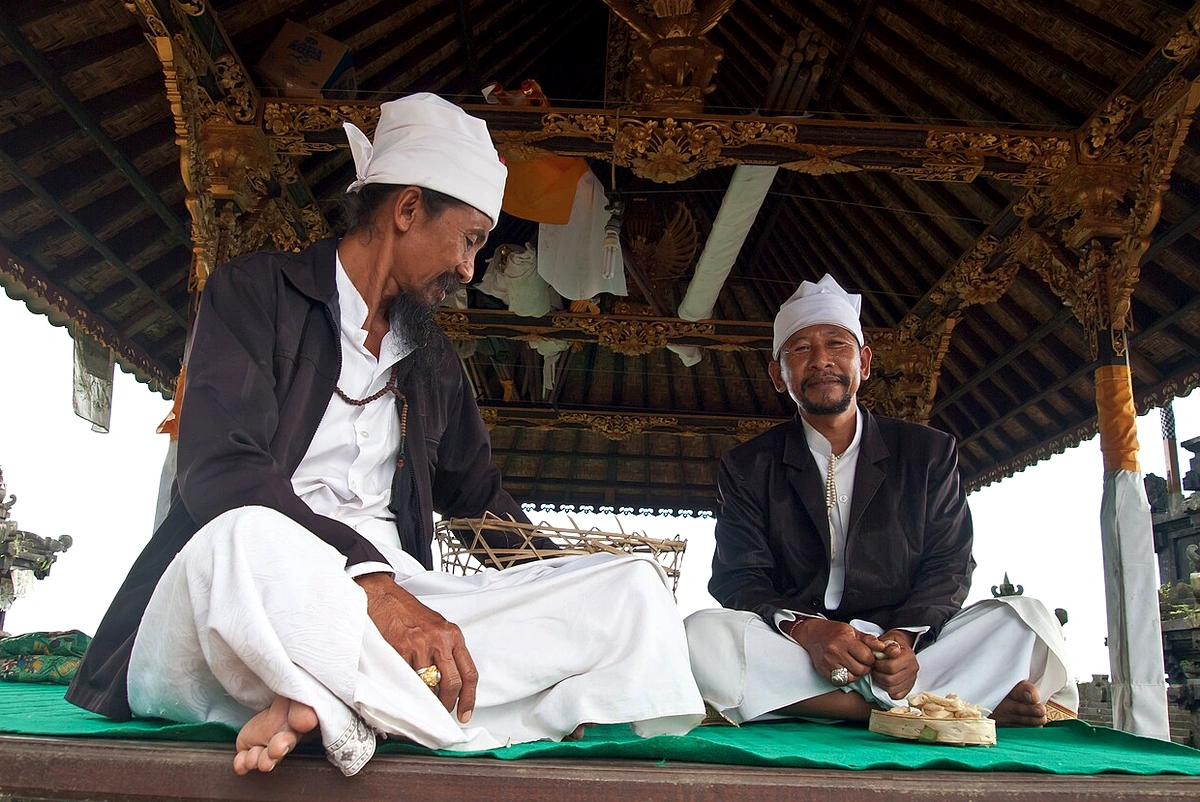
The sanctity of Pura Lempuyang is safeguarded by a council of temple priests known as Pemangku, who perform daily rituals and offer canang sari—intricate palm-leaf baskets filled with fresh blossoms and fragrant incense. These ceremonies continue uninterrupted, preserving a spiritual rhythm sustained for centuries despite the steady stream of international visitors each day. Consequently, the temple transcends the role of a conventional religious monument to act as a living cultural ambassador, conveying the Balinese philosophy of Tri Hita Karana—harmony among humanity, nature, and the divine.
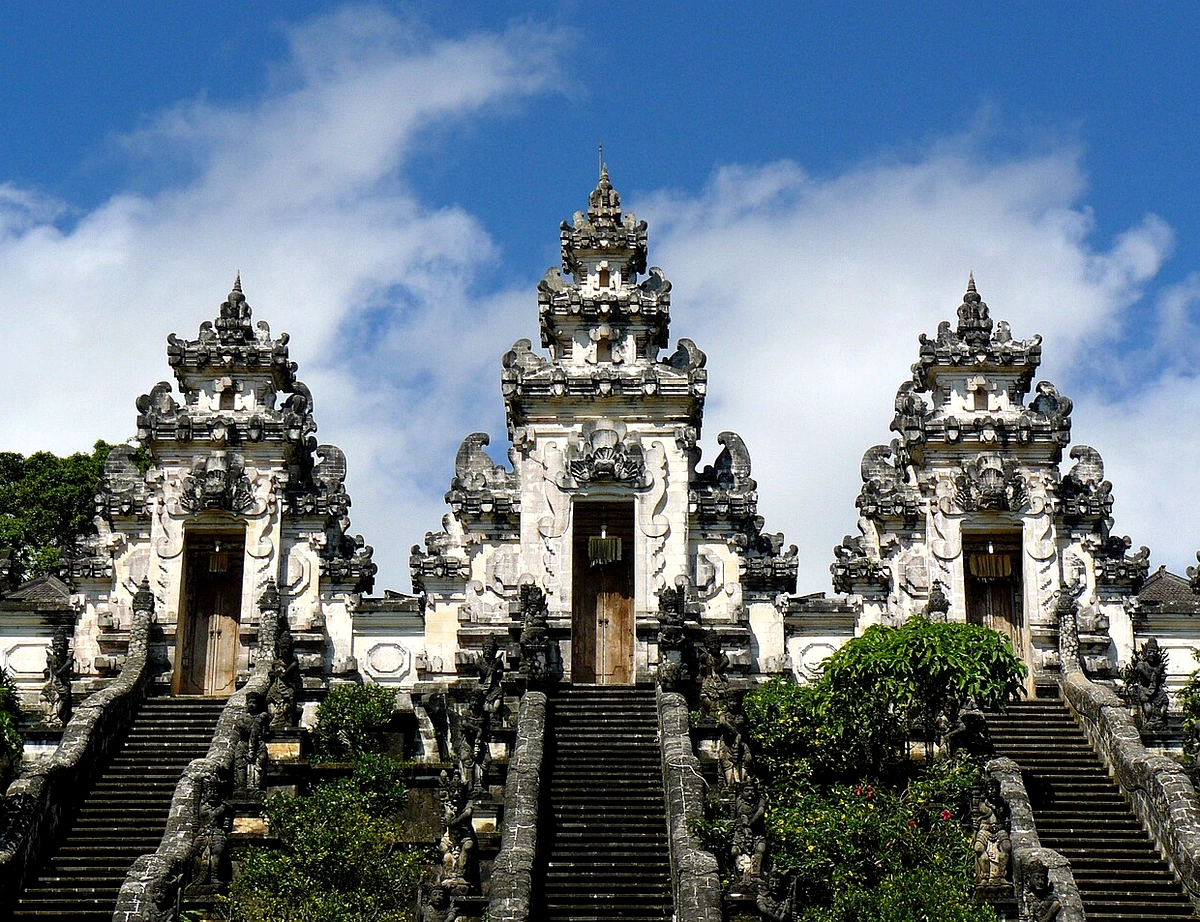
Viewed through the lens of art history, the stone carvings at Lempuyang represent the pinnacle of traditional craftsmanship by Karangasem artisans. Blocks of volcanic tuff stone are meticulously chiseled into deities, mythical guardians, and stylized tropical flora, demonstrating a profound command of material and architectural proportion. The seamless union between the dramatic natural terrain of Mount Lempuyang and its architectural thresholds creates a sacred environment capable of deeply moving every visitor, rising beyond material beauty into a realm of timeless serenity.
Ascending the slopes of Mount Lempuyang in eastern Bali’s Karangasem highlands, Pura Lempuyang exemplifies terrain-adaptive sacred planning within Nusantara Hindu architecture. Rather than imposing rigid flat geometry onto the landscape, its spatial creation reflects a centuries-long dialogue between human craftsmanship and the steep volcanic ridge. At roughly 1,100 meters above sea level, the entire complex unfolds along a vertical axis climbing from foothill to summit, mirroring Hindu cosmological hierarchies separating the secular world from the supreme divine realm. Steep gradients, basalt ravines, and primary tropical montane forest shaped the master plan, prompting generations of traditional Balinese architects to construct monumental basalt staircases that define spatial thresholds and guide pilgrim movement.
In terms of overall layout, Pura Lempuyang functions not as a single structure, but as a linked ensemble of seven temples arranged vertically up the mountainside, with Pura Penataran Agung Lempuyang on the lower terrace serving as the main ceremonial forecourt. From this starting point, spatial organization strictly follows the traditional Balinese tripartite division (Tri Mandala): nista mandala as the outer secular zone, madya mandala as the middle zone for ritual preparation, and utama mandala as the innermost and highest sacred precinct. These zones are delineated by dry-stacked volcanic stone walls paired with candi bentar split gates and roofed paduraksa portals. Beyond serving as physical boundaries, these portals act as carefully aligned optical frames guiding the pilgrim’s gaze upward toward the summit abode of Lord Iswara.
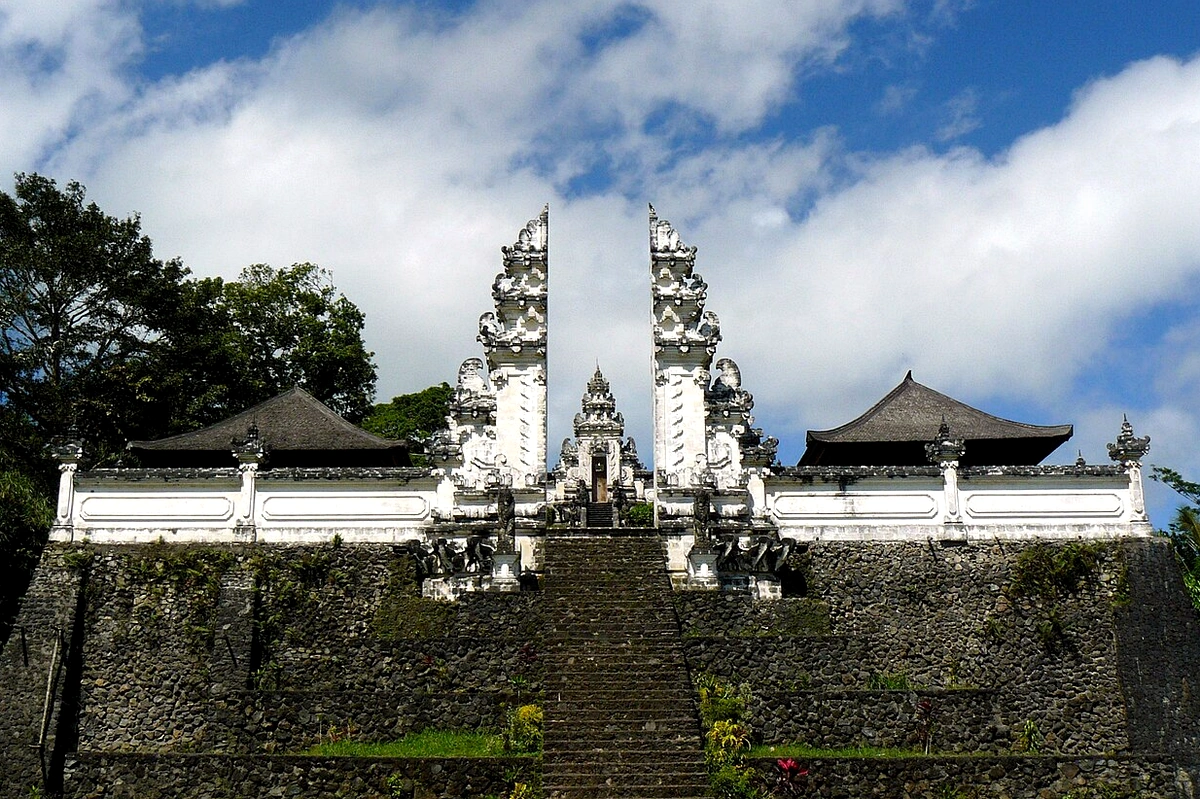
The most celebrated architectural focal point in the ensemble is the split gateway, or candi bentar, at the main lower sanctuary of Pura Penataran Agung. Emerging from a minimalist yet powerfully expressive sculptural concept, its symmetrical halves part cleanly down the middle, creating a vertical cleft rising straight into the sky. Carved in dark gray volcanic stone with flora, fauna, mythical guardians, and cosmological motifs, the towering gate contrasts dramatically against the luminous highland sky. In landscape terms, this split portal does not open into an enclosed interior hall as in Western architectural tradition; instead, it operates as a natural lens framing the sweeping vista ahead, where volcanic Mount Agung rises majestically through morning mist. This design transforms the surrounding valley and expansive sky into an integral part of the temple’s architecture.
The pedestrian circulation network linking the tiered sanctuaries of Lempuyang is an engineering triumph of stone terracing on steep volcanic terrain. More than 1,700 gray stone steps, hand-cut and fitted carefully along the ridge, form the sole artery for both local worshippers and travelers. Climbing this prolonged staircase induces a gradual psychological transition from the bustling mundane world below into the tranquil sanctity of the upper sanctuaries. Along the ascent, surrounding ecosystems shift steadily with altitude—from dense bamboo groves and terraced farms on the lower slopes to drifting mountain mists and cool highland cloud forest surrounding upper sanctuaries such as Pura Lempuyang Luhur at the peak.
Interior spatial arrangements within each individual sanctuary reflect the rigorous social and religious order of ancient Bali. Main courtyards are bordered by open-sided pavilions known as bale, built with timber post-and-beam frames resting on raised stone platforms and thatched with black sugar-palm fiber. Each bale serves a specific ceremonial function—from housing traditional gamelan ensembles and preparing ritual offerings to hosting gatherings of village elders. These structures are oriented along sacred east-west and north-south axes governed by the Balinese cosmological compass, with the eastern sunrise direction holding supreme sanctity and housing multi-tiered meru shrines. Rising with an odd number of stacked roofs symbolizing celestial heavens in Hindu cosmology, these meru towers soar above the forest canopy, lending majestic vertical rhythm to the entire sacred landscape.
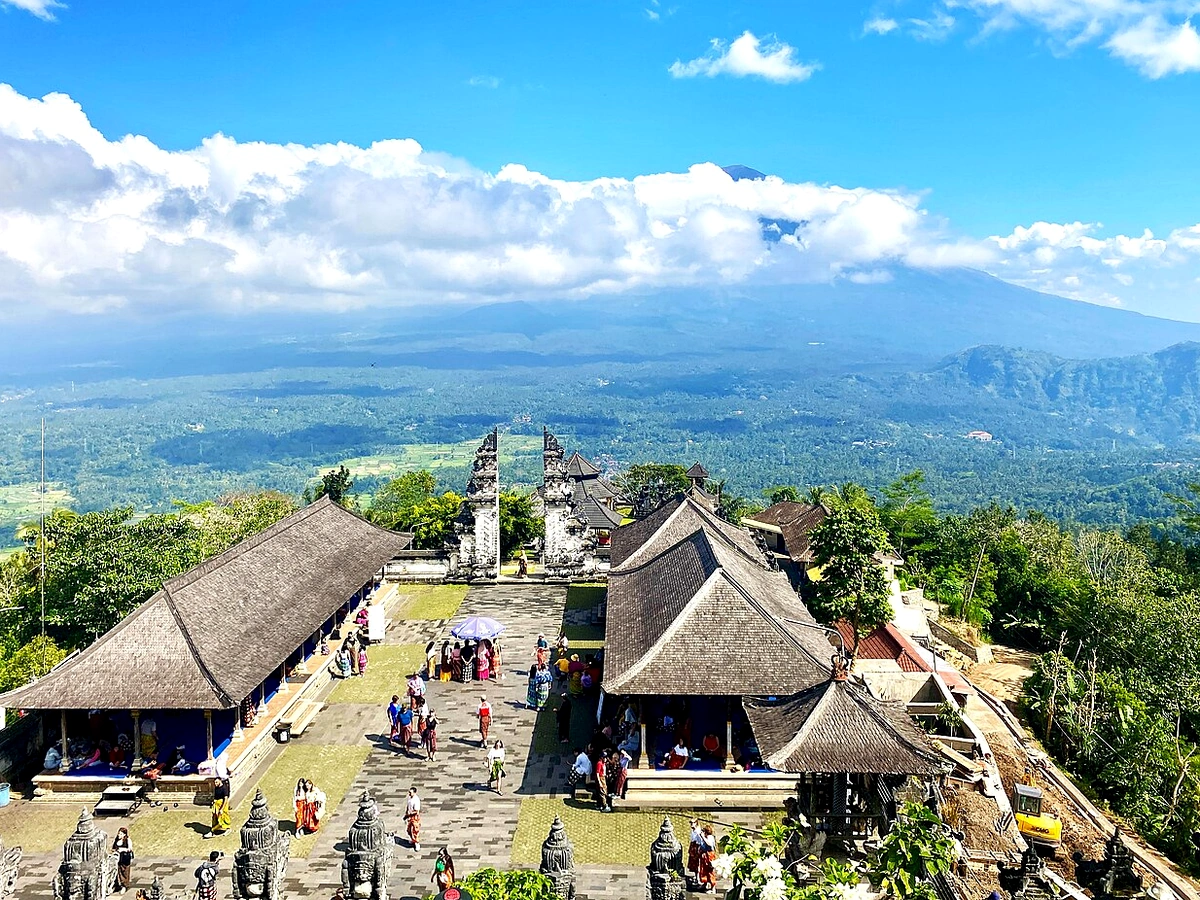
The landscape enveloping Lempuyang is strongly shaped by montane tropical rainforest ecosystems and the distinct microclimate of northeastern Bali. Afternoon clouds frequently drift across the mountainside, continually shifting depth of field and softening rigid boundaries between human masonry and surrounding wilderness. Ancient temple builders harnessed these atmospheric shifts by laying out broad, open-air stone courtyards whose surfaces reflect changing light throughout the day, turning static architecture into a living canvas responsive to sky and weather. Mature sacred trees—such as banyans and giant tree ferns—preserved along perimeter walls carry spiritual significance as symbols of divine shelter while naturally stabilizing volcanic slopes against erosion.
Taken as a whole, the architectural planning of Pura Lempuyang exemplifies Bali’s philosophy of design in harmony with nature—where landscape is never conquered by technology, but honored through restrained yet commanding architectural forms. The ensemble successfully establishes a multi-tiered spatial order uniting micro-level basalt carvings with macro-level volcanic panoramas, standing as a religious heritage landmark of enduring value for understanding sacred architecture and settlement planning across Southeast Asia.
Known in Balinese Hindu tradition as Pura Lempuyang Luhur, the temple complex reigns over the eastern slope of sacred Mount Lempuyang at roughly 1,000 meters above sea level. Its creation is inseparable from Bali’s volcanic belt, where highland elevation establishes a natural threshold between earthly existence and the celestial realm of supreme deities. Ancient Balinese spatial planning for Lempuyang reflects a deep understanding of sacred geography, turning each stone step into an act of inner purification prior to entering the holiest precinct. Distributed vertically along the mountain ridge, the complex adheres faithfully to the traditional Hindu-Javanese Mandala model, in which lower temples act as preparatory stations leading toward the crowning summit sanctuary of Lempuyang Luhur. This tiered progression both protects structures from heavy hillside rainwater runoff and establishes a cosmological ascent in which pilgrims transform awareness from the mundane plane toward the eternal.
The primary building material across Lempuyang’s architecture is dark gray volcanic stone, an abundant local resource born from Bali’s geological activity. Valued for high compressive strength and resilience against high humidity and sharp highland temperature swings, this stone imparts a solemn, dignified visual tone to the entire complex. Alongside volcanic rock, traditional artisans used specialized lime mortar to bind masonry courses and anchor high-relief carvings. Because volcanic basalt is porous and coarse-grained, shaping it required painstaking hand-chiseling techniques to achieve smooth planes and fluid curves without fracturing the stone’s internal crystalline structure. This material choice embodies a core Balinese ecological and philosophical principle: using the very body of Mother Earth to build sanctuaries for the gods, achieving seamless unity between human architecture and wild mountain terrain.
Stone carving at Lempuyang reaches the height of Southeast Asian Hindu architectural sculpture, distinguished by deep relief work and intricate ornamentation echoing classical Javanese artistry from the 4th through 15th centuries. Gateways, perimeter walls, and shrine bases are richly adorned with stylized scrolling foliage, blooming lotuses, and mythical guardians such as the divine bird Garuda, sacred Naga serpents, and protective Kala faces that repel malevolent forces. A hallmark of Balinese master sculptors is strict symmetry paired with nuanced interplay between raised and recessed surfaces, creating subtle visual movement as sunlight shifts across the day. Rather than carving flat decorations alone, artisans sculpted bold three-dimensional figures projecting outward from the stone, infusing sacred statues with spatial depth and vitality grounded in the belief that even stone holds spiritual energy.
The most iconic and academically studied architectural feature here is the split gateway—known as Candi Bentar—located at the lower temple of Pura Penataran Agung Lempuyang. Sculpted in the form of a sacred mountain cleft cleanly down the center into two symmetrical halves, its dramatic vertical opening aligns directly toward towering Mount Agung to the west. Structurally, erecting two soaring, tapering stone towers without an overhead connecting arch posed a formidable engineering challenge for ancient builders. Stability relies entirely on the dead weight of precisely fitted vertical stone courses and concealed stone interlocking joints. Philosophically, this split portal expresses classic Hindu dualism and cosmic balance—where light and shadow, good and evil, masculine and feminine coexist in harmony and converge at the central threshold.
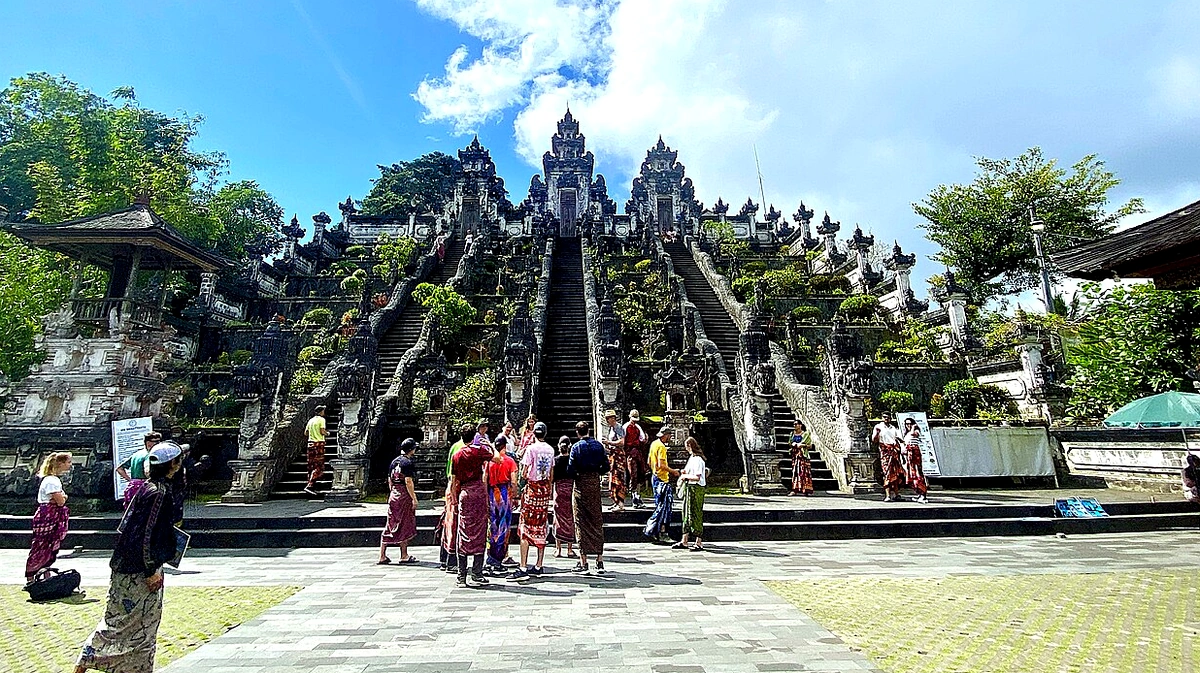
Stepping further beyond the Candi Bentar brings visitors to enclosed roofed portals known as Paduraksa or Kori Agung, which mark the threshold into the innermost sanctuary housing Padmasana thrones dedicated to Acintya, the supreme transcendent deity in Balinese Hinduism. The roofs of Paduraksa gateways follow a multi-tiered pagoda-like profile thatched with durable, waterproof black palm fiber known as ijuk. Stacked in odd-numbered tiers according to each temple’s rank, these roofs symbolize celestial realms in Hindu cosmology. Framing rooflines and corners are terracotta or stone sculptures of Bhoma—a protective guardian visage with bulging eyes and outstretched tongue meant to deflect negative energies from entering the purified worship courtyard.
The architectural aesthetics of Lempuyang are further shaped by a harmonious relationship between built forms and expansive nature, where structures never seek to dominate or obscure the landscape, but instead act as frames directing human perception. Tree-shaded staircases lined with mythical guardian statues establish a deliberate, unhurried pace, inviting pilgrims to leave behind worldly haste and attune themselves to highland stillness. These moss-kissed stone steps serve not only as physical walkways, but also as spiritual ladders guiding seekers beyond earthly desires toward higher wisdom. Every carved detail along the balustrades—from stylized bodhi leaves to undulating dragons—is angled to catch sunlight differently throughout the day, forming a stone chronicle of cosmic order and Balinese ethics.
From a cultural anthropology standpoint, the entire Lempuyang complex functions as a living architectural text embodying Tri Hita Karana—the foundational Balinese principle of maintaining harmony between humanity and the divine, among fellow human beings, and between humanity and nature. Smaller shrines scattered along the mountain slope serve both as places of worship and as sacred milestones binding local villages to the mountain, where residents offer prayers for fertility, abundant harvests, and protection from natural hazards. Handcrafted building methods passed down across generations of master masons preserve invaluable indigenous knowledge of local stone and slope-stabilizing engineering. Despite tropical weather and seismic activity over the centuries, Lempuyang Temple endures as a masterpiece of sacred architecture where stone is given soul to bridge the mortal world and the eternal realm of the gods.
The spiritual complex of Pura Luhur Lempuyang ascends the eastern flank of sacred Mount Lempuyang in Bali’s Karangasem regency, Indonesia. Geographical and religious surveys affirm its status as one of the Sad Kahyangan Jagat—the six foundational sanctuaries anchoring cosmic order and safeguarding Hindu spiritual life across Bali. Rather than sitting on a single elevation, the complex rises vertically up the mountainside from the foothills to its crowning peak at approximately 1,170 meters above sea level. This tiered layout reflects Hindu cosmology, in which deities dwell in pure highland realms far removed from worldly defilement, requiring devotees to undergo physical and spiritual purification through an arduous climb to draw closer to the divine.
A physical visit to Lempuyang begins at the main entrance gate at the foot of the mountain, where travelers complete registration procedures and don traditional ceremonial attire—a sarong and waist sash (selendang)—in accordance with Balinese religious etiquette. From this checkpoint, onward access divides into two distinct options depending on fitness and available time. The first option uses a local shuttle vehicle navigating steep switchbacks to reach the main lower temple, Pura Penataran Agung Lempuyang, on the first terrace. The second, more traditional pilgrimage route follows ancient stone steps winding through primary tropical forest, where visitors can observe native flora and hear distant ceremonial chants echoing through the trees.
The first major focal point—and the station drawing the largest number of visitors—is Pura Penataran Agung Lempuyang, home to the famed Gates of Heaven, known locally as the Candi Bentar. Comprising two symmetrical towers rising cleanly toward the sky, the gateway is intricately carved in dark volcanic stone with Hindu mythological motifs depicting the cosmic Mount Meru dividing earthly and celestial realms. Its central axis aligns directly toward towering Mount Agung to the west, creating an extraordinary visual vista in clear weather. Visitor flow here is carefully regulated by the traditional temple council: guests receive numbered queue tickets and await their turn at the central gateway photo spot, where local temple photographers use a clever mirror technique to capture a crystal-clear reflection effect.
Beyond the lower sanctuary of Pura Penataran Agung, exploration continues deeper into the upper temples scattered along higher ridges. Reaching the middle and upper sanctuaries presents a genuine physical challenge via more than 1,700 steep stone steps shaded by dense forest canopy. Along this pilgrimage trail, the air grows thinner, temperatures cool noticeably, and deep tranquility settles over the mountain, broken only by wild birdsong and wind rustling through ancient trees. Smaller wayside sanctuaries along the ascent—such as Pura Telaga Mas and Pura Luhur Dadah—serve as spiritual rest stops where devotees pause to pray, cleanse their faces with sacred spring water, and gather strength for the climb ahead.
The culmination of the ascent is Pura Luhur Lempuyang, the supreme summit sanctuary standing at the highest point of the pilgrimage trail. In stark contrast to the lively crowds at the lower Gates of Heaven, the summit temple preserves an atmosphere of pure, untouched sanctity and solemn Balinese devotion. Its ancient carved architecture features sacred shrines and pagodas gazing out over the vast ocean and deep valleys far below. Dedicated to Lord Iswara—guardian of the eastern quarter in Hindu cosmology—the inner courtyard requires all visitors to maintain respectful quiet, bodily purity, and proper traditional attire.
From the summit of Lempuyang, sweeping panoramas unfold across eastern Bali’s dramatic terrain, where clouds, sea, and volcanic peaks merge into a vista of cosmic grandeur. In the early morning before mists dissipate, the tiered temples appear to float among drifting clouds, reinforcing the sanctuary’s sacred aura in local consciousness. An optimal itinerary requires careful timing—typically departing well before dawn to catch first light shining through the Candi Bentar, spending the morning ascending to the upper sanctuaries, and descending by early afternoon before highland weather turns misty or rainy.
Ultimately, Lempuyang’s tiered layout and pilgrimage route represent far more than a sightseeing attraction; they form a living archive of anthropology, sacred architecture, and cultural geography within Nusantara civilization. By guiding travelers upward from lower to higher elevations—from the secular to the sacred—the temple offers a journey of genuine philosophical depth calling for both physical effort and mindful presence. Understanding these precincts allows travelers to plan thoughtfully, honor local traditions, and appreciate the enduring spirit of one of Indonesia’s greatest spiritual landmarks.
Situated on the eastern slopes of Mount Lempuyang in Bali’s Karangasem regency, Pura Lempuyang stands as one of the island’s oldest and most revered Hindu centers. Beyond its architectural and religious significance, the temple anchors a rich ecosystem of community-run services, hospitality, and living cultural traditions nurtured over centuries by villages surrounding the mountainside. Local daily life moves in harmony with the temple’s ceremonial calendar, weaving together cultural tourism, traditional agriculture, and devotional practice into an organic social fabric that rewards thoughtful travelers with authentic cultural insight.
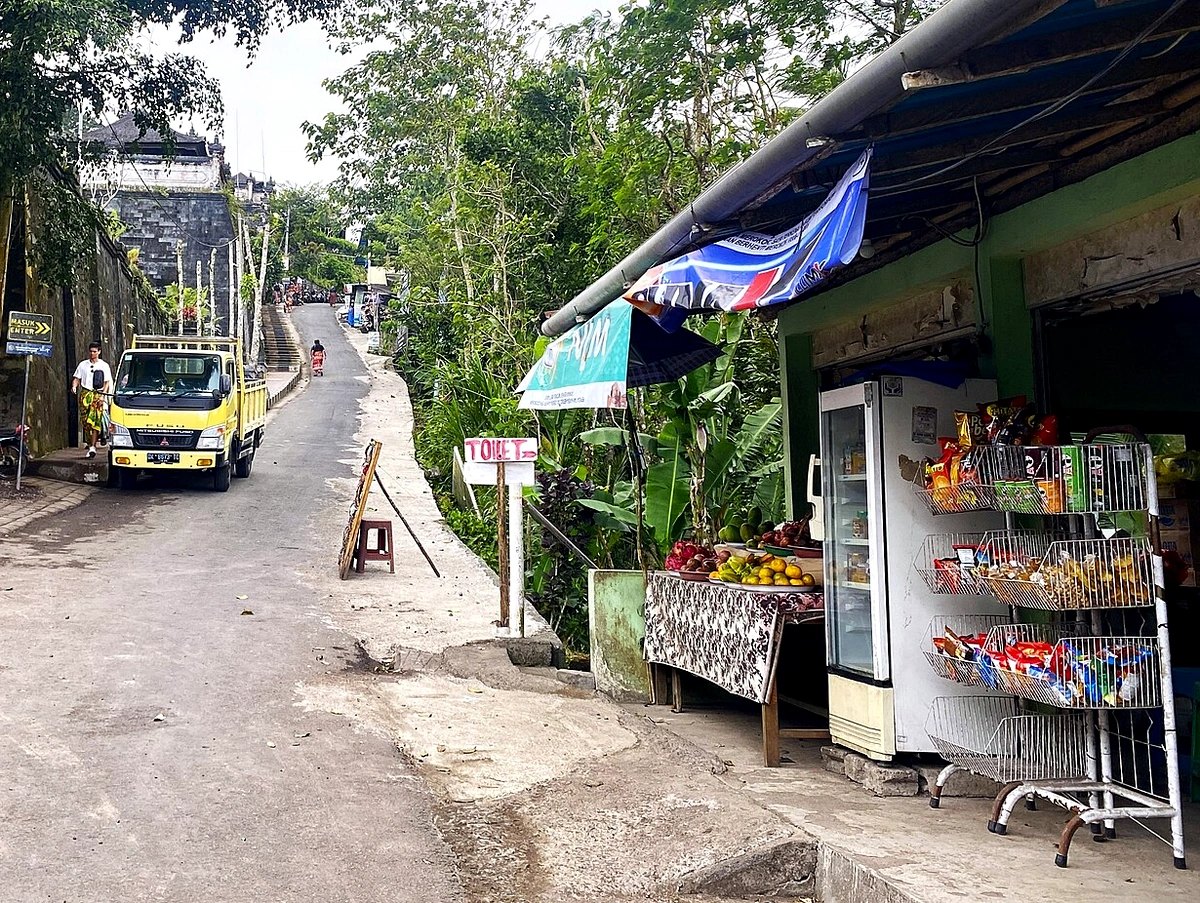
In terms of community interaction, the temple foothills and neighboring villages such as Bisbis serve as the first point of contact between visitors and local Balinese life. Unlike bustling southern resort hubs such as Kuta or Seminyak, everyday life in Karangasem retains the quiet dignity and strong communal cohesion of the banjar—Bali’s traditional village council system. Visitor services here are largely managed by village cooperatives and local families, ranging from steep-hill shuttle transport to rentals of traditional sarong and selendang attire. Putting on ceremonial dress before ascending the stone steps functions not merely as a rule, but as a welcoming cultural rite in which local residents personally help visitors wrap their garments properly while sharing Balinese values of reverence and mindfulness.
The cultural ecosystem around Lempuyang is further enriched by interactive craft traditions and classical music. Local residents maintain small woodcarving and stone-sculpting workshops along the approach roads, where skilled artisans chisel deities and mythical figures from volcanic stone and teakwood. Visitors can watch intricate hand-carving techniques firsthand while hearing stories from the Mahabharata and Ramayana epics passed down orally across generations. In addition, local dance troupes occasionally stage intimate performances of traditional Barong or Legong dances in village courtyards, creating authentic artistic encounters filled with warmth, spirituality, and genuine hospitality.
Local cuisine around Lempuyang reflects the volcanic terroir of Karangasem alongside culinary traditions inherited from the historic Kingdom of Karangasem. Family-run eateries and roadside stalls along the mountainside serve authentic dishes such as Lawar—a finely minced blend of vegetables, meat, grated coconut, and traditional basa genep spice paste made with shallots, garlic, turmeric, ginger, galangal, and white pepper. Another signature specialty is Babi Guling, Balinese whole spit-roasted pig marinated with aromatic island herbs and slow-roasted over wood fires until the skin turns crisp and golden. Locals also offer tuak—a traditional fermented palm-flower beverage—and warming herbal root infusions that help chase away the cool highland mist.
Community life around Lempuyang follows the rhythm of the Balinese Saka lunar calendar and seasonal mountain terrace farming. Rather than relying solely on tourism, most families continue cultivating wet rice, vanilla, coffee, and orchard fruits on steep hillside terraces. Balancing agricultural heritage with cultural tourism has prompted village councils to play a central role in reinvesting entrance fees and service revenues into community infrastructure, shrine maintenance, and major temple anniversary festivals such as Odalan.
While visitor amenities have been thoughtfully upgraded in recent years to meet international standards, they remain modest and harmonious with the surrounding mountain landscape. Locally operated family homestays invite travelers to experience living inside traditional Balinese family compounds laid out according to Hindu cosmological orientation toward sacred Mount Agung and the sea. Staying in these compounds fosters meaningful cultural exchange—from learning how to weave palm-leaf canang sari offering baskets to discovering Bali’s iconic Subak cooperative irrigation system.
Viewed through the lens of local community life and stewardship, Lempuyang Temple rises far above a simple photography stop to stand as a living cultural ecosystem. Active village participation in temple management, culinary hospitality, ritual guidance, and traditional arts has fostered a sustainable, responsible model of cultural tourism in which local identity thrives rather than erodes—reminding travelers that the true heart of cultural travel lies in mutual understanding and respect.
Visiting Pura Lempuyang Luhur on Bali’s eastern slopes rewards thorough preparation and smart timing due to its steep volcanic terrain and year-round popularity among both pilgrims and international travelers. Rising roughly 1,170 meters above sea level on Mount Lempuyang in Karangasem regency, this sacred sanctuary is best experienced when you understand its daily operating rhythm, seasonal weather shifts, road access, and cultural etiquette—ensuring a smooth, respectful, and visually unforgettable journey.
The golden window to visit Lempuyang’s iconic gateway begins at sunrise, before morning light is obscured by clouds that typically gather around the mountain slopes by midday. Visitors staying in southern hubs such as Kuta, Seminyak, or Ubud usually set out very early—around 03:00 to 04:00 AM—to cover the 80-to-90-kilometer drive and reach the temple foothills right as the main gates open at 06:00 AM. Arriving early not only avoids harsh equatorial midday sun, but is also the surest way to minimize wait times for numbered photo tickets at the famous gateway, where peak-season queues can stretch from three to five hours. Conversely, arriving after 03:00 PM frequently brings dense afternoon clouds that veil Mount Agung behind the gate.
Seasonally, Bali’s climate is governed by two distinct monsoon patterns that directly influence conditions at Lempuyang. The dry season runs from April through October, bringing low rainfall, crisp skies, and the highest probability of unobstructed panoramic views across Mount Agung and surrounding valleys. However, this period also coincides with peak international travel, resulting in larger crowds and heavier road traffic. The rainy season spans November through March, bringing higher humidity, sudden afternoon showers, and slick mountain roads leading into Karangasem. Even so, the wet season bathes the highlands in lush emerald greenery and atmospheric drifting mists, offering a quieter, deeply contemplative window into local spiritual life.
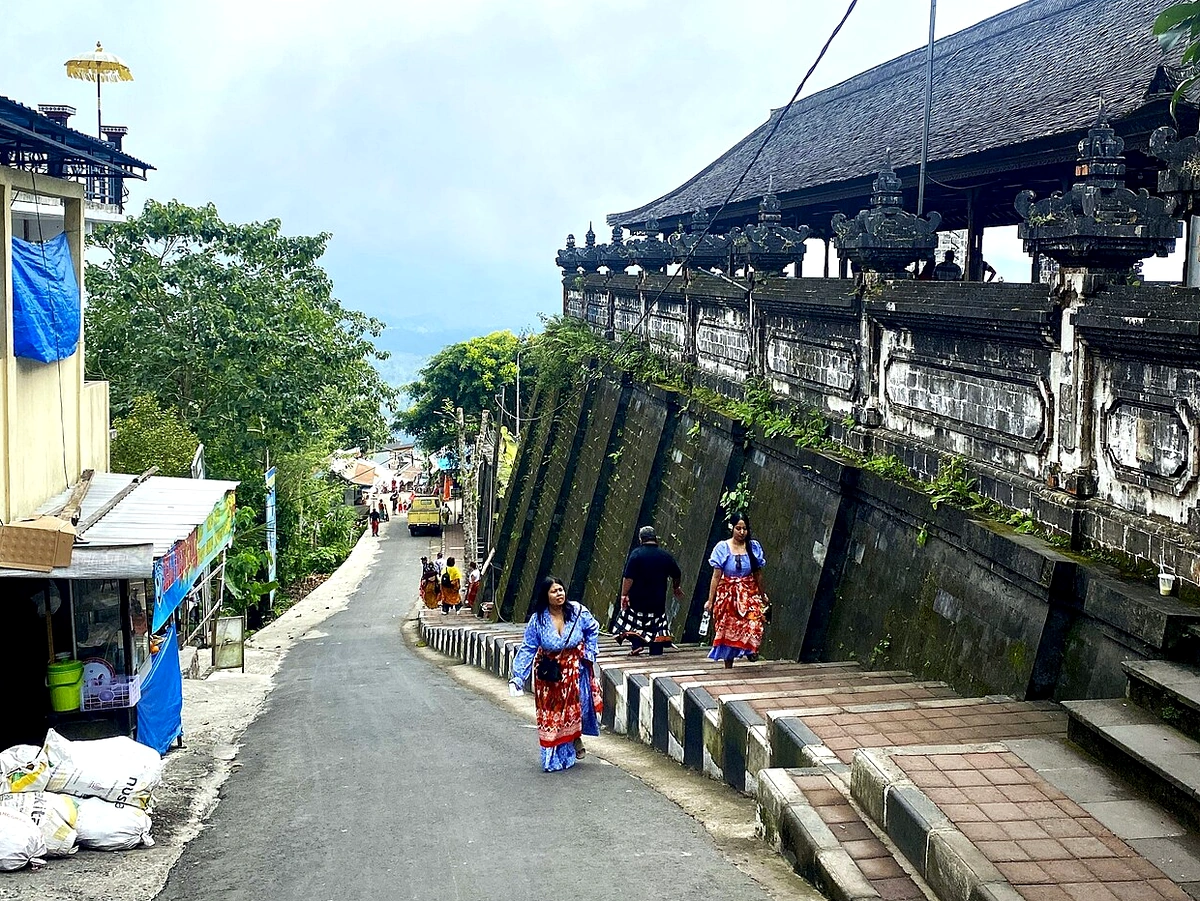
Reaching Lempuyang by road requires careful planning given the winding, steep mountain terrain of eastern Bali. The safest and most comfortable option for international visitors is hiring a private car with an experienced local driver familiar with Karangasem’s narrow, steeply graded passes. Self-riding a scooter from southern Bali is generally discouraged for riders without extensive local road experience, as the nearly three-hour journey along busy highways shared with heavy trucks followed by steep hill climbs can be exhausting. Upon arriving at the main foothill parking area, visitors transfer to official temple-managed shuttle buses or local motorbike taxis to ascend the final steep 500-meter approach road to the main temple entrance, ensuring traffic safety and orderly crowd flow.
Dress code rules at Pura Lempuyang Luhur are mandatory and strictly aligned with Balinese Hindu temple protocol. All visitors, regardless of faith or nationality, must wear a traditional sarong covering from waist to ankles along with a waist sash (selendang). These garments are typically included with admission or available to rent at the entrance checkpoint. Upper-body attire must also be modest, covering shoulders and chest without low necklines, and women who are menstruating are prohibited from entering sacred temple grounds in accordance with longstanding Balinese religious custom. Observing these rules demonstrates genuine respect for sacred space and sustains harmony between international guests and local temple custodians.
Alongside proper dress, strict behavioral etiquette preserves the solemnity of the sanctuary. Visitors must refrain from loud laughter or shouting, flying drones without special permission from temple authorities, or climbing onto sacred shrine platforms reserved exclusively for praying devotees. Public displays of romantic affection, such as kissing or embracing, are considered disrespectful within temple precincts. At the Gates of Heaven photo spot, creating the signature water-reflection effect is standardized and handled exclusively by authorized local temple photographers for a small donation toward temple upkeep, ensuring fairness and order for everyone waiting in line.
Personal packing also deserves thoughtful attention given the highland microclimate above 1,000 meters. Sturdy walking shoes with reliable traction are essential, as stone staircases ascending to Lempuyang’s upper temples can become slick in high humidity or after sudden mountain showers. Bring sufficient drinking water to stay hydrated during the climb and queue, along with a light jacket or windbreaker since early-morning temperatures on the mountain slope feel noticeably cooler than along the coast. Sunscreen, a sun hat, and sunglasses are also recommended to protect against intense equatorial UV rays, ensuring your visit remains comfortable and safe from start to finish.
To experience this journey seamlessly alongside a knowledgeable local guide, explore our curated all-inclusive international tour packages with thoughtfully arranged itineraries.