Located in the heart of Pathum Wan district, where historical currents and modern pulses intersect in Bangkok, CentralWorld is not merely a commercial symbol but a mirror reflecting the ups and downs of the Kingdom of Thailand over more than a century. To understand the sheer scale of this complex today, one must travel back in time to the reign of King Rama VI, when this area was known as the “Pathum Wan Royal Stables”—magnificent royal stables. Under the rule of the monarch renowned for his reformist mindset and outward-looking vision, this land once nurtured fine steed horses serving court rituals, carrying the distinct breath of a golden age where the fusion of Western culture and Siamese traditions began to flourish robustly.
The transformation from a royal symbolic space into a major economic center began in 1990, when Central Group—the powerful retail empire of the Chirathivat family—laid the first bricks for the “World Trade Center” project. This was a bold move, marking the rise of Thai entrepreneurs amid a take-off regional economy. By 2002, following a full acquisition and restructuring, the Chirathivat family officially renamed the project CentralWorld, opening a new chapter in Bangkok’s urban development history. This event was not merely a straightforward business transaction but a reaffirmation of the Chirathivat family’s stature in shaping the nation’s commercial landscape.
The pinnacle of this ambition was realized in 2006 when expansion work concluded, making CentralWorld the largest shopping center in the world at that time. With a total floor area spanning hundreds of thousands of square meters, the structure is not just a block of reinforced concrete, but a “city within a city” gathering the finest elements of global consumerism. However, CentralWorld’s history is written not only in growth numbers or glowing signage, but also scarred by historical turmoil. In 2010, amid escalating political instability in Thailand, the building became the epicenter of the Red Shirts protests. Fires erupting from political conflicts burned down a portion of the space, leaving a painful yet highly symbolic milestone in Bangkok’s modern history.
The 2010 fire incident was not merely a disrupted commercial event, but a test of the resilient vitality of an iconic structure. CentralWorld’s powerful resurrection from the ashes afterward became a metaphor for Bangkok’s capacity for recovery—a city that always knows how to stand up after political fluctuations to keep operating along the rhythm of development. The walls, pathways, and every tiny corner of CentralWorld today quietly recount the story of its transition from Rama VI’s royal stables through the ambitious construction years of the Chirathivat family to the fiery days of historical turbulence. Every step a visitor takes here is therefore not just a shopping journey, but a stroll through historical strata where past and present blend, creating an unmistakable, unique identity of the capital of the Land of Smiles.
Situated in the heart of Pathum Wan district, CentralWorld is not only a top-tier commercial complex in Southeast Asia with a floor area reaching 550,000 square meters, but also an architectural entity shaped by profound Thai feng shui principles. In Bangkok’s urban planning mindset, this area is dubbed by feng shui masters as the “intersection of the Water Dragon.” The presence of the Khlong Saen Saep canal—a waterway transport artery dating back to King Rama III—running along the rear of the building creates the geomantic formation of “Water gathering at heaven’s center.” In East Asian belief, water symbolizes wealth, and this meandering current embracing CentralWorld’s terrain is regarded as a “jade-embracing belt” formation, helping retain auspicious energy, preventing financial leakage, and driving an unceasing circulation of prosperous energy.
The geomantic resonance here is further reinforced by a rare “spiritual magnetic field.” Its location right next to the Erawan Shrine—housing the sacred four-faced Brahma god—and close to other spiritual symbols has turned this area into a genuine “Dragon Lair.” Thai people believe that the presence of deities not only brings protection but also generates a positive energy field, attracting millions of pilgrims and tourists each year. The combination of static spiritual elements and vibrant commercial life creates a perfect yin-yang balance. CentralWorld’s architecture, featuring an expansive facade and giant glass blocks, is meticulously calculated to welcome natural daylight, symbolizing transparency and sustainable development, while the building’s edges are cleverly rounded to deflect malevolent qi from the bustling surrounding traffic intersections.
In terms of planning engineering, CentralWorld is a marvel of spatial connectivity. Following the 2010 fire incident, reconstruction was executed with the most rigorous safety and aesthetic standards. Engineers applied ultra-durable load-bearing steel frame systems combined with reflective tempered glass cladding, which not only optimizes indoor sightlines but also creates a visual effect of a “transparent building” amidst the urban core. The elevated skywalk system connecting directly with the BTS Skytrain system is not merely an engineering solution to ease ground traffic pressure, but also an important “airflow conduit,” channeling crowds—namely the flow of energy—directly into the heart of the architectural block. This is the planning art of “channeling water into the fields,” turning every customer’s footstep into a heartbeat of prosperity.
CentralWorld’s signature landscape is further punctuated by the front plaza, which frequently hosts major festivals like New Year’s Eve countdowns or traditional cultural events. This open space is designed according to the “Bright Hall gathering water” philosophy, a spacious courtyard in front of the facade helping accumulate energy before channeling it inside. Water fountains and contemporary art sculptures placed here serve not only as decorations but also as feng shui “regulating stations,” softening the harshness of concrete and steel while bringing a relaxed sensation to anyone stepping inside. The intersection between ancient spiritual values and modern architectural thinking has turned CentralWorld into a living entity where every brick and every water stream tells a story of Bangkok’s endurance and unceasing growth.
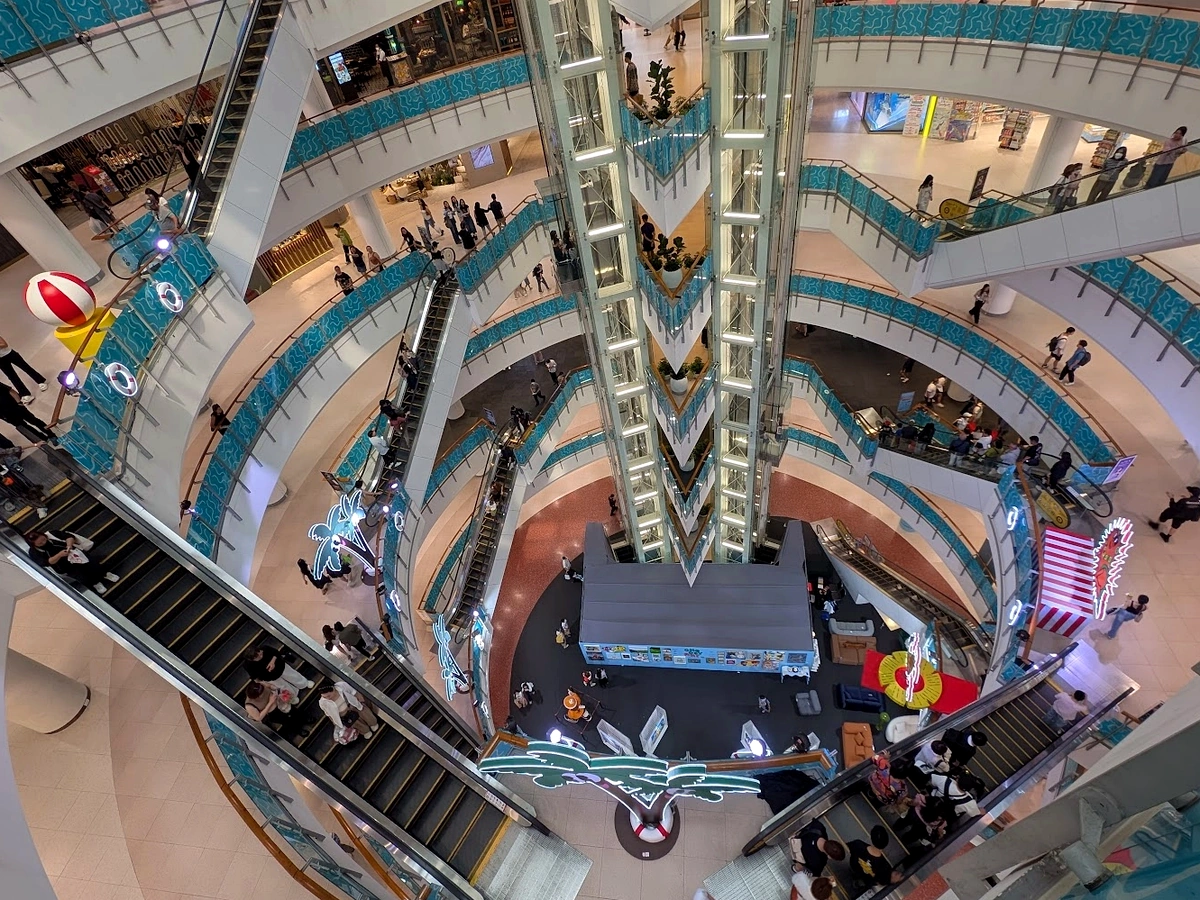
If Bangkok is envisioned as a living, moving body, CentralWorld is its most powerful pulse—an architectural icon challenging all limits of scale and urban spatial thinking. Standing before this massive complex, one sees not just a shopping mall, but an engineering marvel built from ambitions to redefine modern shopping concepts. With a total area reaching 830,000 square meters, CentralWorld is not merely a building, but a “city within a city” where the fusion of advanced construction engineering and Thai open-space philosophy is fully expressed.
The core highlight in CentralWorld’s structure is the application of a colossal steel framework—the Mega-Steel Structure. This was a bold decision by architects to completely eliminate traditional pillar systems in main lobby areas, creating breathtakingly vast, airy atrium spaces. Freeing spaces from rigid concrete pillars not only optimizes sightlines but also creates absolute flexibility for large-scale cultural and art events frequently held here. Under that steel dome, the firmness of industrial materials blends with the softness of light, producing an atmosphere that is both majestic and intimate.
Refinement in craftsmanship is further demonstrated through the “Light Box” glass facade design. Instead of enclosing solid brick walls, architects wrapped the entire structure in large-format tempered glass panels, allowing natural light to flood every corner of the building. By day, CentralWorld resembles a giant crystal block reflecting Bangkok’s sky, while at nightfall, it transforms into a brilliant lantern shining in the capital’s center. This technique not only saves energy but also blurs boundaries between interior spaces and vibrant external urban life, making visitors always feel part of the metropolitan current.
Inside CentralWorld, interior layouts are styled with “fluid corridors,” an artful simulation derived from the structure of traditional Thai markets. While Western shopping malls feature straight, rigid walkways, corridors here meander and intertwine naturally, guiding footsteps through surprising shopping “oases.” This arrangement recalls small alleys or floating markets along the Chao Phraya River, where human connection is prioritized. This flexibility turns shopping into a stroll where every turn offers fresh visual experiences.
CentralWorld’s actual scale is further affirmed through the multi-functional integration of two modern office towers and two world-class international hotels, Centara Grand and Zen. This combination serves commercial needs while creating a complete service ecosystem where business professionals, tourists, and locals converge. Placing five-star hotels directly atop the commercial podium demonstrates an “all-in-one” planning mindset, optimizing time and experiences for luxury guests. Looking down from hotel guest rooms, one can survey the Ratchaprasong intersection—considered Bangkok’s “spiritual and commercial heart,” where sacred shrines like Erawan sit opposite CentralWorld’s prosperity, creating a fascinating contrast between tradition and modernity.
Every minute detail in CentralWorld’s design, from lighting arrangements and material selection to customer traffic flow, is meticulously calculated to honor Thai hospitality. This is not merely a reinforced concrete structure, but a contemporary architectural artwork where colossal scale does not sacrifice refinement, and modernity does not eclipse indigenous cultural values deeply rooted in the Land of Smiles’ subconscious.

When night falls over Bangkok’s sky, CentralWorld is not just a shopping mall, but truly transforms into a living entity, a brilliant “heart” of the modern metropolis. CentralWorld Square—the expansive open space in front of the building—serves as a national stage where Thailand’s cultural pulses are amplified to international stature. Spanning over 8,000 square meters, this is the premier event venue in the Land of Smiles, where hundreds of thousands share a collective breath during sacred New Year countdown moments. New Year countdown events here have long become a cultural icon, a tropical “version” of Times Square, where music, fireworks, and the resonance of tens of thousands of souls generate energy unmatched anywhere else in the world.

Impressive and magnificent scenery at CentralWorld Bangkok Shopping Mall
The mesmerizing visual highlight here is the LED matrix lighting system covering the entire building facade. This technology goes beyond mere decoration, turning the massive architectural block into a giant digital screen where ribbons of color dance to the city’s rhythm. Lighting art at CentralWorld is a sophisticated fusion of modern design thinking and Eastern aesthetic philosophy, where every beam of light is calculated to honor contemporary architectural lines. At deep night, these visual effects create a surreal space, making visitors feel as though they are stepping into a futuristic metropolis where boundaries between reality and digital realms blur.
However, CentralWorld’s appeal lies beyond its glamorous exterior. It serves as a bridge bringing intangible heritage values closer to modern living rhythms. Cultural performances organized periodically in the main plaza stand as clear proof of deep respect for origins. Visitors can encounter traditional puppet artisans—an art form strictly preserved in royal palaces since the Ayutthaya period—gracefully recounting ancient folklore to ethnic musical instruments inside the bustling shopping center. The contrast between the puppets’ delicate movements and the bustling crowd creates a contemplative visual experience.
Additionally, Muay Thai performances—the traditional martial art known as the “art of eight limbs”—are frequently showcased here. Beyond powerful punches and kicks, each demonstration match honors martial arts spirit and traditional Wai Kru rituals, where fighters express reverence to masters and ancestors. Integrating these heritage values into modern commercial spaces is an ambitious cultural strategy, helping international visitors understand that no matter how modern Bangkok becomes, the nation’s soul is nurtured by enduring ancient values.
CentralWorld’s space after sunset delivers an engaging culinary experience. Open-air dining areas and upscale restaurants with views overlooking the plaza allow diners to savor heirloom dishes like royal-recipe Pad Thai or flavorful Tom Yum while soaking in the festival atmosphere. Combining lighting art, street music, and signature flavors creates a sleepless nightlife where every corner tells a distinct story of tradition meeting the future. Here, CentralWorld is not just a shopping destination, but a living museum where art, heritage, and urban life merge into endless lights and sounds.
In vibrant Bangkok, where skyscrapers mirror the Saen Saep canal, CentralWorld is not merely a symbol of modern commerce but a “living museum” preserving the finest culinary values of the Land of Smiles. Stepping into this space, visitors wander into a timeless journey where heirloom formulas from the Rattanakosin golden age come alive, blending with contemporary living pulses. This is not just a shopping mall, but a cultural touchpoint where every dish tells a story of the intersection between noble court cuisines and humble folk lifestyles.
Right in front of the bustling commercial complex lobby lies a renowned spiritual anchor for the people of the Land of Smiles, where visitors frequently stop to pay respects and pray for good fortune at the Erawan Four-Faced Buddha Shrine in Bangkok.
Nara Thai Cuisine is likened to an ambassador of Thai cuisine. Here, Tom Yum is not just a regular spicy-sour soup, but an artwork distilled from premium ingredients. Nara’s chefs strictly adhere to traditional spice-blending rules, balancing kaffir lime sourness, bird’s eye chili heat, and the ethereal fragrance of old galangal to establish a benchmark flavor symphony. Each shimmering, rich spoonful of broth testifies to culinary techniques passed down through generations, recalling ancient palace banquets where every dish achieved perfection in color, aroma, and taste to be served to royalty.
Stepping away from upscale restaurant luxuries, the culinary journey leads diners to the upper-floor Food Hall, preserving proud folk “heritages.” Here, Hainanese chicken rice is not just a dish, but a chef skill test. Intricate deboning techniques requiring patience and deft hands preserve plump, glossy chicken skin without breaking tender meat inside. Uniform chicken slices rest atop rice cooked in rich chicken broth, served with secret-formula dipping sauces, delivering an unforgettable taste experience deeply marked by immigrant contributions enriching Thailand’s culinary map.
Also in this space, Pad Thai—the soul of Thai street food—is elevated through masterful fire-control techniques. Seasoned chefs here remain loyal to “Wok Hei”—the “breath of the wok.” This technique demands absolute precision in adjusting flames so iron wok heat infuses rice noodle strands, soaking them in sweet-sour tamarind sauce, eggs, fresh shrimp, and tofu while retaining signature chewiness. The sizzling wok sounds, garlic aroma, and crushed roasted peanuts mingling in the bustling atmosphere create a signature sound and flavor blend, making anyone tasting it feel the cultural depth behind simple plates.
Culinary experiences at CentralWorld therefore extend beyond satisfying hunger; they connect with sustainable heirloom values. Every dish here distills excellence from historical turbulence, cross-cultural community exchanges, and respect for native ingredients. Sitting in modern spaces, savoring flavors surviving decades, diners understand why Thai cuisine holds such immense appeal: the combination of artisan precision and local freedom, all converging under CentralWorld’s roof to compose a brilliant chapter in Bangkok’s tourism culture encyclopedia.
CentralWorld is Bangkok’s busiest commercial icon, drawing massive crowds of locals and tourists. This mall opens from 10:00 AM to 10:00 PM daily. However, to avoid crowds in the Ratchaprasong district, visitors should avoid peak hours from 6:00 PM to 8:00 PM on weekends. This is when international tourists and locals flock for entertainment, making moving between floors or securing seats at renowned restaurants considerably harder.
Regarding transit, public transport is the optimal choice to reach CentralWorld. Instead of tackling Bangkok’s chronic traffic jams on main avenues, visitors should prioritize the BTS Skytrain. Alight at Chit Lom station, then utilize the R Walk elevated pedestrian path. This bridge avoids the Land of Smiles’ harsh sun while serving as a smart walkway connecting directly from the transit system into the building lobby, saving significant time and effort. Private transport or taxis during peak hours in this area pose major tests of patience.
A privilege international tourists should not miss is the VAT refund policy. At CentralWorld, purchases worth 2,000 THB or more at stores displaying “VAT Refund for Tourists” labels qualify for partial tax refunds. Prerequisite conditions include carrying original passports and requesting store clerks issue P.P.10 forms during payment. Afterward, present these invoices at airport tax refund counters before immigration to claim corresponding funds—a small sum covering an extra specialty meal at the airport before leaving Thailand.
Beyond shopping, CentralWorld bridges modern life and traditional Thai spiritual values. Right in front of the center plaza, home to sacred shrines like the Trimurti and Ganesha shrines, visitors must pay special attention to cultural etiquette. Ensure polite, modest attire showing respect for local beliefs when approaching these areas. Silence is an unwritten rule while observing or participating in religious rituals. Crucially, avoid using flash photography on deity statues or worship ceremonies, considered disrespectful to sacred spaces.
Regarding reference costs, prices at CentralWorld range widely from budget brands to world luxury labels. For dining, the 7th-floor Food Hall is a paradise offering traditional dishes like Pad Thai, Tom Yum, or mango sticky rice at affordable prices, from 150 to 300 THB for quality portions. For a comprehensive overview and deeper experience combining Bangkok’s modernity with long-standing cultural values, travelers can consult practical itineraries via the Bangkok – Pattaya 5D4N tour, where itineraries and local experiences are arranged scientifically and delicately.