In the heart of glamorous Bangkok, where skyscrapers and the hurried current of modern life intersect, the Erawan Shrine (ศาลท้าวมหาพรหม) is not merely a spiritual destination, but a mystical historical witness. To understand the presence of this shrine, we must travel back in time to the mid-1950s, a period when Thailand was striving to modernize its tourism infrastructure to reach out to the world. In 1956, corresponding to Buddhist Era 2499, the Thai government decided to construct the Erawan Hotel—a luxury hotel project of the utmost grandeur at the time, located at the bustling Ratchaprasong intersection. However, construction did not proceed as smoothly as expected; instead, it became a series of bizarre and haunting events.
Builders and engineers of that era faced a series of inexplicable labor accidents, recurring technical incidents without satisfactory explanations, along with prolonged delays that brought project progress to a deadlock. In the mindset of the Thai people—a nation valuing harmony between humanity and the spiritual world—these mishaps were attributed to disrespect toward deities governing the land. The Ratchaprasong area was considered sacred terrain where energy forces converged, and initiating a large-scale project without performing gratitude and permission-seeking rituals inadvertently violated folk taboo beliefs.
Facing this deadlock, Admiral Luang Suwichanphaet—an influential figure well-versed in feng shui and spiritual rituals—stepped forward to initiate building a small shrine right on the hotel grounds. He believed only establishing a solemn worship place could neutralize negative energies, appease deities, and bring peace to the project. Under his direction, M.L. Pum Malakul—a prestigious royal figure with deep understanding of traditional rituals—directly performed vital spiritual rites to lay foundations for the shrine. Choosing the deity Brahma (the Four-Faced Buddha) for worship was no coincidence, because in Thai culture, Brahma symbolizes creation, compassion, and supreme protection, possessing the power to dispel all misfortunes and bring prosperity to sentient beings.
Immediately after the shrine was completed and gratitude rituals were devoutly celebrated, bizarre incidents at the Erawan Hotel construction site abruptly ceased. This transformation reinforced construction workers’ beliefs and created a powerful ripple effect throughout Bangkok’s populace. From a small shrine built to “ward off” bad fortune for a hotel project, Erawan quickly became the capital’s most sacred spiritual symbol. Historical vicissitudes, from periods of Thai economic ebb and flow to political turbulence in the Ratchaprasong area, failed to shake the shrine’s standing. Spanning over half a century, Erawan still stands there, quietly witnessing era changes, serving as an indispensable spiritual anchor for millions of locals and visitors from afar.
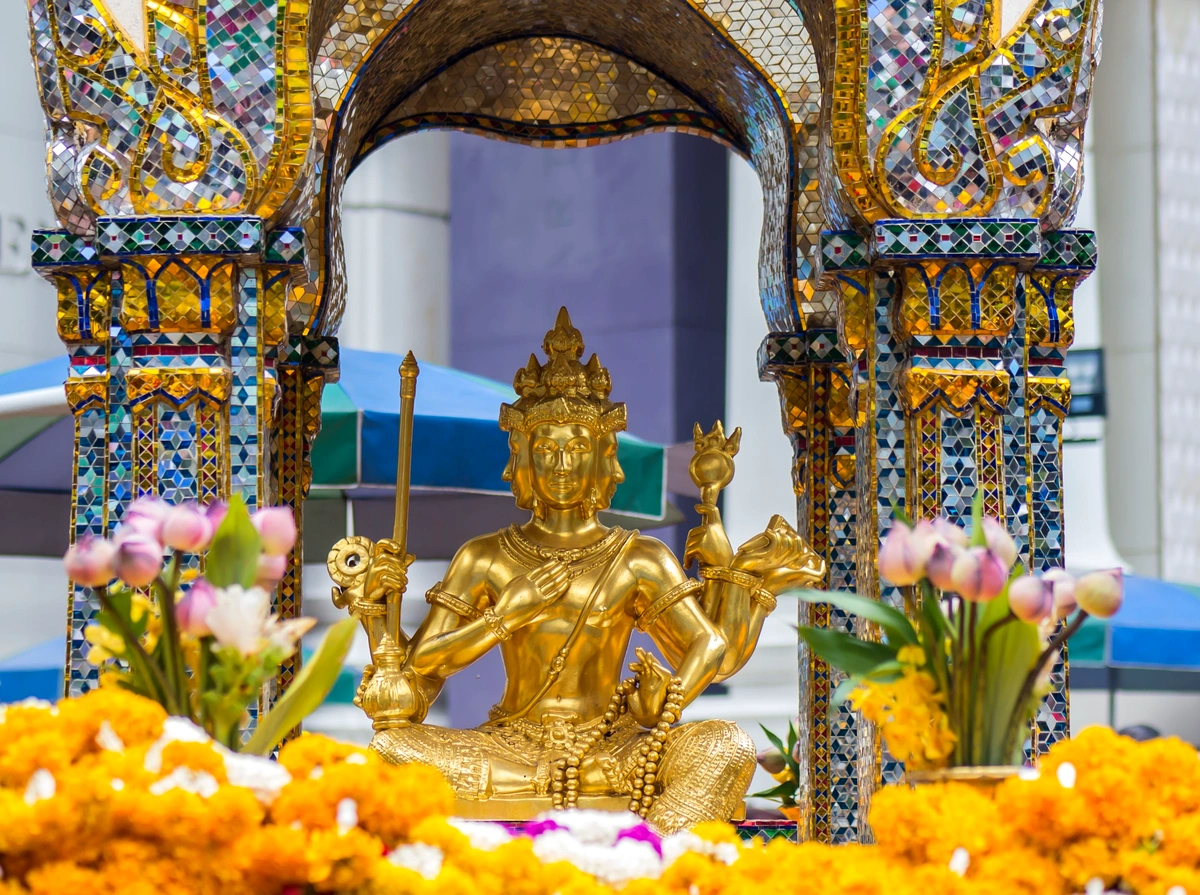
Erawan’s history lies not only in chronological numbers or founders’ names, but in how Thai people cherish and preserve spiritual values within modern currents. The shrine embodies a life philosophy: no matter how advanced technology becomes, no matter how high skyscrapers soar, humanity always needs a quiet space to reconnect with origins, seek protection, and entrust peaceful aspirations. Erawan Shrine’s birth, arising from dramatic spiritual mishaps, became an inseparable part of Bangkok’s cultural identity, an essential piece in the colorful historical portrait of the Land of Smiles.
Situated at the focal point of the Ratchaprasong intersection—dubbed by Bangkok feng shui experts as the capital’s “energy heart”—the Erawan Shrine is not merely a simple religious structure but a testament to sacred spatial planning art amidst modern urban centers. This location was no random choice, but the result of rigorous calculations regarding terrain and energy flows. The Ratchaprasong intersection, the arterial crossroads between Ratchadamri and Ploenchit roads, has long been regarded as a “spiritual strategic point,” where energy streams from all four directions converge, generating a robust magnetic field capable of guarding and regulating prosperity for Thailand’s busiest central business district (CBD).
Regarding topographical planning, the Erawan Shrine is designed as a “tranquil oasis” nestled amidst high-rise concrete blocks, luxury shopping centers, and hurried traffic streams. This contrast generates no conflict; conversely, it establishes a special spatial order: absolute tranquility lying right within the eye of the bustling storm. The shrine’s architecture strictly adheres to Buddhist and Hindu cosmological principles, featuring an open structure allowing energy to circulate freely. The four faces of the Brahma deity face all four cardinal directions, symbolizing panoramic vision, clairvoyance, and boundless compassion, helping suppress feng shui instabilities occurring during Erawan Hotel’s 1950s construction.
Regarding technical and landscaping processes, the shrine is built upon a foundation elevated above street levels, creating a subtle separation between secular and sacred spaces. Elevating foundations protects structures from ground noise while creating panoramic vistas where pilgrims perceive personal-universal connections. Decorative details, from roof carvings to altar arrangements, are calculated to optimize light and wind circulation. Construction materials are carefully selected, combining natural stone and gold-plated details, projecting majesty and intimacy, reflecting sunlight by day and glowing with warm halos under urban lights at night.
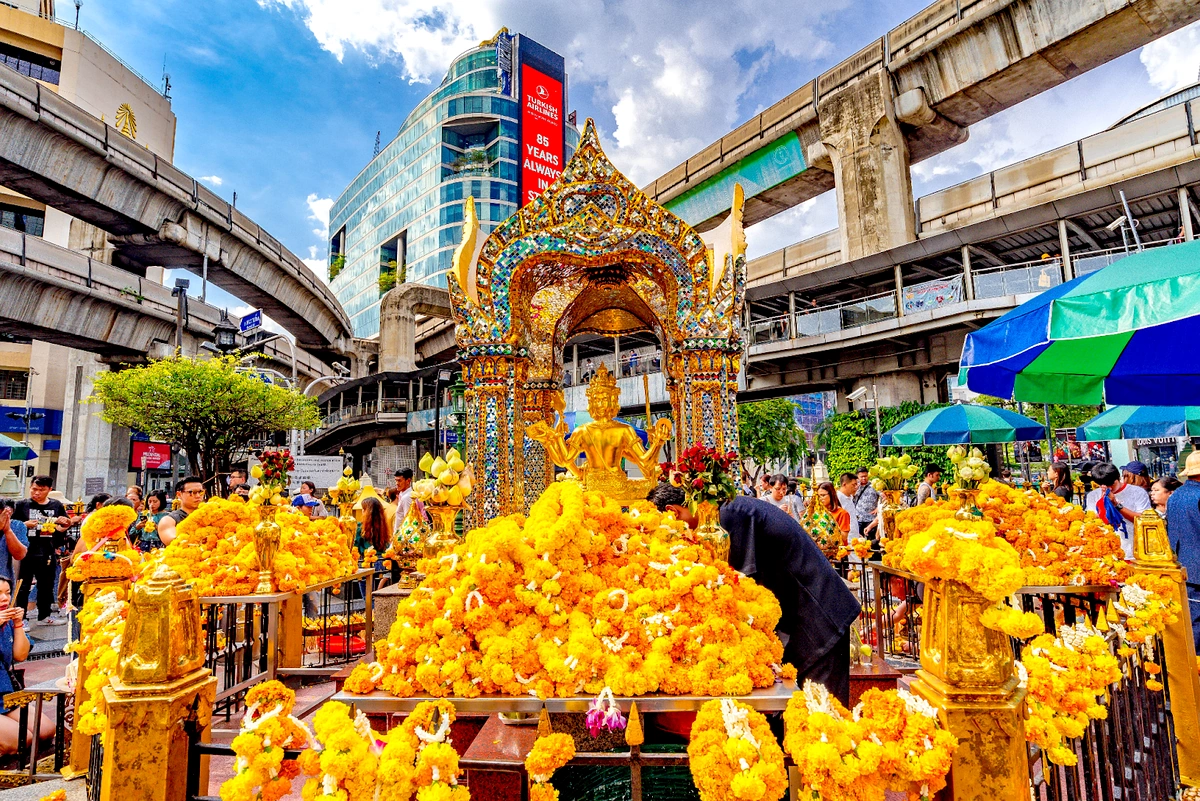
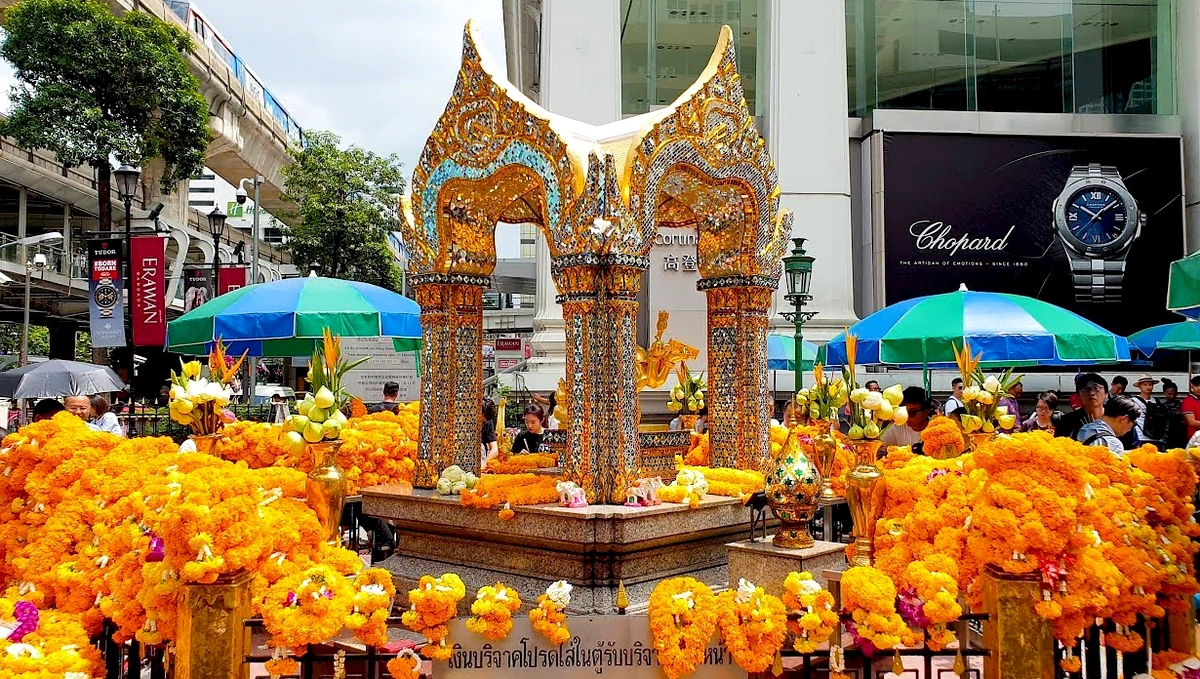
The signature landscaping feature of the Erawan Shrine is the fusion of static and dynamic elements. While the Brahma deity stands motionless centrally, continuous movement surrounds it: traditional Thai dancers, billowy incense smoke, and vibrant golden marigold flower wreaths. This landscape follows no static ancient temple style, breathing life as a “sacred space in public space.” Every minor detail, from lotus vase placements to bronze bell positions, obeys strict feng shui rules ensuring prayers transmit effectively.
Erawan Shrine’s existence at the Ratchaprasong intersection serves as a major lesson in sustainable urban planning where spiritual values ground economic development. Surviving historical turbulence—from post-security restoration to surrounding architectural changes—Erawan maintains its standing as Bangkok’s “energy transfer station.” Maintaining open spaces without enclosed walls permits citizens and visitors from all social strata easy access, transforming it into an irreplaceable spiritual anchor where modern and ancient, tangible and intangible boundaries dissolve artfully.
In vibrant Bangkok, where skyscrapers and ceaseless traffic create modern pulses, the Erawan Shrine emerges as a solemn quiet note, an architectural masterpiece crystallized from intersecting Thai aesthetic thinking and ancient Brahmin philosophies. Lacking sprawling scale like royal temples, Erawan boasts highly symbolic spatial structures where every carved detail conveys spiritual messages passed through generations of master artisans.
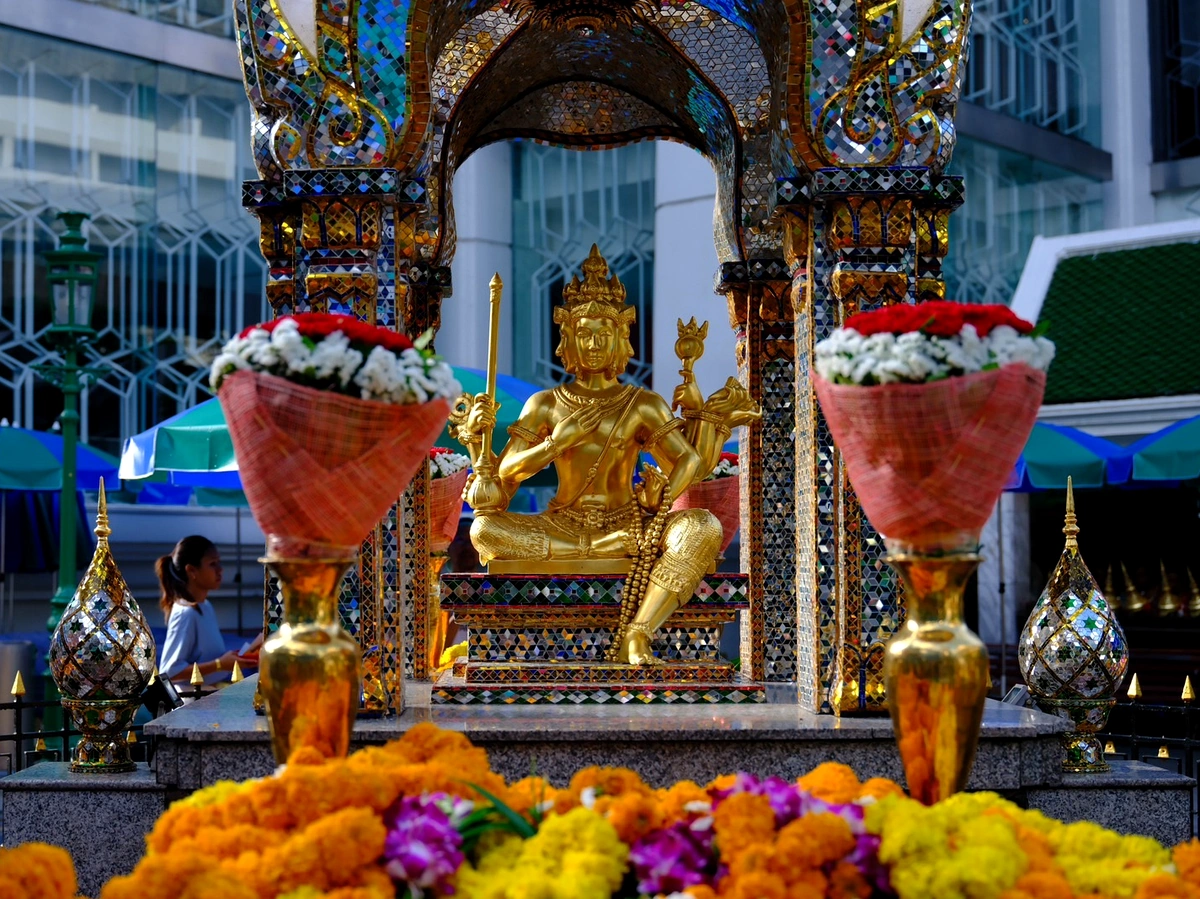
The shrine’s focal point is its four-faced building, also termed the Jaturamuk structure, characteristic of traditional Thai construction art dedicated to sacred worship spaces. Compact yet balanced, it yields a symmetrical axis oriented toward all four directions, symbolizing Brahma’s comprehensive vision. The centrally placed Brahma deity is crafted from precious metals, featuring exquisitely gold-leafed surfaces producing brilliant, majestic daylight appearances. The deity’s four faces, each representing distinct virtues, are sculpted with graceful lines and compassionate expressions, bearing Hindu artistic marks yet “Thailand-ized” to feel approachable and soft to local consciousness.
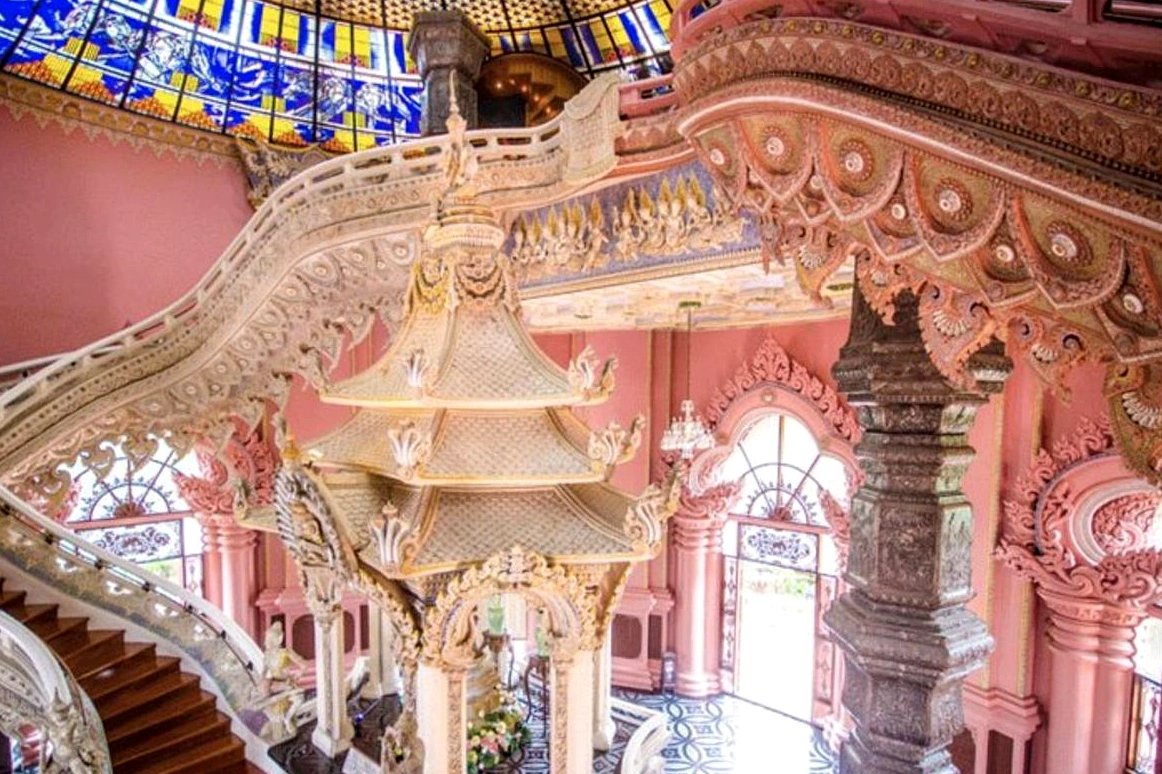
Erawan Shrine’s sophistication extends to decorative patterns blanketing columns and roofs. Prominent are Kanok patterns—curved lines mimicking flames or stylized leaves, the soul of Thai decorative arts. Additionally, artisans skillfully interweave Prachamyam patterns, stylized diamond motifs from ancient temple architecture, acting as visual “anchors” balancing khối blocks. These details transcend mere decoration, testifying to peak craftsmanship where every chisel stroke and gold layer demands absolute artisan focus.
Enduring historical turbulence, especially post-2006 and 2015 events, the shrine faced heavy conservation challenges. Yet under the Erawan Shrine Foundation’s management and dedication, large-scale restorations followed strict preservation principles. Leading restoration experts meticulously revived peeling gold leaf layers and reinforced Jaturamuk structures without losing ancient pattern souls. Maintaining originality protects architectural heritage and preserves spiritual connection cords linking past and present.
Surrounding shrine spaces follow open designs, allowing pilgrims and visitors unobstructed access from all sides, fostering frictionless interactions between humans and deities. Combining durable metals, traditional gold-leafing techniques, and Jaturamuk spatial thinking turns Erawan into a living architectural entity. Nestled amidst bustling commercial centers, the shrine retains necessary tranquility through careful ratio and distance calculations, letting anyone stepping inside experience the intersection of plastic arts and fierce religious belief—an inseparable cultural symbol of Bangkok.
As night falls over Ratchaprasong Avenue, Bangkok’s busiest commercial center, the Erawan Shrine transcends spiritual stopovers to transform into enchanting art entities. Amidst skyscrapers glowing with modern neon lights, the shrine space appears as a glowing golden oasis where reality and sacred realms blur. Spotlight systems arranged subtly, focusing on the four-faced Brahma statue, create striking visual contrast. The deity’s golden tone radiates brilliant halos against dark night skies, compelling passersby to pause before urban majesty and tranquility.
Late-night Erawan tranquility offers rare experiences for travelers seeking peace. While hurried crowds flow along surrounding streets, inside shrine grounds, air thickens with subtle incense aromas and late pilgrim devotion. Ideal for worship, traffic clamor is blocked by perimeter walls, yielding to whispered prayers. Warm golden lighting highlights intricate statue carvings and casts shadows on fresh marigold wreaths, creating magical paintings where lighting art and faith merge.
Nightlife highlights at Erawan include traditional Thai dance performances. Rather than large-scale cinematic shows, these gratitude dances brim with cultural depth and humanity. Dancers in gorgeous traditional attire, featuring characteristic pointed headpieces and graceful hand movements, perform dances following ethnic musical rhythms. Commissioned by believers whose wishes were granted, these dances express gratitude to Brahma. Combining traditional music, ringing bells, and graceful dancer movements builds vibrant cultural spaces, resembling slow-motion films in modern Bangkok.
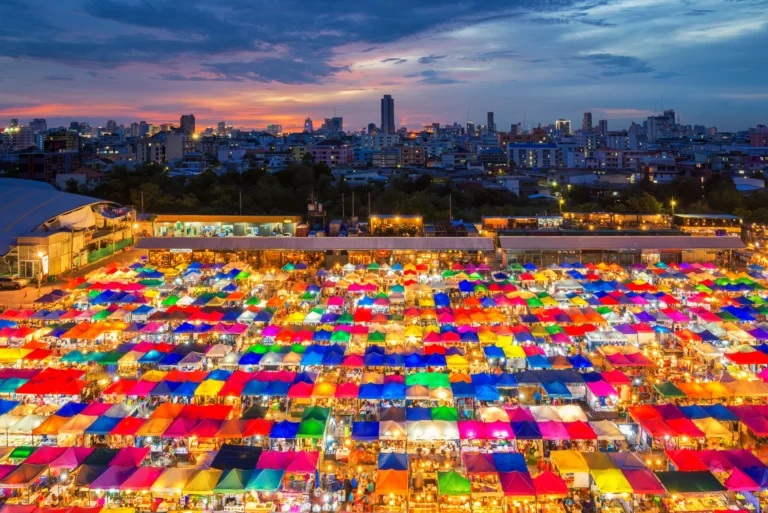
Surrounding dining experiences at night possess distinct charm. Post-worship, travelers stroll nearby streets to feel Bangkok’s nocturnal breath. Street carts selling famous street foods like Pad Thai, Som Tam, or sweet mango sticky rice emit rich aromas, resonating culturally with shrine solemnity. Contrasting Erawan’s mystical tranquility with vibrant street food builds Bangkok’s signature nightlife. Lighting art illuminates structures while honoring heritage, transforming Erawan into a living cultural symbol where past and present coexist under night lights.
Observing Erawan under night lights clarifies its spatial structure. Compact yet positioned prime at Ratchaprasong, the shrine welcomes energy flows from four directions. Spotlights highlight Brahma’s four faces—symbolizing compassion, kindness, forgiveness, and fairness—watching city heartbeats. Combining traditional spiritual architecture with modern lighting engineering turns it into unmissable destinations where visitors find quiet pauses amidst fast-paced modern lives while admiring splendid cultural icons of the Land of Smiles.
The Erawan Shrine honors majestic Brahma worship while serving as gateways to exquisite culinary cultures at Ratchaprasong—Bangkok’s bustling commercial heart. It represents flawless intersections between refined court dining and folk street spirits, generating multi-layered flavor maps reflecting Thai souls: valuing abundance and balance across ingredients.
Right inside the Grand Hyatt Erawan hotel grounds, impressively present beside the shrine, travelers experience royal Thai cuisine. Restaurants serve dishes preserving Rattanakosin heirloom recipes. Diners enjoy “Massaman Curry”—dubbed the “king of curries” blending cinnamon, cardamom, and fresh coconut cream richness, or “Miang Kham”—court snacks wrapped in betel leaves balancing sour, spicy, salty, sweet profiles. Presentation refinement continues court cultures where dishes are art, demanding ingredient selection and manual preparation precision.
Located right at the bustling Ratchaprasong intersection, visitors after paying respects at the shrine can cross the elevated pedestrian bridge to shop and be entertained at the massive CentralWorld Bangkok shopping center right next door.
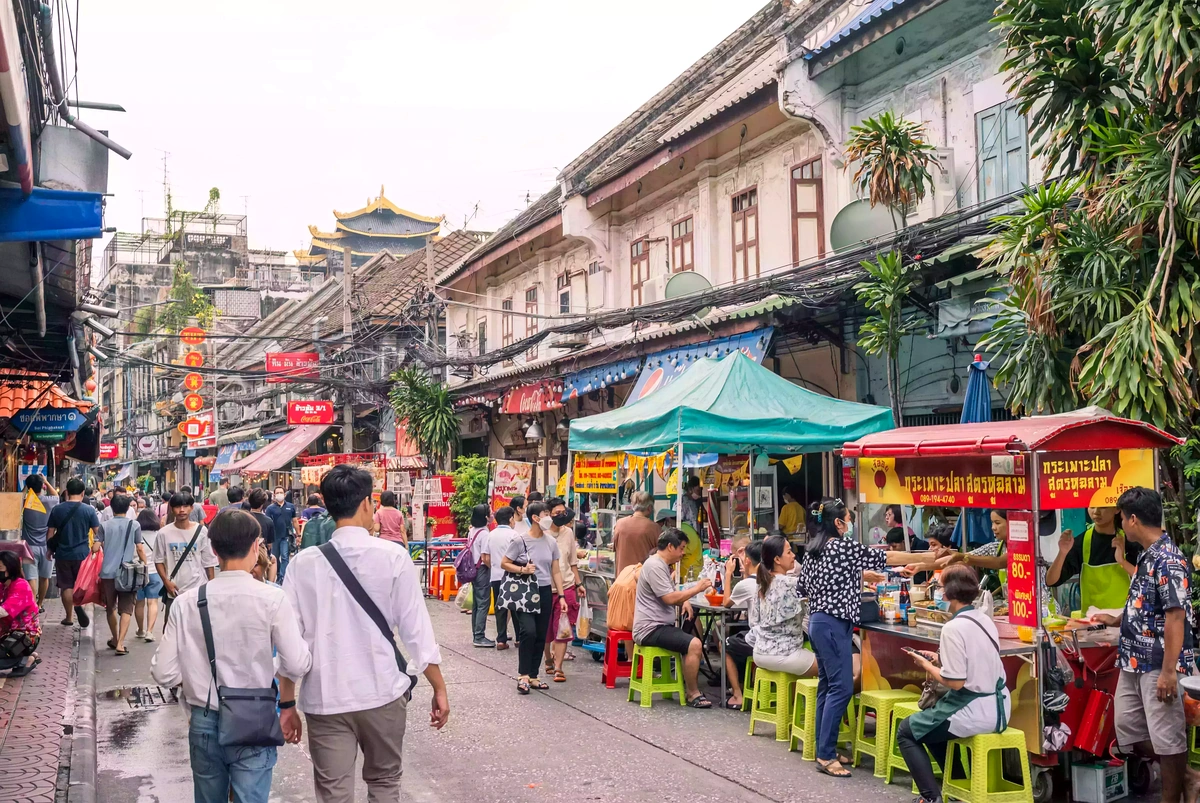
Stepping away from hotel luxuries, strolling a few hundred meters toward Pratunam shifts culinary landscapes toward vibrant, intimate tones. This is the “sanctuary” of legendary street foods enduring decades. Roadside carts with rising soup bone broths form Bangkok culinary souls. “Kuay Teow Reua” (boat noodles) featuring rich, spicy broths or “Pad Thai” stir-fried on large woks retaining bean sprout crunch and peanut aroma remain unmissable. Eating here fuels energy and connects people with hurried local life.
Notably, within Erawan’s spiritual space, culinary concepts elevate into meaningful offerings. Selecting vibrant golden marigold flowers and fresh fruit baskets expresses reverence and deep spiritual culinary culture. Thais believe offerings symbolize abundance, prosperity, and gratitude toward nature. Marigolds—flowers of eternity—combine with tropical fruit sweetness like mangoes, bananas, or coconuts, bridging tangible and intangible realms. This reflects heirloom etiquette: utilizing earth’s finest to pray for peace.
Combining upscale dining in renowned hotels and rustic street foods in Pratunam builds complete culinary ecosystems around Erawan. Visitors satisfy palates with citrus sourness, chili heat, fish sauce saltiness, and palm sugar sweetness while immersing in cultures where food becomes communication. Whether enjoying quiet fine dining or standing among bustling Pratunam crowds for hot noodles, diners directly join Bangkok’s cultural history, where flavors recount prosperity and hospitality.
To ensure smooth pilgrimage experiences at the Erawan Four-Faced Buddha Shrine, practical operating details and behavioral rules are essential. The shrine opens daily from 6:00 AM to 10:00 PM, providing sufficient schedule flexibility for early morning calm visits or evening lighting views contrasting Ratchaprasong commerce.
Regarding transit, Bangkok’s public transit avoids chronic central traffic jams. Prioritize BTS Skytrains, alighting at Chit Lom Station. Follow Exit 2 and walk across modern Skywalks, avoiding harsh sun and granting panoramic high-angle views of Ratchaprasong—Bangkok’s heart.
Upon arrival, adhering to behavioral rules displays respect. Admission is free; purchase fresh flowers, jasmine wreaths, and incense exclusively at official shrine counters ensuring quality and avoiding scams. Dress modestly despite shopping surroundings—avoid short or revealing clothes.
During worship, respect connects spirituality. Maintain silence, avoid loud talk, and never photograph disrespectfully or interrupt locals. Safeguard personal assets: wear backpacks in front and guard valuables.
Pro tip: Thais worship Brahma across four faces clockwise, starting front-facing. Each face governs aspects like career, romance, health, and wealth. Deepen experiences and explore icons via the Bangkok – Pattaya 5D4N tour.